
Objectives Use a Competing Behavior Pathway to Identify
Objectives • Use a Competing Behavior Pathway to Identify Function-based behavior supports that: – Teach positive behaviors to replace problem behavior – Use strategies to prevent problem behavior & prompt positive behaviors – Reinforce replacement & desired behaviors – Effectively respond to problem behaviors by redirecting & minimizing their pay-off
Critical Components of Behavior Support Plans • #1: Competing Behavior Pathway • #2: Function-Based Behavior Support Strategies • #3: Implementation Plan • #4: Evaluation Plan
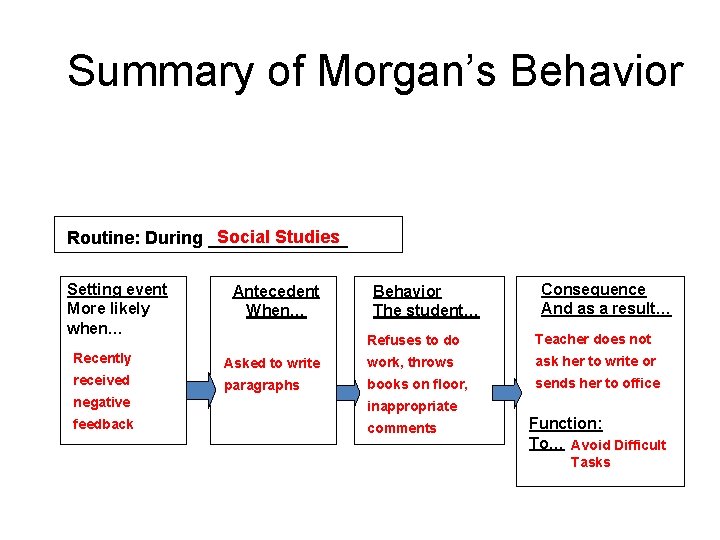
Summary of Morgan’s Behavior Social Studies Routine: During _______ Setting event More likely when… Antecedent When… Behavior The student… Consequence And as a result… Refuses to do Teacher does not Recently Asked to write work, throws ask her to write or received paragraphs books on floor, sends her to office negative inappropriate feedback comments Function: To… Avoid Difficult Tasks
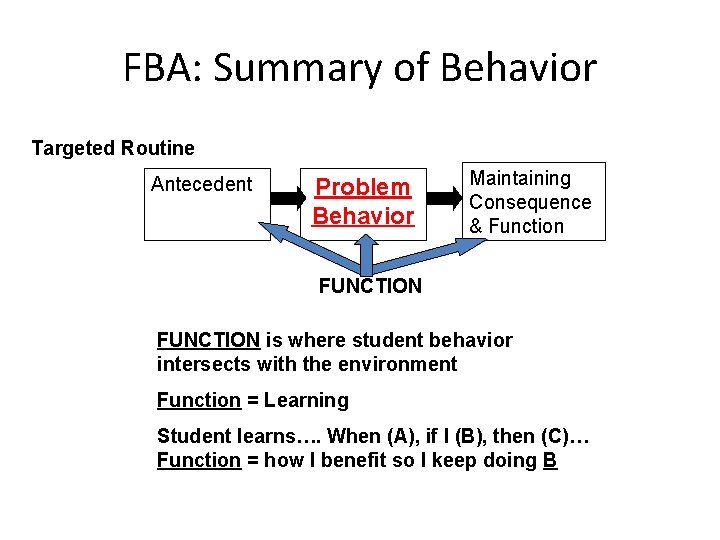
FBA: Summary of Behavior Targeted Routine Antecedent Problem Behavior Maintaining Consequence & Function FUNCTION is where student behavior intersects with the environment Function = Learning Student learns…. When (A), if I (B), then (C)… Function = how I benefit so I keep doing B
Competing Behavior Pathway
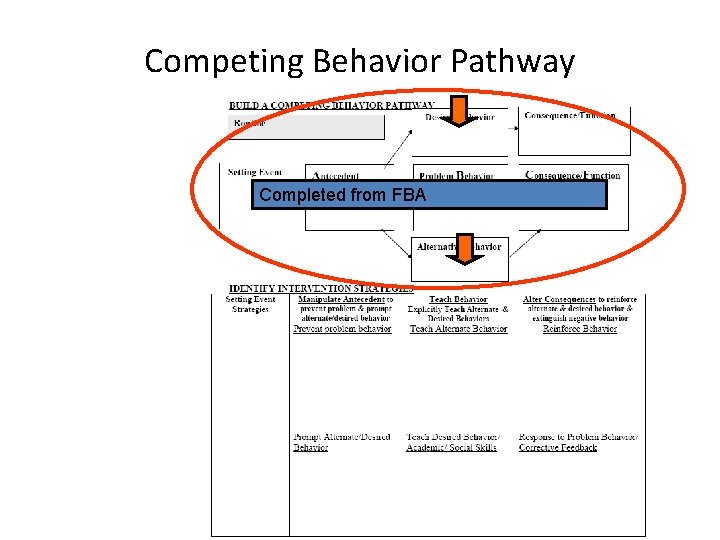
Competing Behavior Pathway Completed from FBA
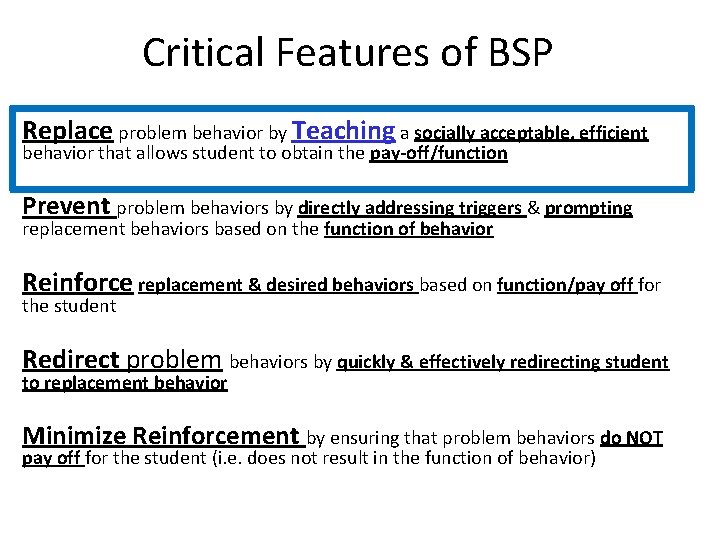
Critical Features of BSP Replace problem behavior by Teaching a socially acceptable, efficient behavior that allows student to obtain the pay-off/function Prevent problem behaviors by directly addressing triggers & prompting replacement behaviors based on the function of behavior Reinforce replacement & desired behaviors based on function/pay off for the student Redirect problem behaviors by quickly & effectively redirecting student to replacement behavior Minimize Reinforcement by ensuring that problem behaviors do NOT pay off for the student (i. e. does not result in the function of behavior)
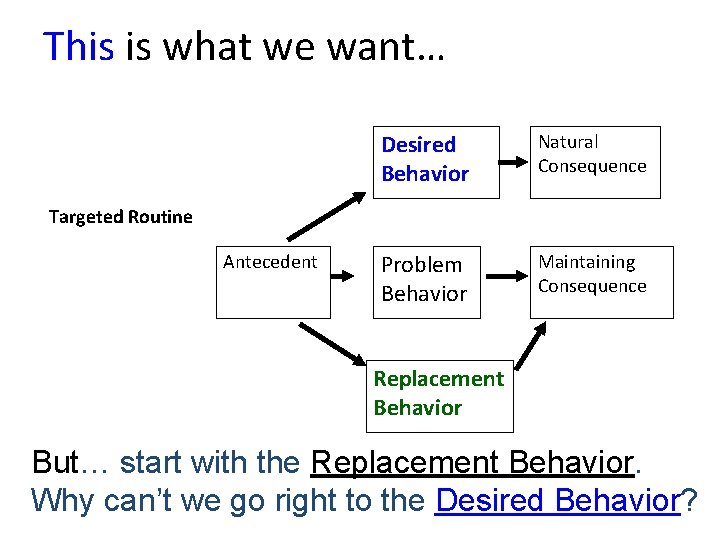
This is what we want… Desired Behavior Natural Consequence Problem Behavior Maintaining Consequence Targeted Routine Antecedent Replacement Behavior But… start with the Replacement Behavior. Why can’t we go right to the Desired Behavior?
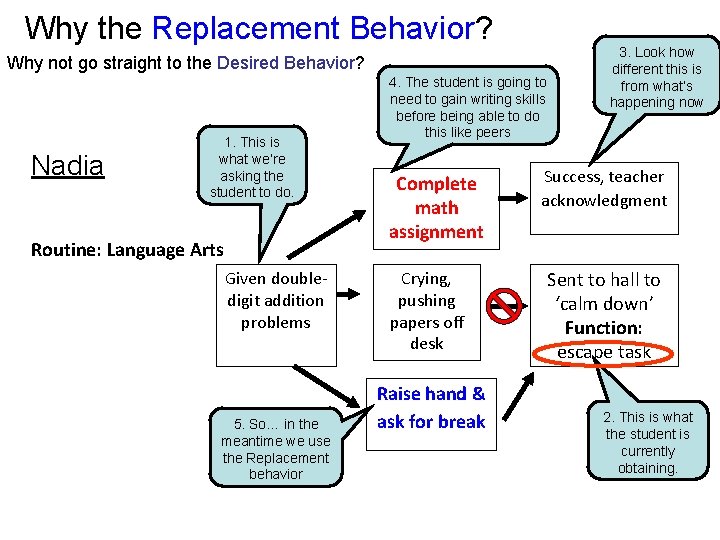
Why the Replacement Behavior? Why not go straight to the Desired Behavior? Nadia 1. This is what we’re asking the student to do. Routine: Language Arts Given doubledigit addition problems 5. So… in the meantime we use the Replacement behavior 4. The student is going to need to gain writing skills before being able to do this like peers Complete math assignment Crying, pushing papers off desk Raise hand & ask for break 3. Look how different this is from what’s happening now Success, teacher acknowledgment Sent to hall to ‘calm down’ Function: escape task 2. This is what the student is currently obtaining.
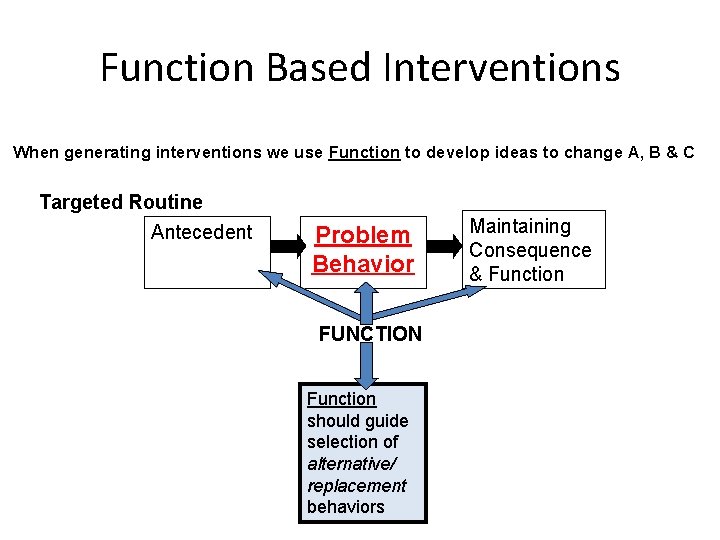
Function Based Interventions When generating interventions we use Function to develop ideas to change A, B & C Targeted Routine Antecedent Problem Behavior FUNCTION Function should guide selection of alternative/ replacement behaviors Maintaining Consequence & Function
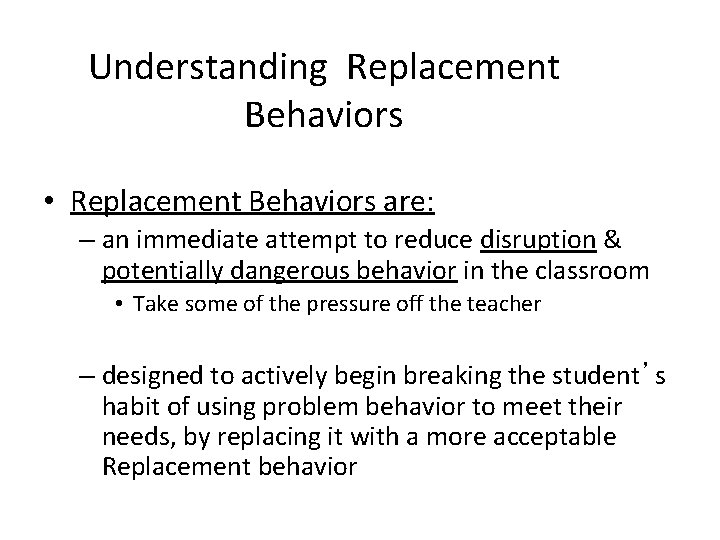
Understanding Replacement Behaviors • Replacement Behaviors are: – an immediate attempt to reduce disruption & potentially dangerous behavior in the classroom • Take some of the pressure off the teacher – designed to actively begin breaking the student’s habit of using problem behavior to meet their needs, by replacing it with a more acceptable Replacement behavior
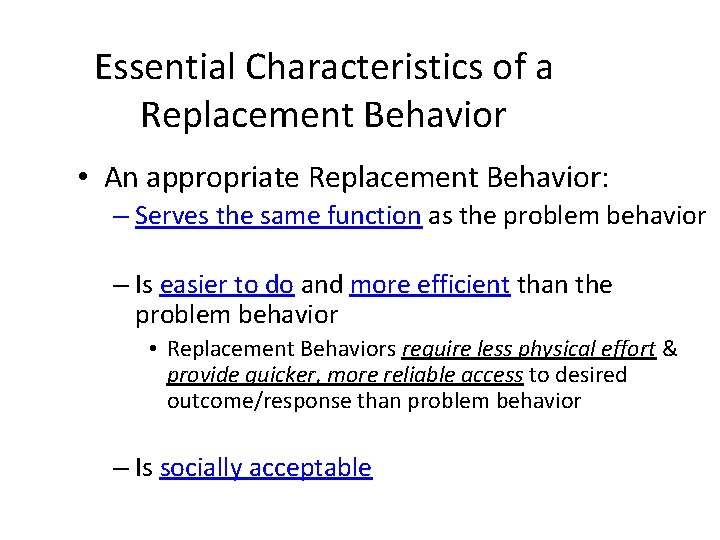
Essential Characteristics of a Replacement Behavior • An appropriate Replacement Behavior: – Serves the same function as the problem behavior – Is easier to do and more efficient than the problem behavior • Replacement Behaviors require less physical effort & provide quicker, more reliable access to desired outcome/response than problem behavior – Is socially acceptable
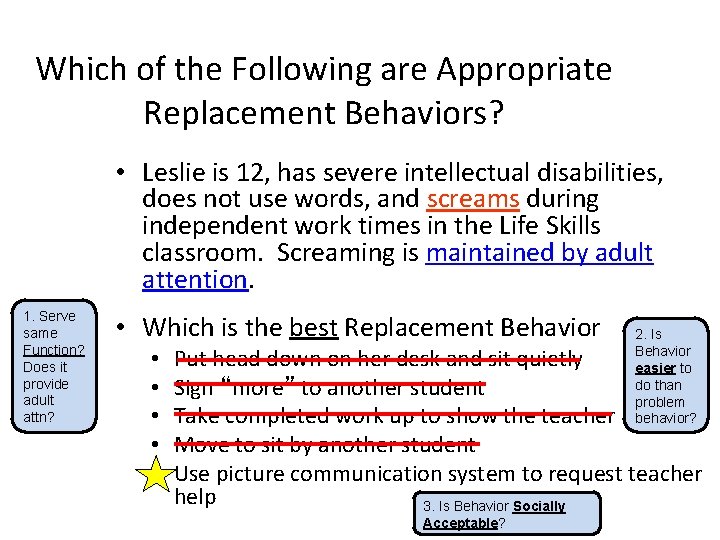
Which of the Following are Appropriate Replacement Behaviors? • Leslie is 12, has severe intellectual disabilities, does not use words, and screams during independent work times in the Life Skills classroom. Screaming is maintained by adult attention. 1. Serve same Function? Does it provide adult attn? • Which is the best Replacement Behavior • • • 2. Is Behavior easier to do than problem behavior? Put head down on her desk and sit quietly Sign “more” to another student Take completed work up to show the teacher Move to sit by another student Use picture communication system to request teacher help 3. Is Behavior Socially Acceptable?
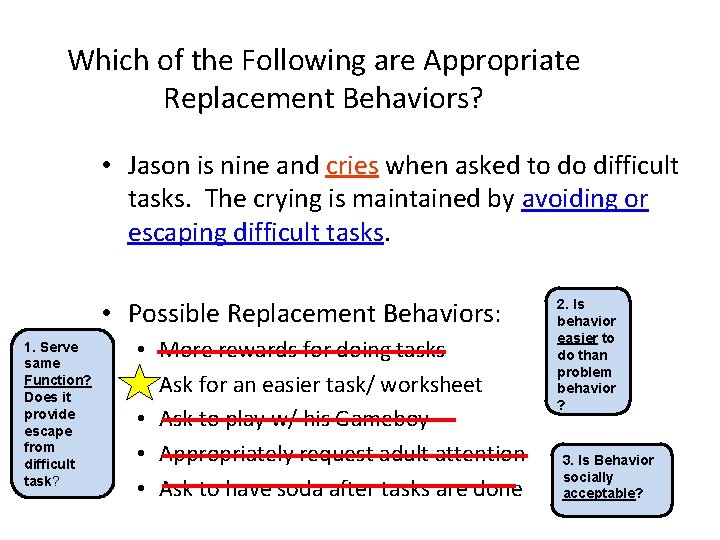
Which of the Following are Appropriate Replacement Behaviors? • Jason is nine and cries when asked to do difficult tasks. The crying is maintained by avoiding or escaping difficult tasks. • Possible Replacement Behaviors: 1. Serve same Function? Does it provide escape from difficult task? • • • More rewards for doing tasks Ask for an easier task/ worksheet Ask to play w/ his Gameboy Appropriately request adult attention Ask to have soda after tasks are done 2. Is behavior easier to do than problem behavior ? 3. Is Behavior socially acceptable?
Developing Function-Based Interventions
Critical Components of Behavior Support Plans • #1: Competing Behavior Pathway • #2: Function-Based Behavior Support Strategies • #3: Implementation Plan • #4: Evaluation Plan
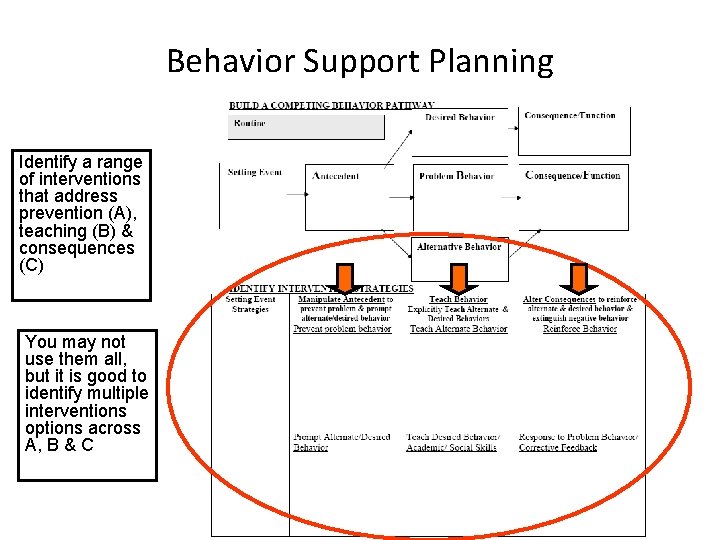
Behavior Support Planning Identify a range of interventions that address prevention (A), teaching (B) & consequences (C) You may not use them all, but it is good to identify multiple interventions options across A, B & C
Teaching Replacement Behavior
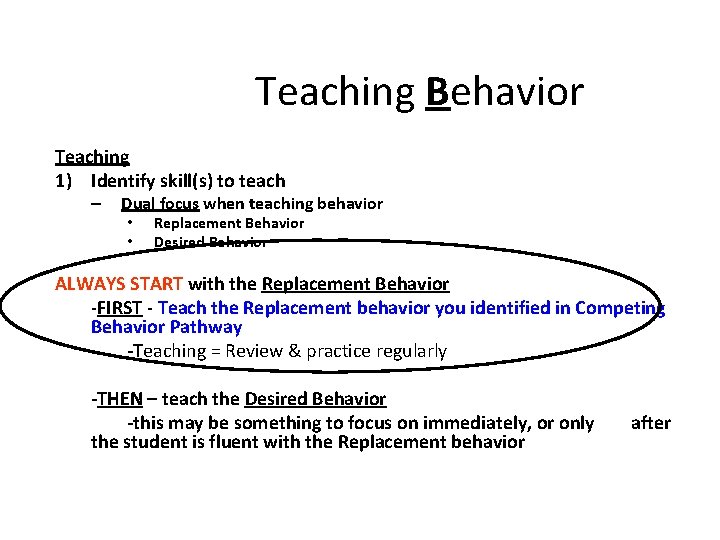
Teaching Behavior Teaching 1) Identify skill(s) to teach – Dual focus when teaching behavior • • Replacement Behavior Desired Behavior ALWAYS START with the Replacement Behavior -FIRST - Teach the Replacement behavior you identified in Competing Behavior Pathway -Teaching = Review & practice regularly -THEN – teach the Desired Behavior -this may be something to focus on immediately, or only the student is fluent with the Replacement behavior after
Teaching Behavior Don’t assume student already has Replacement Behavior in their skill set 1) Develop an observable definition of behavior – Identify examples & non-examples 2) Model/ Lead/ Test 3) Schedule Review & Practice of Skill/ Behavior Regularly
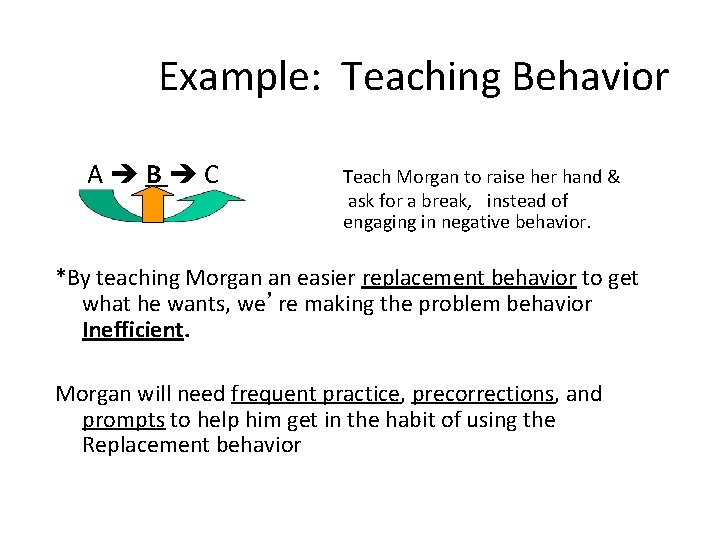
Example: Teaching Behavior A B C Teach Morgan to raise her hand & ask for a break, instead of engaging in negative behavior. *By teaching Morgan an easier replacement behavior to get what he wants, we’re making the problem behavior Inefficient. Morgan will need frequent practice, precorrections, and prompts to help him get in the habit of using the Replacement behavior
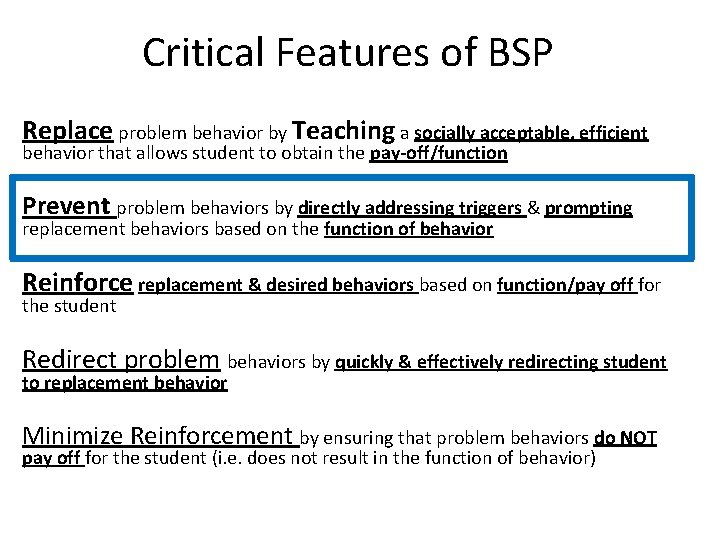
Critical Features of BSP Replace problem behavior by Teaching a socially acceptable, efficient behavior that allows student to obtain the pay-off/function Prevent problem behaviors by directly addressing triggers & prompting replacement behaviors based on the function of behavior Reinforce replacement & desired behaviors based on function/pay off for the student Redirect problem behaviors by quickly & effectively redirecting student to replacement behavior Minimize Reinforcement by ensuring that problem behaviors do NOT pay off for the student (i. e. does not result in the function of behavior)
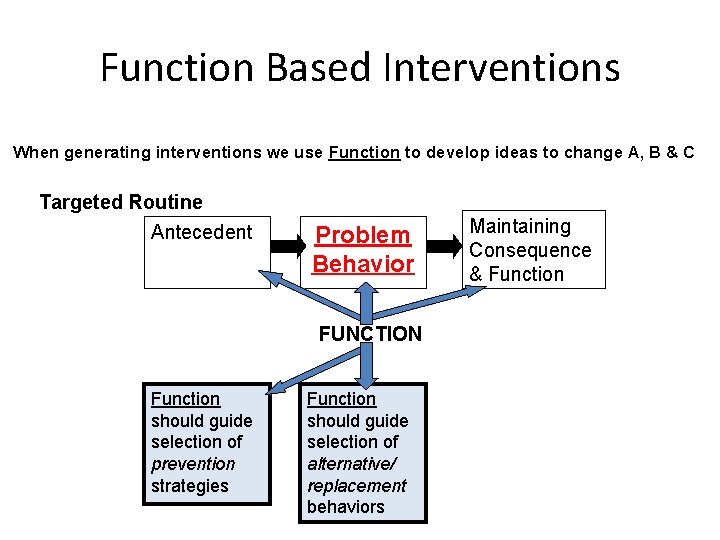
Function Based Interventions When generating interventions we use Function to develop ideas to change A, B & C Targeted Routine Antecedent Problem Behavior FUNCTION Function should guide selection of prevention strategies Function should guide selection of alternative/ replacement behaviors Maintaining Consequence & Function
Selecting Prevention Strategies: Modifying Triggers When identifying preventive antecedent strategies: - Eliminate or alter the trigger so student will no longer need to use problem behavior The BEST antecedent MODIFICATIONS directly address: #1. The identified ANTECEDENT #2. The FUNCTION of the problem behavior
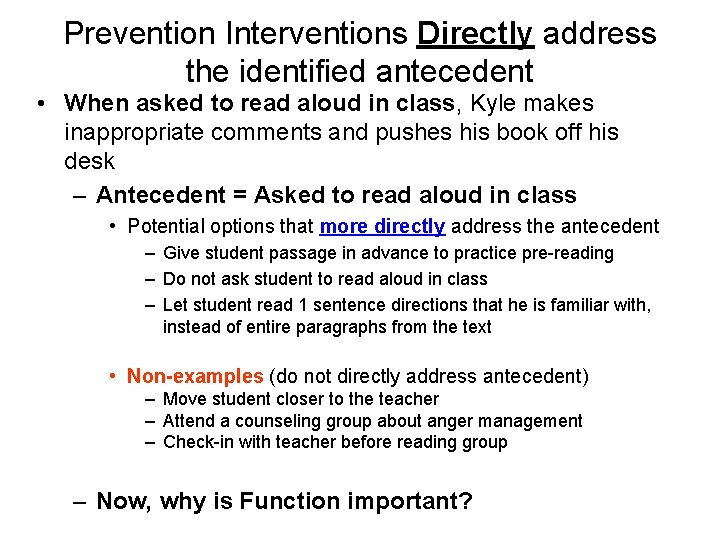
Prevention Interventions Directly address the identified antecedent • When asked to read aloud in class, Kyle makes inappropriate comments and pushes his book off his desk – Antecedent = Asked to read aloud in class • Potential options that more directly address the antecedent – Give student passage in advance to practice pre-reading – Do not ask student to read aloud in class – Let student read 1 sentence directions that he is familiar with, instead of entire paragraphs from the text • Non-examples (do not directly address antecedent) – Move student closer to the teacher – Attend a counseling group about anger management – Check-in with teacher before reading group – Now, why is Function important?
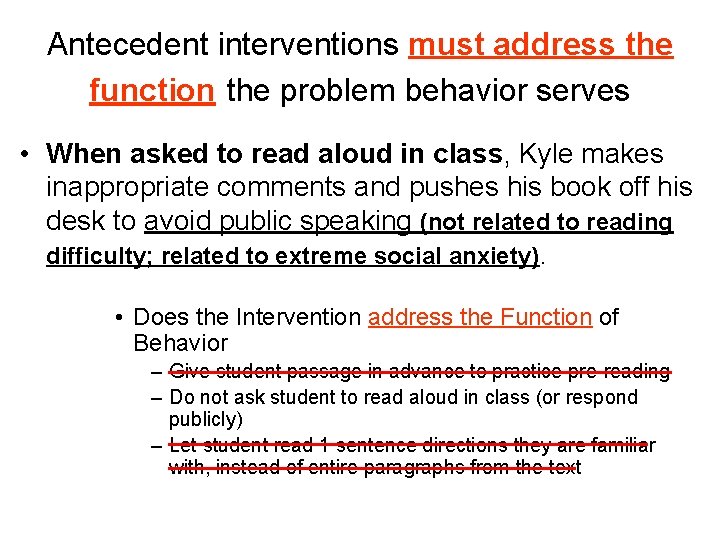
Antecedent interventions must address the function the problem behavior serves • When asked to read aloud in class, Kyle makes inappropriate comments and pushes his book off his desk to avoid public speaking (not related to reading difficulty; related to extreme social anxiety). • Does the Intervention address the Function of Behavior – Give student passage in advance to practice pre-reading – Do not ask student to read aloud in class (or respond publicly) – Let student read 1 sentence directions they are familiar with, instead of entire paragraphs from the text
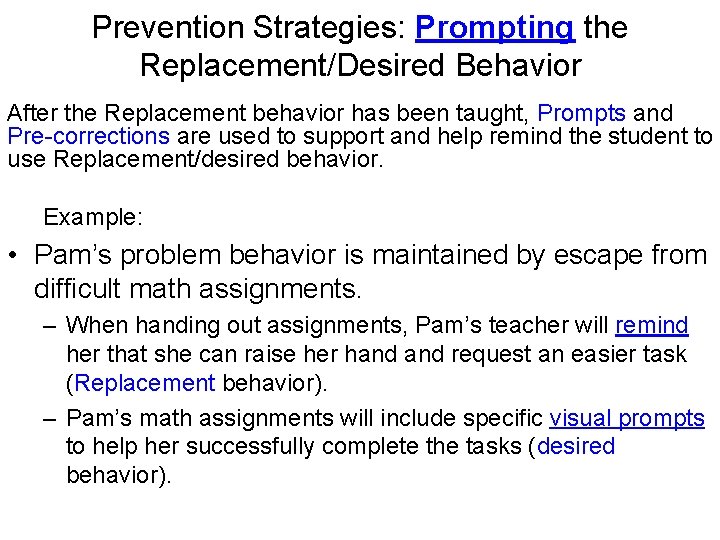
Prevention Strategies: Prompting the Replacement/Desired Behavior After the Replacement behavior has been taught, Prompts and Pre-corrections are used to support and help remind the student to use Replacement/desired behavior. Example: • Pam’s problem behavior is maintained by escape from difficult math assignments. – When handing out assignments, Pam’s teacher will remind her that she can raise her hand request an easier task (Replacement behavior). – Pam’s math assignments will include specific visual prompts to help her successfully complete the tasks (desired behavior).
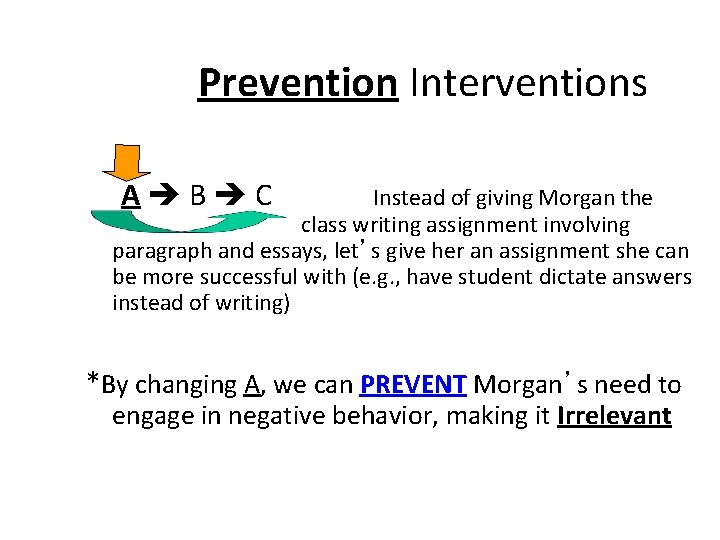
Prevention Interventions A B C Instead of giving Morgan the class writing assignment involving paragraph and essays, let’s give her an assignment she can be more successful with (e. g. , have student dictate answers instead of writing) *By changing A, we can PREVENT Morgan’s need to engage in negative behavior, making it Irrelevant
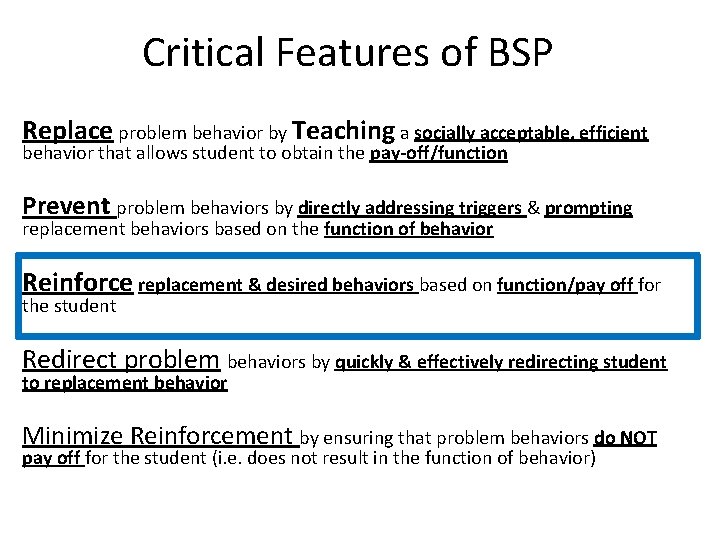
Critical Features of BSP Replace problem behavior by Teaching a socially acceptable, efficient behavior that allows student to obtain the pay-off/function Prevent problem behaviors by directly addressing triggers & prompting replacement behaviors based on the function of behavior Reinforce replacement & desired behaviors based on function/pay off for the student Redirect problem behaviors by quickly & effectively redirecting student to replacement behavior Minimize Reinforcement by ensuring that problem behaviors do NOT pay off for the student (i. e. does not result in the function of behavior)
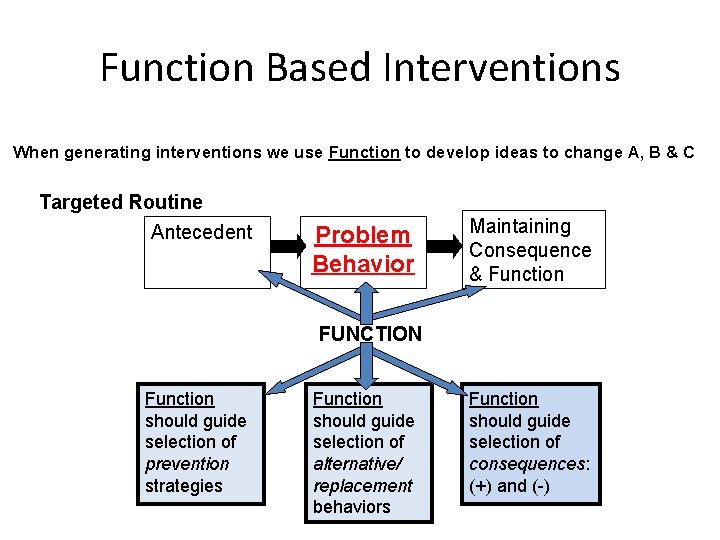
Function Based Interventions When generating interventions we use Function to develop ideas to change A, B & C Targeted Routine Antecedent Problem Behavior Maintaining Consequence & Function FUNCTION Function should guide selection of prevention strategies Function should guide selection of alternative/ replacement behaviors Function should guide selection of consequences: (+) and (-)
Reinforce Positive Behavior • Reinforcement should focus on 2 different sets of behaviors Replacement Behaviors & Desired Behaviors
1. Reinforce the Replacement Behavior ¨ When the student engages in the replacement behavior, quickly provide the student with an outcome that matches the outcome/ function of the problem behavior ¨ E. g. if student raises hand to request an easier, substitute assignment; in order to escape difficult tasks then quickly provide the student with the easier assignment 32
2. Reinforce Desired Behaviors Reinforce the Desired Behavior(s), or approximations of the desired behavior ¨ The ultimate plan is to have the student move beyond the replacement behavior to using the desired behavior ¨ Reinforcing this progression should start from the beginning of the intervention
Considerations for Reinforcing Desired Behavior A. The goals & expectations for desired behavior must be reasonable • Reasonable expectations of student behavior – EXAMPLE: on a daily basis the student is out of seat & off task the entire period & has not turned in any work the entire term – Probably NOT a Reasonable Expectation = student to be in seat the whole class period and turn in completed worksheets – More Reasonable approximations (Start Small & Build on Success): » Turns in assignments 50% completed » On task and trying to complete work for 15 minutes each period
Reinforcing Desired Behavior B. The timeframe for goals for desired behavior must be reasonable – In the Beginning try to Reinforce Every occurrence or approximation – Reasonable timeframes for Reinforcement • Probably NOT Reasonable Timeframes for reinforcement – If student turns in all worksheets for week 1, he will earn 15 min. in skate park on Friday – If student is in seat and on-task for the entire period, he will earn a candy bar • More Reasonable Timeframes for reinforcement – If student completes 5 problems, he can choose 3 problems to cross off the worksheet – If student is on task for 10 min. , he will earn 4 min. of computer time
Considerations for Reinforcing Desired Behavior C. The reinforcer must be valued by the student – The function of behavior is a good place to start when identifying valued reinforcers – e. g. If the function of behavior is to Gain Peer Attention, the reinforcer should give access to Peer Attention – e. g. if the function of behavior is to Avoid Difficult Task the reinforcer could be a “Free Homework Pass”
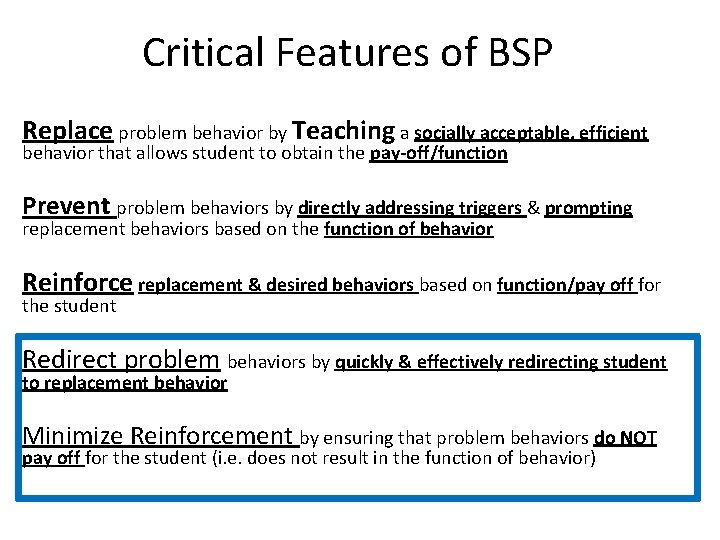
Critical Features of BSP Replace problem behavior by Teaching a socially acceptable, efficient behavior that allows student to obtain the pay-off/function Prevent problem behaviors by directly addressing triggers & prompting replacement behaviors based on the function of behavior Reinforce replacement & desired behaviors based on function/pay off for the student Redirect problem behaviors by quickly & effectively redirecting student to replacement behavior Minimize Reinforcement by ensuring that problem behaviors do NOT pay off for the student (i. e. does not result in the function of behavior)
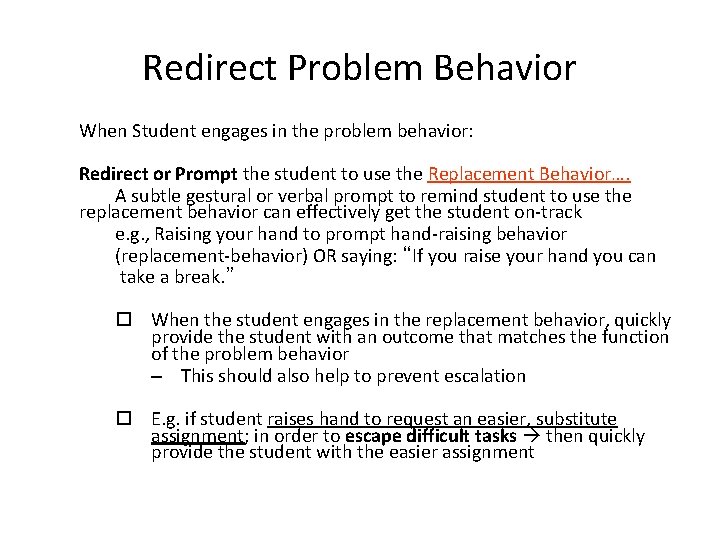
Redirect Problem Behavior When Student engages in the problem behavior: Redirect or Prompt the student to use the Replacement Behavior…. A subtle gestural or verbal prompt to remind student to use the replacement behavior can effectively get the student on-track e. g. , Raising your hand to prompt hand-raising behavior (replacement-behavior) OR saying: “If you raise your hand you can take a break. ” ¨ When the student engages in the replacement behavior, quickly provide the student with an outcome that matches the function of the problem behavior – This should also help to prevent escalation ¨ E. g. if student raises hand to request an easier, substitute assignment; in order to escape difficult tasks then quickly provide the student with the easier assignment
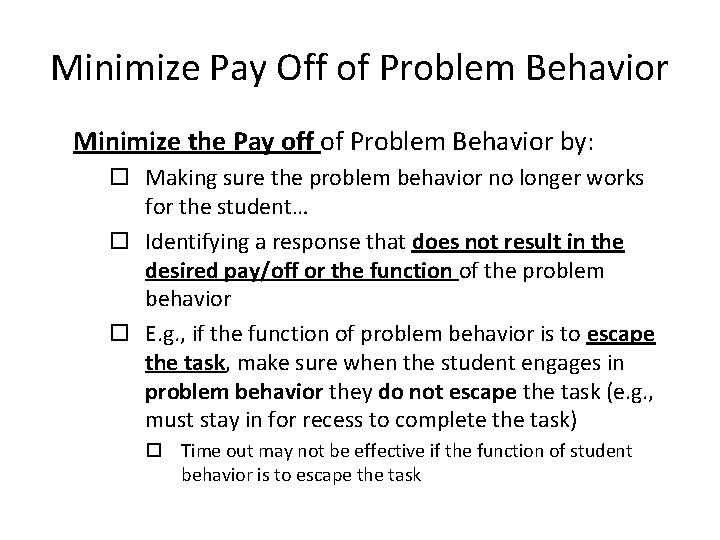
Minimize Pay Off of Problem Behavior Minimize the Pay off of Problem Behavior by: ¨ Making sure the problem behavior no longer works for the student… ¨ Identifying a response that does not result in the desired pay/off or the function of the problem behavior ¨ E. g. , if the function of problem behavior is to escape the task, make sure when the student engages in problem behavior they do not escape the task (e. g. , must stay in for recess to complete the task) ¨ Time out may not be effective if the function of student behavior is to escape the task
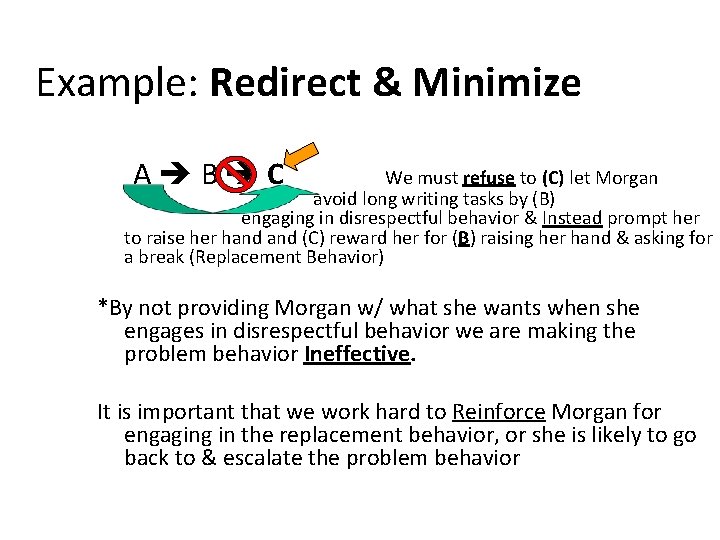
Example: Redirect & Minimize A B C We must refuse to (C) let Morgan avoid long writing tasks by (B) engaging in disrespectful behavior & Instead prompt her to raise her hand (C) reward her for (B) raising her hand & asking for a break (Replacement Behavior) *By not providing Morgan w/ what she wants when she engages in disrespectful behavior we are making the problem behavior Ineffective. It is important that we work hard to Reinforce Morgan for engaging in the replacement behavior, or she is likely to go back to & escalate the problem behavior
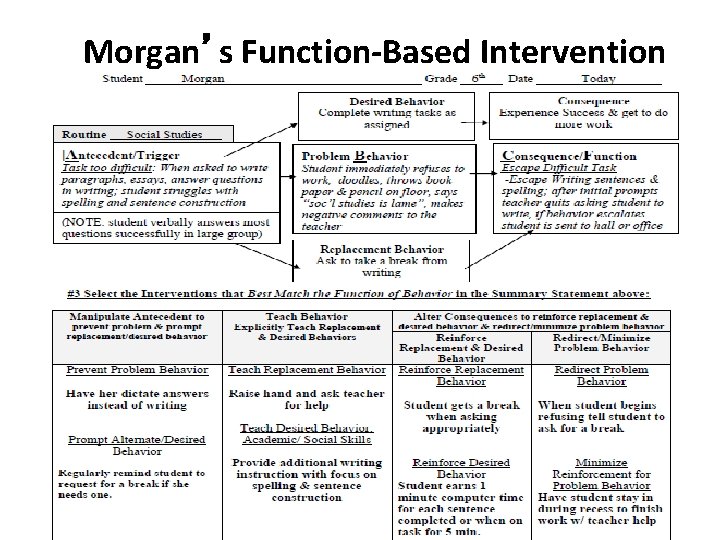
Morgan’s Function-Based Intervention
Objectives By the end of this module you will be able to: 1. Explain the meaning and importance of “Contextual Fit” 2. Describe the essential components of implementation plans 3. Define the necessary components of evaluation plans and provide examples of appropriate shortand long-term goals 4. Describe data collection procedures that would be used to track implementation fidelity and student 42 progress when provided with a sample BSP
Contextual Fit
Selecting Behavior Support Strategies • Once the team has identified functionbased support strategies it is important to also: Ensure CONTEXTUAL FIT of those strategies
What is Contextual Fit? Why is It Important? • Contextual fit refers to the extent to which support strategies “fit” with: • The skills and values of the implementers • The available resources • Administrative supports in place • In other words… How FEASIBLE are the strategies? • Strategies with good “fit” are more likely to be implemented with fidelity!!
Considerations to Help Ensure Contextual Fit • Are plan implementers involved in the design/selection? • Are strategies consistent with the skills of the implementers? – How much additional training would be needed? Who would provide training? • Are necessary resources available (staff, time, space)? – Are there other interventions already being implemented in our school that can be modified to fit this student’s particular needs? • Do the selected strategies fit with the values of team members and those who will be implementing the plan? – Are they perceived as (a) likely to be effective, and (b) in the best interest of the student? • Will there be administrative support for the selected interventions/strategies? Is the plan consistent with current schoolwide discipline procedures?
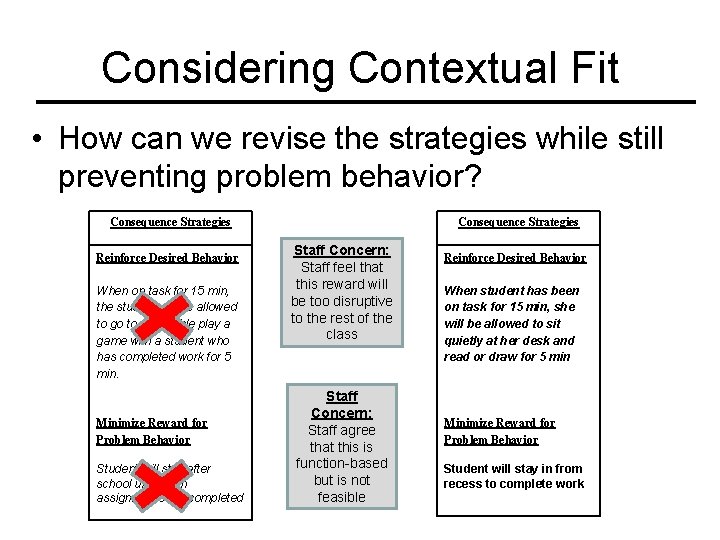
Considering Contextual Fit • How can we revise the strategies while still preventing problem behavior? Consequence Strategies Reinforce Desired Behavior When on task for 15 min, the student will be allowed to go to back table play a game with a student who has completed work for 5 min. Minimize Reward for Problem Behavior Student will stay after school until math assignments are completed Consequence Strategies Staff Concern: Staff feel that this reward will be too disruptive to the rest of the class Staff Concern: Staff agree that this is function-based but is not feasible Reinforce Desired Behavior When student has been on task for 15 min, she will be allowed to sit quietly at her desk and read or draw for 5 min Minimize Reward for Problem Behavior Student will stay in from recess to complete work
Implementation & Evaluation Planning
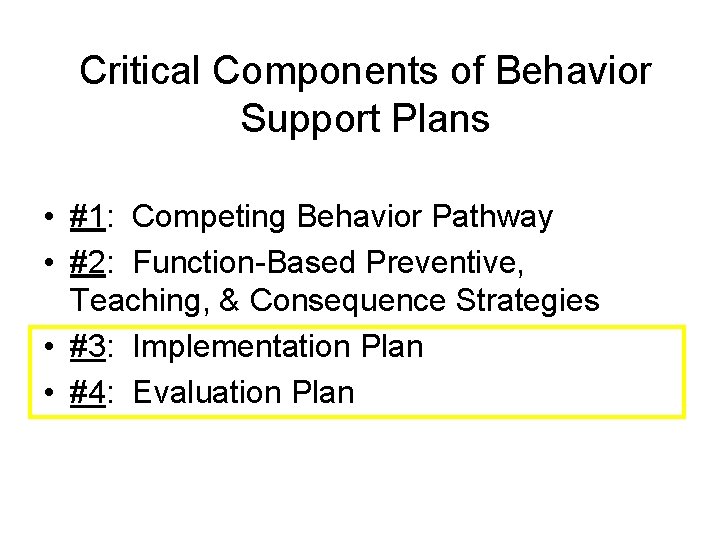
Critical Components of Behavior Support Plans • #1: Competing Behavior Pathway • #2: Function-Based Preventive, Teaching, & Consequence Strategies • #3: Implementation Plan • #4: Evaluation Plan
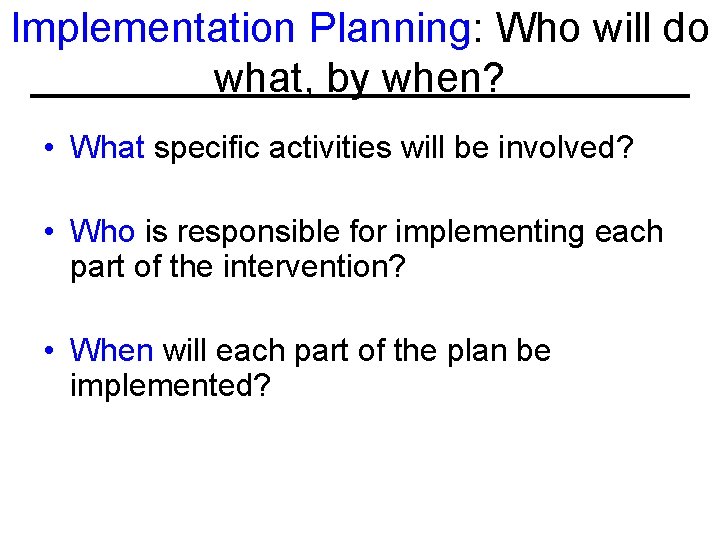
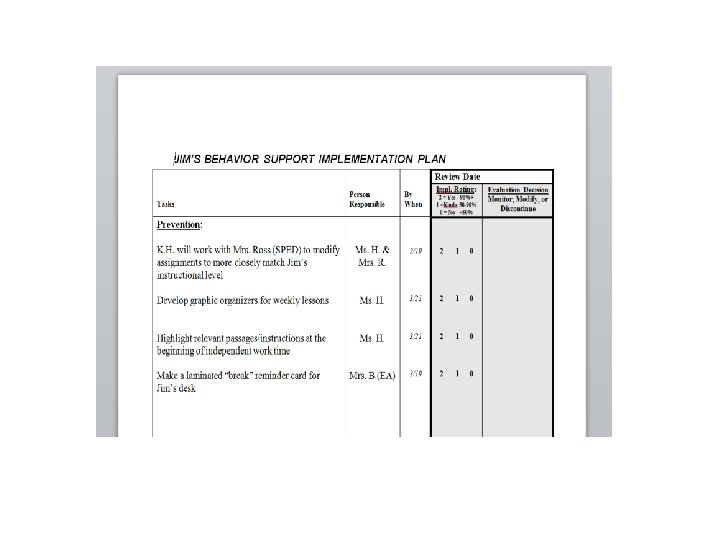
Implementation Planning: Who will do what, by when? • What specific activities will be involved? • Who is responsible for implementing each part of the intervention? • When will each part of the plan be implemented?
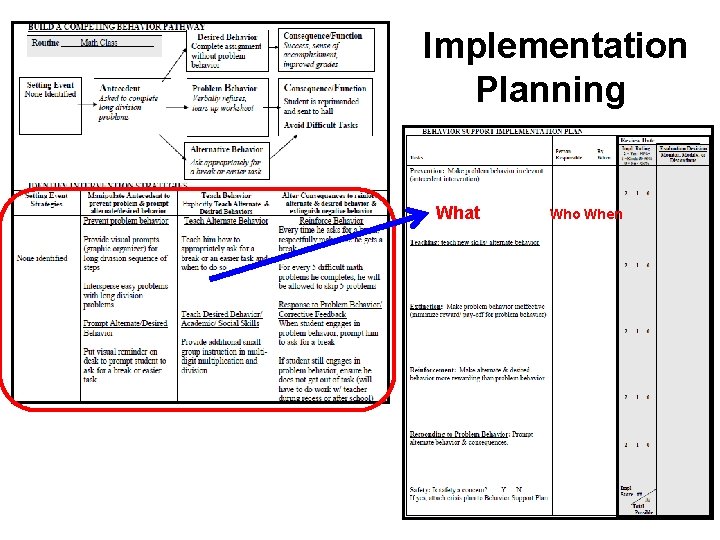
Implementation Planning What Who When 51
Implementation Planning Considerations • It is not enough to simply write down the strategy. We need to consider: • Will materials need to be made/gathered (ex. visual reminders, reinforcement system) before we can use this strategy? • How (specifically) are we going to teach the replacement behavior – When/during what routines? What examples/nonexamples will we use? Opportunities to practice? • How will we begin teaching desired skills? – Will the student need modified assignments? Who will do this? 52
Ensure that Staff Understand How to Implement the BSP • The plan will not be implemented if: – Staff don’t understand how to do it • The plan will not work if: – The intervention is being used incorrectly • May need to plan for Roleplay, Modeling and Feedback – Roleplay with teacher/staff outside of problem context • What actions will be taken, what words will be used, what materials are needed and how will they be used? – Observe plan strategies implemented in the problem context • Provide feedback • Model correct procedures • Problem solve around unexpected situations/results
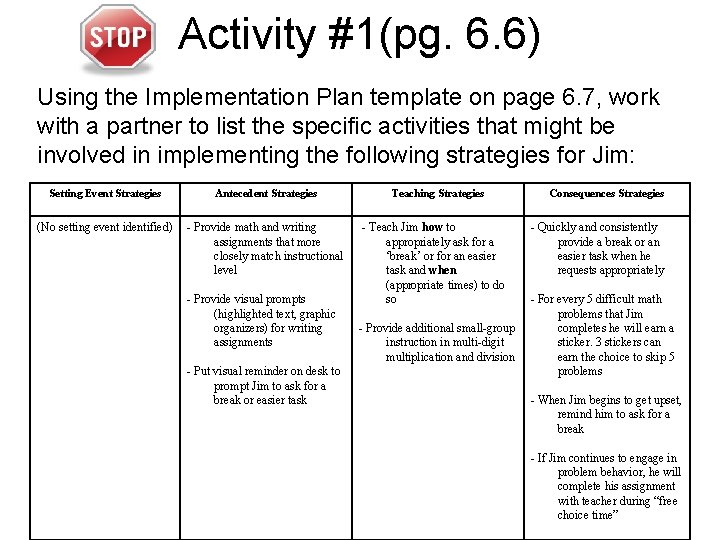
Activity #1(pg. 6. 6) Using the Implementation Plan template on page 6. 7, work with a partner to list the specific activities that might be involved in implementing the following strategies for Jim: Setting Event Strategies Antecedent Strategies (No setting event identified) - Provide math and writing assignments that more closely match instructional level - Provide visual prompts (highlighted text, graphic organizers) for writing assignments - Put visual reminder on desk to prompt Jim to ask for a break or easier task Teaching Strategies - Teach Jim how to appropriately ask for a ‘break’ or for an easier task and when (appropriate times) to do so - Provide additional small-group instruction in multi-digit multiplication and division Consequences Strategies - Quickly and consistently provide a break or an easier task when he requests appropriately - For every 5 difficult math problems that Jim completes he will earn a sticker. 3 stickers can earn the choice to skip 5 problems - When Jim begins to get upset, remind him to ask for a break - If Jim continues to engage in problem behavior, he will complete his assignment with teacher during “free choice time”
Evaluation Planning • The team leader will ensure that the BSP includes an evaluation plan with: – A short-term goal that is reasonable based on current performance – A long-term goal focused on increasing desired behavior – Specific activities/procedures that will be used to evaluate progress – A specified date when the team will next meet to review progress 56
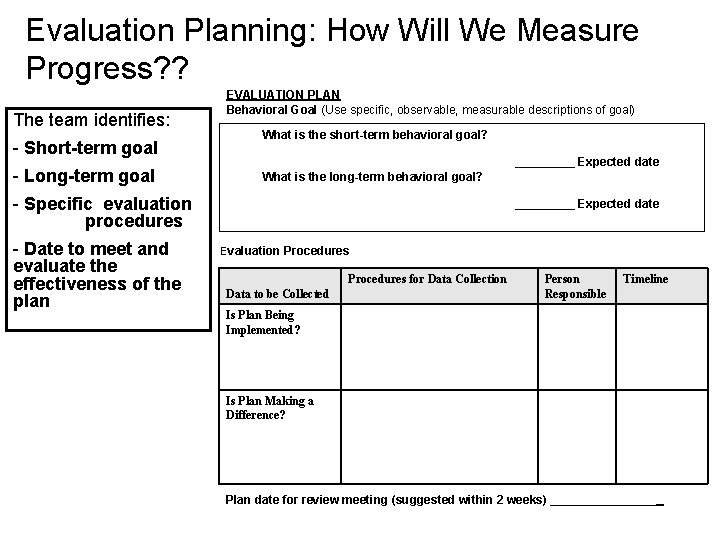
Evaluation Planning: How Will We Measure Progress? ? The team identifies: - Short-term goal - Long-term goal EVALUATION PLAN Behavioral Goal (Use specific, observable, measurable descriptions of goal) What is the short-term behavioral goal? _____ Expected date What is the long-term behavioral goal? - Specific evaluation procedures - Date to meet and evaluate the effectiveness of the plan _____ Expected date Evaluation Procedures for Data Collection Data to be Collected Person Responsible Timeline Is Plan Being Implemented? Is Plan Making a Difference? Plan date for review meeting (suggested within 2 weeks) ________
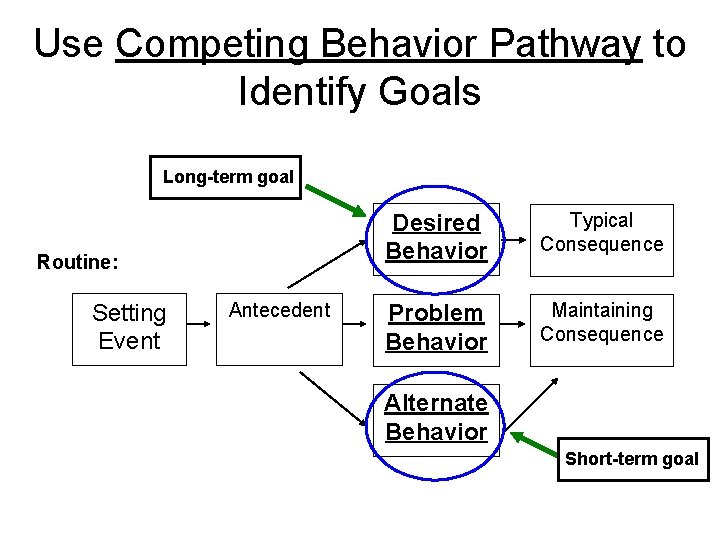
Use Competing Behavior Pathway to Identify Goals Long-term goal Routine: Setting Event Antecedent Desired Behavior Typical Consequence Problem Behavior Maintaining Consequence Alternate Behavior Short-term goal
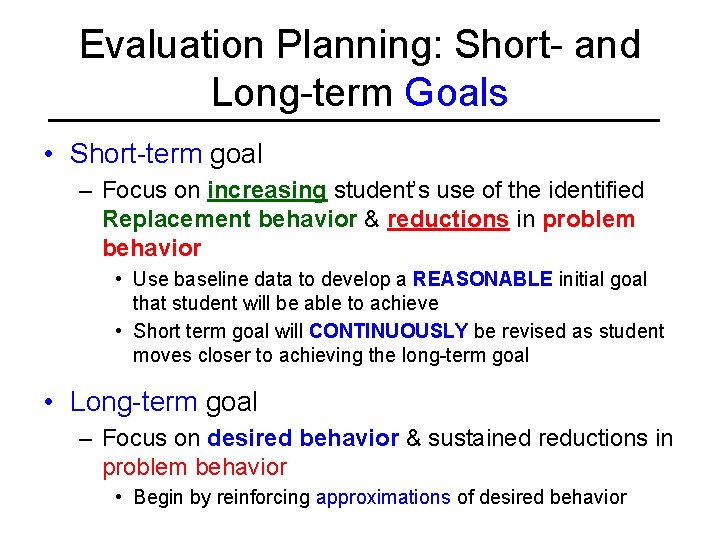
Evaluation Planning: Short- and Long-term Goals • Short-term goal – Focus on increasing student’s use of the identified Replacement behavior & reductions in problem behavior • Use baseline data to develop a REASONABLE initial goal that student will be able to achieve • Short term goal will CONTINUOUSLY be revised as student moves closer to achieving the long-term goal • Long-term goal – Focus on desired behavior & sustained reductions in problem behavior • Begin by reinforcing approximations of desired behavior
Dexter’s Summary Statement • When asked to complete independent writing tasks, Dexter often gets out of his seat, walks around the room and talks to peers to avoid completing the non-preferred task. He is currently completing about 10% of his writing assignments. His team has selected “asking to work with a peer partner” as a replacement behavior. The longterm goal behavior (i. e. , end goal) is for Dexter to complete his writing tasks independently.
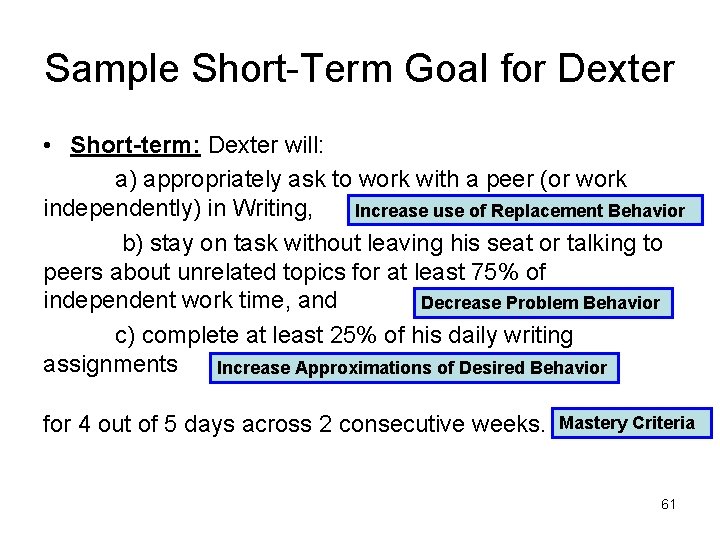
Sample Short-Term Goal for Dexter • Short-term: Dexter will: a) appropriately ask to work with a peer (or work independently) in Writing, Increase use of Replacement Behavior b) stay on task without leaving his seat or talking to peers about unrelated topics for at least 75% of independent work time, and Decrease Problem Behavior c) complete at least 25% of his daily writing assignments Increase Approximations of Desired Behavior for 4 out of 5 days across 2 consecutive weeks. Mastery Criteria 61
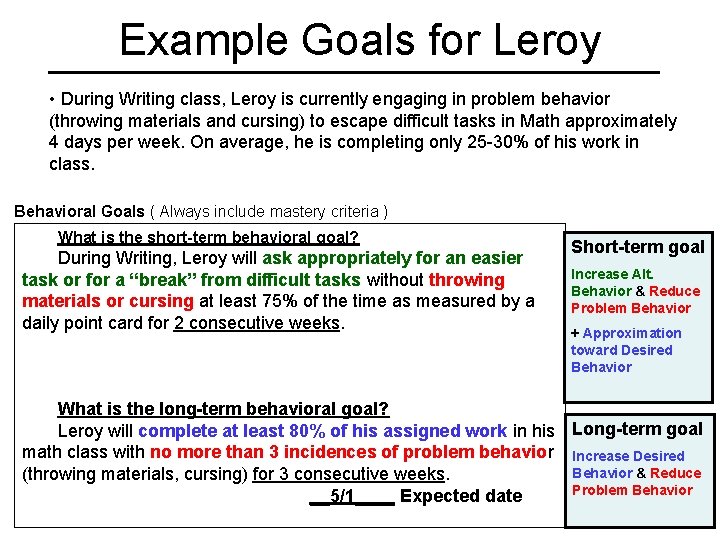
Example Goals for Leroy • During Writing class, Leroy is currently engaging in problem behavior (throwing materials and cursing) to escape difficult tasks in Math approximately 4 days per week. On average, he is completing only 25 -30% of his work in class. Behavioral Goals ( Always include mastery criteria ) What is the short-term behavioral goal? During Writing, Leroy will ask appropriately for an easier task or for a “break” from difficult tasks without throwing materials or cursing at least 75% of the time as measured by a daily point card for 2 consecutive weeks. Short-term goal Increase Alt. Behavior & Reduce Problem Behavior + Approximation toward Desired Behavior What is the long-term behavioral goal? Leroy will complete at least 80% of his assigned work in his Long-term goal math class with no more than 3 incidences of problem behavior Increase Desired Behavior & Reduce (throwing materials, cursing) for 3 consecutive weeks. Problem Behavior __5/1____ Expected date
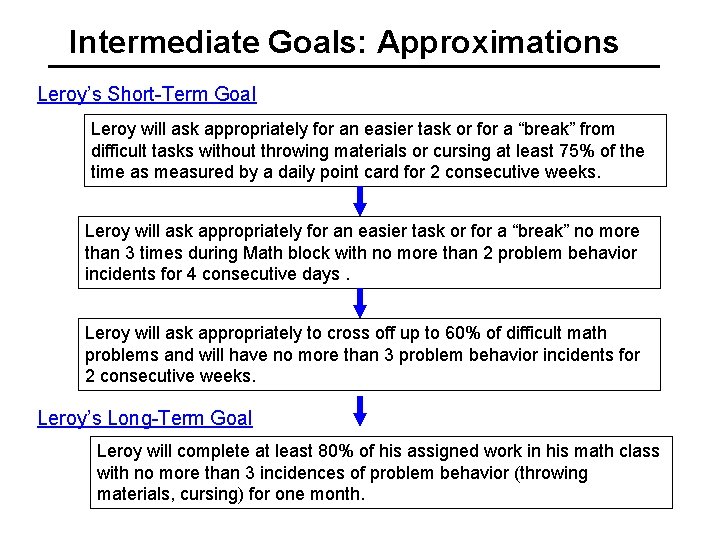
Intermediate Goals: Approximations Leroy’s Short-Term Goal Leroy will ask appropriately for an easier task or for a “break” from difficult tasks without throwing materials or cursing at least 75% of the time as measured by a daily point card for 2 consecutive weeks. Leroy will ask appropriately for an easier task or for a “break” no more than 3 times during Math block with no more than 2 problem behavior incidents for 4 consecutive days. Leroy will ask appropriately to cross off up to 60% of difficult math problems and will have no more than 3 problem behavior incidents for 2 consecutive weeks. Leroy’s Long-Term Goal Leroy will complete at least 80% of his assigned work in his math class with no more than 3 incidences of problem behavior (throwing materials, cursing) for one month.
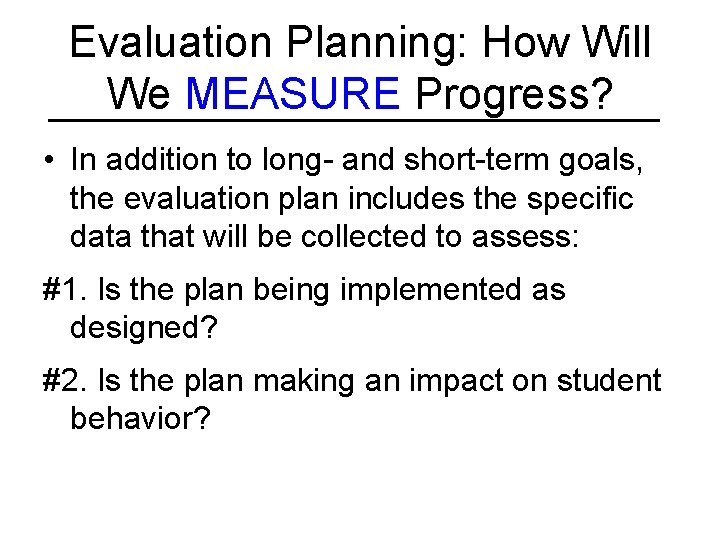
Evaluation Planning: How Will We MEASURE Progress? • In addition to long- and short-term goals, the evaluation plan includes the specific data that will be collected to assess: #1. Is the plan being implemented as designed? #2. Is the plan making an impact on student behavior?
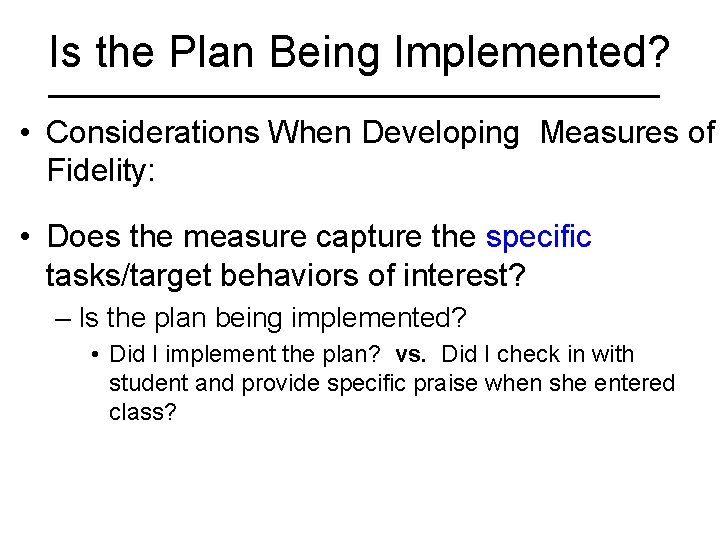
Is the Plan Being Implemented? • Considerations When Developing Measures of Fidelity: • Does the measure capture the specific tasks/target behaviors of interest? – Is the plan being implemented? • Did I implement the plan? vs. Did I check in with student and provide specific praise when she entered class?
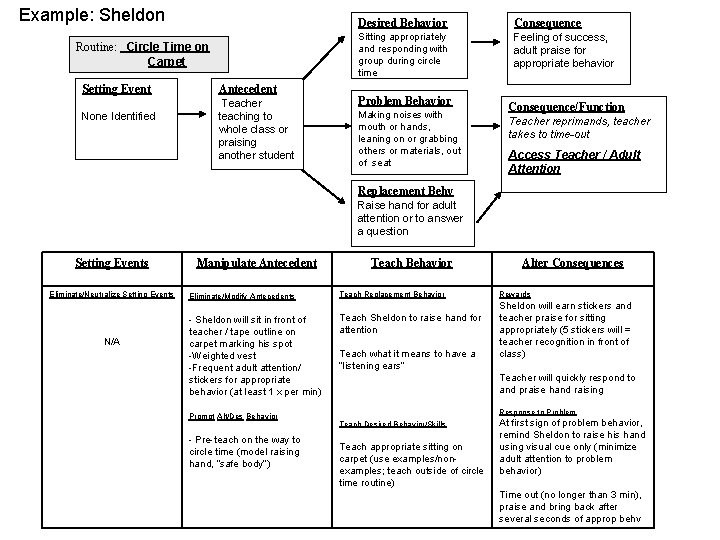
Example: Sheldon Routine: Circle Time on Carpet Setting Event None Identified Antecedent Teacher teaching to whole class or praising another student Desired Behavior Consequence Sitting appropriately and responding with group during circle time Feeling of success, adult praise for appropriate behavior Problem Behavior Making noises with mouth or hands, leaning on or grabbing others or materials, out of seat Consequence/Function Teacher reprimands, teacher takes to time-out Access Teacher / Adult Attention Replacement Behv Raise hand for adult attention or to answer a question Setting Events Eliminate/Neutralize Setting Events N/A Manipulate Antecedent Teach Behavior Eliminate/Modify Antecedents Teach Replacement Behavior - Sheldon will sit in front of teacher / tape outline on carpet marking his spot -Weighted vest -Frequent adult attention/ stickers for appropriate behavior (at least 1 x per min) Teach Sheldon to raise hand for attention Prompt Alt/Des Behavior - Pre-teach on the way to circle time (model raising hand, “safe body”) Teach what it means to have a “listening ears” Alter Consequences Rewards Sheldon will earn stickers and teacher praise for sitting appropriately (5 stickers will = teacher recognition in front of class) Teacher will quickly respond to and praise hand raising Response to Problem Teach Desired Behavior/Skills Teach appropriate sitting on carpet (use examples/nonexamples; teach outside of circle time routine) At first sign of problem behavior, remind Sheldon to raise his hand using visual cue only (minimize adult attention to problem behavior) Time out (no longer than 3 min), praise and bring back after several seconds of approp behv
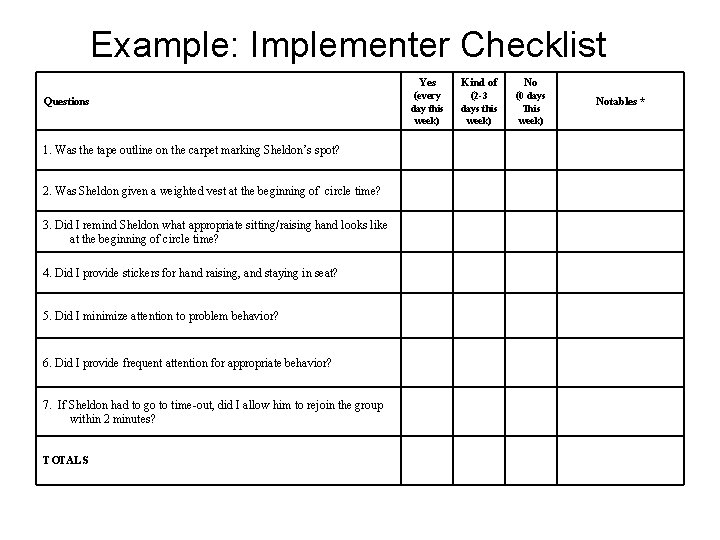
Example: Implementer Checklist Questions 1. Was the tape outline on the carpet marking Sheldon’s spot? 2. Was Sheldon given a weighted vest at the beginning of circle time? 3. Did I remind Sheldon what appropriate sitting/raising hand looks like at the beginning of circle time? 4. Did I provide stickers for hand raising, and staying in seat? 5. Did I minimize attention to problem behavior? 6. Did I provide frequent attention for appropriate behavior? 7. If Sheldon had to go to time-out, did I allow him to rejoin the group within 2 minutes? TOTALS Yes (every Kind of (2 -3 No (0 days day this week) days this week) This week) Notables *
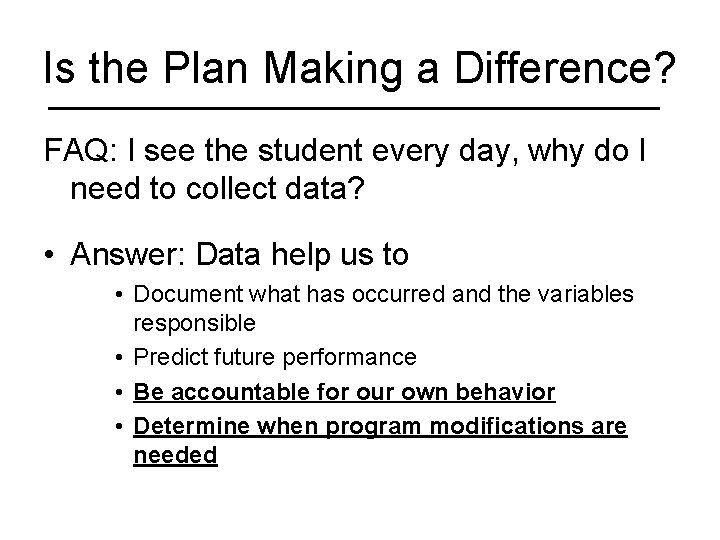
Is the Plan Making a Difference? FAQ: I see the student every day, why do I need to collect data? • Answer: Data help us to • Document what has occurred and the variables responsible • Predict future performance • Be accountable for our own behavior • Determine when program modifications are needed
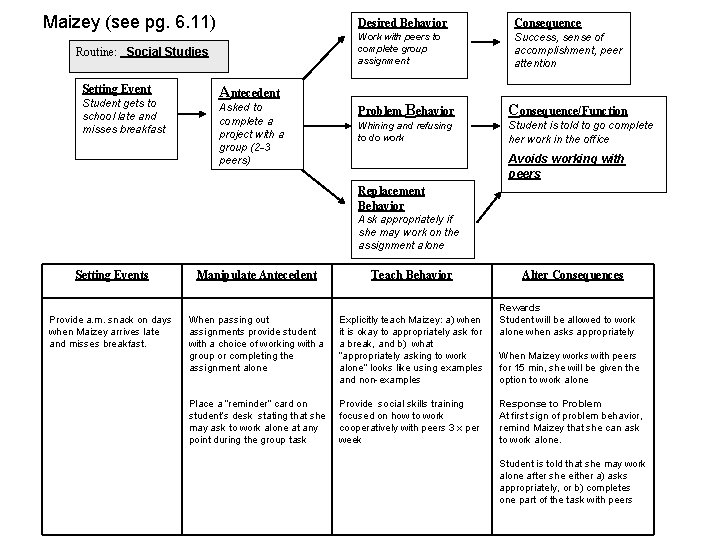
Maizey (see pg. 6. 11) Routine: Social Studies Setting Event Student gets to school late and misses breakfast Desired Behavior Consequence Work with peers to complete group assignment Success, sense of accomplishment, peer attention Antecedent Asked to complete a project with a group (2 -3 peers) Problem Behavior Consequence/Function Whining and refusing to do work Student is told to go complete her work in the office Avoids working with peers Replacement Behavior Ask appropriately if she may work on the assignment alone Setting Events Manipulate Antecedent Teach Behavior Provide a. m. snack on days when Maizey arrives late and misses breakfast. When passing out assignments provide student with a choice of working with a group or completing the assignment alone Explicitly teach Maizey: a) when it is okay to appropriately ask for a break, and b) what “appropriately asking to work alone” looks like using examples and non-examples Place a “reminder” card on student’s desk stating that she may ask to work alone at any point during the group task Provide social skills training focused on how to work cooperatively with peers 3 x per week Alter Consequences Rewards Student will be allowed to work alone when asks appropriately When Maizey works with peers for 15 min, she will be given the option to work alone Response to Problem At first sign of problem behavior, remind Maizey that she can ask to work alone. Student is told that she may work alone after she either a) asks appropriately, or b) completes one part of the task with peers
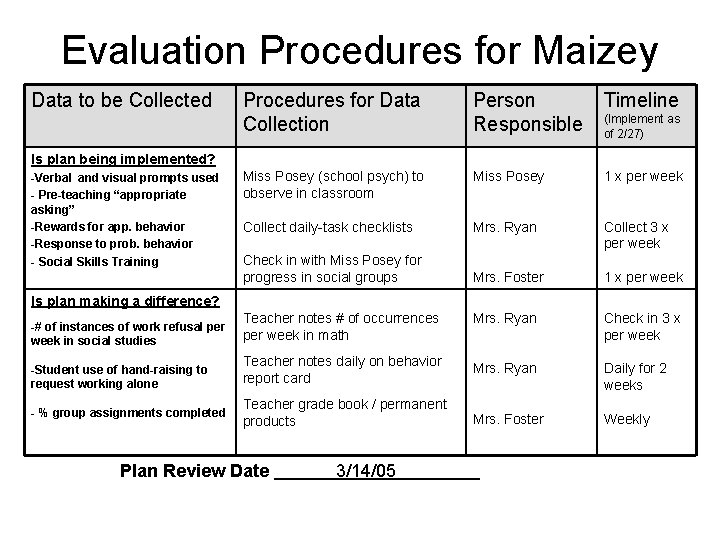
Evaluation Procedures for Maizey Data to be Collected Procedures for Data Collection Person Responsible Timeline Miss Posey (school psych) to observe in classroom Miss Posey 1 x per week Collect daily-task checklists Mrs. Ryan Collect 3 x per week Check in with Miss Posey for progress in social groups Mrs. Foster 1 x per week Mrs. Ryan Check in 3 x per week (Implement as of 2/27) Is plan being implemented? -Verbal and visual prompts used - Pre-teaching “appropriate asking” -Rewards for app. behavior -Response to prob. behavior - Social Skills Training Is plan making a difference? -# of instances of work refusal per week in social studies Teacher notes # of occurrences per week in math -Student use of hand-raising to request working alone Teacher notes daily on behavior report card Mrs. Ryan Daily for 2 weeks Teacher grade book / permanent products Mrs. Foster Weekly - % group assignments completed Plan Review Date 3/14/05
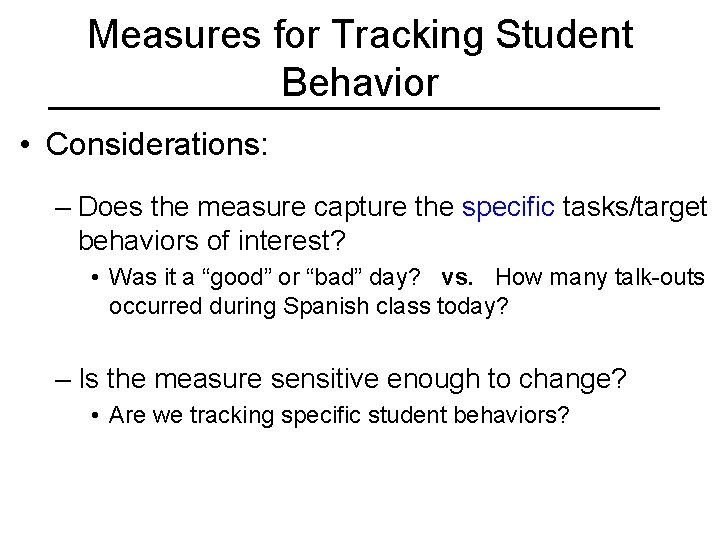
Measures for Tracking Student Behavior • Considerations: – Does the measure capture the specific tasks/target behaviors of interest? • Was it a “good” or “bad” day? vs. How many talk-outs occurred during Spanish class today? – Is the measure sensitive enough to change? • Are we tracking specific student behaviors?
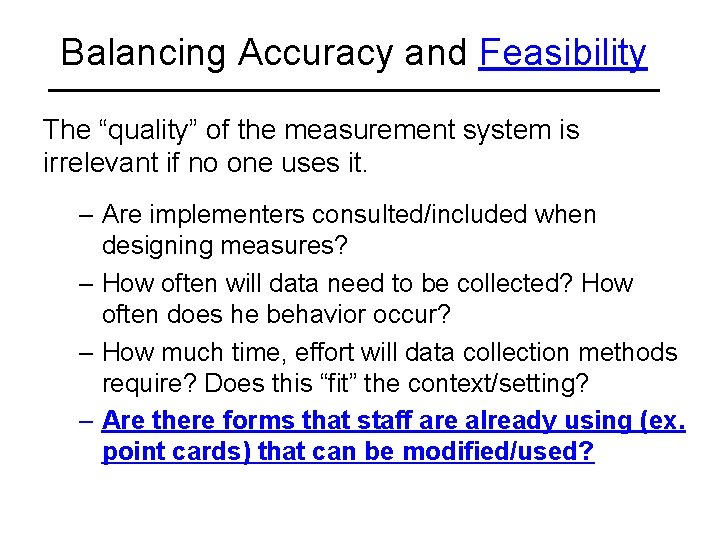
Balancing Accuracy and Feasibility The “quality” of the measurement system is irrelevant if no one uses it. – Are implementers consulted/included when designing measures? – How often will data need to be collected? How often does he behavior occur? – How much time, effort will data collection methods require? Does this “fit” the context/setting? – Are there forms that staff are already using (ex. point cards) that can be modified/used?
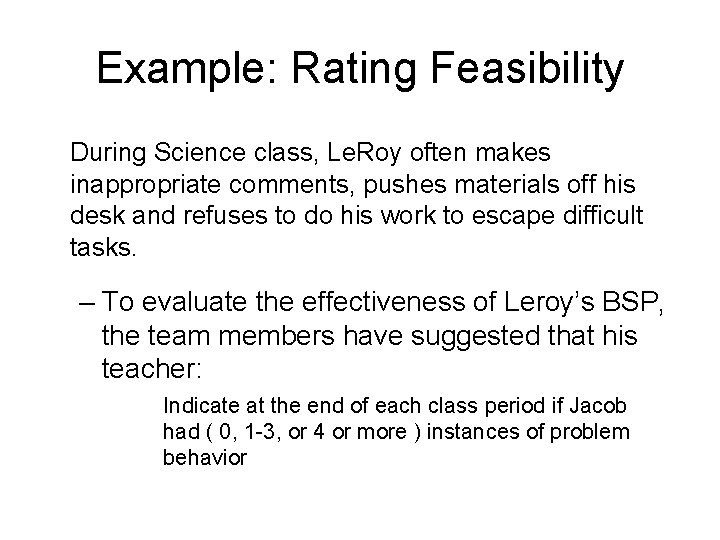
Example: Rating Feasibility During Science class, Le. Roy often makes inappropriate comments, pushes materials off his desk and refuses to do his work to escape difficult tasks. – To evaluate the effectiveness of Leroy’s BSP, the team members have suggested that his teacher: Collect continuous partial on the Indicate at the end 5 ofsec each classinterval period data if Jacob occurrence/non-occurrence of each of problem had ( 0, 1 -3, or 4 or more ) instances of his problem behaviors behavior
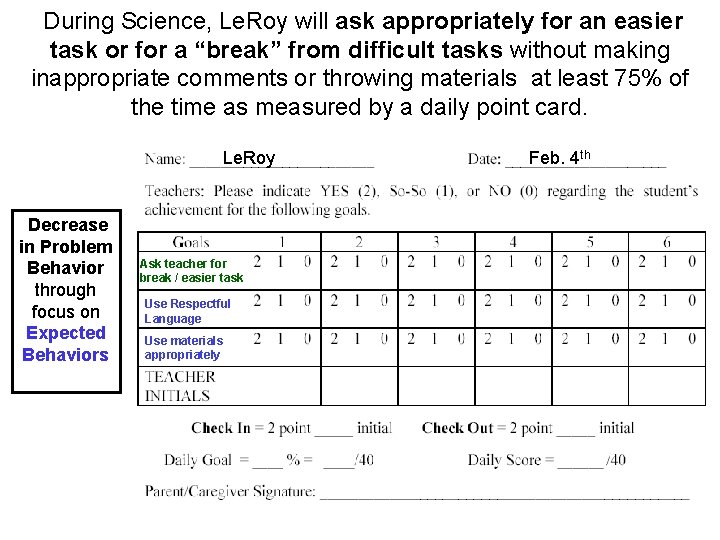
During Science, Le. Roy will ask appropriately for an easier task or for a “break” from difficult tasks without making inappropriate comments or throwing materials at least 75% of the time as measured by a daily point card. Measuring the Short-term Goal Le. Roy Decrease in Problem Behavior through focus on Expected Behaviors Ask teacher for break / easier task Use Respectful Language Use materials appropriately Feb. 4 th
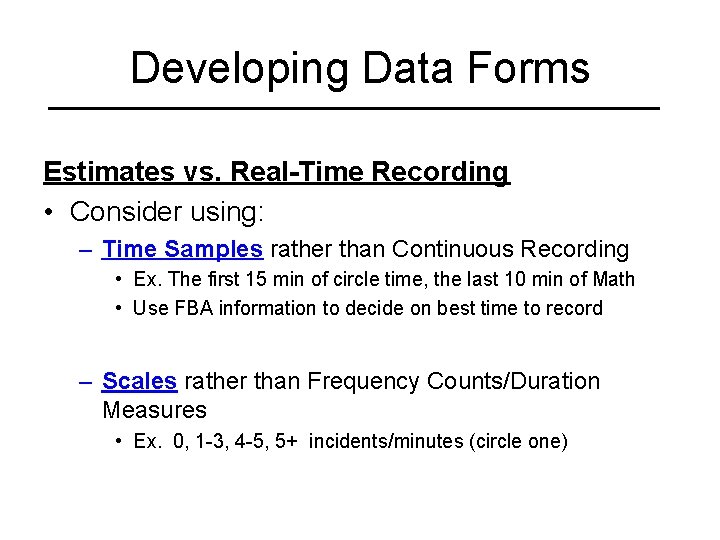
Developing Data Forms Estimates vs. Real-Time Recording • Consider using: – Time Samples rather than Continuous Recording • Ex. The first 15 min of circle time, the last 10 min of Math • Use FBA information to decide on best time to record – Scales rather than Frequency Counts/Duration Measures • Ex. 0, 1 -3, 4 -5, 5+ incidents/minutes (circle one)
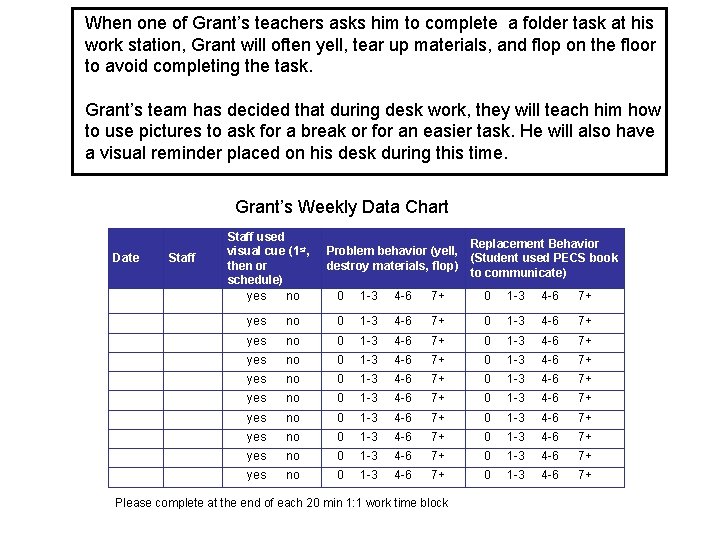
When one of Grant’s teachers asks him to complete a folder task at his work station, Grant will often yell, tear up materials, and flop on the floor to avoid completing the task. Grant’s team has decided that during desk work, they will teach him how to use pictures to ask for a break or for an easier task. He will also have a visual reminder placed on his desk during this time. Grant’s Weekly Data Chart Date Staff used visual cue (1 st, then or schedule) yes no Replacement Behavior Problem behavior (yell, (Student used PECS book destroy materials, flop) to communicate) 0 1 -3 4 -6 7+ 0 1 -3 4 -6 7+ yes no 0 1 -3 4 -6 7+ 0 1 -3 4 -6 7+ yes no 0 1 -3 4 -6 7+ yes no 0 1 -3 4 -6 7+ Please complete at the end of each 20 min 1: 1 work time block
- Slides: 76