
Objectives Transform quadratic functions Describe the effects of
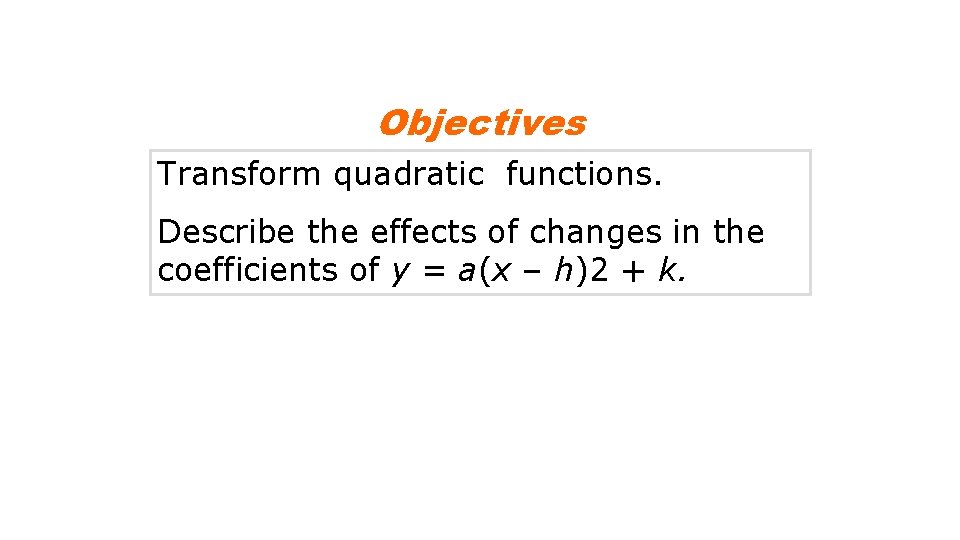
Objectives Transform quadratic functions. Describe the effects of changes in the coefficients of y = a(x – h)2 + k.
Vocabulary quadratic function parabola vertex of a parabola vertex form
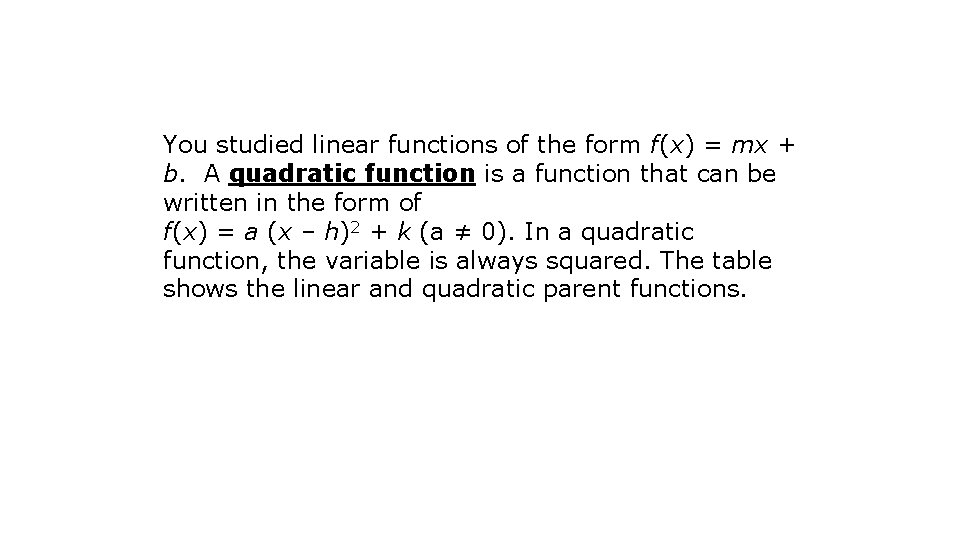
You studied linear functions of the form f(x) = mx + b. A quadratic function is a function that can be written in the form of f(x) = a (x – h)2 + k (a ≠ 0). In a quadratic function, the variable is always squared. The table shows the linear and quadratic parent functions.
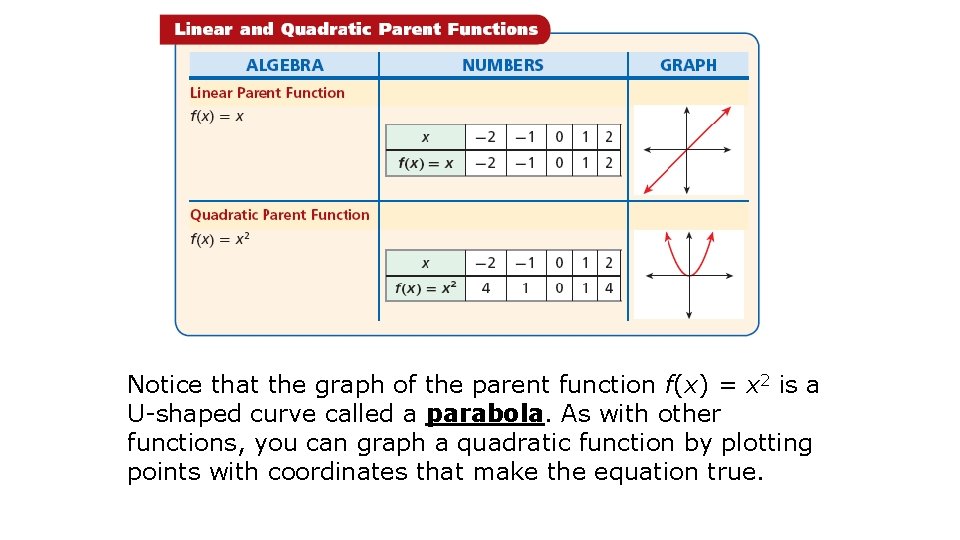
Notice that the graph of the parent function f(x) = x 2 is a U-shaped curve called a parabola. As with other functions, you can graph a quadratic function by plotting points with coordinates that make the equation true.

You can also graph quadratic functions by applying transformations to the parent function f(x) = x 2. Transforming quadratic functions is similar to transforming linear functions.
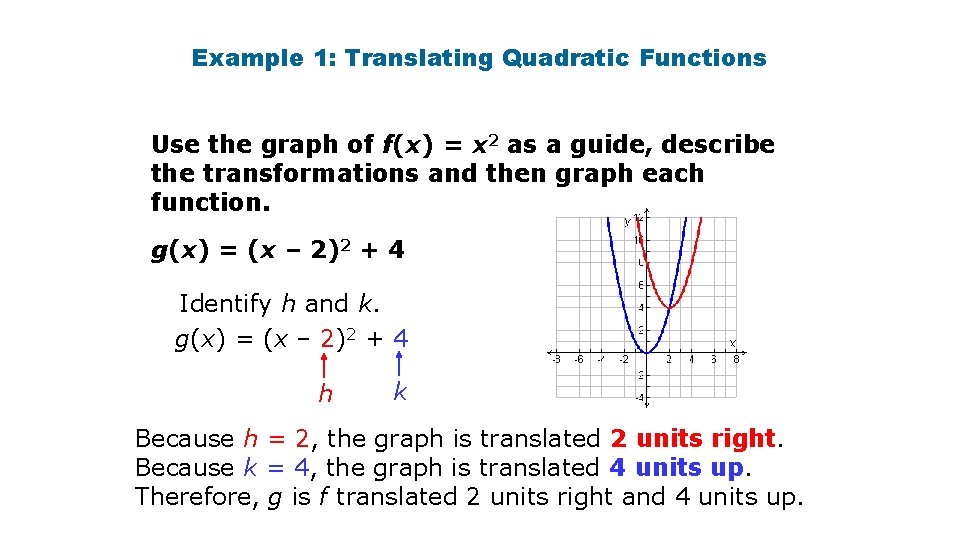
Example 1: Translating Quadratic Functions Use the graph of f(x) = x 2 as a guide, describe the transformations and then graph each function. g(x) = (x – 2)2 + 4 Identify h and k. g(x) = (x – 2)2 + 4 h k Because h = 2, the graph is translated 2 units right. Because k = 4, the graph is translated 4 units up. Therefore, g is f translated 2 units right and 4 units up.
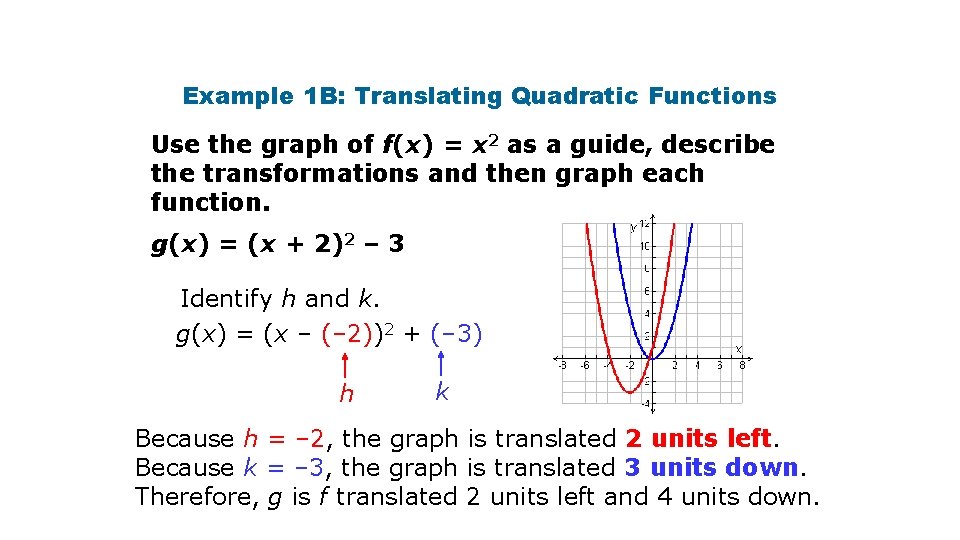
Example 1 B: Translating Quadratic Functions Use the graph of f(x) = x 2 as a guide, describe the transformations and then graph each function. g(x) = (x + 2)2 – 3 Identify h and k. g(x) = (x – (– 2))2 + (– 3) h k Because h = – 2, the graph is translated 2 units left. Because k = – 3, the graph is translated 3 units down. Therefore, g is f translated 2 units left and 4 units down.
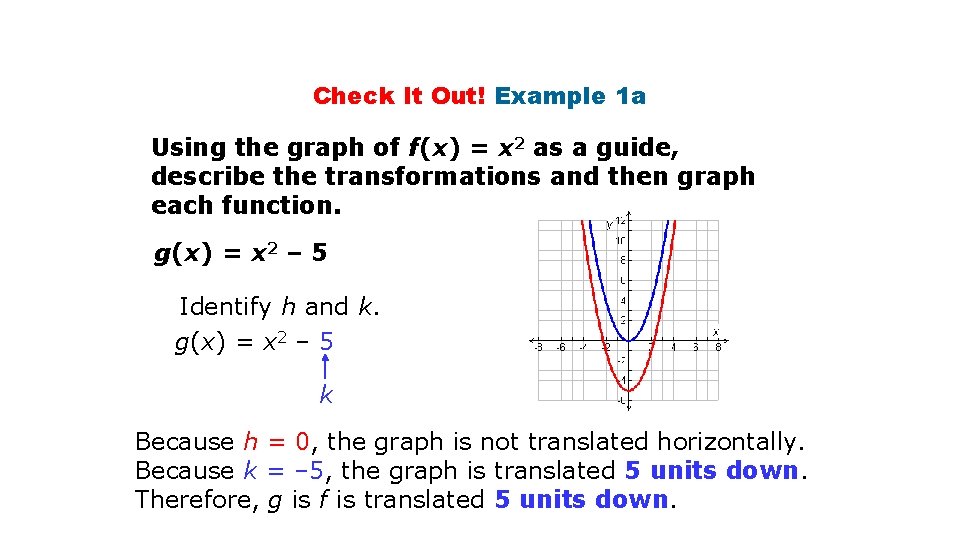
Check It Out! Example 1 a Using the graph of f(x) = x 2 as a guide, describe the transformations and then graph each function. g(x) = x 2 – 5 Identify h and k. g(x) = x 2 – 5 k Because h = 0, the graph is not translated horizontally. Because k = – 5, the graph is translated 5 units down. Therefore, g is f is translated 5 units down.
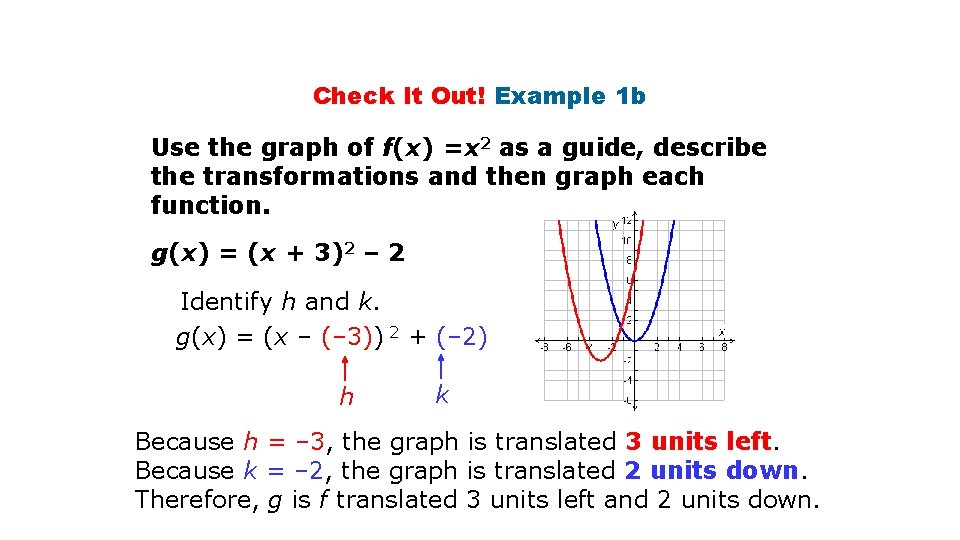
Check It Out! Example 1 b Use the graph of f(x) =x 2 as a guide, describe the transformations and then graph each function. g(x) = (x + 3)2 – 2 Identify h and k. g(x) = (x – (– 3)) 2 + (– 2) h k Because h = – 3, the graph is translated 3 units left. Because k = – 2, the graph is translated 2 units down. Therefore, g is f translated 3 units left and 2 units down.
Recall that functions can also be reflected, stretched, or compressed.
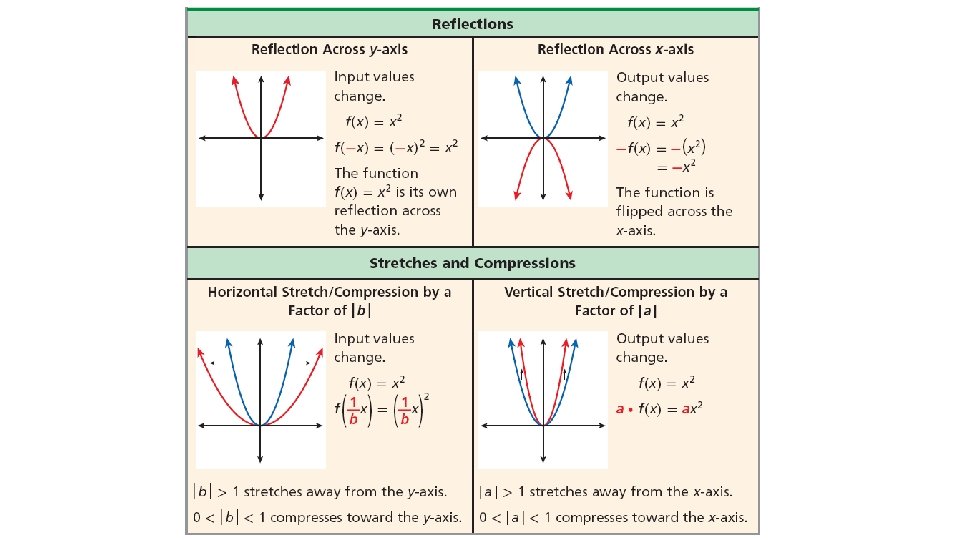
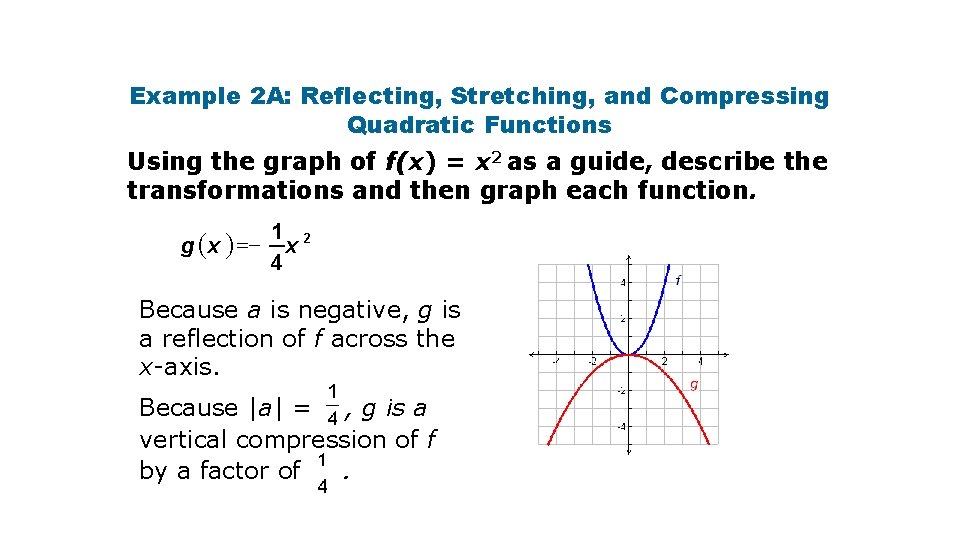
Example 2 A: Reflecting, Stretching, and Compressing Quadratic Functions Using the graph of f(x) = x 2 as a guide, describe the transformations and then graph each function. g (x ) =- 1 x 4 2 Because a is negative, g is a reflection of f across the x-axis. Because |a| = , g is a vertical compression of f by a factor of.
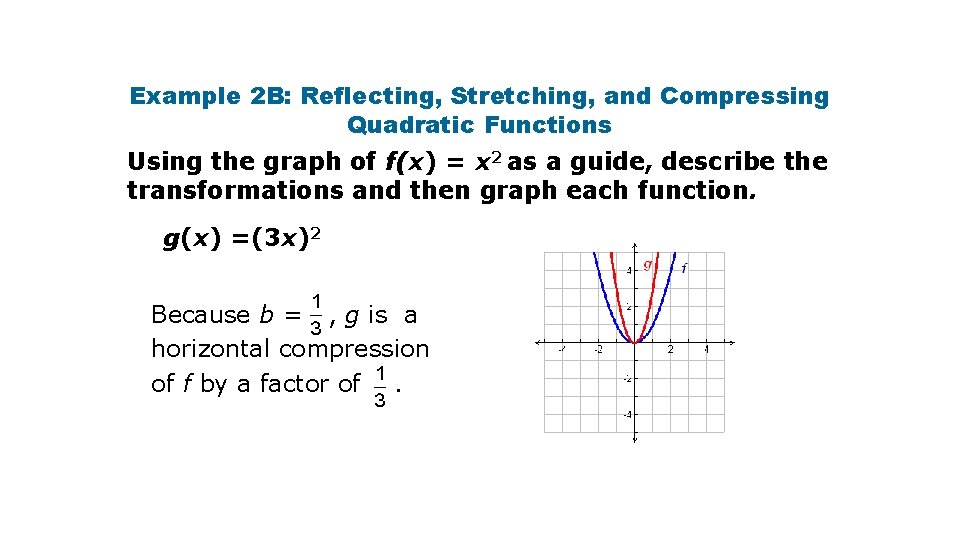
Example 2 B: Reflecting, Stretching, and Compressing Quadratic Functions Using the graph of f(x) = x 2 as a guide, describe the transformations and then graph each function. g(x) =(3 x)2 Because b = , g is a horizontal compression of f by a factor of.
- Slides: 14