
OBJECTIVES To identify and define various forms of

OBJECTIVES: • To identify and define various forms of figurative language • To interpret and analyze figurative language within text
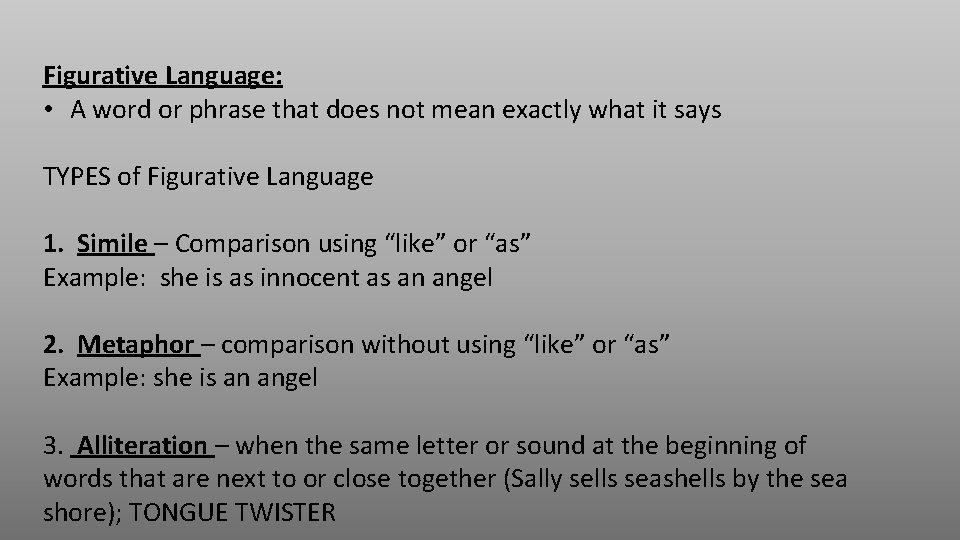
Figurative Language: • A word or phrase that does not mean exactly what it says TYPES of Figurative Language 1. Simile – Comparison using “like” or “as” Example: she is as innocent as an angel 2. Metaphor – comparison without using “like” or “as” Example: she is an angel 3. Alliteration – when the same letter or sound at the beginning of words that are next to or close together (Sally sells seashells by the sea shore); TONGUE TWISTER
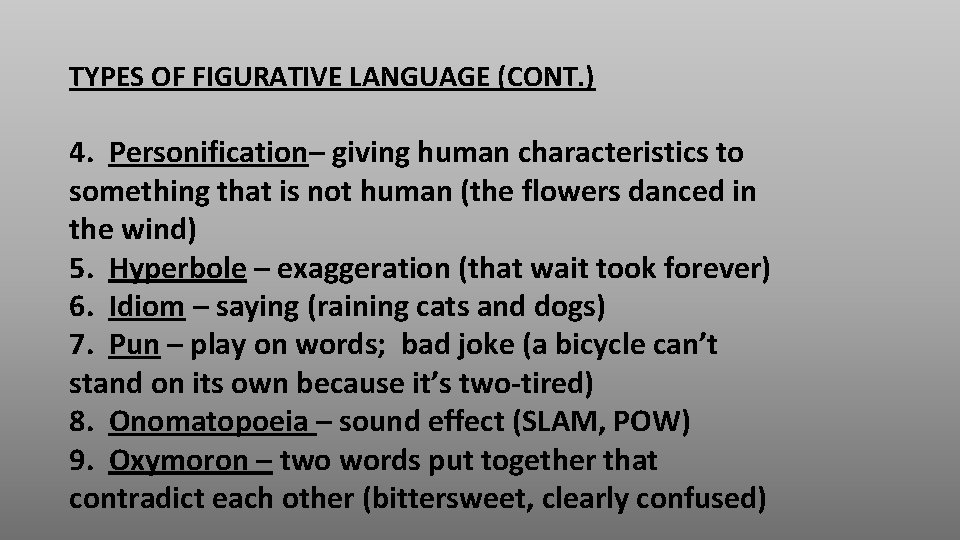
TYPES OF FIGURATIVE LANGUAGE (CONT. ) 4. Personification– giving human characteristics to something that is not human (the flowers danced in the wind) 5. Hyperbole – exaggeration (that wait took forever) 6. Idiom – saying (raining cats and dogs) 7. Pun – play on words; bad joke (a bicycle can’t stand on its own because it’s two-tired) 8. Onomatopoeia – sound effect (SLAM, POW) 9. Oxymoron – two words put together that contradict each other (bittersweet, clearly confused)

TRY THESE: EXAMPLES: 1. The sun sizzled in a sky so blue it could have been created out of a paint can. 2. When they left the town behind, they rode between stands of tall, whispering grass rising on each side of the highway. 3. His tires buzzed against the smooth blacktop, and the wind swept through his hair holding it back from his face as if by strong fingers.
- Slides: 4