
OBJECTIVES To identify and define figurative language and
OBJECTIVES: • To identify and define figurative language and various forms of figurative language • To interpret and analyze figurative language • To define connotation and denotation • To analyze the poem, Nothing Gold Can Stay by Robert Frost
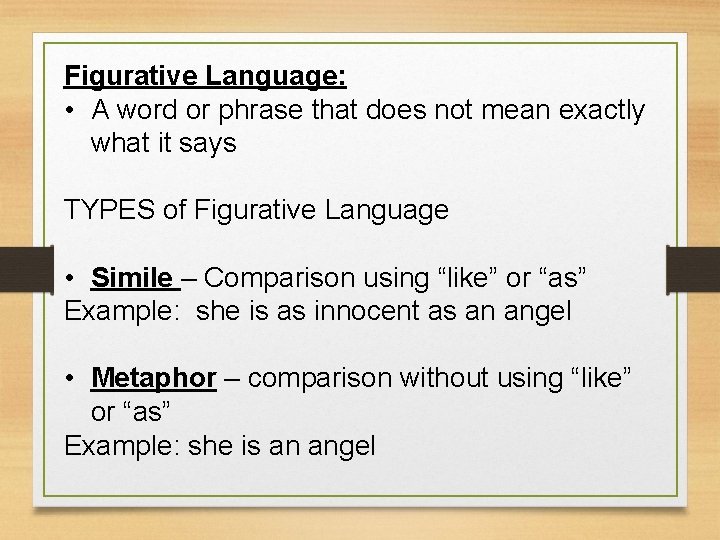
Figurative Language: • A word or phrase that does not mean exactly what it says TYPES of Figurative Language • Simile – Comparison using “like” or “as” Example: she is as innocent as an angel • Metaphor – comparison without using “like” or “as” Example: she is an angel
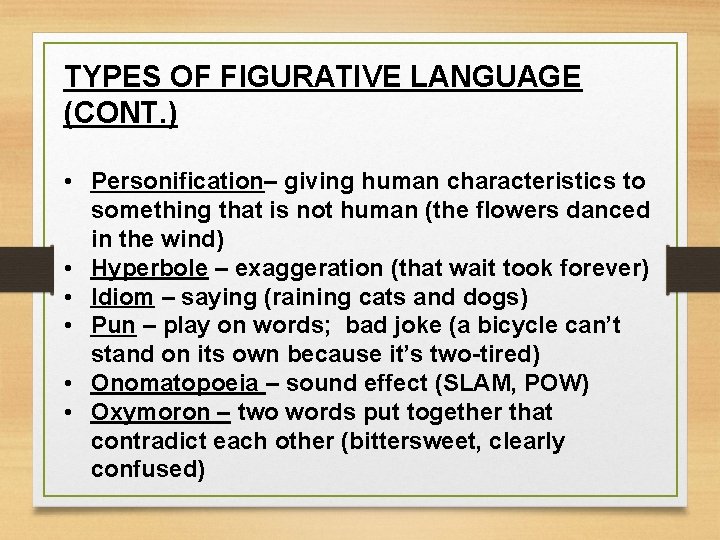
TYPES OF FIGURATIVE LANGUAGE (CONT. ) • Personification– giving human characteristics to something that is not human (the flowers danced in the wind) • Hyperbole – exaggeration (that wait took forever) • Idiom – saying (raining cats and dogs) • Pun – play on words; bad joke (a bicycle can’t stand on its own because it’s two-tired) • Onomatopoeia – sound effect (SLAM, POW) • Oxymoron – two words put together that contradict each other (bittersweet, clearly confused)

Connotation vs. Denotation • Denotation - literal meaning (dictionary) • Connotation – suggestive meanings • Example: “blue” ** literal meaning = the color (denotation) ** suggestive meaning = feeling of sadness (connotation) Example: “childish” and “youthful” **literal - they both mean young or applying to a child (denotation) ** suggestive meaning: ** childish refers to immature behavior and youthful implies someone being lively and energetic (connotation)
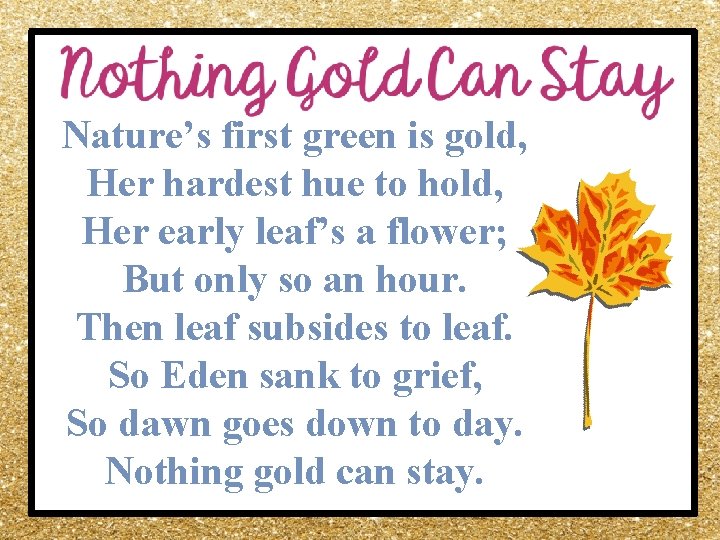
Nature’s first green is gold, Her hardest hue to hold, Her early leaf’s a flower; But only so an hour. Then leaf subsides to leaf. So Eden sank to grief, So dawn goes down to day. Nothing gold can stay.
Line 1 Question 1 a) What does "nature's first green” mean? b) Why is it "gold"? Do you think Frost means the color gold? What else could gold symbolize/represent?
Question 1 (Line 1): a) What does "nature's first green” mean? b) Why is it "gold"? Do you think Frost means the color gold? What else could gold symbolize/represent? Nature’s first green could be interpreted as spring when plants and greenery come to life after the cold, winter. It is described as gold. This can be interpreted to mean that springtime is precious and valuable.
Line 2 Question 2 a) What is a "hue"? b) Do you think nature has a hard time "holding" onto green?
Question 2 (Line 2): a) What is a "hue"? b) Do you think nature has a hard time "holding" onto green? • This line suggests that the green of springtime (or the ‘gold’) is a color (hue) that does not last long or is difficult to ‘hold’. This line shows that nature’s precious and valuable green doesn’t last long.
Line 3 & 4 Question 3 a) What would an "early leaf" be? b) Why is it only that way for an hour? Is it really an hour? What is Frost saying here?
Question 3 (Lines 3 & 4): a) What would an "early leaf" be? b) Why is it only that way for an hour? Is it really an hour? What is Frost saying here? In early spring, nature is full of beautiful flowers, but that this precious gift only lasts a short while. This is shown when it says the flowers last only an hour.
Line 5 & 6 Question 4 a) What does the word "subsides" mean? a) What is "Eden"? c) What do you think is meant by the reference to "grief”?
Question 4 (Lines 5 & 6): a) What does the word "subsides" mean? a) What is "Eden"? c) What do you think is meant by the reference to "grief”? Subsides means to go down. These lines show the change from the ‘golden’ early spring of lush flowers and beautiful hues to leaves slowly falling as the season changes. The speaker is also comparing mankind’s fall from the Garden of Eden (Biblical reference) to the changes described in the first part of the poem. These ideas are connected to show the negative repercussions that come from change. © Presto Plans
Line 7 & 8 Question 5 a) We don't typically think of dawn, or a sunrise, as "going down", as we would with dusk. Why do you think Frost worded it like this? b) What is meant by "nothing gold can stay"? © Presto Plans
Question 5 (Lines 7 & 8): a) We don't typically think of dawn, or a sunrise, as "going down", as we would with dusk. Why do you think Frost worded it like this? b) What is meant by "nothing gold can stay”? These lines stand out as most people see the dawn as ‘rising up’ rather than going down. The author changes this idea to show the temporal and passing nature of dawn. The final line connects directly with the first line of the poem. When Frost says, ‘Nothing gold can stay’. He means that good things must eventually come to an end. and that change is inevitable.
Question 6: Do you think the message of this poem could apply to more than nature? What does it say about people and life in general or how could it relate to the novel? • This poem relays the message that all good things must come to an end. • This idea can be applied to holding onto youth and innocence in this novel. • Later in the novel, you will see the idea of ‘gold’ again and it will become clear that this poem relates to holding onto innocence and being shielded from the harsh realities of life. • Characters will be encouraged to hold onto ‘golden’ qualities that set him apart from the other members of the gang.
What are some things in your lives that will eventually change? How do you think you cope with these changes? © Presto Plans
- Slides: 17