
Objectives To describe the communication and listening processes
Objectives • To describe the communication and listening processes. • To analyze different communication models. • To interpret the effects of non-verbal communication. • To apply communication to professional situations. • To examine the impact of communication on society. 2
Main Menu • Communication Process & Models • Styles Overview • Listening Process • Non-Verbal Communication • Professional Communication • Communication & Society 3
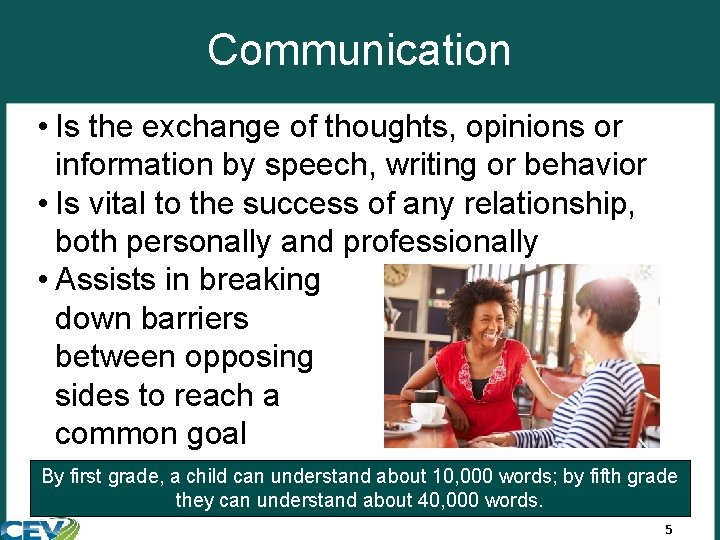
Communication • Is the exchange of thoughts, opinions or information by speech, writing or behavior • Is vital to the success of any relationship, both personally and professionally • Assists in breaking down barriers between opposing sides to reach a common goal By first grade, a child can understand about 10, 000 words; by fifth grade they can understand about 40, 000 words. 5
Communication • Is defined as a process in which we create and convey a message in an attempt to develop a shared understanding • Occurs when there is a message to be shared, person or persons to share it and a medium they can use to make the sharing possible − this can be as simple as two people talking or as complex as all the planning and thought which occurs when developing an ad for television 6
Basic Elements of Communication • Include: − sender • individual or group who sends the message − message • thought, idea, opinion, etc. which the sender has encoded and wants conveyed − channel • portion of the communication process which carries the message to its desired location − receiver • target of the message − feedback • response of the receiver to the message 7
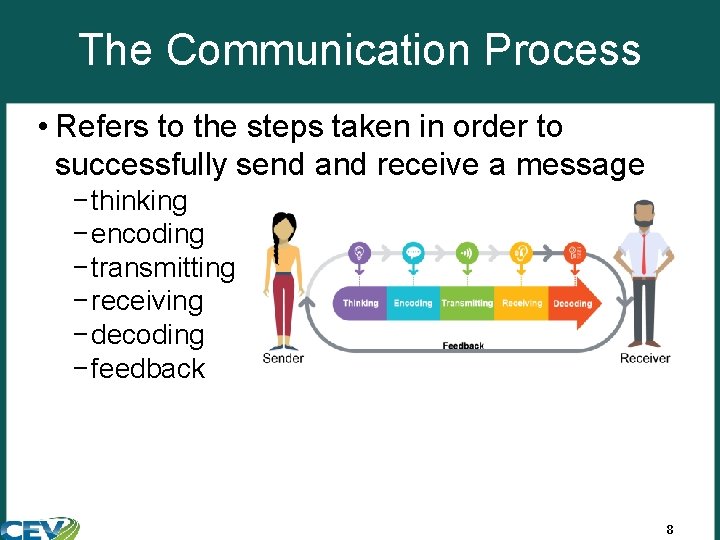
The Communication Process • Refers to the steps taken in order to successfully send and receive a message − thinking − encoding − transmitting − receiving − decoding − feedback 8
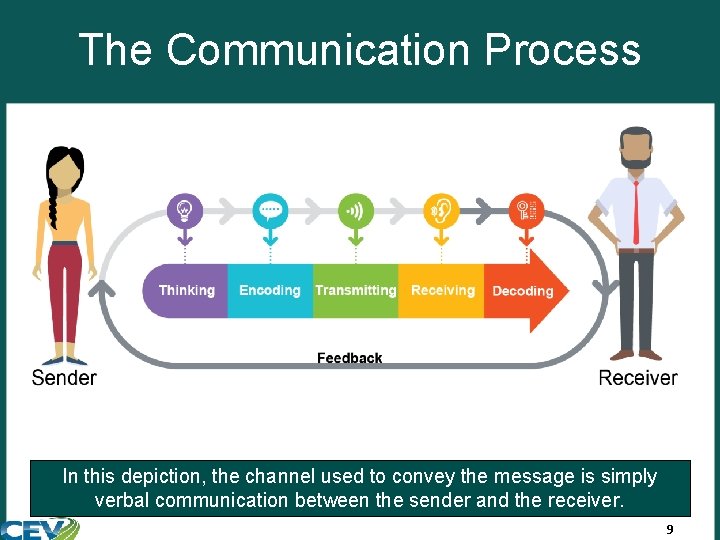
The Communication Process In this depiction, the channel used to convey the message is simply verbal communication between the sender and the receiver. 9
Thinking • Is the initial step in the communication process • Involves the source or sender generating information intended to be shared with others − information can be primary or secondary • primary information is an original, fundamental and authoritative statement pertaining to an event or subject of inquiry; a first-hand or eyewitness account of an event 10
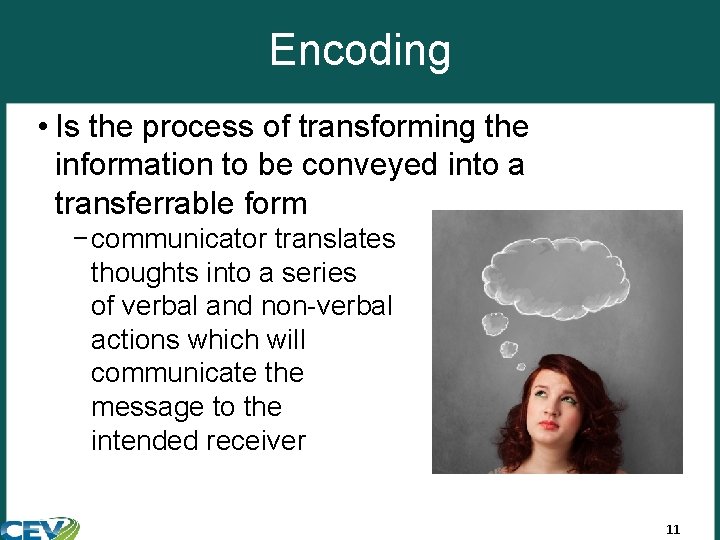
Encoding • Is the process of transforming the information to be conveyed into a transferrable form − communicator translates thoughts into a series of verbal and non-verbal actions which will communicate the message to the intended receiver 11
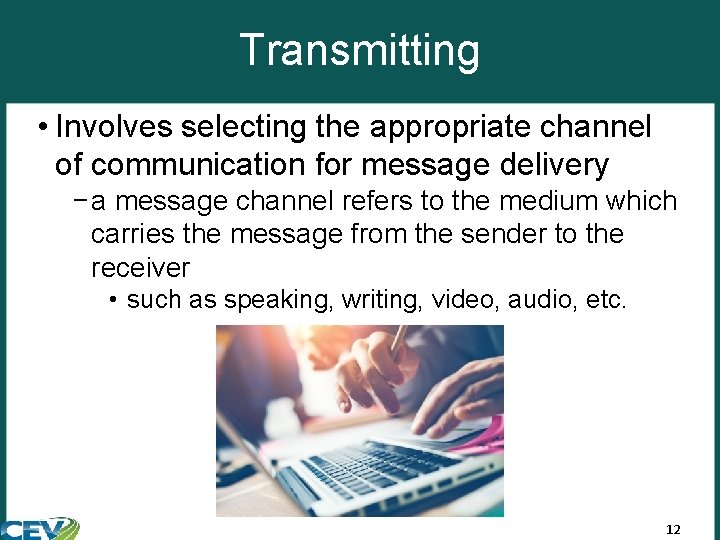
Transmitting • Involves selecting the appropriate channel of communication for message delivery − a message channel refers to the medium which carries the message from the sender to the receiver • such as speaking, writing, video, audio, etc. 12
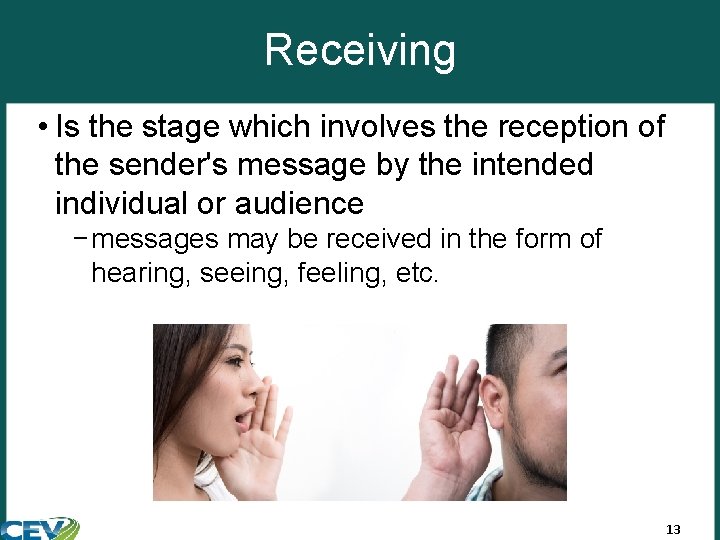
Receiving • Is the stage which involves the reception of the sender's message by the intended individual or audience − messages may be received in the form of hearing, seeing, feeling, etc. 13
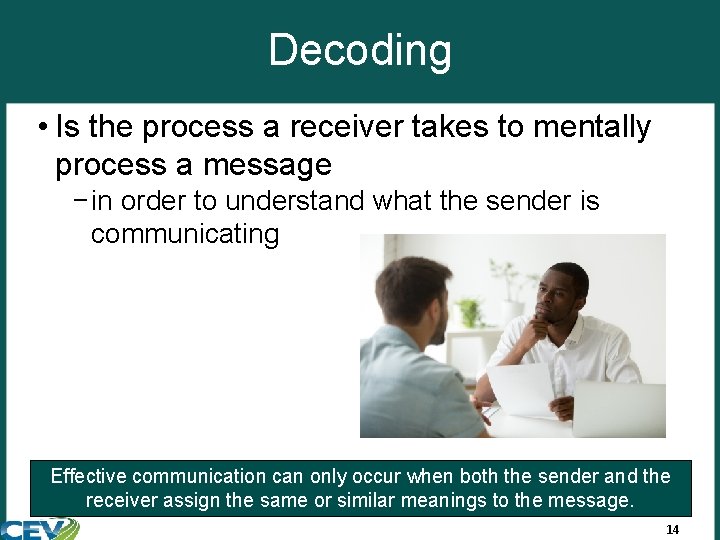
Decoding • Is the process a receiver takes to mentally process a message − in order to understand what the sender is communicating Effective communication can only occur when both the sender and the receiver assign the same or similar meanings to the message. 14
Feedback • Is the final step of the communication process • Refers to any response the receiver offers to the message − this could be communication or behavior • a person or group of people conversing back to the sender of the message • facial expressions or body movement • Increases effective communication − ensuring the receiver has correctly understood the message 15
Models of Communication • Refer to conceptual models used to explain the communication process • Examples include: − Linear Model − Interactive Model − Transactional Model 16
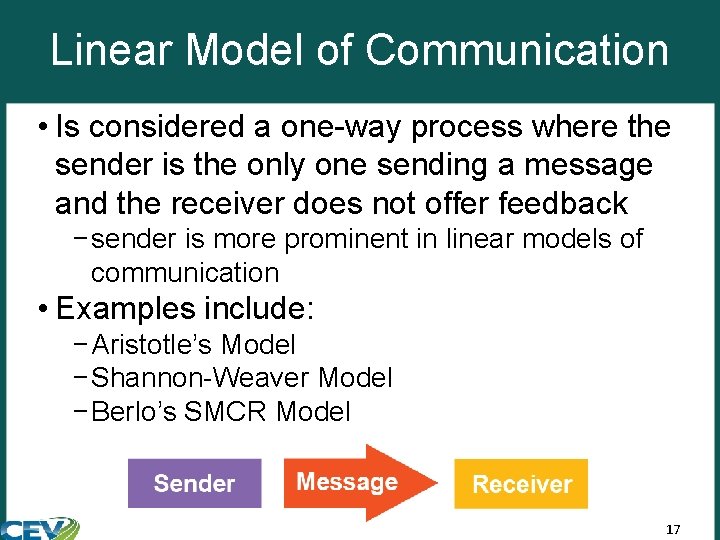
Linear Model of Communication • Is considered a one-way process where the sender is the only one sending a message and the receiver does not offer feedback − sender is more prominent in linear models of communication • Examples include: − Aristotle’s Model − Shannon-Weaver Model − Berlo’s SMCR Model 17
Aristotle’s Model of Communication • Is the model used in public speaking, persuasion and propaganda • Focuses on the speaker and the message or speech − is a speaker centered model as the speaker has the most important role and is the only one who is active while the audience is passive and influenced by the speech 18
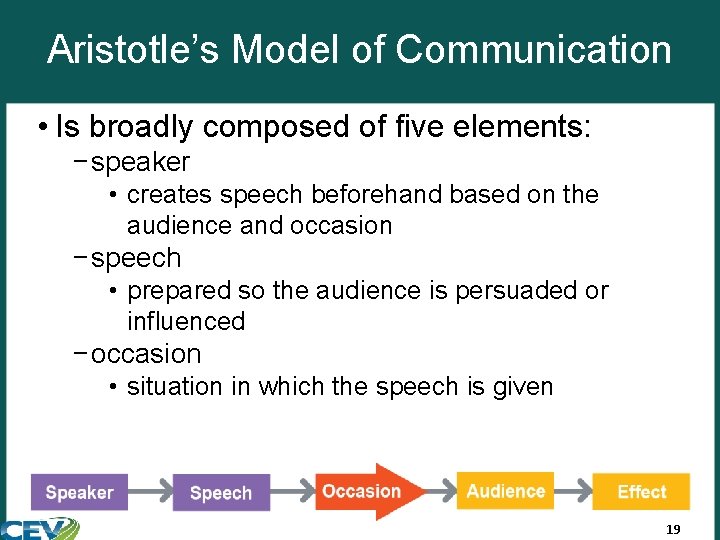
Aristotle’s Model of Communication • Is broadly composed of five elements: − speaker • creates speech beforehand based on the audience and occasion − speech • prepared so the audience is persuaded or influenced − occasion • situation in which the speech is given 19
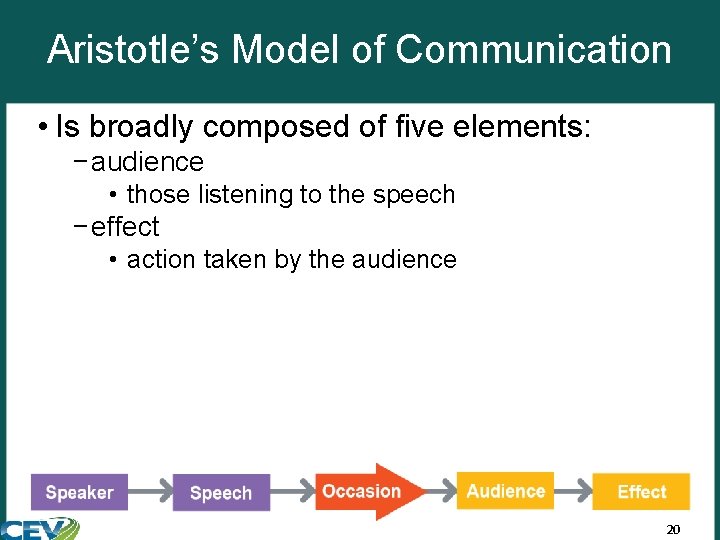
Aristotle’s Model of Communication • Is broadly composed of five elements: − audience • those listening to the speech − effect • action taken by the audience 20
Shannon-Weaver Model of Communication • Is based on the following elements: − information source • sender which produces the message − transmitter • encodes messages into signals − channel • method of getting the message to the receiver − noise • physical interference such as loud noises 21
Shannon-Weaver Model of Communication • Is based on the following elements: − reception • reception of the message to be decoded − destination • location or person where the signal arrives − feedback • response of the receiver 22
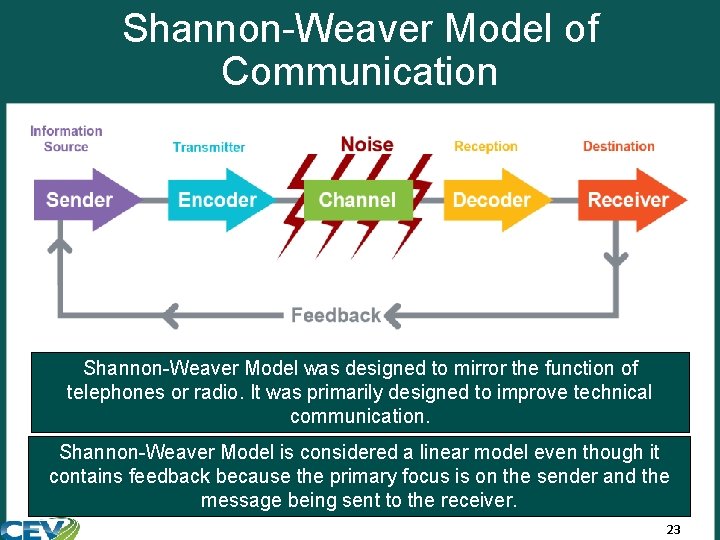
Shannon-Weaver Model of Communication Shannon-Weaver Model was designed to mirror the function of telephones or radio. It was primarily designed to improve technical communication. Shannon-Weaver Model is considered a linear model even though it contains feedback because the primary focus is on the sender and the message being sent to the receiver. 23
Berlo’s SMCR (Sender-Message-Channel. Receiver) Model of Communication • Was developed from the Shannon-Weaver Model • Follows the process of a source encoding a message for a channel to a receiver who decodes the message • Describes factors impacting the individual components in communication as well as encoding and decoding • Does not take into account noise or barriers to communication or feedback 24
Berlo’s SMCR Model of Communication • Has four main components: − sender (S) • source of the message − message (M) • substance/information being sent by sender − channel (C) • medium used to send the message − receiver (R) • person/group who receives the message • Depicts how each component is affected by different factors 25
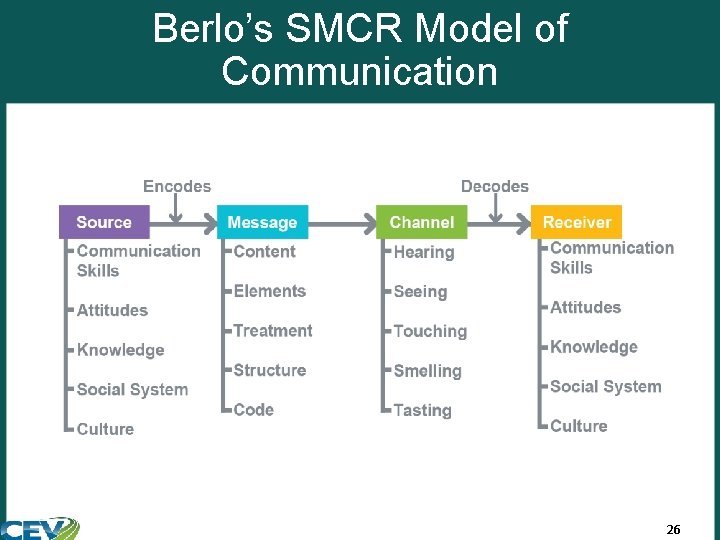
Berlo’s SMCR Model of Communication 26
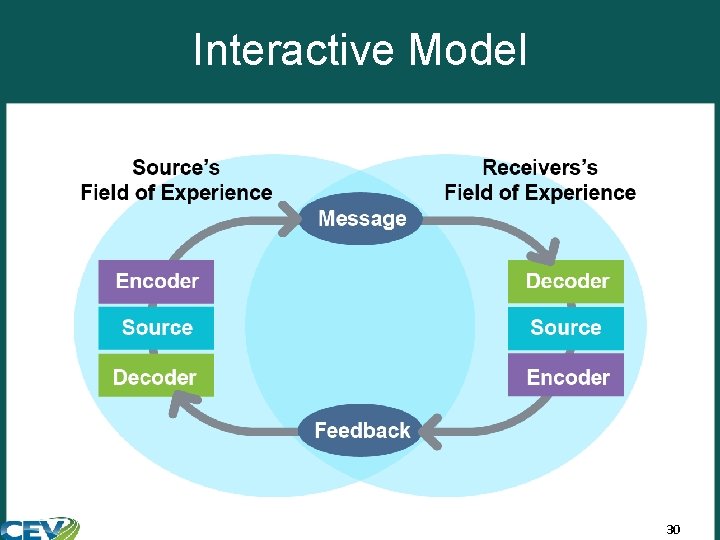
Interactive Model • Is also known as the Convergence Model of Communication • Depicts the exchange of ideas and messages taking place both from the sender to the receiver and vice versa, but not as a simultaneous process • Can be applied to the communication process which takes place between humans and machines − for example, this model can be applied to technologies like the Internet 27
Interactive Model • Includes the following components: − encoder-source-decoder • person who originates the message is the source and will also have the role of encoder and decoder; second source will also have the role of encoder and decoder − first source acts as an encoder while sending the message and as a decoder when receiving a message − second source acts as a decoder when receiving the message and then as an encoder when sending feedback 28
Interactive Model • Includes the following components: − message • information sent − feedback • response to the information sent − field of experience • experience and knowledge a source possesses which impacts the message formation and interpretation − culture, social behavior, education level, etc. 29
Interactive Model 30
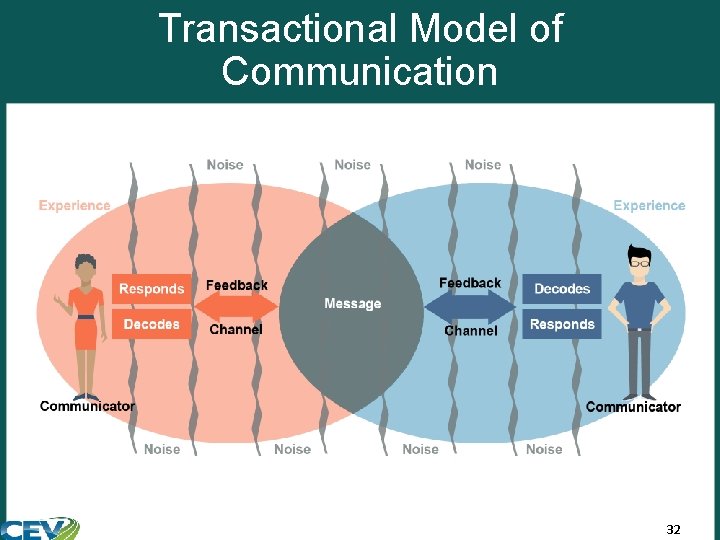
Transactional Model of Communication • Is the exchange of messages between the sender and receiver where each takes turns to send or receive messages − in this model, communication is a simultaneous process where both the sender and receiver are communicators and their role reverses each time in the communication process as both processes occur at the same time • Is most commonly used in interpersonal communication 31
Transactional Model of Communication 32
Transactional Model of Communication • Takes into account a communicator’s environment − physical location, personal experiences and cultural backgrounds of the communicator • Examines how the channel chosen can impact the meaning of a message • Includes any noise which can interfere with communication 33
Transactional Model of Communication • Contains an overlap between each communicator − this is representative of similarities in the communicators and can show communication can be more difficult when communicators have less in common 34
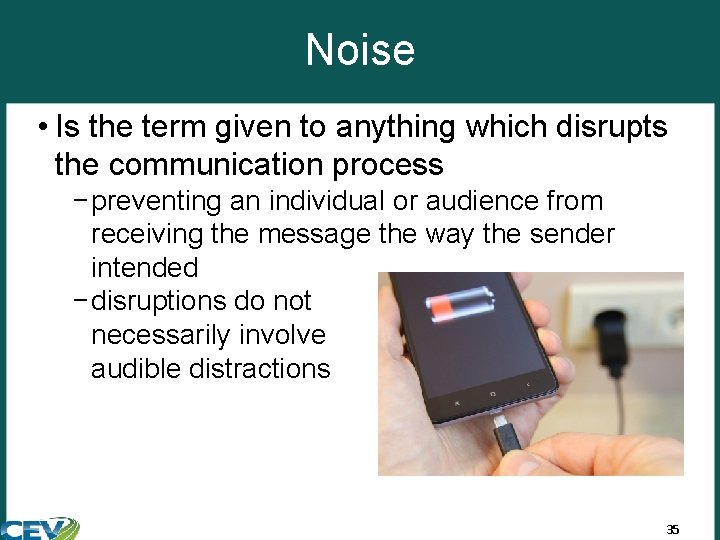
Noise • Is the term given to anything which disrupts the communication process − preventing an individual or audience from receiving the message the way the sender intended − disruptions do not necessarily involve audible distractions 35
Noise • Can be: − external noise: • physical noises or barriers (loud sounds) − physiological noise: • biological noise factors (illness, tiredness, etc. ) − psychological noise: • internal forces which interfere (personal feelings, unwillingness to listen) 36
Communication Styles • Refer to the way a message is conveyed − whether communicating through speech or another method, the style impacts how much of what is “said” will be understood and accepted • Include the following: − assertive − aggressive − passive-aggressive 38
Assertive Communication • Is characterized by trying to reach a mutually agreed upon solution • Usually involves a familiar way of expression and communication − this is typically described as how people normally communicate • Provides the healthiest and most effective style of communication − by creating an atmosphere where others can express themselves and reach a common solution 39
Assertive Communication Example • • • Salesman: I would like to show you some of our products. Person: No thank you, I'm not interested. Salesman: We really have a great range to offer you. Person: That may be true, but I'm not interested at the moment. Salesman: Is there someone else here who would be interested? Person: I don't want any of these products. Salesman: Okay, would you take this brochure and think about it? Person: Yes, I will take a brochure. Salesman: Thank you. Person: You're welcome. 40
Assertive Communication • Can also be referred to as a “broken record” since the salesman in the example continues to ask the same question repeatedly − two parties communicated what they wanted and in the end achieved the goal of the salesman by having the person take a brochure 41
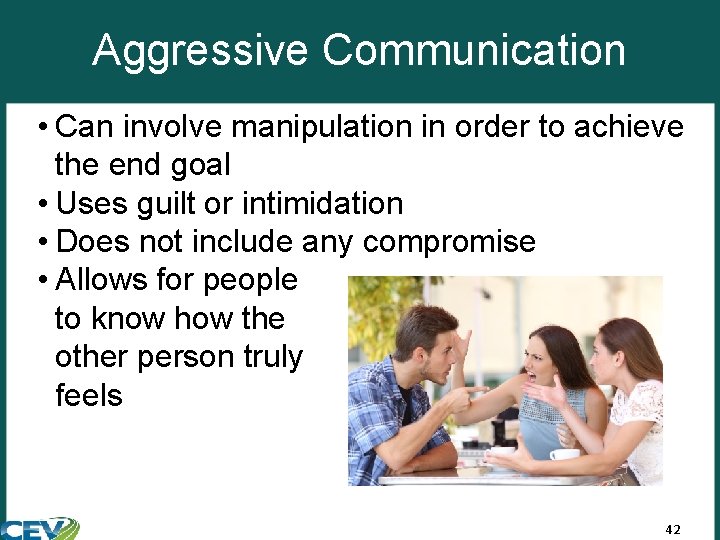
Aggressive Communication • Can involve manipulation in order to achieve the end goal • Uses guilt or intimidation • Does not include any compromise • Allows for people to know how the other person truly feels 42
Aggressive Communication Example • I feel frustrated when you are late to meetings, I don’t like having to repeat the information − this example provides feedback and allows the other person to know when they arrive late they are interrupting the meeting • allows for the other person to know how the speaker is feeling − the person being told the information knows exactly what needs to be done in order to fix the problem without being able to compromise on the solution 43
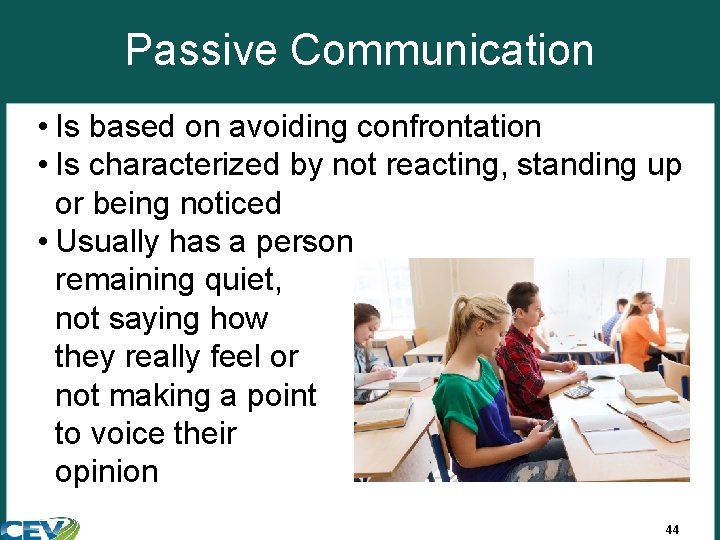
Passive Communication • Is based on avoiding confrontation • Is characterized by not reacting, standing up or being noticed • Usually has a person remaining quiet, not saying how they really feel or not making a point to voice their opinion 44
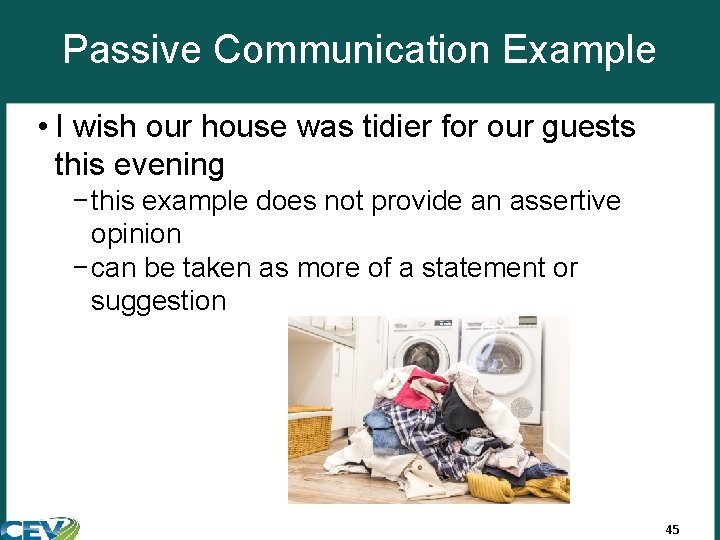
Passive Communication Example • I wish our house was tidier for our guests this evening − this example does not provide an assertive opinion − can be taken as more of a statement or suggestion 45
Passive-Aggressive Communication • Is a combination of passive communication and aggressive communication • Includes the desire to avoid conflicts but still tries to manipulate the situation so the outcome is in their favor • Is the most commonly seen style 46
Passive-Aggressive Communication Example • Samantha and her friend were going to watch a movie but instead the friend cancels to hang out with her boyfriend; when the friend asks the Samantha what is wrong, she simply replies, “Nothing, ” when in all reality there is clearly something upsetting her 47
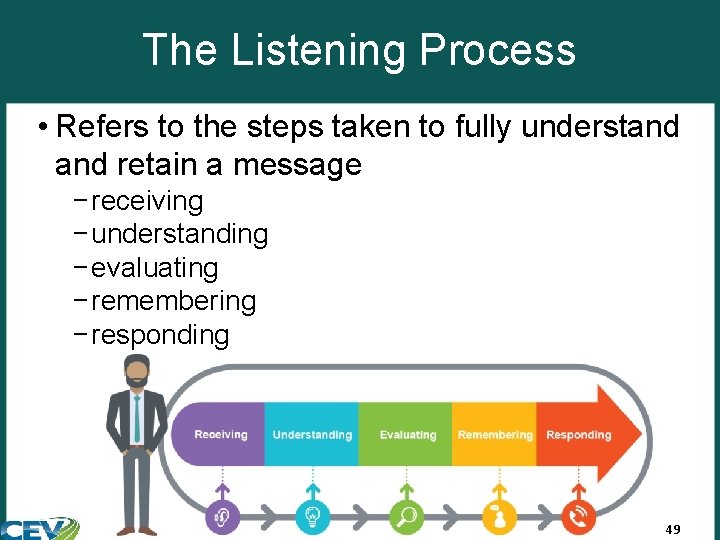
The Listening Process • Refers to the steps taken to fully understand retain a message − receiving − understanding − evaluating − remembering − responding 49
Receiving • Involves hearing and attending − hearing is the ability to register sound waves as they hit the eardrum − attending is the process of identifying and interpreting particular sounds as words The sounds we hear have no meaning until we place them in the proper context. 50
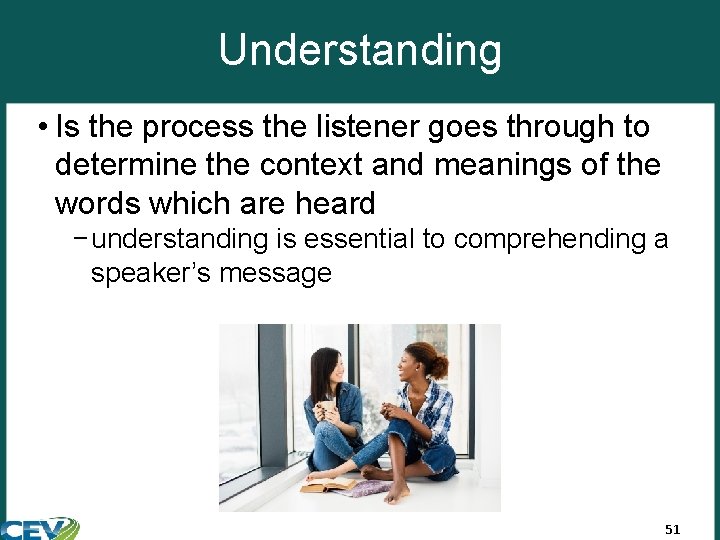
Understanding • Is the process the listener goes through to determine the context and meanings of the words which are heard − understanding is essential to comprehending a speaker’s message 51
Evaluating • Is the process the listener takes to assess the information received from the speaker − this stage is only effective once the listener fully understands what the speaker is trying to say • Allows a listener to form an opinion on what was heard − evaluating is important for a listener in terms of forming personal ideas, decisions, actions and/or beliefs 52
Remembering • Occurs as the listener categorizes and retains the information gathered from the speaker • Allows individuals to record information about individuals, objects and events for later recall − this occurs during and after a speaker’s delivery 53
Responding • Is the stage when the listener provides verbal and/or non-verbal reactions to a message − non-verbal reactions include nodding, making eye contact, smiling and other body language − verbal reactions include asking a question, requesting additional information and repeating what a speaker has said 54
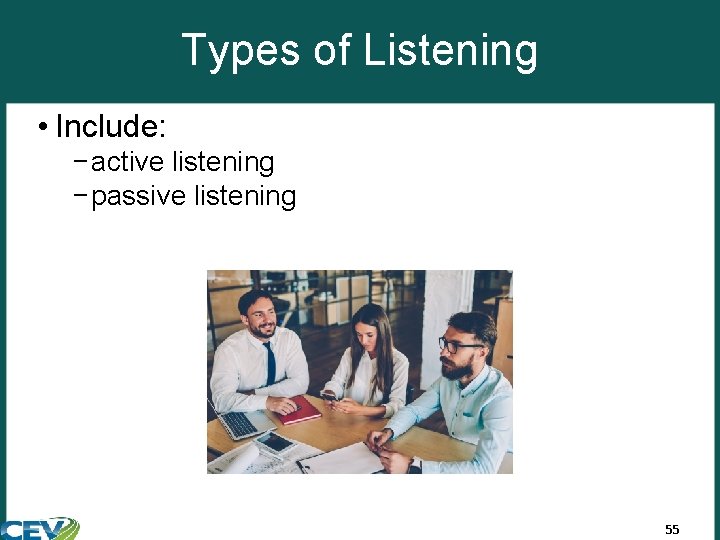
Types of Listening • Include: − active listening − passive listening 55
Active Listening • Requires retaining and applying information • Typically occurs in more formal settings − such as in an office or school • Involves the listener providing feedback to the speaker according to the information received − restating or paraphrasing what was heard 56
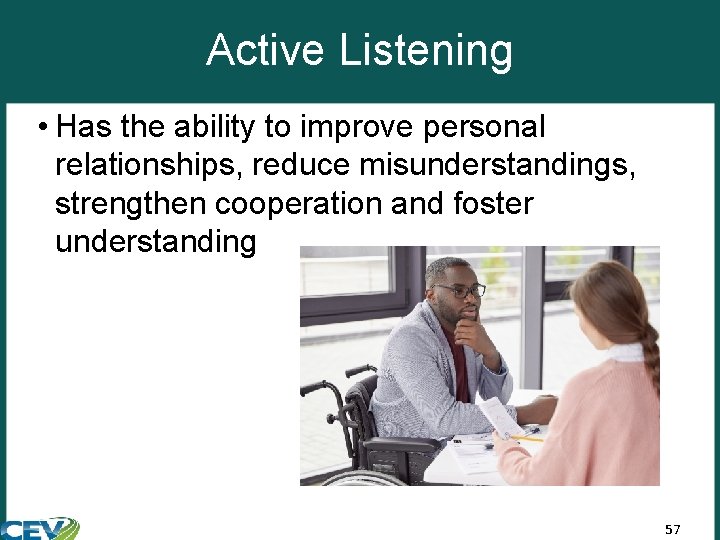
Active Listening • Has the ability to improve personal relationships, reduce misunderstandings, strengthen cooperation and foster understanding 57
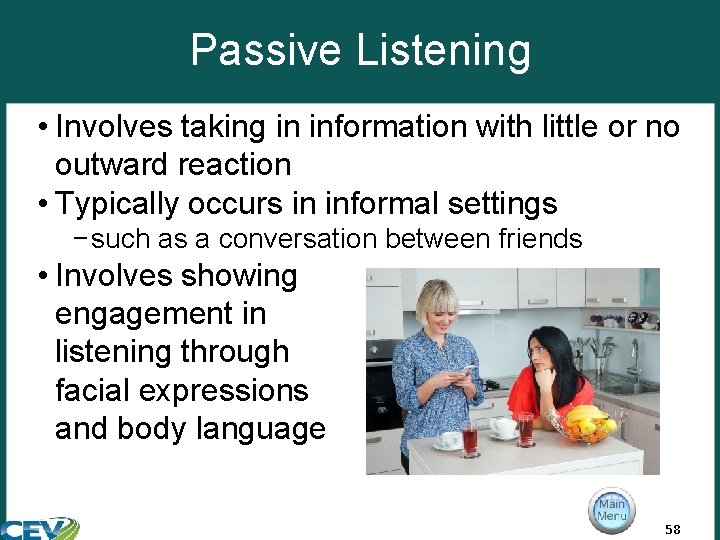
Passive Listening • Involves taking in information with little or no outward reaction • Typically occurs in informal settings − such as a conversation between friends • Involves showing engagement in listening through facial expressions and body language 58
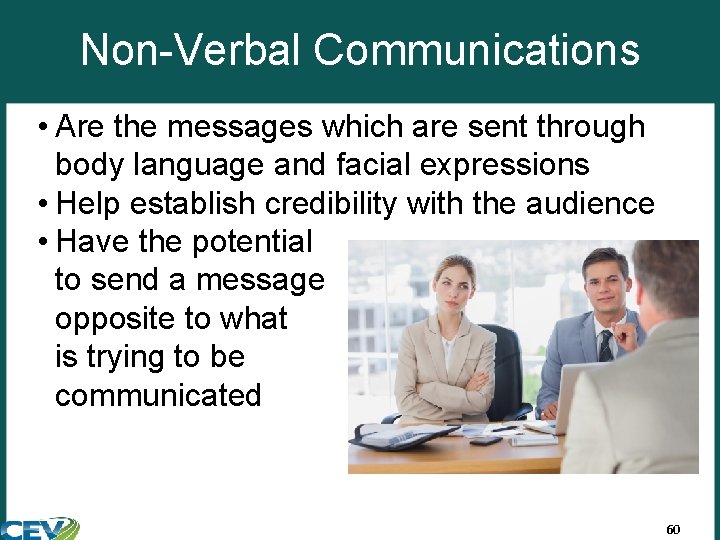
Non-Verbal Communications • Are the messages which are sent through body language and facial expressions • Help establish credibility with the audience • Have the potential to send a message opposite to what is trying to be communicated 60
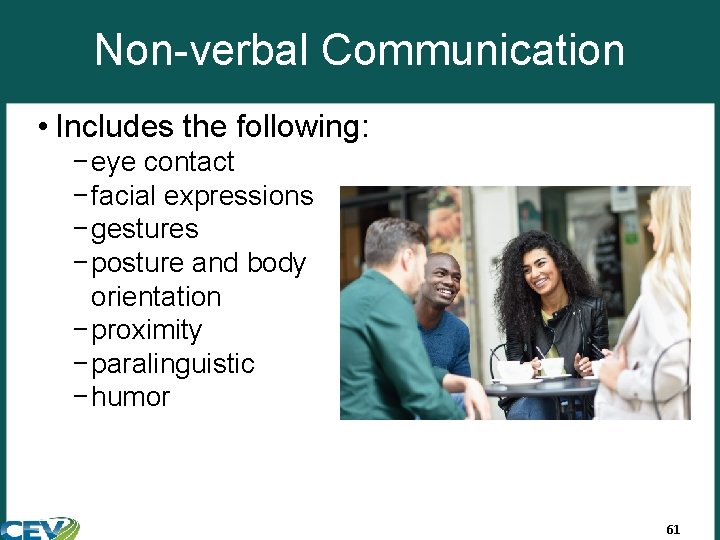
Non-verbal Communication • Includes the following: − eye contact − facial expressions − gestures − posture and body orientation − proximity − paralinguistic − humor 61
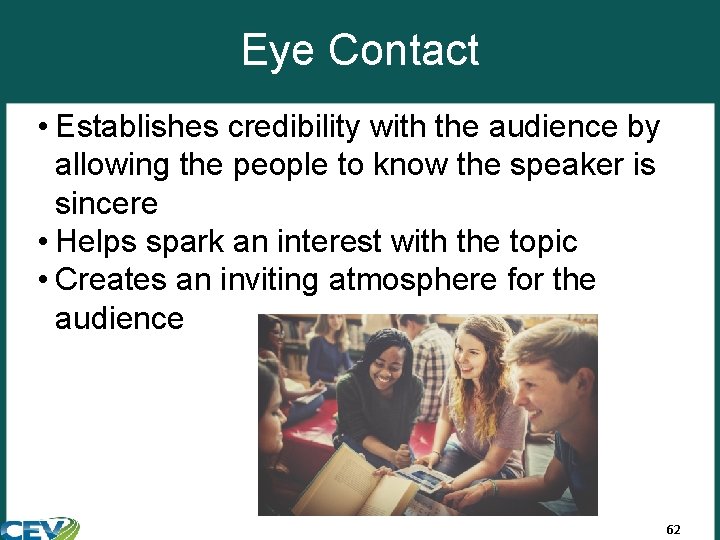
Eye Contact • Establishes credibility with the audience by allowing the people to know the speaker is sincere • Helps spark an interest with the topic • Creates an inviting atmosphere for the audience 62
Facial Expressions • Set the tone for the conversation − a simple smile can send a message which is inviting and happy to the audience • Can provide feedback on the information being communicated − a look of confusion during a conversation can help the speaker realize they need to go back and explain the information further and clarify any questions 63
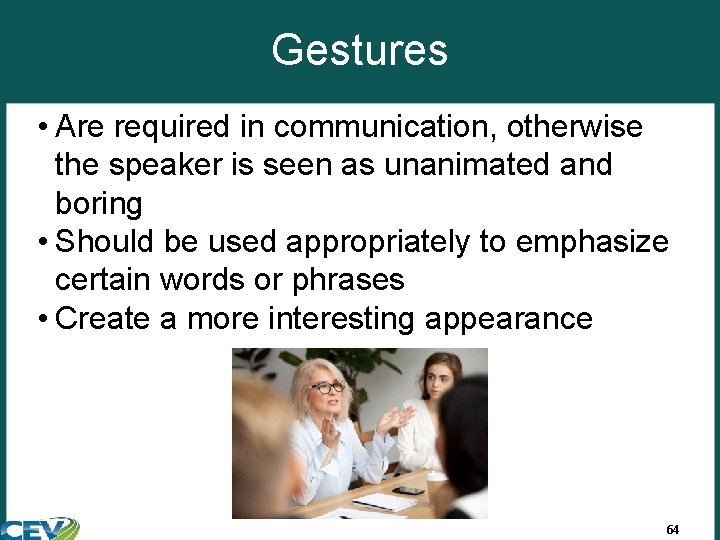
Gestures • Are required in communication, otherwise the speaker is seen as unanimated and boring • Should be used appropriately to emphasize certain words or phrases • Create a more interesting appearance 64
Posture & Body Orientation • Can communicate countless messages by simply walking, talking, standing or sitting • Should be presented where the speaker appears approachable and friendly rather than distant or rude • Can be distracting if the speaker sways back and forth or is constantly pacing the stage Using open body language, such as uncrossed arms and legs, sends the message of being more positive and open to the message. 65
Proximity • Is the distance from where the speaker is to the audience • Differs from culture to culture • Should be close enough for the audience to maintain attention, but far enough to not invade the audience’s space 66
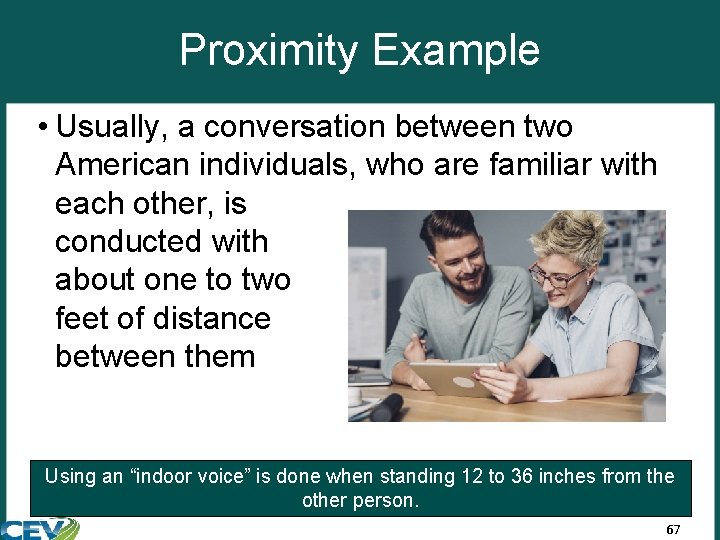
Proximity Example • Usually, a conversation between two American individuals, who are familiar with each other, is conducted with about one to two feet of distance between them Using an “indoor voice” is done when standing 12 to 36 inches from the other person. 67
Paralinguistics • Consists of tone, pitch, rhythm, loudness and inflection of voice • Requires practice to reach the correct volume, tone or pitch for a presentation − each presentation style will vary − finding the appropriate tone, pitch, rhythm, volume and inflection is key − can be used to convey emotion The most common mistake for most people is being monotone. 68
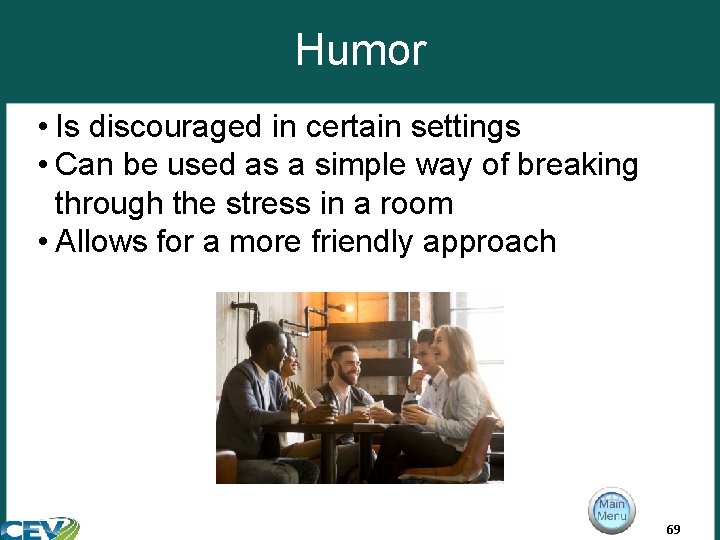
Humor • Is discouraged in certain settings • Can be used as a simple way of breaking through the stress in a room • Allows for a more friendly approach 69
Professional Communication • Refers to the methods used to convey information in the workplace − effective professional communication is critical in the workplace to ensure the flow of ideas, facts, decisions and advice • Involves: − communication between co-workers, colleagues, clients and/or professional contacts − professional speeches or presentations 71
Tips for Communication in the Workplace • Includes: − listening • actively listen to those who are speaking − paying attention to body language • take in and respond to non-verbal cues − considering communication preference • e-mail may be a great way to communicate with one co-worker but another may prefer face-toface communication − keeping tone in mind • make sure language is clear and cannot be misconstrued • do not let anger show in communication 72
Tips for Communication in the Workplace • Includes: − not being too casual • keep communication professional, being too casual can make others uncomfortable − checking grammar, spelling and punctuation • proofread everything which is written − keeping criticism constructive and positive • make sure comments are not emotional; provide positive reinforcement 73
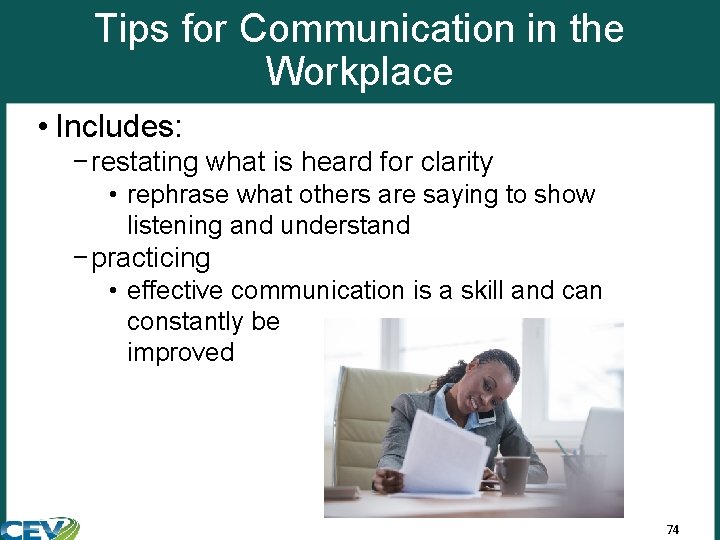
Tips for Communication in the Workplace • Includes: − restating what is heard for clarity • rephrase what others are saying to show listening and understand − practicing • effective communication is a skill and can constantly be improved 74
Professional Speeches & Presentations • Are another type of professional communication • Can be developed by following these steps: − preparation • audience identification • topic selection • writing − speaking or presenting 75
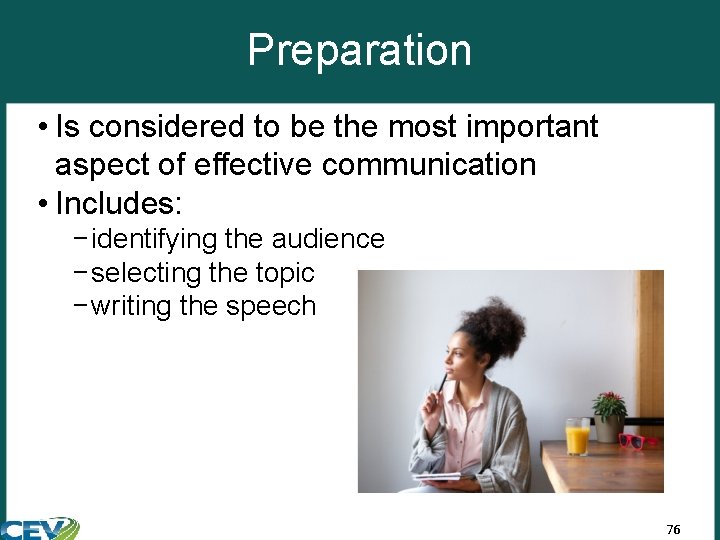
Preparation • Is considered to be the most important aspect of effective communication • Includes: − identifying the audience − selecting the topic − writing the speech 76
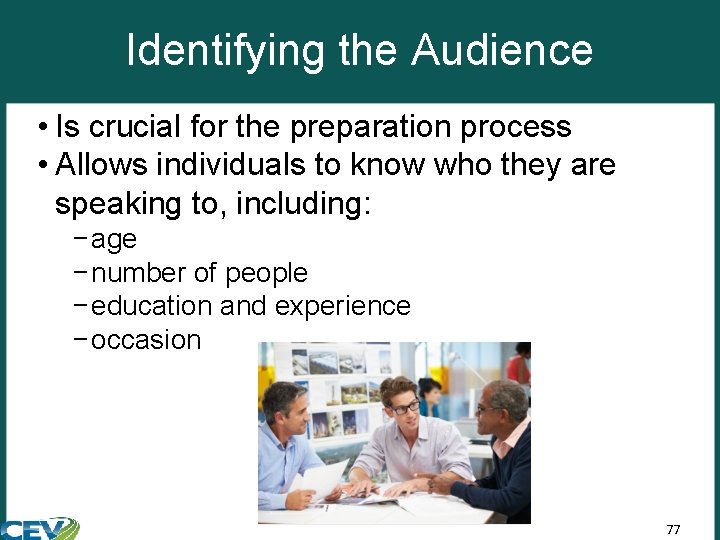
Identifying the Audience • Is crucial for the preparation process • Allows individuals to know who they are speaking to, including: − age − number of people − education and experience − occasion 77
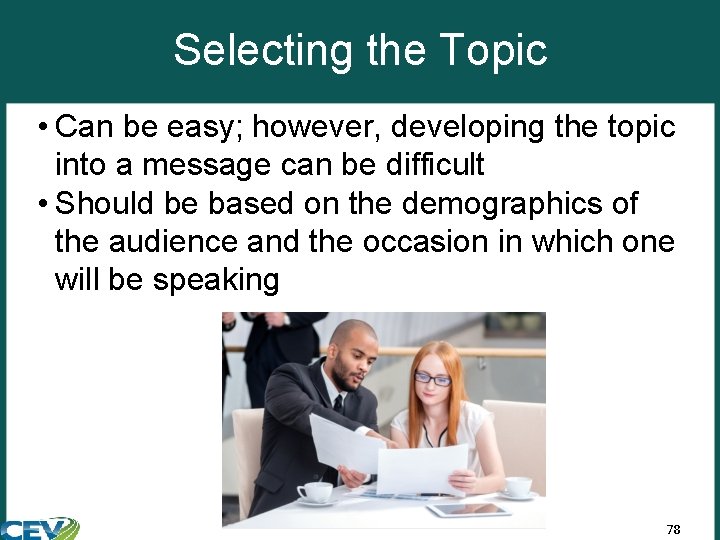
Selecting the Topic • Can be easy; however, developing the topic into a message can be difficult • Should be based on the demographics of the audience and the occasion in which one will be speaking 78
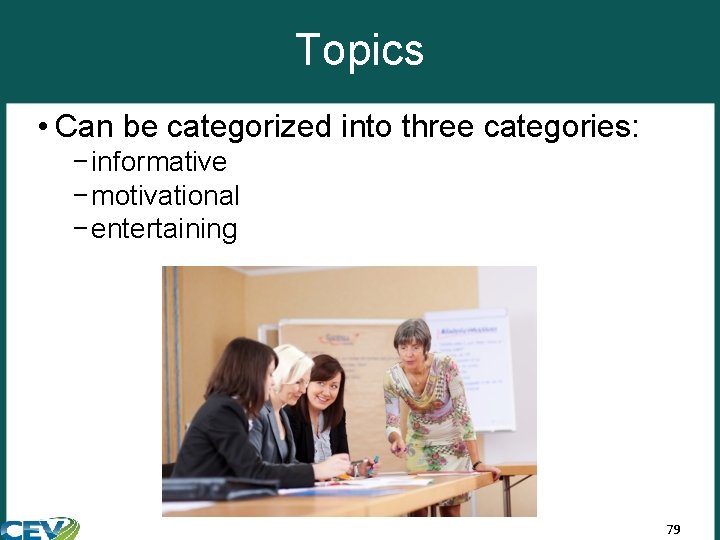
Topics • Can be categorized into three categories: − informative − motivational − entertaining 79
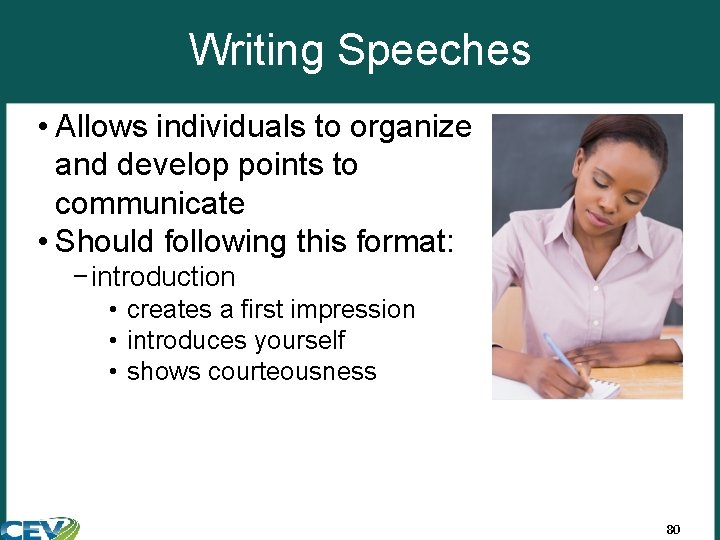
Writing Speeches • Allows individuals to organize and develop points to communicate • Should following this format: − introduction • creates a first impression • introduces yourself • shows courteousness 80
Writing Speeches • Should following this format: − body • largest portion of the speech • provides main points • supports evidence − conclusion • review of main points • instructs audience the speech is ending 81
Organizing Information • Provides a reasonable thought process of how and when information should be communicated − allows for the information to be easily understood − can be done utilizing various techniques, such as: • outlines • diagrams • flow charts 82
Organizing Information • Is important because it allows for: − recognizing and retaining information more effectively − communicating information efficiently − disregarding useless and unimportant information − identifying patterns and relating unlike information into knowledge 83
Organizing Information • Helps in establishing the goal for the communication − whether it requires persuading or informing another • Assists in ordering thoughts logically in sentences 84
Tips for Speeches & Presentations • Make sure the content matches the audience • Practice and rehearse − record the presentation so analyzing the techniques used can be accomplished • Speak with conviction • Maintain sincere eye contact • Use effective body language • Utilize pauses to emphasize points • Relax 85
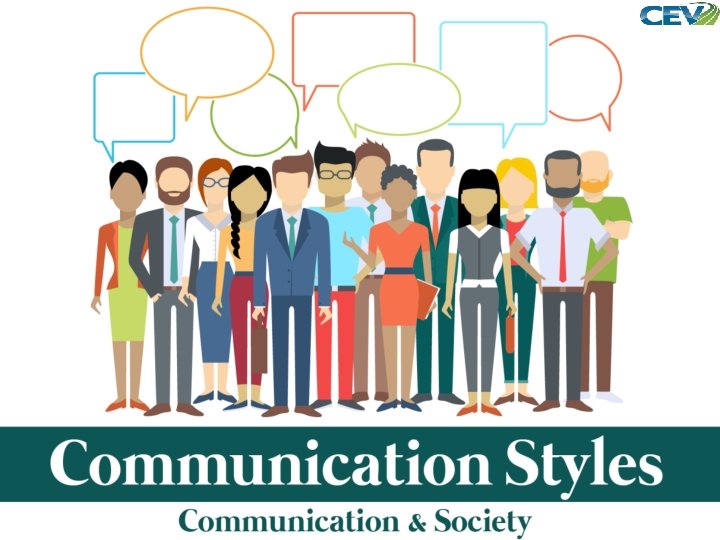
Impact of Communication on Society • Bridges a gap between cultures and communities • Creates and shares meanings through words, customs or dress • Is the common denominator which can bring people together 87
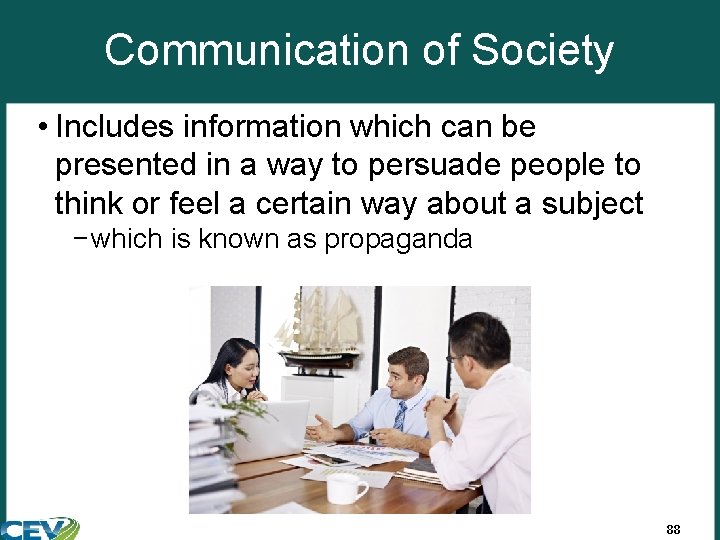
Communication of Society • Includes information which can be presented in a way to persuade people to think or feel a certain way about a subject − which is known as propaganda 88
Propaganda • Can be used to damage the opposing cause • Can be used to influence attitudes toward a product, idea or issue • Encourages people to think or act in some way because other people are doing so 89
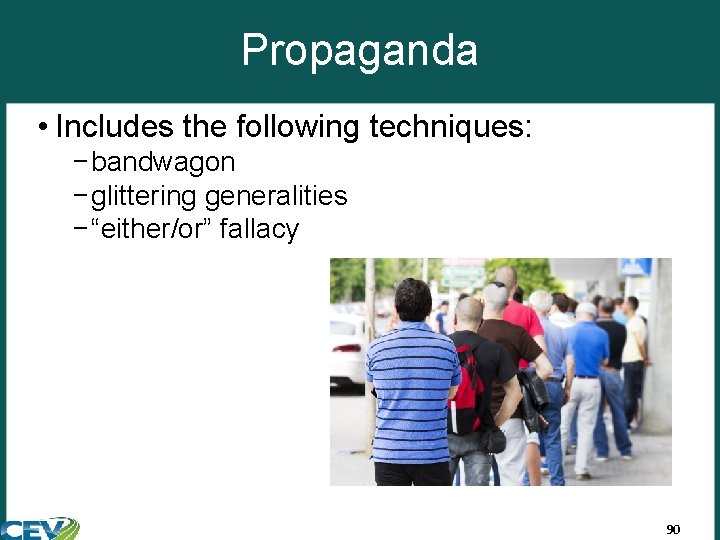
Propaganda • Includes the following techniques: − bandwagon − glittering generalities − “either/or” fallacy 90
Bandwagon • Is the approach encouraging someone to believe, because everyone else is doing something, they should too, and if they do not, they will be left out • Is the most commonly used technique • Usually referred to as “Keeping up with the Joneses” was created by Arthur “Pop” Momand in 1913 as a comic strip for U. S. Newspapers. 91
Glittering Generalities • Are characterized by using important sounding words in a general statement, which has no true meaning and cannot be proved or disproved • Common words used are: “good, ” “fair” and “best” 92
Glittering Generalities • Include the use of assumptions − information which is accepted as truth without having proof − for example: • if a doctor is giving a speech about health, you assume the doctor knows what he or she is talking about • Are based on misinformation, obsolete data or beliefs 93

Glittering Generalities Example • Pure, fresh mountain spring water; bottled just for you in Colorado from only our purest springs 94
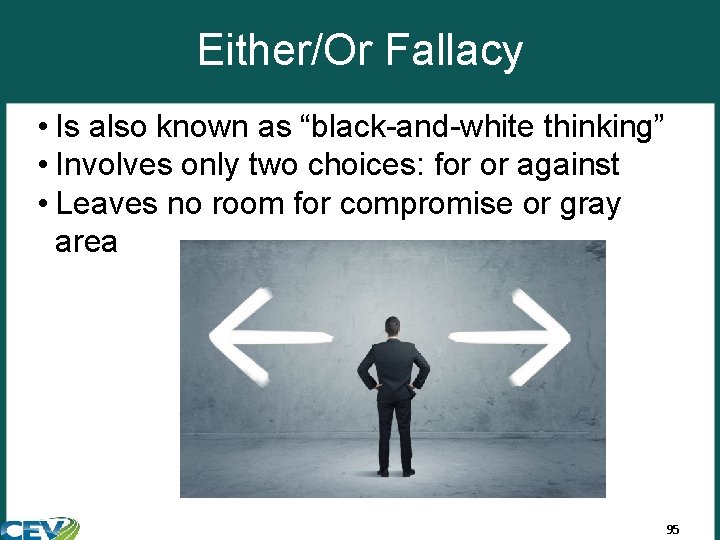
Either/Or Fallacy • Is also known as “black-and-white thinking” • Involves only two choices: for or against • Leaves no room for compromise or gray area 95
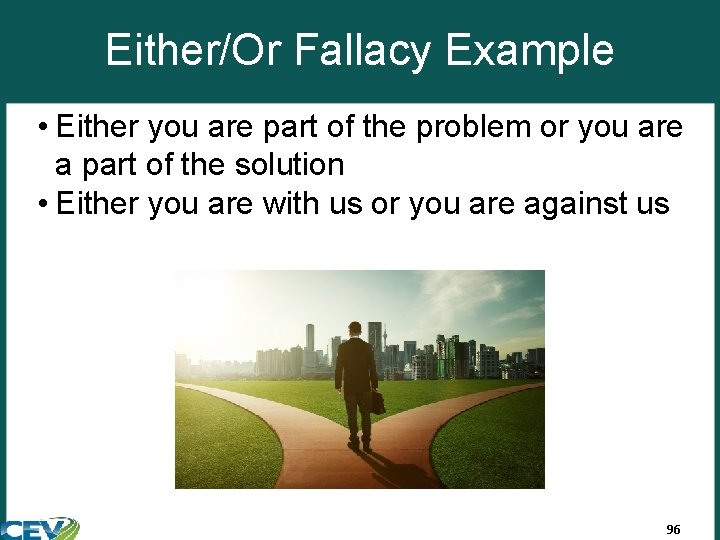
Either/Or Fallacy Example • Either you are part of the problem or you are a part of the solution • Either you are with us or you are against us 96
Identifying the Purpose • In communication is important in order to decide what approach and structure appropriate to use • Requires the speaker to: − know their audience − understand their topic − realize the goal of their communication 97
Communication Mistakes • Are very common • Include: − being poorly prepared − speaking in a manner which is not easily understood • talking too fast • taking too soft • using too many fillers such as um, eh or well − avoiding eye contact 98
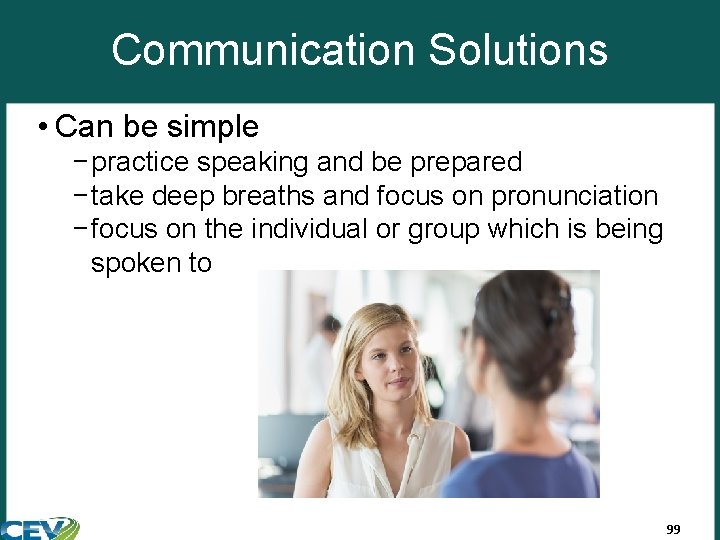
Communication Solutions • Can be simple − practice speaking and be prepared − take deep breaths and focus on pronunciation − focus on the individual or group which is being spoken to 99
Outcomes • Are the observable end result • Are based on communication goals • Can be measured by: − testing audience understanding • question and answer • quality measures − focus groups, interviews, open-ended survey question • Can be unanticipated − based on what the audience finds most important 100
Key Economic Factors Influencing the Communication Industry • Include: − stage of economic development − standard of living − per capita income − distribution of wealth − currency stability − exchange rates 101
Resources • Adler, R. B. , Rosenfeld, L. B. , & Proctor, Russell, F. (2004). Interplay: The process of interpersonal communication (9 th ed. ). New York, NY: Oxford University Press. • “Communication Strategy”. Elway Research Inc. (2006). Retrieved from http: //www. elwayresearch. com • “Creating a Communicating Strategy That Works”. (2006) Natural Resource Center. Retrieved from http: //www. ccfbest. org • Fournier, Steve. (2010). “ A Brief History and Theory of Speaking”. Retrieved from http: //stevefournier 01. tripod. com • “The Information Universe”. (2003) Alverno College. Retrieved from http: //depts. alverno. edu • National Communication Association. “Communication and Society”. Retrieved from http: //www. natcom. org • “Recognizing Propaganda Techniques and Errors of Faulty Logic”. Cuesta College. (2003). Retrieved from http: //academic. cuesta. edu • Ritts, Stein “Six Ways to Improve Your Nonverbal Communication”. Retrieved from http: //honolulu. hawaii. edu 102
Acknowledgements Production Coordinators Mai Lee Holmes Amy Hogan Brand Manager Stevi Huffaker Director of Brand Management Megan O’Quinn Graphics Editor Megan O’Quinn V. P. of Brand Management Clayton Franklin Quality Control Director Angela Dehls Executive Producer Gordon W. Davis, Ph. D. © MMXVIII CEV Multimedia, Ltd. 103
- Slides: 103