
Objectives q Identify the domain and range of
* Objectives q Identify the domain and range of relations and functions. q Determine whether a relation is a function.
Vocabulary relation domain range function
A relation is a pairing of input values with output values. It can be shown as a set of ordered pairs (x, y), where x is an input and y is an output. The set of input values for a relation is called the domain, and the set of output values is called the range.
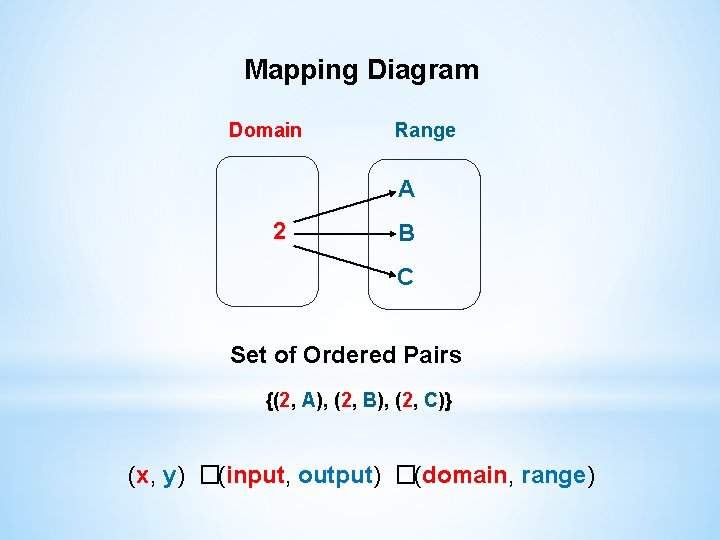
Mapping Diagram Domain Range A 2 B C Set of Ordered Pairs {(2, A), (2, B), (2, C)} (x, y) �(input, output) �(domain, range)
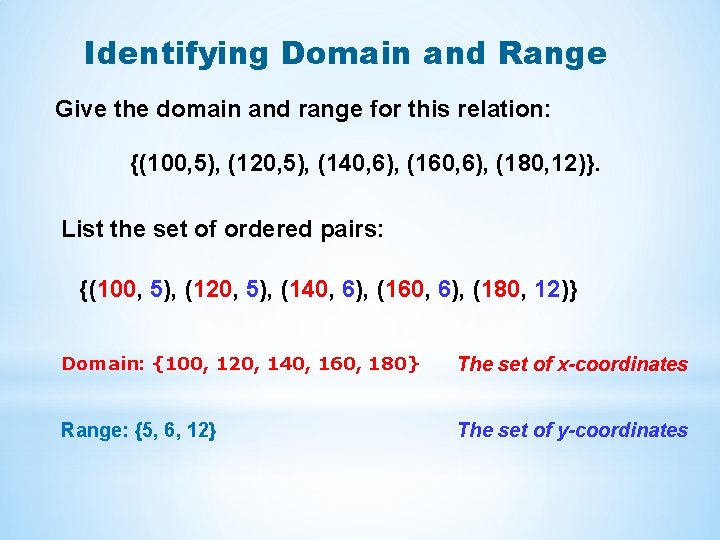
Identifying Domain and Range Give the domain and range for this relation: {(100, 5), (120, 5), (140, 6), (160, 6), (180, 12)}. List the set of ordered pairs: {(100, 5), (120, 5), (140, 6), (160, 6), (180, 12)} Domain: {100, 120, 140, 160, 180} The set of x-coordinates Range: {5, 6, 12} The set of y-coordinates
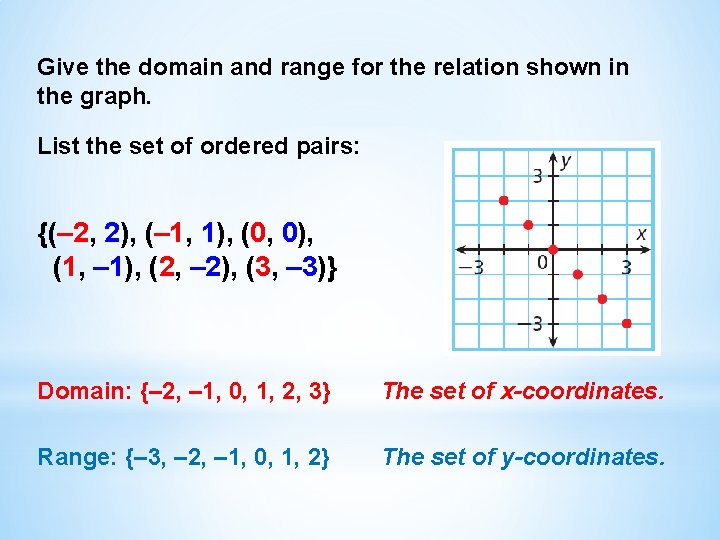
Give the domain and range for the relation shown in the graph. List the set of ordered pairs: {(– 2, 2), (– 1, 1), (0, 0), (1, – 1), (2, – 2), (3, – 3)} Domain: {– 2, – 1, 0, 1, 2, 3} The set of x-coordinates. Range: {– 3, – 2, – 1, 0, 1, 2} The set of y-coordinates.
Suppose you are told that a person entered a word into a text message using the numbers 6, 2, 8, and 4 on a cell phone. It would be difficult to determine the word without seeing it because each number can be used to enter three different letters.
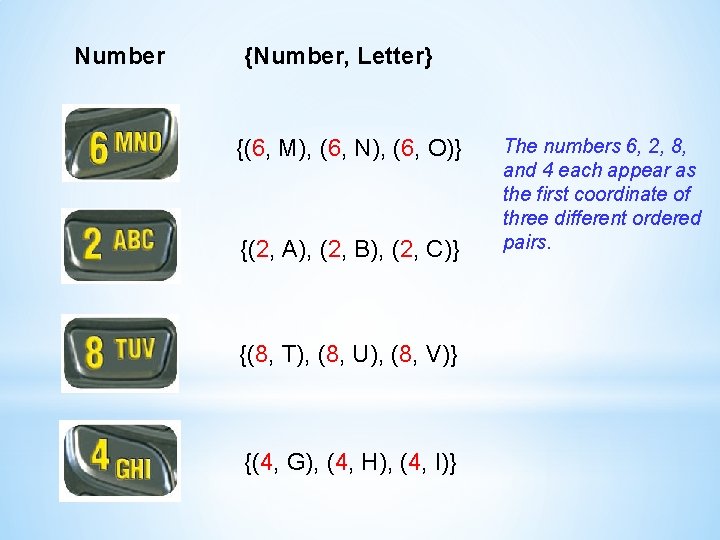
Number {Number, Letter} {(6, M), (6, N), (6, O)} {(2, A), (2, B), (2, C)} {(8, T), (8, U), (8, V)} {(4, G), (4, H), (4, I)} The numbers 6, 2, 8, and 4 each appear as the first coordinate of three different ordered pairs.
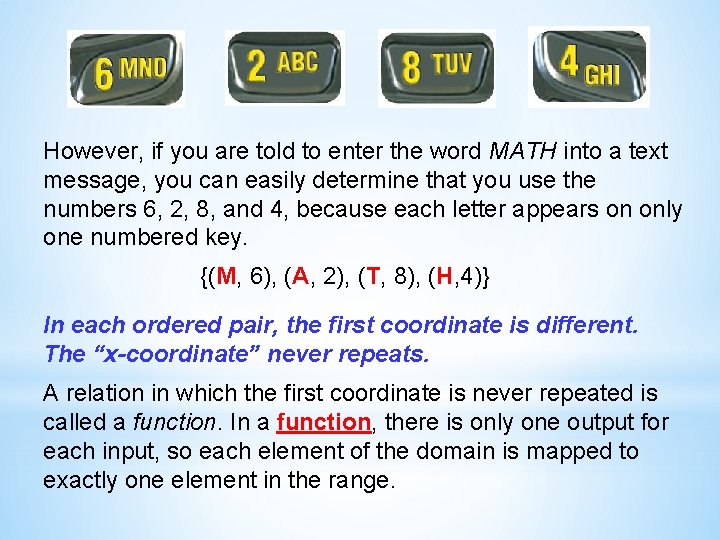
However, if you are told to enter the word MATH into a text message, you can easily determine that you use the numbers 6, 2, 8, and 4, because each letter appears on only one numbered key. {(M, 6), (A, 2), (T, 8), (H, 4)} In each ordered pair, the first coordinate is different. The “x-coordinate” never repeats. A relation in which the first coordinate is never repeated is called a function. In a function, there is only one output for each input, so each element of the domain is mapped to exactly one element in the range.
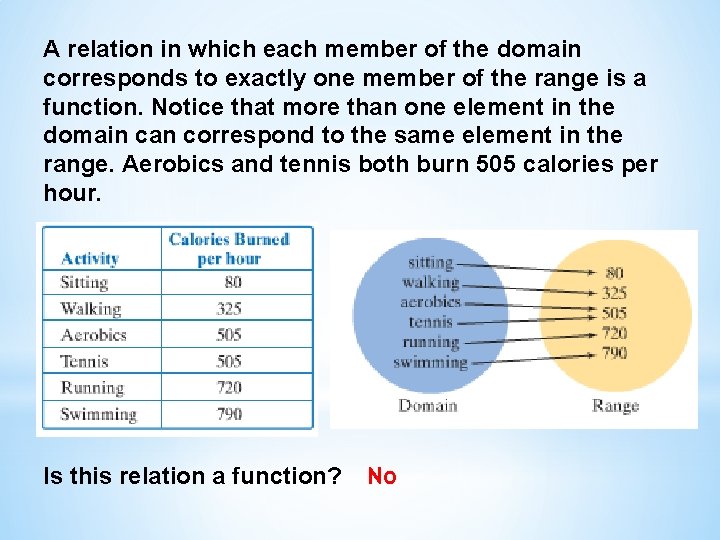
A relation in which each member of the domain corresponds to exactly one member of the range is a function. Notice that more than one element in the domain can correspond to the same element in the range. Aerobics and tennis both burn 505 calories per hour. Is this relation a function? No
Determine whether each relation is a function? {(1, 8), (2, 9), (3, 10)} Yes {(3, 4), (5, 6), (3, 7)} No {(2, 6), (3, 6), (4, 6)} Yes
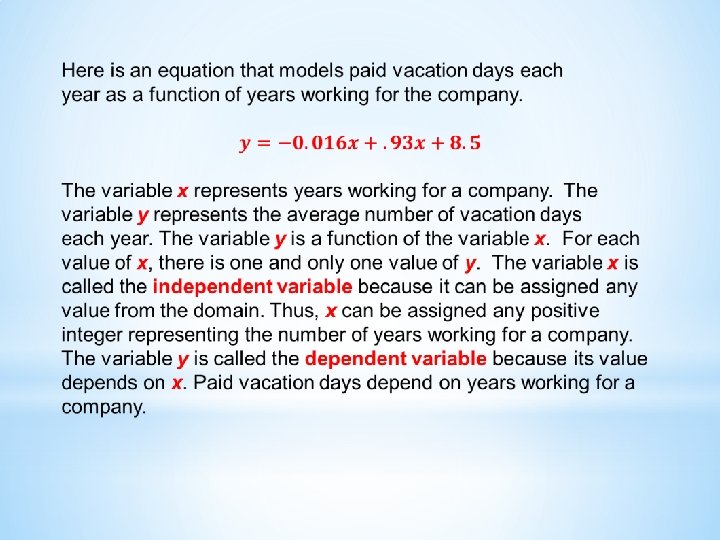
Functions as Equations
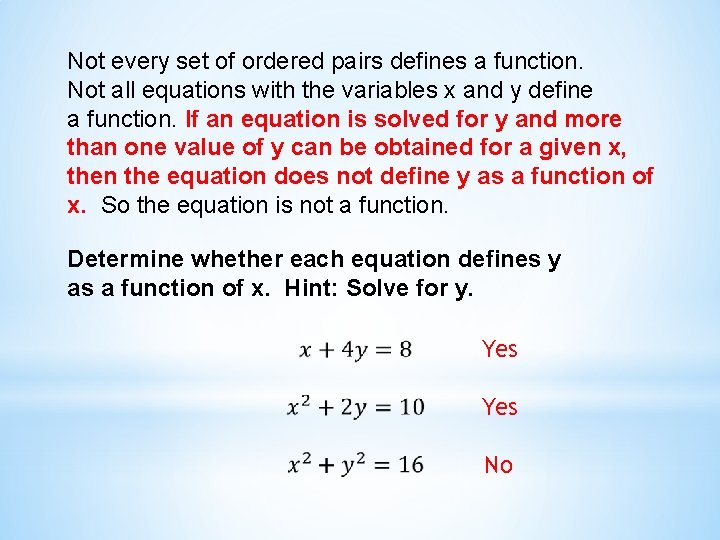
Not every set of ordered pairs defines a function. Not all equations with the variables x and y define a function. If an equation is solved for y and more than one value of y can be obtained for a given x, then the equation does not define y as a function of x. So the equation is not a function. Determine whether each equation defines y as a function of x. Hint: Solve for y. Yes No
Function Notation
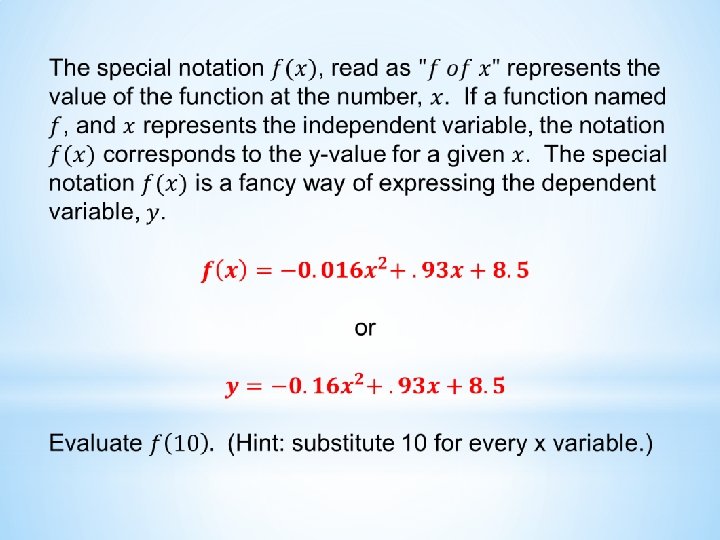

Graphing Calculator- evaluating a function .
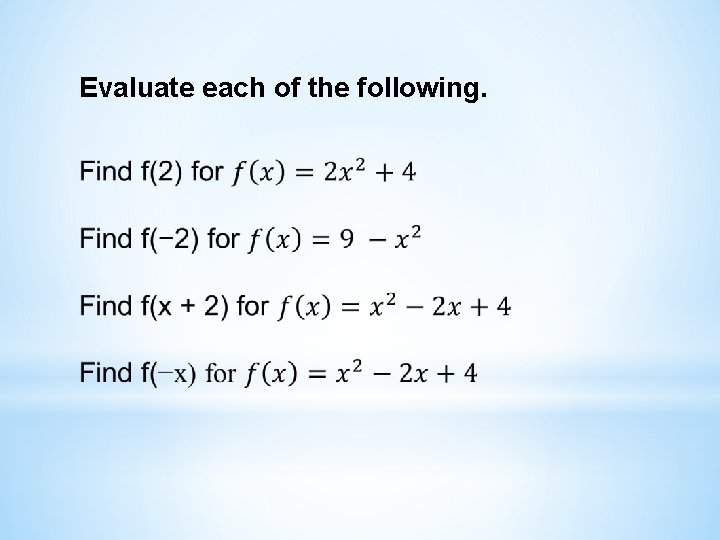
Evaluate each of the following.
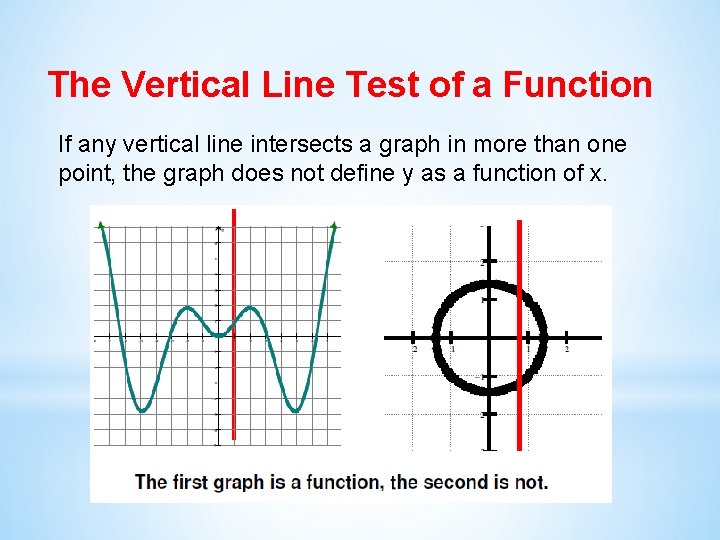
The Vertical Line Test of a Function If any vertical line intersects a graph in more than one point, the graph does not define y as a function of x.
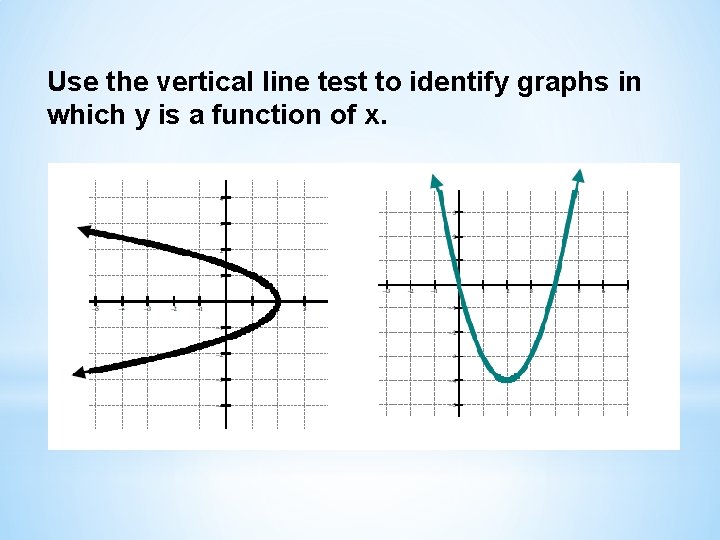
Use the vertical line test to identify graphs in which y is a function of x.
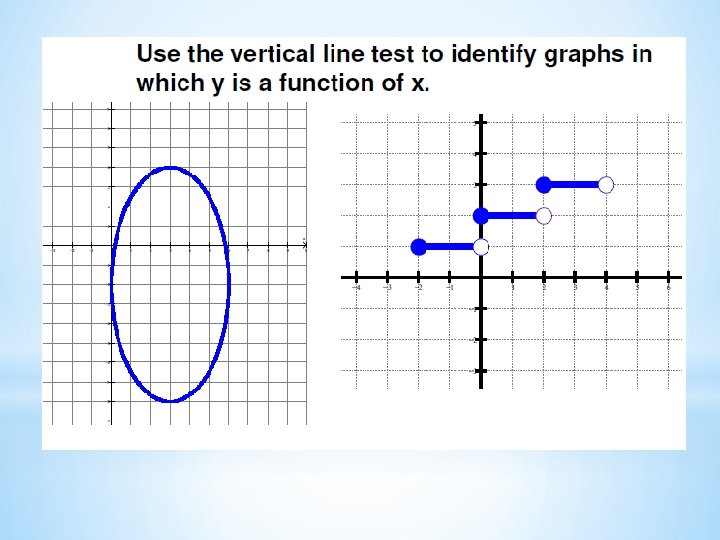
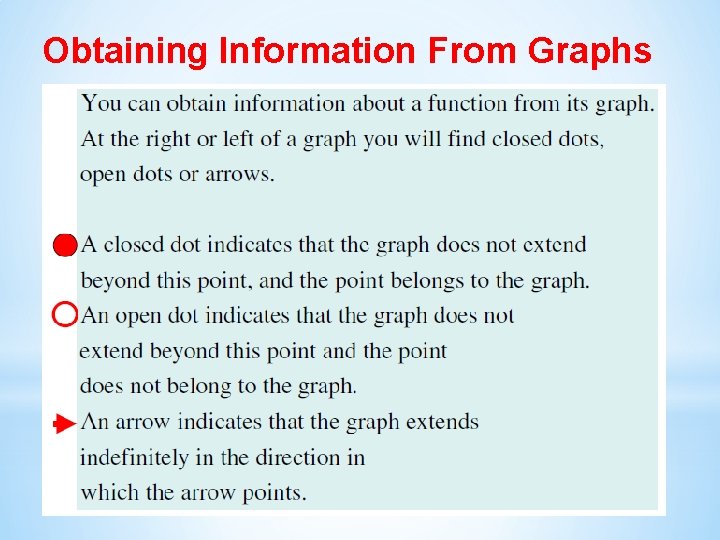
Obtaining Information From Graphs
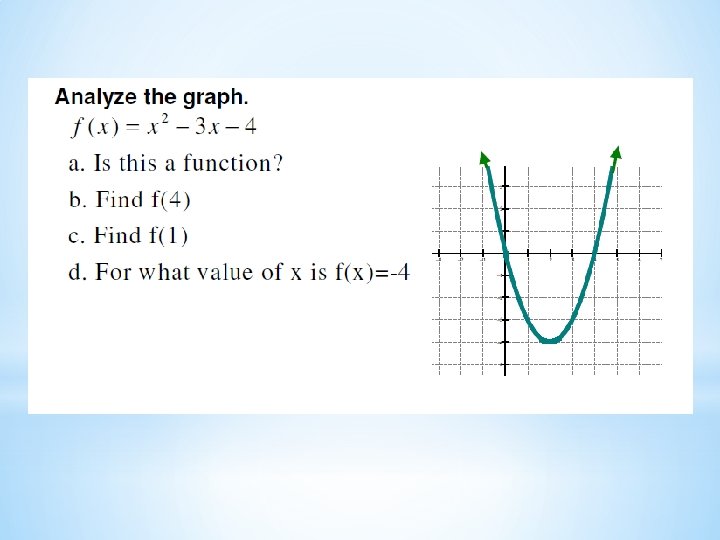

Identifying Domain and Range from a Function’s Graph Using Interval Notation Find the coordinates of the endpoints.
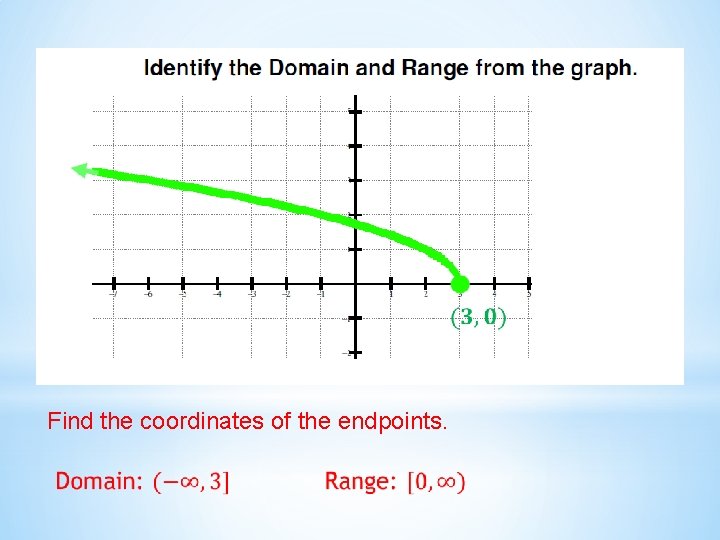
Find the coordinates of the endpoints.
![Find the coordinates of the endpoints. Range: (0, 2]](http://slidetodoc.com/presentation_image/28643fbb9f6a76e2968966680d4b0017/image-26.jpg "Find the coordinates of the endpoints. Range: (0, 2]")
Find the coordinates of the endpoints. Range: (0, 2]
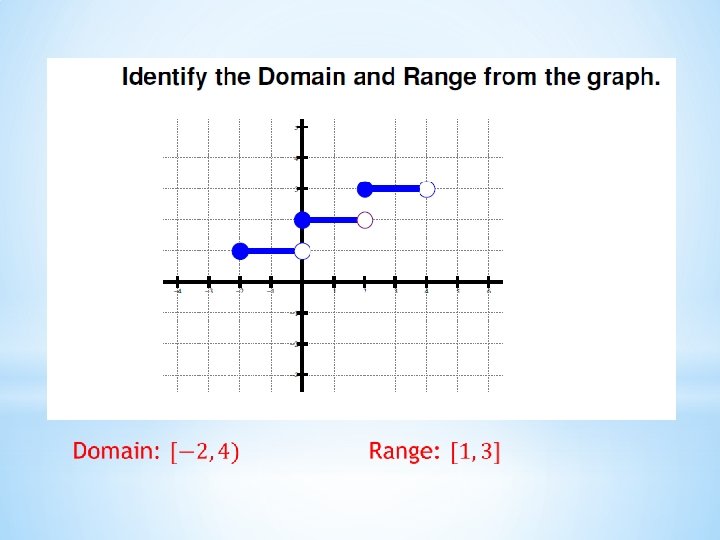
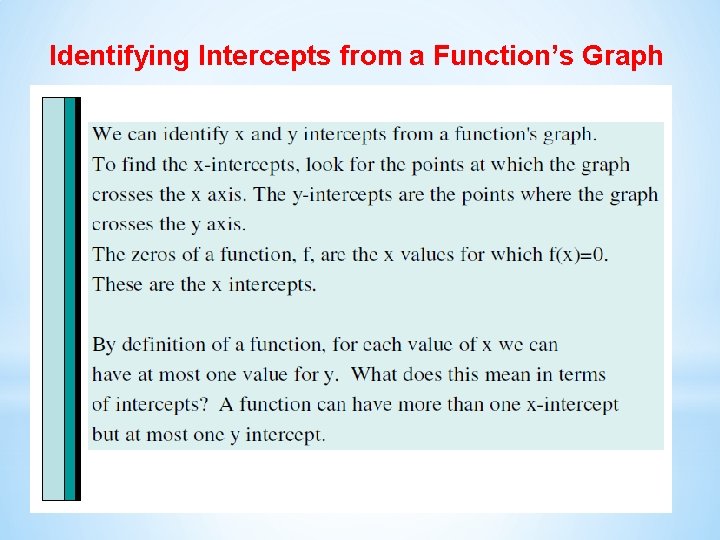
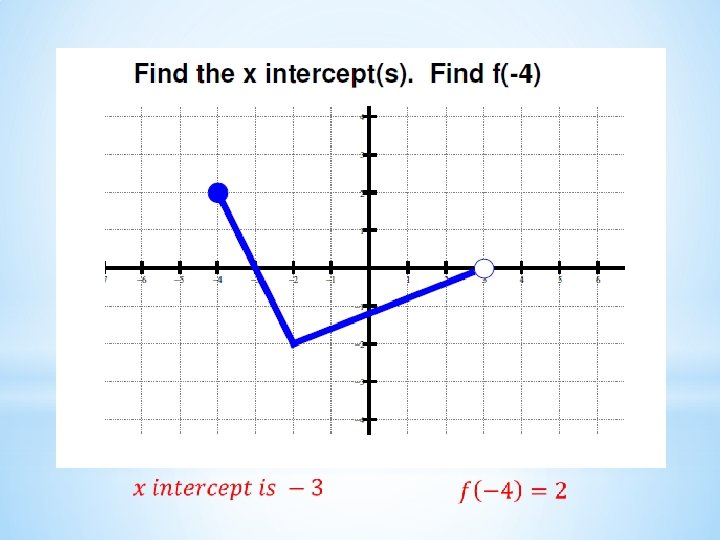
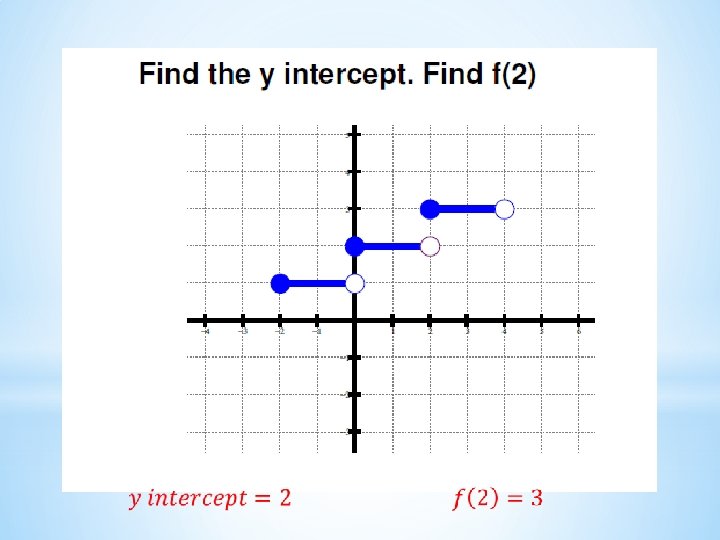
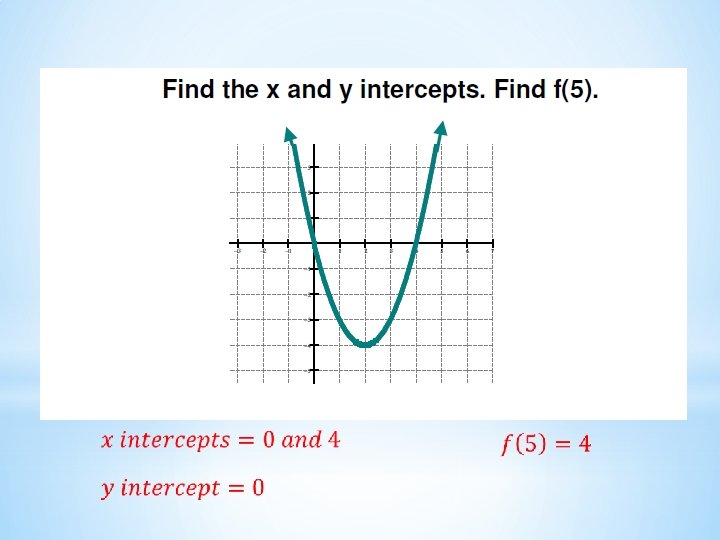
Identifying Intercepts from a Function’s Graph

- Slides: 32