
Objectives of Service Marketing Lecture Service Definitions Classifications
Objectives of Service Marketing Lecture • Service Definitions & Classifications • How Services Differ From Goods • Improving Service Differentiation, Quality, & Productivity • Improving Customer Support Services 1

Service Marketing The four Ps of services marketing: people, people. Richard Dow We need to look at our business as more than simply the building and selling of personal computers. Our business is the delivery of information and the lifelike interactive experiences. Intel Chairman Andrew Grove. I. Role of Service Marketing in Society 1. Service Sector represented 79% of the gross domestic product of the United States. • In 1997 there was an $85 billion trade surplus in services. • Services will provide 90 percent of all new jobs in the next ten years. • Services account for 47 cents of every dollar that consumers spend. II. Service Marketing: Definitions: Services are deeds, processes, and performances. Include all economic activities whose output is not a physical product or construction. 2

Categories of Service Mix Pure Tangible Good w/ Services Major Pure Hybrid Service w/ Goods 3
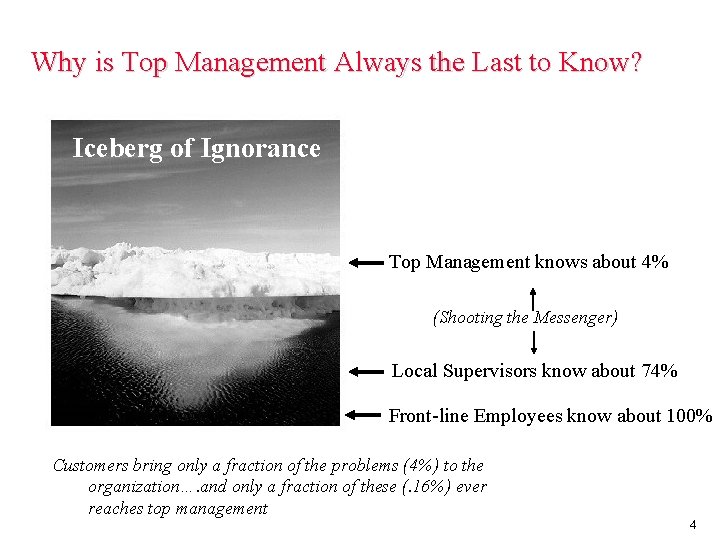
Why is Top Management Always the Last to Know? Iceberg of Ignorance Top Management knows about 4% (Shooting the Messenger) Local Supervisors know about 74% Front-line Employees know about 100% Customers bring only a fraction of the problems (4%) to the organization…. and only a fraction of these (. 16%) ever reaches top management 4
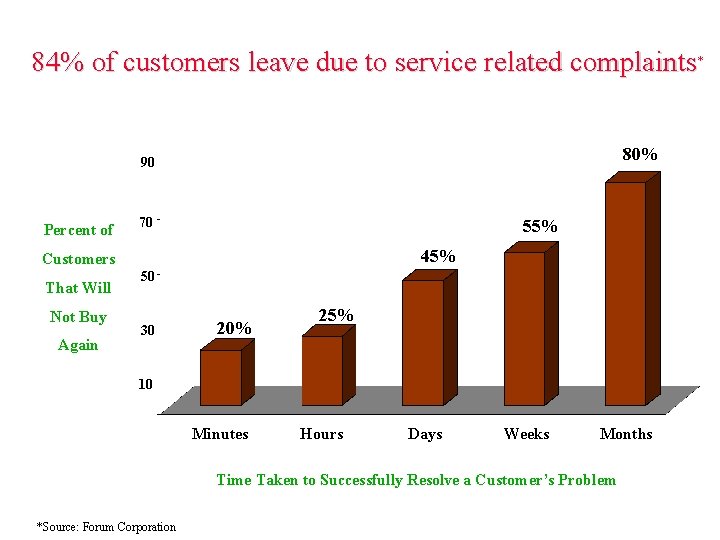
84% of customers leave due to service related complaints * 80% 90 Percent of 70 55% 45% Customers That Will Not Buy Again 50 30 20% 25% 10 Minutes Hours Days Weeks Months Time Taken to Successfully Resolve a Customer’s Problem *Source: Forum Corporation 5
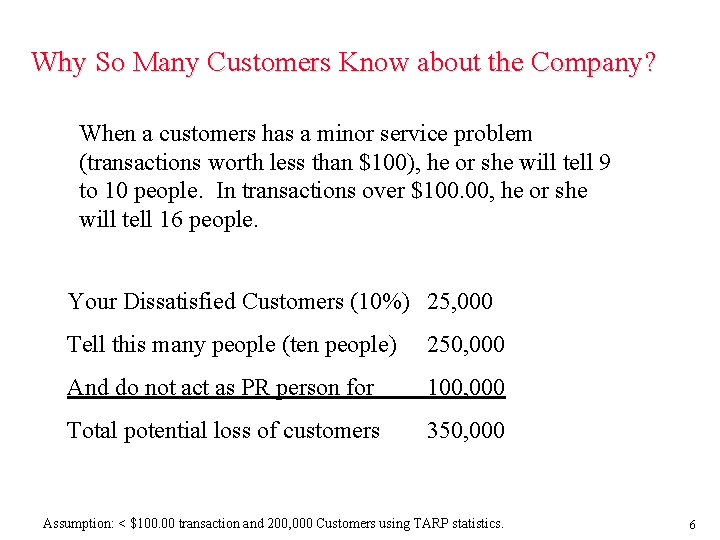
Why So Many Customers Know about the Company? When a customers has a minor service problem (transactions worth less than $100), he or she will tell 9 to 10 people. In transactions over $100. 00, he or she will tell 16 people. Your Dissatisfied Customers (10%) 25, 000 Tell this many people (ten people) 250, 000 And do not act as PR person for 100, 000 Total potential loss of customers 350, 000 Assumption: < $100. 00 transaction and 200, 000 Customers using TARP statistics. 6
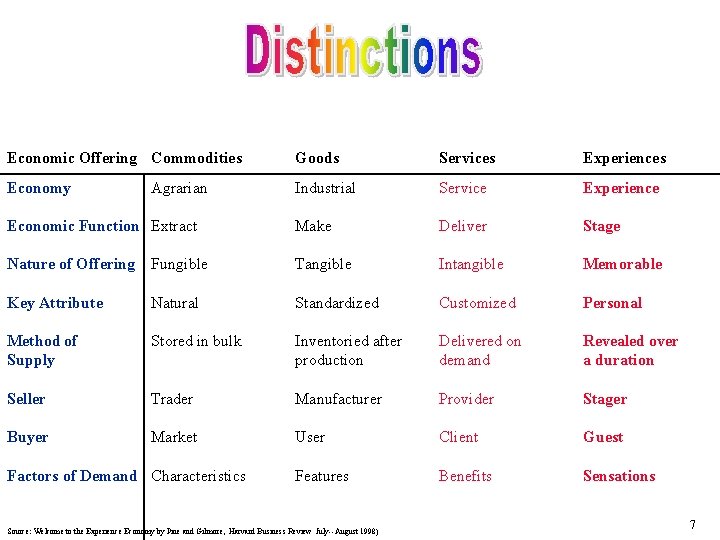
Economic Offering Commodities Goods Services Experiences Economy Industrial Service Experience Economic Function Extract Make Deliver Stage Nature of Offering Fungible Tangible Intangible Memorable Key Attribute Natural Standardized Customized Personal Method of Supply Stored in bulk Inventoried after production Delivered on demand Revealed over a duration Seller Trader Manufacturer Provider Stager Buyer Market User Client Guest Features Benefits Sensations Agrarian Factors of Demand Characteristics Source: Welcome to the Experience Economy by Pine and Gilmore, Harvard Business Review July--August 1998) 7
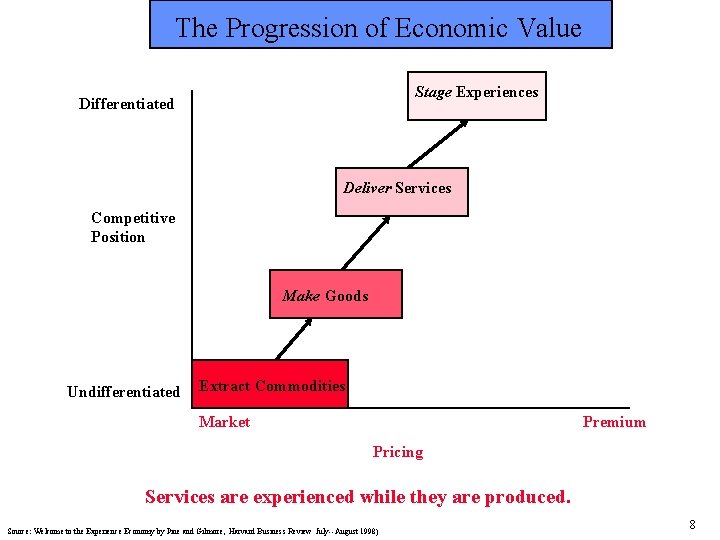
The Progression of Economic Value Stage Experiences Differentiated Deliver Services Competitive Position Make Goods Undifferentiated Extract Commodities Market Premium Pricing Services are experienced while they are produced. Source: Welcome to the Experience Economy by Pine and Gilmore, Harvard Business Review July--August 1998) 8
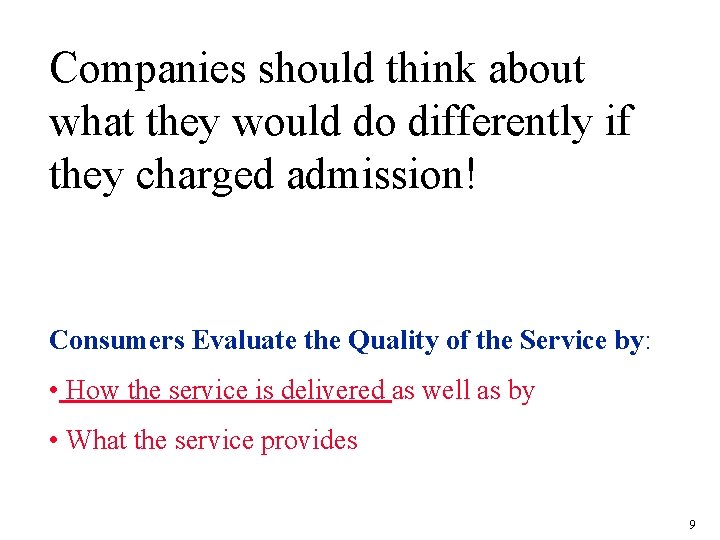
Companies should think about what they would do differently if they charged admission! Consumers Evaluate the Quality of the Service by: • How the service is delivered as well as by • What the service provides 9

Intangibility Services cannot be seen, tasted, felt, heard, or smelled before purchase Inseparability Services cannot be separated from their providers Services Variability Quality of services depends on who provides them and when, where, and how Perishability Services cannot be stored for later sale or use 10

Inseparability Increase productivity of providers Intangibility Use cues to make it tangible Services Variability Standardize service production & delivery Perishability Match supply and demand 11
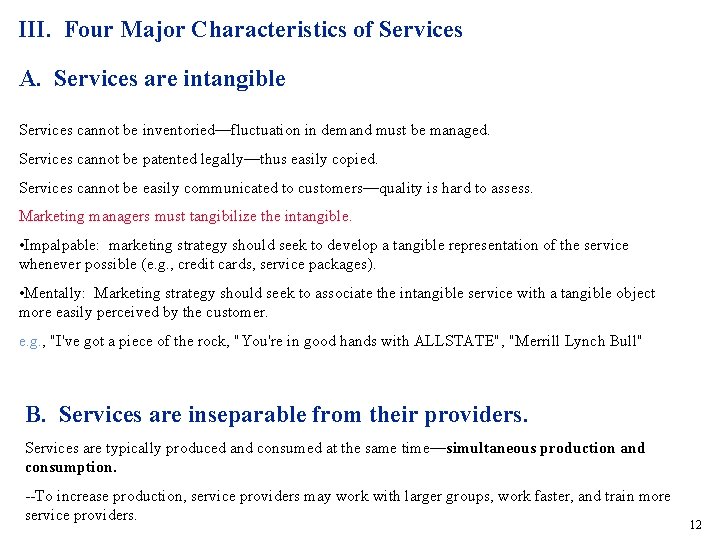
III. Four Major Characteristics of Services A. Services are intangible Services cannot be inventoried—fluctuation in demand must be managed. Services cannot be patented legally—thus easily copied. Services cannot be easily communicated to customers—quality is hard to assess. Marketing managers must tangibilize the intangible. • Impalpable: marketing strategy should seek to develop a tangible representation of the service whenever possible (e. g. , credit cards, service packages). • Mentally: Marketing strategy should seek to associate the intangible service with a tangible object more easily perceived by the customer. e. g. , "I've got a piece of the rock, "You're in good hands with ALLSTATE", "Merrill Lynch Bull" B. Services are inseparable from their providers. Services are typically produced and consumed at the same time—simultaneous production and consumption. --To increase production, service providers may work with larger groups, work faster, and train more service providers. 12
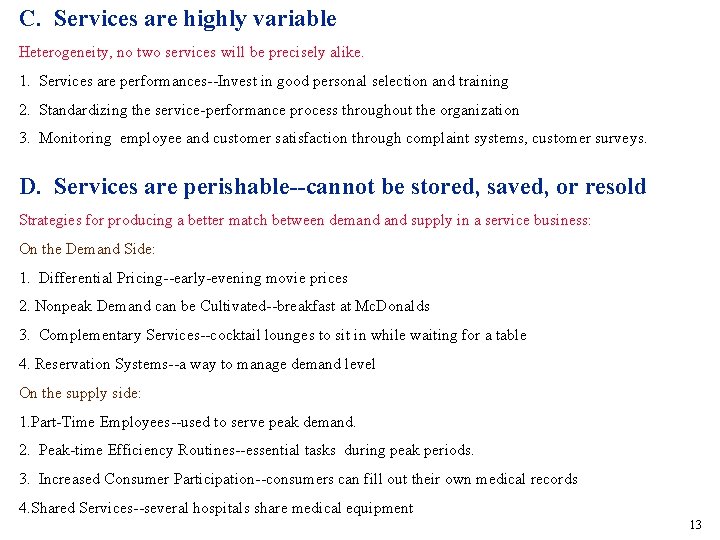
C. Services are highly variable Heterogeneity, no two services will be precisely alike. 1. Services are performances--Invest in good personal selection and training 2. Standardizing the service-performance process throughout the organization 3. Monitoring employee and customer satisfaction through complaint systems, customer surveys. D. Services are perishable--cannot be stored, saved, or resold Strategies for producing a better match between demand supply in a service business: On the Demand Side: 1. Differential Pricing--early-evening movie prices 2. Nonpeak Demand can be Cultivated--breakfast at Mc. Donalds 3. Complementary Services--cocktail lounges to sit in while waiting for a table 4. Reservation Systems--a way to manage demand level On the supply side: 1. Part-Time Employees--used to serve peak demand. 2. Peak-time Efficiency Routines--essential tasks during peak periods. 3. Increased Consumer Participation--consumers can fill out their own medical records 4. Shared Services--several hospitals share medical equipment 13
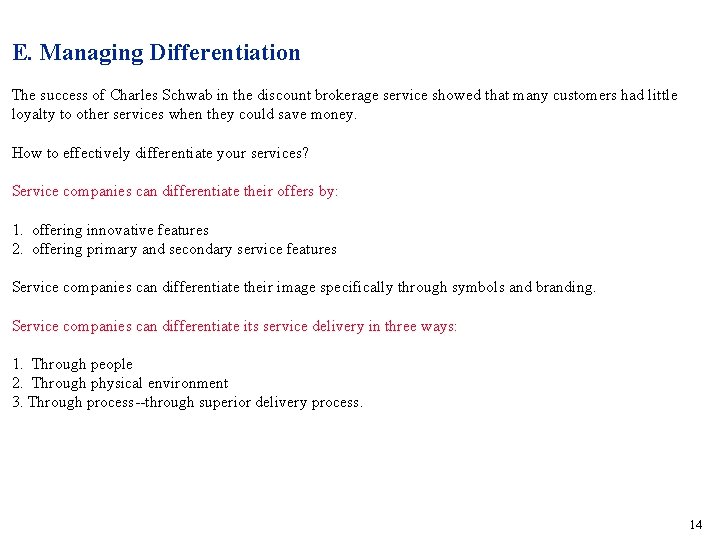
E. Managing Differentiation The success of Charles Schwab in the discount brokerage service showed that many customers had little loyalty to other services when they could save money. How to effectively differentiate your services? Service companies can differentiate their offers by: 1. offering innovative features 2. offering primary and secondary service features Service companies can differentiate their image specifically through symbols and branding. Service companies can differentiate its service delivery in three ways: 1. Through people 2. Through physical environment 3. Through process--through superior delivery process. 14
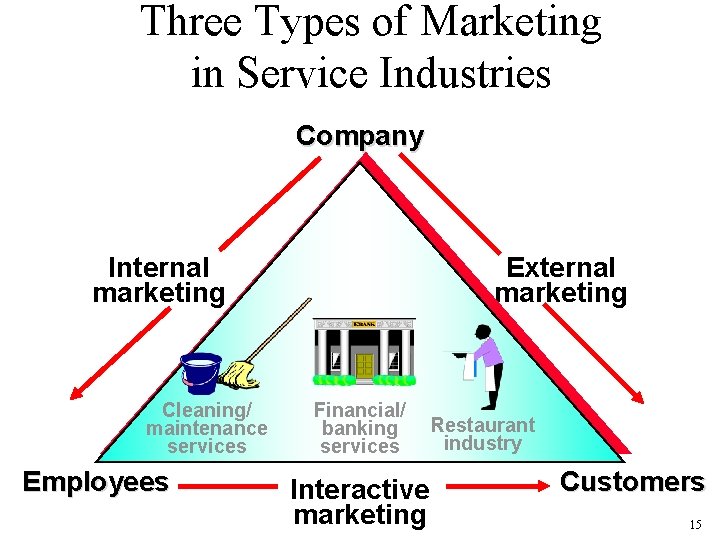
Three Types of Marketing in Service Industries Company Internal marketing Cleaning/ maintenance services Employees External marketing Financial/ banking services Interactive marketing Restaurant industry Customers 15
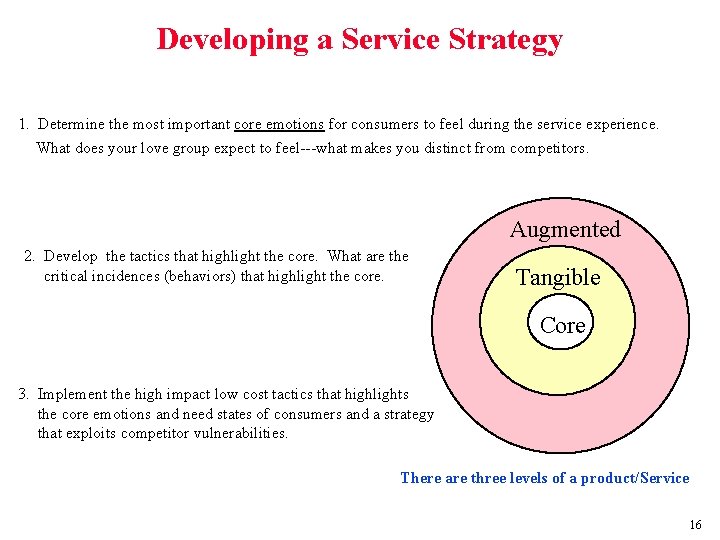
Developing a Service Strategy 1. Determine the most important core emotions for consumers to feel during the service experience. What does your love group expect to feel---what makes you distinct from competitors. Augmented 2. Develop the tactics that highlight the core. What are the critical incidences (behaviors) that highlight the core. Tangible Core 3. Implement the high impact low cost tactics that highlights the core emotions and need states of consumers and a strategy that exploits competitor vulnerabilities. There are three levels of a product/Service 16
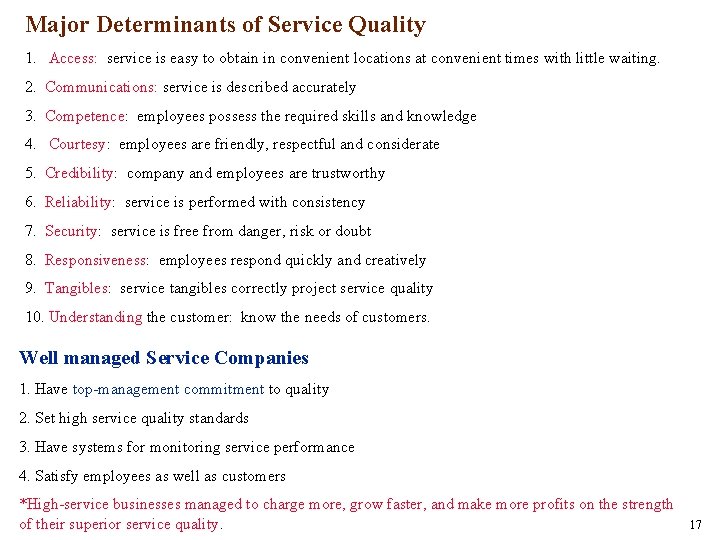
Major Determinants of Service Quality 1. Access: service is easy to obtain in convenient locations at convenient times with little waiting. 2. Communications: service is described accurately 3. Competence: employees possess the required skills and knowledge 4. Courtesy: employees are friendly, respectful and considerate 5. Credibility: company and employees are trustworthy 6. Reliability: service is performed with consistency 7. Security: service is free from danger, risk or doubt 8. Responsiveness: employees respond quickly and creatively 9. Tangibles: service tangibles correctly project service quality 10. Understanding the customer: know the needs of customers. Well managed Service Companies 1. Have top-management commitment to quality 2. Set high service quality standards 3. Have systems for monitoring service performance 4. Satisfy employees as well as customers *High-service businesses managed to charge more, grow faster, and make more profits on the strength of their superior service quality. 17
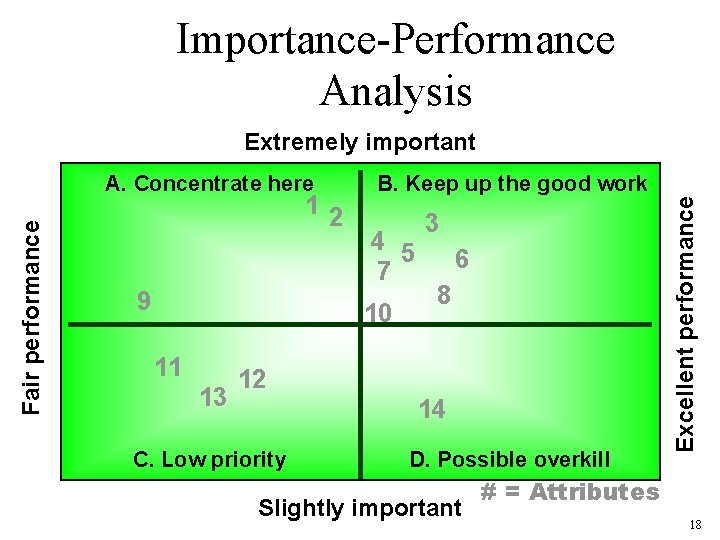
Importance-Performance Analysis Fair performance A. Concentrate here 12 9 B. Keep up the good work 4 5 7 10 11 13 3 6 8 12 14 C. Low priority D. Possible overkill Slightly important Excellent performance Extremely important # = Attributes 18
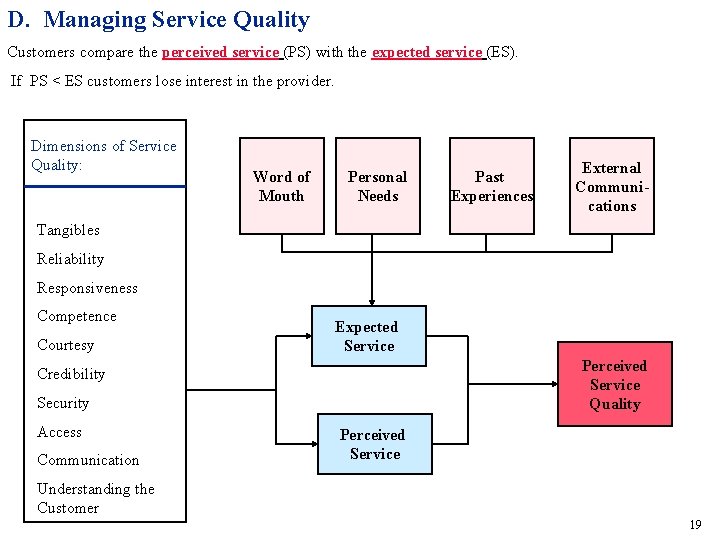
D. Managing Service Quality Customers compare the perceived service (PS) with the expected service (ES). If PS < ES customers lose interest in the provider. Dimensions of Service Quality: Word of Mouth Personal Needs Past Experiences External Communications Tangibles Reliability Responsiveness Competence Courtesy Expected Service Perceived Service Quality Credibility Security Access Communication Perceived Service Understanding the Customer 19
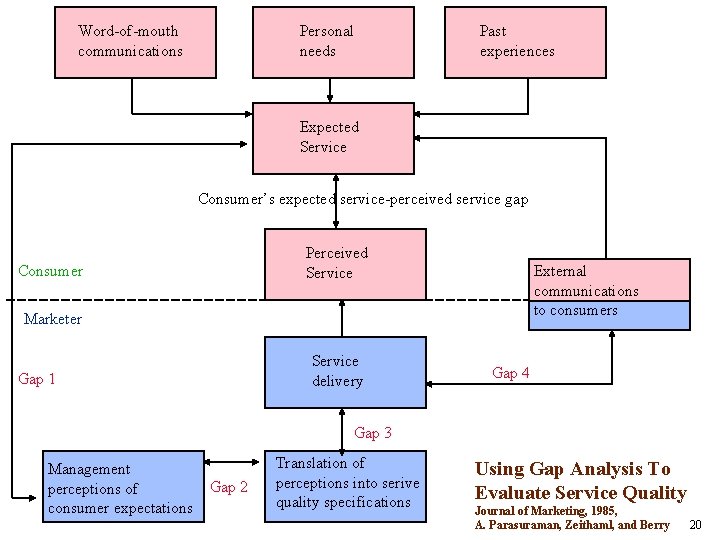
Word-of-mouth communications Personal needs Past experiences Expected Service Consumer’s expected service-perceived service gap Consumer Perceived Service External communications to consumers Marketer Gap 1 Service delivery Gap 4 Gap 3 Management Gap 2 perceptions of consumer expectations Translation of perceptions into serive quality specifications Using Gap Analysis To Evaluate Service Quality Journal of Marketing, 1985, A. Parasuraman, Zeithaml, and Berry 20
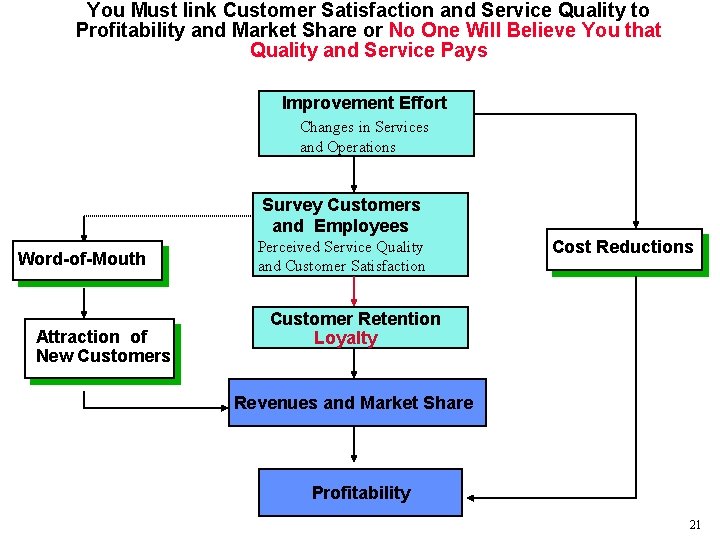
You Must link Customer Satisfaction and Service Quality to Profitability and Market Share or No One Will Believe You that Quality and Service Pays Improvement Effort Changes in Services and Operations Survey Customers and Employees Word-of-Mouth Attraction of New Customers Perceived Service Quality and Customer Satisfaction Cost Reductions Customer Retention Loyalty Revenues and Market Share Profitability 21
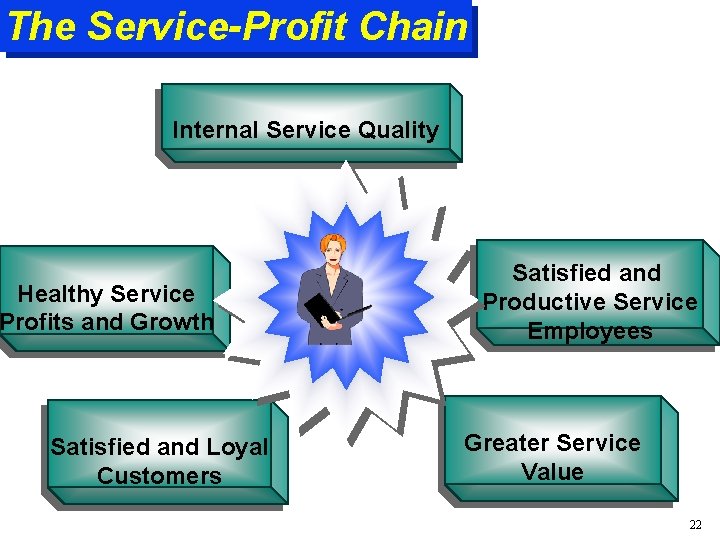
The Service-Profit Chain Internal Service Quality Healthy Service Profits and Growth Satisfied and Loyal Customers Satisfied and Productive Service Employees Greater Service Value 22
Service Excellence • • Strategic Concept Top-Management Commitment High Standards Monitoring Systems Satisfying Customer Complaints Satisfying Both Employees & Customers Managing Productivity 23
10 Great Management Lies 1. Employees are our most valuable asset 2. I have an open-door policy 3. You could earn more money under the new plan 4. We’re reorganizing to better serve our customers 5. The future is bright 6. We reward risk takers 7. Performance will be rewarded 8. We don’t shoot the messenger 9. Training is a high priority 10. I haven’t heard any rumors 11. We’ll review your performance in six months 12. Our people are the best 13. Your input is important to us Scott Adams, author of Dilbert’s Management Handbook 24
- Slides: 24