
Objectives of Normalization To create a formal framework
Objectives of Normalization ¨ To create a formal framework for analyzing relation schemas based on their keys and on the functional dependencies among their attributes. ¨ To obtain powerful relational retrieval algorithms based on a collection of primitive relational operators. ¨ To free relations from undesirable insertion, update and deletion anomalies. ¨ To reduce the need for restructuring the relations as new data types are introduced. ¨ To carry out series of tests on individual relation schema so that the relational database can be normalized to some degree. Neeraj Rathore, Jaypee University 1
Neeraj Rathore, Jaypee University 2
Functional Dependence (FD) A functional dependency is an association between two attributes of the same relational database table. One of the attributes is called the determinant and the other attribute is called the determined. For each value of the determinant there is associated one and only one value of the determined. If A is the determinant and B is the determined then we say that A functionally determines B and graphically represent this as A B. The symbols A B can also be expressed as B is functionally determined by A. Neeraj Rathore, Jaypee University 3
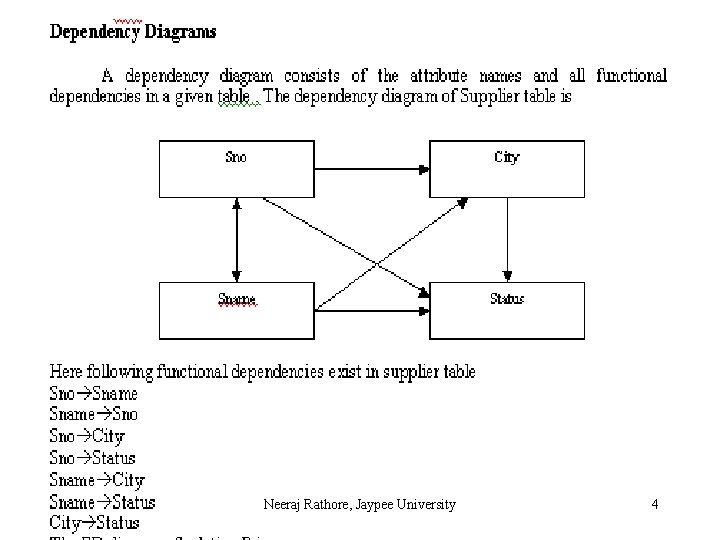
Neeraj Rathore, Jaypee University 4
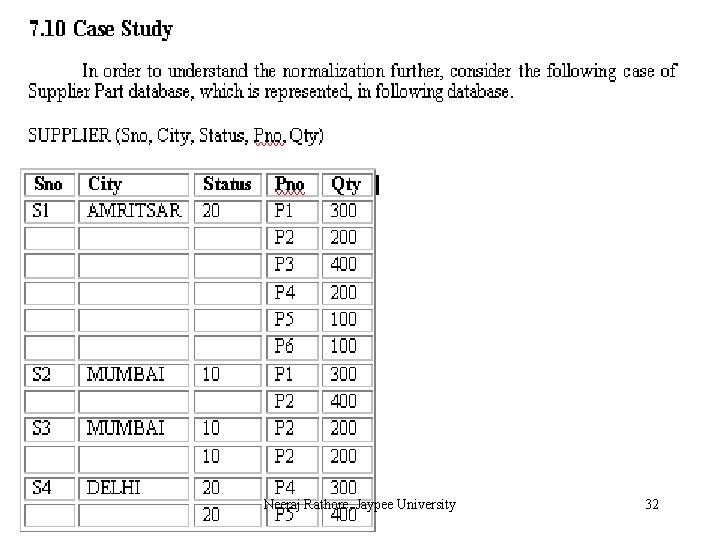
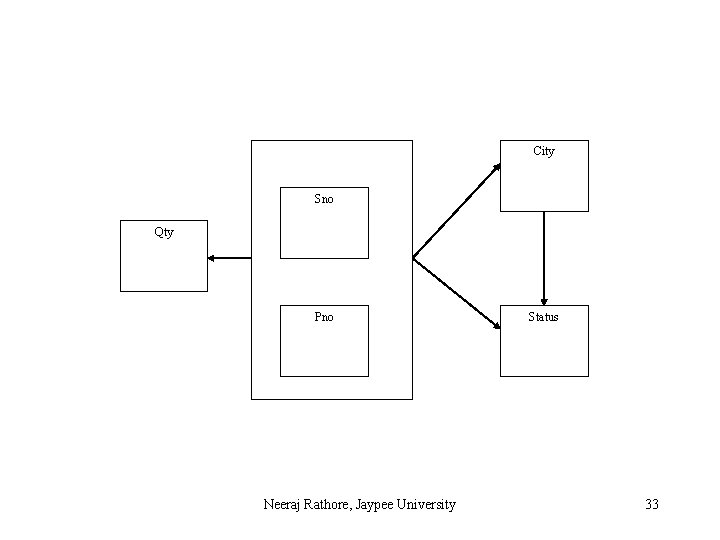
Fully Functional Dependence(FFD) is defined as Attribute Y is FFD on attribute X , if it is FD on X and not FD on any proper subset of X. For example, in relation Supplier, different cities may have the same status. It may be possible that cities like Amritsar, Jalandhar may have the same status 10. So, the City is not FD on Status But, the combination of Sno, Status can give only one corresponding City, because Sno is unique. Thus, (Sno, Status) City It means city is FD on composite attribute (Sno, Status) however City is not fully functional dependent on this composite attribute, Neeraj Rathore, Jaypee University 5
Consider the another case of SP table: Here, Qty is FD on combination of Sno, Pno. Here, X has two proper subsets Sno and Pno. Qty is not FD on Sno, because one Sno can supply more than one quantity. Qty is also not FD on Pno, because one Pno may be supplied many times by different suppliers with different or same quantities. So, Qty is FFD on composite attribute of (Sno, Pno). Neeraj Rathore, Jaypee University 6
First Normal Form Definition of First Normal Form A relation is said to be in First Normal Form (1 NF) if and only if every entry of the relation (the intersection of a tuple and a column) has at most a single value. In other words “a relation is in First Normal Form if and only if all underlying domains contain atomic values or single value only. ” Neeraj Rathore, Jaypee University 7
Neeraj Rathore, Jaypee University 8
Neeraj Rathore, Jaypee University 9
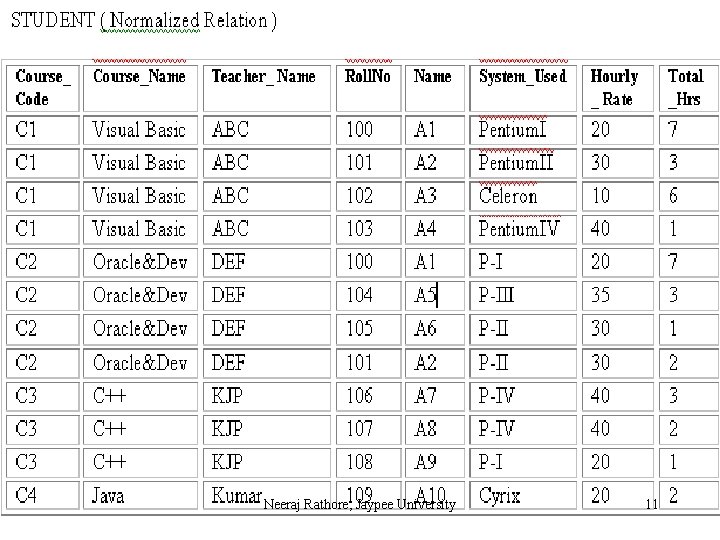
First Approach: Flattening the table The first approach known as “flattening the table” removes repeating groups by filling in the “missing” entries of each “incomplete row” of the table with copies of their corresponding non-repeating attributes. The following example illustrates this. Neeraj Rathore, Jaypee University 10
Neeraj Rathore, Jaypee University 11
Second Approach: Decomposition of the table The second approach for normalizing a table requires that the table be decomposed into two new tables that will replace the original table. However, before decomposing the original table it is necessary to identify an attribute or a set of its attributes that can be used as table identifiers. Neeraj Rathore, Jaypee University 12
Rule of decomposition ¨ One of the two tables contains the table identifier of the original table and all the non-repeating attributes. ¨ The other table contains a copy of the table identifier and all the repeating attributes. Neeraj Rathore, Jaypee University 13
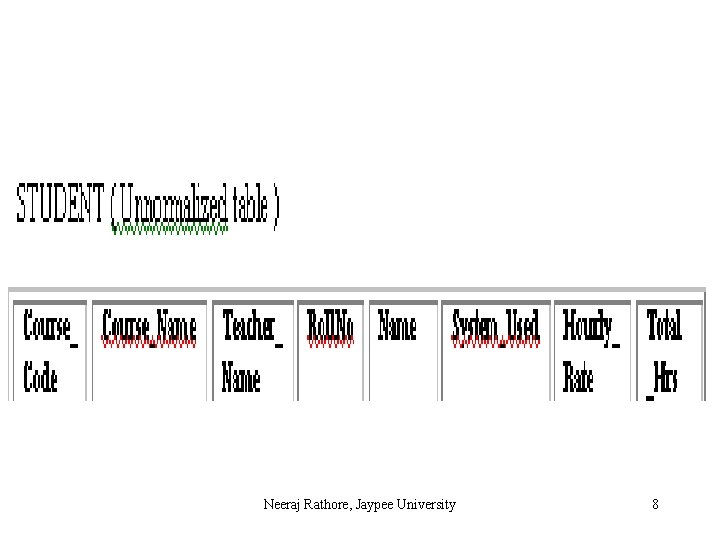
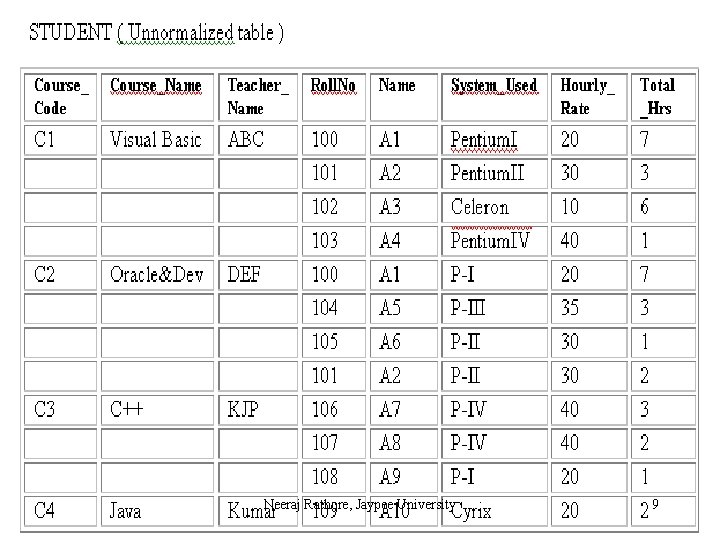
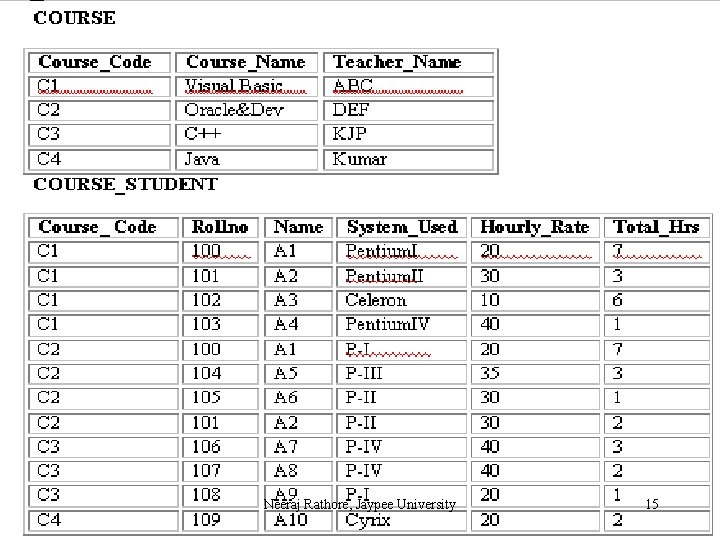
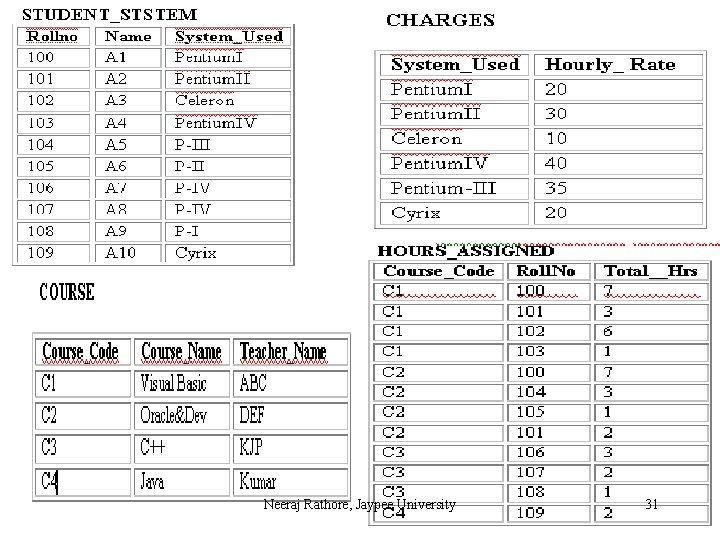
To normalize the STUDENT table we need to replace it by two new tables. The first table COURSE contains the table identifier and the nonrepeating groups. These attributes are Course_Code (the table identifier), Course_Name, and Teacher_Name. The second table contains the table identifier and all the repeating groups. Therefore, the attributes of COURSE_STUDENT table are Course_Code, Rollno, Name, System_Used, Hourly_Rate and Total_Hrs. Neeraj Rathore, Jaypee University 14
Neeraj Rathore, Jaypee University 15
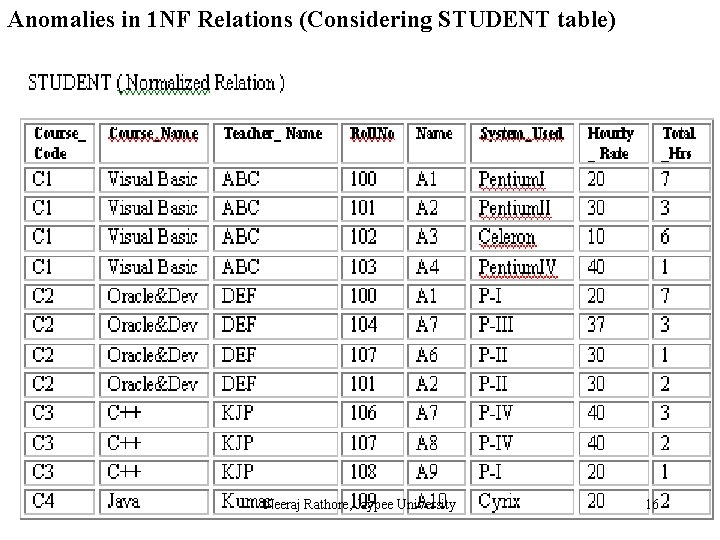
Anomalies in 1 NF Relations (Considering STUDENT table) Neeraj Rathore, Jaypee University 16
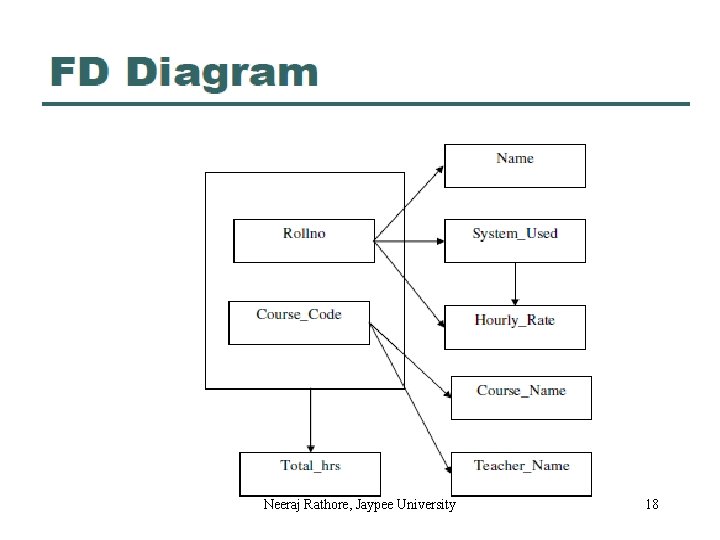
Second Normal Form Definition A relation R is in second normal form (2 NF) if and only if it is in 1 NF and every non-key attribute is fully functional dependent on the primary key. A resultant database of first normal form COURSE_CODE does not satisfy above rule, because non-key attributes Name, System_Used and Hourly_Rate are not fully dependent on the primary key (Course_Code, Rollno) because Name, System_Used and Hourly_Rate are functional dependent on Rollno and Rollno is a subset of the primary key so it does not hold the law of fully functional dependence. In order to convert COURSE_CODE database into second normal form following rule is used. Neeraj Rathore, Jaypee University 17
Neeraj Rathore, Jaypee University 18
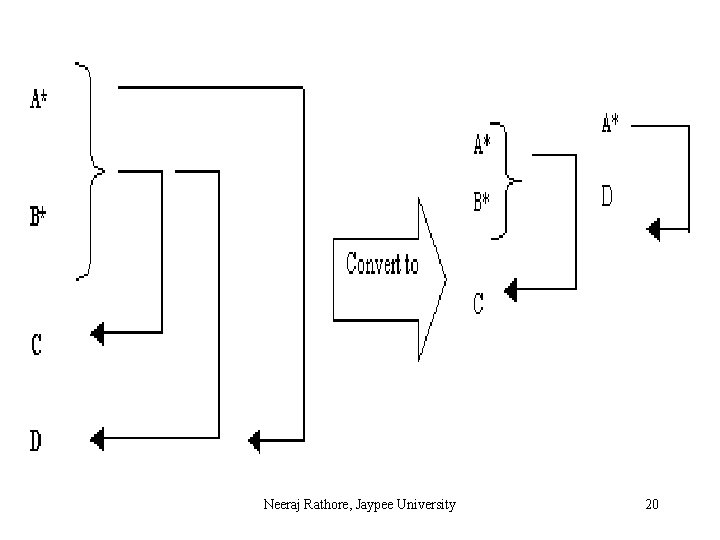
Rule to convert First Normal Form to Second Normal Form Consider a relation where a primary key consists of attributes A and B. These two attributes determine all other attributes. Attribute C is fully dependent on the key. Attribute D is partially dependent on the key because we only need attribute A to functionally determine it. Attributes C and D are nonprime or non-key attributes. Here the rule is to replace the original relation by two new relations. The first new relation has three attributes: A, B and C. The primary key of this relation is (A, B) i. e the primary key of the original relation. The second relation has A and D as its only two attributes. Observe that attribute A has been designated, as the primary key of the second relation and that attribute D is now fully dependent on the key. Neeraj Rathore, Jaypee University 19
Neeraj Rathore, Jaypee University 20

Neeraj Rathore, Jaypee University 21
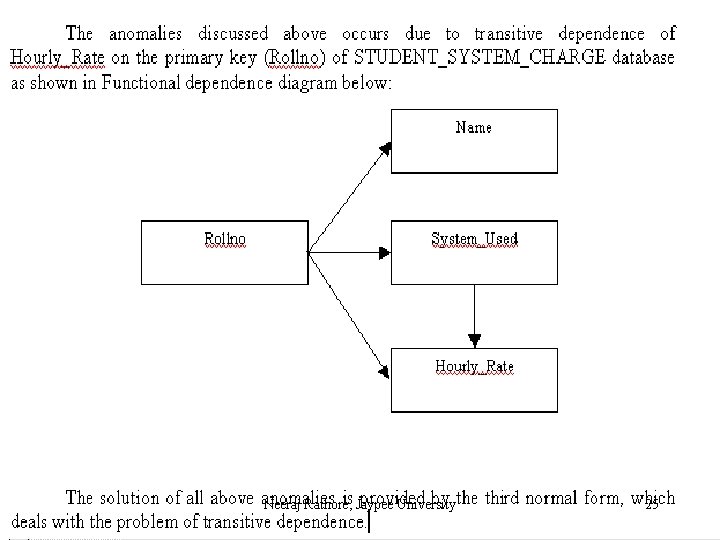
Data Anomalies in 2 NF Relations in 2 NF are still subject to data anomalies. For sake of explanation, let us assume that the system on which a student works functionally determines the hourly rate charged from the student. That is, System_Used Hourly_Rate. This fact was not considered in the explanation of the previous normal form but it is not an unrealistic situation. Neeraj Rathore, Jaypee University 22
Insertion anomalies occur in the STUDENT_SYSTEM_CHARGE relation. For example consider a situation where we would like to set in advance the rate to be charged from the students for a particular system. We cannot insert this information until there is a student assigned to that type of system. Notice that the rate that is charged from student for a particular system is independent of whether or not any student uses that system or not. Update anomalies will also occur in the STUDENT_SYSTEM_CHARGE relation because there may be several students which are working on the same type of the system. If the Hourly_Rate for that particular system changes, we need to make sure that the corresponding rate is changed for all students that work on that type of system. Otherwise. Neeraj the. Rathore, database may end up in an inconsistent Jaypee University 23 state.
Delete anomalies The STUDENT_SYSTEM_CHARGE relation is also susceptible to deletion anomalies. This type of anomaly occurs whenever we delete the tuple of a student who happens to be the only student left which is working on a particular system. In this case we will also lose the information about the rate that we charge for that particular system. Neeraj Rathore, Jaypee University 24
Neeraj Rathore, Jaypee University 25
Third Normal Form A relation R is in Third Normal Form (3 NF) if and only if the following conditions are satisfied simultaneously: (1) R is already in 2 NF (2) No nonprime attribute is transitively dependent on the key. Another way of expressing the conditions for Third Normal Form is as follows: (1) R is already in 2 NF (2) No nonprime attribute functionally determines any other nonprime attribute. These two sets of conditions are equivalent. Neeraj Rathore, Jaypee University 26
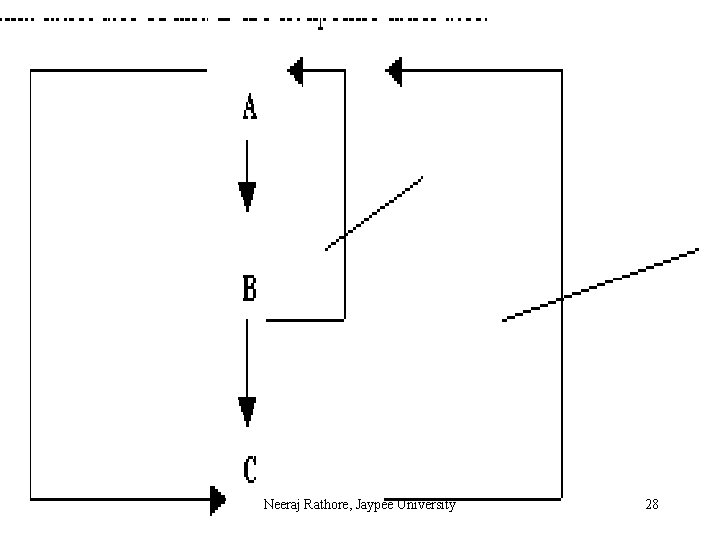
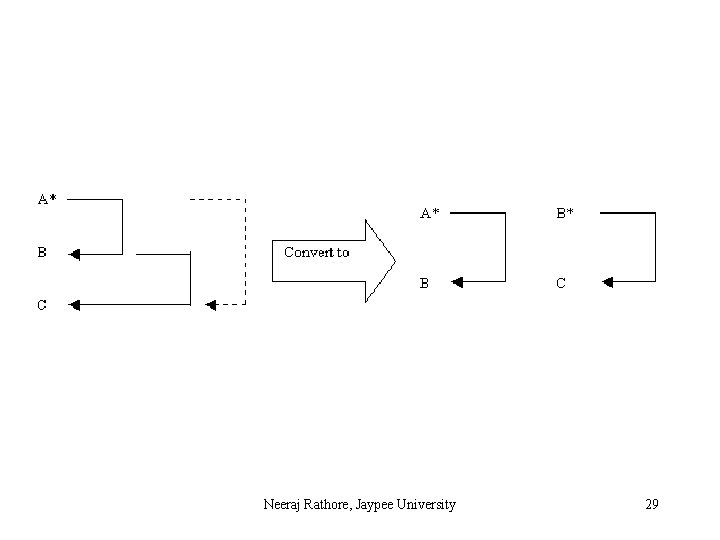
Transitive Dependencies Assume that A, B and C are the set of attributes of a relation R. Further assume that the following functional dependencies are satisfied simultaneously: A B, B A, B C and C A and A C. Observe that C B is neither prohibited nor required. If all these conditions are true, we will say that attribute C is transitively dependent on attribute A. It should be clear that these functional depend Neeraj Rathore, Jaypee University 27
Neeraj Rathore, Jaypee University 28
Neeraj Rathore, Jaypee University 29
Conversion of STUDENT_SYSTEM_CHARGE (Rollno, Name, System_Used, Hourly_Rate) to Third Normal Form The scheme of the first relation is STUDENT_SYSTEM (Rollno, Name, System_Used). The scheme of the second relation is CHARGES (System_Used, Hourly_Rate). Neeraj Rathore, Jaypee University 30
Neeraj Rathore, Jaypee University 31
Neeraj Rathore, Jaypee University 32
City Sno Qty Pno Neeraj Rathore, Jaypee University Status 33

Neeraj Rathore, Jaypee University 34
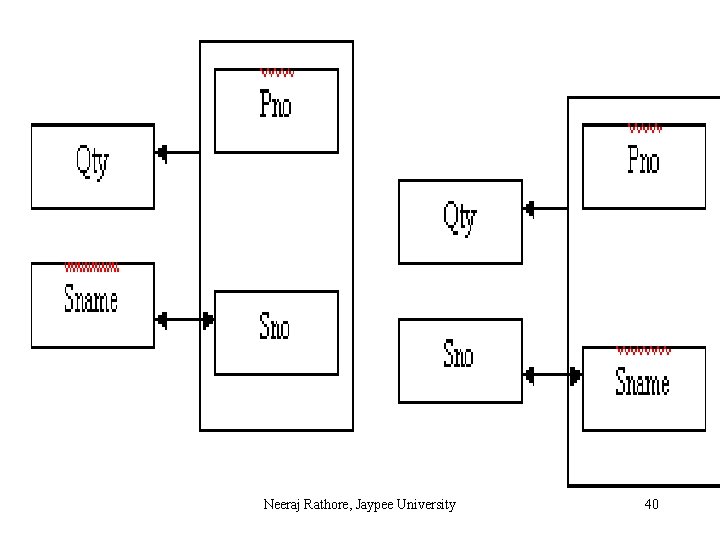
BCNF is simply a stronger definition of 3 NF. BCNF makes no explicit reference to first and second normal form as such, nor the concept of full and transitive dependence. BCNF states that A relation R is in Boyce/Codd N/F (BCNF) if and only if every determinant is a candidate key. Here determinant is a simple attribute or composite attribute on which some other attribute is fully functionally dependent. For example Qty is FFD on (Sno, Pno) Qty, here (Sno, Pno) is a composite determinant. Sno Sname Here Sno is simple attribute determinat. Neeraj Rathore, Jaypee University 35
Similarities between 3 NF and BCNF A relation which are achieved after application of 3 NF can also be achieved by BCNF. For example, relation COURSE_STUDENT and STUDENT_SYSTEM_CHARGE which are not in 3 NF are also not in BCNF. COURSE_STUDENT (Course_Code, Rollno, Name, System_Used, Hourly_Rate, Total_Hours) Here, (Course_Code, Rollno) Total_Hours Rollno Name | System_Used | Hourly_Rate Here, Rollno is a determinant but not candidate key so relation COURSE_STUDENT is not in BCNF. In relation (Rollno, Name, System_Used, Hourly_Rate) STUDENT_SYSTEM_CHARGE Rollno Name | System_Used | Hourly_Rate System_Used Hourly_Rate Here, System_Used is also Neeraj a determinant but it is not unique, so 36 relation Rathore, Jaypee University STUDENT_SYSTEM_CHARGE is not in BCNF.
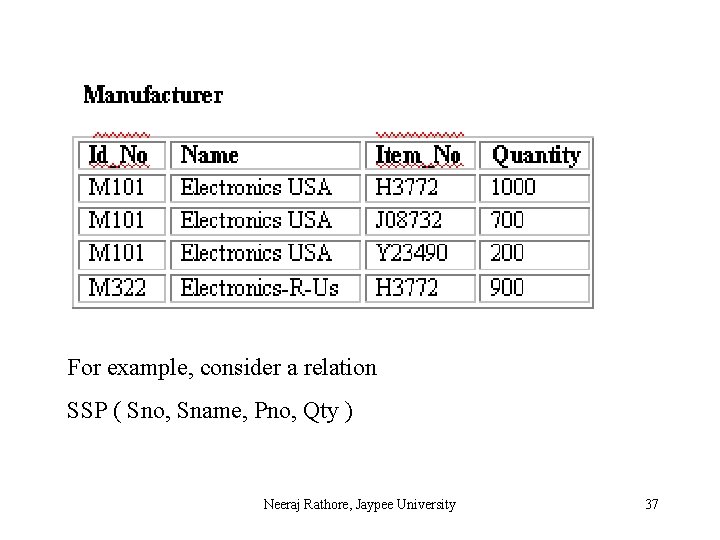
For example, consider a relation SSP ( Sno, Sname, Pno, Qty ) Neeraj Rathore, Jaypee University 37
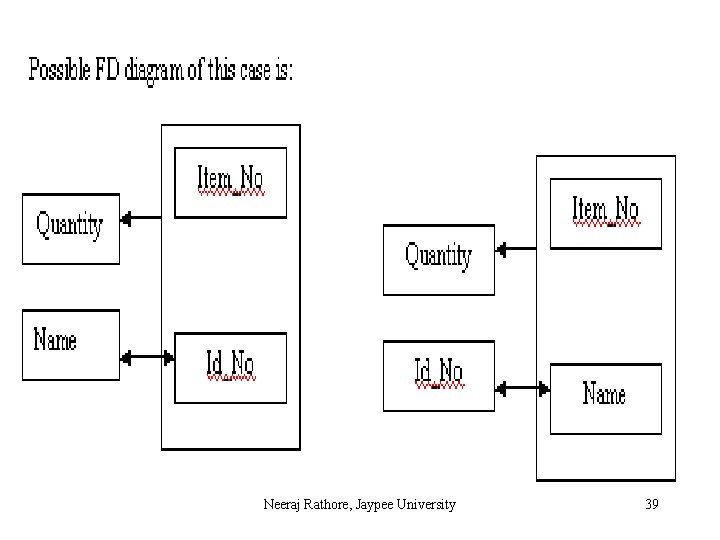
Differences in 3 NF and BCNF In order to show the difference between 3 NF and BCNF, relations having overlapping of candidate keys are considered in detail. Overlapping of Candidate keys: Two candidate keys overlap if they involve two or more attributes each and have an attribute in common. (Id_no, Item_No) Quantity (Name, Item_No) Quantity Item_No Name Item_No Neeraj Rathore, Jaypee University 38
Neeraj Rathore, Jaypee University 39
Neeraj Rathore, Jaypee University 40
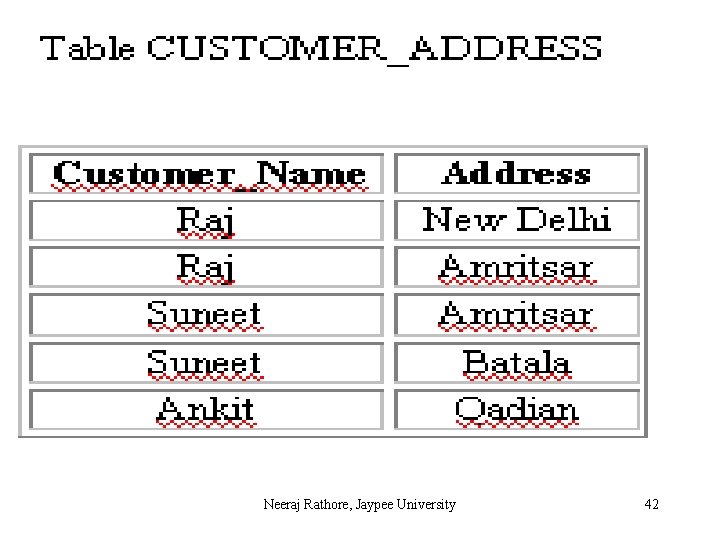
Fourth Normal Form (4 NF) A relation R is in Fourth Normal Form (4 NF) if and only if the following conditions are satisfied simultaneously: (1) R is already in 3 NF or BCNF. (2) If it contains no multi-valued dependencies. Multi-Valued Dependency (MVD) MVD is the dependency where one attribute value is potentially a ‘multivalued fact’ about another. Consider the table Neeraj Rathore, Jaypee University 41
Neeraj Rathore, Jaypee University 42
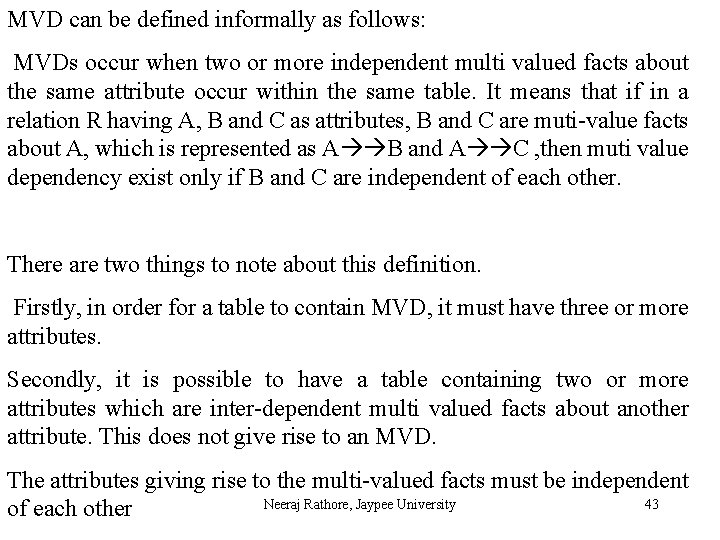
MVD can be defined informally as follows: MVDs occur when two or more independent multi valued facts about the same attribute occur within the same table. It means that if in a relation R having A, B and C as attributes, B and C are muti-value facts about A, which is represented as A B and A C , then muti value dependency exist only if B and C are independent of each other. There are two things to note about this definition. Firstly, in order for a table to contain MVD, it must have three or more attributes. Secondly, it is possible to have a table containing two or more attributes which are inter-dependent multi valued facts about another attribute. This does not give rise to an MVD. The attributes giving rise to the multi-valued facts must be independent Neeraj Rathore, Jaypee University 43 of each other

Neeraj Rathore, Jaypee University 44
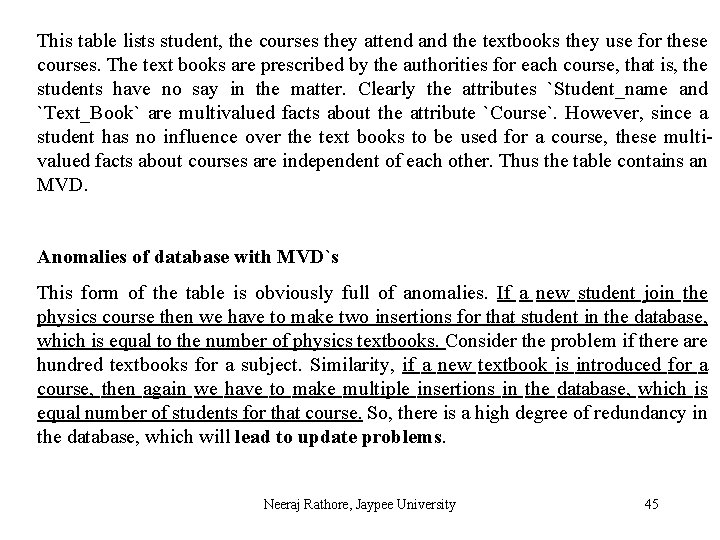
This table lists student, the courses they attend and the textbooks they use for these courses. The text books are prescribed by the authorities for each course, that is, the students have no say in the matter. Clearly the attributes `Student_name and `Text_Book` are multivalued facts about the attribute `Course`. However, since a student has no influence over the text books to be used for a course, these multivalued facts about courses are independent of each other. Thus the table contains an MVD. Anomalies of database with MVD`s This form of the table is obviously full of anomalies. If a new student join the physics course then we have to make two insertions for that student in the database, which is equal to the number of physics textbooks. Consider the problem if there are hundred textbooks for a subject. Similarity, if a new textbook is introduced for a course, then again we have to make multiple insertions in the database, which is equal number of students for that course. So, there is a high degree of redundancy in the database, which will lead to update problems. Neeraj Rathore, Jaypee University 45
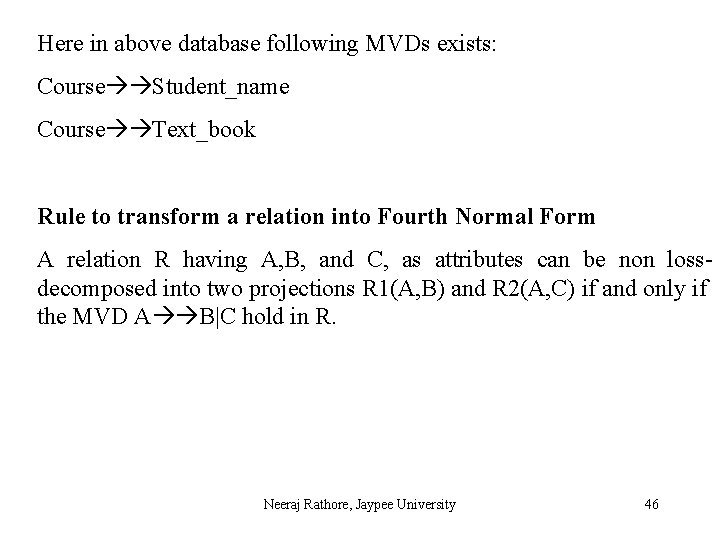
Here in above database following MVDs exists: Course Student_name Course Text_book Rule to transform a relation into Fourth Normal Form A relation R having A, B, and C, as attributes can be non lossdecomposed into two projections R 1(A, B) and R 2(A, C) if and only if the MVD A B|C hold in R. Neeraj Rathore, Jaypee University 46
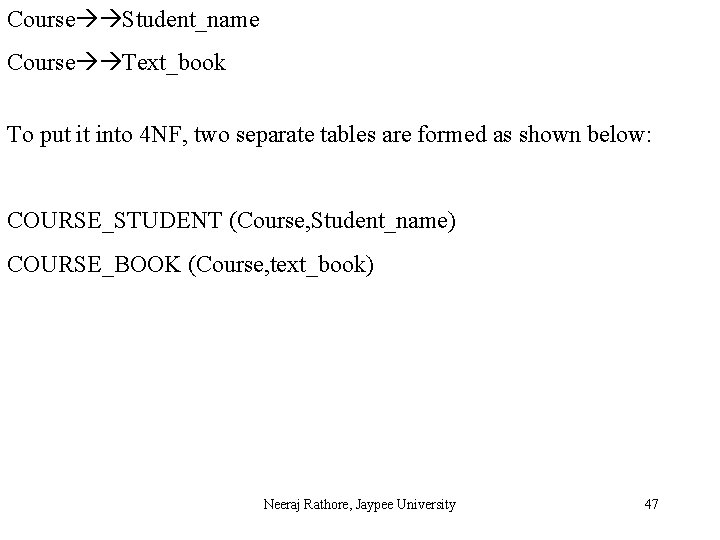
Course Student_name Course Text_book To put it into 4 NF, two separate tables are formed as shown below: COURSE_STUDENT (Course, Student_name) COURSE_BOOK (Course, text_book) Neeraj Rathore, Jaypee University 47

Neeraj Rathore, Jaypee University 48
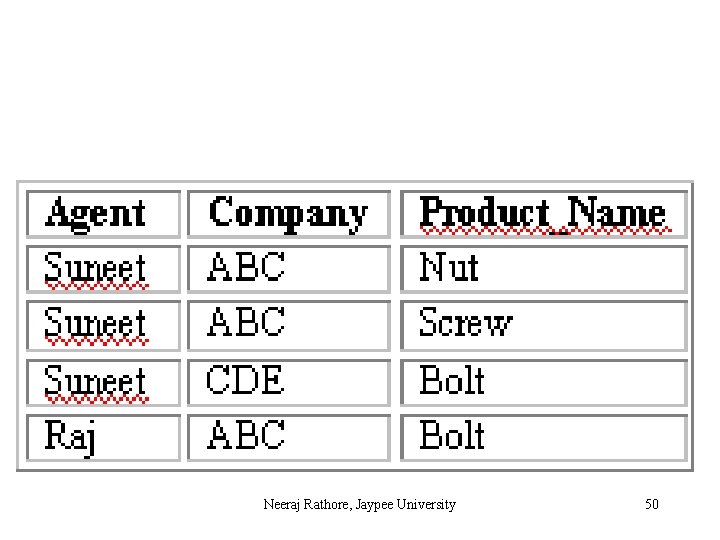
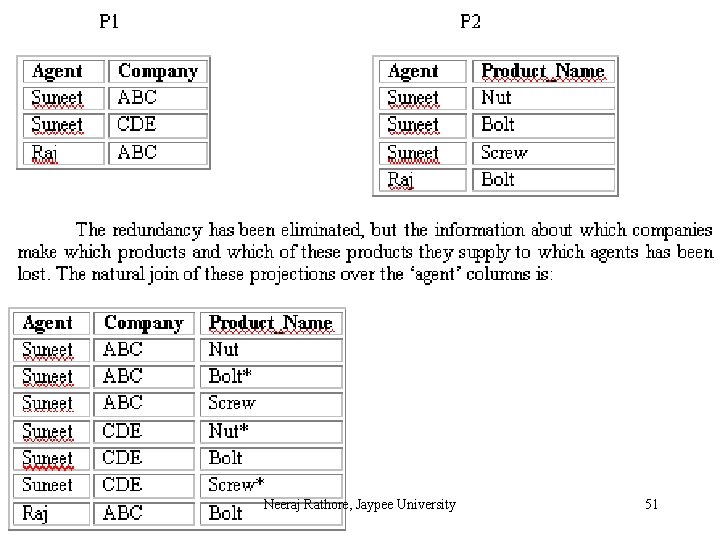
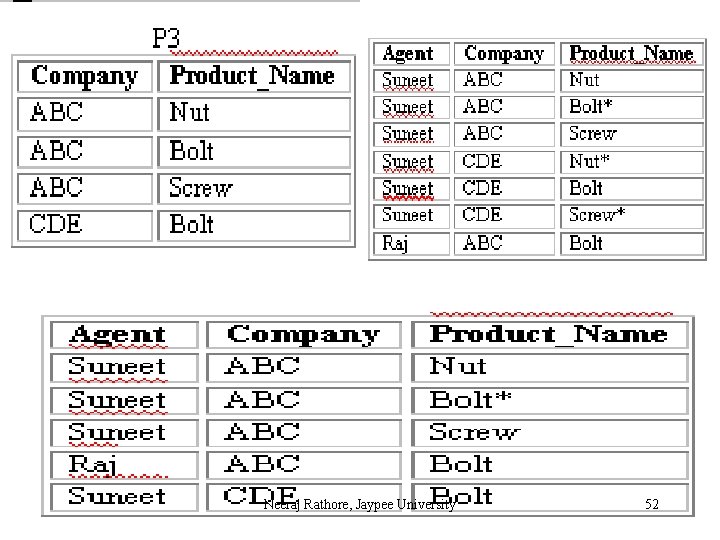
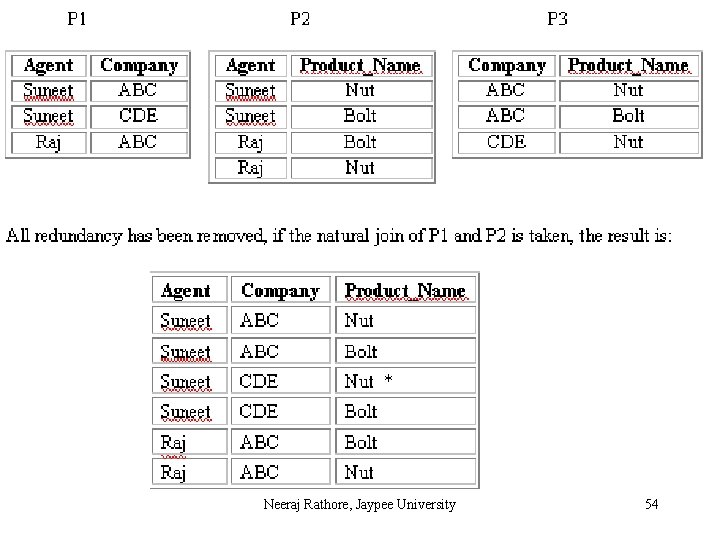
Fifth Normal Form (5 NF) A relation R is in Fifth Normal Form (5 NF) if and only if the following conditions are satisfied simultaneously: (1) R is already in 4 NF. (2) It cannot be further non-loss decomposed. 5 NF is of little practical use to the database designer, but it is of interest from a theoretical point of view and a discussion of it is included here to complete the picture of the further normal forms. In all of the further normal forms discussed so far, no loss decomposition was achieved by the decomposing of a single table into two separate tables. No loss decomposition is possible because of the availability of the join operator as part of the relational model. In considering 5 NF, consideration must be given to tables where this non-loss decomposition can only be achieved by decomposition into three or more separate tables. Neeraj Rathore, Jaypee University 49
Neeraj Rathore, Jaypee University 50
Neeraj Rathore, Jaypee University 51
Neeraj Rathore, Jaypee University 52
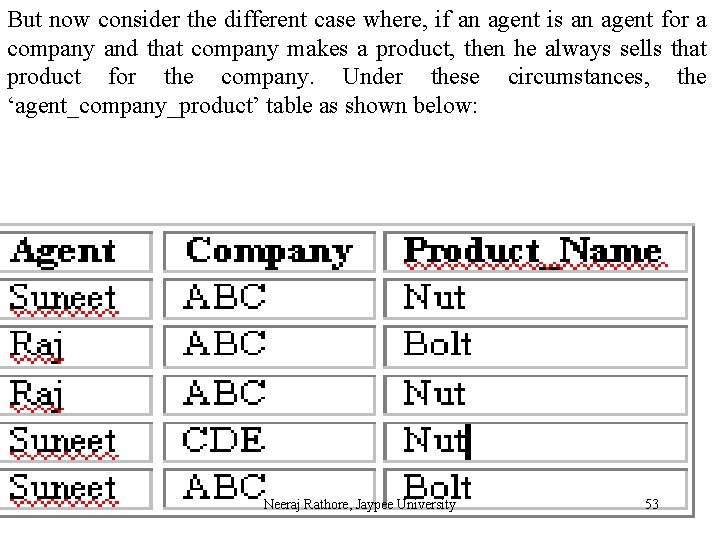
But now consider the different case where, if an agent is an agent for a company and that company makes a product, then he always sells that product for the company. Under these circumstances, the ‘agent_company_product’ table as shown below: Neeraj Rathore, Jaypee University 53
Neeraj Rathore, Jaypee University 54
- Slides: 54