
Objectives o Describe the main criteria of skeletal
Objectives: o Describe the main criteria of skeletal muscles. o Describe the attachments of skeletal muscles. o Describe the different directions of skeletal muscle fibers. o Describe the mode of action of skeletal muscles. o Describe briefly the naming of skeletal muscles. o Describe briefly the nerve supply of skeletal muscles.
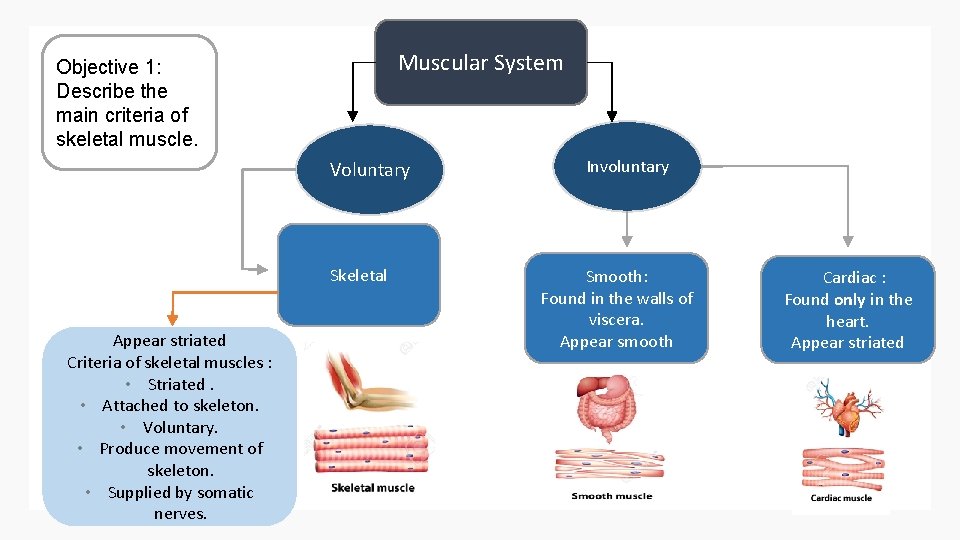
Muscular System Objective 1: Describe the main criteria of skeletal muscle. Involuntary Voluntary Skeletal Appear striated Criteria of skeletal muscles : • Striated. • Attached to skeleton. • Voluntary. • Produce movement of skeleton. • Supplied by somatic nerves. Smooth: Found in the walls of viscera. Appear smooth Cardiac : Found only in the heart. Appear striated
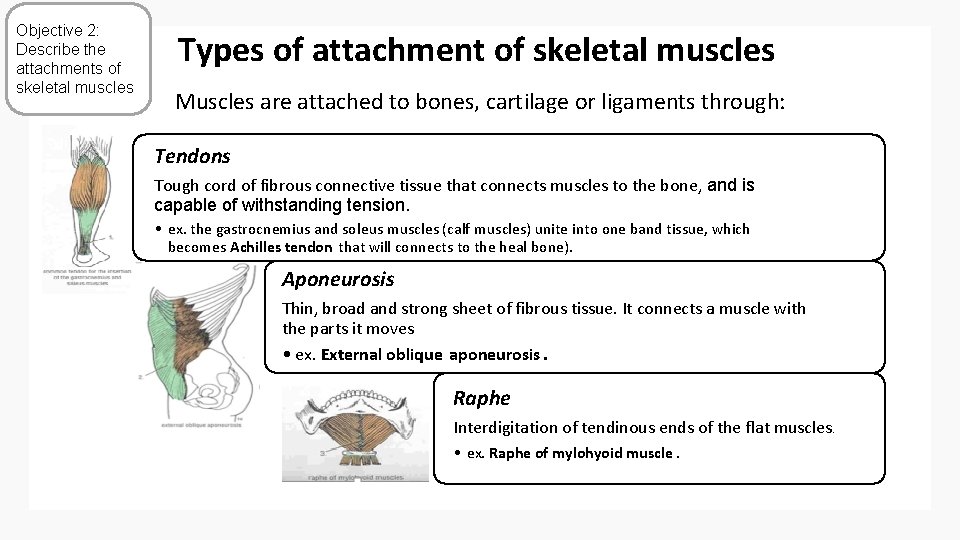
Objective 2: Describe the attachments of skeletal muscles Types of attachment of skeletal muscles Muscles are attached to bones, cartilage or ligaments through: Tendons Tough cord of fibrous connective tissue that connects muscles to the bone, and is capable of withstanding tension. • ex. the gastrocnemius and soleus muscles (calf muscles) unite into one band tissue, which becomes Achilles tendon that will connects to the heal bone). Aponeurosis Thin, broad and strong sheet of fibrous tissue. It connects a muscle with the parts it moves • ex. External oblique aponeurosis. Raphe Interdigitation of tendinous ends of the flat muscles. • ex. Raphe of mylohyoid muscle.
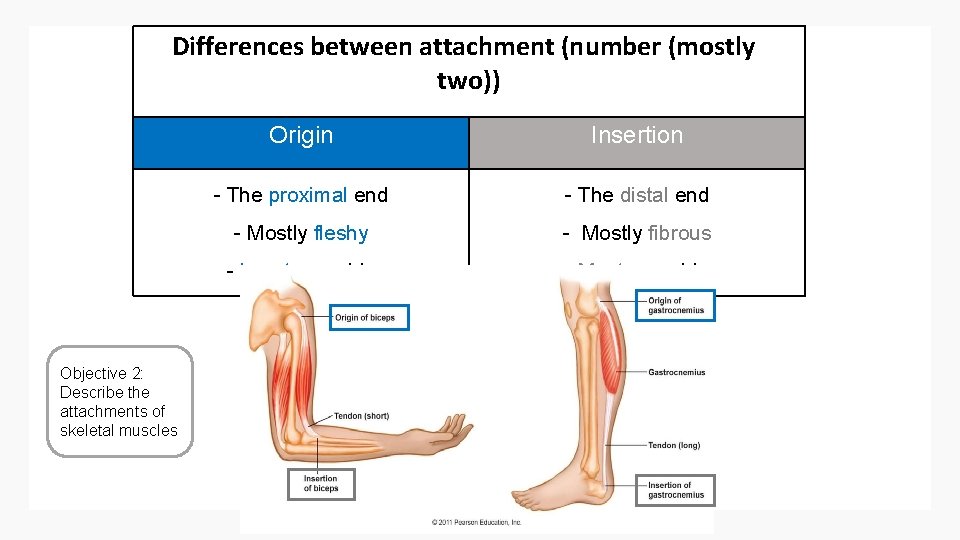
Differences between attachment (number (mostly two)) Objective 2: Describe the attachments of skeletal muscles Origin Insertion - The proximal end - The distal end - Mostly fleshy - Mostly fibrous - Least movable - Most movable
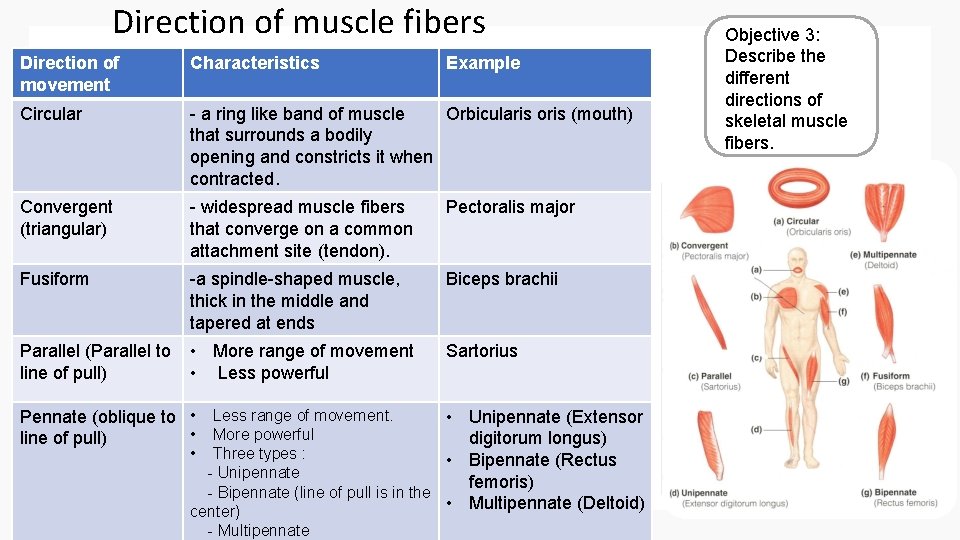
Direction of muscle fibers Direction of movement Characteristics Circular - a ring like band of muscle Orbicularis oris (mouth) that surrounds a bodily opening and constricts it when contracted. Convergent (triangular) - widespread muscle fibers that converge on a common attachment site (tendon). Pectoralis major Fusiform -a spindle-shaped muscle, thick in the middle and tapered at ends Biceps brachii Parallel (Parallel to line of pull) • More range of movement • Less powerful Sartorius Pennate (oblique to • Less range of movement. • More powerful line of pull) Example • Unipennate (Extensor digitorum longus) • Three types : • Bipennate (Rectus - Unipennate femoris) - Bipennate (line of pull is in the • Multipennate (Deltoid) center) - Multipennate Objective 3: Describe the different directions of skeletal muscle fibers.
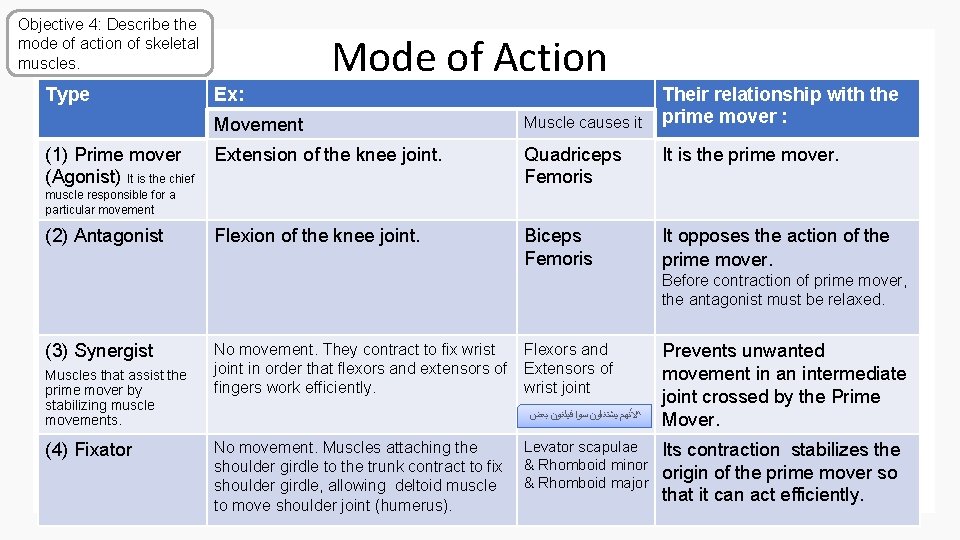
Objective 4: Describe the mode of action of skeletal muscles. Type (1) Prime mover (Agonist) It is the chief Mode of Action Ex: Their relationship with the prime mover : Movement Muscle causes it Extension of the knee joint. Quadriceps Femoris It is the prime mover. Flexion of the knee joint. Biceps Femoris It opposes the action of the prime mover. muscle responsible for a particular movement (2) Antagonist Before contraction of prime mover, the antagonist must be relaxed. (3) Synergist Muscles that assist the prime mover by stabilizing muscle movements. (4) Fixator No movement. They contract to fix wrist joint in order that flexors and extensors of fingers work efficiently. Flexors and Extensors of wrist joint ^ﻷﻨﻬﻢ ﻳﺸﺘﻐﻠﻮﻥ ﺳﻮﺍ ﻓﻴﻠﻐﻮﻥ ﺑﻌﺾ No movement. Muscles attaching the shoulder girdle to the trunk contract to fix shoulder girdle, allowing deltoid muscle to move shoulder joint (humerus). Levator scapulae & Rhomboid minor & Rhomboid major Prevents unwanted movement in an intermediate joint crossed by the Prime Mover. Its contraction stabilizes the origin of the prime mover so that it can act efficiently.
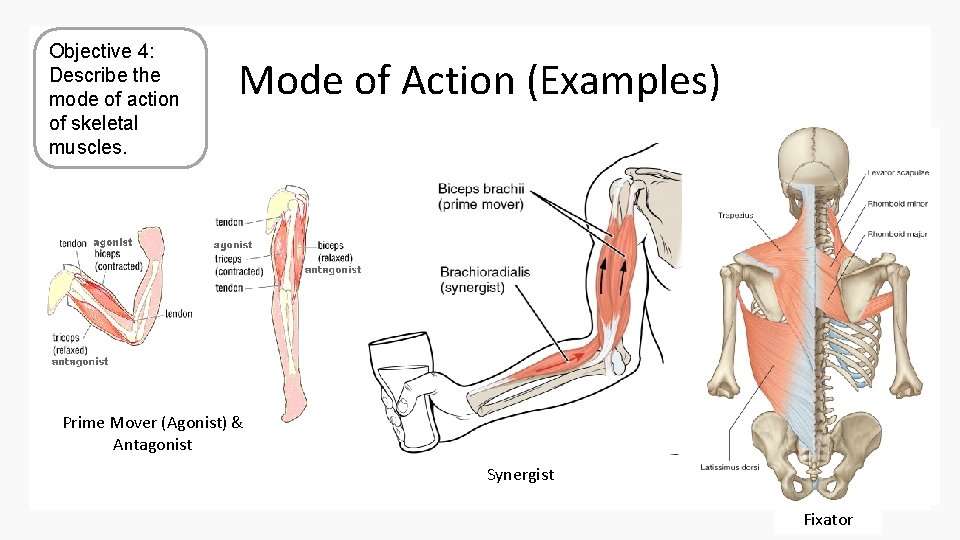
Objective 4: Describe the mode of action of skeletal muscles. Mode of Action (Examples) Prime Mover (Agonist) & Antagonist Synergist Fixator
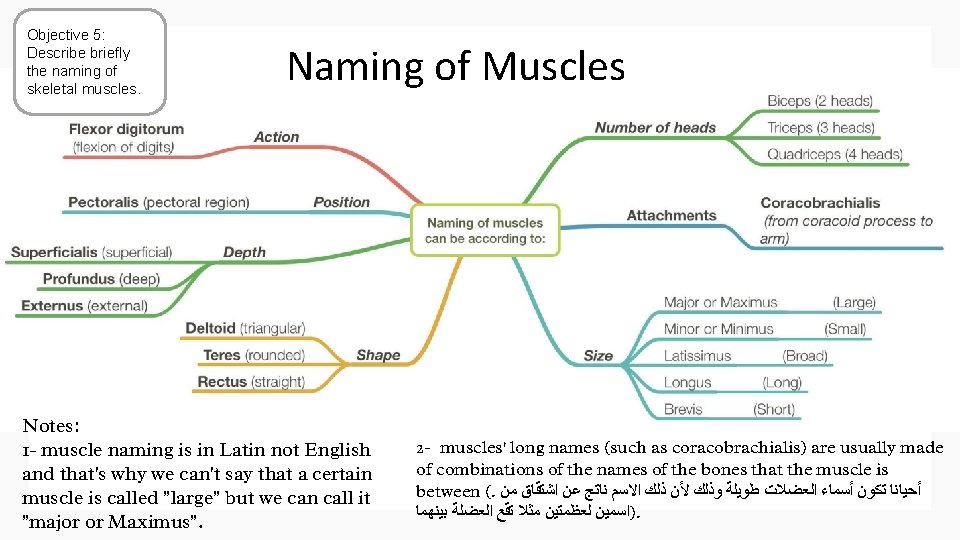
. Objective 5: Describe briefly the naming of skeletal muscles. Naming of Muscles Notes: 1 - muscle naming is in Latin not English and that's why we can't say that a certain muscle is called "large" but we can call it "major or Maximus". 2 - muscles' long names (such as coracobrachialis) are usually made of combinations of the names of the bones that the muscle is between (. ﺃﺤﻴﺎﻧﺎ ﺗﻜﻮﻥ ﺃﺴﻤﺎﺀ ﺍﻟﻌﻀﻼﺕ ﻃﻮﻳﻠﺔ ﻭﺫﻟﻚ ﻷﻦ ﺫﻟﻚ ﺍﻻﺳﻢ ﻧﺎﺗﺞ ﻋﻦ ﺍﺷﺘﻘﺎﻕ ﻣﻦ )ﺍﺳﻤﻴﻦ ﻟﻌﻈﻤﺘﻴﻦ ﻣﺜﻼ ﺗﻘﻊ ﺍﻟﻌﻀﻠﺔ ﺑﻴﻨﻬﻤﺎ.
Objective 6: Describe briefly the nerve supply of skeletal muscles. Nerve Supply of Skeletal Muscles • The somatic nervous system is the part of the peripheral nervous system associated with skeletal muscle voluntary control of body movements. • The nerves supplying the skeletal muscles are mixed: • 60% are Motor (responsible of movement and actions) • 40% are Sensory. • It has some Autonomic fibers (Sympathetic) for its blood vessels. • The nerve enters the muscle at about the middle point of its deep surface. Notes: • Sensory nerves: carries information from the nerves to the central nervous system. • Motor nerves: carries information from the brain and the spinal cord to the muscles.
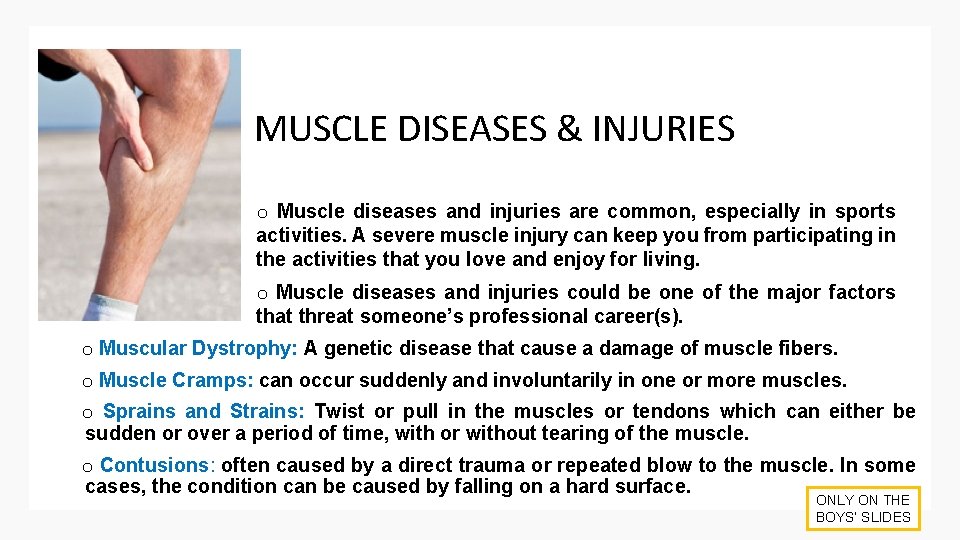
MUSCLE DISEASES & INJURIES o Muscle diseases and injuries are common, especially in sports activities. A severe muscle injury can keep you from participating in the activities that you love and enjoy for living. o Muscle diseases and injuries could be one of the major factors that threat someone’s professional career(s). o Muscular Dystrophy: A genetic disease that cause a damage of muscle fibers. o Muscle Cramps: can occur suddenly and involuntarily in one or more muscles. o Sprains and Strains: Twist or pull in the muscles or tendons which can either be sudden or over a period of time, with or without tearing of the muscle. o Contusions: often caused by a direct trauma or repeated blow to the muscle. In some cases, the condition can be caused by falling on a hard surface. ONLY ON THE BOYS’ SLIDES
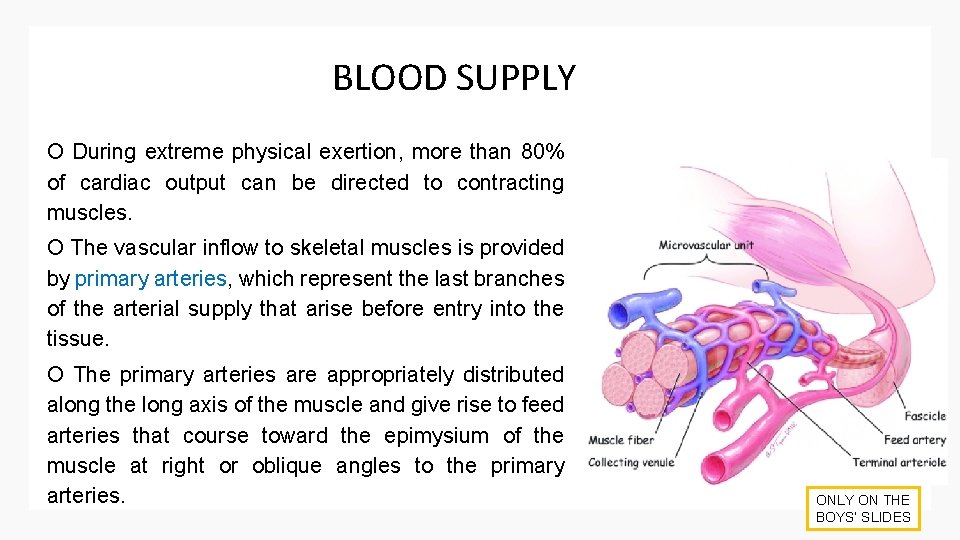
BLOOD SUPPLY O During extreme physical exertion, more than 80% of cardiac output can be directed to contracting muscles. O The vascular inflow to skeletal muscles is provided by primary arteries, which represent the last branches of the arterial supply that arise before entry into the tissue. O The primary arteries are appropriately distributed along the long axis of the muscle and give rise to feed arteries that course toward the epimysium of the muscle at right or oblique angles to the primary arteries. ONLY ON THE BOYS’ SLIDES

MUSCLE TREATMENTS O Minor muscle injuries may be treated with simple home remedies, such as rest, applying ice, using compression bandage, and elevating your injured limb. O Anti-inflammatory medication. O Physiotherapy O Severe muscle injuries need to be checked by a qualified health care provider. O A torn muscle or tendon may need to be surgically repaired. ONLY ON THE BOYS’ SLIDES
SUMMARY o Skeletal muscles are striated, striated voluntary muscles attached to & move the skeleton. o They have 2 attachments: origin & insertion o Their fibers may be parallel or oblique (pennate ) to the line of pull. o According to mode of action, they are classified as: prime mover , antagonist, synergist or fixator o They may be named according to: size, shape, number of heads, position, attachments, depth or action. o They are supplied by a mixed somatic nerve.
Helpful Links Videos • https: //www. youtube. com/watch? v=I 80 Xx 7 p. A 9 h. Q 1 - Mode of actions 2 - Describing the attachments • https: //www. youtube. com/watch? v=PGDXXUt. Pw 4 A Modes of actions • https: //www. youtube. com/watch? v=z. ETNc. HZT 3 Qw The direction of muscle fibres. Quizzes https: //www. cliffsnotes. com/study-guides/anatomy-and-physiology/the-muscular-system/quiz-skeletalmuscle-actions
Team Members Jawaher Abanumy (Leader) Dania Alkelabi Heba Alnasser Deena Alnowiser Jawaher Alkhayyal Rana Barasain Wejdan Alzaid Shouq Albogami Lara Al. Saleem Ghadah Almazrou Ameera Niazi Lama Alfawzan Nawaf Al. Khudairy (Leader) Mohammed Ghandour Khalid Aleedan Abdullah Jammah Abdulmalik Alhadlaq Majed Al Zain Rakan Bahammam Mosaed Alnowaiser Mohammed Alyousef Mohammed Nasr Yazeed Suhaibani anatomyteam 436@gmail. com
- Slides: 16