
Objectives n n Identify the types of injections

Objectives n n Identify the types of injections administered to patients Describe the angle, site and types of medications for each type of injection Compare and contrast an ampule and a vial. Perform the following skills ¡ Intradermal injection ¡ Subcutaneous injection ¡ Intramuscular injection ¡ Intravenous injection

Types of injections n Many factors determine the type of injection used ¡ ¡ Site Medication Patient age Compromised site n n n skin, Disease process amputation
Types of injections n Intradermal ¡ Commonly used for n n ¡ Needle size n n ¡ 10 -15 degrees Sites used n n ¡ Fine gauge of 26 or 27 3/8 to 5/8 inches in length Angle of injection n ¡ skin tests (TB) Allergy testing Anterior forearm Mid back Very small amount of medication is administered
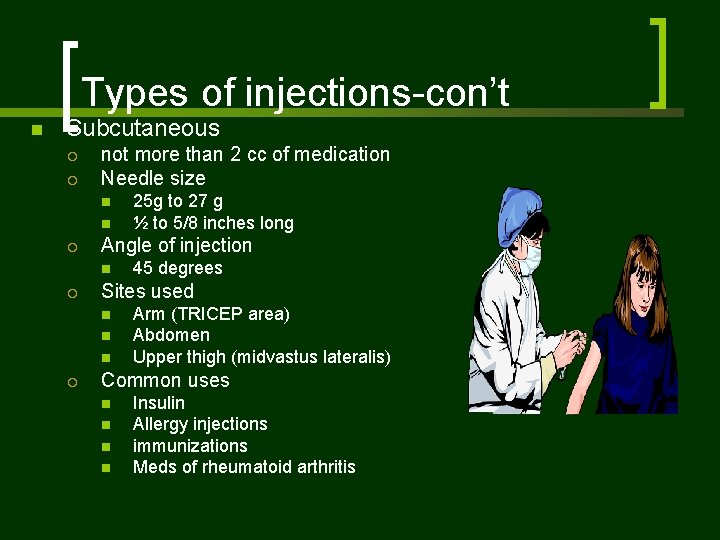
Types of injections-con’t n Subcutaneous ¡ ¡ not more than 2 cc of medication Needle size n n ¡ Angle of injection n ¡ 45 degrees Sites used n n n ¡ 25 g to 27 g ½ to 5/8 inches long Arm (TRICEP area) Abdomen Upper thigh (midvastus lateralis) Common uses n n Insulin Allergy injections immunizations Meds of rheumatoid arthritis
Types of injections-con’t n Intramuscular ¡ ¡ Made into the muscle tissue Common sites n n ¡ Needle size n n ¡ 1 -3 inches long 18 -23 guage-( dependent of the substance being injected and patient size) Angle of needle n ¡ Deltoid (upper outer) Gluteus medious (upper outer portion of the hip) Ventrogluteal (lateral outside portion of the hip) Vastus lateralis (midportion of the thigh) 90 degrees Types of medications n n n Pain Antinausea chemotherapy
Types of injections-con’t n Intravenous ¡ ¡ ¡ Only given by a nurse of MD Medications are introduced directly into the bloodstream Needle size n n ¡ Amount n ¡ 1 -11/2 inches 20 - 21 gauge a few ml to large IV drip (piggy back, primary) Types of medications n n Pain, Anitibiotics Vitamins hydration
Preparing the patient n n n Calm anxiety and fears by explaining the procedure to them Don’t allow to view the needle Pediatric patients need added help to restrain Get consent-usually written Secure the site
Preparing the patient-con’t n Select the site ¡ Dependent on medication n ¡ Size of patient n n ¡ Amount Painful type Weight Muscular development Age of patient
Preparing the site v v v Remove restrictive clothing Apply gloves Clean the site Prepare the medication Position the patient decrease muscle tightness v v leg/arm/=sitting down gluteal=standing or lying down
Vials and Ampules n n Many medications come in vial or ampule form Vial=closed lid with a stopper on the top Ampule= glass container that must be opened Medication is drawn into a syringe for administration.
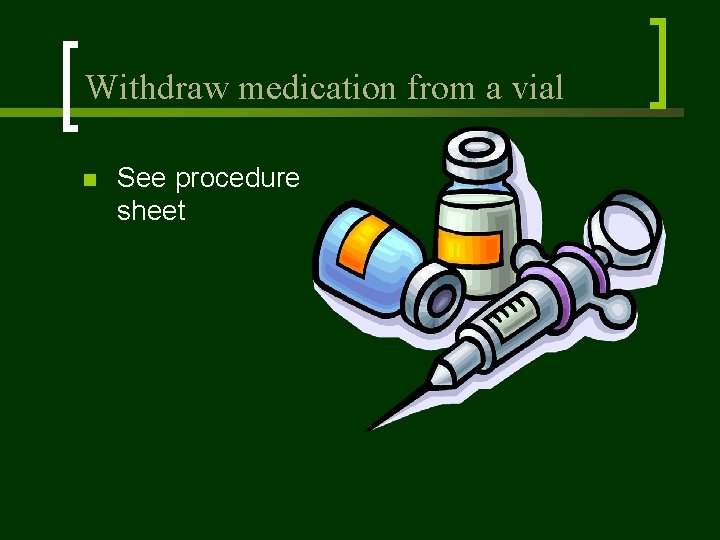
Withdraw medication from a vial n See procedure sheet
Give an intradermal injection n See procedure sheet
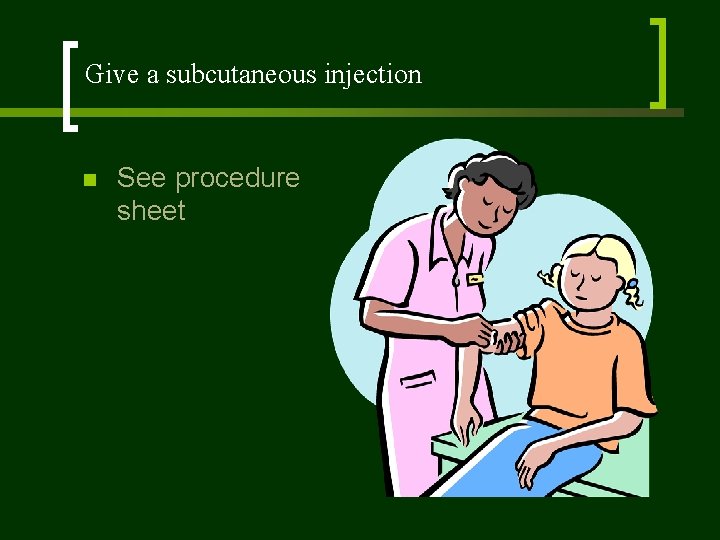
Give a subcutaneous injection n See procedure sheet
Give an intramuscular injection n See procedure sheet
Intravenous medications
- Slides: 16