
Objectives Know the following definitions w Natural Selection
Objectives • Know the following definitions: w Natural Selection w Adaptive Radiation • Understand the steps involved in Primary and Secondary Succession • Explain how Droughts, floods, and insects can all affect mature communities (communities make up ecosystems).
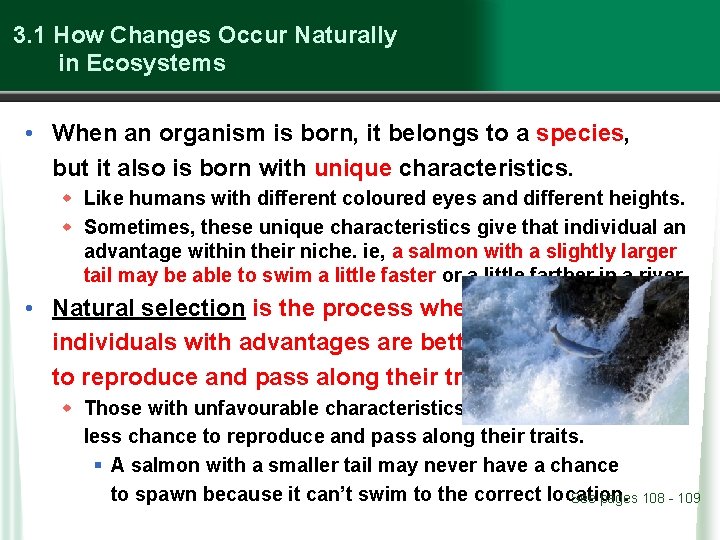
3. 1 How Changes Occur Naturally in Ecosystems • When an organism is born, it belongs to a species, but it also is born with unique characteristics. w Like humans with different coloured eyes and different heights. w Sometimes, these unique characteristics give that individual an advantage within their niche. ie, a salmon with a slightly larger tail may be able to swim a little faster or a little farther in a river. • Natural selection is the process where individuals with advantages are better able to reproduce and pass along their traits. w Those with unfavourable characteristics have less chance to reproduce and pass along their traits. § A salmon with a smaller tail may never have a chance to spawn because it can’t swim to the correct location. See pages 108 - 109
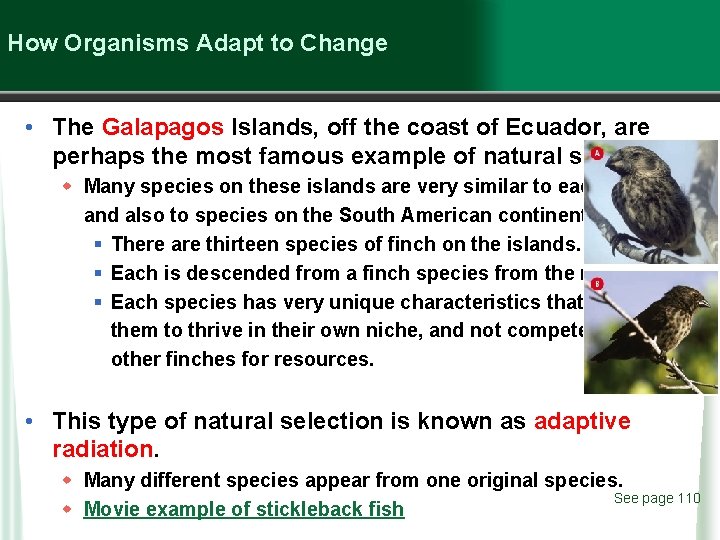
How Organisms Adapt to Change • The Galapagos Islands, off the coast of Ecuador, are perhaps the most famous example of natural selection. Galapagos w Many species on these islands are very similar to each other, finches and also to species on the South American continent. § There are thirteen species of finch on the islands. § Each is descended from a finch species from the mainland. § Each species has very unique characteristics that allow them to thrive in their own niche, and not compete with other finches for resources. • This type of natural selection is known as adaptive radiation. w Many different species appear from one original species. See page 110 w Movie example of stickleback fish
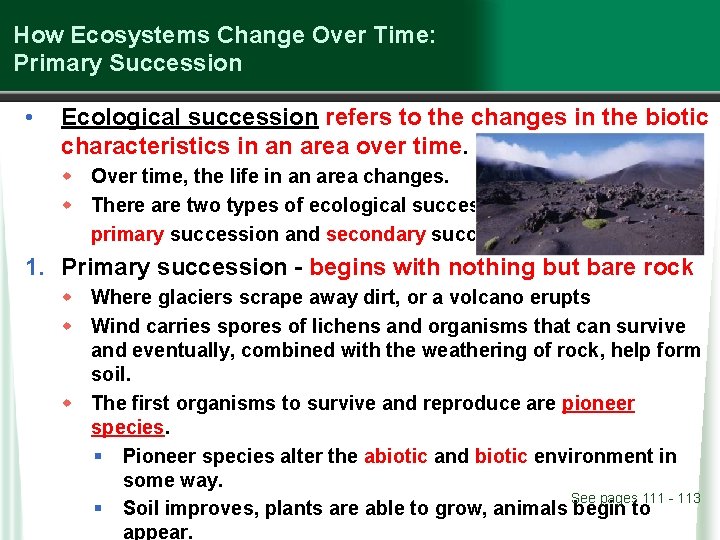
How Ecosystems Change Over Time: Primary Succession • Ecological succession refers to the changes in the biotic characteristics in an area over time. w Over time, the life in an area changes. w There are two types of ecological succession: primary succession and secondary succession. 1. Primary succession - begins with nothing but bare rock w Where glaciers scrape away dirt, or a volcano erupts w Wind carries spores of lichens and organisms that can survive and eventually, combined with the weathering of rock, help form soil. w The first organisms to survive and reproduce are pioneer species. § Pioneer species alter the abiotic and biotic environment in some way. See pages 111 - 113 § Soil improves, plants are able to grow, animals begin to appear.
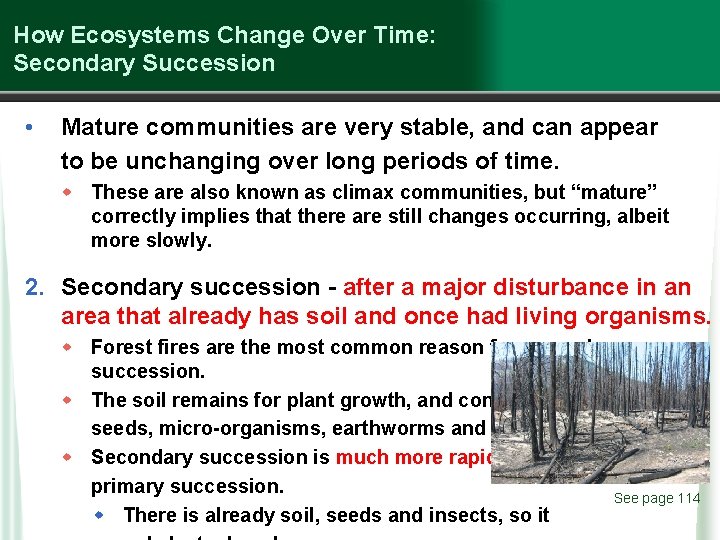
How Ecosystems Change Over Time: Secondary Succession • Mature communities are very stable, and can appear to be unchanging over long periods of time. w These are also known as climax communities, but “mature” correctly implies that there are still changes occurring, albeit more slowly. 2. Secondary succession - after a major disturbance in an area that already has soil and once had living organisms. w Forest fires are the most common reason for secondary succession. w The soil remains for plant growth, and contains seeds, micro-organisms, earthworms and insects. w Secondary succession is much more rapid than primary succession. See page 114 w There is already soil, seeds and insects, so it
How Natural Events Affect Ecosystems • Many other disturbances can affect mature communities. • Flooding w Water is not contained within natural or artificial barriers. w Generally occurs in locations where water levels can change rapidly. w It can result in soil erosion, as well as the spread of pollutants and harmful bacteria associated with wastes. w Climate change and global warming may be increasing incidents of flooding. w A tsunami occurs when huge waves, from large earthquakes or volcanic eruptions, flood coastal areas. • Drought w Occurs when an area receives a lower than average. See amount of- 116 pages 115 rainfall over a very long period of time.

How Natural Events Affect Ecosystems (continued) • Insect infestations w Many insects play important roles in their ecosystems. w Even insects that appear destructive, such as the mountain pine beetle, actually play a role in the renewal of the forest. § The beetles even have a symbiotic relationship with a species of fungus that inhibits the trees’ ability to use resin for protection. w However, when normal conditions are changed, infestations can occur. § Trees can be stressed from overcrowding, drought or animal grazing, and do not resist the insects as effectively. § A warmer climate, and lack of forest fires, allows the insects to spread much more effectively than in the past. See page 117 w Not only are the trees affected, but so is the entire forest ecosystem, as well as any human industries relying on the
- Slides: 7