
Objectives Introduce thermodynamic property entropy S using the
Objectives • Introduce thermodynamic property entropy (S) using the Clausius inequality • Recognize the fact that the entropy is always increasing for an isolated system (or a system plus its surroundings) based on the increase of entropy principle • Analysis of entopy change of a thermodynamic process (how to use thermodynamic table, ideal gas relation) • Property diagrams involving entropy (T-s and h-s diagrams) • Entropy balance: entropy change = entropy transfer + entropy change
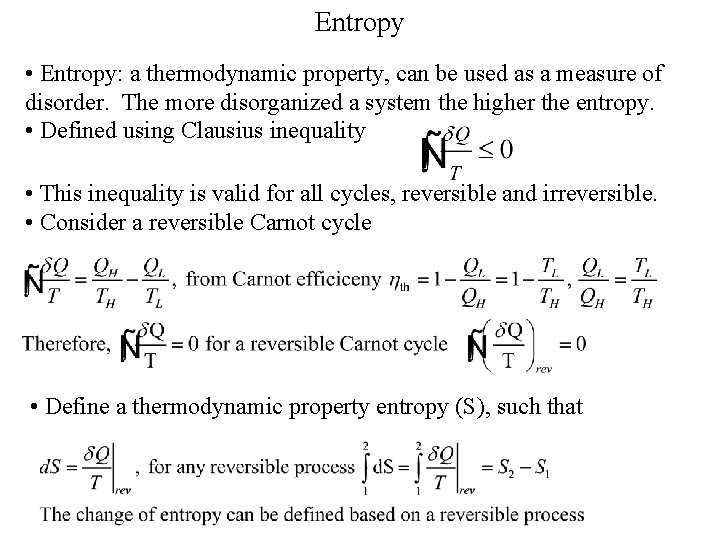
Entropy • Entropy: a thermodynamic property, can be used as a measure of disorder. The more disorganized a system the higher the entropy. • Defined using Clausius inequality • This inequality is valid for all cycles, reversible and irreversible. • Consider a reversible Carnot cycle • Define a thermodynamic property entropy (S), such that
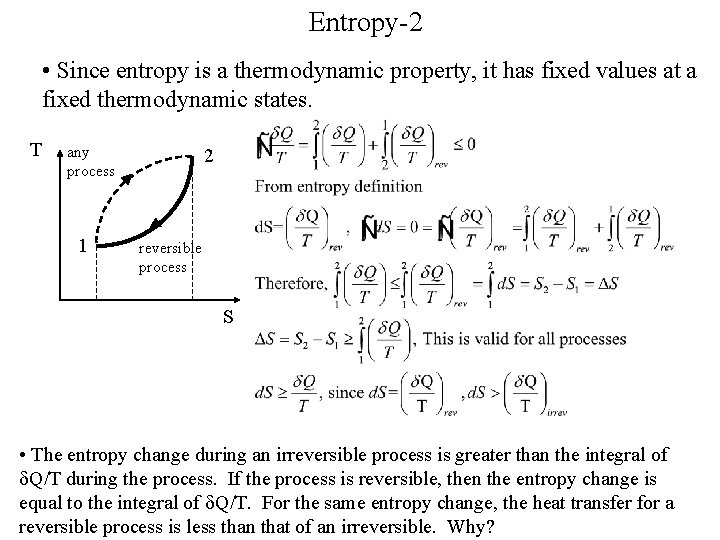
Entropy-2 • Since entropy is a thermodynamic property, it has fixed values at a fixed thermodynamic states. T any process 1 2 reversible process S • The entropy change during an irreversible process is greater than the integral of Q/T during the process. If the process is reversible, then the entropy change is equal to the integral of Q/T. For the same entropy change, the heat transfer for a reversible process is less than that of an irreversible. Why?
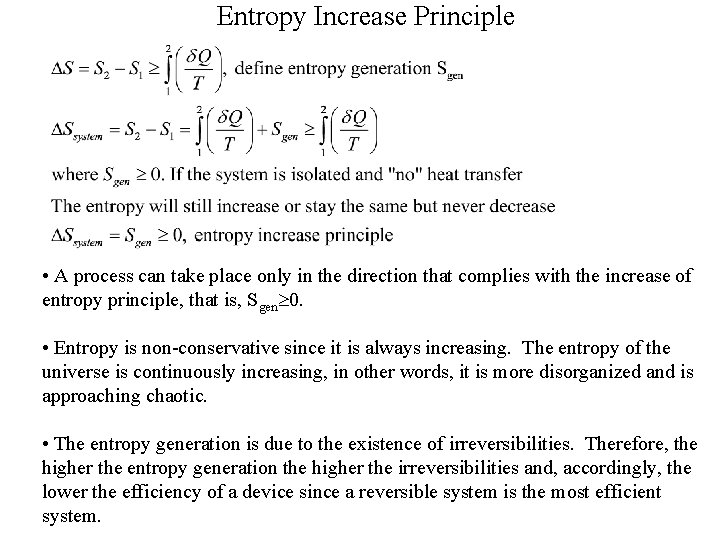
Entropy Increase Principle • A process can take place only in the direction that complies with the increase of entropy principle, that is, Sgen 0. • Entropy is non-conservative since it is always increasing. The entropy of the universe is continuously increasing, in other words, it is more disorganized and is approaching chaotic. • The entropy generation is due to the existence of irreversibilities. Therefore, the higher the entropy generation the higher the irreversibilities and, accordingly, the lower the efficiency of a device since a reversible system is the most efficient system.
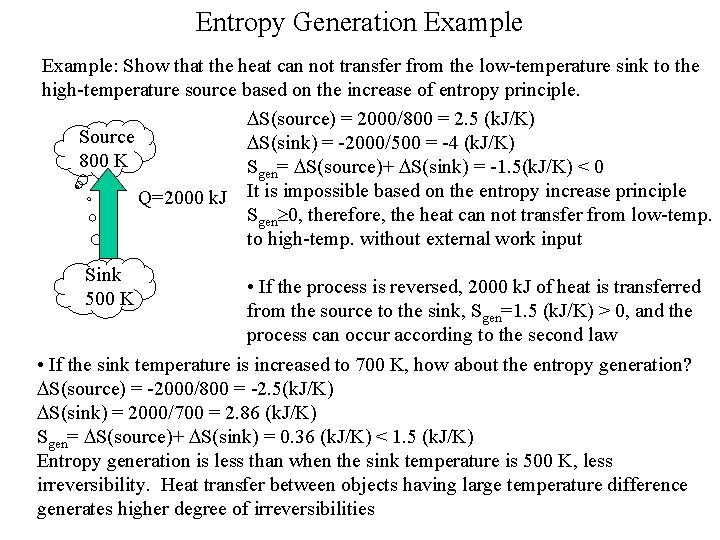
Entropy Generation Example: Show that the heat can not transfer from the low-temperature sink to the high-temperature source based on the increase of entropy principle. DS(source) = 2000/800 = 2. 5 (k. J/K) Source DS(sink) = -2000/500 = -4 (k. J/K) 800 K Sgen= DS(source)+ DS(sink) = -1. 5(k. J/K) < 0 Q=2000 k. J It is impossible based on the entropy increase principle Sgen 0, therefore, the heat can not transfer from low-temp. to high-temp. without external work input Sink 500 K • If the process is reversed, 2000 k. J of heat is transferred from the source to the sink, Sgen=1. 5 (k. J/K) > 0, and the process can occur according to the second law • If the sink temperature is increased to 700 K, how about the entropy generation? DS(source) = -2000/800 = -2. 5(k. J/K) DS(sink) = 2000/700 = 2. 86 (k. J/K) Sgen= DS(source)+ DS(sink) = 0. 36 (k. J/K) < 1. 5 (k. J/K) Entropy generation is less than when the sink temperature is 500 K, less irreversibility. Heat transfer between objects having large temperature difference generates higher degree of irreversibilities
- Slides: 5