
Objectives How was AngloSaxon Britain ruled Objectives To
Objectives How was Anglo-Saxon Britain ruled? Objectives • To find out how Anglo-Saxon kingdoms were organised • To investigate Anglo-Saxon place names ©KS 2 History. com
Starter Activity Five Kingdoms Each group of settlers in Anglo-Saxon times had their own ruler. Some of the rulers became a king (‘cyning’) with his own kingdom to rule. Over time several large main kingdoms were established, and the most powerful of these were Northumbria, Wessex and Mercia. Reminder Have a look at the map of five different Saxon kingdoms in AD 600, we looked at these before https: //tinyurl. com/Saxonmap. We live in East Anglia. ©KS 2 History. com Anglo-Saxons Lesson 5: How were Anglo-Saxon Kingdoms organised?
Main Input Who was in charge? In Anglo-Saxon times, the king was the most important person in each kingdom, and some of the kings liked to claim that they were ‘bretwalda’, or over-king of all Britain. However, the kingdoms were not united and in reality there was nobody who was in charge of all of Britain. ©KS 2 History. com Anglo-Saxons Lesson 5: How were Anglo-Saxon Kingdoms organised?
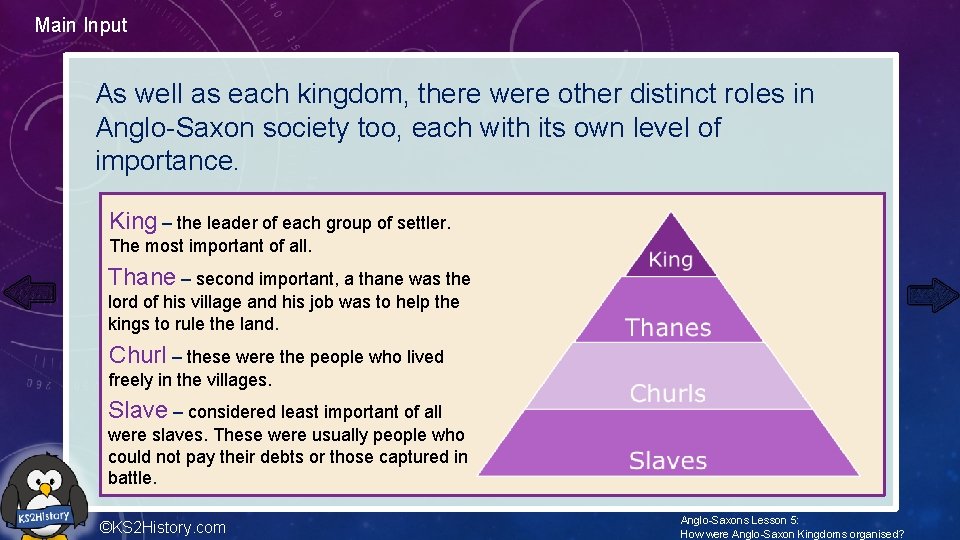
Main Input As well as each kingdom, there were other distinct roles in Anglo-Saxon society too, each with its own level of importance. King – the leader of each group of settler. The most important of all. Thane – second important, a thane was the lord of his village and his job was to help the kings to rule the land. Churl – these were the people who lived freely in the villages. Slave – considered least important of all were slaves. These were usually people who could not pay their debts or those captured in battle. ©KS 2 History. com Anglo-Saxons Lesson 5: How were Anglo-Saxon Kingdoms organised?
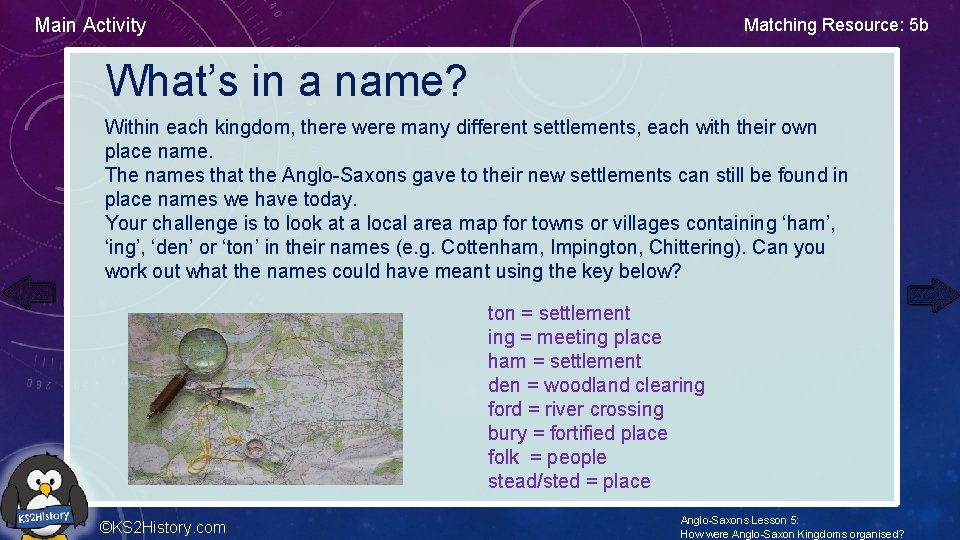
Main Activity Matching Resource: 5 b What’s in a name? Within each kingdom, there were many different settlements, each with their own place name. The names that the Anglo-Saxons gave to their new settlements can still be found in place names we have today. Your challenge is to look at a local area map for towns or villages containing ‘ham’, ‘ing’, ‘den’ or ‘ton’ in their names (e. g. Cottenham, Impington, Chittering). Can you work out what the names could have meant using the key below? ton = settlement ing = meeting place ham = settlement den = woodland clearing ford = river crossing bury = fortified place folk = people stead/sted = place ©KS 2 History. com Anglo-Saxons Lesson 5: How were Anglo-Saxon Kingdoms organised?
You’re in charge! Imagine that you are the king of one of the Anglo-Saxon kingdoms. You have the power to rule however you like! v Which kingdom are you in charge of? v What new laws would you like to introduce? v How would you deal with people who did not keep your laws? v How would you stop other kingdoms attacking yours? ©KS 2 History. com Anglo-Saxons Lesson 5: How were Anglo-Saxon Kingdoms organised?
- Slides: 6