
Objectives How do we describe the natural world
Objectives § How do we describe the natural world? § Crafting your research question § We will review Descriptive/Qualitative designs § Discuss core elements of an Experimental/Quantitative research design 1
What Does Research Methods Allow us to Do? Describe the world Made predictions (hypotheses)
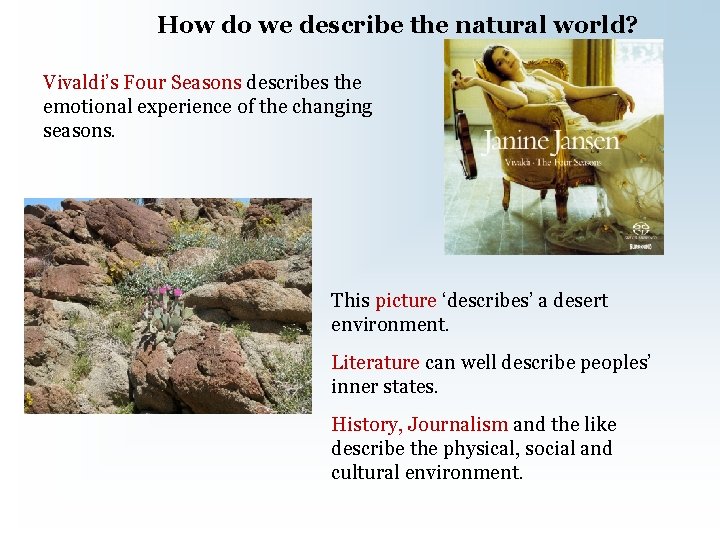
How do we describe the natural world? Vivaldi’s Four Seasons describes the emotional experience of the changing seasons. This picture ‘describes’ a desert environment. Literature can well describe peoples’ inner states. History, Journalism and the like describe the physical, social and cultural environment.
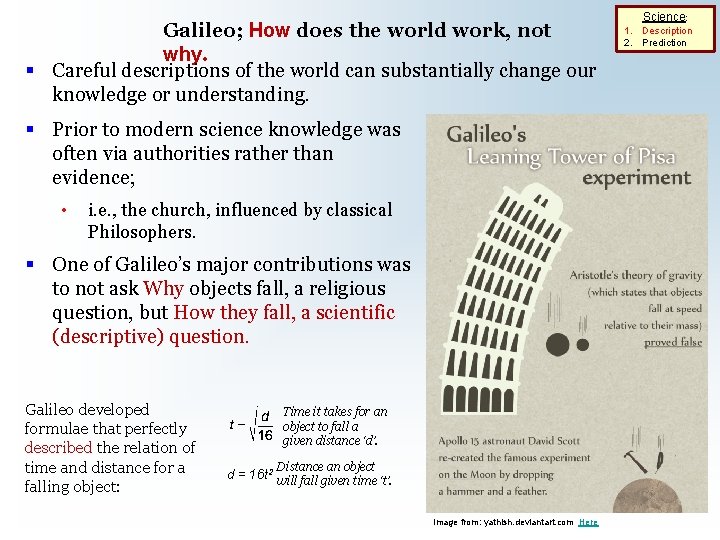
Galileo; How does the world work, not why. § Careful descriptions of the world can substantially change our knowledge or understanding. § Prior to modern science knowledge was often via authorities rather than evidence; • i. e. , the church, influenced by classical Philosophers. § One of Galileo’s major contributions was to not ask Why objects fall, a religious question, but How they fall, a scientific (descriptive) question. Galileo developed formulae that perfectly described the relation of time and distance for a falling object: Time it takes for an object to fall a given distance ‘d’. d = 16 t 2 Distance an object will fall given time ‘t’. Image from: yathish. deviantart. com Here Science: 1. Description 2. Prediction
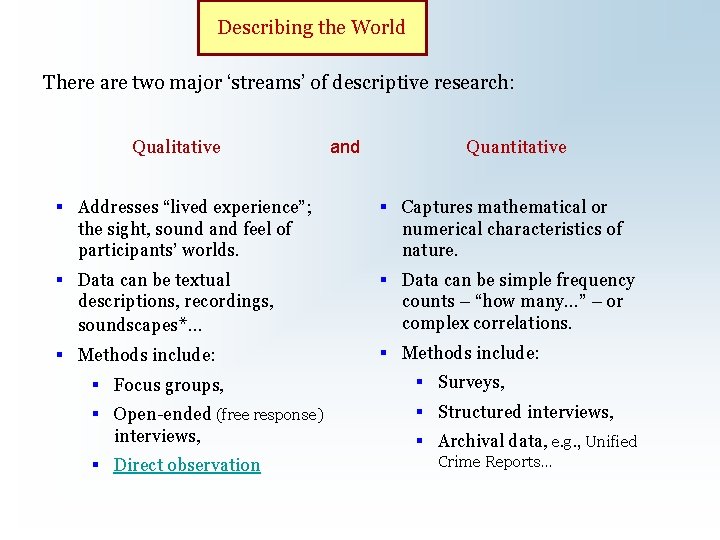
Describing the World There are two major ‘streams’ of descriptive research: Qualitative and Quantitative § Addresses “lived experience”; the sight, sound and feel of participants’ worlds. § Captures mathematical or numerical characteristics of nature. § Data can be textual descriptions, recordings, soundscapes*… § Data can be simple frequency counts – “how many…” – or complex correlations. § Methods include: § Focus groups, § Surveys, § Open-ended (free response) interviews, § Structured interviews, § Direct observation § Archival data, e. g. , Unified Crime Reports…
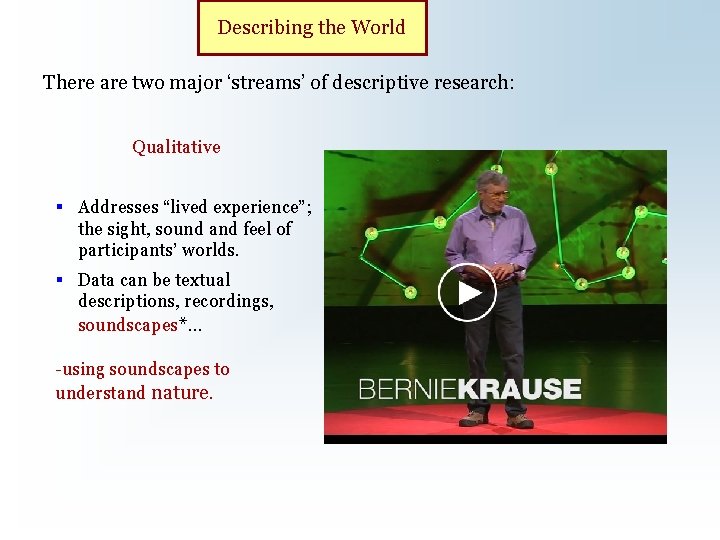
Describing the World There are two major ‘streams’ of descriptive research: Qualitative § Addresses “lived experience”; the sight, sound and feel of participants’ worlds. § Data can be textual descriptions, recordings, soundscapes*… -using soundscapes to understand nature.
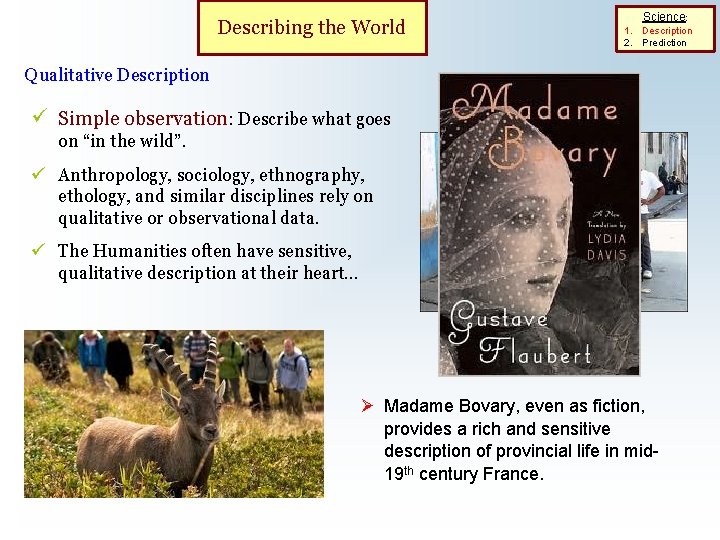
Describing the World Science: 1. Description 2. Prediction Qualitative Description ü Simple observation: Describe what goes on “in the wild”. ü Anthropology, sociology, ethnography, ethology, and similar disciplines rely on qualitative or observational data. ü The Humanities often have sensitive, qualitative description at their heart… Ø Madame Bovary, even as fiction, provides a rich and sensitive description of provincial life in mid 19 th century France.
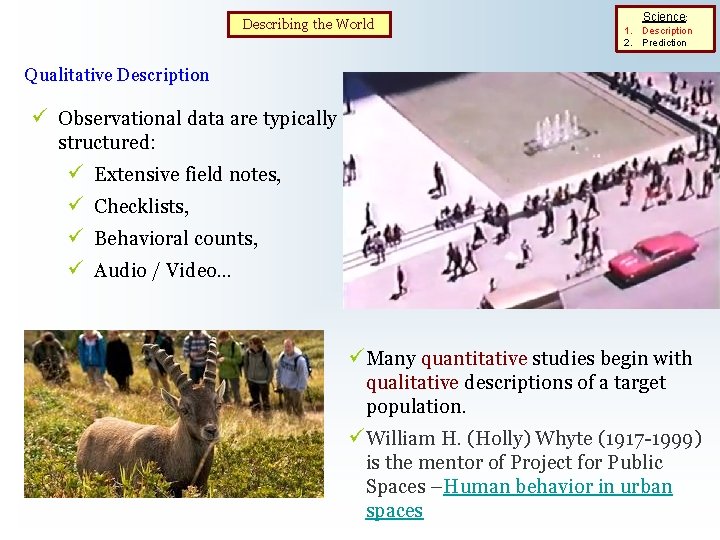
Describing the World Science: 1. Description 2. Prediction Qualitative Description ü Observational data are typically structured: ü ü Extensive field notes, Checklists, Behavioral counts, Audio / Video… ü Many quantitative studies begin with qualitative descriptions of a target population. ü William H. (Holly) Whyte (1917 -1999) is the mentor of Project for Public Spaces –Human behavior in urban spaces
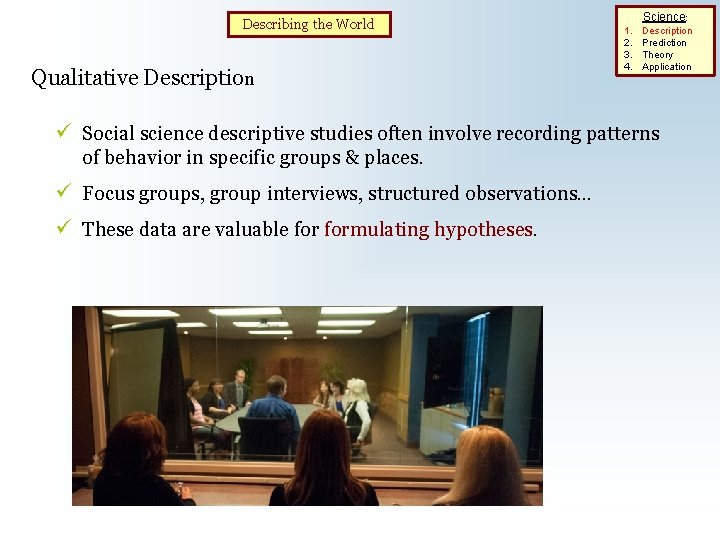
Describing the World Qualitative Description 1. 2. 3. 4. Science: Description Prediction Theory Application ü Social science descriptive studies often involve recording patterns of behavior in specific groups & places. ü Focus groups, group interviews, structured observations… ü These data are valuable formulating hypotheses.

Focus Group Coding
Now is the time to craft the idea into more of a reality § Who am I as a [your discipline] researcher and what kinds of questions do I want to answer? What do I want to describe in the world? § Avoid the problems listed on the following slide § The point of the exercise is to stretch your mind to approach your area of interest from as many different ways as possible so you can find the research question best for you.
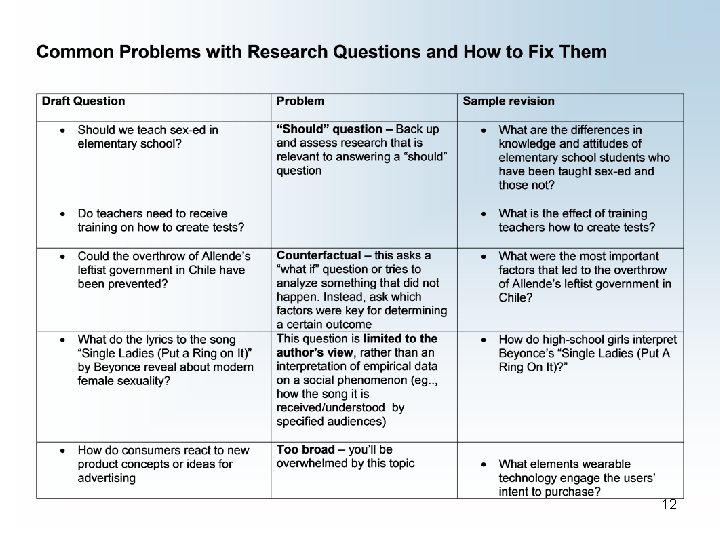
12
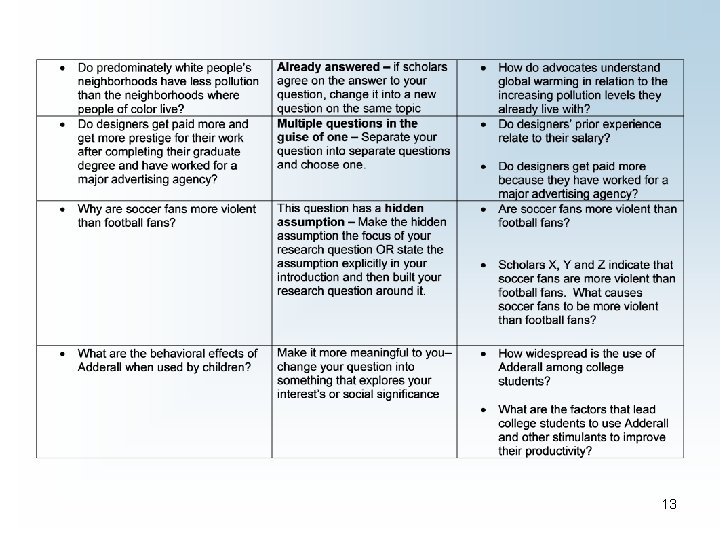
13
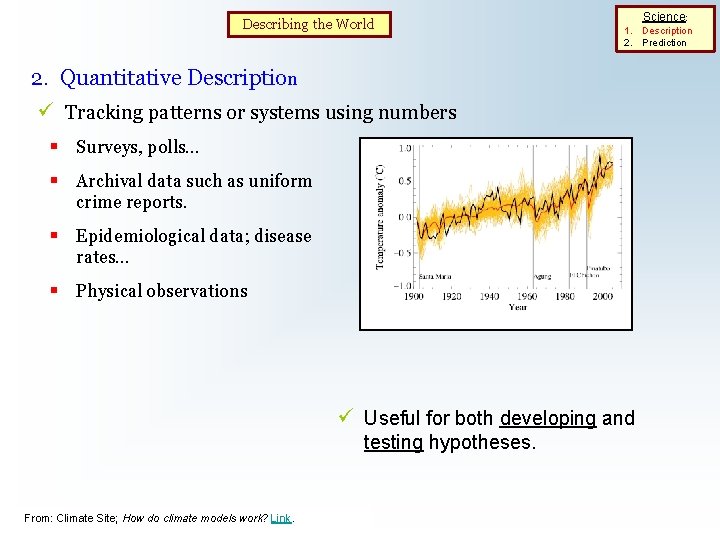
Describing the World Science: 1. Description 2. Prediction 2. Quantitative Description ü Tracking patterns or systems using numbers § Surveys, polls… § Archival data such as uniform crime reports. § Epidemiological data; disease rates… § Physical observations ü Useful for both developing and testing hypotheses. From: Climate Site; How do climate models work? Link.
2. Making Predictions • Practical applications: n n What traits predicts talent in people? Can I predict which employees will be most successful? These applications (should) stem from a theory. n Delay of gratification and motivation Talent n A specific personality constellation Career Success… That is (or should be…) supported by empirical evidence. Science: 1. Description 2. Prediction
Predictions Science: 1. Description 2. Prediction • Practical applications: n Testing hypotheses: ü An hypothesis is a testable prediction § Correlational research; § I predict that cultures undergoing rapid economic change will be prone to irrational beliefs. § Experimental research; § I predict that interventions to stabilize economic conditions will decrease people’s irrational beliefs.

Experimental designs and validity Internal validity § In experiments we manipulate (induce…) the Independent Variable. § We then measure the Dependent Variable. § Experimental hypothesis: the outcome (the level of the Dependent Variable) is caused by – and only by – the Independent Variable. § Internal validity: How confident are we that the outcome was due only to the Independent Variable. § Confound: A variable other than the IV that caused or influenced the result. § Did the participants in the experimental v. control groups differ on something other than the IV? § Were the procedures biased in some way…?

Examples of Field and Laboratory Experiments 18
Starts with a Question: Can People Be Wrong About Whether They Are Sexually Aroused? Assumptions • Sexual arousal may not be accurately attributed. • Ambiguities of sexual arousal – Sexual stimulation may affect the brain, or the genitals, neither, or both – The disconnect between the brain and the genitals is greater among women than men.
Research Design: Field Experiment • Dutton & Aron (1974) examined the mis-interpretation of arousal according to environmental feedback • Male participants crossed either • a wobbly suspension bridge high over a canyon = high anxiety OR • or a solid bridge only 10 feet above a brook =low anxiety • As each participant crossed the bridge, an attractive female research assistant approached and • administered questionnaire about some ambiguous pictures of people • gave him her phone number in case he had questions about the study
Is there a misattribution of arousal? • IV: ? • DVs: sexual themes in pictures; Later calls or does not call the attractive female E • Hypothesis: Men who had crossed the scary bridge were ____likely to call the attractive female E than those who had crossed the standard bridge.

• Results: confirmed hypothesis • Conclusion: The arousal that occurred on the wobbly suspension bridge was fear, but participants misattributed it to sexual arousal because of the presence of the attractive research assistant
Methodological issues • Experimental methods in field • Naturalistic settings outside laboratory • Field experiments have high external validity • Less control over extraneous variables • More difficult to obtain subjective measures (usually relies on observed behavior)
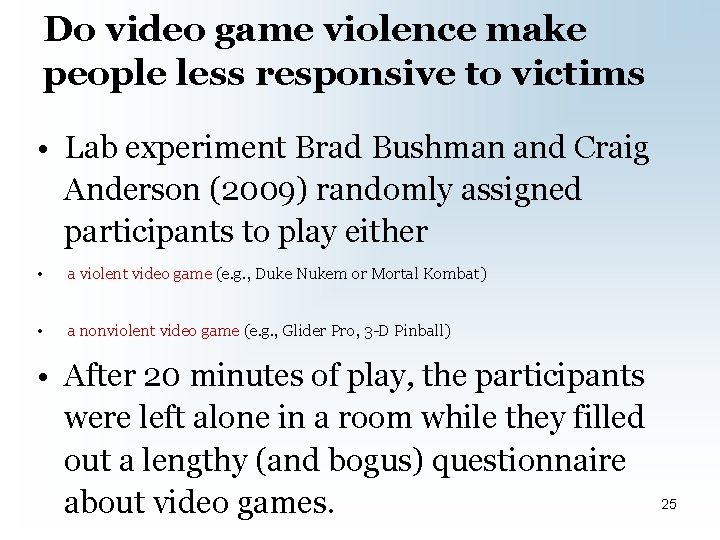
Do video game violence make people less responsive to victims • Lab experiment Brad Bushman and Craig Anderson (2009) randomly assigned participants to play either • a violent video game (e. g. , Duke Nukem or Mortal Kombat) • a nonviolent video game (e. g. , Glider Pro, 3 -D Pinball) • After 20 minutes of play, the participants were left alone in a room while they filled out a lengthy (and bogus) questionnaire about video games. 25
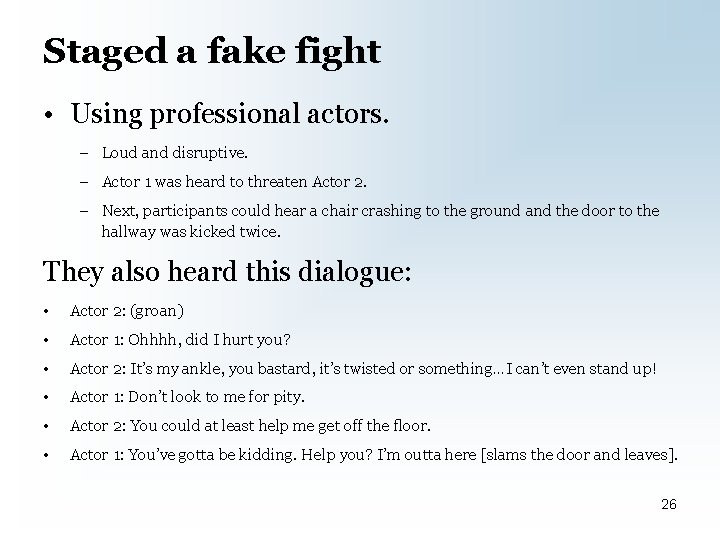
Staged a fake fight • Using professional actors. – Loud and disruptive. – Actor 1 was heard to threaten Actor 2. – Next, participants could hear a chair crashing to the ground and the door to the hallway was kicked twice. They also heard this dialogue: • Actor 2: (groan) • Actor 1: Ohhhh, did I hurt you? • Actor 2: It’s my ankle, you bastard, it’s twisted or something…I can’t even stand up! • Actor 1: Don’t look to me for pity. • Actor 2: You could at least help me get off the floor. • Actor 1: You’ve gotta be kidding. Help you? I’m outta here [slams the door and leaves]. 26
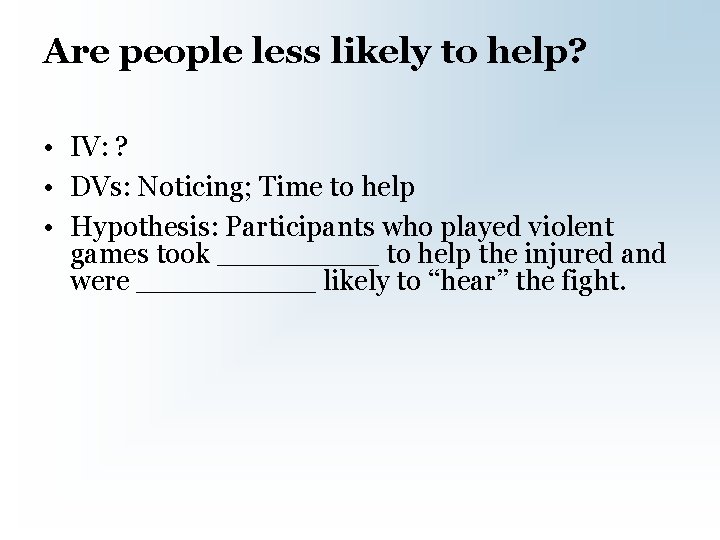
Are people less likely to help? • IV: ? • DVs: Noticing; Time to help • Hypothesis: Participants who played violent games took _____ to help the injured and were _____ likely to ‘‘hear’’ the fight.
• Results: confirmed hypothesis • Conclusion: media violence can desensitize individuals and reduce helping behavior
Methodological issues • contrived nature • potential for demand characteristics. • highly unnatural “fight” with stilted dialogue breaking out improbably in a psychology laboratory (just after one has played a violent video game)
Final thoughts: If you were to do an experiment on our focus group data, what would that look like? 30
- Slides: 30