
OBJECTIVES Group Presentation Submission of Draft Lesson Plan
OBJECTIVES Group Presentation Submission of Draft Lesson Plan Questions about Journal Article Teaching Concepts
THE UNIVERSITY OF THE WEST INDIES School of Continuing Studies Certificate in Physical Education The Fundamentals of Elementary Physical Education SESSION #7 Teaching Concepts and Content. Specific Pedagogy
Teaching Games and Sports The game can be more than the combination of skills. Each game or sport consists of many different motor skills that must be acquired and used in conjunction with each other. Players must learn to use these skills appropriately in offensive and defensive (tactical) frameworks.
The Games Stages
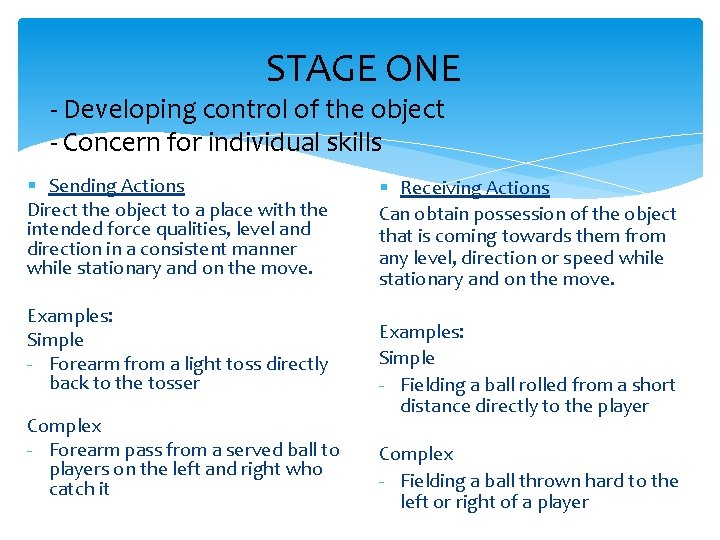
STAGE ONE - Developing control of the object - Concern for individual skills § Sending Actions Direct the object to a place with the intended force qualities, level and direction in a consistent manner while stationary and on the move. Examples: Simple - Forearm from a light toss directly back to the tosser Complex - Forearm pass from a served ball to players on the left and right who catch it § Receiving Actions Can obtain possession of the object that is coming towards them from any level, direction or speed while stationary and on the move. Examples: Simple - Fielding a ball rolled from a short distance directly to the player Complex - Fielding a ball thrown hard to the left or right of a player
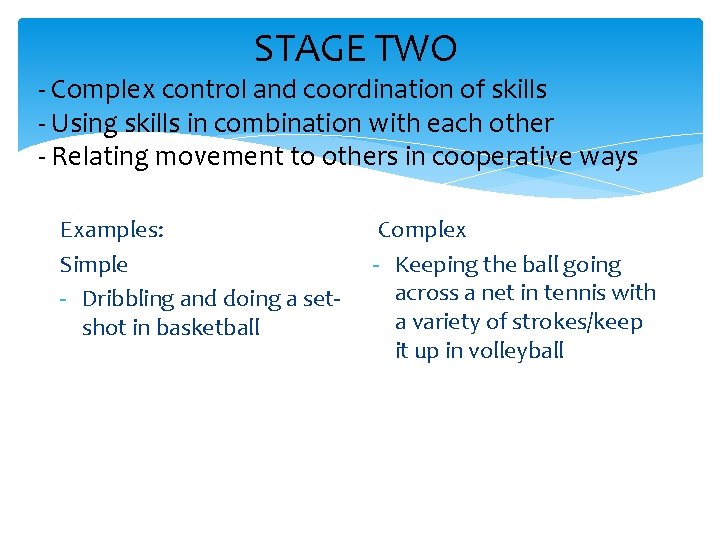
STAGE TWO - Complex control and coordination of skills - Using skills in combination with each other - Relating movement to others in cooperative ways Examples: Simple - Dribbling and doing a setshot in basketball Complex - Keeping the ball going across a net in tennis with a variety of strokes/keep it up in volleyball
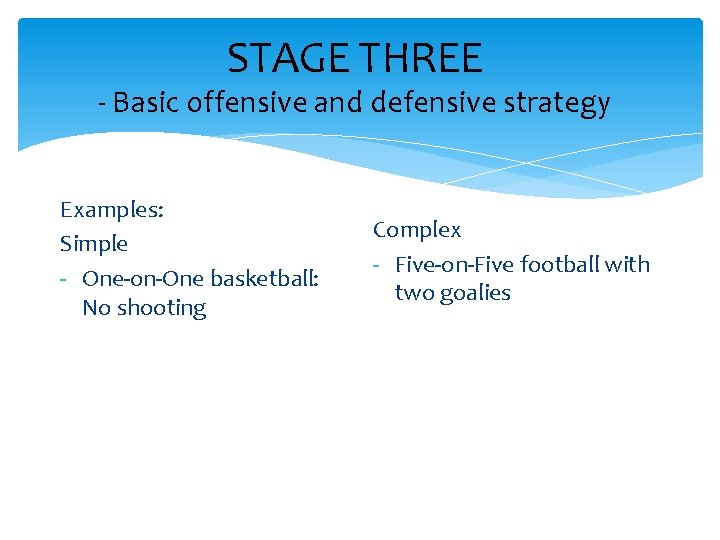
STAGE THREE - Basic offensive and defensive strategy Examples: Simple - One-on-One basketball: No shooting Complex - Five-on-Five football with two goalies
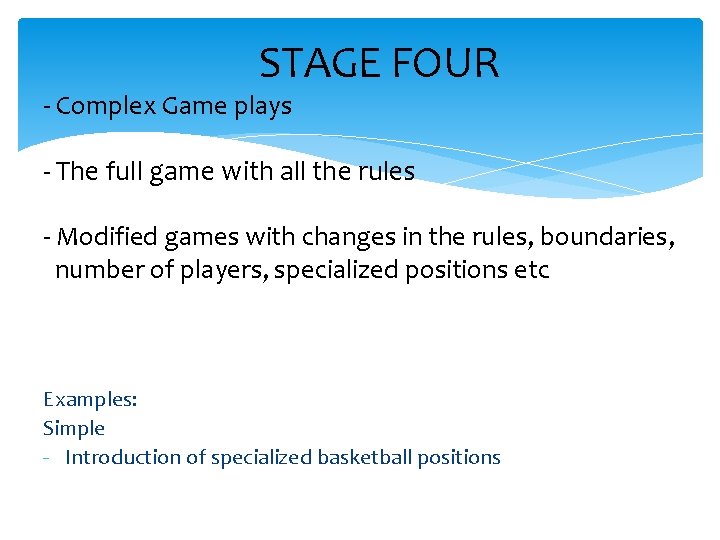
STAGE FOUR - Complex Game plays - The full game with all the rules - Modified games with changes in the rules, boundaries, number of players, specialized positions etc Examples: Simple - Introduction of specialized basketball positions
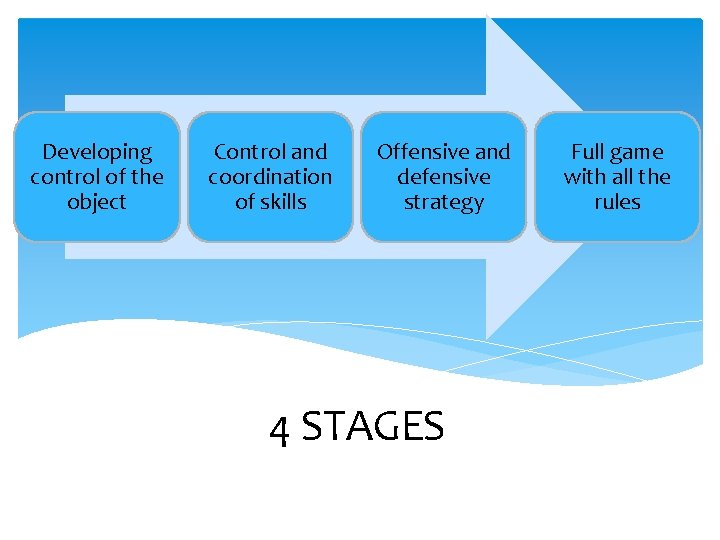
Developing control of the object Control and coordination of skills Offensive and defensive strategy 4 STAGES Full game with all the rules
Considerations for Using the Games Stages 1. Students do not leave one stage when they are ready for another. 2. Physical Education programmes tend to neglect stages 2 and 3 3. Analysis of skills and strategies in a game can help with the determination 4. of skill requirements 5. PAGES 286 -290
Teaching the Understanding of Basic Strategies of a Type of Game ‘What is meaningful to the student is playing the game’ Reduce the game or sport to its essence - Example 2 offensive players against a defender The skill will emerge when the game demands it Control of the equipment may be essential for some games The teacher can… - Reduce the manipulative skills used in the game OR - Allow the students the time to develop control
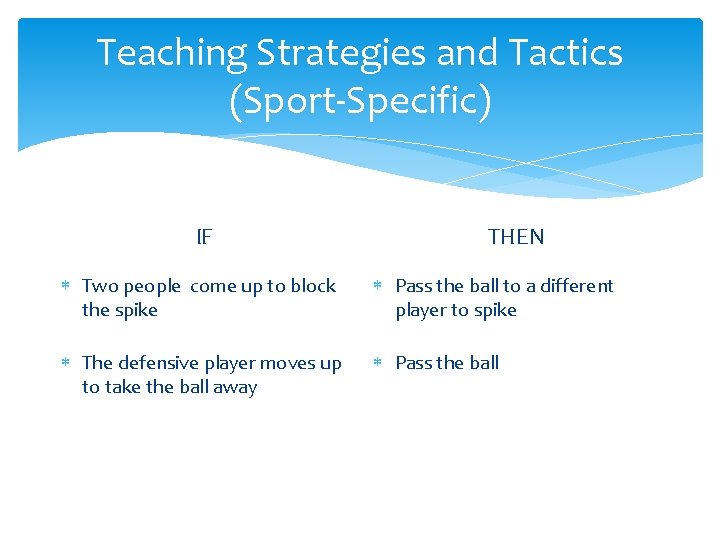
Teaching Strategies and Tactics (Sport-Specific) IF THEN Two people come up to block the spike Pass the ball to a different player to spike The defensive player moves up to take the ball away Pass the ball
Teaching Movement Concepts
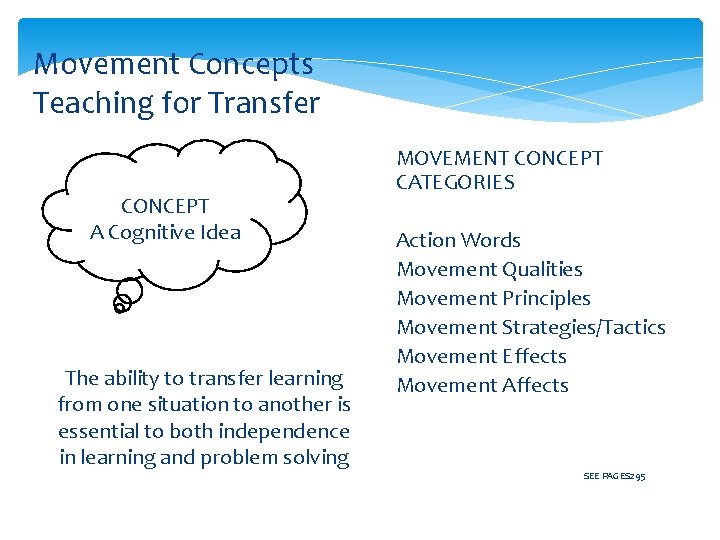
Movement Concepts Teaching for Transfer CONCEPT A Cognitive Idea The ability to transfer learning from one situation to another is essential to both independence in learning and problem solving MOVEMENT CONCEPT CATEGORIES Action Words Movement Qualities Movement Principles Movement Strategies/Tactics Movement Effects Movement Affects SEE PAGES 295
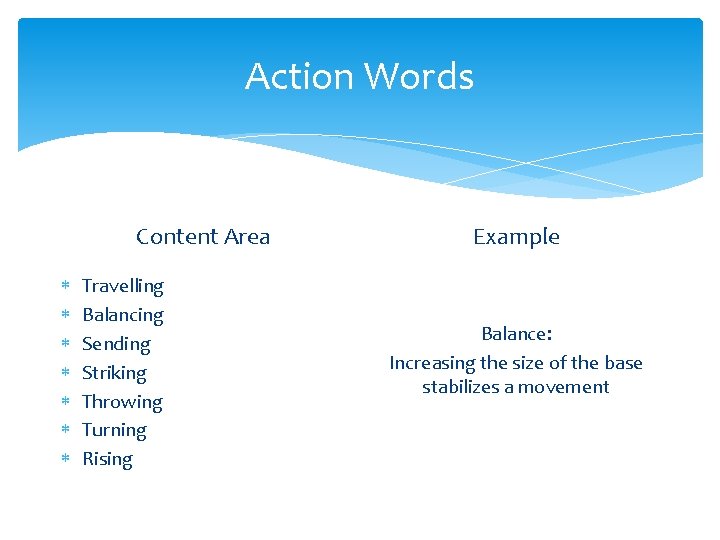
Action Words Content Area Travelling Balancing Sending Striking Throwing Turning Rising Example Balance: Increasing the size of the base stabilizes a movement
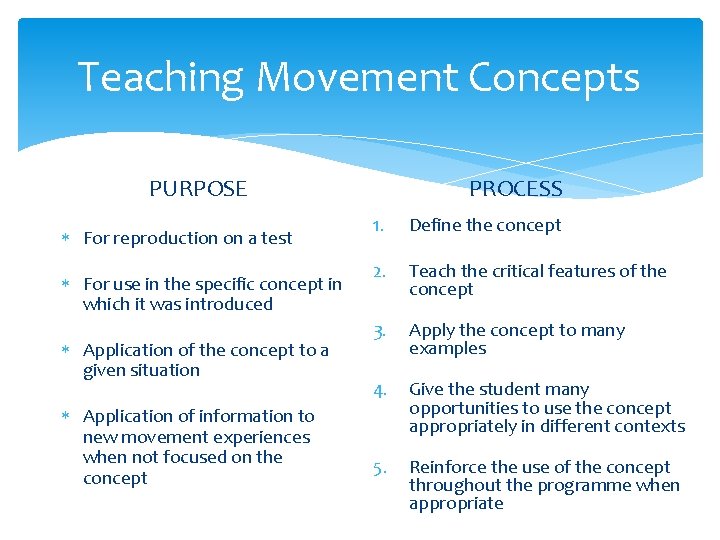
Teaching Movement Concepts PURPOSE For reproduction on a test For use in the specific concept in which it was introduced Application of the concept to a given situation Application of information to new movement experiences when not focused on the concept PROCESS 1. Define the concept 2. Teach the critical features of the concept 3. Apply the concept to many examples 4. Give the student many opportunities to use the concept appropriately in different contexts 5. Reinforce the use of the concept throughout the programme when appropriate
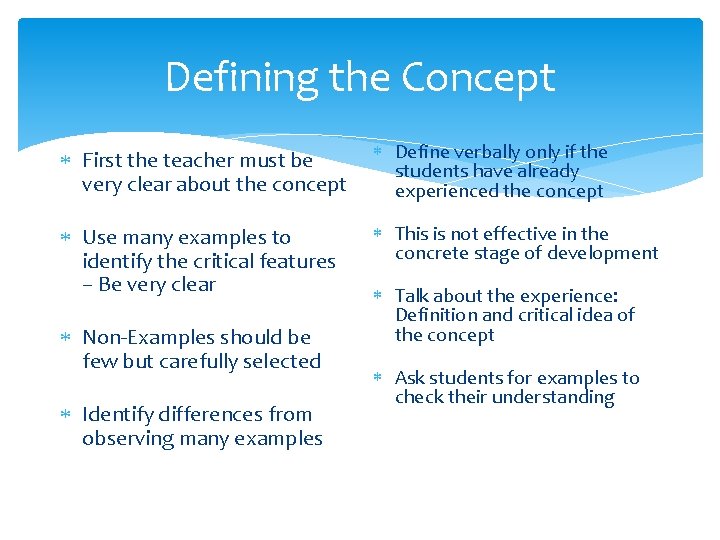
Defining the Concept First the teacher must be very clear about the concept Define verbally only if the students have already experienced the concept Use many examples to identify the critical features – Be very clear This is not effective in the concrete stage of development Non-Examples should be few but carefully selected Identify differences from observing many examples Talk about the experience: Definition and critical idea of the concept Ask students for examples to check their understanding
Content-Specific Pedagogy - FITNESS - GYMNASTICS - DANCE - OUTDOOR PURSUITS
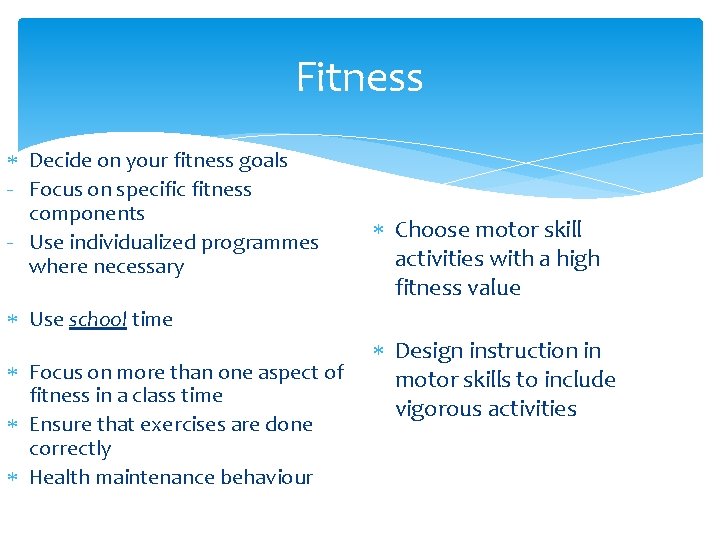
Fitness Decide on your fitness goals - Focus on specific fitness components - Use individualized programmes where necessary Choose motor skill activities with a high fitness value Use school time Focus on more than one aspect of fitness in a class time Ensure that exercises are done correctly Health maintenance behaviour Design instruction in motor skills to include vigorous activities
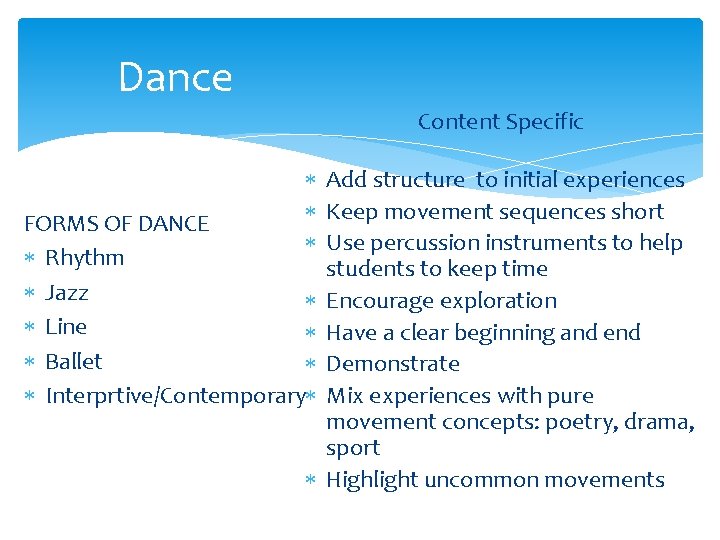
Dance Content Specific Add structure to initial experiences Keep movement sequences short FORMS OF DANCE Use percussion instruments to help Rhythm students to keep time Jazz Encourage exploration Line Have a clear beginning and end Ballet Demonstrate Interprtive/Contemporary Mix experiences with pure movement concepts: poetry, drama, sport Highlight uncommon movements
Educational Gymnastics Safety - Many movements require high degrees of upper body strength, abdominal strength and flexibility. - Allow students to develop prerequisites or simplify skill - Students should be taught how to manage their own body weight Tailor the movements to (no crashing, control movements) the students - Use of mats and other equipment Good form is encouraged - Spotting Rest-off equipment - S. T. O. P. Use video assessment Work towards a goal
Outdoor Pursuits Examples Kayaking, Orienteering, Skiing, Bicycling, Canoeing, Sailing, Ropes Courses, Camping, Map Reading Guidelines Safety Keep class sizes small Move from simple to complex basic concepts Direct students to clubs Field trip Allow experts to visit the classroom
Bibliography Rink, J (1998) - Teaching Physical Education for Learning Chapter 13
- Slides: 23