
Objectives Finish with Heat transfer Learn about Psychometrics
Objectives Finish with Heat transfer Learn about Psychometrics • Psychometric chart
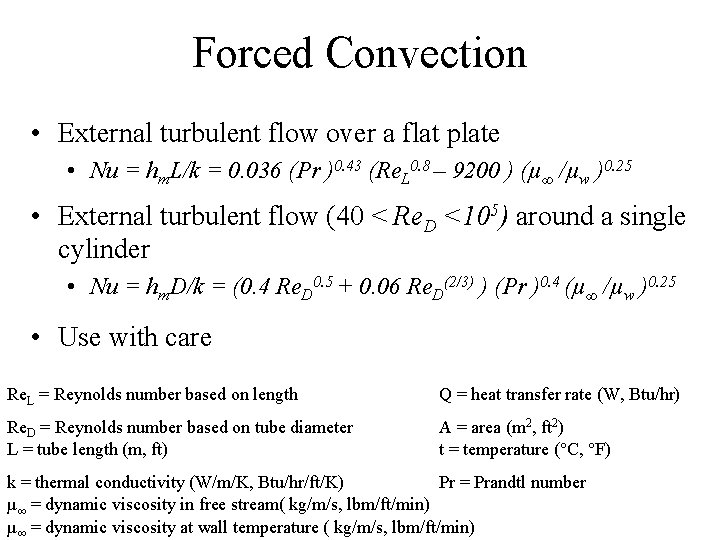
Forced Convection • External turbulent flow over a flat plate • Nu = hm. L/k = 0. 036 (Pr )0. 43 (Re. L 0. 8 – 9200 ) (µ∞ /µw )0. 25 • External turbulent flow (40 < Re. D <105) around a single cylinder • Nu = hm. D/k = (0. 4 Re. D 0. 5 + 0. 06 Re. D(2/3) ) (Pr )0. 4 (µ∞ /µw )0. 25 • Use with care Re. L = Reynolds number based on length Q = heat transfer rate (W, Btu/hr) Re. D = Reynolds number based on tube diameter L = tube length (m, ft) A = area (m 2, ft 2) t = temperature (°C, °F) k = thermal conductivity (W/m/K, Btu/hr/ft/K) Pr = Prandtl number µ∞ = dynamic viscosity in free stream( kg/m/s, lbm/ft/min) µ∞ = dynamic viscosity at wall temperature ( kg/m/s, lbm/ft/min)
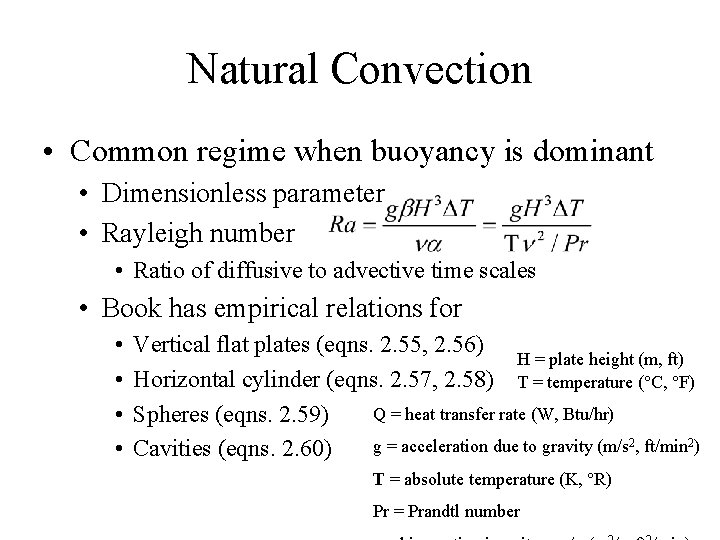
Natural Convection • Common regime when buoyancy is dominant • Dimensionless parameter • Rayleigh number • Ratio of diffusive to advective time scales • Book has empirical relations for • • Vertical flat plates (eqns. 2. 55, 2. 56) H = plate height (m, ft) Horizontal cylinder (eqns. 2. 57, 2. 58) T = temperature (°C, °F) Q = heat transfer rate (W, Btu/hr) Spheres (eqns. 2. 59) g = acceleration due to gravity (m/s 2, ft/min 2) Cavities (eqns. 2. 60) T = absolute temperature (K, °R) Pr = Prandtl number

Phase Change –Boiling • What temperature does water boil under ideal conditions?

Radiation • Transfer of energy by electromagnetic radiation • Does not require matter (only requires that the bodies can “see” each other) • 100 – 10, 000 nm (mostly IR)
Surface Radiation Issues 1) Surface properties are spectral, f(λ) Usually: assume integrated properties for two beams: Short-wave and Long-wave radiation 2) Surface properties are directional, f(θ) Usually assume diffuse
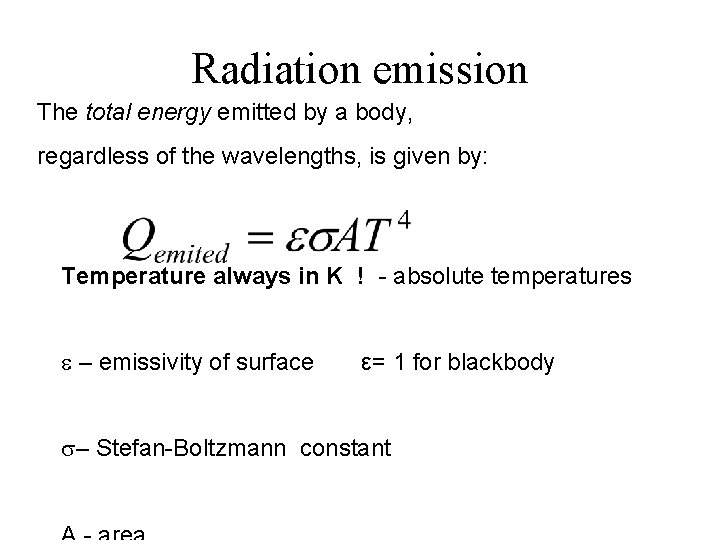
Radiation emission The total energy emitted by a body, regardless of the wavelengths, is given by: Temperature always in K ! - absolute temperatures e – emissivity of surface ε= 1 for blackbody s– Stefan-Boltzmann constant
Short-wave & long-wave radiation • Short-wave – solar radiation • <3 mm • Glass is transparent • Does not depend on surface temperature • Long-wave – surface or temperature radiation • >3 mm • Glass is not transparent • Depends on surface temperature

Radiation Equations Q 1 -2 = Qrad = heat transferred by radiation (W, BTU/hr) F 1 -2 = shape factor hr = radiation heat transfer coefficient (W/m 2/K, Btu/hr/ft 2/F) A = area (ft 2, m 2) T, t = absolute temperature (°R , K) , temperature (°F, °C)
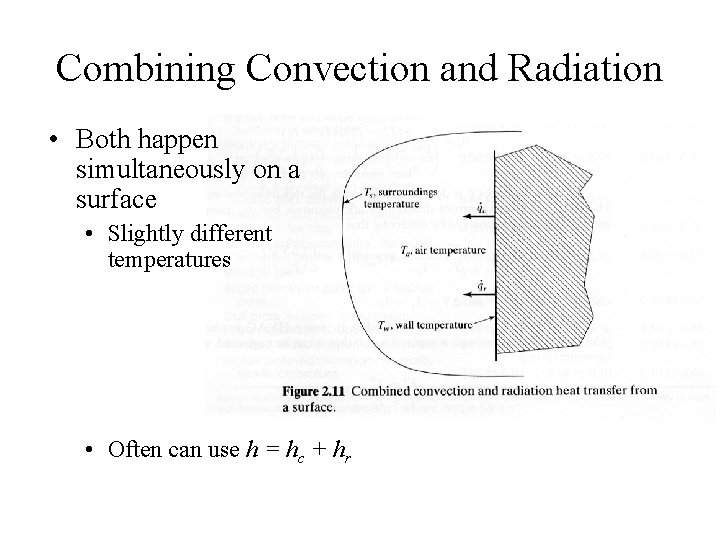
Combining Convection and Radiation • Both happen simultaneously on a surface • Slightly different temperatures • Often can use h = hc + hr
Humidity Ratio, W • W = mw/ma • Degree of saturation, µ = W/Ws • Humidity ratio is hard to measure, but very useful in calculations • What are units? • Is W a function of temperature? What about Ws ? Ws = humidity ratio at saturation ma = mass of dry air mw = mass of water vapor
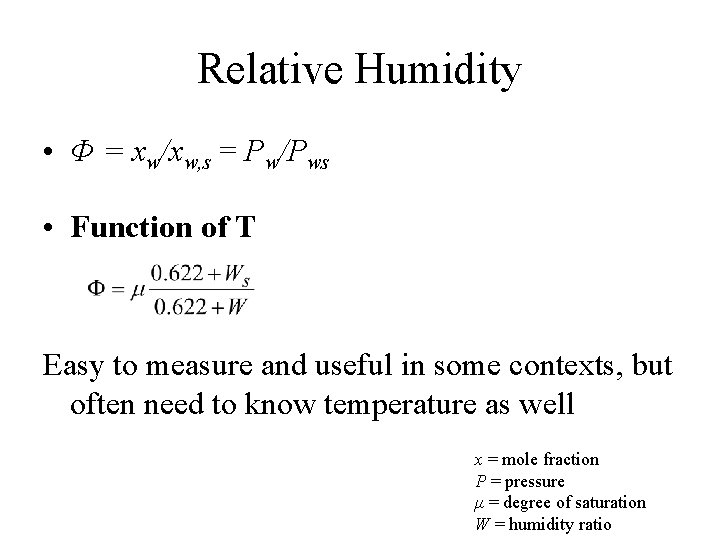
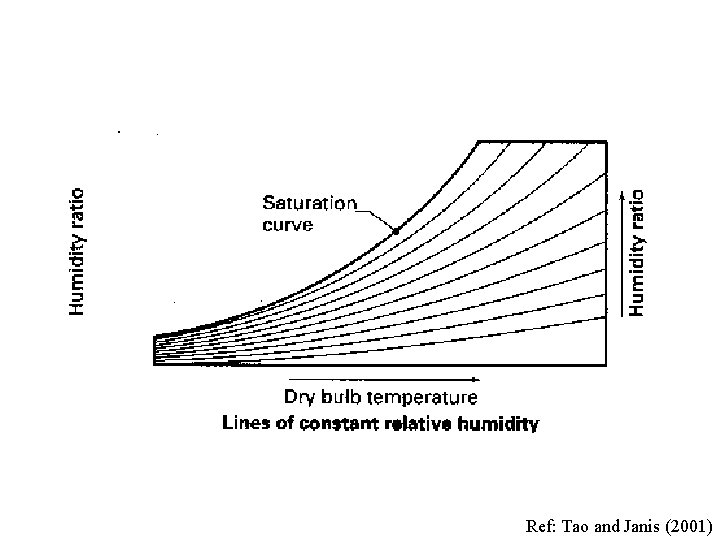
Relative Humidity • Φ = xw/xw, s = Pw/Pws • Function of T Easy to measure and useful in some contexts, but often need to know temperature as well x = mole fraction P = pressure μ = degree of saturation W = humidity ratio

Dew-point temperature, td • Temperature at which condensation will form • Under appropriate surface conditions • Vapor is saturated • Φ=? • Ws(P, td) = W
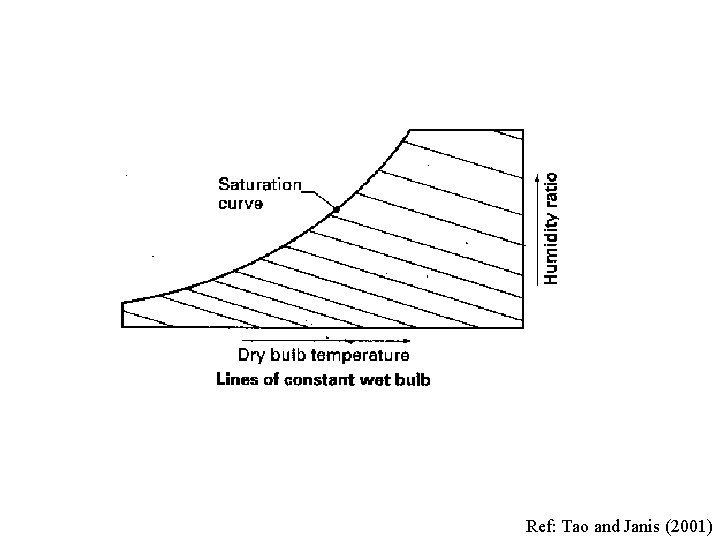
Wet-bulb temperature, VBT (t*) • Temperature of wet surface or • Temperature at which water, by evaporating into the air, will bring air to saturation adiabatically • * superscript is designation that variable is evaluated at the wet-bulb temperature • Note, distinct from that measured by a sling psychrometer • Section 9. 5

Tables for Moist Air (P = 1 atm) • Tables A. 4 in your text • Ability to get Ws for calculations • Subscripts: • a = dry air, s = saturated air v = va+µvas h = ha+µhas s = sa+µsas
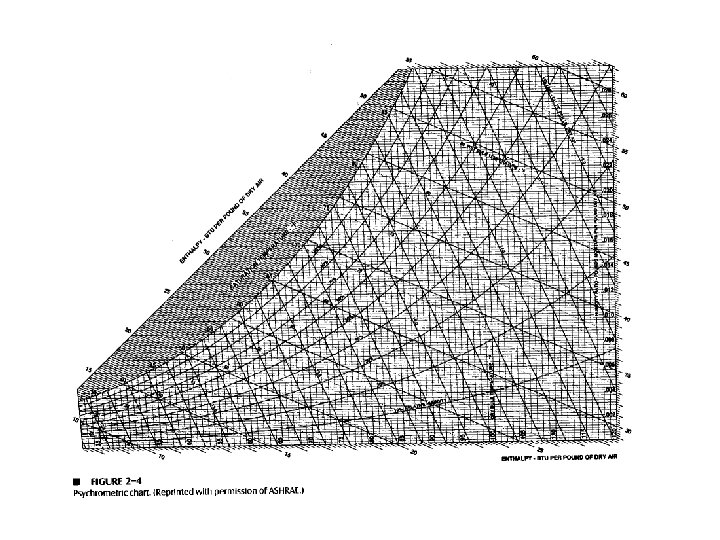
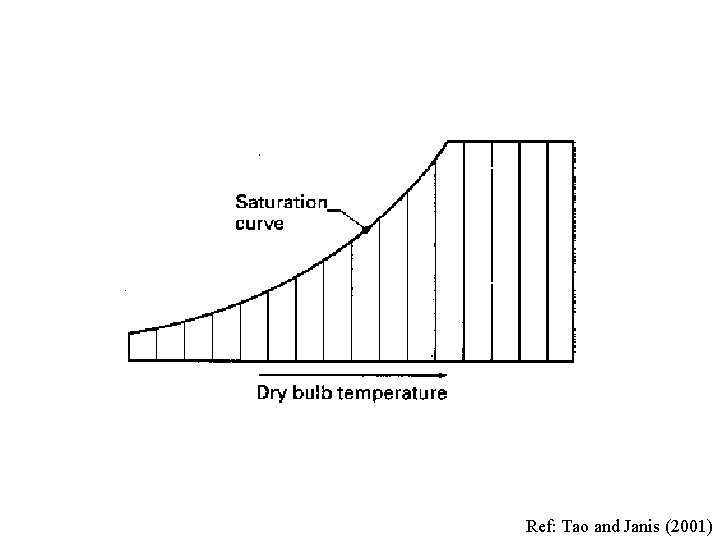
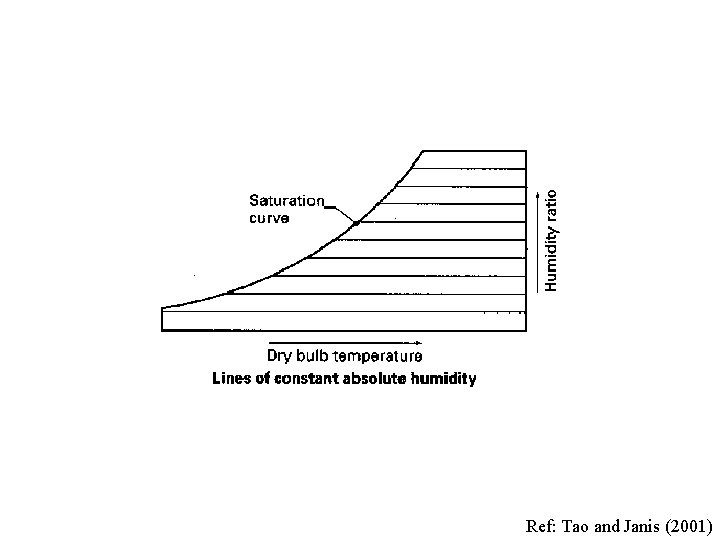
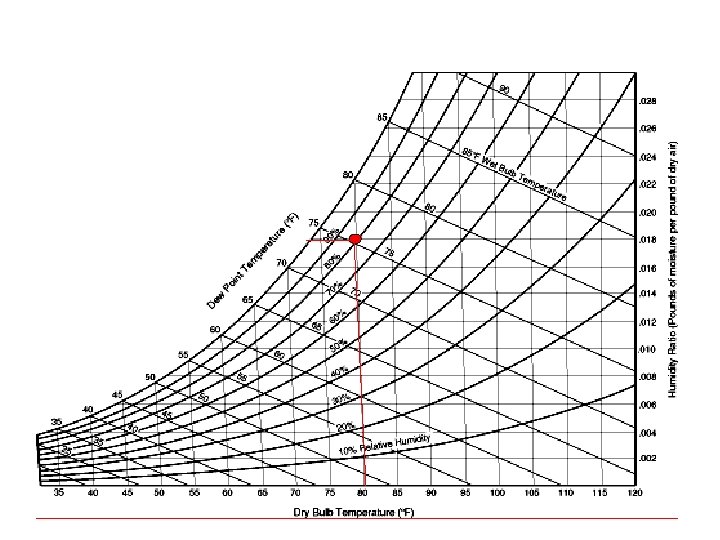
Psychrometric Chart • Need two quantities for a state point • Can get all other quantities from a state point • Can do all calculations without a chart • Often require iteration • Many “digital” psychrometric charts available • Can make your own • Best source is ASHRAE fundamentals (Chapter 6) • Also in your text (back cover fold-out)
Ref: Tao and Janis (2001)
Ref: Tao and Janis (2001)
Ref: Tao and Janis (2001)
Ref: Tao and Janis (2001)
Examples • What is enthalpy of air in the classroom right now? • Condensation on windows when taking a shower • How cold does it have to be outside for condensation to form on windows? – Assumption is that windows are the same temperature as outside air – 80 °F, RH = 80%
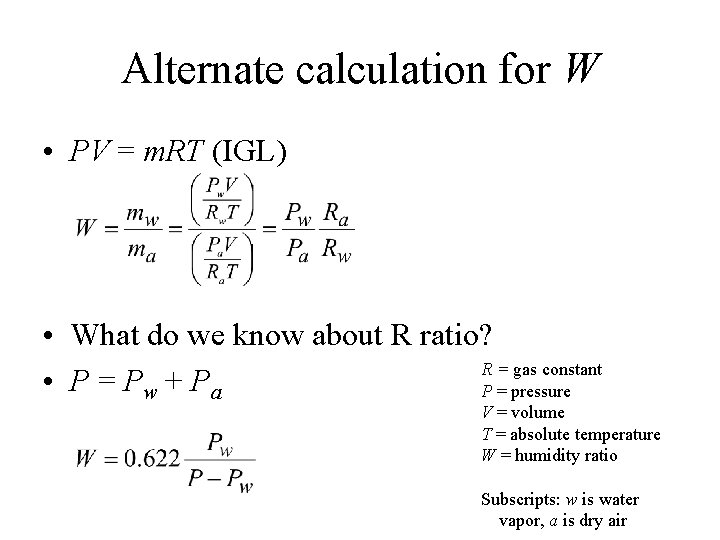
Alternate calculation for W • PV = m. RT (IGL) • What do we know about R ratio? R = gas constant • P = Pw + Pa P = pressure V = volume T = absolute temperature W = humidity ratio Subscripts: w is water vapor, a is dry air
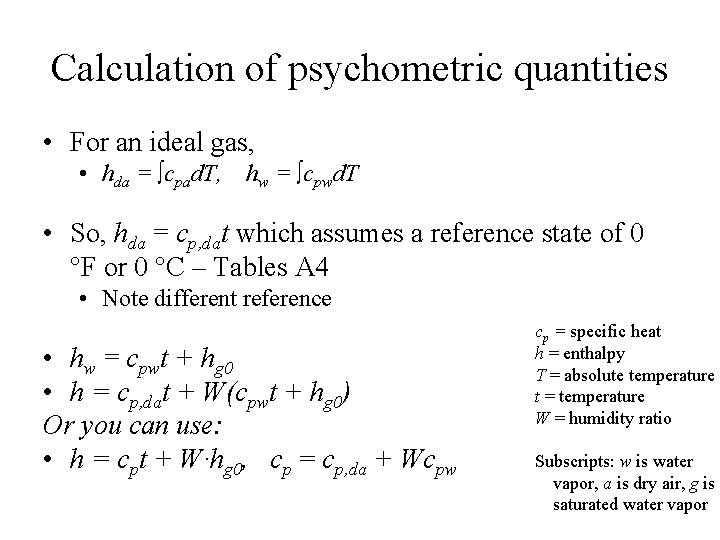
Calculation of psychometric quantities • For an ideal gas, • hda = ∫cpad. T, hw = ∫cpwd. T • So, hda = cp, dat which assumes a reference state of 0 °F or 0 °C – Tables A 4 • Note different reference • hw = cpwt + hg 0 • h = cp, dat + W(cpwt + hg 0) Or you can use: • h = cpt + W∙hg 0, cp = cp, da + Wcpw cp = specific heat h = enthalpy T = absolute temperature t = temperature W = humidity ratio Subscripts: w is water vapor, a is dry air, g is saturated water vapor
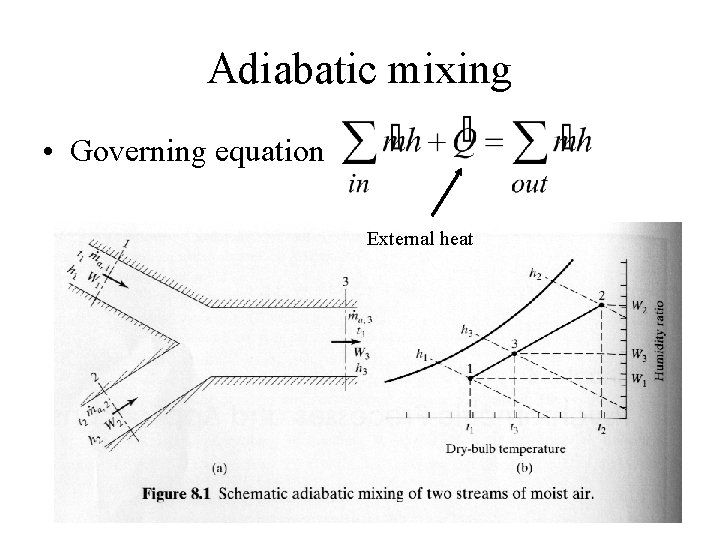
Adiabatic mixing • Governing equation External heat
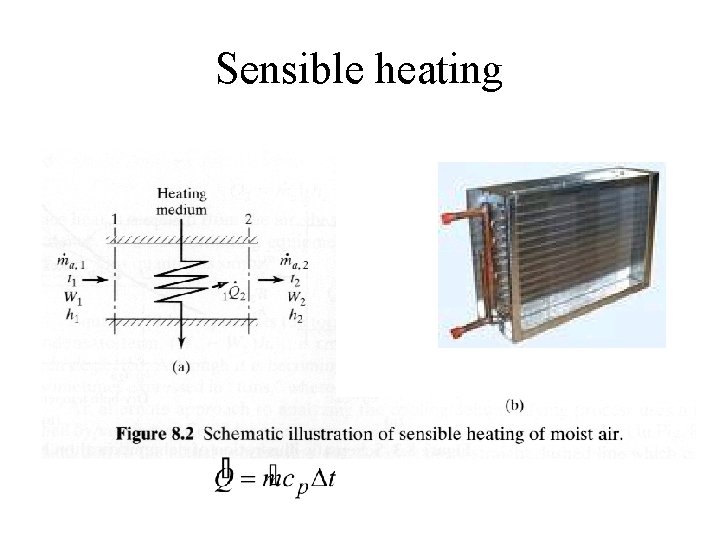
Sensible heating
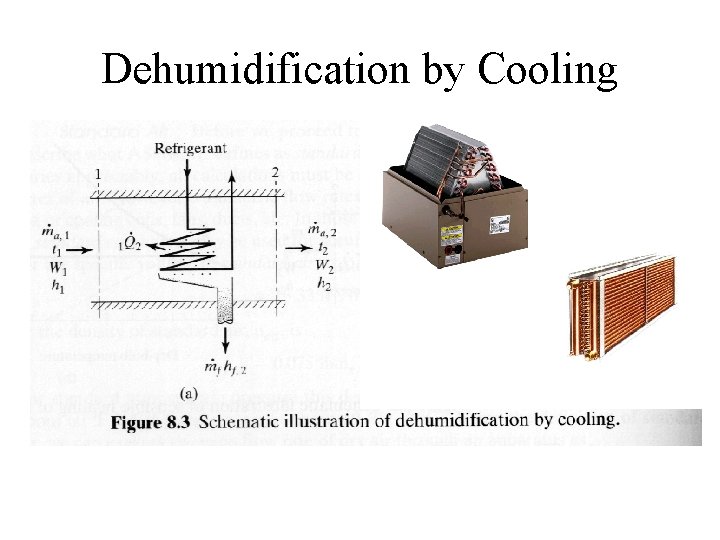
Dehumidification by Cooling
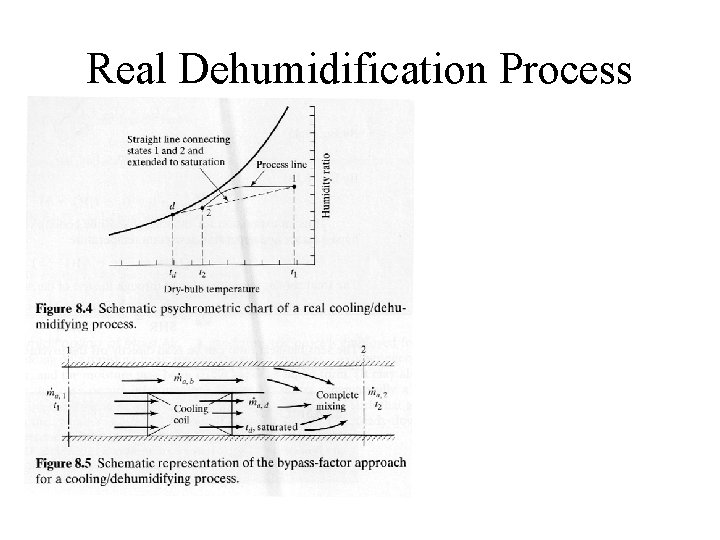
Real Dehumidification Process
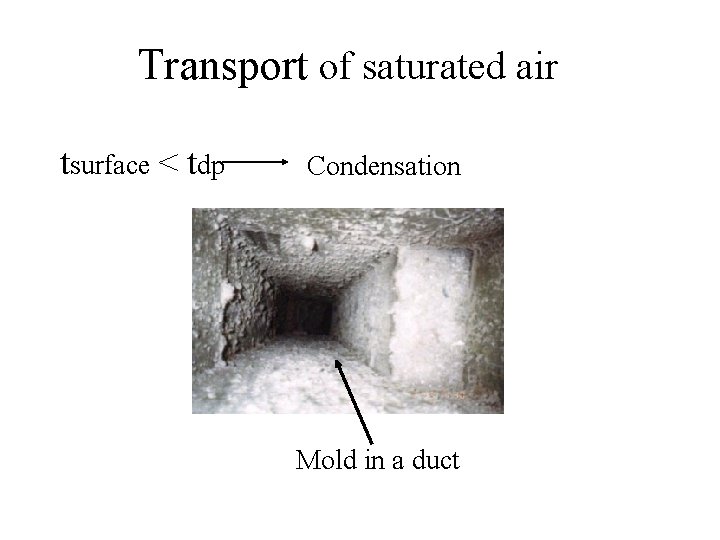
Transport of saturated air tsurface < tdp Condensation Mold in a duct
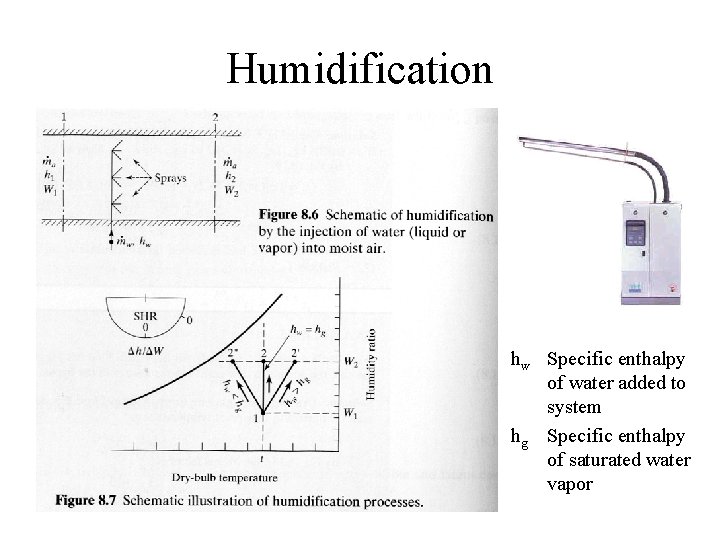
Humidification hw Specific enthalpy of water added to system hg Specific enthalpy of saturated water vapor
Summary • Describe psychrometric quantities • Given any two psychrometric quantities, calculate any other quantity • Use Tables A 4 or psychrometric charts to look up psychrometric quantities • Calculate psychrometric quantities at nonstandard conditions
- Slides: 32