
Objectives Distinguish incident categories Describe basic first aid

Objectives • Distinguish incident categories • Describe basic first aid requirements • Notify and report incidents externally and internally • Carry out an investigation into a workplace incident • Prepare an accident report

Three types of incidents • Lost-time injuries/diseases – those occurrences that resulted in a fatality, permanent disability or time lost from work of one day/shift or more (LTIs) • No lost-time injuries/diseases – those occurrences that were not lost-time injuries and for which first aid and/or medical treatment was administered • Near misses – any unplanned incidents that occurred at the workplace that, although not resulting in any injury or disease, had the potential to do so
Incident procedures • Each jurisdiction has regulations and guidance material governing incidents – Definitions – What to do – Who to notify
Incident procedures • Definitions of incident categories • Responsibilities of employees, managers, first aid officers, medical personnel, authorities, insurers • Rights of employees, for example, to compensation information
Incident procedures • Required activities and time frames to cover treatment of injuries, notifying, reporting, investigating and record keeping • Any maps and contact details
First Aid Facilities required depend on • • • law type of industry type of hazards in your workplace number of employees number of locations your workplace covers proximity to local services (doctors, hospital, ambulance)
First Aid Facilities can include: • • first aid kits, rooms, medical centres certified first aid officers record-keeping location and contact details Workplace injury and disease recording standard AS 1885. 1 -1990 contains a workplace injury and disease recording form for use by employers.
Investigations • Incidents occur when hazard controls are ineffective – or don’t exist at all • Investigations are to prevent a recurrence by finding out why controls were ineffective and taking any corrective steps • Focus is on controls that make up the core of your OHS management system
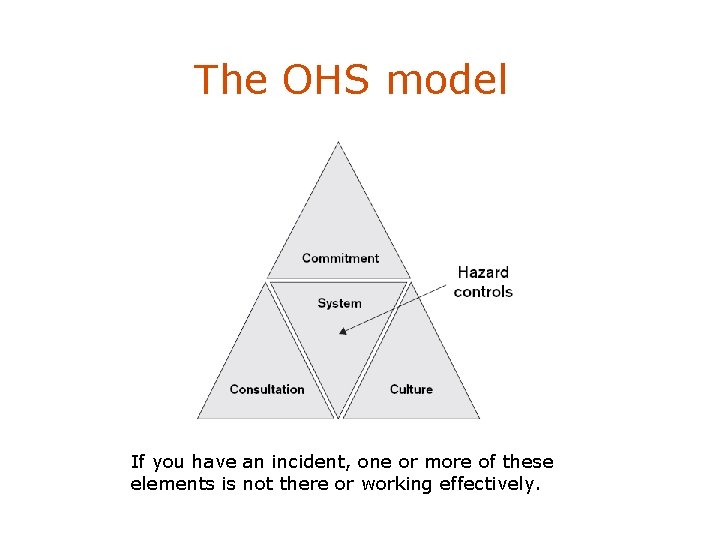
The OHS model If you have an incident, one or more of these elements is not there or working effectively.
Investigation procedures • When – ASAP ! • Who should be involved and their authority • Steps to be taken, e. g. isolation of the accident site • Equipment • Report format
Investigation procedures • Nature of recommendations – correction, prevention and follow-up • Report lines – senior management, health and safety committee • Keeping records and evidence • Confidentiality requirements
Accuracy and logic • Value of an investigation depends on the effectiveness of its recommendations – will they prevent a recurrence? • Root cause(s) must be found and removed • Is the information accurate, complete and does it support the conclusions?
Planning and team • Scope the investigation and set objectives • Team – health and safety manager, local manager, supervisor, HSR, specialists… • Government investigation in serious incidents
Gathering information • Factual description, not a causal explanation • Equipment could include: pen and note pad, camera, small tape recorder, tape measure, plastic bags or containers, gloves, protective equipment… • Take steps to preserve evidence and identify witnesses
Physical evidence • • Make an early record of the site Photos, sketches Measurement Remove debris and samples
Eyewitness accounts • Interview witnesses individually rather than in a group – small tape recorder and notes • Try to put the witness at ease; be supportive, non-intimidating, nonjudgemental • Assist with any language, literacy or educational problems; avoid technical jargon • Emphasise the reason for the investigation – to prevent a recurrence
Eyewitness accounts • After identifying the witness, time and location, allow the witness to talk – do not interrupt, prompt or ask leading questions; use simple, positive, open questions instead • Take short notes during the interview when significant points are mentioned • If making a written record only, confirm with the witness that the record is correct
Leading and open-ended questions • ‘Was the lockout system not in use? ’ v/s ‘What precautions were taken at the time? ’ • Asking open-ended questions is not only less threatening, but increases the chances of getting additional details and greater accuracy from that person’s perspective • Closed questions requiring simple responses can be helpful for directing attention toward relevant facts after basic information has been gathered
Gathering workplace information You will need background technical data, e. g. maintenance reports, past reports of incidents, information on work processes, safe work procedures and training records
Gathering organisational information Also may need information on company structure, plans, budgets, policies, procedures or practices to determine whether they exercised any influence on hazard controls
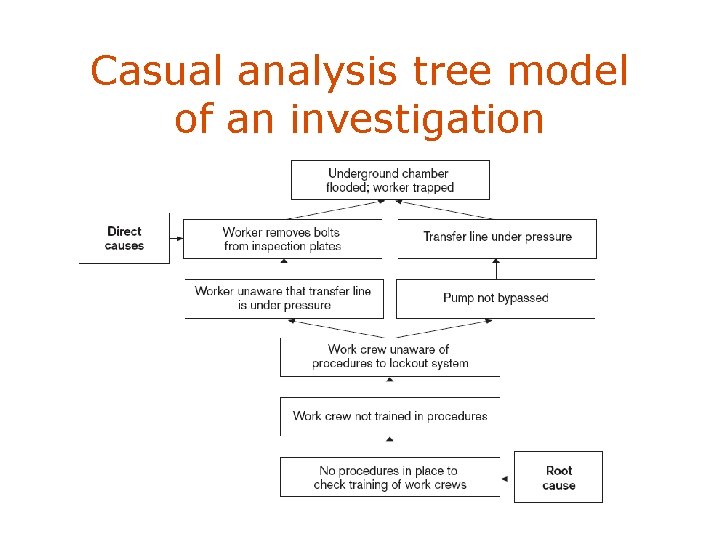
Casual analysis tree model of an investigation
Regulations and codes • Refer to applicable regulations and codes to see if proper controls were in place
Individual and organisational accidents • The difference depends on the degree of control
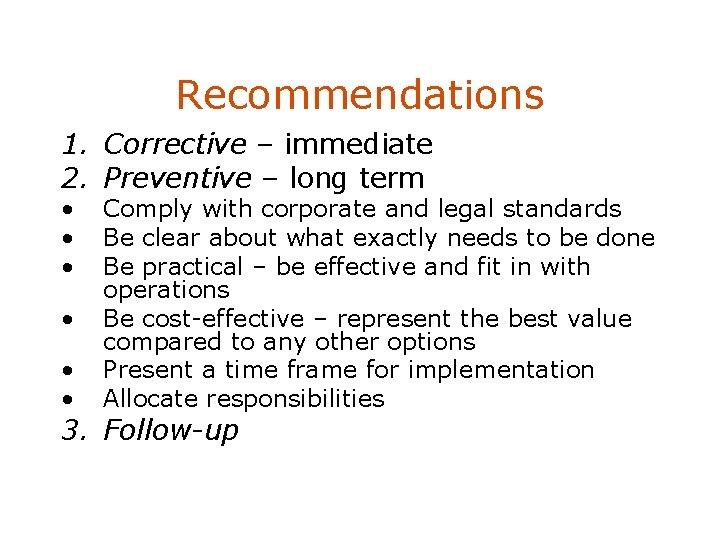
Recommendations 1. Corrective – immediate 2. Preventive – long term • • • Comply with corporate and legal standards Be clear about what exactly needs to be done Be practical – be effective and fit in with operations Be cost-effective – represent the best value compared to any other options Present a time frame for implementation Allocate responsibilities 3. Follow-up
- Slides: 25