
Objectives Describe the anatomy of the pleura Subdivisions
Objectives Describe the anatomy of the pleura: Subdivisions into parietal & visceral pleura, nerve supply of each part. List the parts of parietal pleura and its recesses. Describe the surface anatomy of both pleura and lungs. Describe the anatomy of lungs: shape, relations, nerve supply, blood supply. ● Describe the difference between right & left lungs. ● Describe the formation of bronchopulmonary segments and the main characteristics of these segment in the lung. ● ● ● ● ● Text in BLUE was found only in the boys’ slides Text in PINK was found only in the girls’ slides Text in RED is considered important Text in GREY is considered extra notes

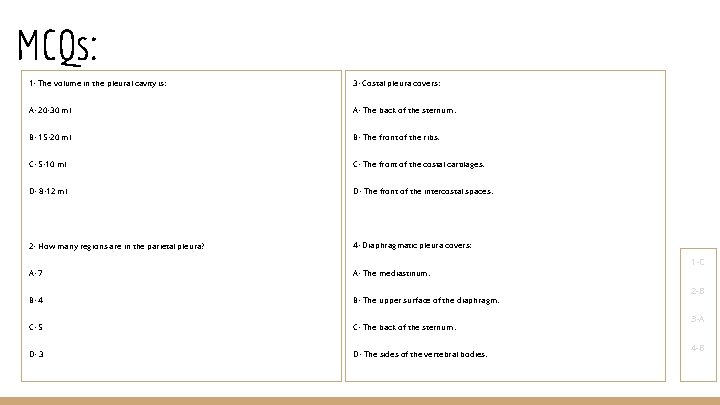
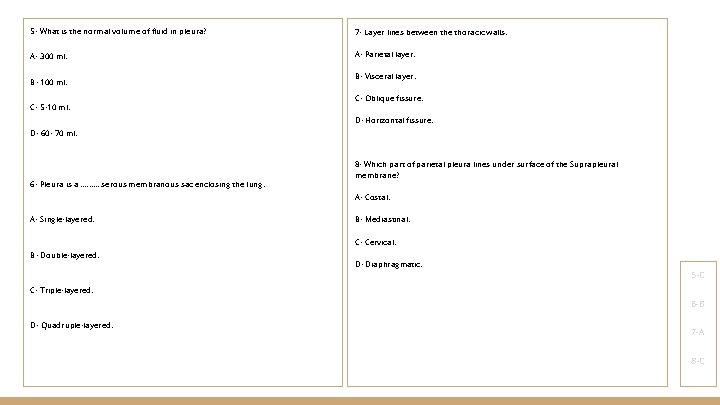
What is Pleura? Double-layered serous Membrane / Membranous sac enclosing the lung. ● Has two layers: ○ Parietal layer, which lines the thoracic walls. ○ Visceral layer, which covers the surfaces of the lung. ● The two layers continue with each other around the root* of the lung, where it forms a loose cuff hanging down called the: ○ Pulmonary ligament. ● The space between the 2 layers: ○ Is the Pleural cavity. ○ It contains a very thin film of pleural fluid (5 -10 ml. ). ** Parietal Pleura ● ● . ﺯﻱ ﺍﻷﻌﺼﺎﺏ ﻭ ﺍﻷﻮﻋﻴﺔ ﺍﻟﺪﻣﻮﻳﺔ Hilum of Lung ﻣﻜﻥ ﻣﻦ ﺍﻷﺸﻴﺎﺀ ﺍﻟﻠﻲ ﺗﺪﺧﻞ ﻭ ﺗﻄﻠﻊ ﻣﻦ ﺍﻝ ROOT *ﺍﻝ . ﻳﺴﻬﻞ ﺍﻟﺤﺮﻛﺔ ﻭ ﻳﻤﻨﻊ ﺍﻟﺘﺼﺎﻕ ﺍﻟﻐﺸﺎﺋﻴﻦ ﻣﻊ ﺑﻌﻀﻬﻢ ﺍﻟﺒﻌﺾ FLUID **ﺍﻝ It is divided according to the region in which it lies and the surfaces it covers, into: ○ ○ Cervical. Costal. Mediastinal. Diaphragmatic.
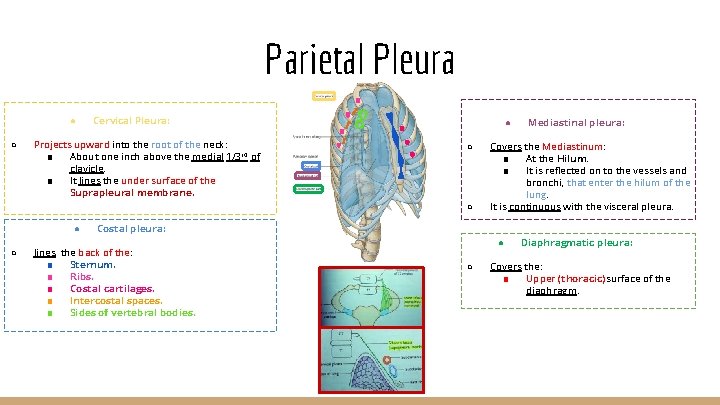
Parietal Pleura ● ○ Cervical Pleura: Projects upward into the root of the neck: ■ About one inch above the medial 1/3 rd of clavicle. ■ It lines the under surface of the Suprapleural membrane. ● ○ ○ ● ○ Mediastinal pleura: Covers the Mediastinum: ■ At the Hilum. ■ It is reflected on to the vessels and bronchi, that enter the hilum of the lung. It is continuous with the visceral pleura. Costal pleura: lines, the back of the: ■ Sternum. ■ Ribs. ■ Costal cartilages. ■ Intercostal spaces. ■ Sides of vertebral bodies. ● ○ Diaphragmatic pleura: Covers the: ■ Upper (thoracic)surface of the diaphragm.
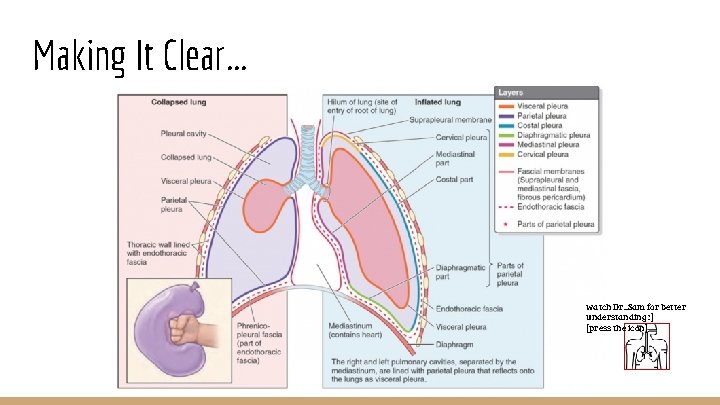
Making It Clear. . . watch Dr. . Sam for better understanding : ) (press the icon)

Pleural Recesses ● Costodiaphragmatic Recess: ○ Slit like space* between Costal & Diaphragmatic. Pleurae ○ Along the inferior border of the lung. ○ The lung enters through it in deep inspiration. Costomediastinal Recess: ○ Slit like space between Costal and Mediastinal. Pleurae, along the anterior border of the lung. ○ The lung enters through it in deep inspiration. *ﻓﺮﺍﻍ ﻳﺸﺒﻪ ﺍﻟﺸﻖ Pleura: Nerve Supply ● ● Parietal pleura: P ( PTT). ○ Sensitive to Pain, Pressure, Temperature, and Touch. It is supplied as follows: ○ Costal pleura is segmentally supplied by the intercostal nerves. ○ Mediastinal pleura is supplied by phrenic nerves. ○ Diaphragmatic pleura is supplied as follow: ■ Central part (over diaphragmatic domes) by phrenic nerves. ■ Around the periphery by lower 6 intercostal nerves. Visceral pleura: ○ sensitive to stretch only and is supplied by the autonomic fibers from the pulmonary plexus.
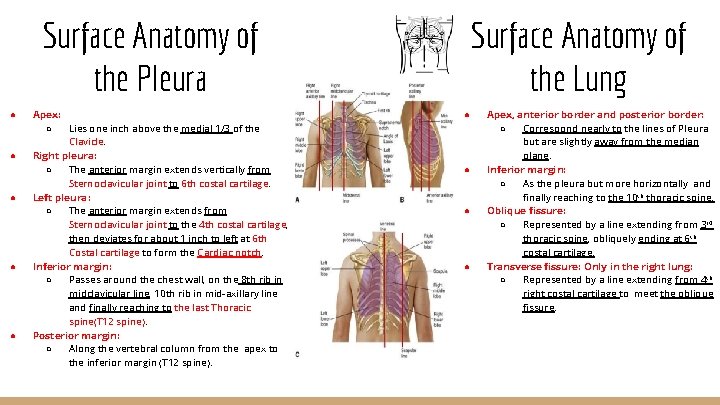
Surface Anatomy of the Pleura ● ● ● Apex: ○ Lies one inch above the medial 1/3 of the Clavicle. Right pleura: ○ The anterior margin extends vertically from Sternoclavicular joint to 6 th costal cartilage. Left pleura: ○ The anterior margin extends from Sternoclavicular joint to the 4 th costal cartilage, then deviates for about 1 inch to left at 6 th Costal cartilage to form the Cardiac notch. Inferior margin: ○ Passes around the chest wall, on the 8 th rib in midclavicular line, 10 th rib in mid-axillary line and finally reaching to the last Thoracic spine(T 12 spine). Posterior margin: ○ Along the vertebral column from the apex to the inferior margin (T 12 spine). Surface Anatomy of the Lung ● ● Apex, anterior border and posterior border: ○ Correspond nearly to the lines of Pleura but are slightly away from the median plane. Inferior margin: ○ As the pleura but more horizontally and finally reaching to the 10 th thoracic spine. Oblique fissure: ○ Represented by a line extending from 3 rd thoracic spine, obliquely ending at 6 th costal cartilage. Transverse fissure: Only in the right lung: ○ Represented by a line extending from 4 th right costal cartilage to meet the oblique fissure.
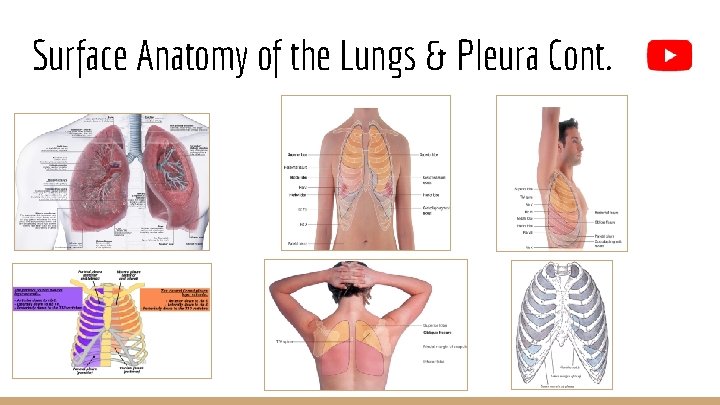
Surface Anatomy of the Lungs & Pleura Cont.
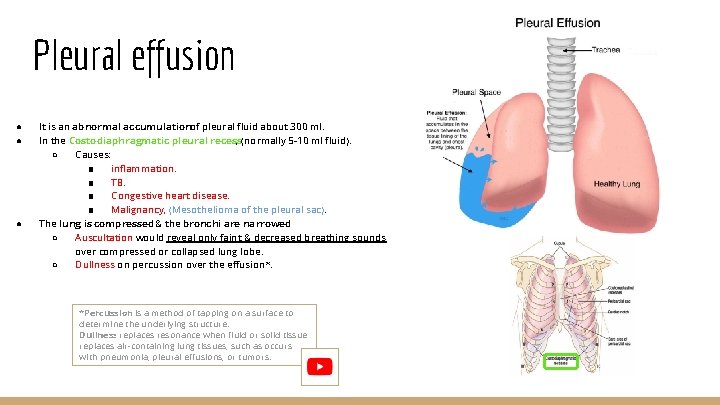
Pleural effusion ● ● ● It is an abnormal accumulationof pleural fluid about 300 ml. In the Costodiaphragmatic pleural recess , (normally 5 -10 ml fluid). ○ Causes: ■ inflammation. ■ TB. ■ Congestive heart disease. ■ Malignancy, (Mesothelioma of the pleural sac). The lung is compressed & the bronchi are narrowed. ○ Auscultation would reveal only faint & decreased breathing sounds over compressed or collapsed lung lobe. ○ Dullness on percussion over the effusion*. *Percussion is a method of tapping on a surface to determine the underlying structure. Dullness replaces resonance when fluid or solid tissue replaces air-containing lung tissues, such as occurs with pneumonia, pleural effusions, or tumors.
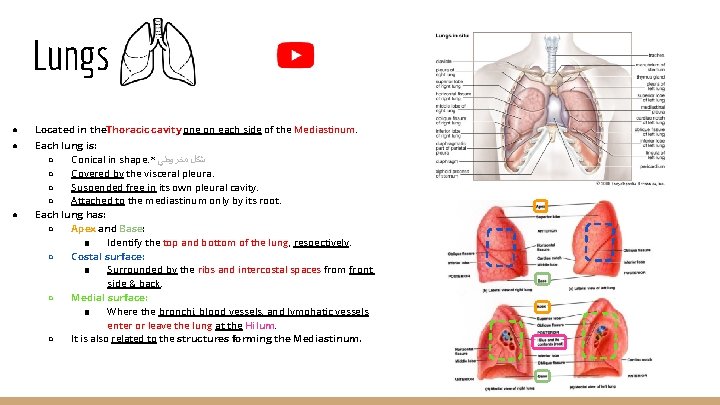
Lungs ● Located in the. Thoracic cavity, one on each side of the Mediastinum. ● Each lung is: ○ Conical in shape. * ﺷﻜﻞ ﻣﺨﺮﻭﻃﻲ ○ Covered by the visceral pleura. ○ Suspended free in its own pleural cavity. ○ Attached to the mediastinum only by its root. Each lung has: ○ Apex and Base: ■ Identify the top and bottom of the lung, respectively. ○ Costal surface: ■ Surrounded by the ribs and intercostal spaces from front, side & back. ○ Medial surface: ■ Where the bronchi, blood vessels, and lymphatic vessels enter or leave the lung at the Hilum. ○ It is also related to the structures forming the Mediastinum. ●
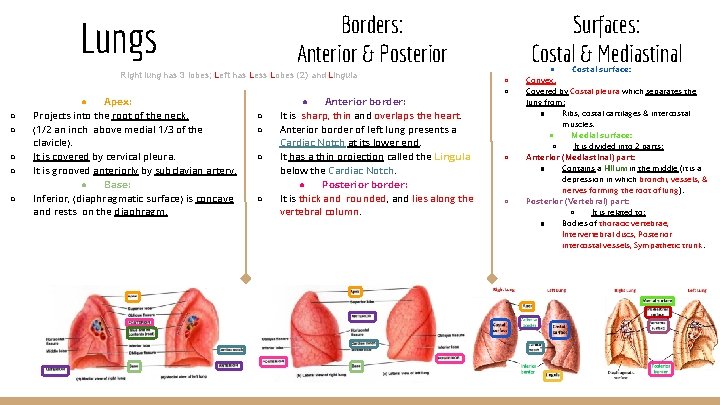
Borders: Anterior & Posterior Lungs Right lung has 3 lobes; Left has Less Lobes (2) and Lingula ○ ○ ○ ● Apex: Projects into the root of the neck. (1/2 an inch above medial 1/3 of the clavicle). It is covered by cervical pleura. It is grooved anteriorly by subclavian artery. ● Base: Inferior, (diaphragmatic surface) is concave and rests on the diaphragm. ○ ○ ● Anterior border: It is sharp, thin and overlaps the heart. Anterior border of left lung presents a Cardiac Notch at its lower end. It has a thin projection called the Lingula below the Cardiac Notch. ● Posterior border: It is thick and rounded, and lies along the vertebral column. Surfaces: Costal & Mediastinal ○ ○ ● Costal surface: Convex. Covered by Costal pleura which separates the lung from: ■ Ribs, costal cartilages & intercostal muscles. ● Medial surface: ○ It is divided into 2 parts: Anterior (Mediastinal) part: ■ Contains a Hilum in the middle (it is a depression in which bronchi, vessels, & nerves forming the root of lung). Posterior (Vertebral) part: ○ It is related to: ■ Bodies of thoracic vertebrae, Intervertebral discs, Posterior intercostal vessels, Sympathetic trunk.
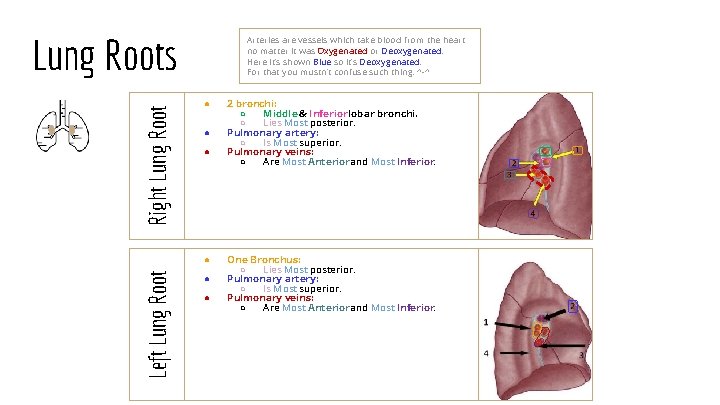
Right Lung Roots Arteries are vessels which take blood from the heart no matter it was Oxygenated or Deoxygenated. Here it’s shown Blue so it’s Deoxygenated. For that you mustn’t confuse such thing. ^-^ ● ● ● Left Lung Root ● ● ● 2 bronchi: ○ Middle & Inferior lobar bronchi. ○ Lies Most posterior. Pulmonary artery: ○ Is Most superior. Pulmonary veins: ○ Are Most Anterior and Most Inferior. One Bronchus: ○ Lies Most posterior. Pulmonary artery: ○ Is Most superior. Pulmonary veins: ○ Are Most Anterior and Most Inferior.
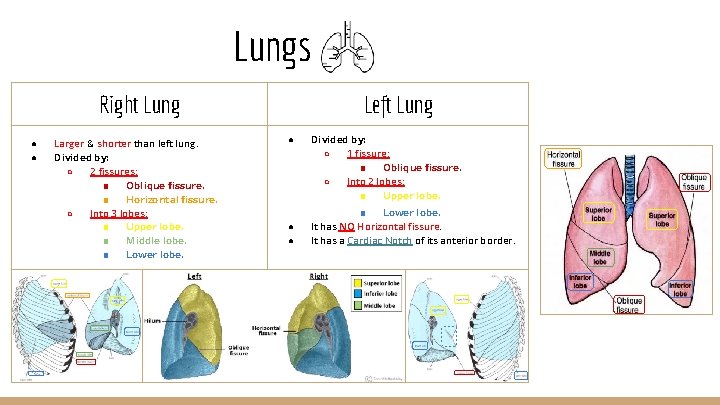
Lungs Right Lung ● ● Larger & shorter than left lung. Divided by: ○ 2 fissures: ■ Oblique fissure. ■ Horizontal fissure. ○ Into 3 lobes: ■ Upper lobe. ■ Middle lobe. ■ Lower lobe. Left Lung ● ● ● Divided by: ○ 1 fissure: ■ Oblique fissure. ○ Into 2 lobes: ■ Upper lobe. ■ Lower lobe. It has NO Horizontal fissure. It has a Cardiac Notch of its anterior border.
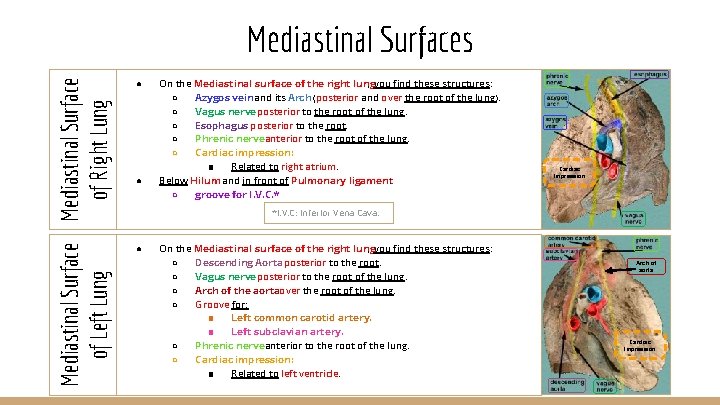
Mediastinal Surface of Right Lung of Left Lung Mediastinal Surfaces ● ● On the Mediastinal surface of the right lung , you find these structures: ○ Azygos vein and its Arch (posterior and over the root of the lung). ○ Vagus nerve posterior to the root of the lung. ○ Esophagus posterior to the root. ○ Phrenic nerveanterior to the root of the lung. ○ Cardiac impression: ■ Related to right atrium. Below Hilum and in front of Pulmonary ligament: ○ groove for I. V. C. * Cardiac Impression *I. V. C: Inferior Vena Cava. ● On the Mediastinal surface of the right lung , you find these structures: ○ Descending Aortaposterior to the root. ○ Vagus nerve posterior to the root of the lung. ○ Arch of the aortaover the root of the lung. ○ Groove for: ■ Left common carotid artery. ■ Left subclavian artery. ○ Phrenic nerveanterior to the root of the lung. ○ Cardiac impression: ■ Related to left ventricle. Arch of aorta Cardiac Impression
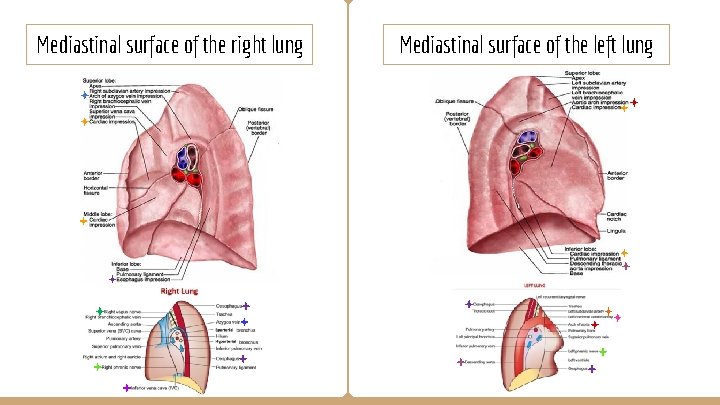
Mediastinal surface of the right lung Mediastinal surface of the left lung
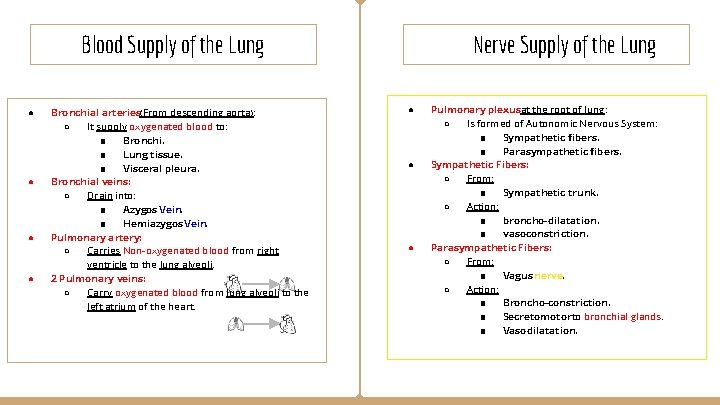
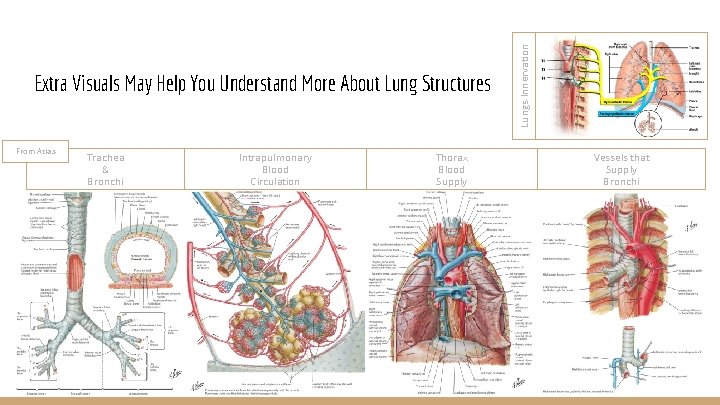
Blood Supply of the Lung ● ● Bronchial arteries(From descending aorta): ○ It supply oxygenated blood to: ■ Bronchi. ■ Lung tissue. ■ Visceral pleura. Bronchial veins: ○ Drain into: ■ Azygos Vein. ■ Hemiazygos Vein. Pulmonary artery: ○ Carries Non-oxygenated blood from right ventricle to the lung alveoli. 2 Pulmonary veins: ○ Carry oxygenated blood from lung alveoli to the left atrium of the heart. Nerve Supply of the Lung ● ● ● Pulmonary plexusat the root of lung: ○ Is formed of Autonomic Nervous System: ■ Sympathetic fibers. ■ Parasympathetic fibers. Sympathetic Fibers: ○ From: ■ Sympathetic trunk. ○ Action: ■ broncho-dilatation. ■ vasoconstriction. Parasympathetic Fibers: ○ From: ■ Vagus nerve. ○ Action: ■ Broncho-constriction. ■ Secretomotor to bronchial glands. ■ Vasodilatation.
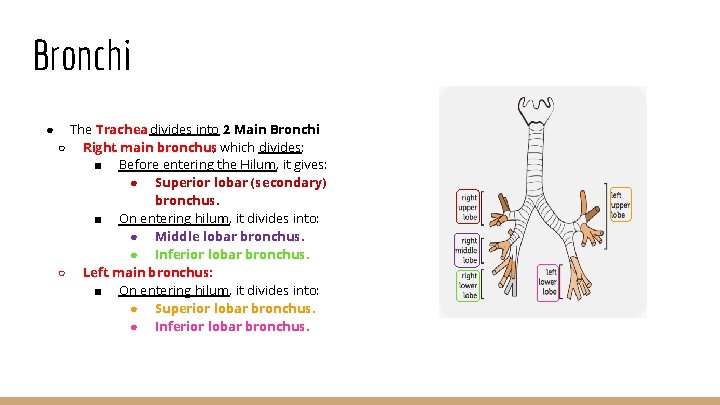
Bronchi ● The Trachea divides into 2 Main Bronchi: ○ Right main bronchus, which divides: ■ Before entering the Hilum, it gives: ● Superior lobar (secondary) bronchus. ■ On entering hilum, it divides into: ● Middle lobar bronchus. ● Inferior lobar bronchus. ○ Left main bronchus: ■ On entering hilum, it divides into: ● Superior lobar bronchus. ● Inferior lobar bronchus.
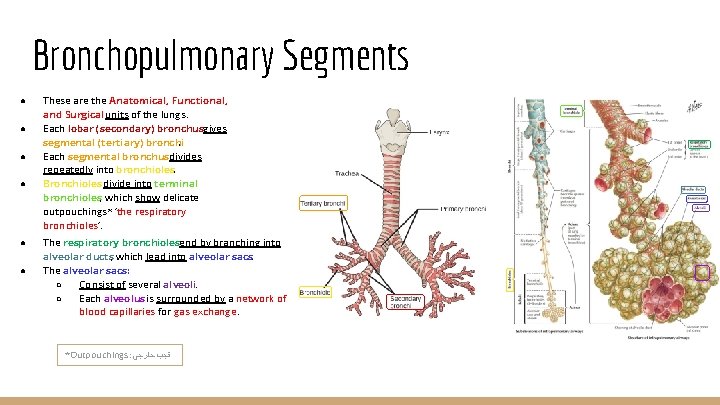
Bronchopulmonary Segments ● ● ● These are the Anatomical, Functional, and Surgical units of the lungs. Each lobar (secondary) bronchusgives segmental (tertiary) bronchi. Each segmental bronchusdivides repeatedly into bronchioles. Bronchioles divide into terminal bronchioles, which show delicate outpouchings* ‘the respiratory bronchioles’. The respiratory bronchiolesend by branching into alveolar ducts, which lead into alveolar sacs. The alveolar sacs: ○ Consist of several alveoli. ○ Each alveolus is surrounded by a network of blood capillaries for gas exchange. *Outpouchings: ﺗﺠﺏ ﺧﺎﺭﺟﻲ
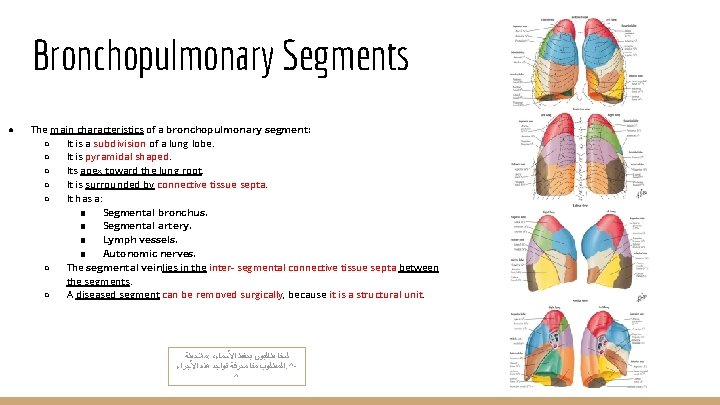
Bronchopulmonary Segments ● The main characteristics of a bronchopulmonary segment: ○ It is a subdivision of a lung lobe. ○ It is pyramidal shaped. ○ Its apex toward the lung root. ○ It is surrounded by connective tissue septa. ○ It has a: ■ Segmental bronchus. ■ Segmental artery. ■ Lymph vessels. ■ Autonomic nerves. ○ The segmental veinlies in the inter- segmental connective tissue septa between the segments. ○ A diseased segment can be removed surgically, because it is a structural unit. ﻣﻼﺣﻈﺔ : ، ﻟﺴﻨﺎ ﻃﺎﻟﺒﻮﻥ ﺑﺤﻔﻆ ﺍﻷﺴﻤﺎﺀ ﺍﻟﻤﻄﻠﻮﺏ ﻣﻨﺎ ﻣﻌﺮﻓﺔ ﺗﻮﺍﺟﺪ ﻫﺬﻩ ﺍﻷﺠﺰﺍﺀ. ^^
From Atlas Trachea & Bronchi Intrapulmonary Blood Circulation Thorax Blood Supply Lungs Innervation Extra Visuals May Help You Understand More About Lung Structures Vessels that Supply Bronchi
MCQs: 1 - The volume in the pleural cavity is: 3 - Costal pleura covers: A- 20 -30 ml A- The back of the sternum. B- 15 -20 ml B- The front of the ribs. C- 5 -10 ml C- The front of the costal cartilages. D- 8 -12 ml D- The front of the intercostal spaces. 2 - How many regions are in the parietal pleura? 4 - Diaphragmatic pleura covers: A- 7 A- The mediastinum. B- 4 B- The upper surface of the diaphragm. C- 5 C- The back of the sternum. D- 3 D- The sides of the vertebral bodies. 1 -C 2 -B 3 -A 4 -B
5 - What is the normal volume of fluid in pleura? 7 - Layer lines between the thoracic walls. A- 300 ml. A- Parietal layer. B- 100 ml. C- 5 -10 ml. B- Visceral layer. C- Oblique fissure. D- Horizontal fissure. D- 60 - 70 ml. 6 - Pleura is a. . serous membranous sac enclosing the lung. 8 - Which part of parietal pleura lines under surface of the Suprapleural membrane? A- Costal. A- Single-layered. B- Mediastinal. C- Cervical. B- Double-layered. D- Diaphragmatic. 5 -C C- Triple-layered. 6 -B D- Quadruple-layered. 7 -A 8 -C
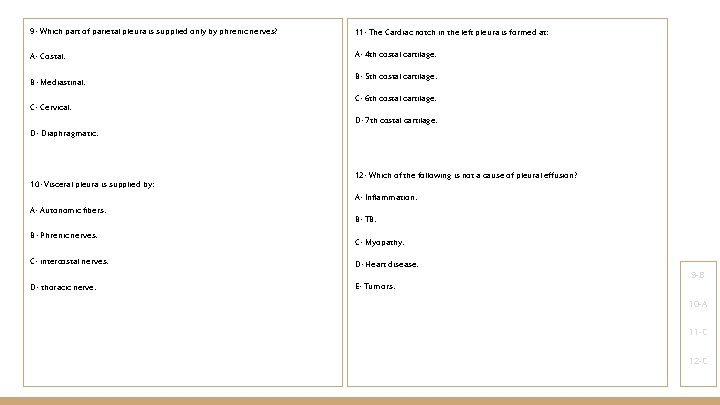
9 - Which part of parietal pleura is supplied only by phrenic nerves? 11 - The Cardiac notch in the left pleura is formed at: A- Costal. A- 4 th costal cartilage. B- Mediastinal. C- Cervical. B- 5 th costal cartilage. C- 6 th costal cartilage. D- 7 th costal cartilage. D- Diaphragmatic. 10 - Visceral pleura is supplied by: 12 - Which of the following is not a cause of pleural effusion? A- Inflammation. A- Autonomic fibers. B- Phrenic nerves. B- TB. C- Myopathy. C- intercostal nerves. D- Heart disease. D- thoracic nerve. E- Tumors. 9 -B 10 -A 11 -C 12 -C
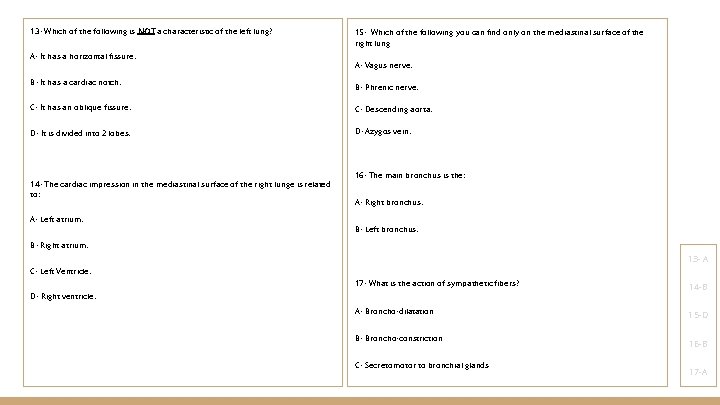
13 - Which of the following is NOT a characteristic of the left lung? A- It has a horizontal fissure. B- It has a cardiac notch. 15 - Which of the following you can find only on the mediastinal surface of the right lung A- Vagus nerve. B- Phrenic nerve. C- It has an oblique fissure. C- Descending aorta. D- It is divided into 2 lobes. D- Azygos vein. 14 - The cardiac impression in the mediastinal surface of the right lunge is related to: A- Left atrium. 16 - The main bronchus is the: A- Right bronchus. B- Left bronchus. B- Right atrium. 13 - A C- Left Ventricle. 17 - What is the action of sympathetic fibers? 14 -B A- Broncho-dilatation 15 -D D- Right ventricle. B- Broncho-constriction C- Secretomotor to bronchial glands 16 -B 17 -A
Team Members Lamia Abdullah Alkuwaiz (Team Leader) Faisal Fahad Alsaif (Team Leader) Rawan Mohammad Alharbi Abeer Alabduljabbar Afnan Abdulaziz Almustafa Ahad Ahmed Algrain Albandari Alshaye Al. Fhadah abdullah alsaleem Ghaida Alsanad Layan Hassan Alwatban Lojain Azizalrahman Maha Barakah Majd Khalid Al. Barrak Nouf Alotaibi Rinad Musaed Alghoraiby Wafa Alotaibi Wejdan Fahad Albadrani Abdulaziz Al dukhayel Abdulelah Aldossari Abdulrahman Alduhayyim Hamdan Aldossari Mohammed Alomar Saud Alghufaily Hassan Aloraini Abdullah Alomar Fahad Alfaiz Saad Aloqile Abdulmajeed Alwardi Rayyan Almousa Sultan Alfuhaid Ali Alammari Fahad alshughaithry Fayez Ghiyath Aldarsouni Mohammed Alquwayfili Saleh Almoaiqel Abdullah Almeaither Abduljabbar Al-yamane Sultan Al-nasser Majed Aljohani Zeyad Al-khenaizan Mohammed Nouri Abdulaziz Al-drgam Fahad Aldhowaihy Omar alyabis Akram Alfandi Abdulhaziz Alabdulkareem
- Slides: 25