
Objectives Describe at least two personality traits and

Objectives. �Describe at least two personality traits and personal issues in yourself that could affect your ability to interact with clients in the clinical setting? �Articulate how self-awareness can be an effective tool in the clinical setting? 11/30/2020 2
Questions? ? ? �What was your initial reaction when you were told that you have posting in psychiatric ward ? How did you feel? How did you resolve your feelings? �Are you more comfortable performing tasks or relating to people? �Are you flexible or do you prefer an orderly routine? �Are you an introvert or extrovert? 11/30/2020 3
Question Answer? �Your first assignment in the psychiatric clinical setting is to provide care for a female client who appears sad and verbalizes hopelessness to the staff. You are uncertain how to approach the client. Which of the following actions would be the most effective? 11/30/2020 4
a. Ask a peer to introduce you to the client. b. Wait for the client to approach you to avoid bothering the client. c. Ask a staff member what approach is usually effective with the client. d. Discuss your feelings with your instructor before approaching the client. 11/30/2020 5
QA? �One of your peers states that your assigned client looks like a drug addict. Which of the following best describes your peer? a. Introvert b. Judgmental attitude c. Extrovert d. Prejudice 11/30/2020 6
Unit I- Topics �Perspectives of mental health nursing, evolution of mental health services, treatments and nursing practices. �Prevalence and incidence of mental health problems and disorders �Nature and scope of mental health nursing �Role and function of mental health nurse in psychiatric setting and factors affecting the level of nursing practice �Concepts of normal and abnormal behavior 11/30/2020 7
Introduction Two major purposes: To introduce the concepts of mental health and mental illness q To describe the historical development of the role of the psychiatric nurse. q 11/30/2020 8
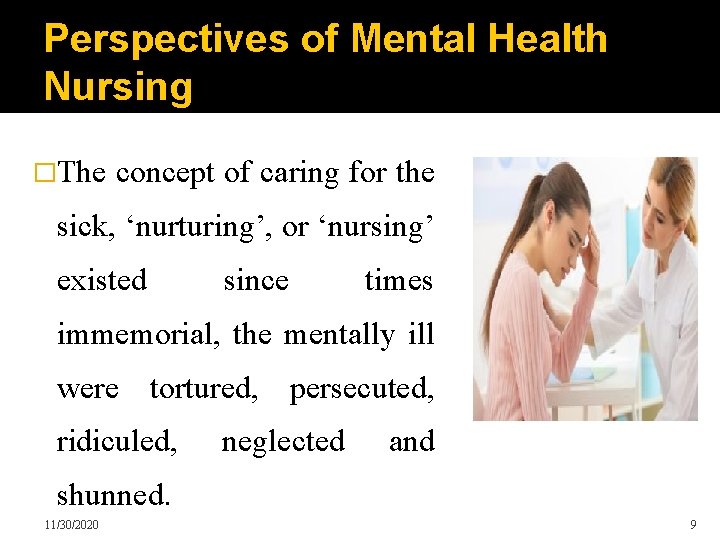
Perspectives of Mental Health Nursing �The concept of caring for the sick, ‘nurturing’, or ‘nursing’ existed since times immemorial, the mentally ill were tortured, persecuted, ridiculed, neglected and shunned. 11/30/2020 9
�Before 1860, the emphasis in psychiatric institutions was on custodial care. � Untrained people controlled (not cared) the mentally ill. �Psychiatric care as such was nonexistent. �But psychiatry evolved through ages and attained the stage that is today. 11/30/2020 10
Concept of mental health �Mental health is a positive state in which one is responsible, displays self-awareness, is self- directive, is reasonably worry free, and can cope with usual daily tensions. � Such individuals function well in society, are accepted within a group, and are generally satisfied with their lives. 11/30/2020 11
MENTAL HEALTH- Definition �Mental health is defined as a state of well-being in which every individual realizes his or her own potential, can cope with the normal stresses of life, can work productively and fruitfully, and is able to make a contribution to her or his community. WHO, 2014. 11/30/2020 12
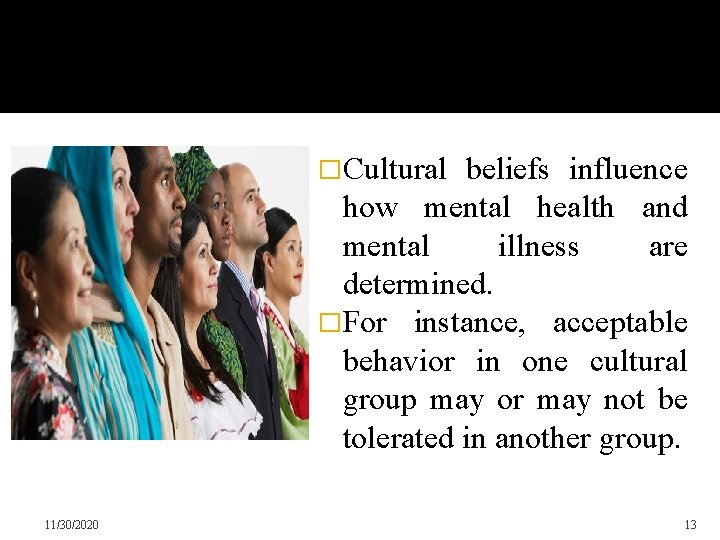
�Cultural beliefs influence how mental health and mental illness are determined. �For instance, acceptable behavior in one cultural group may or may not be tolerated in another group. 11/30/2020 13
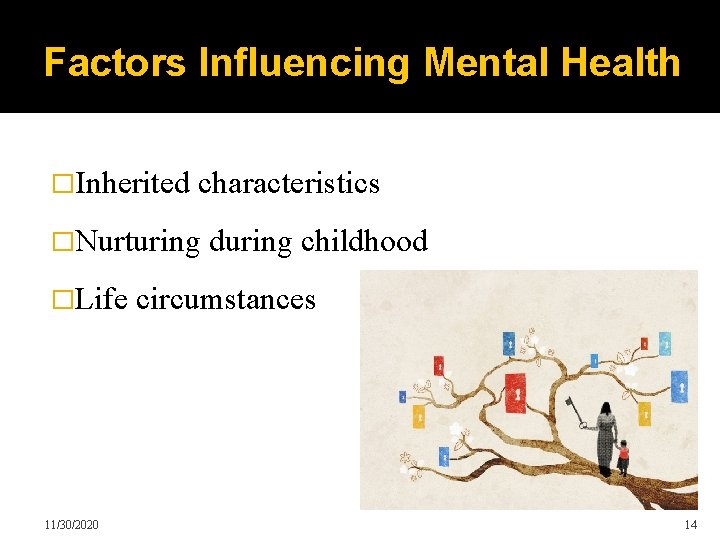
Factors Influencing Mental Health �Inherited characteristics �Nurturing �Life 11/30/2020 during childhood circumstances 14
INDICATORS OF MENTAL HEALTH �In the health care and public health arena, more emphasis and resources have been devoted to screening, diagnosis, and treatment of mental illness than mental health. �Little has been done to protect the mental health of those free of mental illness. 11/30/2020 15
Three domains- Indicators Of Mental Health �Emotional well-being such as perceived life satisfaction, happiness, cheerfulness, peacefulness. �Psychological well-being such as self-acceptance, personal growth including openness to new experiences, optimism, hopefulness, purpose in life, control of one’s environment, spirituality, self-direction, and positive relationships. �Social well-being social acceptance, beliefs in the potential of people and society as a whole, personal self-worth and usefulness to society, sense of community. 11/30/2020 16
Characteristics Of Mentally Healthy Person A mentally healthy person: � has an ability to make adjustments. a sense of personal worth, feels worthwhile and important. � solves his problems largely by his own efforts and makes his own decisions. � has a sense of personal security and feels secure in a group, shows understanding of other people’s problems and motives. � has a sense of responsibility 11/30/2020 17
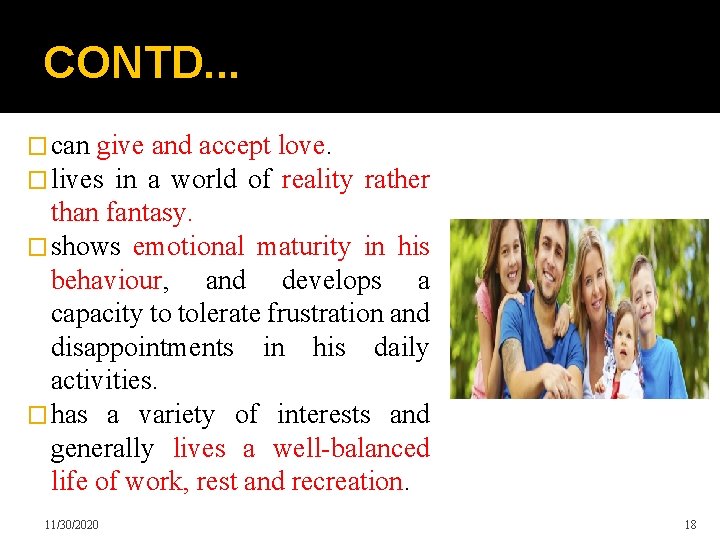
CONTD. . . � can give and accept love. � lives in a world of reality rather than fantasy. � shows emotional maturity in his behaviour, and develops a capacity to tolerate frustration and disappointments in his daily activities. � has a variety of interests and generally lives a well-balanced life of work, rest and recreation. 11/30/2020 18
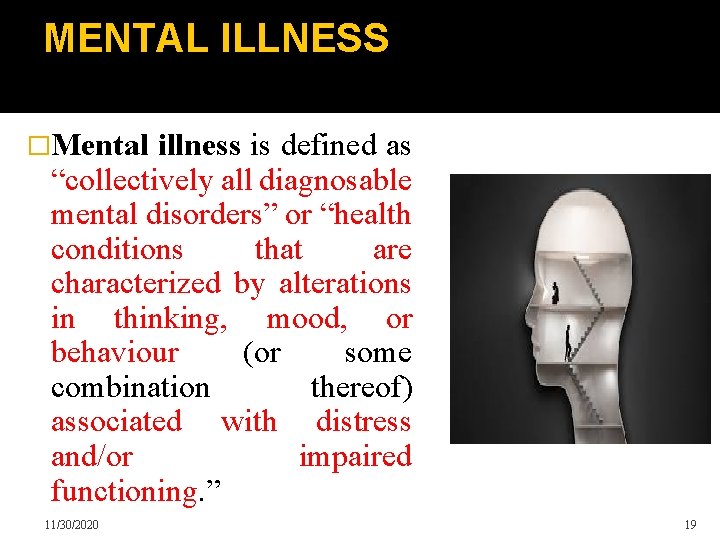
MENTAL ILLNESS �Mental illness is defined as “collectively all diagnosable mental disorders” or “health conditions that are characterized by alterations in thinking, mood, or behaviour (or some combination thereof) associated with distress and/or impaired functioning. ” 11/30/2020 19
MENTAL HEALTH NURSING �Mental health nursing involves the diagnosis and treatment of human responses to actual or potential mental health problems. �Comprehensive services focus on prevention of mental illness, health maintenance, management of and referral for mental and physical health problems, diagnosis and treatment. 11/30/2020 20

Historical Development �The origins of most of psychiatry's concepts begin with prehistoric times when primitive people believed spirits possessed the body and had to be driven out to effect a cure. �Before the 5 th century BC, the Greeks, Romans, and Arabs believed that emotional disorders were an organic dysfunction of the brain. 11/30/2020 21
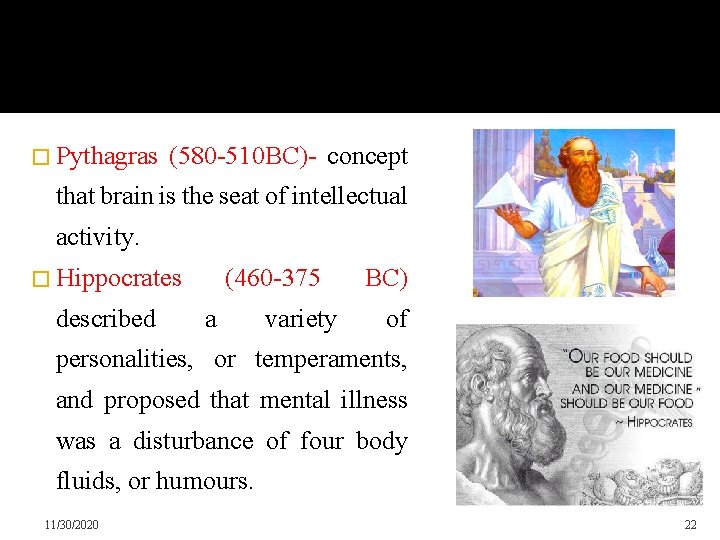
� Pythagras (580 -510 BC)- concept that brain is the seat of intellectual activity. � Hippocrates described (460 -375 a variety BC) of personalities, or temperaments, and proposed that mental illness was a disturbance of four body fluids, or humours. 11/30/2020 22
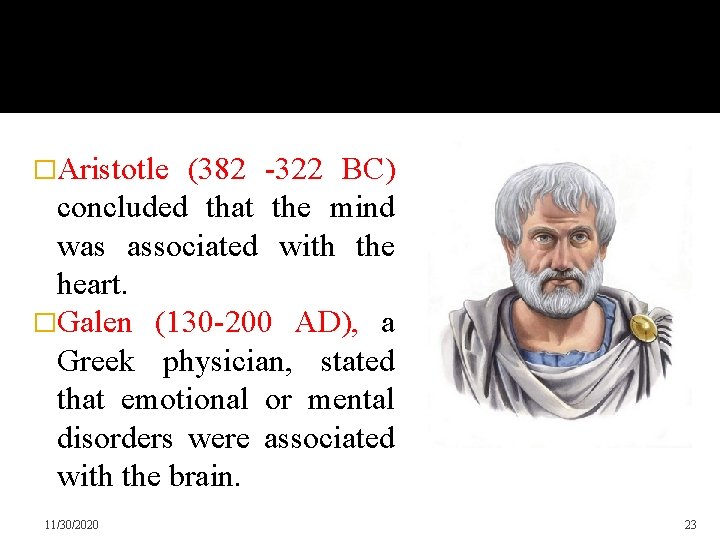
�Aristotle (382 -322 BC) concluded that the mind was associated with the heart. �Galen (130 -200 AD), a Greek physician, stated that emotional or mental disorders were associated with the brain. 11/30/2020 23
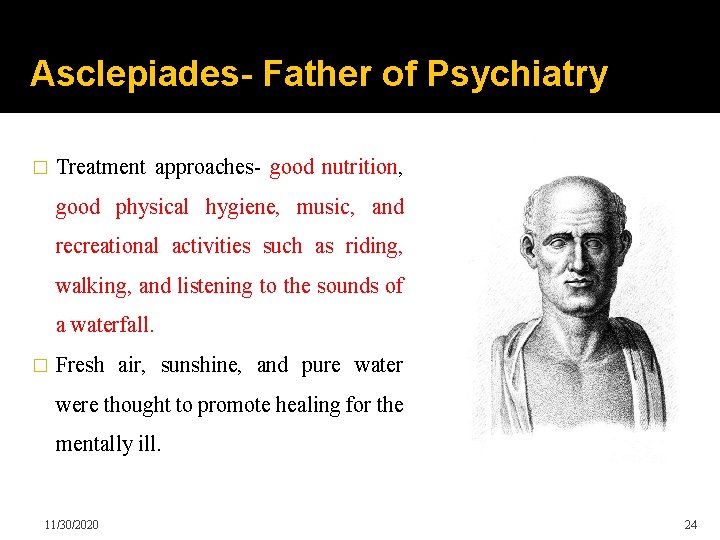
Asclepiades- Father of Psychiatry � Treatment approaches- good nutrition, good physical hygiene, music, and recreational activities such as riding, walking, and listening to the sounds of a waterfall. � Fresh air, sunshine, and pure water were thought to promote healing for the mentally ill. 11/30/2020 24
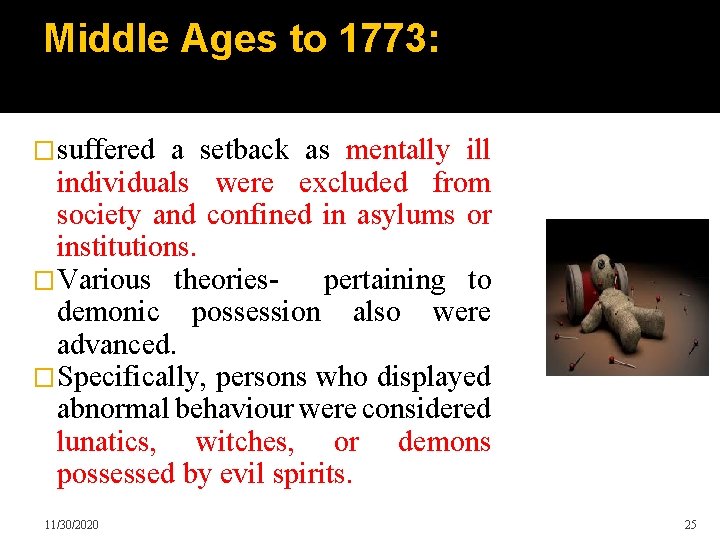
Middle Ages to 1773: �suffered a setback as mentally ill individuals were excluded from society and confined in asylums or institutions. �Various theoriespertaining to demonic possession also were advanced. �Specifically, persons who displayed abnormal behaviour were considered lunatics, witches, or demons possessed by evil spirits. 11/30/2020 25
�Superstition, magic, and witchcraft prevailed as patients were locked in asylums, flogged, starved, tortured, or subjected to bloodletting. �Beheading, hanging, and burning at the stake were common occurrences. �During this same period, physicians described symptoms of depression, paranoia, delusions, hysteria, and nightmares. 11/30/2020 26
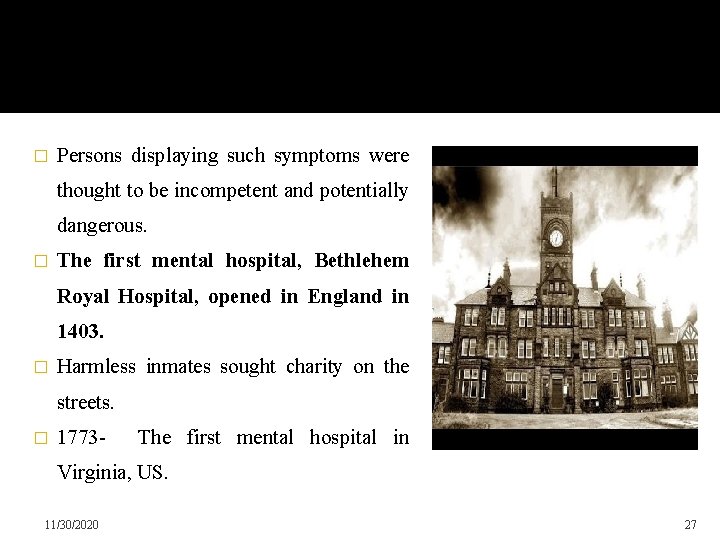
� Persons displaying such symptoms were thought to be incompetent and potentially dangerous. � The first mental hospital, Bethlehem Royal Hospital, opened in England in 1403. � Harmless inmates sought charity on the streets. � 1773 - The first mental hospital in Virginia, US. 11/30/2020 27
� 1793 - Philip Pinel- first revolution in Psychiatry( removed the chains of mentally ill) � 1812 - Benjamin Rush(father of American psychiatry) first American textbook of psychiatry. � 1908 - Clifford Beers- The Mind That Found Itself- book changed conditions of mental hospital. 11/30/2020 28
� 1912 - Eugene Bleuler- Swiss Psychiatrist coined the term Schizophrenia. � 1938 - ECT used � 1939 - Sigmund Freud- Theory and therapy of psycho analysis. � 1949 - Lithium used for Mania � 1952 - Chlorpromazine- Revolution in Psychopharmacology 11/30/2020 29
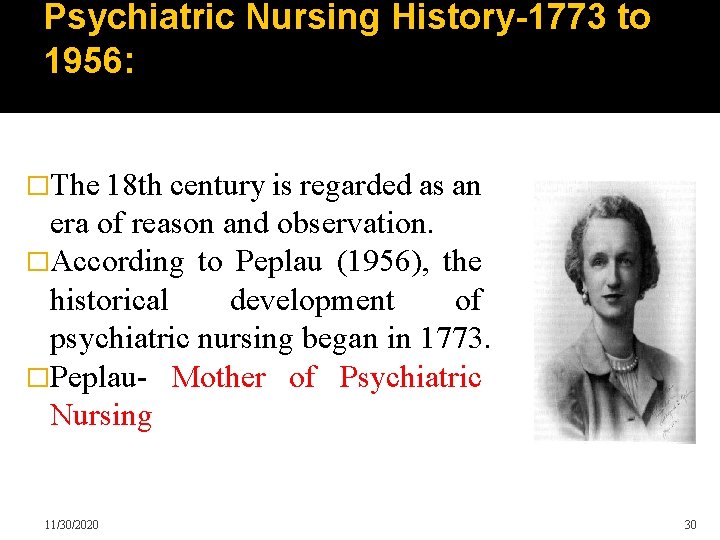
Psychiatric Nursing History-1773 to 1956: �The 18 th century is regarded as an era of reason and observation. �According to Peplau (1956), the historical development of psychiatric nursing began in 1773. �Peplau- Mother of Psychiatric Nursing 11/30/2020 30
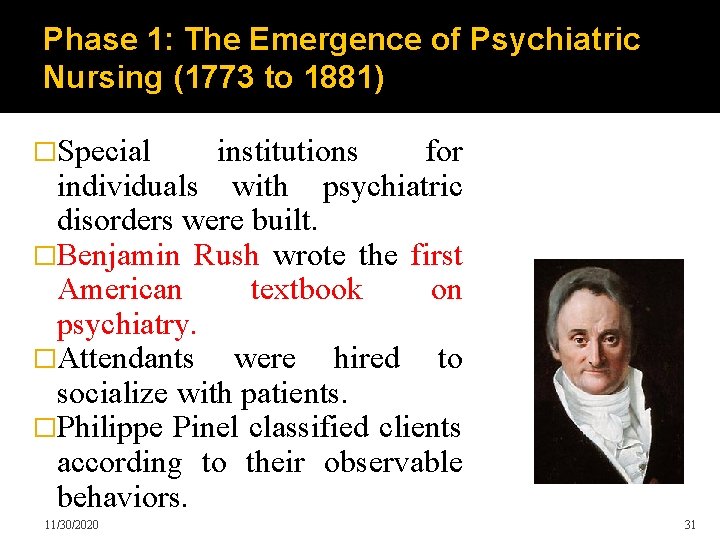
Phase 1: The Emergence of Psychiatric Nursing (1773 to 1881) �Special institutions for individuals with psychiatric disorders were built. �Benjamin Rush wrote the first American textbook on psychiatry. �Attendants were hired to socialize with patients. �Philippe Pinel classified clients according to their observable behaviors. 11/30/2020 31
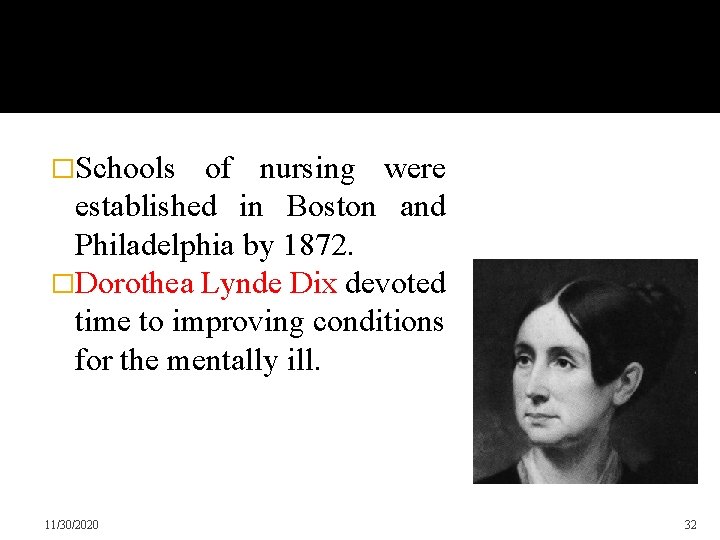
�Schools of nursing were established in Boston and Philadelphia by 1872. �Dorothea Lynde Dix devoted time to improving conditions for the mentally ill. 11/30/2020 32
Phase 2: Development of the Work Role of the Psychiatric Nurse (1882 to 1914) Training schools for nurses in the psychiatric setting were established at Mc. Lean Hospital in Belmont, Massachusetts and at Buffalo State Hospital in New York (1882). Trained nurses were employed in state mental hospitals (1890). First undergraduate psychiatric nursing program was established. National Society for Mental Hygiene was founded in 1909. 11/30/2020 33
Phase 3: Development of Undergraduate Psychiatric Nursing Education (1915 to 1935) Linda Richards, the first graduate nurse in the United States, suggested that mentally ill clients receive the same quality care as physically ill clients. Harriet Bailey wrote the first psychiatric nursing textbook, Nursing Mental Diseases. John Hopkins- First school of nursing had fully developed Psychiatric nursing course Insulin shock therapy, electroconvulsive therapy, and prefrontal lobotomy were introduced in the psychiatric clinical setting. 11/30/2020 34
Phase 4: Development of Graduate Psychiatric Nursing Education (1936 to 1945) Approximately half of all nursing schools provided psychiatric nursing courses; The National League of Nursing Education developed curriculum guidelines for psychiatric nursing graduate education. By 1943, three universitysponsored graduate programs existed. 11/30/2020 35
�Phase 5: Development of Consultation and Research in Psychiatric Nursing Practice (1946 to 1956) � 1952 - Hildegard Peplau- Interpersonal relations in nursing � 1953 - Maxwell Jones- Therapeutic Community 11/30/2020 36
Mental Health Services in India �BRITISH ERA: �Indian mental health is a child born to British parents and bred in Indian culture. �The Indian Lunacy Act (1912) was based on the British legislation then in force. �The history of Indian psychiatry runs parallel to British Psychiatry and the basic structure remains the same even to this day. 11/30/2020 37
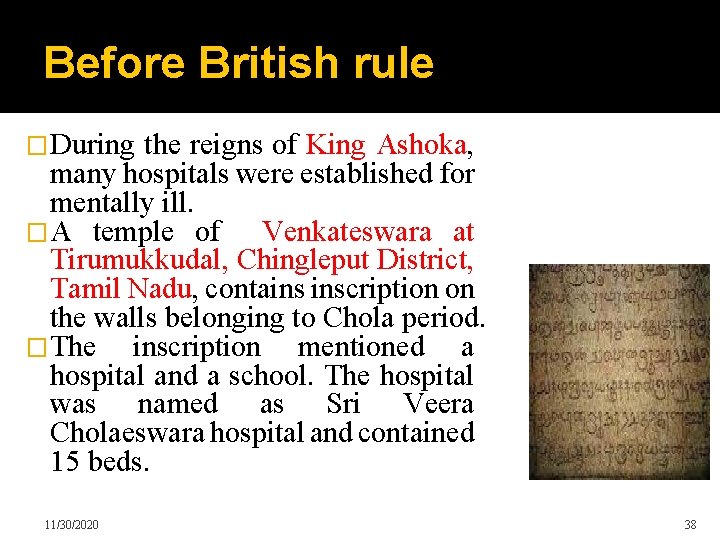
Before British rule �During the reigns of King Ashoka, many hospitals were established for mentally ill. �A temple of Venkateswara at Tirumukkudal, Chingleput District, Tamil Nadu, contains inscription on the walls belonging to Chola period. �The inscription mentioned a hospital and a school. The hospital was named as Sri Veera Cholaeswara hospital and contained 15 beds. 11/30/2020 38
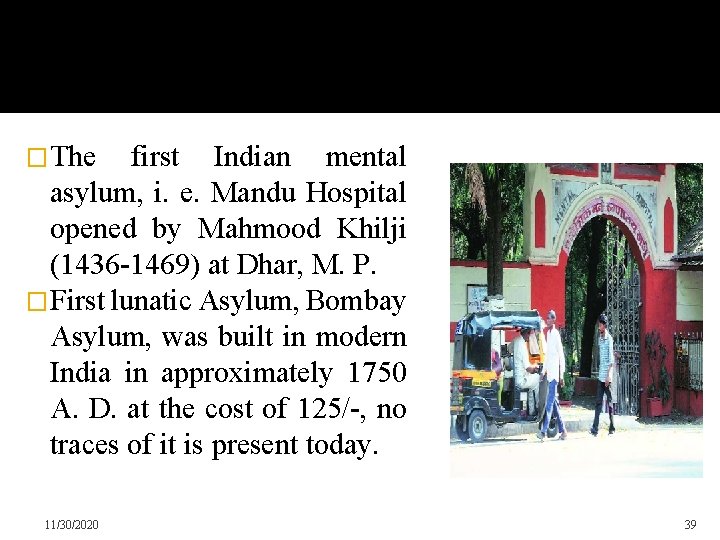
�The first Indian mental asylum, i. e. Mandu Hospital opened by Mahmood Khilji (1436 -1469) at Dhar, M. P. �First lunatic Asylum, Bombay Asylum, was built in modern India in approximately 1750 A. D. at the cost of 125/-, no traces of it is present today. 11/30/2020 39
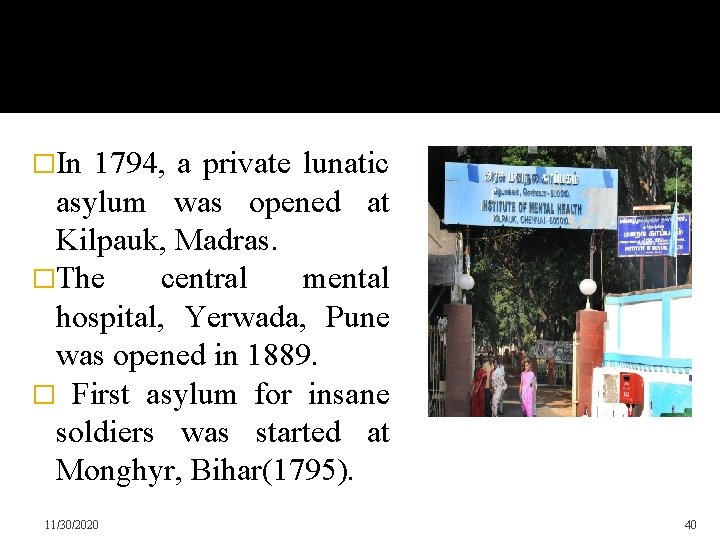
�In 1794, a private lunatic asylum was opened at Kilpauk, Madras. �The central mental hospital, Yerwada, Pune was opened in 1889. � First asylum for insane soldiers was started at Monghyr, Bihar(1795). 11/30/2020 40
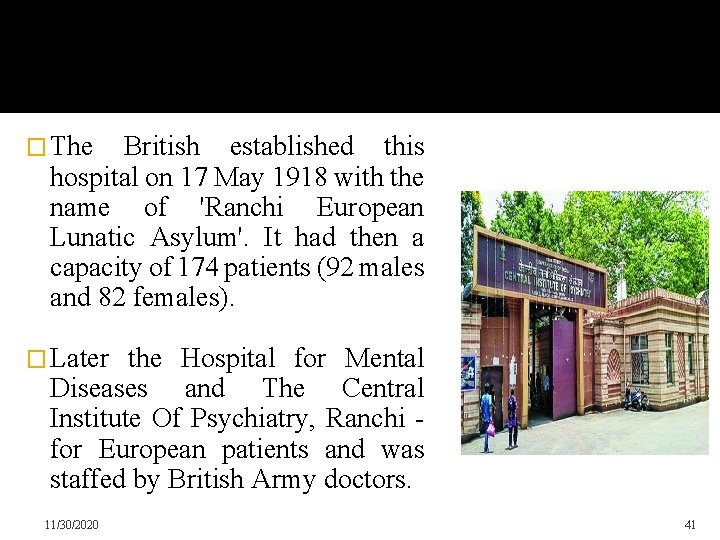
� The British established this hospital on 17 May 1918 with the name of 'Ranchi European Lunatic Asylum'. It had then a capacity of 174 patients (92 males and 82 females). � Later the Hospital for Mental Diseases and The Central Institute Of Psychiatry, Ranchi for European patients and was staffed by British Army doctors. 11/30/2020 41
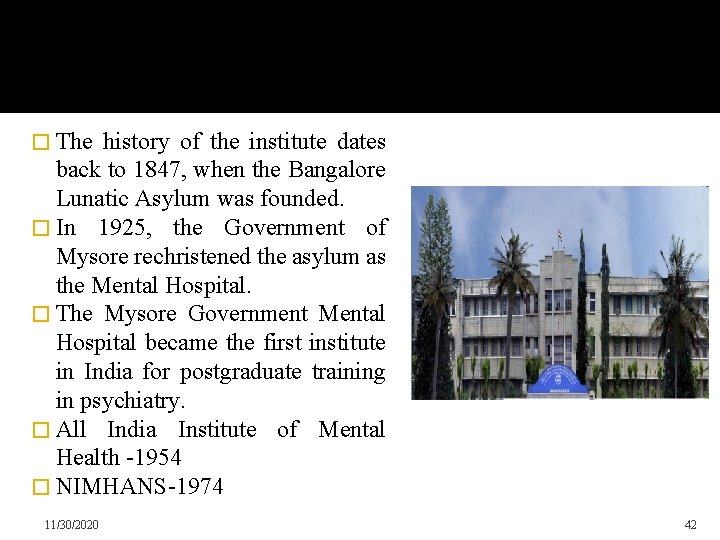
� The history of the institute dates back to 1847, when the Bangalore Lunatic Asylum was founded. � In 1925, the Government of Mysore rechristened the asylum as the Mental Hospital. � The Mysore Government Mental Hospital became the first institute in India for postgraduate training in psychiatry. � All India Institute of Mental Health -1954 � NIMHANS-1974 11/30/2020 42
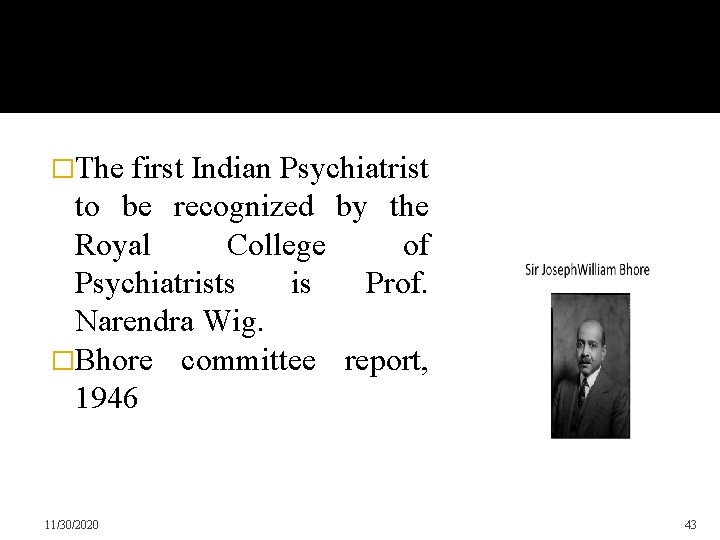
�The first Indian Psychiatrist to be recognized by the Royal College of Psychiatrists is Prof. Narendra Wig. �Bhore committee report, 1946 11/30/2020 43
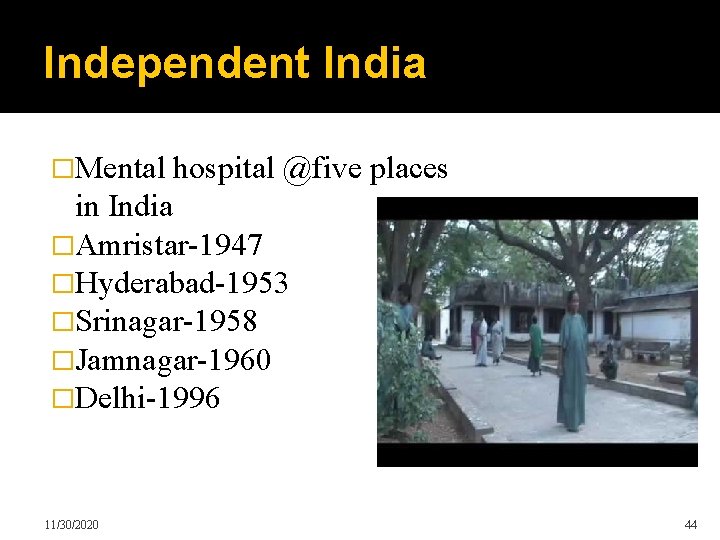
Independent India �Mental hospital @five places in India �Amristar-1947 �Hyderabad-1953 �Srinagar-1958 �Jamnagar-1960 �Delhi-1996 11/30/2020 44
� 1954 - Nur Manzil Mental Health Centre started orientation courses in Psyc. Nursing � 1956 - 1 year diploma in Psy. Nsg @ NIMHANS � 1963 - Community mental health centres act passed. � 1982 - National Mental Health Programme � 1986 -INC included Psy. Nsg in GNM syllabus. � 1987 - Indian Mental Health Act 11/30/2020 45
Mental Health Services as on Today in India �Institutionalization Vs Deinstitutionalization �Focus shifted to Community Based Care �District Mental Health Programme �National Mental Health Policy �Revision Of Mental Health Act 11/30/2020 46
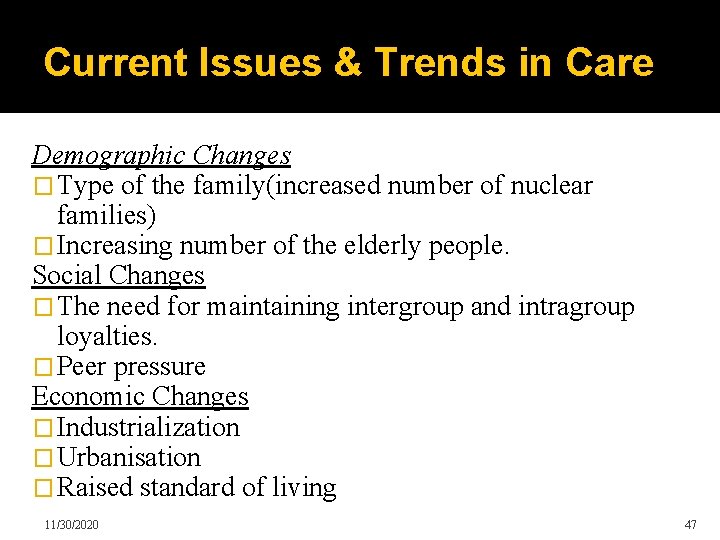
Current Issues & Trends in Care Demographic Changes � Type of the family(increased number of nuclear families) � Increasing number of the elderly people. Social Changes � The need for maintaining intergroup and intragroup loyalties. � Peer pressure Economic Changes � Industrialization � Urbanisation � Raised standard of living 11/30/2020 47
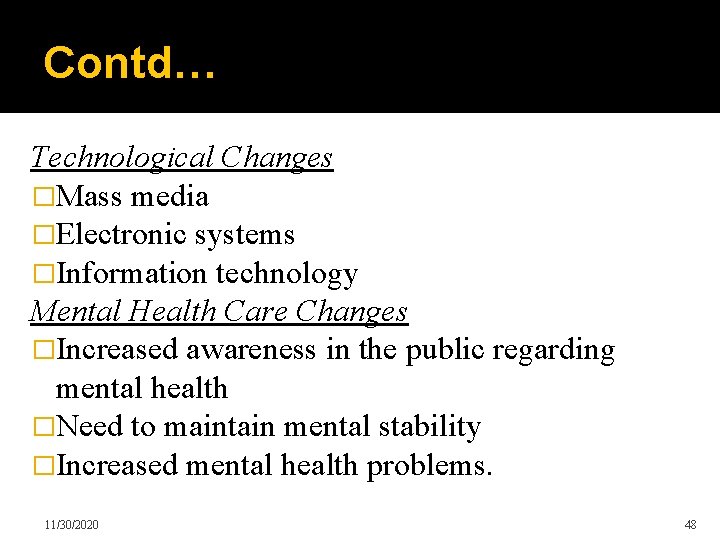
Contd… Technological Changes �Mass media �Electronic systems �Information technology Mental Health Care Changes �Increased awareness in the public regarding mental health �Need to maintain mental stability �Increased mental health problems. 11/30/2020 48
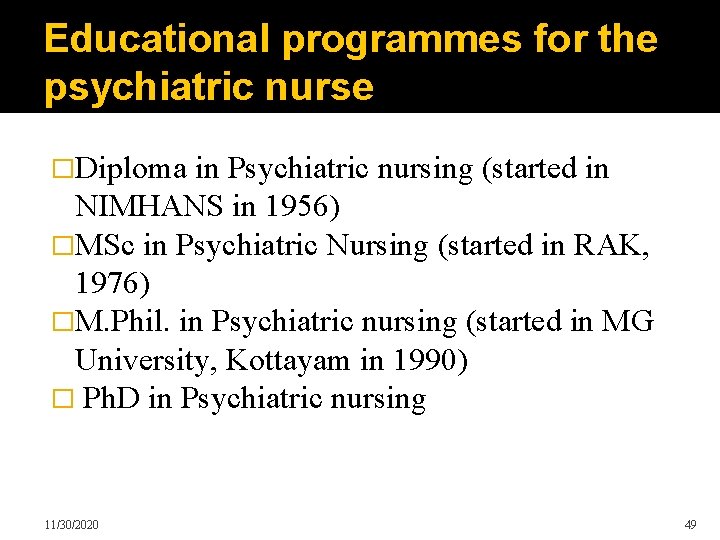
Educational programmes for the psychiatric nurse �Diploma in Psychiatric nursing (started in NIMHANS in 1956) �MSc in Psychiatric Nursing (started in RAK, 1976) �M. Phil. in Psychiatric nursing (started in MG University, Kottayam in 1990) � Ph. D in Psychiatric nursing 11/30/2020 49
Nursing Service � Expanded roles � Advanced practice roles � Independent practice 11/30/2020 50
Prevalence and incidence of mental health problems and disorders
Meaning Of Incidence & Prevalence: �Incidence is ‘the number of instances of illness commencing, or of persons becoming ill’ (or dying or being hurt in injuries, or whatever) ‘during a given period in a specified population’. �Incidence can tell us how many new cases of a particular illness have been suffered by a community, 11/30/2020 52
�Prevalence is a frequently used epidemiological measure of how commonly a disease or condition occurs in a population. �Prevalence measures how much of some disease or condition there is in a population at a particular point in time. 11/30/2020 53
Prevalence Of Mental Illness In Abroad �Mental disorders are common in India and internationally. �One in 10 children have a diagnosable mental disorder in a given year. One in four families has at least one member with a mental disorder. 11/30/2020 54
Prevalence Of Mental Disorders In India: �The all-India national rate (rural + urban) to be 65. 4/1000, rural rate as 64. 4 and urban rate as 66. 4. �Thus the urban rate is marginally higher than the rural rate. 11/30/2020 55
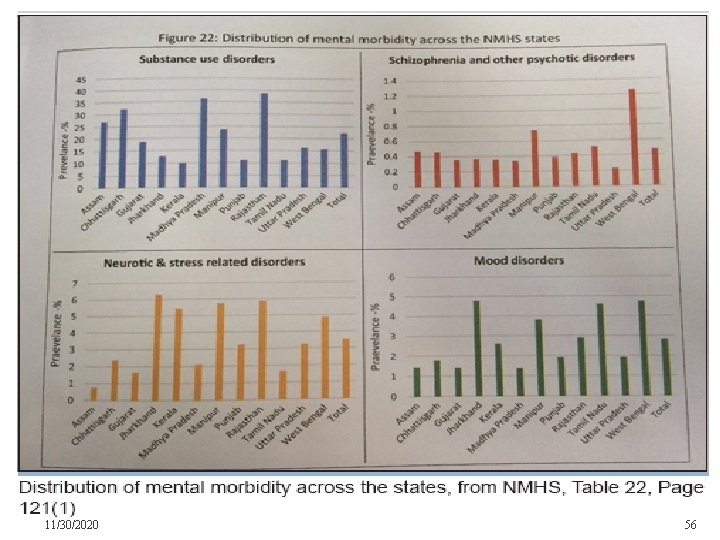
11/30/2020 56
All mental disorder (national): �For schizophrenia, the national rate observed was 2. 3 per 1000. �The category - affective disorders incorporates data regarding all depressive disorders, neurotic and psychotic. The all India value observed was 31. 2 per 1000. �Mental retardation was observed to �have national rate of 4. 2 per 1000. 11/30/2020 57
�The most widely prevalent disorders were observed to be depression and anxiety, in that order (18. 5 per 1000 for the later). �Rural-urban difference: The urban morbidity rate was observed to be 2 per 1000 higher than the rural morbidity rate (66. 4 and 64. 4 respectively). 11/30/2020 58
�Studies reported prevalence rates of psychiatric disorders among children ranging from 13 to 94 per 1000. Since children and adolescent form 40% of the total population of India, approximately four crores of the population requires professional help. 11/30/2020 59
Uttarkhand – State mental health system overview � Uttarakhand has neither a mental hospital nor a community mental health facility. � There is no specific mental health related information system in the state. � The state does not have a separate mental health act however the Mental Health Act 1987 applies to the entire country. � For implementation of the Mental Health Act, the government has constituted (June 2005) a State Mental Health Authority (SMHA) is yet to start regular functioning. 11/30/2020 60
�The state does not have a mental health outpatient facility in the public sector. �The only mental health outpatient facility and day treatment facility is available at the Himalayan Institute Trust Hospital near Dehradun and AIIMS, Rishikesh. 11/30/2020 61
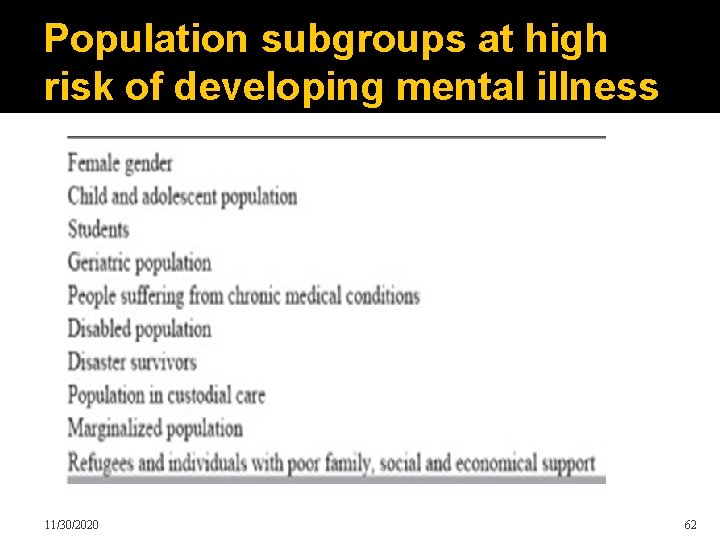
Population subgroups at high risk of developing mental illness 11/30/2020 62
Economic cost of treating psychiatric patients in India �Prevalence of mental illness is approximately 200/1000 population. � In simple words, approximately 20 crores of the population requires professional help. �Each mentally ill patient requires Rs. 500 per month for mental healthcare. �This includes medication cost, doctor's fees and travelling cost to meet the doctor. 11/30/2020 63
�It is high time to stop the long-term debate about the prevalence rate of mental illness in India and move forward to actual actions that call for investing and improving the mental health services in India. 11/30/2020 64

ANY QUESTIONS? ? ? 11/30/2020 65

CONCLUSION 11/30/2020 66

THANK YOU 11/30/2020 67
- Slides: 67