
Objectives Define the vocabulary words Define CDC and
Objectives • • Define the vocabulary words Define CDC and explain its function Define the patterns of disease List and describe the basic mechanisms of disease and risk factors associated with disease • List and describe the five categories of pathogenic organisms and explain how they cause disease (Be able to identify each example on handout)
• Know Common Aseptic Methods in Table 5 -6 on page 116 • Distinguish between the terms benign and malignant as they apply to tumors (Know Table 5 -7 on page 118) • Describe the pathogenesis of cancer • Outline the events of the inflammatory response and explain its role in disease
Vocabulary Words • Health – physical, mental, and social well-being; not merely absence of disease • Disease – abnormality in body function that threatens health • Etiology – the study of factors that cause disease
More vocabulary words • Idiopathic – refers to a disease with an unknown cause • Signs – objective abnormalities that can be seen or measured by someone other than the patient • Symptoms – subjective abnormalities felt only by the patient • Syndrome – a collection of different signs and symptoms
Vocabulary (cont’d) • Acute – signs and symptoms appear suddenly, persist for a short time, then disappear • Chronic – develops slowly and lasts for a long time • Communicable – can be transferred from one person to another • Pathogenesis – the pattern of a disease’s development
• Incubation – latent or “hidden” stage, no signs of disease are visible • Convalescence – recovery • Remission – reversal of a chronic disease; when permanent the person is considered “cured”
CDC • Centers for Disease Control and Prevention • Branch of U. S. Public Health Service • Headquarters in Atlanta • Morbidity – disease rates in specific populations • Mortality – number of deaths caused by specific diseases
Patterns of Disease • Epidemiology – study of occurrence, distribution, and transmission of diseases in human populations • Endemic – native to a local region • Epidemic – disease affects many people at the same time • Pandemic – widespread, perhaps global, epidemic
Pathophysiology the study of underlying physiological aspects of disease
Mechanisms of Disease • • Genetic mechanisms Pathogenic organisms Malnutrition Tumors and cancer Physical and chemical agents Autoimmunity Inflammation Degeneration (when tissues break apart)
Risk Factors • • Genetic factors Age Lifestyle Stress – psychogenic (mind-caused), ulcers, headaches, hypertension • Environmental factors • Preexisting conditions- example: blisters from a burn break open…. . bacterial infection
Pathogenic Organisms • Viruses invade cells and insert their own genetic code into the host cell’s genetic code causing the cell to produce viral DNA or RNA and protein coats • Classified by shape, nucleic acid type, and method of reproduction • Know Table 5 -1 on page 109
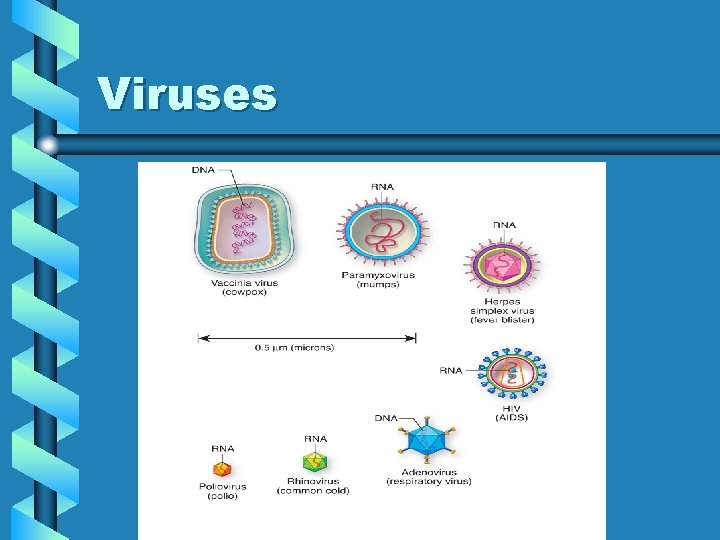
Viruses
• Bacteria secrete toxic substances that damage human tissues, become parasites inside human cells, or may form colonies that disrupt normal human function • Spores - nonreproducing forms of bacteria that resist unfavorable environmental conditions
Classifying Bacteria • Function: aerobic (require oxygen) vs. anaerobic (no O 2) • Staining properties (composition of cell wall): • Gram-positive – stained purple by Gram’s staining technique • Gram-negative – no staining • Shape and size
Fungi (Fun-jye) • Fungi that are pathogenic parasitize tissue on or near the skin or mucous membranes; mycotic infections (often resist treatment) • Protozoa are one-celled organisms that can infest human fluids and cause disease by parasitizing cells or directly destroying them
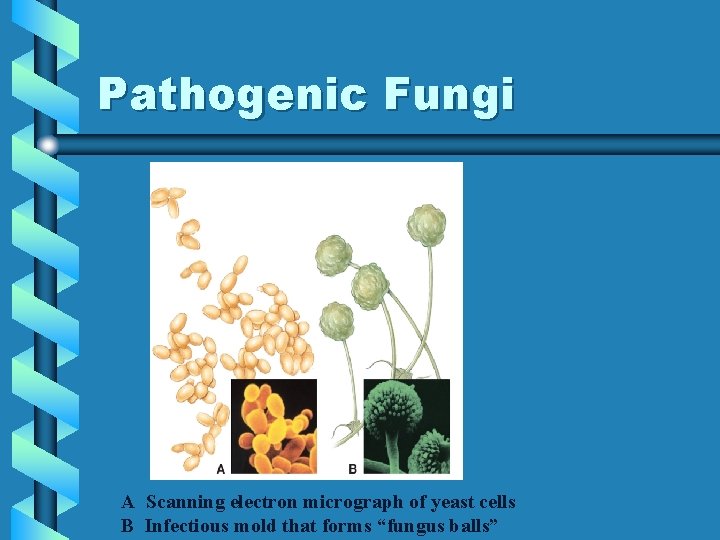
Pathogenic Fungi A Scanning electron micrograph of yeast cells B Infectious mold that forms “fungus balls”
Major Groups of Protozoa • Amoebas – pseudopodia • Flagellates • Ciliates • Sporozoa (coccidia) – enter cells during one phase of a two part life cycle; borne by vectors (transmitters) during the other phase
• Pathogenic animals are sometimes called metazoa. Large, multicellular organisms cause disease by parasitizing humans or causing direct injury
Prevention and Control • • • Person-to-person contact Environmental contact Opportunistic invasion Transmission by a vector Vaccination Chemicals – antibiotics (natural compounds derived from living organisms) and synthetic compounds
Tumors and Cancer • Neoplasms (tumors) – abnormal growths of cells • Benign – remain localized • Malignant – spread, forming secondary tumors • Metastasis – cells leave a primary tumor and start a secondary tumor at a new location
Classification of Tumors • Benign, epithelial tumors: • Papilloma – finger-like projection • (wart) • Adenoma – glandular tumor • Nevus – small. Pigmented tumor • (mole)
• Benign, Connective Tissue Tumors: • Lipoma – adipose (fat) tumor • Osteoma – bone tumor • Chondroma – cartilage tumor
Carcinomas • Malignant epithelial tissues: • Melanoma – involves melanocytes (pigment-producing cells of the skin) • Adenocarcinoma – glandular cancer
Sarcomas • Connective tissue cancer • Lymphoma – lymphatic cancer • Osteosarcoma – bone cancer • Myeloma – bone marrow tumor • Fibrosarcoma – cancer of fibrous connective tissue
Causes of Cancer • Hyperplasia – growth of too many cells • Anaplasia – development of undifferentiated cells • Genetics • Carcinogens • Age • Injury (radiation) • Viruses
Pathogenesis of Cancer • • Early detection Methods of detection: Self-examination Diagnostic imaging (Know pages 121 -122) Grading – assess likely pattern Cachexia (Ka-Kek-see-ah) – syndrome: appetite loss, weight loss, general weakness
• Causes of death: secondary infections, organ failure, hemorrhage, undetermined • Treatments: chemotherapy, surgery, radiotherapy, laser therapy, immunotherapy, new strategies (vaccines)
Inflammation • Response reduces injury to tissues, homeostasis • Signs- redness, swelling, heat, pain • Inflammation mediators released from tissues– histamine, prostaglandins, kinins
Inflammation Mediators • Some cause blood vessels to dilate (widen), increasing blood volume (redness, heat); white blood cells travel quickly to site
• Some increase blood vessel permeability (swelling (edema) and pain); white blood cells move easily out of vessels, irritant is diluted, and exudate (fluid in inflamed tissue)accumulates
• Some attract white blood cells to the site - chemotaxis • Phagocytosis • Pus – exudate becomes thick with white blood cells, dead tissue and bacterial cells
Inflammatory Diseases • Local or systemic (body-wide) • Fever – destroys pathogens and enhances immunity • Chronic inflammation – damages tissues • Arthritis, asthma, eczema, chronic bronchitis
- Slides: 33