
Objectives Define the magnetic field discussing magnetic poles
Objectives: • Define the magnetic field, discussing magnetic poles and flux lines. • Solve problems involving the magnitude and direction of forces on charges moving in a magnetic field. • Solve problems involving the magnitude and direction of forces on current carrying conductors in a B-field.
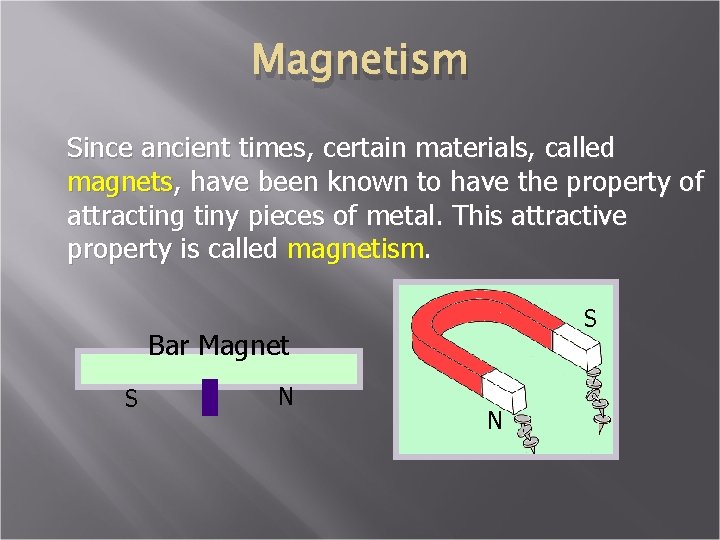
Magnetism Since ancient times, certain materials, called magnets, have been known to have the property of attracting tiny pieces of metal. This attractive property is called magnetism. S Bar Magnet S N N
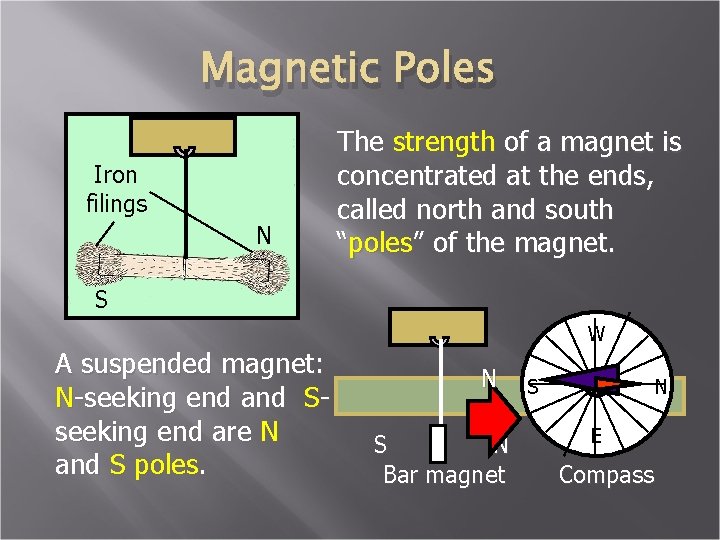
Magnetic Poles Iron filings N The strength of a magnet is concentrated at the ends, called north and south “poles” of the magnet. S A suspended magnet: N-seeking end and Sseeking end are N and S poles. W N S N Bar magnet S N E Compass

Magnetic Attraction-Repulsion S S N N N Magnetic Forces: Like Poles Repel S S N N S Unlike Poles Attract
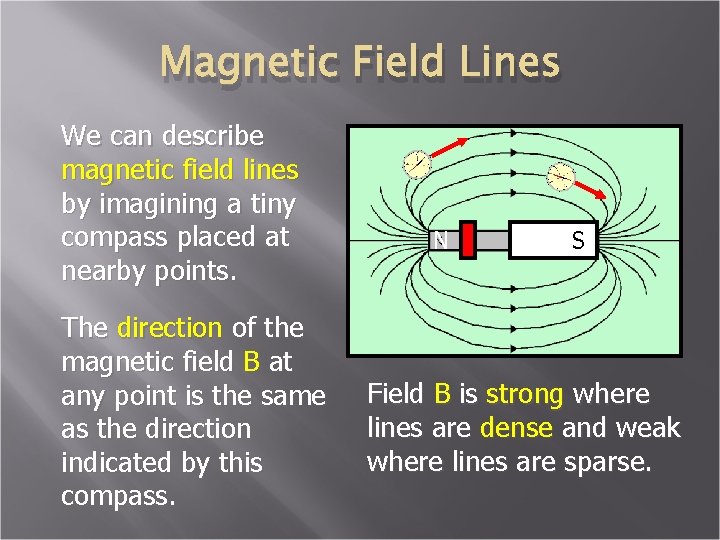
Magnetic Field Lines We can describe magnetic field lines by imagining a tiny compass placed at nearby points. The direction of the magnetic field B at any point is the same as the direction indicated by this compass. N S Field B is strong where lines are dense and weak where lines are sparse.
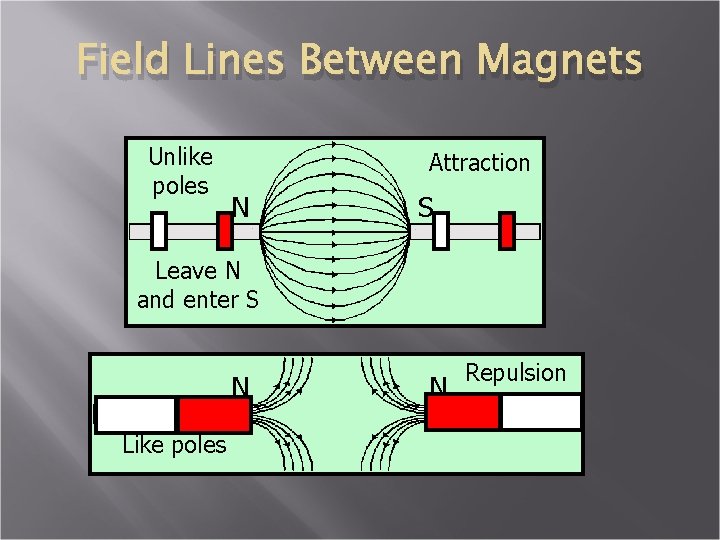
Field Lines Between Magnets Unlike poles Attraction N S Leave N and enter S N Like poles N Repulsion
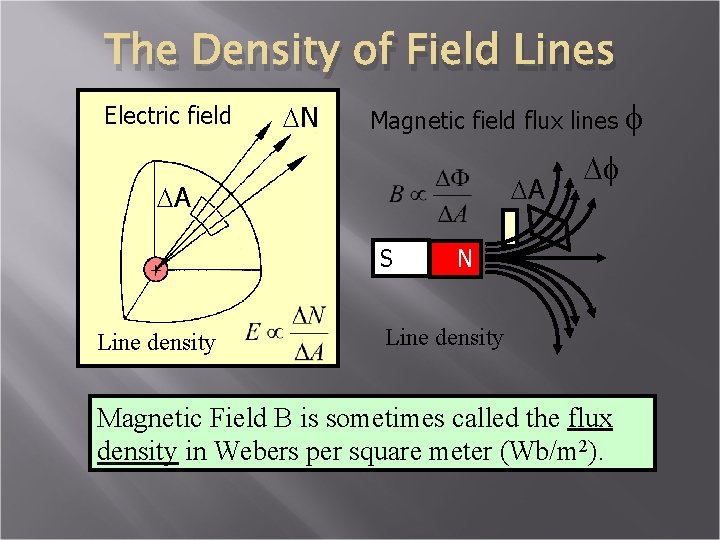
The Density of Field Lines Electric field DN Magnetic field flux lines DA DA S Line density Df N Line density Magnetic Field B is sometimes called the flux density in Webers per square meter (Wb/m 2). f
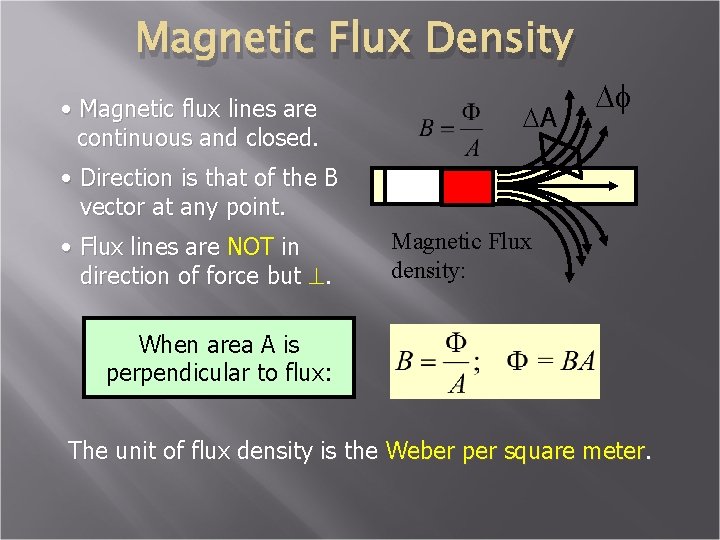
Magnetic Flux Density • Magnetic flux lines are continuous and closed. DA Df • Direction is that of the B vector at any point. • Flux lines are NOT in direction of force but ^. Magnetic Flux density: When area A is perpendicular to flux: The unit of flux density is the Weber per square meter.

Calculating Flux Density When Area is Not Perpendicular The flux penetrating the area A when the normal vector n makes an angle of q with the B-field is: n A q a B The angle q is the complement of the angle a that the plane of the area makes with the B field. (Cos q = Sin a)
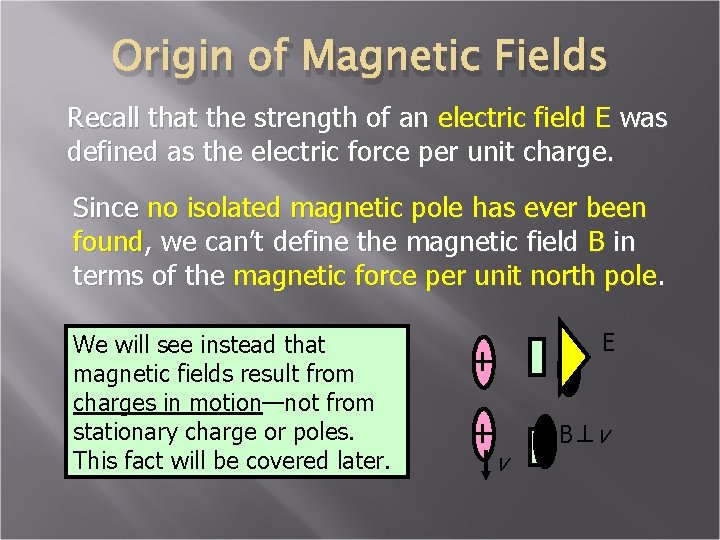
Origin of Magnetic Fields Recall that the strength of an electric field E was defined as the electric force per unit charge. Since no isolated magnetic pole has ever been found, we can’t define the magnetic field B in terms of the magnetic force per unit north pole. We will see instead that magnetic fields result from charges in motion—not from stationary charge or poles. This fact will be covered later. E + + v B^v
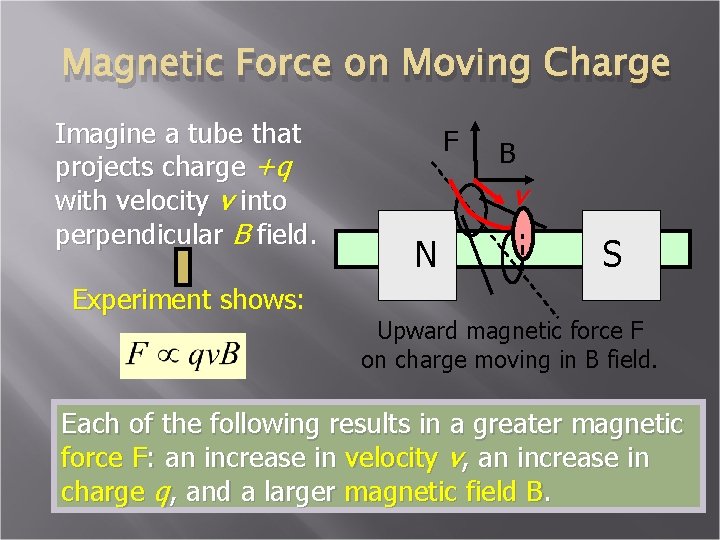
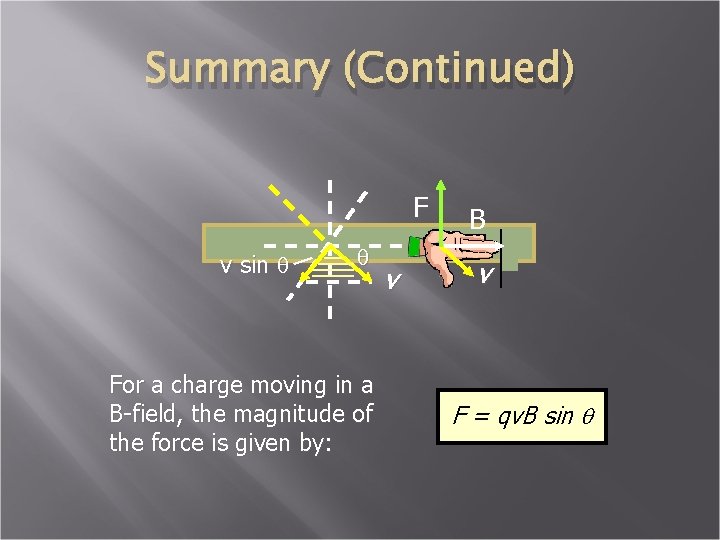
Magnetic Force on Moving Charge Imagine a tube that projects charge +q with velocity v into perpendicular B field. Experiment shows: F B v N S Upward magnetic force F on charge moving in B field. Each of the following results in a greater magnetic force F: an increase in velocity v, an increase in charge q, and a larger magnetic field B.
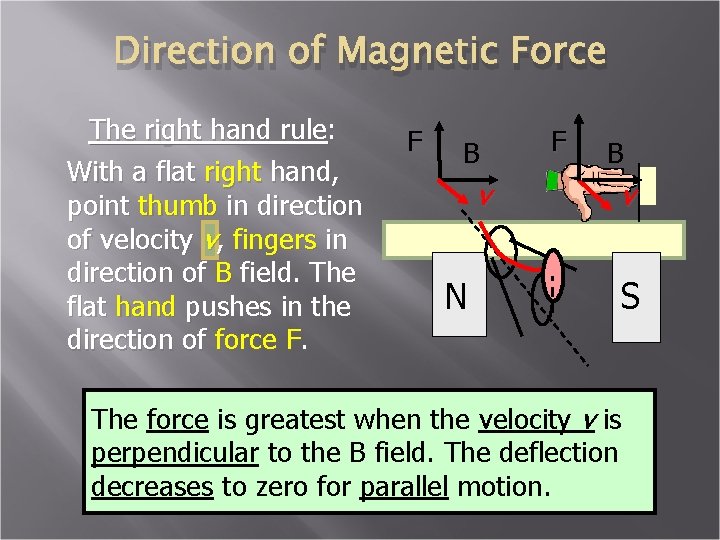
Direction of Magnetic Force The right hand rule: With a flat right hand, point thumb in direction of velocity v, fingers in direction of B field. The flat hand pushes in the direction of force F. F B v N F B v S The force is greatest when the velocity v is perpendicular to the B field. The deflection decreases to zero for parallel motion.
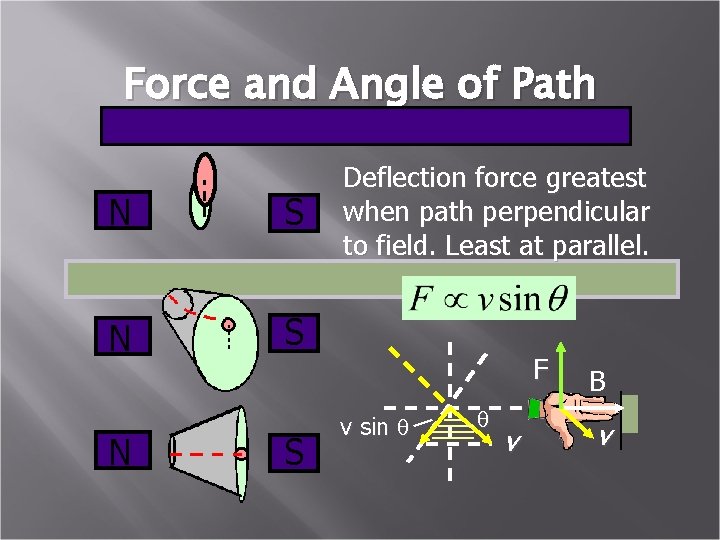
Force and Angle of Path N S N S Deflection force greatest when path perpendicular to field. Least at parallel. F v sin q q v B v
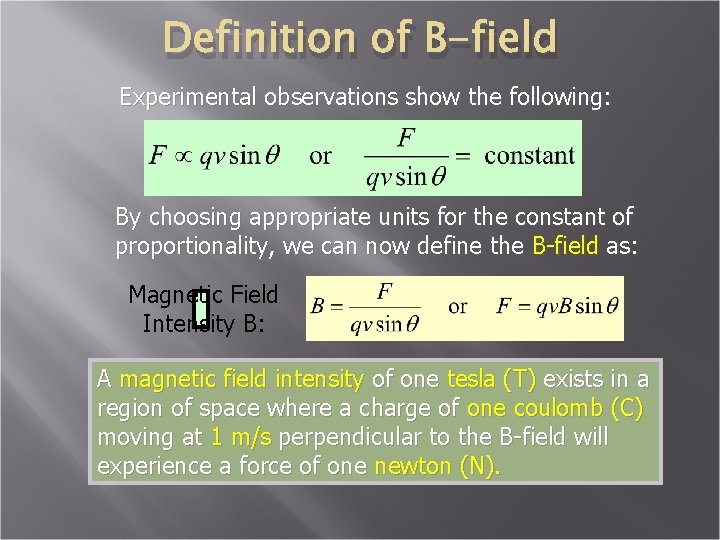
Definition of B-field Experimental observations show the following: By choosing appropriate units for the constant of proportionality, we can now define the B-field as: Magnetic Field Intensity B: A magnetic field intensity of one tesla (T) exists in a region of space where a charge of one coulomb (C) moving at 1 m/s perpendicular to the B-field will experience a force of one newton (N).
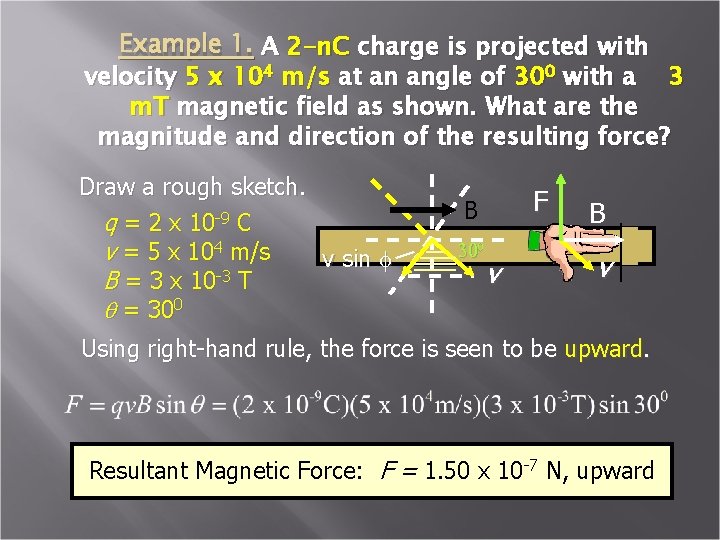
Example 1. A 2 -n. C charge is projected with velocity 5 x 10⁴ m/s at an angle of 300 with a 3 m. T magnetic field as shown. What are the magnitude and direction of the resulting force? Draw a rough sketch. q = 2 x 10 -9 C v = 5 x 10⁴ m/s v sin f B = 3 x 10 -3 T q = 300 F B 300 v B v Using right-hand rule, the force is seen to be upward. Resultant Magnetic Force: F = 1. 50 x 10 -7 N, upward
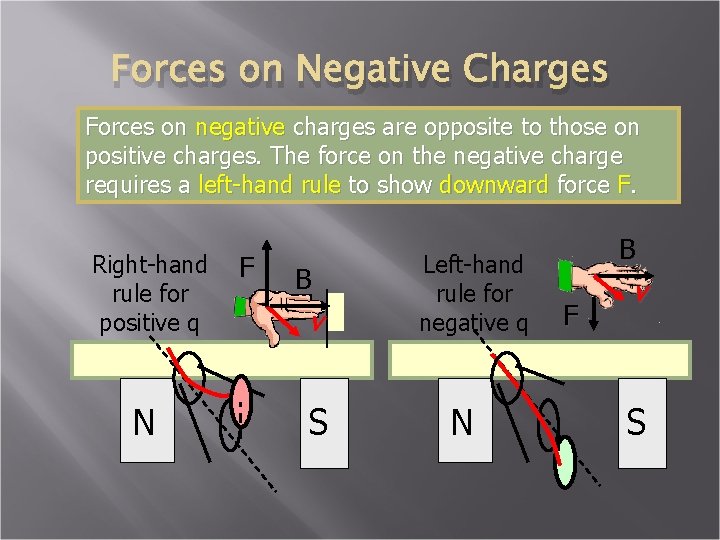
Forces on Negative Charges Forces on negative charges are opposite to those on positive charges. The force on the negative charge requires a left-hand rule to show downward force F. Right-hand rule for positive q N F B v S Left-hand rule for negative q N B F v S
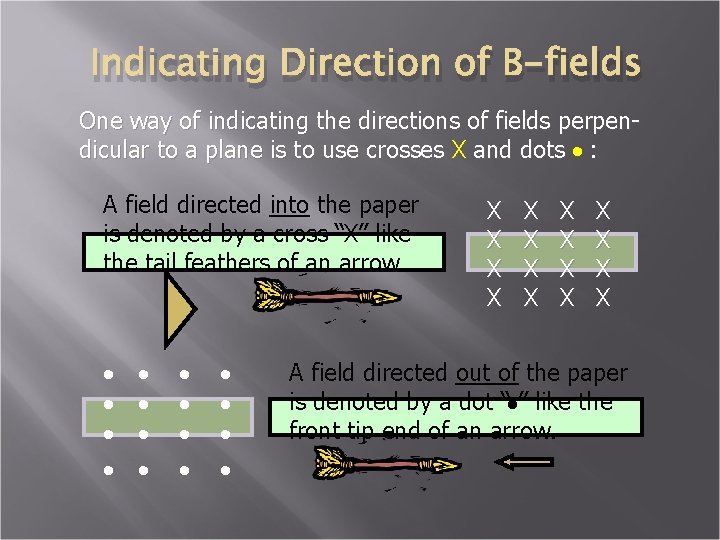
Indicating Direction of B-fields One way of indicating the directions of fields perpendicular to a plane is to use crosses X and dots · : A field directed into the paper is denoted by a cross “X” like the tail feathers of an arrow. · · · · X X X X A field directed out of the paper is denoted by a dot “·” like the front tip end of an arrow.
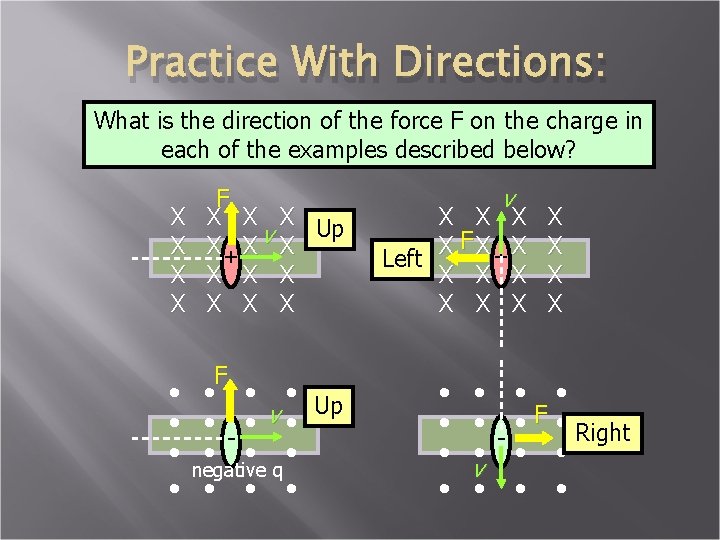
Practice With Directions: What is the direction of the force F on the charge in each of the examples described below? v X X F X X X Up X+ X v X X X X · · · F · · · Up v · · - · · · · negative q · · X X FX + X Left X X X X X · · ·F · Right · · · v · · ·
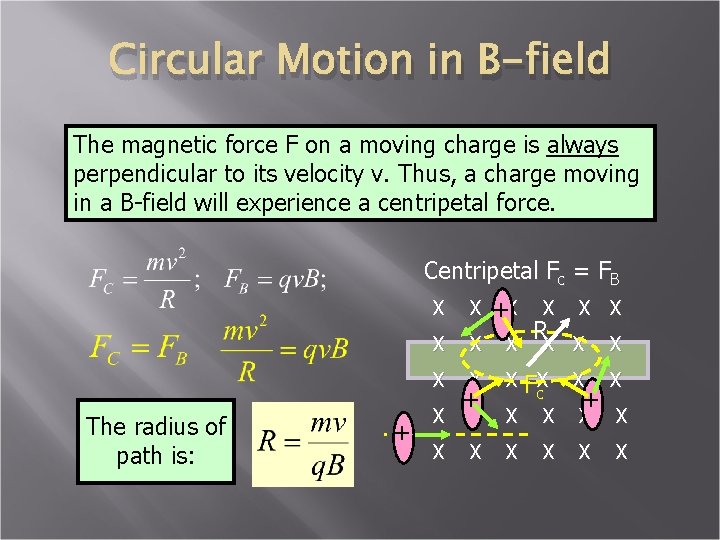
Circular Motion in B-field The magnetic force F on a moving charge is always perpendicular to its velocity v. Thus, a charge moving in a B-field will experience a centripetal force. Centripetal Fc = FB The radius of path is: + X X +X X X X FX X X X + X X X RX X c X + X X
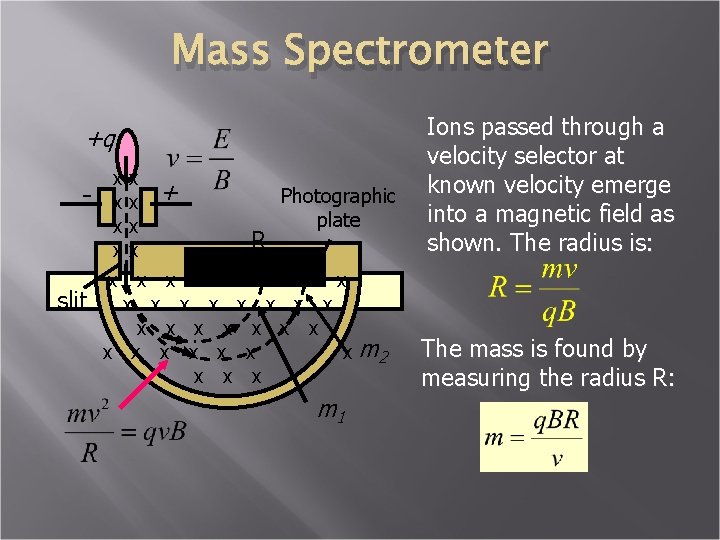
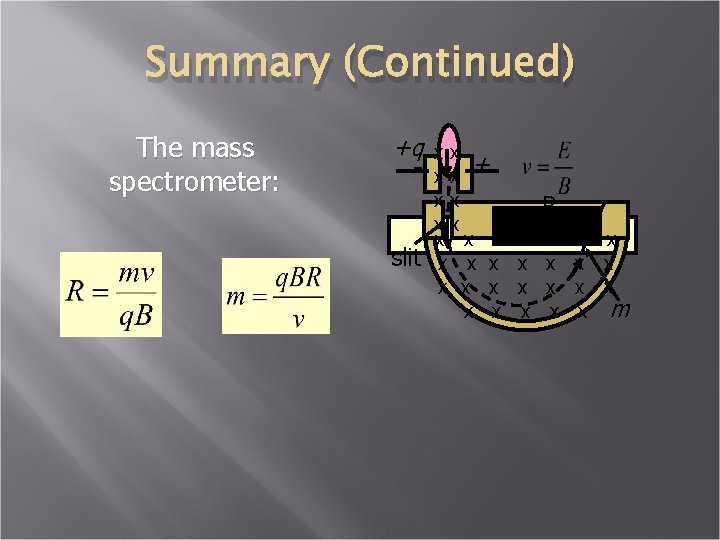
Mass Spectrometer +q slit xx Photographic xx + plate xx R xx x x x x x x x m 2 x x x m 1 Ions passed through a velocity selector at known velocity emerge into a magnetic field as shown. The radius is: The mass is found by measuring the radius R:
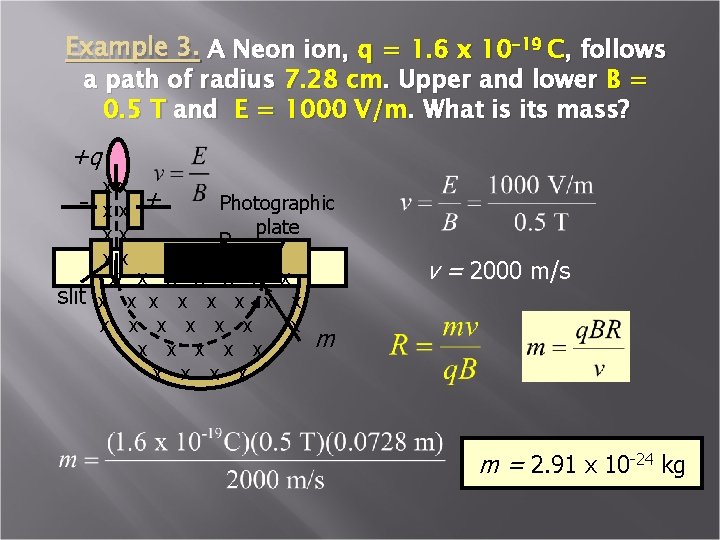
Example 3. A Neon ion, q = 1. 6 x 10 -19 C, follows a path of radius 7. 28 cm. Upper and lower B = 0. 5 T and E = 1000 V/m. What is its mass? +q slit xx Photographic xx + plate xx R xx x x x x x m x x x x x v = 2000 m/s m = 2. 91 x 10 -24 kg
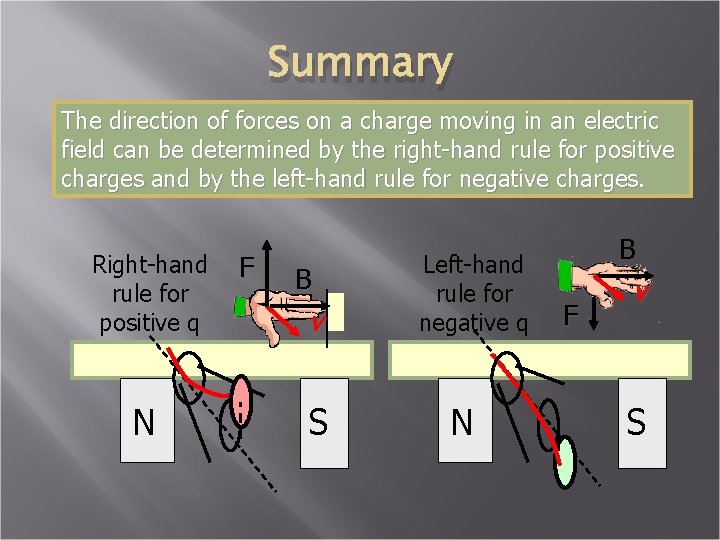
Summary The direction of forces on a charge moving in an electric field can be determined by the right-hand rule for positive charges and by the left-hand rule for negative charges. Right-hand rule for positive q N F B v S Left-hand rule for negative q N B F v S
Summary (Continued) F v sin q q For a charge moving in a B-field, the magnitude of the force is given by: v B v F = qv. B sin q
Summary (Continued) The mass spectrometer: +q - slit xx xx + xx xx x x R x x x x m
- Slides: 24