
Objectives Clarify double regression analysis Sensor signal processing
Objectives • Clarify double regression analysis • Sensor signal processing • Velocity and flow measurement
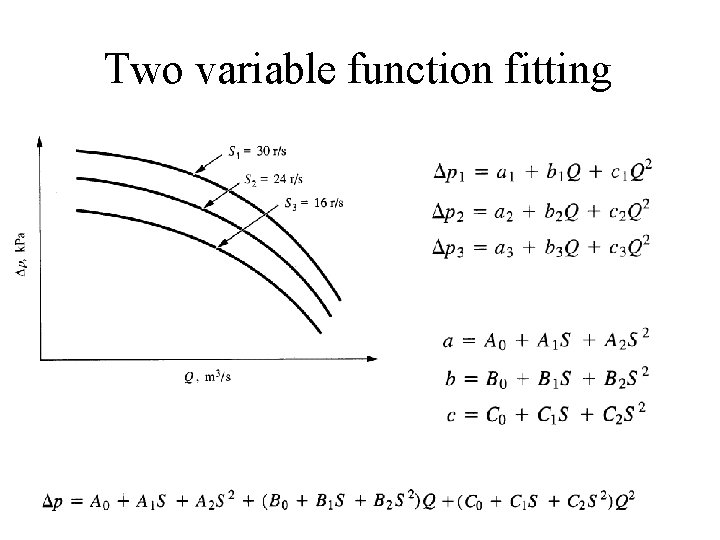
Two variable function fitting

Example For any Tc: q =A 0 + A 1 Te + A 2 Te 2 (1) Tc=25 C: q =152. 7 + 5. 81 Te + 0. 046 Te 2 Tc=35 C: q =117. 1 + 7. 76 Te - 0. 24 Te 2 Tc=45 C: q =81 A 0 =239. 51 -3. 41 Tc-0. 0025 Tc 2 + 3. 57 Te + 0. 098 Te 2 A 2 =3. 49 -0. 2158 Tc+0. 00312 Tc 2 A 1 =-25. 92+2. 037 Tc-0. 0307 Tc 2 Substitute into (1): q = q(Tc, Te)=…. . For homework 1 use this method for a large amount of mesured data!
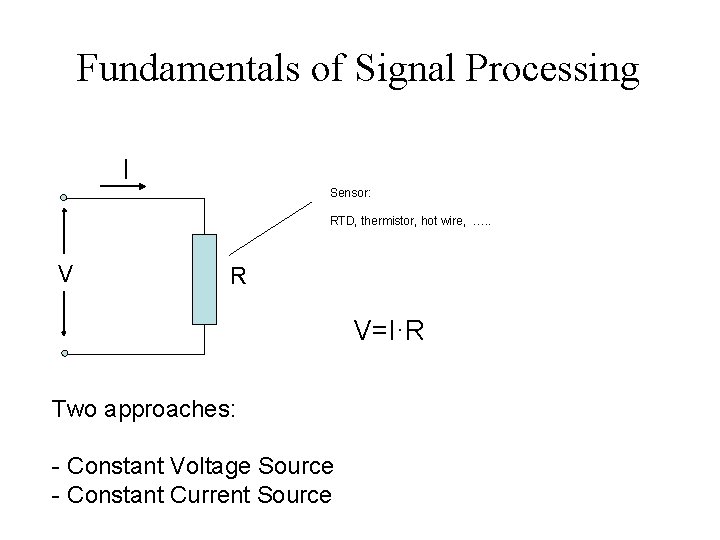
Fundamentals of Signal Processing I Sensor: RTD, thermistor, hot wire, …. . V R V=I·R Two approaches: - Constant Voltage Source - Constant Current Source
![Cable Losses DC signal [m. V] cable Sensor Voltage drop in the cable Rcable=l·r](http://slidetodoc.com/presentation_image_h/09b4a5eb79f1a068ce10e81671d0751a/image-5.jpg "Cable Losses DC signal [m. V] cable Sensor Voltage drop in the cable Rcable=l·r")
Cable Losses DC signal [m. V] cable Sensor Voltage drop in the cable Rcable=l·r (l length of cable , r resistance per unit of length) r = f ( voltage, current, diameter, material ) Rcable can be same order of value like DC signal - Use same length of cables (shorter if possible) - Size diameter of cables to have significantly smaller voltage drop in cable than DC signal Signal processing
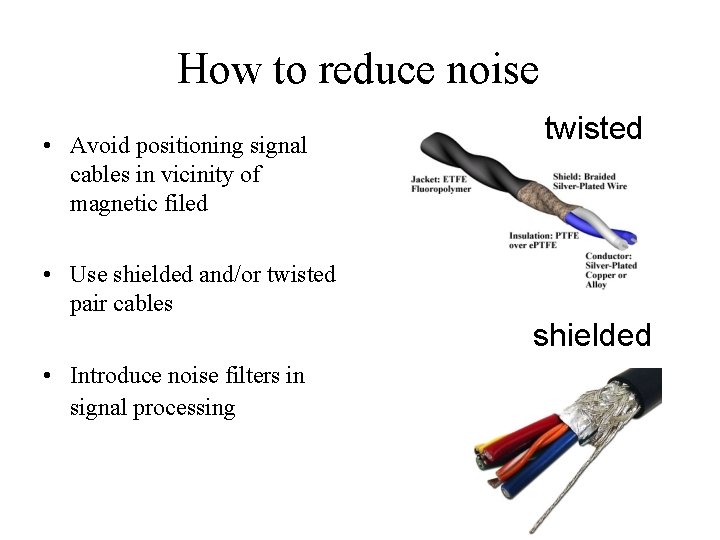
How to reduce noise • Avoid positioning signal cables in vicinity of magnetic filed twisted • Use shielded and/or twisted pair cables shielded • Introduce noise filters in signal processing
![Signal noise AC current [120 V] DC signal [m. V] cable Signal processing Sensor](http://slidetodoc.com/presentation_image_h/09b4a5eb79f1a068ce10e81671d0751a/image-7.jpg "Signal noise AC current [120 V] DC signal [m. V] cable Signal processing Sensor")
Signal noise AC current [120 V] DC signal [m. V] cable Signal processing Sensor Current Induction (signal nose) noise Magnetic field

Signal noise filters A low pass filter is placed on the signal wires between a signal and an A/D board. It stops frequencies greater than the cut off frequency from entering the A/D board's analog or digital inputs. The key term in a low pass filter circuit is CUT OFF FREQUENCY. The cut off frequency is the frequency above which no variation of voltage with respect to time may enter the circuit. For example, if a low pass filter had a cut off frequency of 30 Hz, the type of interference associated with line voltage (60 Hz) would be filtered out but a signal of 25 Hz would be allowed to pass A low pass filter may be constructed from on resistor R and one capacitor C. The cut off frequency Fc is determined according to the formula: Fc= 1/(2*Pi*R*C) where Pi= or R= 1/(2*Pi*C*Fc) See the side diagram: Ground
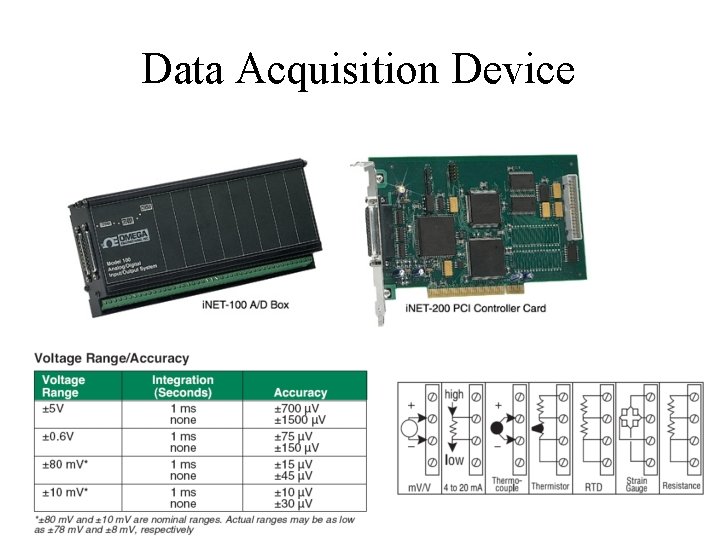
Data Acquisition Device
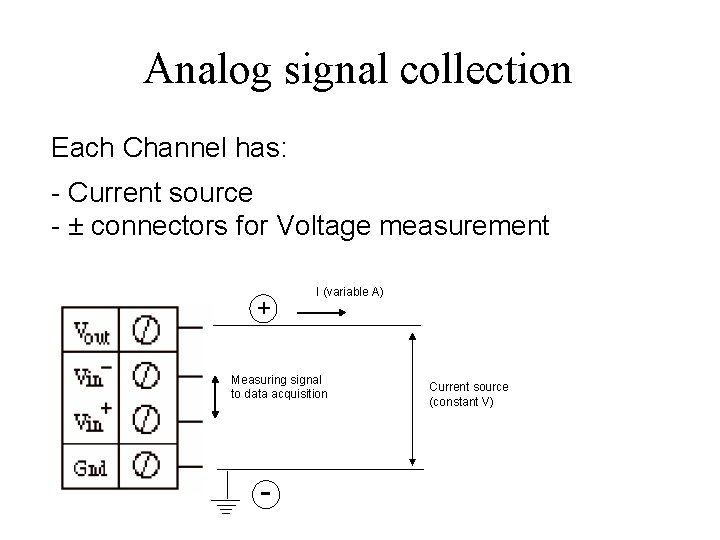
Analog signal collection Each Channel has: - Current source - ± connectors for Voltage measurement + I (variable A) Measuring signal to data acquisition - Current source (constant V)
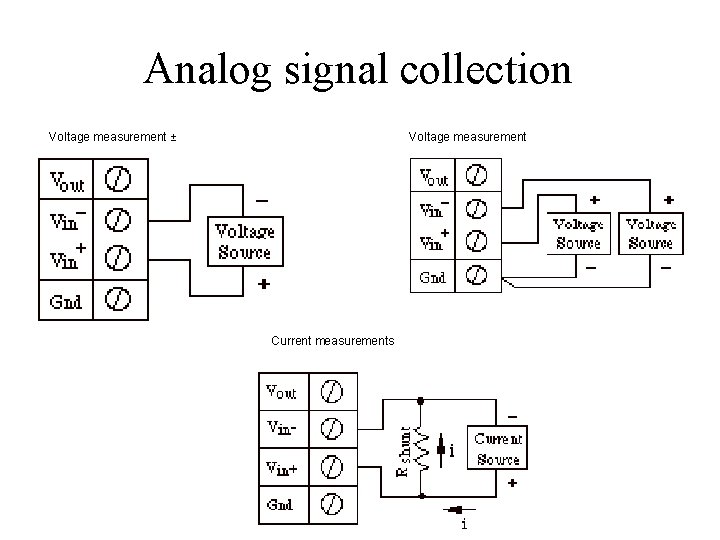
Analog signal collection Voltage measurement ± Voltage measurement Current measurements
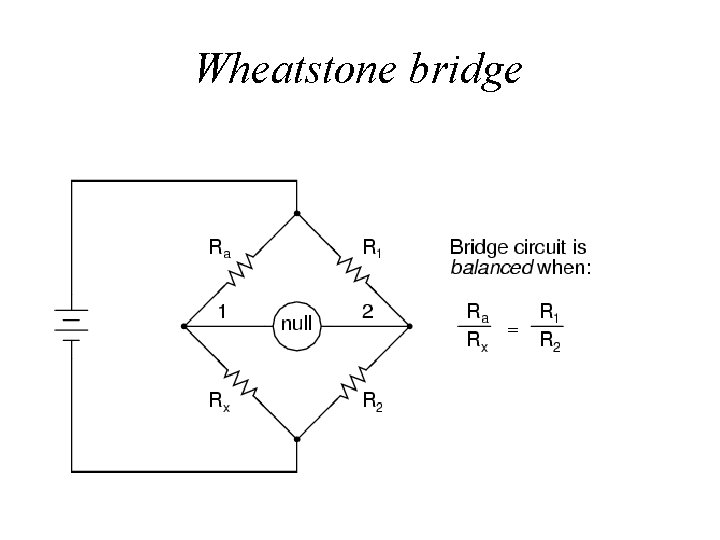
Wheatstone bridge
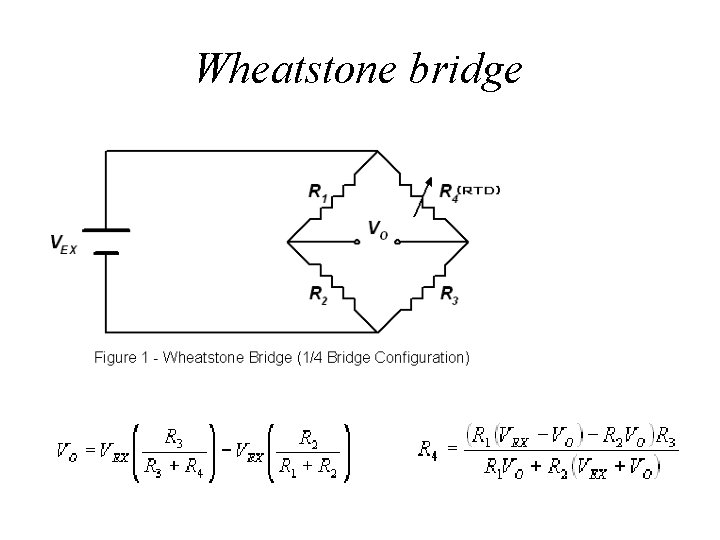
Wheatstone bridge
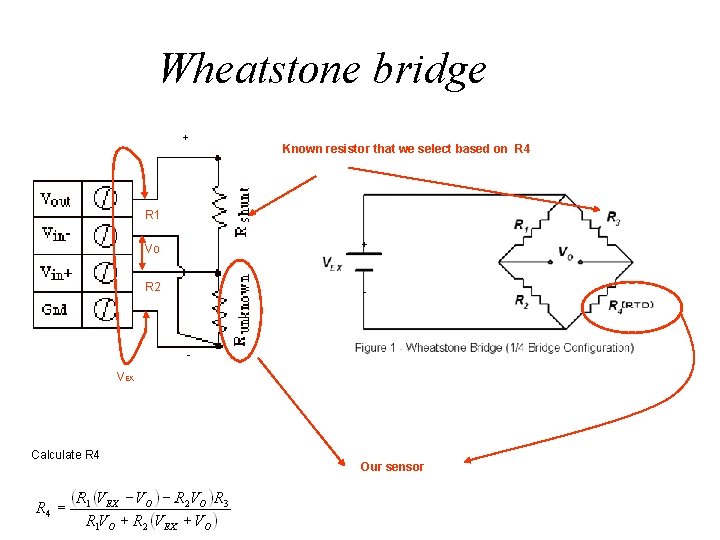
Wheatstone bridge + Known resistor that we select based on R 4 R 1 Vo + R 2 - VEX Calculate R 4 Our sensor

Converting Analog signal to Digital signal Analog-to-digital converter (ADC) - electronic device that converts analog signals to an equivalent digital form - heart of most data acquisition systems Loss of information in conversion, but no loss in transport and processing
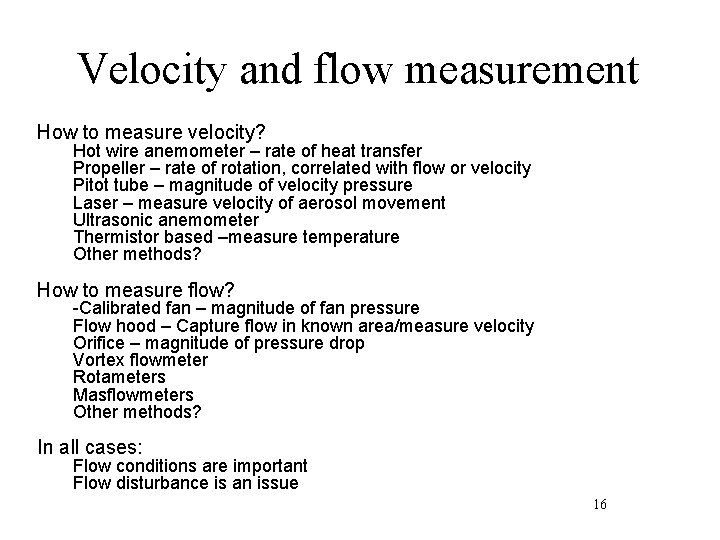
Velocity and flow measurement How to measure velocity? Hot wire anemometer – rate of heat transfer Propeller – rate of rotation, correlated with flow or velocity Pitot tube – magnitude of velocity pressure Laser – measure velocity of aerosol movement Ultrasonic anemometer Thermistor based –measure temperature Other methods? How to measure flow? -Calibrated fan – magnitude of fan pressure Flow hood – Capture flow in known area/measure velocity Orifice – magnitude of pressure drop Vortex flowmeter Rotameters Masflowmeters Other methods? In all cases: Flow conditions are important Flow disturbance is an issue 16
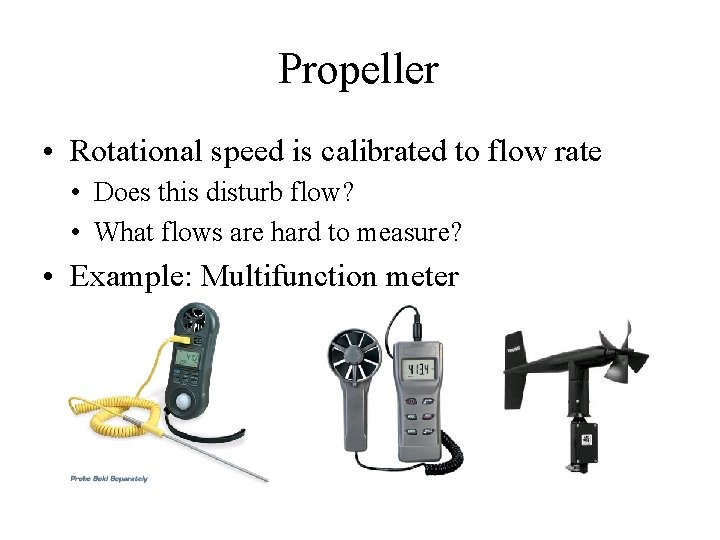
Propeller • Rotational speed is calibrated to flow rate • Does this disturb flow? • What flows are hard to measure? • Example: Multifunction meter
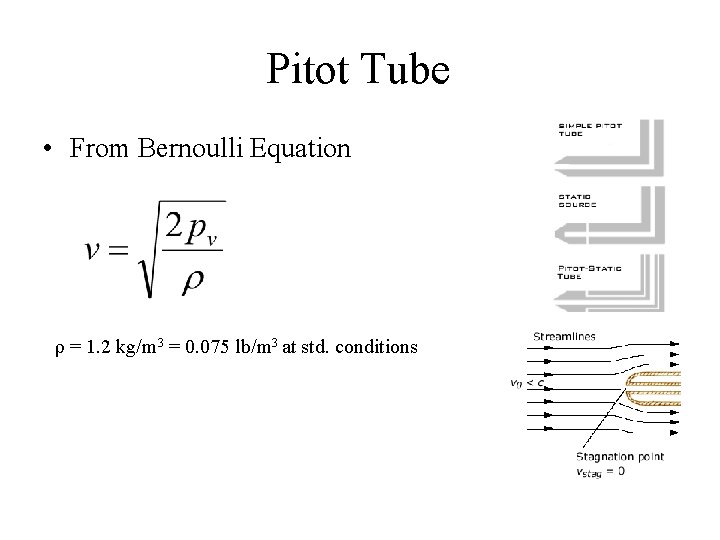
Pitot Tube • From Bernoulli Equation ρ = 1. 2 kg/m 3 = 0. 075 lb/m 3 at std. conditions
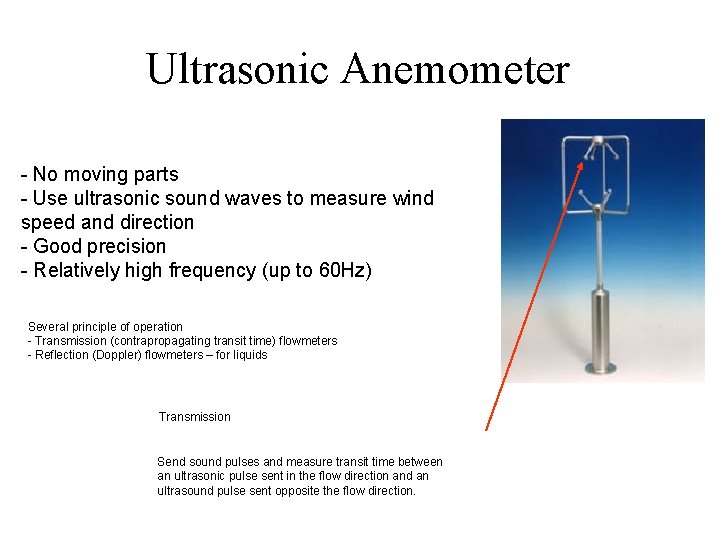
Ultrasonic Anemometer - No moving parts - Use ultrasonic sound waves to measure wind speed and direction - Good precision - Relatively high frequency (up to 60 Hz) Several principle of operation - Transmission (contrapropagating transit time) flowmeters - Reflection (Doppler) flowmeters – for liquids Transmission Send sound pulses and measure transit time between an ultrasonic pulse sent in the flow direction and an ultrasound pulse sent opposite the flow direction.
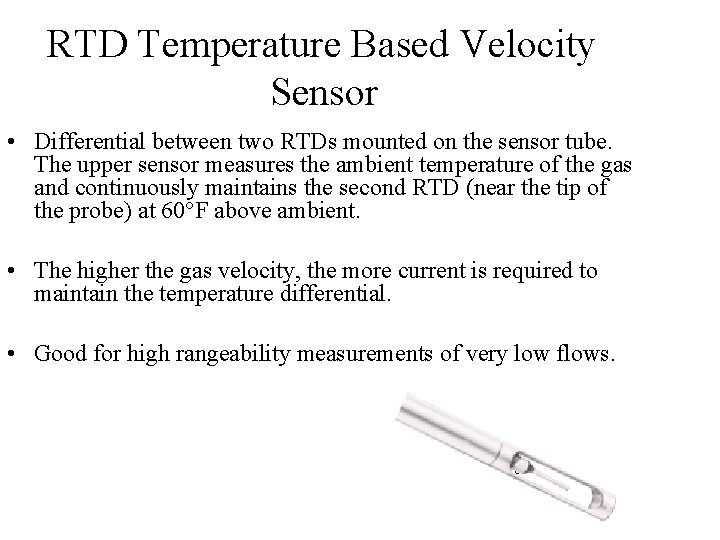
RTD Temperature Based Velocity Sensor • Differential between two RTDs mounted on the sensor tube. The upper sensor measures the ambient temperature of the gas and continuously maintains the second RTD (near the tip of the probe) at 60°F above ambient. • The higher the gas velocity, the more current is required to maintain the temperature differential. • Good for high rangeability measurements of very low flows.
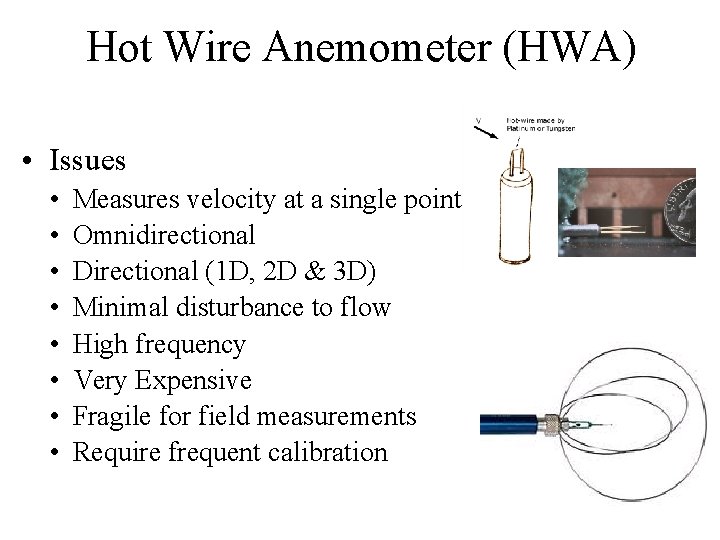
Hot Wire Anemometer (HWA) • Issues • • Measures velocity at a single point Omnidirectional Directional (1 D, 2 D & 3 D) Minimal disturbance to flow High frequency Very Expensive Fragile for field measurements Require frequent calibration
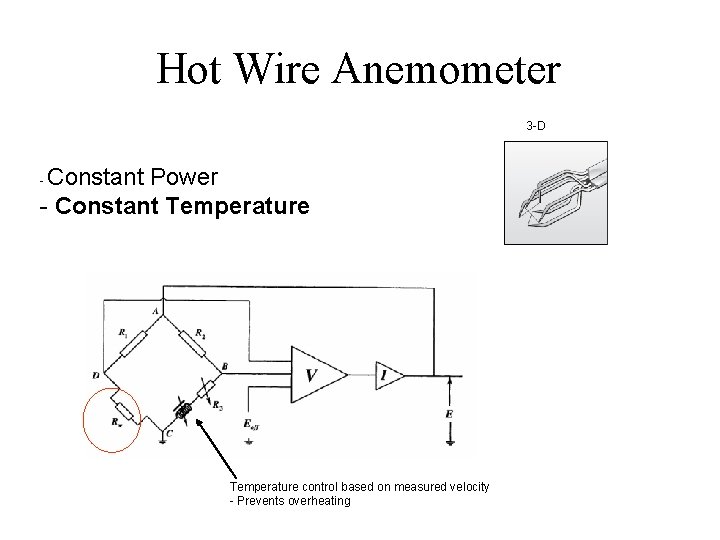
Hot Wire Anemometer 3 -D Constant Power - Constant Temperature - Temperature control based on measured velocity - Prevents overheating
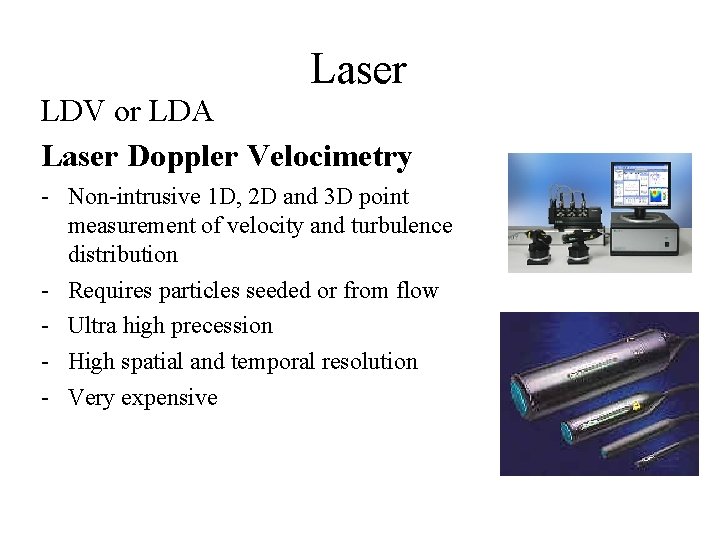
Laser LDV or LDA Laser Doppler Velocimetry - Non-intrusive 1 D, 2 D and 3 D point measurement of velocity and turbulence distribution - Requires particles seeded or from flow - Ultra high precession - High spatial and temporal resolution - Very expensive
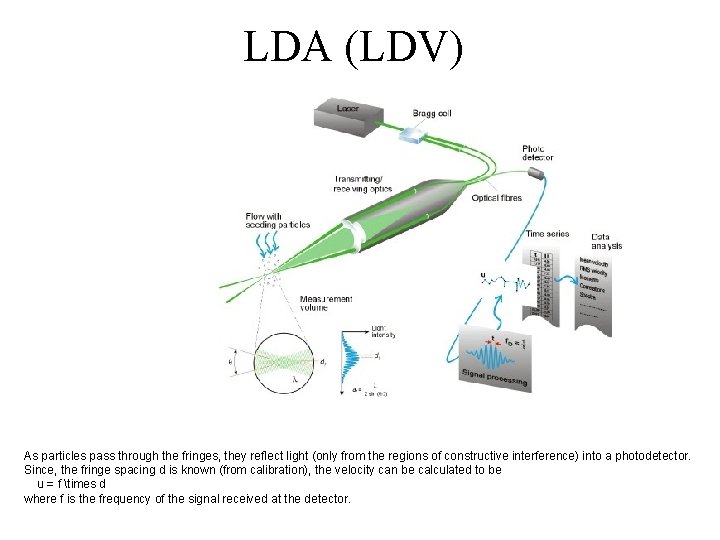
LDA (LDV) As particles pass through the fringes, they reflect light (only from the regions of constructive interference) into a photodetector. Since, the fringe spacing d is known (from calibration), the velocity can be calculated to be u = f times d where f is the frequency of the signal received at the detector.
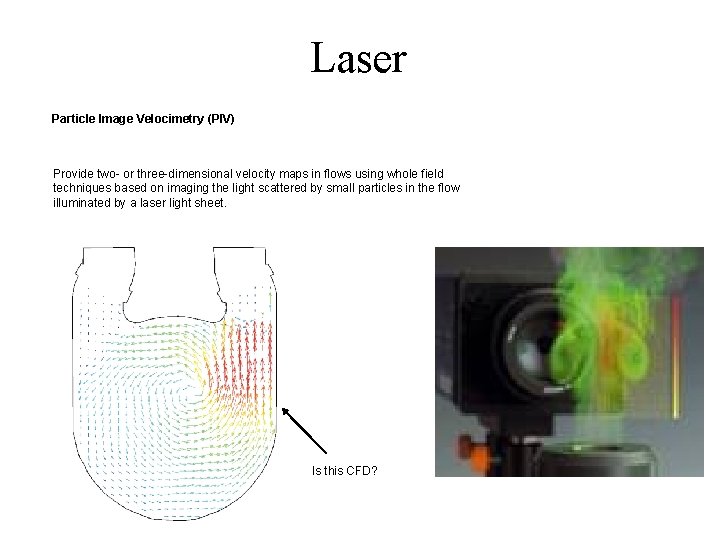
Laser Particle Image Velocimetry (PIV) Provide two- or three-dimensional velocity maps in flows using whole field techniques based on imaging the light scattered by small particles in the flow illuminated by a laser light sheet. Is this CFD?
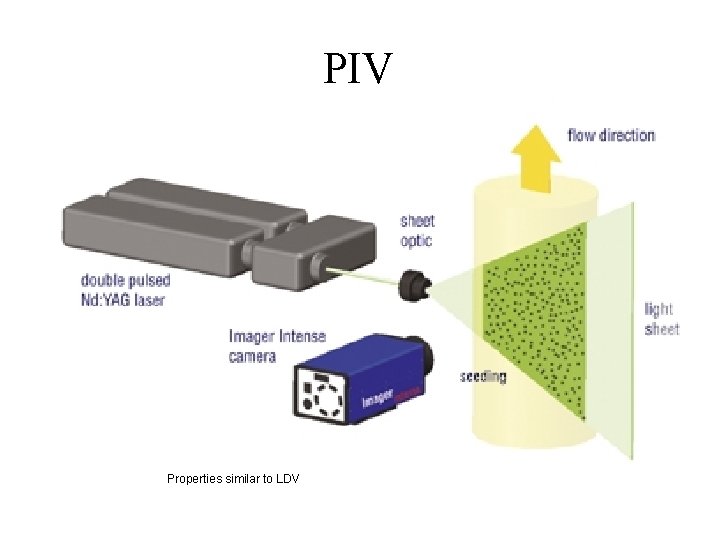
PIV Properties similar to LDV
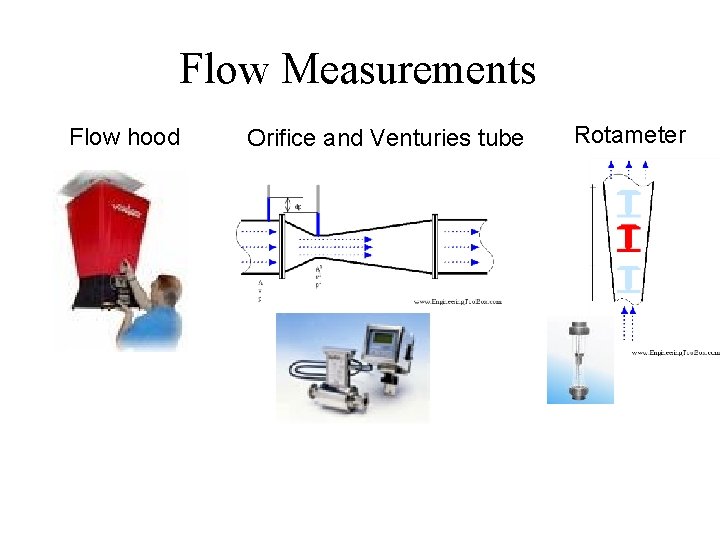
Flow Measurements Flow hood Orifice and Venturies tube Rotameter
Orifice • Pressure drop through a known (circular, sharp edged) hole • Flow is smoothed before entry (usually need ~10 diameters upstream) • Q = C √ΔP • C provided by manufacturer (sometimes √ too) • Concerns/issues • Example: Trueflow Plate
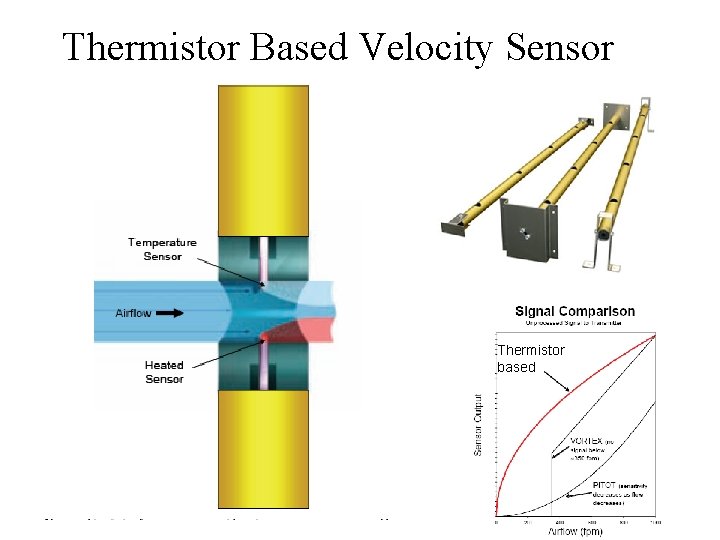
Thermistor Based Velocity Sensor Thermistor based
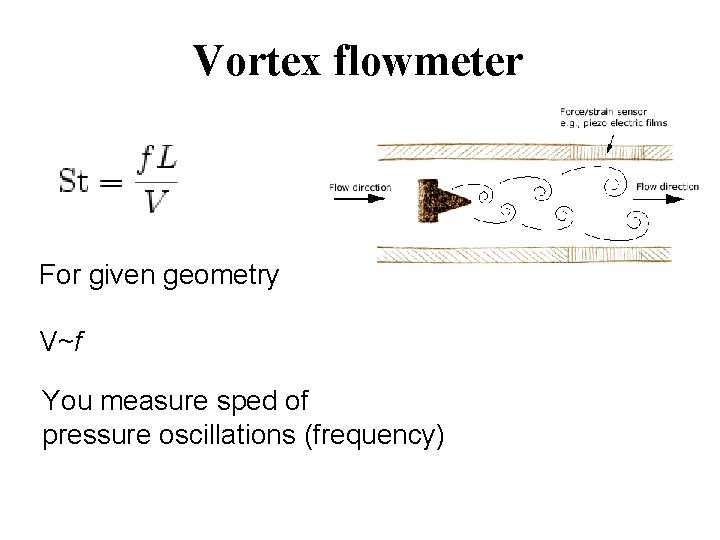
Vortex flowmeter For given geometry V~f You measure sped of pressure oscillations (frequency)
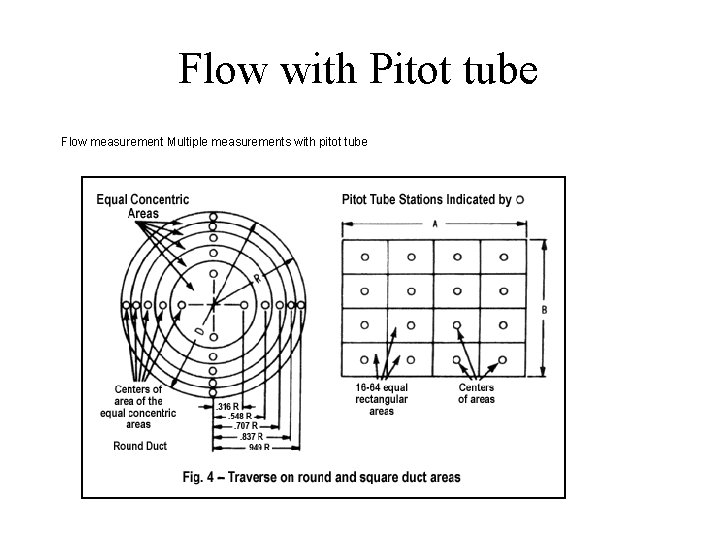
Flow with Pitot tube Flow measurement Multiple measurements with pitot tube
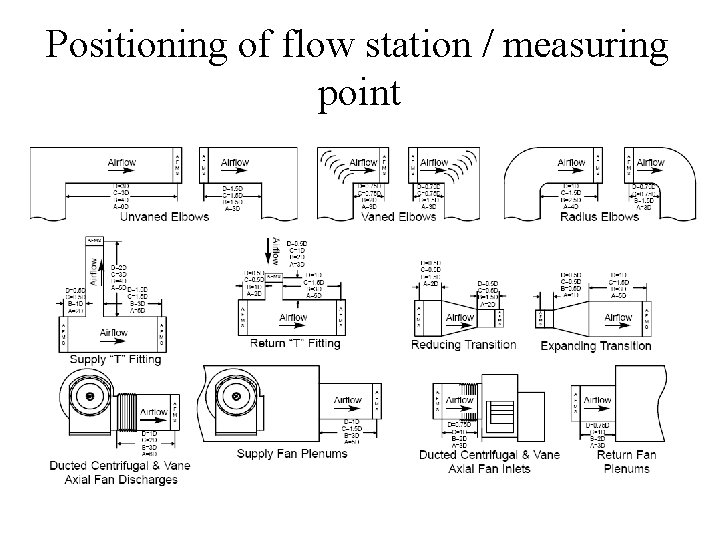
Positioning of flow station / measuring point
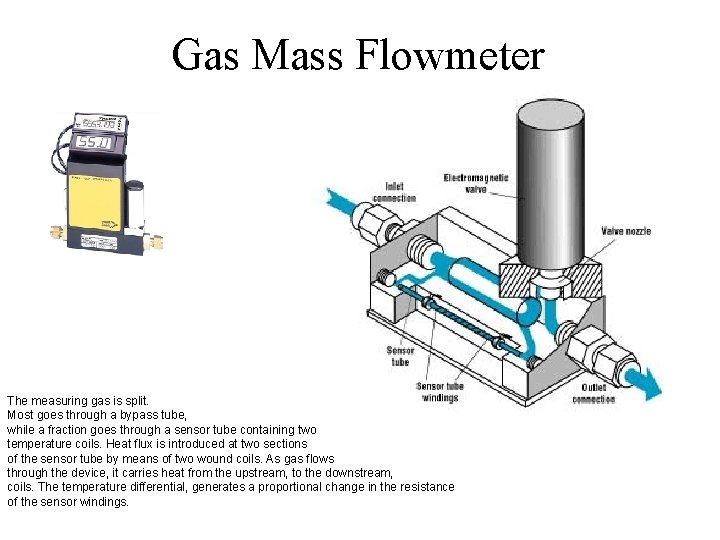
Gas Mass Flowmeter The measuring gas is split. Most goes through a bypass tube, while a fraction goes through a sensor tube containing two temperature coils. Heat flux is introduced at two sections of the sensor tube by means of two wound coils. As gas flows through the device, it carries heat from the upstream, to the downstream, coils. The temperature differential, generates a proportional change in the resistance of the sensor windings.
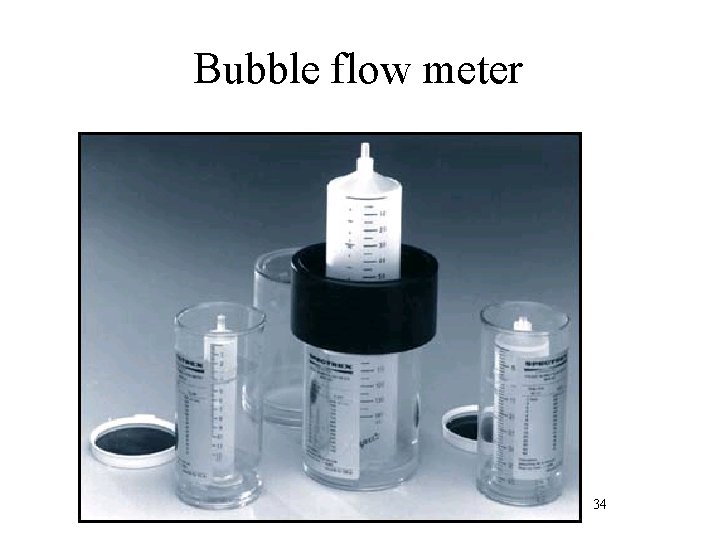
Bubble flow meter 34
- Slides: 34