
Objectives At the end of the lecture students
§ Objectives At the end of the lecture, students should be able to: ü List the different parts of large intestine. ü List the characteristic features of colon. ü Describe the anatomy of different parts of large intestine regarding: the surface anatomy , peritoneal covering , relations, arterial & nerve supply.
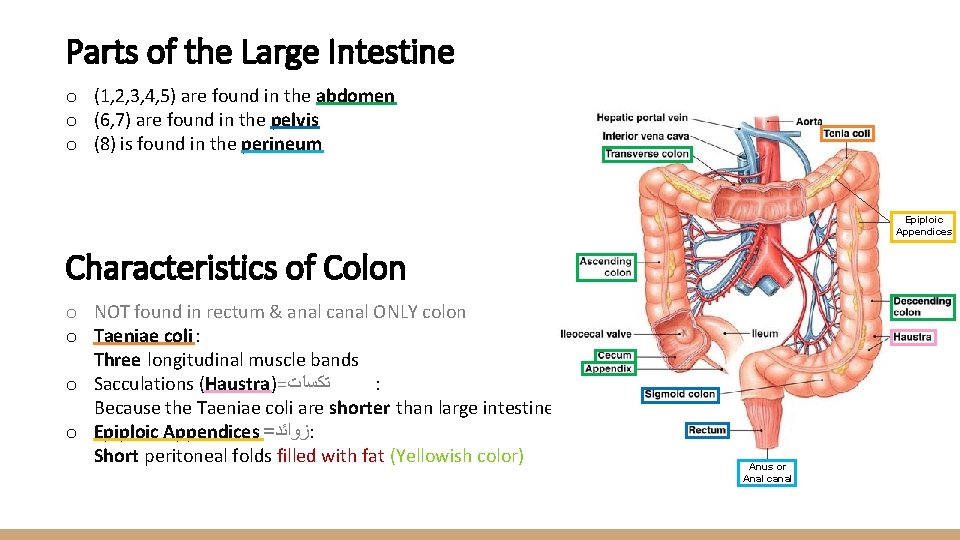
Parts of the Large Intestine o (1, 2, 3, 4, 5) are found in the abdomen o (6, 7) are found in the pelvis o (8) is found in the perineum Epiploic Appendices Characteristics of Colon o NOT found in rectum & anal canal ONLY colon o Taeniae coli : Three longitudinal muscle bands o Sacculations (Haustra)= ﺗﻜﺳﺎﺕ : Because the Taeniae coli are shorter than large intestine o Epiploic Appendices = ﺯﻭﺍﺋﺪ : Short peritoneal folds filled with fat (Yellowish color) Anus or Anal canal

Peritoneal Covering Parts with mesentery 1 1. Transverse colon 3 2. Sigmoid colon 3. Appendix 4. Cecum Parts with Retroperitoneal 2 1. Ascending colon 2. Descending colon 3. Upper 2/3 of rectum Parts devoid of (without) peritoneal covering 1. Lower 1/3 of rectum 2. Anal canal Rectum Anal canal 1 - The peritoneum covers the anterior and posterior surfaces. 2 - The peritoneum only covers the anterior surface 3 - First 2 inches WITHOUT mesentery
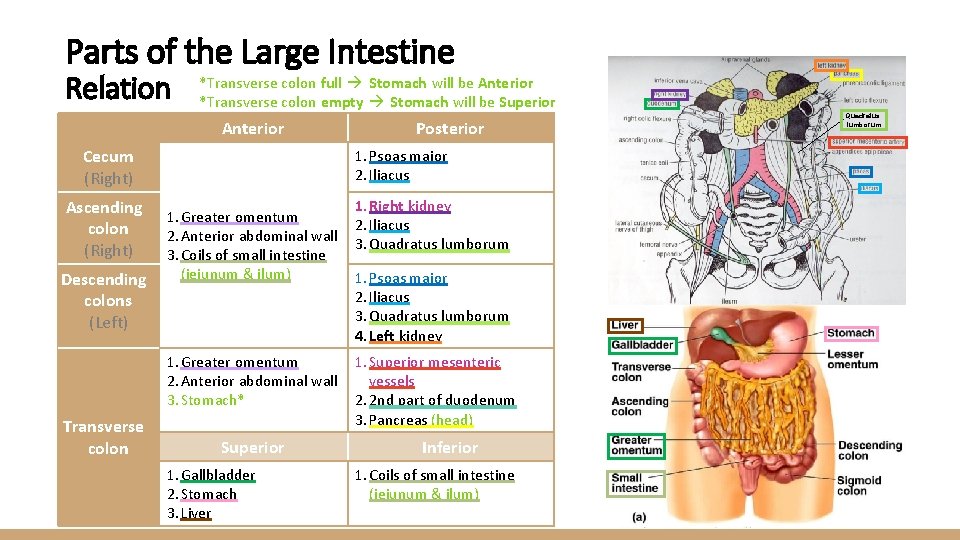
Parts of the Large Intestine Relation *Transverse colon full Stomach will be Anterior *Transverse colon empty Stomach will be Superior Anterior 1. Psoas major 2. Iliacus Cecum (Right) Ascending colon (Right) Descending colons (Left) 1. Greater omentum 2. Anterior abdominal wall 3. Coils of small intestine (jejunum & ilum) 1. Greater omentum 2. Anterior abdominal wall 3. Stomach* Transverse colon Posterior Superior 1. Gallbladder 2. Stomach 3. Liver 1. Right kidney 2. Iliacus 3. Quadratus lumborum 1. Psoas major 2. Iliacus 3. Quadratus lumborum 4. Left kidney 1. Superior mesenteric vessels 2. 2 nd part of duodenum 3. Pancreas (head) Inferior 1. Coils of small intestine (jejunum & ilum) Quadratus lumborum
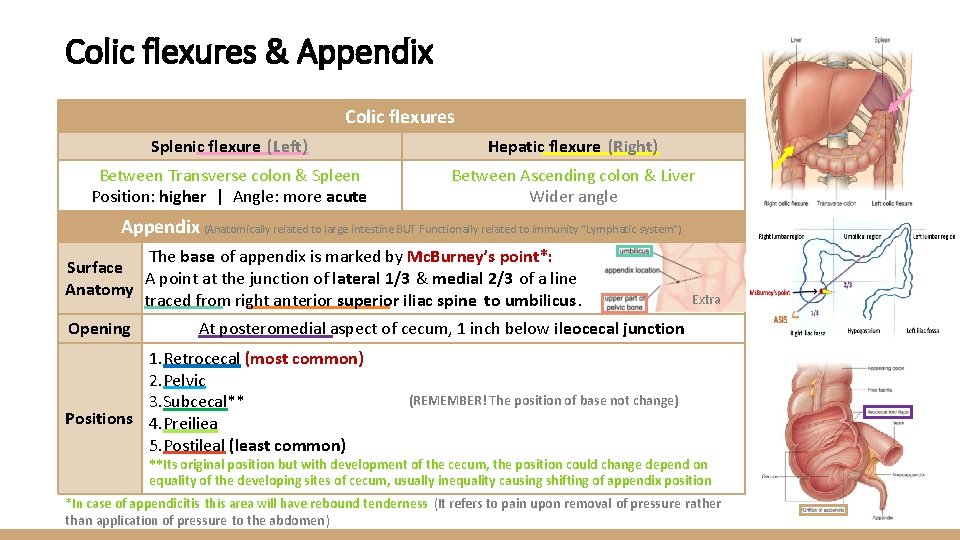
Colic flexures & Appendix Colic flexures Splenic flexure (Left) Hepatic flexure (Right) Between Transverse colon & Spleen Position: higher | Angle: more acute Between Ascending colon & Liver Wider angle Appendix (Anatomically related to large intestine BUT Functionally related to immunity “Lymphatic system”) The base of appendix is marked by Mc. Burney’s point*: Surface A point at the junction of lateral 1/3 & medial 2/3 of a line Anatomy traced from right anterior superior iliac spine to umbilicus. Opening Extra At posteromedial aspect of cecum, 1 inch below ileocecal junction 1. Retrocecal (most common) 2. Pelvic 3. Subcecal** Positions 4. Preiliea 5. Postileal (least common) (REMEMBER! The position of base not change) **Its original position but with development of the cecum, the position could change depend on equality of the developing sites of cecum, usually inequality causing shifting of appendix position *In case of appendicitis this area will have rebound tenderness (It refers to pain upon removal of pressure rather than application of pressure to the abdomen)
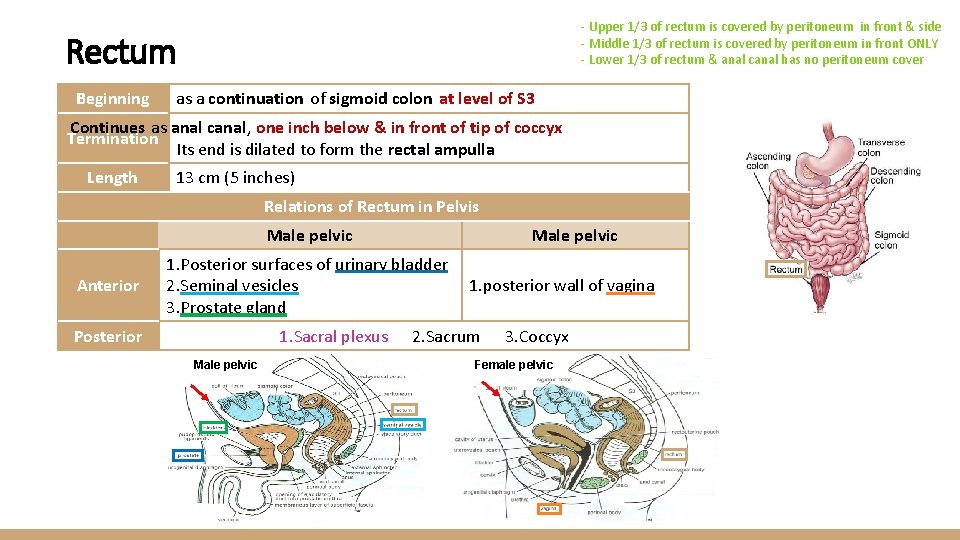
- Upper 1/3 of rectum is covered by peritoneum in front & side - Middle 1/3 of rectum is covered by peritoneum in front ONLY - Lower 1/3 of rectum & anal canal has no peritoneum cover Rectum Beginning as a continuation of sigmoid colon at level of S 3 Continues as anal canal , one inch below & in front of tip of coccyx Termination Its end is dilated to form the rectal ampulla Length 13 cm (5 inches) Relations of Rectum in Pelvis Male pelvic Anterior Male pelvic 1. Posterior surfaces of urinary bladder 2. Seminal vesicles 3. Prostate gland 1. Sacral plexus Posterior Male pelvic 1. posterior wall of vagina 2. Sacrum 3. Coccyx Female pelvic
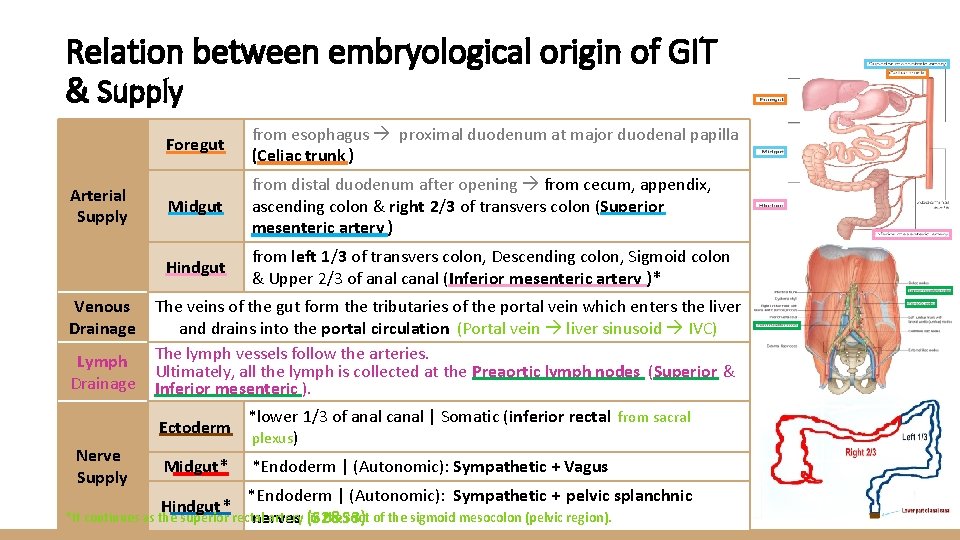
Relation between embryological origin of GIT & Supply Arterial Supply Venous Drainage Lymph Drainage Nerve Supply Foregut from esophagus proximal duodenum at major duodenal papilla (Celiac trunk ) Midgut from distal duodenum after opening from cecum, appendix, ascending colon & right 2/3 of transvers colon (Superior mesenteric artery ) Hindgut from left 1/3 of transvers colon, Descending colon, Sigmoid colon & Upper 2/3 of anal canal (Inferior mesenteric artery )* The veins of the gut form the tributaries of the portal vein which enters the liver and drains into the portal circulation (Portal vein liver sinusoid IVC) The lymph vessels follow the arteries. Ultimately, all the lymph is collected at the Preaortic lymph nodes (Superior & Inferior mesenteric ). Ectoderm *lower 1/3 of anal canal | Somatic (inferior rectal from sacral plexus) Midgut * *Endoderm | (Autonomic): Sympathetic + Vagus *Endoderm | (Autonomic): Sympathetic + pelvic splanchnic *It continues as the superior rectal artery (S 2&S 3) in the root of the sigmoid mesocolon (pelvic region). nerves Hindgut *
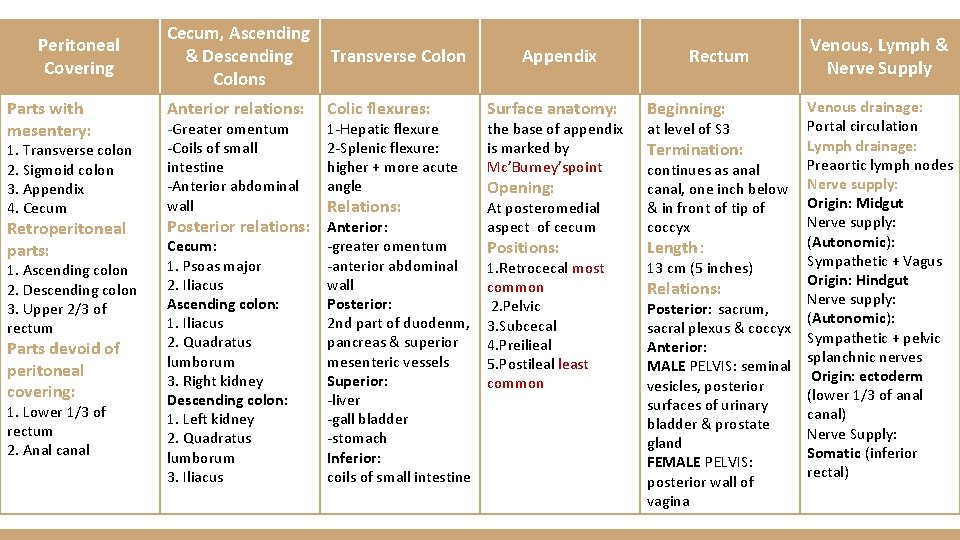
Peritoneal Covering Parts with mesentery: 1. Transverse colon 2. Sigmoid colon 3. Appendix 4. Cecum Retroperitoneal parts: 1. Ascending colon 2. Descending colon 3. Upper 2/3 of rectum Parts devoid of peritoneal covering: 1. Lower 1/3 of rectum 2. Anal canal Cecum, Ascending & Descending Colons Transverse Colon Anterior relations: Colic flexures: -Greater omentum -Coils of small intestine -Anterior abdominal wall 1 -Hepatic flexure 2 -Splenic flexure: higher + more acute angle Relations: Posterior relations: Anterior: Cecum: 1. Psoas major 2. Iliacus Ascending colon: 1. Iliacus 2. Quadratus lumborum 3. Right kidney Descending colon: 1. Left kidney 2. Quadratus lumborum 3. Iliacus -greater omentum -anterior abdominal wall Posterior: 2 nd part of duodenm, pancreas & superior mesenteric vessels Superior: -liver -gall bladder -stomach Inferior: coils of small intestine Appendix Surface anatomy: the base of appendix is marked by Mc’Burney’spoint Opening: At posteromedial aspect of cecum Positions: 1. Retrocecal most common 2. Pelvic 3. Subcecal 4. Preilieal 5. Postileal least common Rectum Beginning: at level of S 3 Termination: continues as anal canal, one inch below & in front of tip of coccyx Length: 13 cm (5 inches) Relations: Posterior: sacrum, sacral plexus & coccyx Anterior: MALE PELVIS: seminal vesicles, posterior surfaces of urinary bladder & prostate gland FEMALE PELVIS: posterior wall of vagina Venous, Lymph & Nerve Supply Venous drainage: Portal circulation Lymph drainage: Preaortic lymph nodes Nerve supply: Origin: Midgut Nerve supply: (Autonomic): Sympathetic + Vagus Origin: Hindgut Nerve supply: (Autonomic): Sympathetic + pelvic splanchnic nerves Origin: ectoderm (lower 1/3 of anal canal) Nerve Supply: Somatic (inferior rectal)
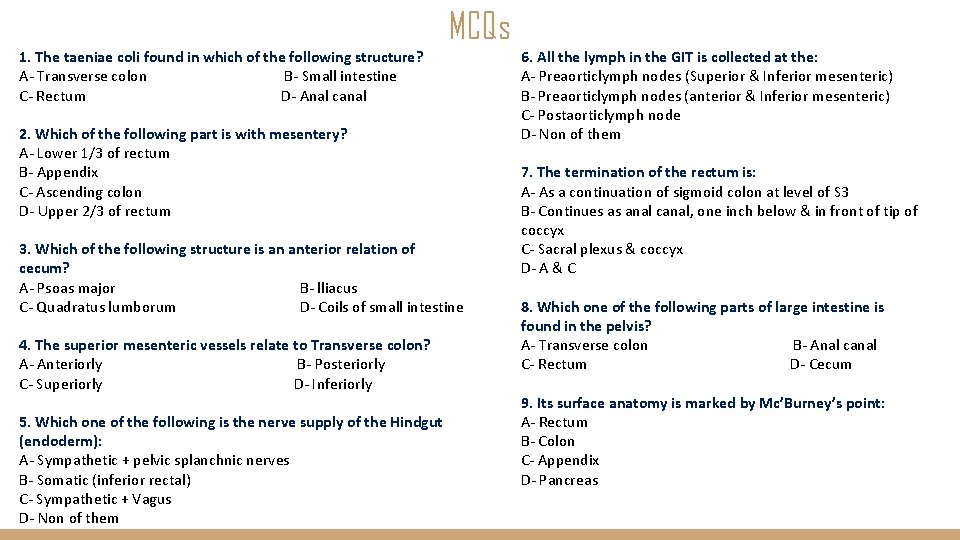
MCQs 1. The taeniae coli found in which of the following structure? A- Transverse colon B- Small intestine C- Rectum D- Anal canal 2. Which of the following part is with mesentery? A- Lower 1/3 of rectum B- Appendix C- Ascending colon D- Upper 2/3 of rectum 3. Which of the following structure is an anterior relation of cecum? A- Psoas major B- lliacus C- Quadratus lumborum D- Coils of small intestine 4. The superior mesenteric vessels relate to Transverse colon? A- Anteriorly B- Posteriorly C- Superiorly D- Inferiorly 5. Which one of the following is the nerve supply of the Hindgut (endoderm): A- Sympathetic + pelvic splanchnic nerves B- Somatic (inferior rectal) C- Sympathetic + Vagus D- Non of them 6. All the lymph in the GIT is collected at the: A- Preaorticlymph nodes (Superior & Inferior mesenteric) B- Preaorticlymph nodes (anterior & Inferior mesenteric) C- Postaorticlymph node D- Non of them 7. The termination of the rectum is: A- As a continuation of sigmoid colon at level of S 3 B- Continues as anal canal, one inch below & in front of tip of coccyx C- Sacral plexus & coccyx D- A & C 8. Which one of the following parts of large intestine is found in the pelvis? A- Transverse colon B- Anal canal C- Rectum D- Cecum 9. Its surface anatomy is marked by Mc’Burney’s point: A- Rectum B- Colon C- Appendix D- Pancreas
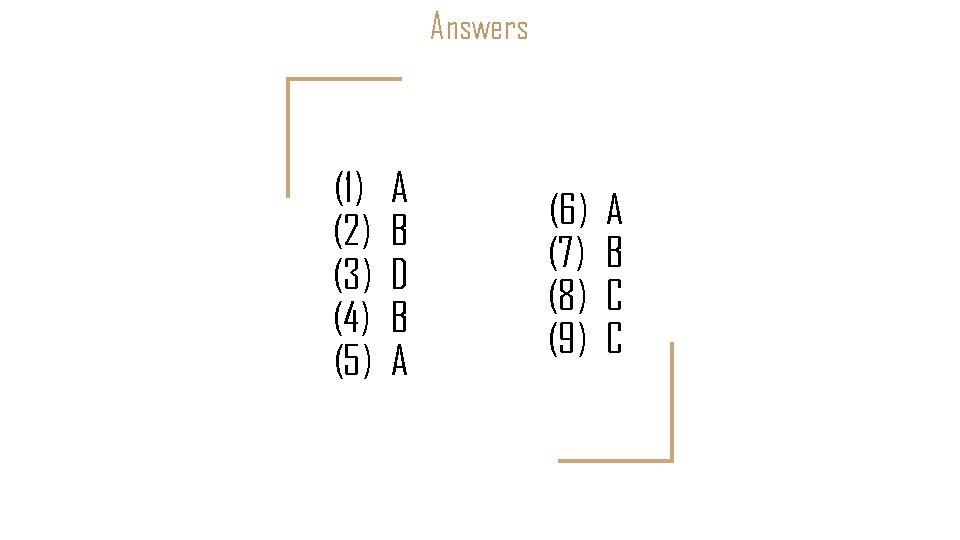
Answers (1) (2) (3) (4) (5) A B D B A (6) (7) (8) (9) A B C C
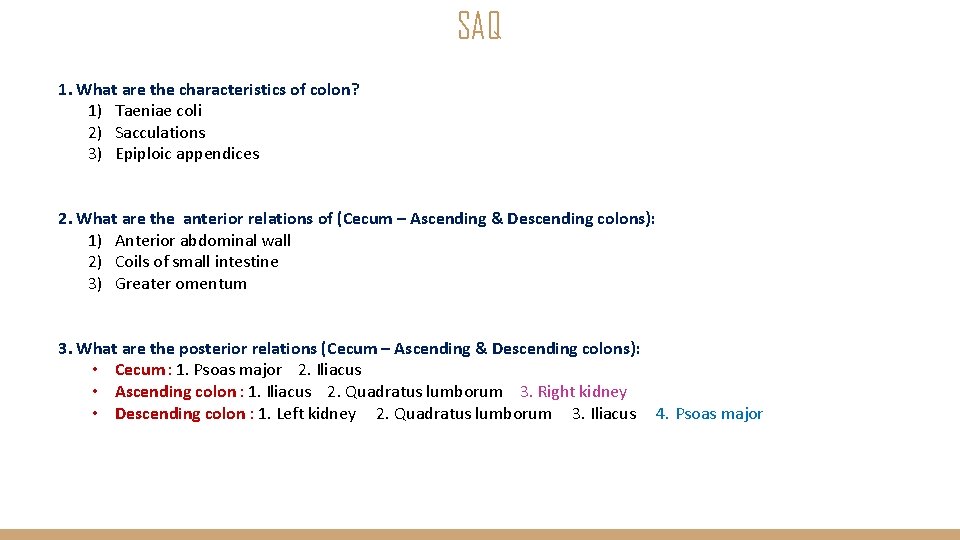
SAQ 1. What are the characteristics of colon? 1) Taeniae coli 2) Sacculations 3) Epiploic appendices 2. What are the anterior relations of (Cecum – Ascending & Descending colons): 1) Anterior abdominal wall 2) Coils of small intestine 3) Greater omentum 3. What are the posterior relations (Cecum – Ascending & Descending colons): • Cecum: 1. Psoas major 2. Iliacus • Ascending colon : 1. Iliacus 2. Quadratus lumborum 3. Right kidney • Descending colon : 1. Left kidney 2. Quadratus lumborum 3. Iliacus 4. Psoas major
Good luck Special thank for team 436 Team Leaders: Faisal Fahad Alsaif Rawan Mohammad Alharbi Team Members: Abdulaziz Aldukhayel Abdulrahman Alduhayyim Rinad Alghoraiby Majd Albarrak Twitter. com/Anatomy 437 Anatomyteam. 437@gmail. com § References: 1. Girls’ & Boys’ Slides 2. Earthslab. com 3. Teach. Me. Anatomy. com
- Slides: 13