
Objectives At the end of the lecture students
§ Objectives At the end of the lecture, students should be able to: ü List the nuclei related to accessory and hypoglossal nerves in the brain stem. ü Describe the type and site of each nucleus. ü Describe site of emergence and course of accessory and hypoglossal nerves. ü Describe important relations of accessory and hypoglossal nerves in the neck. ü List the branches of accessory and hypoglossal nerves. ü Describe the main motor effects in case of lesion of accessory and hypoglossal nerves.
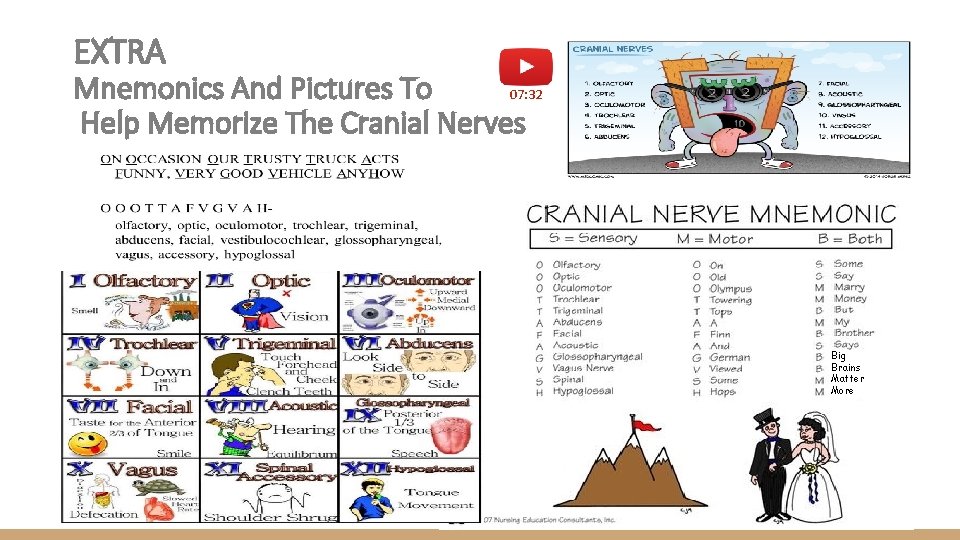
EXTRA Mnemonics And Pictures To 07: 32 Help Memorize The Cranial Nerves Big Brains Matter More
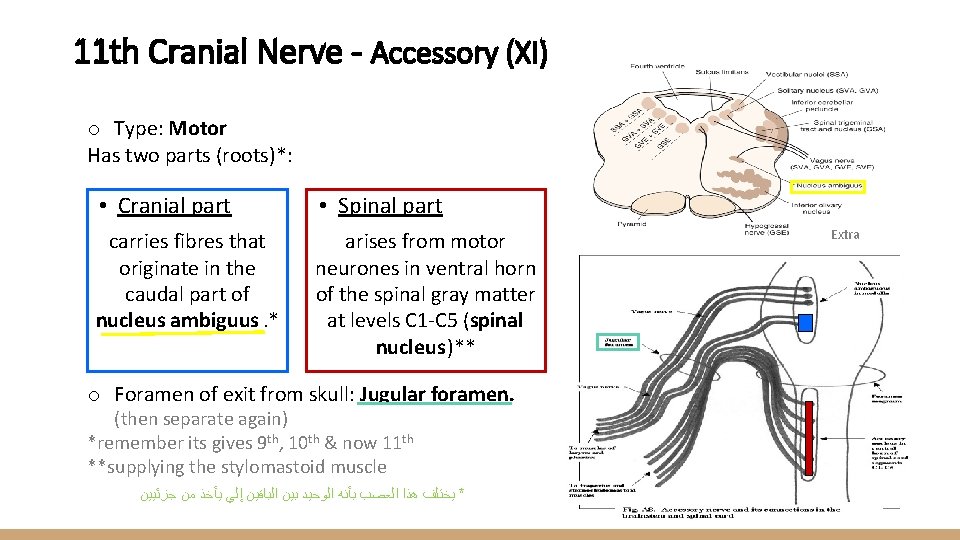
11 th Cranial Nerve - Accessory (XI) o Type: Motor Has two parts (roots)*: • Cranial part • Spinal part carries fibres that originate in the caudal part of nucleus ambiguus. * arises from motor neurones in ventral horn of the spinal gray matter at levels C 1 -C 5 (spinal nucleus)** o Foramen of exit from skull: Jugular foramen. (then separate again) *remember its gives 9 th, 10 th & now 11 th **supplying the stylomastoid muscle * ﻳﺨﺘﻠﻒ ﻫﺬﺍ ﺍﻟﻌﺼﺐ ﺑﺄﻨﻪ ﺍﻟﻮﺣﻴﺪ ﺑﻴﻦ ﺍﻟﺒﺎﻗﻴﻦ ﺇﻟﻲ ﻳﺄﺨﺬ ﻣﻦ ﺟﺰﺋﻴﻴﻦ Extra
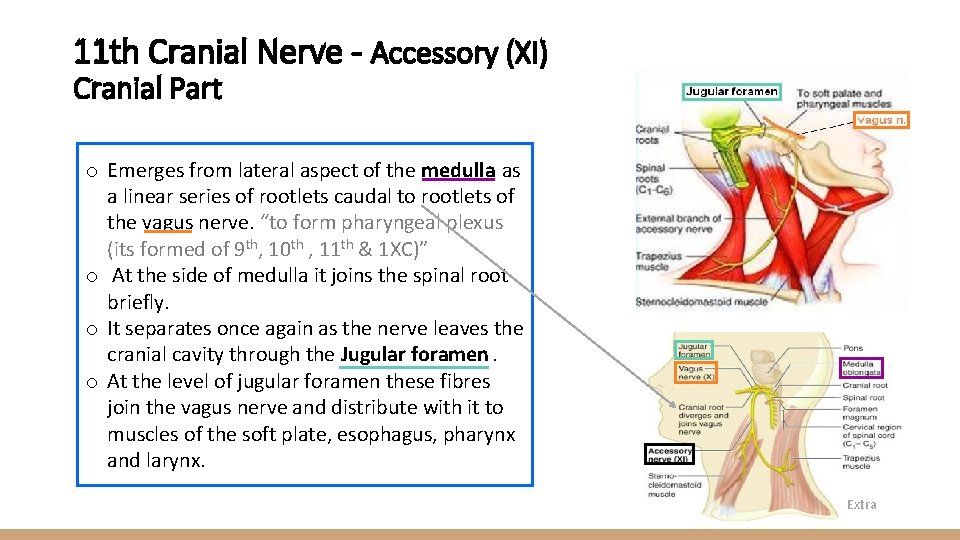
11 th Cranial Nerve - Accessory (XI) Cranial Part o Emerges from lateral aspect of the medulla as a linear series of rootlets caudal to rootlets of the vagus nerve. “to form pharyngeal plexus (its formed of 9 th, 10 th , 11 th & 1 XC)” o At the side of medulla it joins the spinal root briefly. o It separates once again as the nerve leaves the cranial cavity through the Jugular foramen. o At the level of jugular foramen these fibres join the vagus nerve and distribute with it to muscles of the soft plate, esophagus, pharynx and larynx. Extra
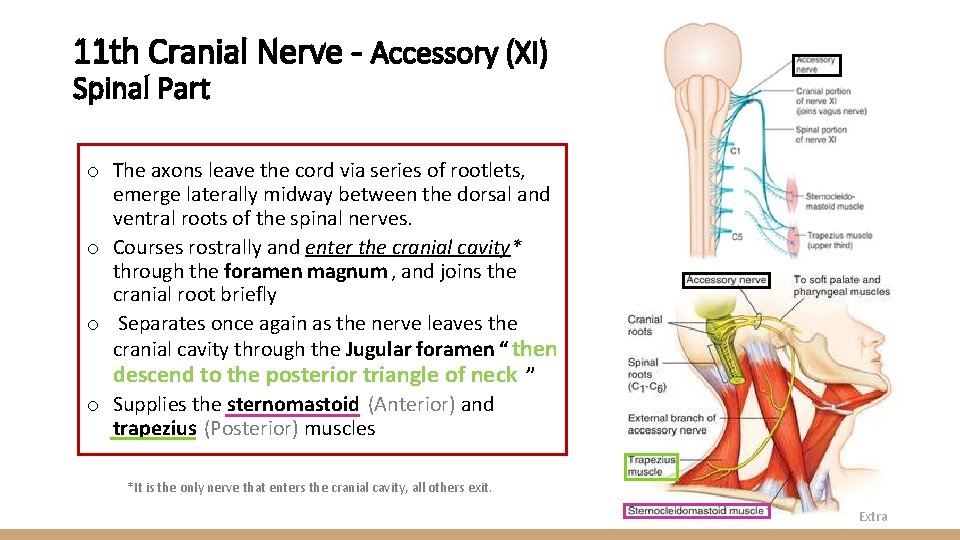
11 th Cranial Nerve - Accessory (XI) Spinal Part o The axons leave the cord via series of rootlets, emerge laterally midway between the dorsal and ventral roots of the spinal nerves. o Courses rostrally and enter the cranial cavity* through the foramen magnum , and joins the cranial root briefly o Separates once again as the nerve leaves the cranial cavity through the Jugular foramen “ then descend to the posterior triangle of neck ” o Supplies the sternomastoid (Anterior) and trapezius (Posterior) muscles *It is the only nerve that enters the cranial cavity, all others exit. Extra
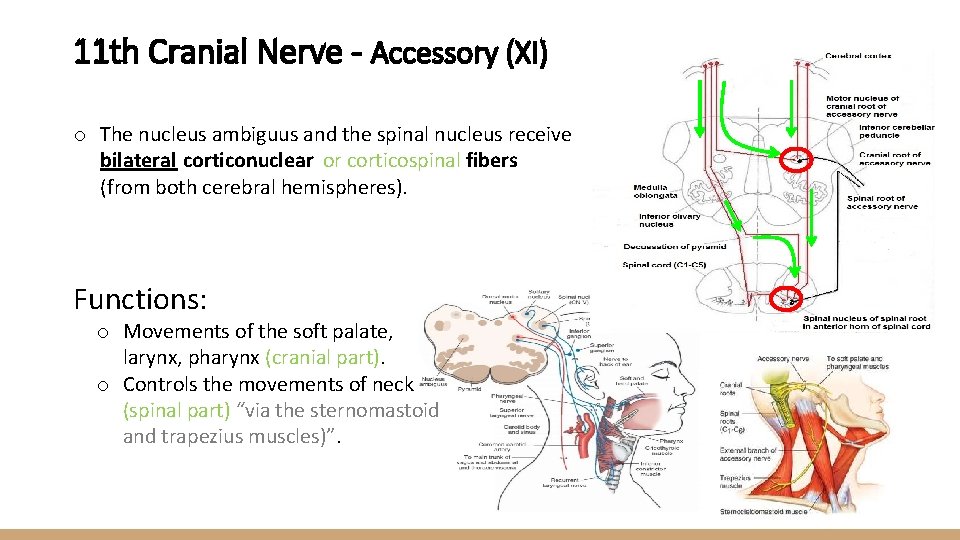
11 th Cranial Nerve - Accessory (XI) o The nucleus ambiguus and the spinal nucleus receive bilateral corticonuclear or corticospinal fibers (from both cerebral hemispheres). Functions: o Movements of the soft palate, larynx, pharynx (cranial part). o Controls the movements of neck (spinal part) “via the sternomastoid and trapezius muscles)”.
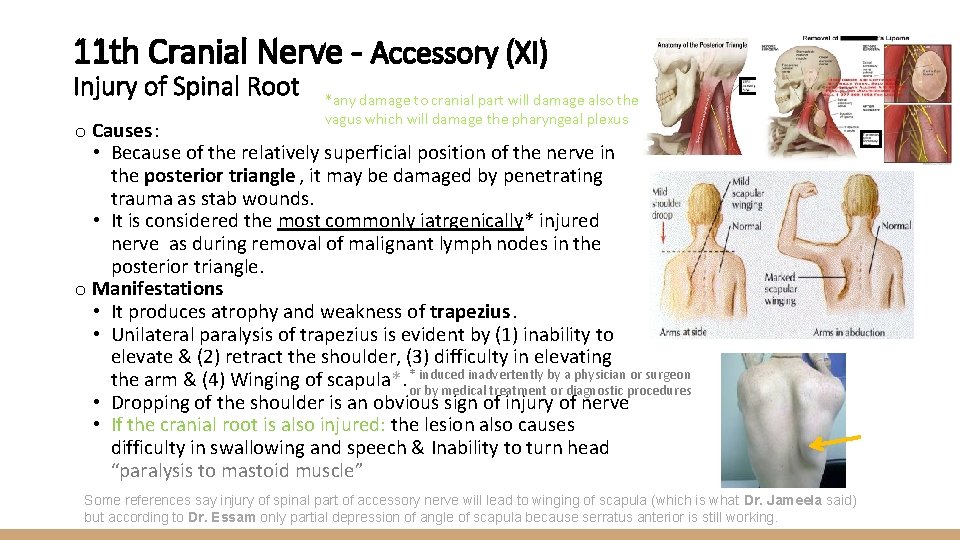
11 th Cranial Nerve - Accessory (XI) Injury of Spinal Root *any damage to cranial part will damage also the vagus which will damage the pharyngeal plexus o Causes: • Because of the relatively superficial position of the nerve in the posterior triangle , it may be damaged by penetrating trauma as stab wounds. • It is considered the most commonly iatrgenically* injured nerve as during removal of malignant lymph nodes in the posterior triangle. o Manifestations • It produces atrophy and weakness of trapezius. • Unilateral paralysis of trapezius is evident by (1) inability to elevate & (2) retract the shoulder, (3) difficulty in elevating inadvertently by a physician or surgeon the arm & (4) Winging of scapula*. *orinduced by medical treatment or diagnostic procedures • Dropping of the shoulder is an obvious sign of injury of nerve • If the cranial root is also injured: the lesion also causes difficulty in swallowing and speech & Inability to turn head “paralysis to mastoid muscle” Some references say injury of spinal part of accessory nerve will lead to winging of scapula (which is what Dr. Jameela said) but according to Dr. Essam only partial depression of angle of scapula because serratus anterior is still working.
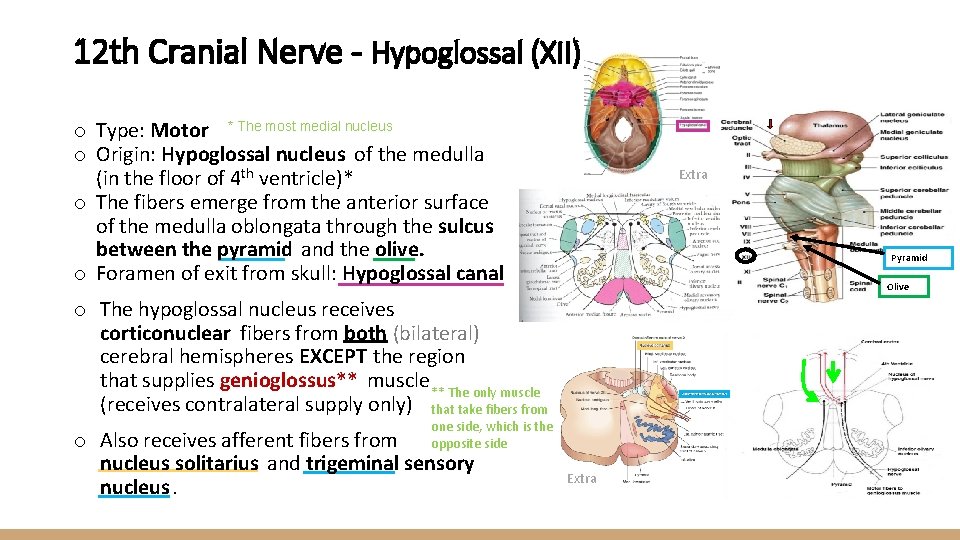
12 th Cranial Nerve - Hypoglossal (XII) o Type: Motor * The most medial nucleus o Origin: Hypoglossal nucleus of the medulla (in the floor of 4 th ventricle)* o The fibers emerge from the anterior surface of the medulla oblongata through the sulcus between the pyramid and the olive. o Foramen of exit from skull: Hypoglossal canal Extra Pyramid Olive o The hypoglossal nucleus receives corticonuclear fibers from both (bilateral) cerebral hemispheres EXCEPT the region that supplies genioglossus** muscle ** The only muscle (receives contralateral supply only) that take fibers from one side, which is the opposite side o Also receives afferent fibers from nucleus solitarius and trigeminal sensory nucleus. Extra
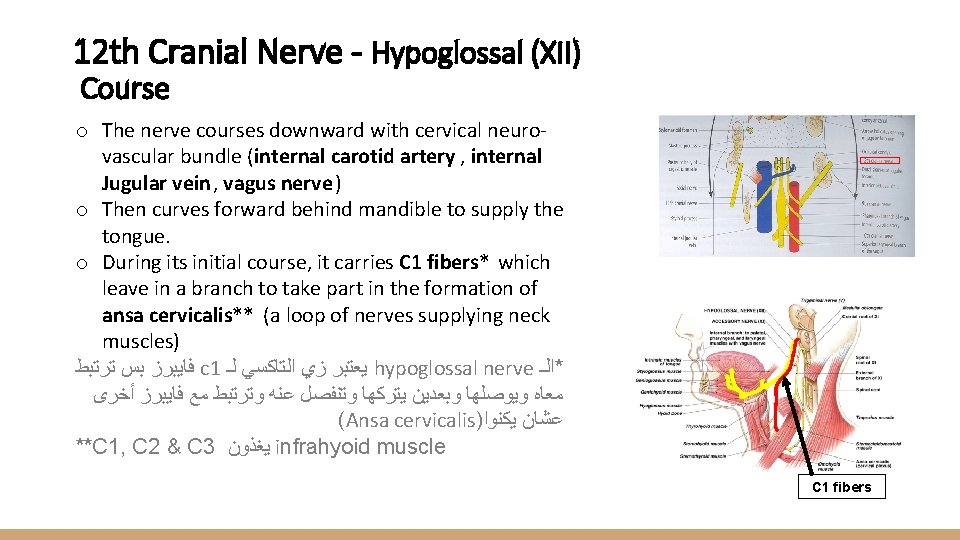
12 th Cranial Nerve - Hypoglossal (XII) Course o The nerve courses downward with cervical neurovascular bundle (internal carotid artery , internal Jugular vein, vagus nerve) o Then curves forward behind mandible to supply the tongue. o During its initial course, it carries C 1 fibers* which leave in a branch to take part in the formation of ansa cervicalis** (a loop of nerves supplying neck muscles) ﻓﺎﻳﺒﺮﺯ ﺑﺲ ﺗﺮﺗﺒﻂ c 1 ﻳﻌﺘﺒﺮ ﺯﻱ ﺍﻟﺘﺎﻛﺴﻲ ﻟـ hypoglossal nerve *ﺍﻟـ ﻣﻌﺎﻩ ﻭﻳﻮﺻﻠﻬﺎ ﻭﺑﻌﺪﻳﻦ ﻳﺘﺮﻛﻬﺎ ﻭﺗﻨﻔﺼﻞ ﻋﻨﻪ ﻭﺗﺮﺗﺒﻂ ﻣﻊ ﻓﺎﻳﺒﺮﺯ ﺃﺨﺮﻯ (Ansa cervicalis) ﻋﺸﺎﻥ ﻳﻜﻧﻮﺍ **C 1, C 2 & C 3 ﻳﻐﺬﻭﻥ infrahyoid muscle C 1 fibers
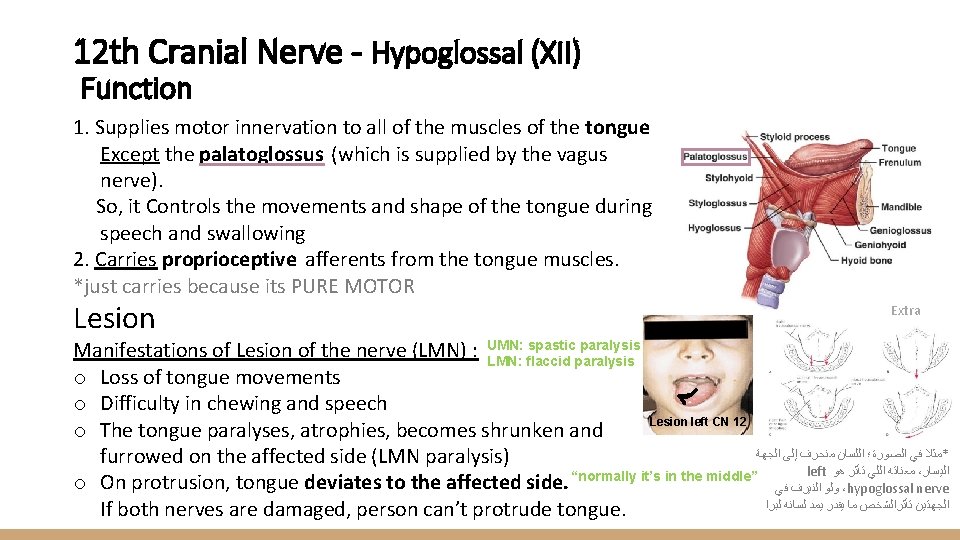
12 th Cranial Nerve - Hypoglossal (XII) Function 1. Supplies motor innervation to all of the muscles of the tongue Except the palatoglossus (which is supplied by the vagus nerve). So, it Controls the movements and shape of the tongue during speech and swallowing 2. Carries proprioceptive afferents from the tongue muscles. *just carries because its PURE MOTOR Lesion Extra spastic paralysis Manifestations of Lesion of the nerve (LMN) : UMN: LMN: flaccid paralysis o Loss of tongue movements o Difficulty in chewing and speech Lesion left CN 12 o The tongue paralyses, atrophies, becomes shrunken and *ﻣﺜﻼ ﻓﻲ ﺍﻟﺼﻮﺭﺓ؛ ﺍﻟﻠﺴﺎﻥ ﻣﻨﺤﺮﻑ ﺇﻟﻰ ﺍﻟﺠﻬﺔ furrowed on the affected side (LMN paralysis) left ﻣﻌﻨﺎﺗﻪ ﺍﻟﻠﻲ ﺗﺄﺜﺮ ﻫﻮ ، ﺍﻟﻴﺴﺎﺭ o On protrusion, tongue deviates to the affected side. “normally it’s in the middle” ﻭﻟﻮ ﺍﻟﻨﻴﺮﻑ ﻓﻲ ،hypoglossal nerve ﺍﻟﺠﻬﺘﻴﻦ ﺗﺄﺜﺮﺍﻟﺸﺨﺺ ﻣﺎ ﻳﻘﺪﺭ ﻳﻤﺪ ﻟﺴﺎﻧﻪ ﻟﺒﺮﺍ If both nerves are damaged, person can’t protrude tongue.
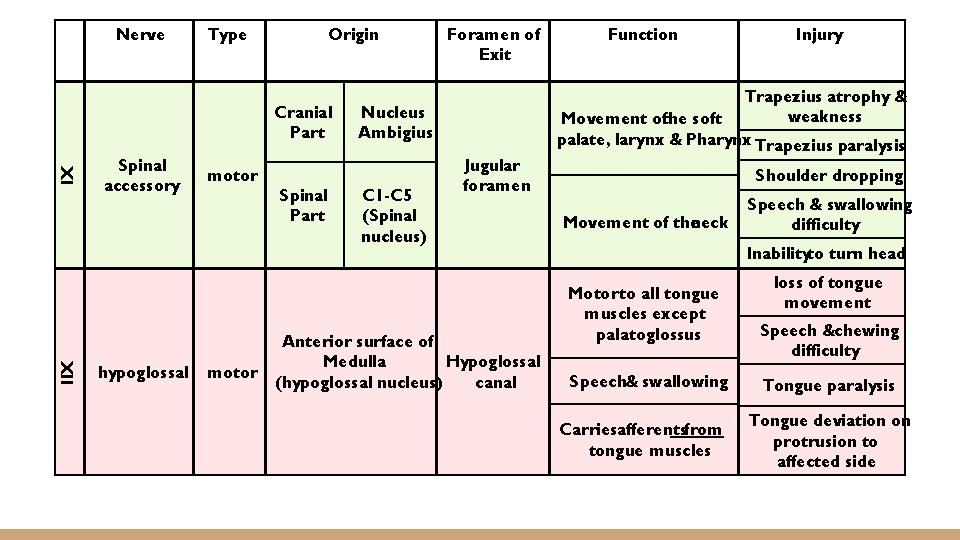
Nerve Type Origin Cranial Part XI Spinal accessory XII hypoglossal motor Spinal Part Foramen of Exit Injury Trapezius atrophy & weakness Movement ofthe soft palate, larynx & Pharynx Trapezius paralysis Nucleus Ambigius C 1 -C 5 (Spinal nucleus) Function Jugular foramen Anterior surface of Hypoglossal Medulla canal (hypoglossal nucleus) Shoulder dropping Movement of theneck Speech & swallowing difficulty Inabilityto turn head Motor to all tongue muscles except palatoglossus Speech& swallowing Carriesafferentsfrom tongue muscles loss of tongue movement Speech &chewing difficulty Tongue paralysis Tongue deviation on protrusion to affected side
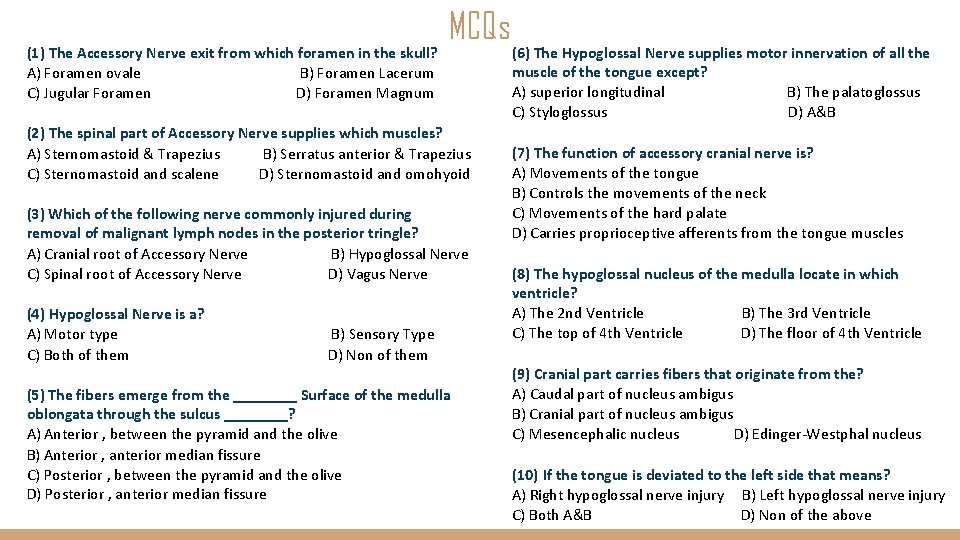
(1) The Accessory Nerve exit from which foramen in the skull? A) Foramen ovale B) Foramen Lacerum C) Jugular Foramen D) Foramen Magnum MCQs (2) The spinal part of Accessory Nerve supplies which muscles? A) Sternomastoid & Trapezius B) Serratus anterior & Trapezius C) Sternomastoid and scalene D) Sternomastoid and omohyoid (3) Which of the following nerve commonly injured during removal of malignant lymph nodes in the posterior tringle? A) Cranial root of Accessory Nerve B) Hypoglossal Nerve C) Spinal root of Accessory Nerve D) Vagus Nerve (4) Hypoglossal Nerve is a? A) Motor type C) Both of them B) Sensory Type D) Non of them (5) The fibers emerge from the ____ Surface of the medulla oblongata through the sulcus ____? A) Anterior , between the pyramid and the olive B) Anterior , anterior median fissure C) Posterior , between the pyramid and the olive D) Posterior , anterior median fissure (6) The Hypoglossal Nerve supplies motor innervation of all the muscle of the tongue except? A) superior longitudinal B) The palatoglossus C) Styloglossus D) A&B (7) The function of accessory cranial nerve is? A) Movements of the tongue B) Controls the movements of the neck C) Movements of the hard palate D) Carries proprioceptive afferents from the tongue muscles (8) The hypoglossal nucleus of the medulla locate in which ventricle? A) The 2 nd Ventricle B) The 3 rd Ventricle C) The top of 4 th Ventricle D) The floor of 4 th Ventricle (9) Cranial part carries fibers that originate from the? A) Caudal part of nucleus ambigus B) Cranial part of nucleus ambigus C) Mesencephalic nucleus D) Edinger-Westphal nucleus (10) If the tongue is deviated to the left side that means? A) Right hypoglossal nerve injury B) Left hypoglossal nerve injury C) Both A&B D) Non of the above
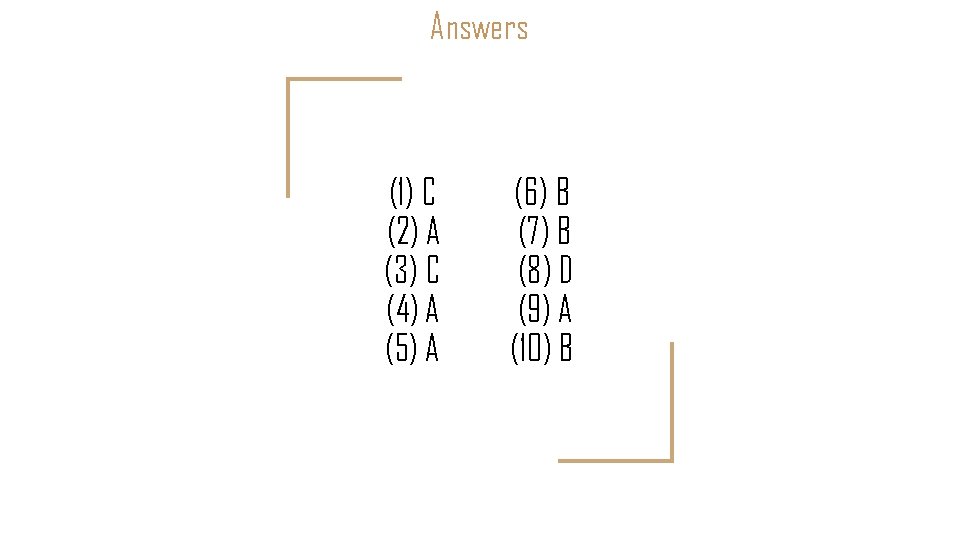
Answers (1) C (2) A (3) C (4) A (5) A (6) B (7) B (8) D (9) A (10) B
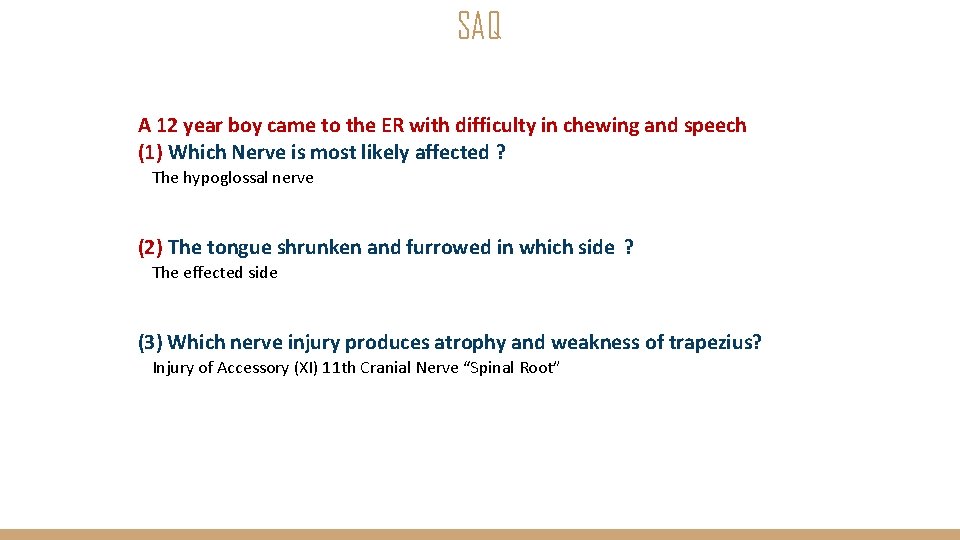
SAQ A 12 year boy came to the ER with difficulty in chewing and speech (1) Which Nerve is most likely affected ? The hypoglossal nerve (2) The tongue shrunken and furrowed in which side ? The effected side (3) Which nerve injury produces atrophy and weakness of trapezius? Injury of Accessory (XI) 11 th Cranial Nerve “Spinal Root”
Good luck Special thank for team 436 Team Leaders: Faisal Fahad Alsaif Rawan Mohammad Alharbi Team Members: Abdulaziz Aldukhayel Abdulrahman Alduhayyim Rinad Alghoraiby Rawan Mishal Twitter. com/Anatomy 437 Anatomyteam. 437@gmail. com § References: 1. Girls’ & Boys’ Slides 2. Greys Anatomy for Students 3. Teach. Me. Anatomy. com
- Slides: 16