
Objectives and Projects of the E D C
Objectives and Projects of the E. D. C. for the dissemination of the Italian Supreme Court judgments Alessio Scarcella Italian Supreme Court’s judge Magistrate assigned to the E. D. C. alessio. scarcella@giustizia. it
General goals � Free consultation by citizens of the case law of the Court of Cassation � Greater transparency of the justice service � Ease of access to legal documents � Increased awareness of their rights and duties � Strengthening the role of e-Documentation Center (EDC) to spread knowledge of the regulations, case law and legal doctrine 2
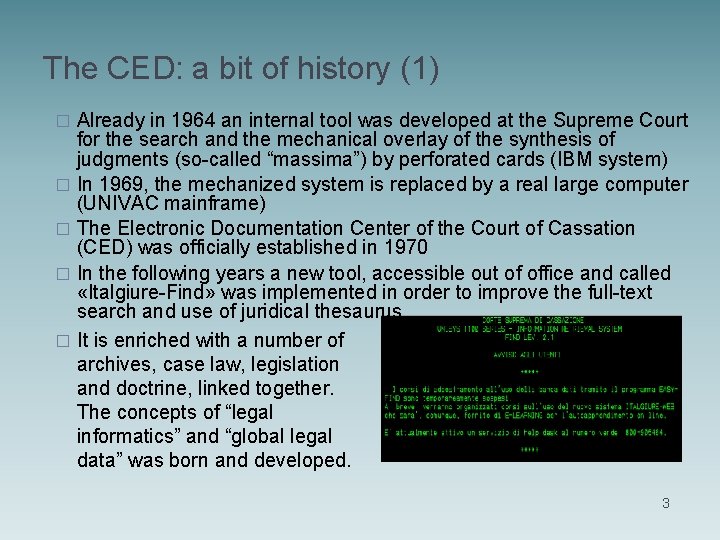
The CED: a bit of history (1) Already in 1964 an internal tool was developed at the Supreme Court for the search and the mechanical overlay of the synthesis of judgments (so-called “massima”) by perforated cards (IBM system) � In 1969, the mechanized system is replaced by a real large computer (UNIVAC mainframe) � The Electronic Documentation Center of the Court of Cassation (CED) was officially established in 1970 � In the following years a new tool, accessible out of office and called «Italgiure-Find» was implemented in order to improve the full-text search and use of juridical thesaurus � It is enriched with a number of archives, case law, legislation and doctrine, linked together. The concepts of “legal informatics” and “global legal data” was born and developed. � 3
The CED: a bit of history (2) In 1981, the legal information service provided by the CED, first reserved only to magistrates and judicial offices, became public service (Decree of the President of the Republic No. 322/1981) � The research model and archives of the CED drew international attention. The CED promotes several international conferences: � The legal informatics at the service of the country (1978) � Legal Informatics and National and International Communities (1983) � IT and legal regulations (1988), at that time the most important assembly of judicial practitioners worldwide (66 participating countries) � IT and legal activities (1993) � 4
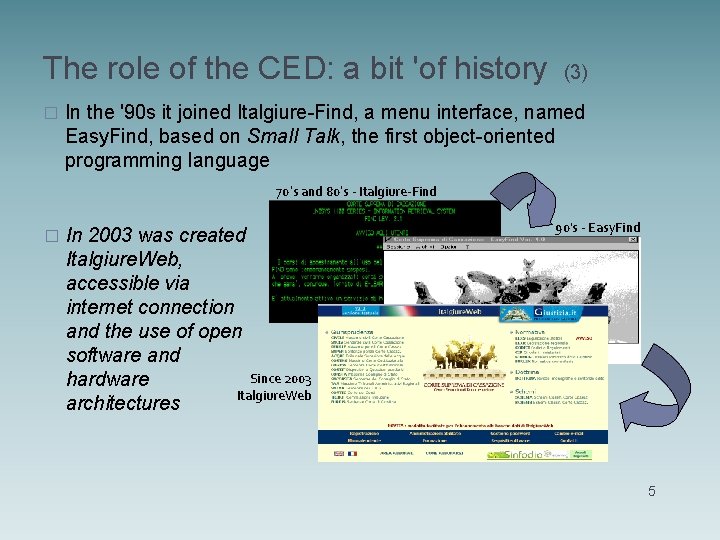
The role of the CED: a bit 'of history � (3) In the '90 s it joined Italgiure-Find, a menu interface, named Easy. Find, based on Small Talk, the first object-oriented programming language 70’s and 80’s - Italgiure-Find � In 2003 was created Italgiure. Web, accessible via internet connection and the use of open software and Since 2003 hardware Italgiure. Web architectures 90's - Easy. Find 5
The CED: a bit of history (4) � In 2004, the CED goals are expanded: � The C. E. D. of the Italian Supreme Court performs a public service of legal informatics, in order to spread knowledge of the regulations, case law and legal doctrine (Art. 1 of the Presidential Decree, no. 195 of 2004) � Recently, in addition to the Italgiure. Web search engine, the Court of Cassation website and the new Sentenze. Web website have been added 6
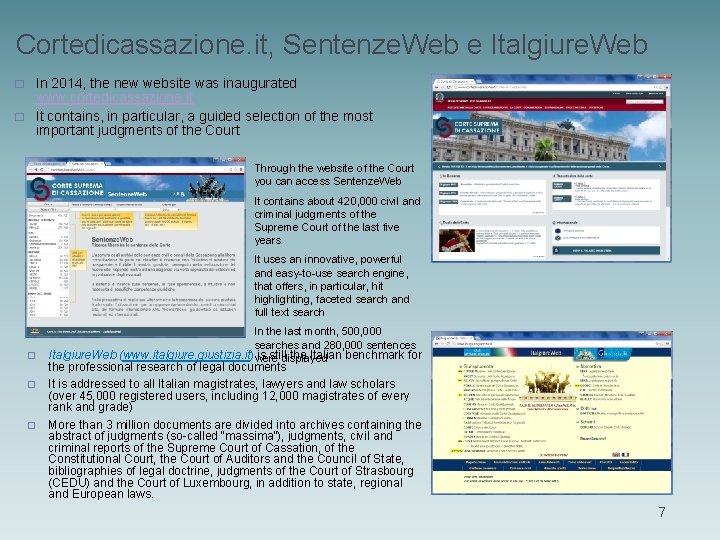
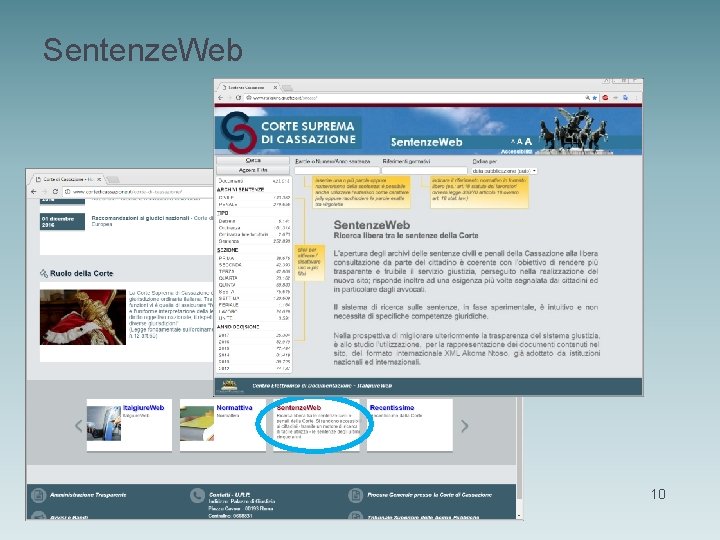
Cortedicassazione. it, Sentenze. Web e Italgiure. Web � � In 2014, the new website was inaugurated www. cortedicassazione. it It contains, in particular, a guided selection of the most important judgments of the Court � Through the website of the Court you can access Sentenze. Web � It contains about 420, 000 civil and criminal judgments of the Supreme Court of the last five years � It uses an innovative, powerful and easy-to-use search engine, that offers, in particular, hit highlighting, faceted search and full text search In the last month, 500, 000 searches and 280, 000 sentences Italgiure. Web (www. italgiure. giustizia. it) were is stilldisplayed the Italian benchmark for � � the professional research of legal documents � It is addressed to all Italian magistrates, lawyers and law scholars (over 45, 000 registered users, including 12, 000 magistrates of every rank and grade) � More than 3 million documents are divided into archives containing the abstract of judgments (so-called “massima”), judgments, civil and criminal reports of the Supreme Court of Cassation, of the Constitutional Court, the Court of Auditors and the Council of State, bibliographies of legal doctrine, judgments of the Court of Strasbourg (CEDU) and the Court of Luxembourg, in addition to state, regional and European laws. 7
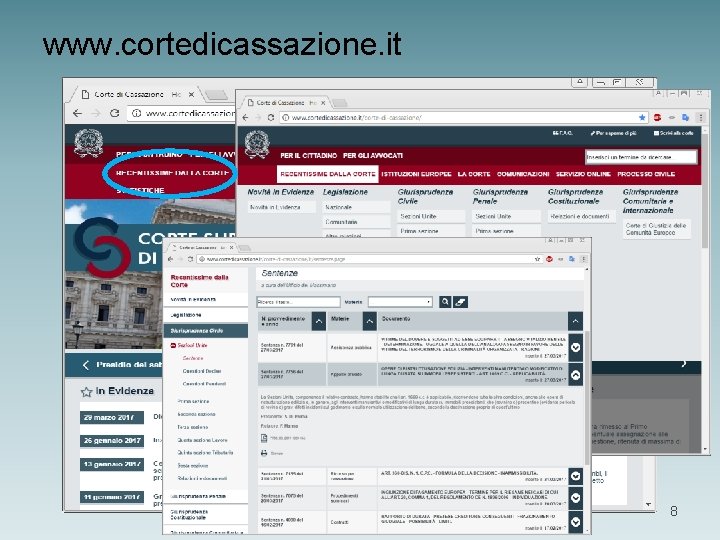
www. cortedicassazione. it 8
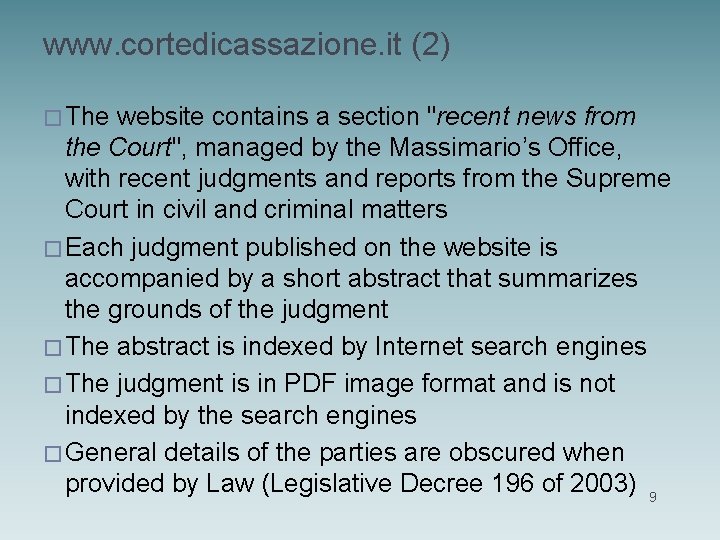
www. cortedicassazione. it (2) � The website contains a section "recent news from the Court", managed by the Massimario’s Office, with recent judgments and reports from the Supreme Court in civil and criminal matters � Each judgment published on the website is accompanied by a short abstract that summarizes the grounds of the judgment � The abstract is indexed by Internet search engines � The judgment is in PDF image format and is not indexed by the search engines � General details of the parties are obscured when provided by Law (Legislative Decree 196 of 2003) 9
Sentenze. Web 10
Sentenze. Web (2) � Free search through the judgments of the Supreme Court of the last five years � Free access for everyone and without registration � It is very easy to use and does not need particular expertise � The opening of the archives of the civil and penal judgments of the Cassation is an important innovation for Italy and it’s in line with Presidential Decree 195 of 2004 which assigns to the CED the task of spreading the legal data � It also aims to make the justice service more transparent and accessible and meets a need repeatedly indicated by 11 Italian citizens and in particular by lawyers
Sentenze. Web (3) � The archive contains over 420, 000 judgments in PDF_image format, two thirds of which are in criminal matters � It is updated daily with judgments filed up in the previous day � The text of the judgments is extracted from the PDF using an automatic character recognition software (OCR) � The search interface uses the Apache Solr engine, which is an open source search platform � It implements full-text search, hit-highlighting features (extracting and displaying document sentences that contain the words the user is looking for, which are, in turn, highlighted) and faceted search (the possibility to apply filters with a click on matter, type, year and section of the Supreme Court) 12 � It offers the automatic search of normative references in
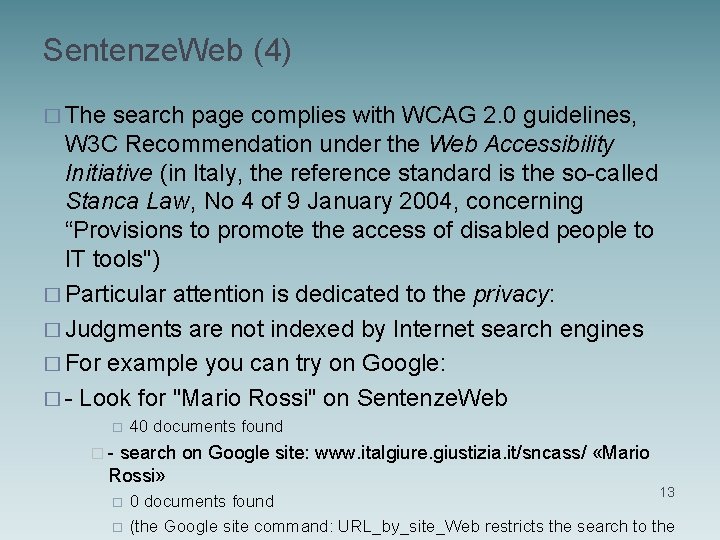
Sentenze. Web (4) � The search page complies with WCAG 2. 0 guidelines, W 3 C Recommendation under the Web Accessibility Initiative (in Italy, the reference standard is the so-called Stanca Law, No 4 of 9 January 2004, concerning “Provisions to promote the access of disabled people to IT tools") � Particular attention is dedicated to the privacy: � Judgments are not indexed by Internet search engines � For example you can try on Google: � - Look for "Mario Rossi" on Sentenze. Web 40 documents found �- search on Google site: www. italgiure. giustizia. it/sncass/ «Mario Rossi» 13 0 documents found (the Google site command: URL_by_site_Web restricts the search to the
Sentenze. Web (5) � Judgments remain online only 5 years, in addition to the current year, also to safeguard the So-called “Right to forget” � Judgments older than 5 years are deleted from the Sentenze. Web archive � The judgments for which the general and other identification data, in accordance with Article 52 of the Personal Data Protection Code (Legislative Decree no. 196/2003), are omitted in case of dissemination, are subsequently published, with general information and other identifying data appropriately masked � In the meantime, only the extremes of the judgment obscured are published online 14
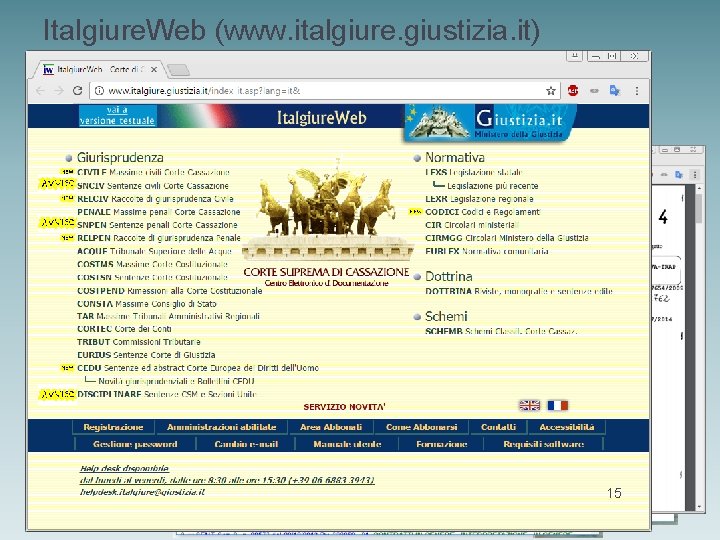
Italgiure. Web (www. italgiure. giustizia. it) 15
Italgiure. Web (2) � The "Italgiureweb" service is instead targeted at professional users, distinguished between free access users and paying users � Free Access Users are constitutional judges, ordinary judges, administrative, accounting and military judges, State attorneys and prosecutors, tax judges, honorary judges and judges of peace, honorary prosecutors and employees of central government � Paying users are made up of regions, municipalities, provinces, state companies, parastatal agencies, universities, attorneys, accountants, notaries, trade unions, etc. . . � Reference laws: Decree of the President of the Republic no. 322 of 1981 "Regulations for the licence’s release to the users of the C. E. D. Supreme Court of Cassation” � Decree of the President of the Republic n. o 195 of 2004 "Supplementary regulation of the discipline and access to the legal 16 information service” � Decree of the Ministry of Justice - February 7, 2006 "Modalities and �
Italgiure. Web (3) � Over the time, more than 45, 000 users registered to Italgiure. Web. More than 15, 000 used at least once a month in the last year � The average monthly queries amount to over 7 million and 300 thousands per day � The average number of 'unique' users per day is over 4, 000 � This tool is particularly appreciated and used by both the professional and honorary magistrates, whose queries amount to about the 85% of those made on the web site 17
Italgiure. Web (4) � The archives contain: � 520, 000 synthesis of judgments (so-called “massima”) in civil matters and 171, 000 synthesis of judgments (socalled “massima”) in criminal matters, dating back to the sixties � 602, 000 judgments in civil matters and 672, 000 judgments in criminal matters, which increase at the rate of 80, 000 judgments a year � 41, 000 judgments of the Strasbourg Court (ECHR) � 51, 000 of the Court of Luxembourg � 780, 000 bibliographic records of legal doctrine � 490, 000 normative acts in the historical version dating back to 1861 � The archives of the judgments of the Court of Cassation are updated daily, the other archives on a bi-weekly basis or when the update is available 18
Italgiure. Web (5) � It offers many advanced search features: Search for words in natural language and widening results through a thesaurus of legal-oriented documents � The ability to set both the order and the maximum distance between the words � Search for concepts through a dedicated thesaurus � Research possibilities on the judgments just published in image format (character recognition using OCR) � Research of normative references given in natural language (free form) or by the proposer's name (eg. Bassanini law) or other name currently used (eg. law transparency administrative acts) � Automatic identification of normative and case-law references, as indicated in the ECLI standard, in the archives of the 19 judgments of the Supreme Court �
Italgiure. Web (6) � Other advanced search features: � Displaying on a single screen of all the selections made (research branches) in a so-called “tree structure” � Possibility to perform Boolean operations, even complex ones, combining the branches of searches with the Boolean operators AND, OR, NOT, etc. � Possibility to view, and use in the search (so-called SPECTR). the indexes for each document, such as Year, Publication Date, Section, Type of Act, Authority, Words, Classification, etc. � Possibility of automatic selection of all judgments, previous and subsequent, which are in conformity and contrary in respect of a certain judgment (network of jurisprudence references) � Automatic reporting in the synthesis of judgments (so-called alerts), not only of the legal notation records, but also of the subsequent judgments, in accordance with or not, as well as the topics already decided and those still pending before the Constitutional Court � Automatic reporting of news in relation to one or more saved searches 20
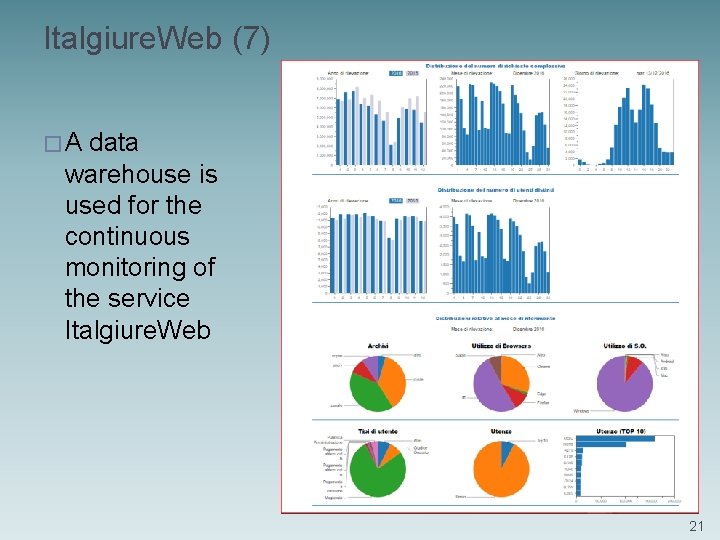
Italgiure. Web (7) �A data warehouse is used for the continuous monitoring of the service Italgiure. Web 21
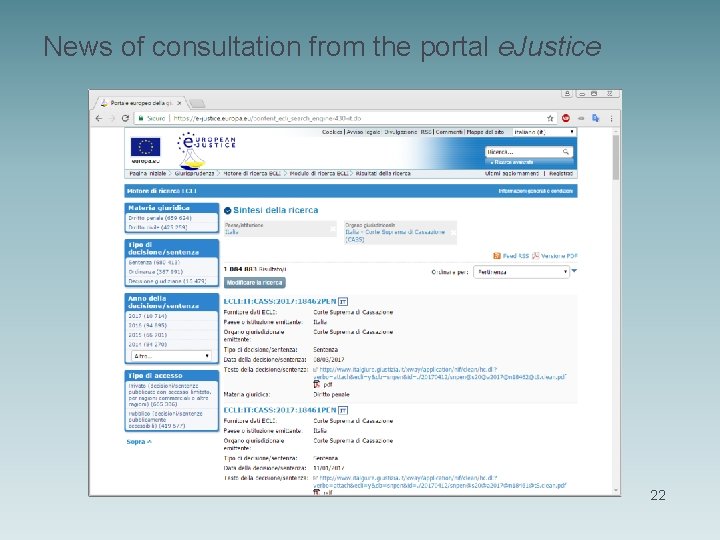
News of consultation from the portal e. Justice 22
News of consultation from the portal e. Justice (2) � In January 2017, the work was completed to include in the European portal e. Justice the possibility to search on over 1. 1 million judgments of the Italian Supreme Court � The search through text words is only active for judgments of the last 5 years, which can be viewed freely (they are the same as the Sentenze. Web site) � All judgments, even older ones, are also searchable through the words of the synthesis of judgments (socalled “massima”) or abstracts (not all judgments are however synthesized) 23
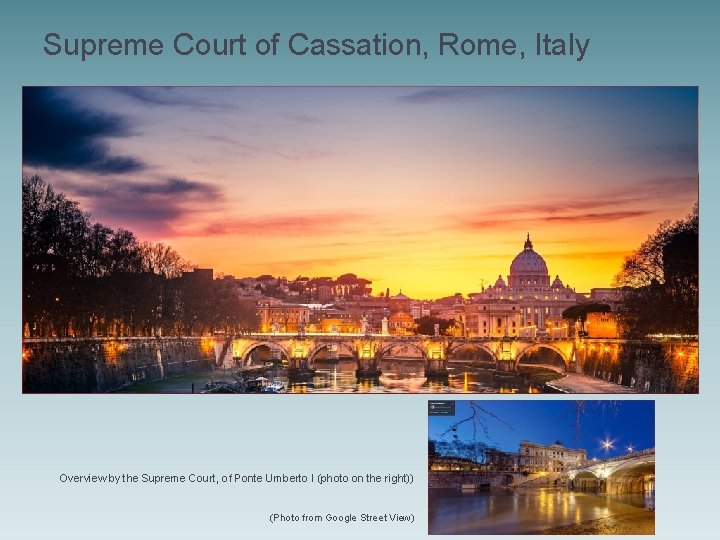
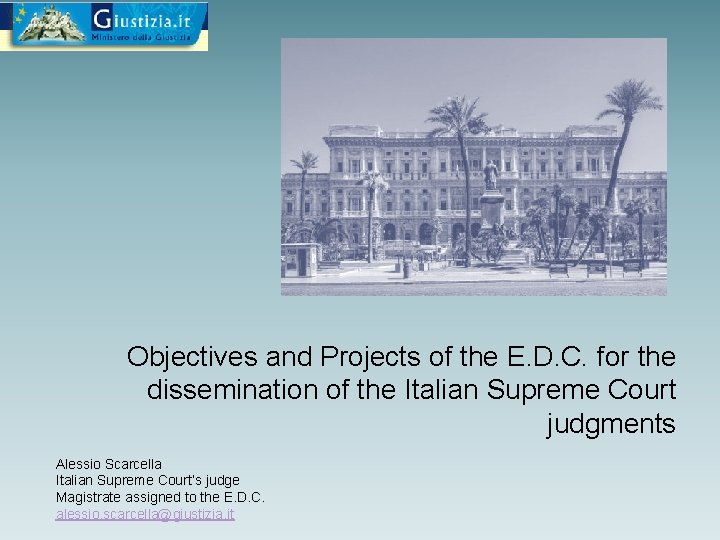
Supreme Court of Cassation, Rome, Italy Overview by the Supreme Court, of Ponte Umberto I (photo on the right)) (Photo from Google Street View)

Thanks for your attention Questions or suggestions?
- Slides: 25