
OBJECTIVES After studying Chapter 12 the reader should
OBJECTIVES After studying Chapter 12, the reader should be able to: 1. Perform and analyze the tests that are used to diagnose transmission problems. 2. Determine the root cause of the transmission’s problem. 3. Recommend the proper repair procedure. 4. Perform the SAE tasks for general transmission/transaxle diagnosis and the mechanical/hydraulic system. Automatic Transmissions and Transaxles, Fourth Edition By Tom Birch and Chuck Rockwood © 2010 Pearson Higher Education, Inc. Pearson Prentice Hall - Upper Saddle River, NJ 07458
INTRODUCTION • An automatic transmission is a complicated device, and there are many possible reasons for complete or partial failure. • A sound knowledge of automatic transmission operation helps greatly when diagnosing transmission failures. Automatic Transmissions and Transaxles, Fourth Edition By Tom Birch and Chuck Rockwood © 2010 Pearson Higher Education, Inc. Pearson Prentice Hall - Upper Saddle River, NJ 07458
INTRODUCTION • The following is a series of tests and checks that can be used to determine the exact cause of automatic transmission problems: – Visual inspection, Fluid check, Road test, Electrical system check, Torque converter clutch (TCC) test, Hydraulic pressure test, Modulator check, Stall test, Leak check, Oil pan debris check, Air test, Wet air test, Noise, vibration, harshness (NVH) check Automatic Transmissions and Transaxles, Fourth Edition By Tom Birch and Chuck Rockwood © 2010 Pearson Higher Education, Inc. Pearson Prentice Hall - Upper Saddle River, NJ 07458
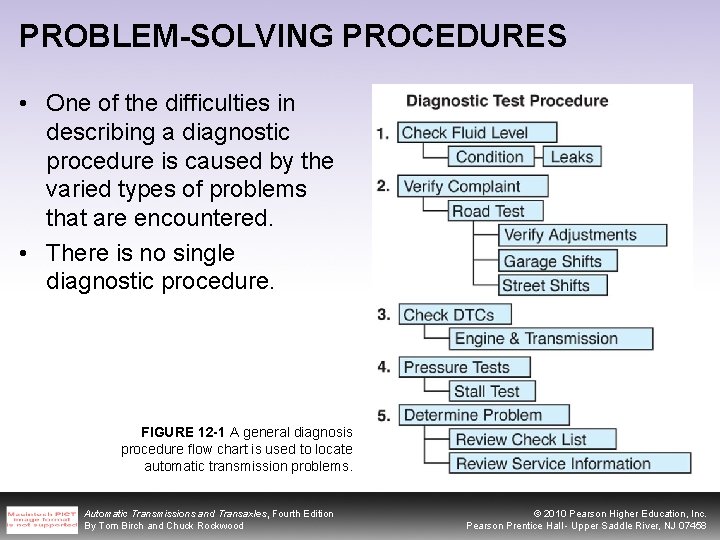
PROBLEM-SOLVING PROCEDURES • One of the difficulties in describing a diagnostic procedure is caused by the varied types of problems that are encountered. • There is no single diagnostic procedure. FIGURE 12 -1 A general diagnosis procedure flow chart is used to locate automatic transmission problems. Automatic Transmissions and Transaxles, Fourth Edition By Tom Birch and Chuck Rockwood © 2010 Pearson Higher Education, Inc. Pearson Prentice Hall - Upper Saddle River, NJ 07458
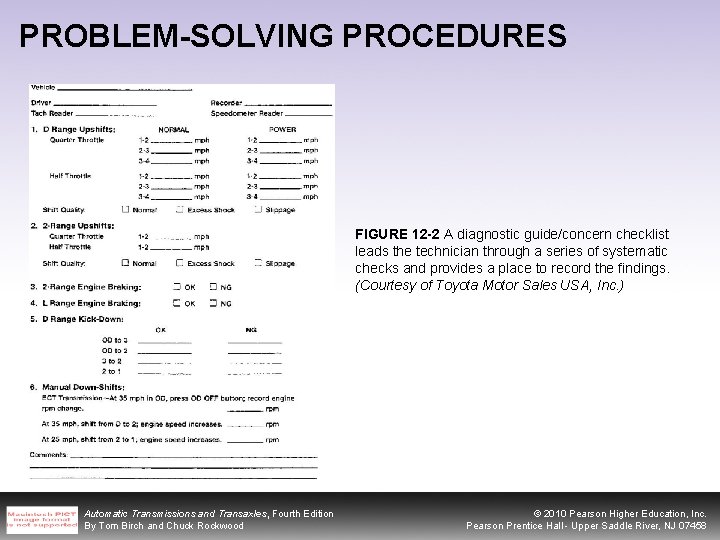
PROBLEM-SOLVING PROCEDURES FIGURE 12 -2 A diagnostic guide/concern checklist leads the technician through a series of systematic checks and provides a place to record the findings. (Courtesy of Toyota Motor Sales USA, Inc. ) Automatic Transmissions and Transaxles, Fourth Edition By Tom Birch and Chuck Rockwood © 2010 Pearson Higher Education, Inc. Pearson Prentice Hall - Upper Saddle River, NJ 07458
DIAGNOSTIC PROCEDURE • All transmission problem solving should begin with a check of the fluid level and fluid condition. • Many problems can be caused by low or high fluid level or poor fluid condition. • Fluid level and condition will often give you a clue as to the cause of the problem. • Many technicians make it a practice to check the manual shift linkage and the throttle linkage at this time. Automatic Transmissions and Transaxles, Fourth Edition By Tom Birch and Chuck Rockwood © 2010 Pearson Higher Education, Inc. Pearson Prentice Hall - Upper Saddle River, NJ 07458
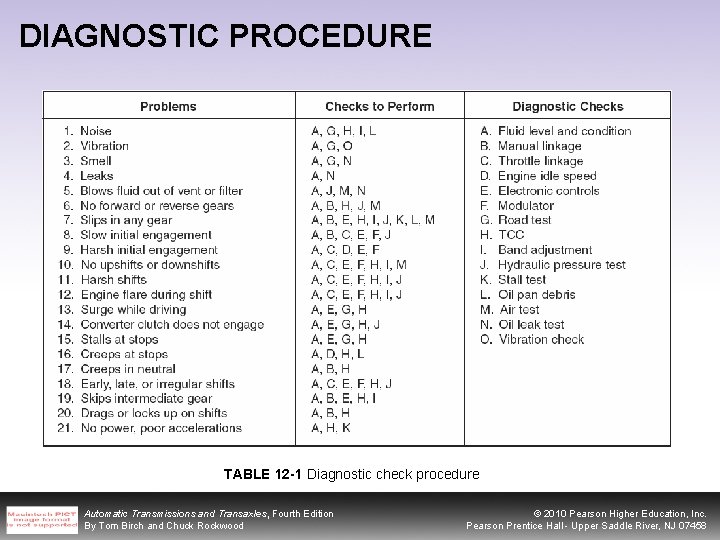
DIAGNOSTIC PROCEDURE TABLE 12 -1 Diagnostic check procedure Automatic Transmissions and Transaxles, Fourth Edition By Tom Birch and Chuck Rockwood © 2010 Pearson Higher Education, Inc. Pearson Prentice Hall - Upper Saddle River, NJ 07458
VISUAL INSPECTION • Before beginning any of the complex diagnosis checks, make a quick visual inspection of the vehicle and transmission to avoid overlooking the obvious. • These checks should include the following: – – – – Fluid level and condition Fluid leaks Engine running condition Signs of past repair or tampering Motor/transmission mount condition Electrical connections to the transmission Vacuum connections to the transmission and engine If the vehicle does not move, the drive shaft(s), final drive, and differential condition Automatic Transmissions and Transaxles, Fourth Edition By Tom Birch and Chuck Rockwood © 2010 Pearson Higher Education, Inc. Pearson Prentice Hall - Upper Saddle River, NJ 07458
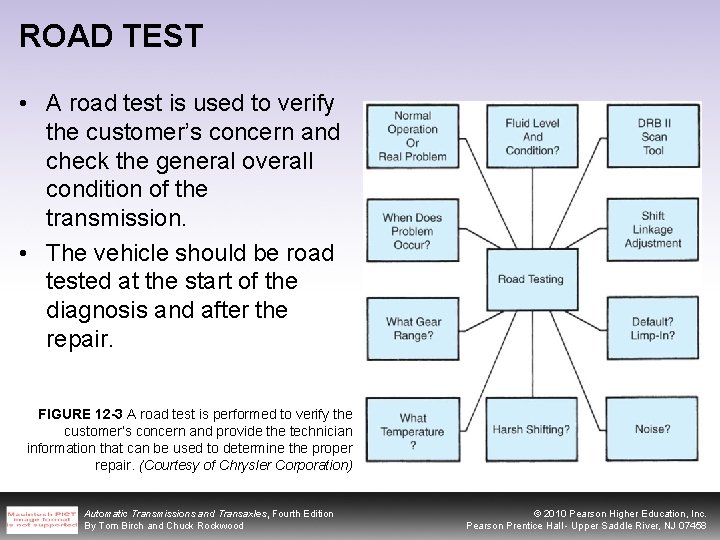
ROAD TEST • A road test is used to verify the customer’s concern and check the general overall condition of the transmission. • The vehicle should be road tested at the start of the diagnosis and after the repair. FIGURE 12 -3 A road test is performed to verify the customer’s concern and provide the technician information that can be used to determine the proper repair. (Courtesy of Chrysler Corporation) Automatic Transmissions and Transaxles, Fourth Edition By Tom Birch and Chuck Rockwood © 2010 Pearson Higher Education, Inc. Pearson Prentice Hall - Upper Saddle River, NJ 07458
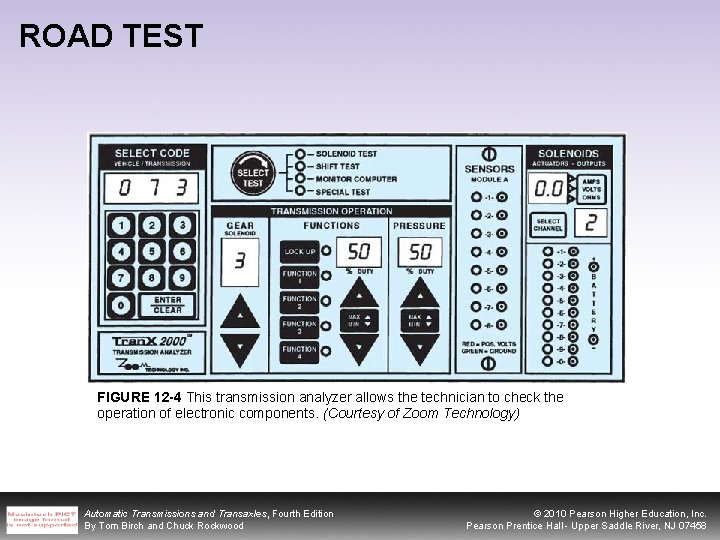
ROAD TEST FIGURE 12 -4 This transmission analyzer allows the technician to check the operation of electronic components. (Courtesy of Zoom Technology) Automatic Transmissions and Transaxles, Fourth Edition By Tom Birch and Chuck Rockwood © 2010 Pearson Higher Education, Inc. Pearson Prentice Hall - Upper Saddle River, NJ 07458
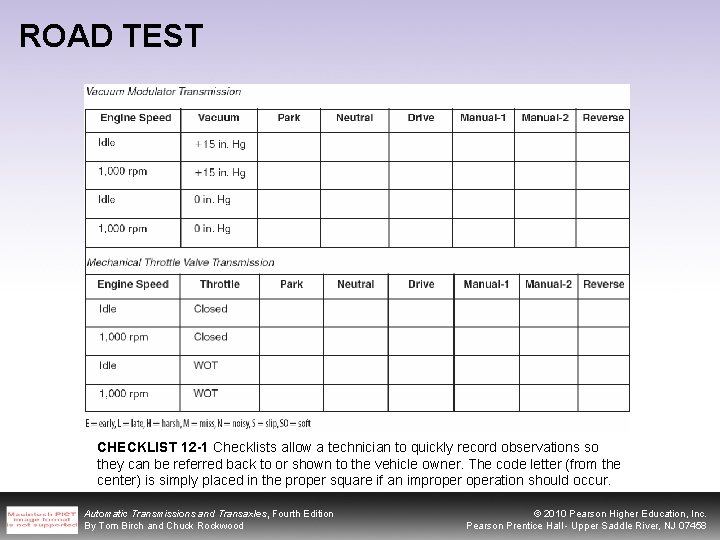
ROAD TEST CHECKLIST 12 -1 Checklists allow a technician to quickly record observations so they can be referred back to or shown to the vehicle owner. The code letter (from the center) is simply placed in the proper square if an improperation should occur. Automatic Transmissions and Transaxles, Fourth Edition By Tom Birch and Chuck Rockwood © 2010 Pearson Higher Education, Inc. Pearson Prentice Hall - Upper Saddle River, NJ 07458
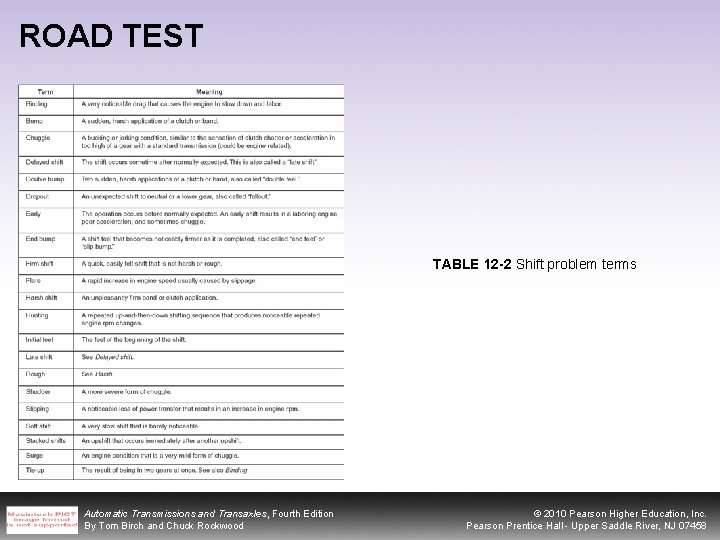
ROAD TEST TABLE 12 -2 Shift problem terms Automatic Transmissions and Transaxles, Fourth Edition By Tom Birch and Chuck Rockwood © 2010 Pearson Higher Education, Inc. Pearson Prentice Hall - Upper Saddle River, NJ 07458
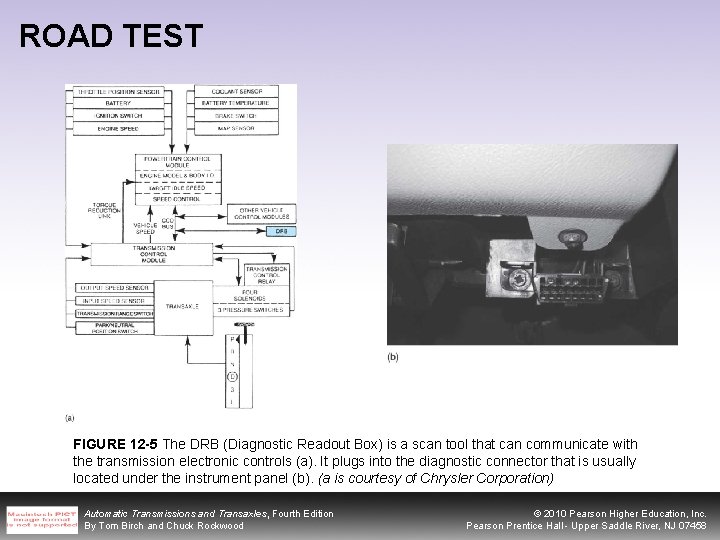
ROAD TEST FIGURE 12 -5 The DRB (Diagnostic Readout Box) is a scan tool that can communicate with the transmission electronic controls (a). It plugs into the diagnostic connector that is usually located under the instrument panel (b). (a is courtesy of Chrysler Corporation) Automatic Transmissions and Transaxles, Fourth Edition By Tom Birch and Chuck Rockwood © 2010 Pearson Higher Education, Inc. Pearson Prentice Hall - Upper Saddle River, NJ 07458
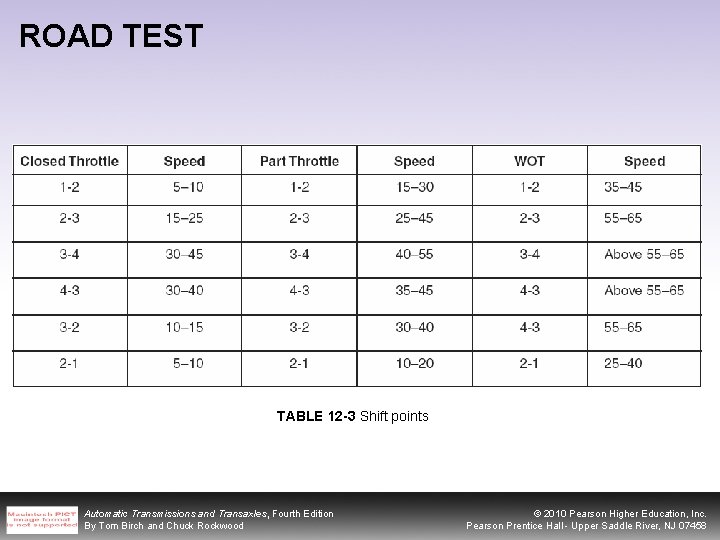
ROAD TEST TABLE 12 -3 Shift points Automatic Transmissions and Transaxles, Fourth Edition By Tom Birch and Chuck Rockwood © 2010 Pearson Higher Education, Inc. Pearson Prentice Hall - Upper Saddle River, NJ 07458
TORQUE CONVERTER CLUTCH TESTS • Possible TCC problems are failure to apply, failure to release, hunting or busyness, early application, or harsh application. • These problems can be confirmed on a road test by using a scan tool or tachometer to note the engine speed change during clutch application. • Converter Clutch Hydraulic Checks – To test converter clutch apply pressure, you should: Automatic Transmissions and Transaxles, Fourth Edition By Tom Birch and Chuck Rockwood © 2010 Pearson Higher Education, Inc. Pearson Prentice Hall - Upper Saddle River, NJ 07458
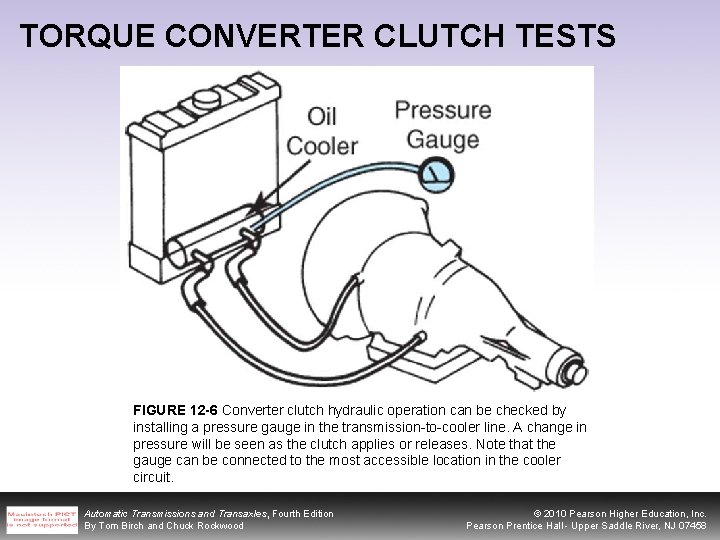
TORQUE CONVERTER CLUTCH TESTS FIGURE 12 -6 Converter clutch hydraulic operation can be checked by installing a pressure gauge in the transmission-to-cooler line. A change in pressure will be seen as the clutch applies or releases. Note that the gauge can be connected to the most accessible location in the cooler circuit. Automatic Transmissions and Transaxles, Fourth Edition By Tom Birch and Chuck Rockwood © 2010 Pearson Higher Education, Inc. Pearson Prentice Hall - Upper Saddle River, NJ 07458
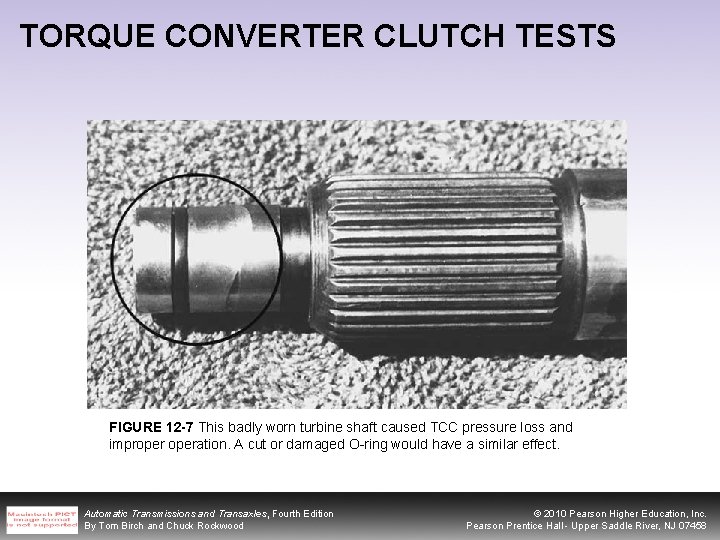
TORQUE CONVERTER CLUTCH TESTS FIGURE 12 -7 This badly worn turbine shaft caused TCC pressure loss and improperation. A cut or damaged O-ring would have a similar effect. Automatic Transmissions and Transaxles, Fourth Edition By Tom Birch and Chuck Rockwood © 2010 Pearson Higher Education, Inc. Pearson Prentice Hall - Upper Saddle River, NJ 07458
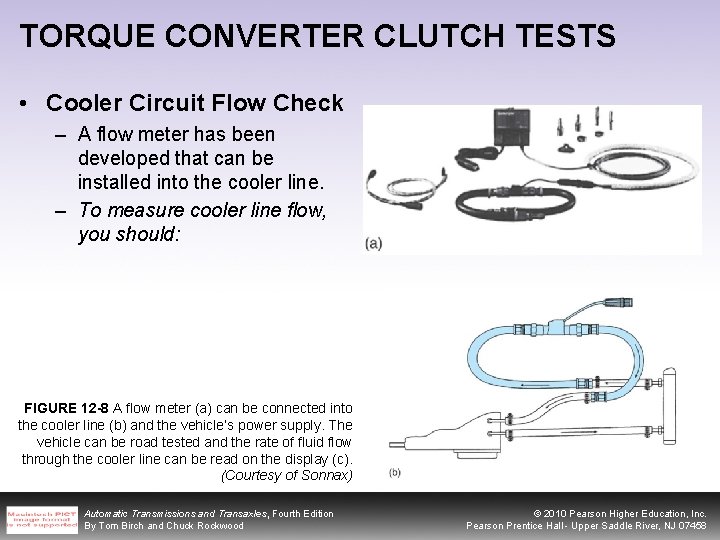
TORQUE CONVERTER CLUTCH TESTS • Cooler Circuit Flow Check – A flow meter has been developed that can be installed into the cooler line. – To measure cooler line flow, you should: FIGURE 12 -8 A flow meter (a) can be connected into the cooler line (b) and the vehicle’s power supply. The vehicle can be road tested and the rate of fluid flow through the cooler line can be read on the display (c). (Courtesy of Sonnax) Automatic Transmissions and Transaxles, Fourth Edition By Tom Birch and Chuck Rockwood © 2010 Pearson Higher Education, Inc. Pearson Prentice Hall - Upper Saddle River, NJ 07458
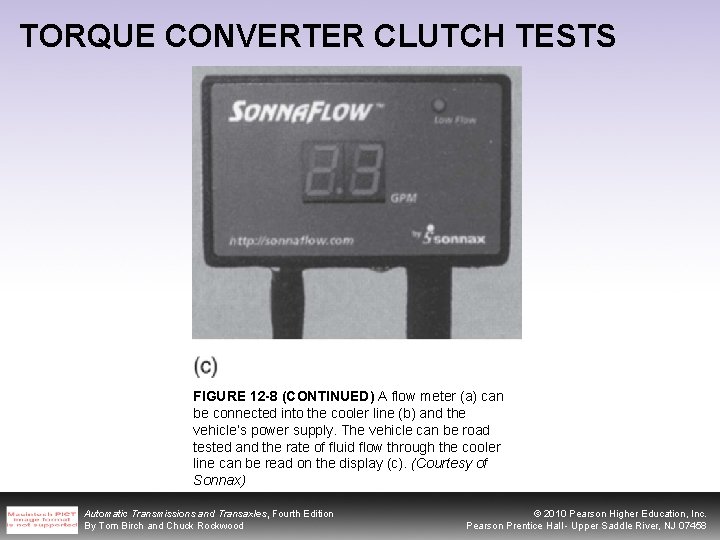
TORQUE CONVERTER CLUTCH TESTS FIGURE 12 -8 (CONTINUED) A flow meter (a) can be connected into the cooler line (b) and the vehicle’s power supply. The vehicle can be road tested and the rate of fluid flow through the cooler line can be read on the display (c). (Courtesy of Sonnax) Automatic Transmissions and Transaxles, Fourth Edition By Tom Birch and Chuck Rockwood © 2010 Pearson Higher Education, Inc. Pearson Prentice Hall - Upper Saddle River, NJ 07458
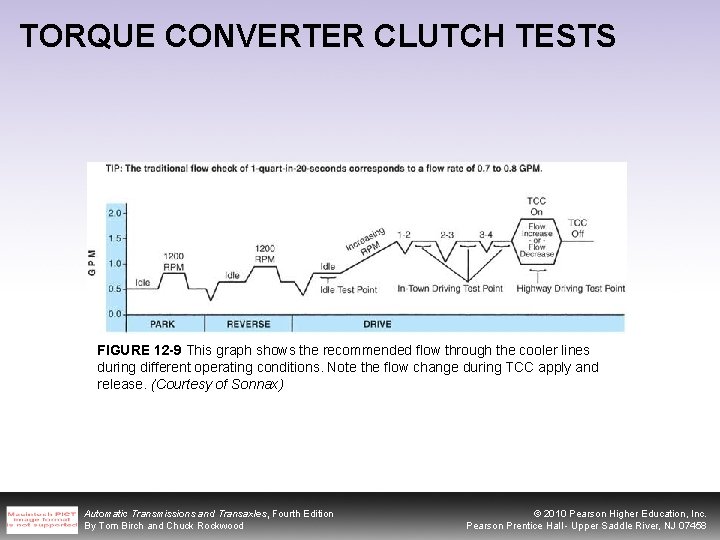
TORQUE CONVERTER CLUTCH TESTS FIGURE 12 -9 This graph shows the recommended flow through the cooler lines during different operating conditions. Note the flow change during TCC apply and release. (Courtesy of Sonnax) Automatic Transmissions and Transaxles, Fourth Edition By Tom Birch and Chuck Rockwood © 2010 Pearson Higher Education, Inc. Pearson Prentice Hall - Upper Saddle River, NJ 07458
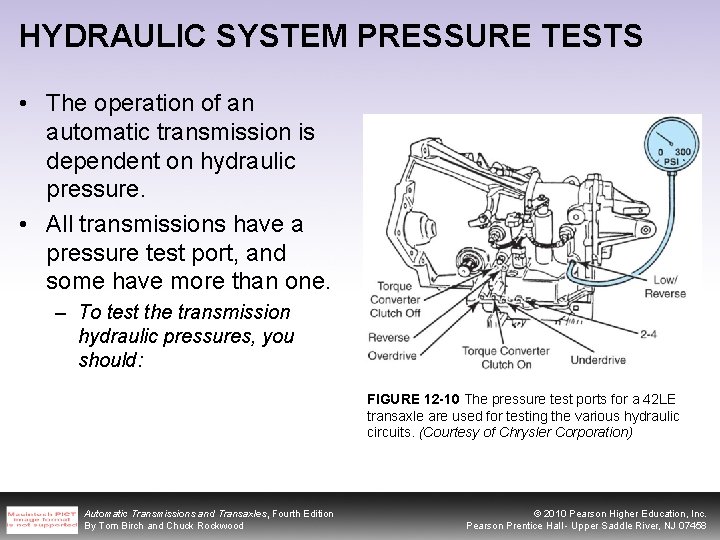
HYDRAULIC SYSTEM PRESSURE TESTS • The operation of an automatic transmission is dependent on hydraulic pressure. • All transmissions have a pressure test port, and some have more than one. – To test the transmission hydraulic pressures, you should: FIGURE 12 -10 The pressure test ports for a 42 LE transaxle are used for testing the various hydraulic circuits. (Courtesy of Chrysler Corporation) Automatic Transmissions and Transaxles, Fourth Edition By Tom Birch and Chuck Rockwood © 2010 Pearson Higher Education, Inc. Pearson Prentice Hall - Upper Saddle River, NJ 07458
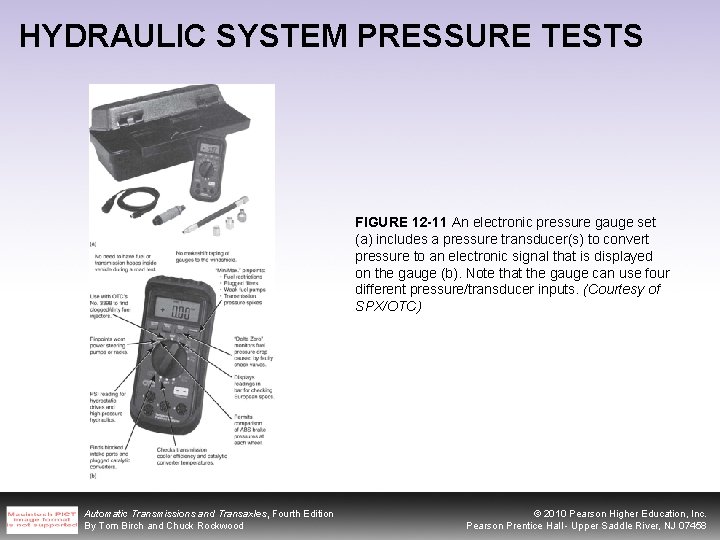
HYDRAULIC SYSTEM PRESSURE TESTS FIGURE 12 -11 An electronic pressure gauge set (a) includes a pressure transducer(s) to convert pressure to an electronic signal that is displayed on the gauge (b). Note that the gauge can use four different pressure/transducer inputs. (Courtesy of SPX/OTC) Automatic Transmissions and Transaxles, Fourth Edition By Tom Birch and Chuck Rockwood © 2010 Pearson Higher Education, Inc. Pearson Prentice Hall - Upper Saddle River, NJ 07458
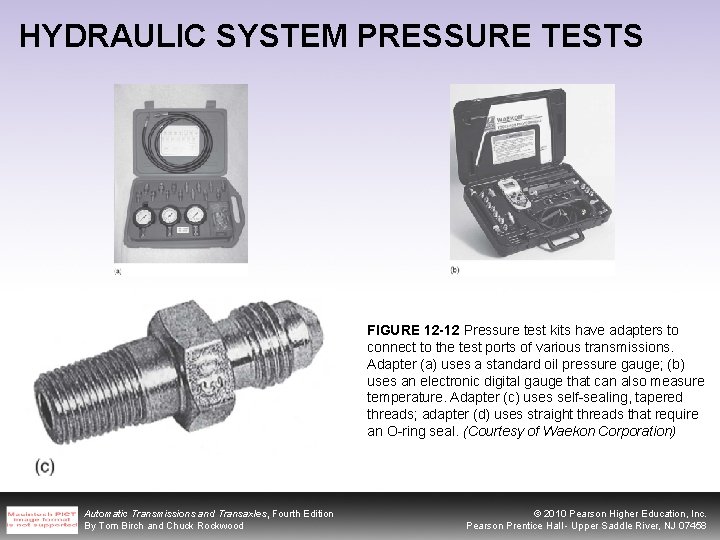
HYDRAULIC SYSTEM PRESSURE TESTS FIGURE 12 -12 Pressure test kits have adapters to connect to the test ports of various transmissions. Adapter (a) uses a standard oil pressure gauge; (b) uses an electronic digital gauge that can also measure temperature. Adapter (c) uses self-sealing, tapered threads; adapter (d) uses straight threads that require an O-ring seal. (Courtesy of Waekon Corporation) Automatic Transmissions and Transaxles, Fourth Edition By Tom Birch and Chuck Rockwood © 2010 Pearson Higher Education, Inc. Pearson Prentice Hall - Upper Saddle River, NJ 07458
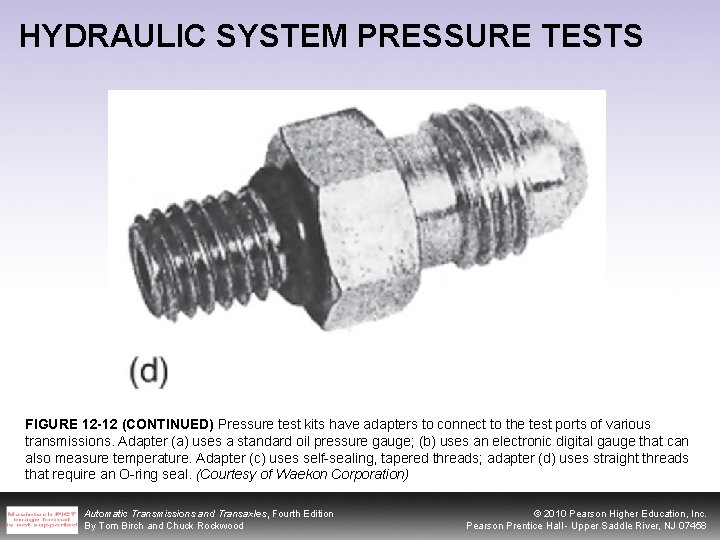
HYDRAULIC SYSTEM PRESSURE TESTS FIGURE 12 -12 (CONTINUED) Pressure test kits have adapters to connect to the test ports of various transmissions. Adapter (a) uses a standard oil pressure gauge; (b) uses an electronic digital gauge that can also measure temperature. Adapter (c) uses self-sealing, tapered threads; adapter (d) uses straight threads that require an O-ring seal. (Courtesy of Waekon Corporation) Automatic Transmissions and Transaxles, Fourth Edition By Tom Birch and Chuck Rockwood © 2010 Pearson Higher Education, Inc. Pearson Prentice Hall - Upper Saddle River, NJ 07458
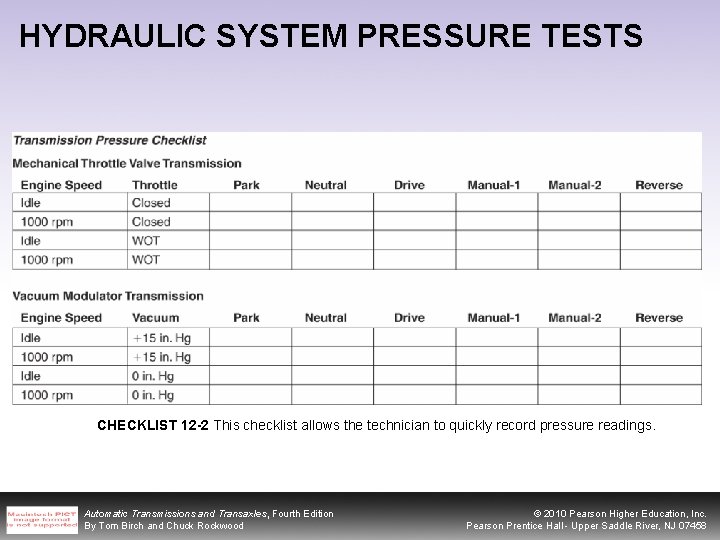
HYDRAULIC SYSTEM PRESSURE TESTS CHECKLIST 12 -2 This checklist allows the technician to quickly record pressure readings. Automatic Transmissions and Transaxles, Fourth Edition By Tom Birch and Chuck Rockwood © 2010 Pearson Higher Education, Inc. Pearson Prentice Hall - Upper Saddle River, NJ 07458
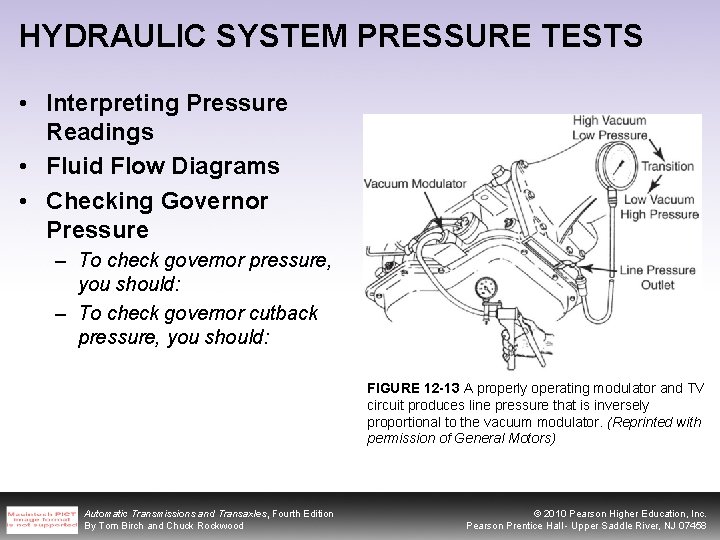
HYDRAULIC SYSTEM PRESSURE TESTS • Interpreting Pressure Readings • Fluid Flow Diagrams • Checking Governor Pressure – To check governor pressure, you should: – To check governor cutback pressure, you should: FIGURE 12 -13 A properly operating modulator and TV circuit produces line pressure that is inversely proportional to the vacuum modulator. (Reprinted with permission of General Motors) Automatic Transmissions and Transaxles, Fourth Edition By Tom Birch and Chuck Rockwood © 2010 Pearson Higher Education, Inc. Pearson Prentice Hall - Upper Saddle River, NJ 07458
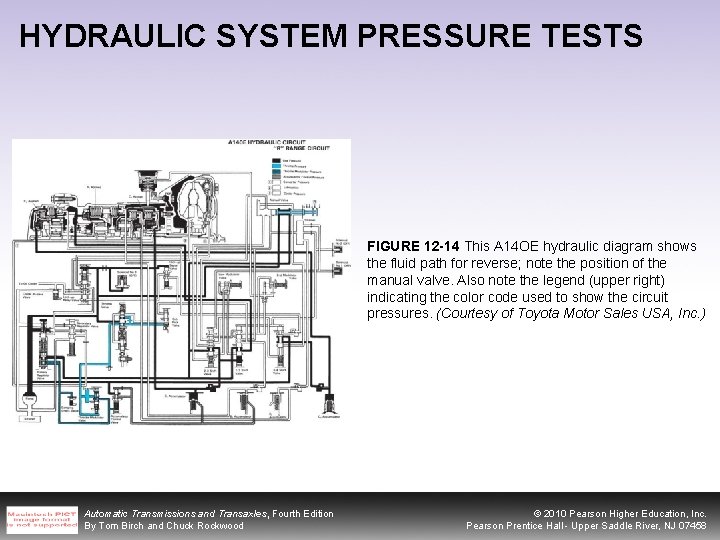
HYDRAULIC SYSTEM PRESSURE TESTS FIGURE 12 -14 This A 14 OE hydraulic diagram shows the fluid path for reverse; note the position of the manual valve. Also note the legend (upper right) indicating the color code used to show the circuit pressures. (Courtesy of Toyota Motor Sales USA, Inc. ) Automatic Transmissions and Transaxles, Fourth Edition By Tom Birch and Chuck Rockwood © 2010 Pearson Higher Education, Inc. Pearson Prentice Hall - Upper Saddle River, NJ 07458
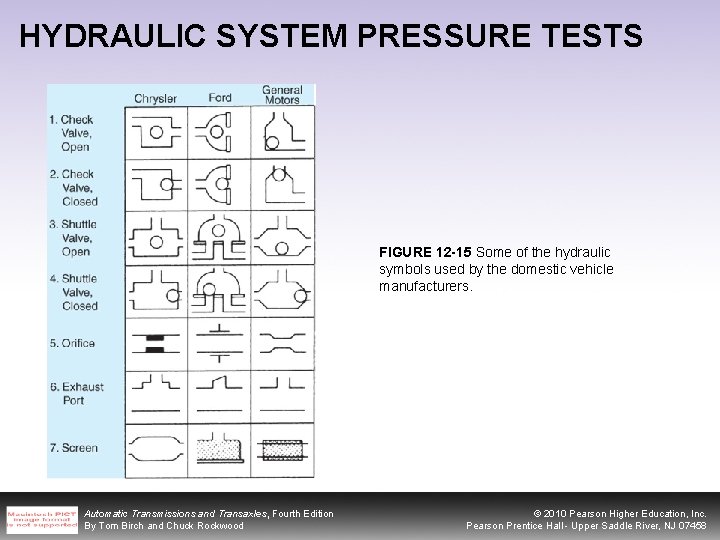
HYDRAULIC SYSTEM PRESSURE TESTS FIGURE 12 -15 Some of the hydraulic symbols used by the domestic vehicle manufacturers. Automatic Transmissions and Transaxles, Fourth Edition By Tom Birch and Chuck Rockwood © 2010 Pearson Higher Education, Inc. Pearson Prentice Hall - Upper Saddle River, NJ 07458
MODULATOR CHECKS • Some transmissions use a vacuum modulator to control shift points and feel. • Engine vacuum is used to adjust TV, line, accumulator, or shift valve pressure. • Modulator checks should include diaphragm leakage, vacuum supply, sleeve/stem alignment, spring pressure, and on-car operation. – – Modulator Diaphragm Leakage Modulator Vacuum Supply Modulator Stem Alignment Modulator Spring Pressure Automatic Transmissions and Transaxles, Fourth Edition By Tom Birch and Chuck Rockwood © 2010 Pearson Higher Education, Inc. Pearson Prentice Hall - Upper Saddle River, NJ 07458
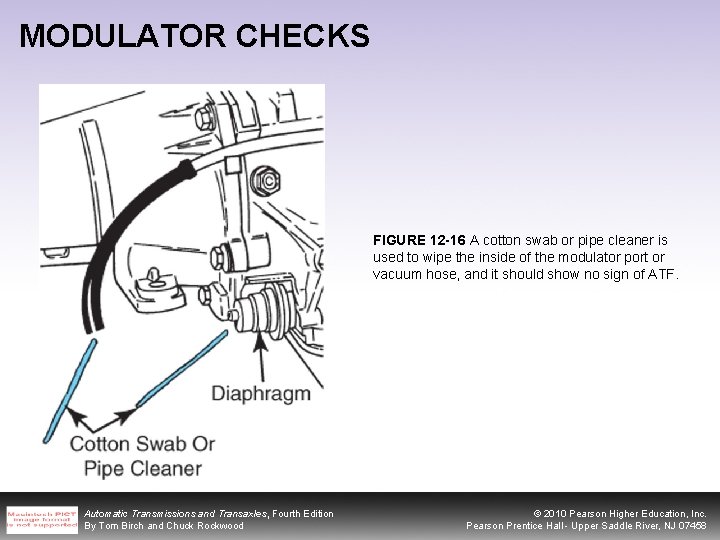
MODULATOR CHECKS FIGURE 12 -16 A cotton swab or pipe cleaner is used to wipe the inside of the modulator port or vacuum hose, and it should show no sign of ATF. Automatic Transmissions and Transaxles, Fourth Edition By Tom Birch and Chuck Rockwood © 2010 Pearson Higher Education, Inc. Pearson Prentice Hall - Upper Saddle River, NJ 07458
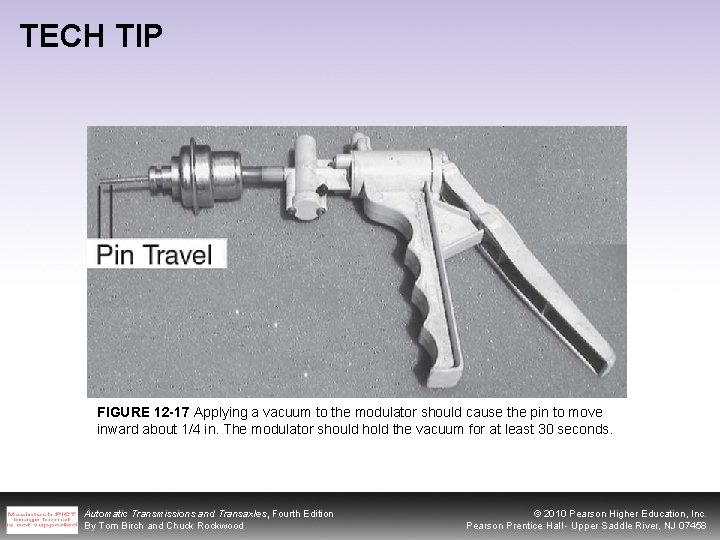
TECH TIP FIGURE 12 -17 Applying a vacuum to the modulator should cause the pin to move inward about 1/4 in. The modulator should hold the vacuum for at least 30 seconds. Automatic Transmissions and Transaxles, Fourth Edition By Tom Birch and Chuck Rockwood © 2010 Pearson Higher Education, Inc. Pearson Prentice Hall - Upper Saddle River, NJ 07458
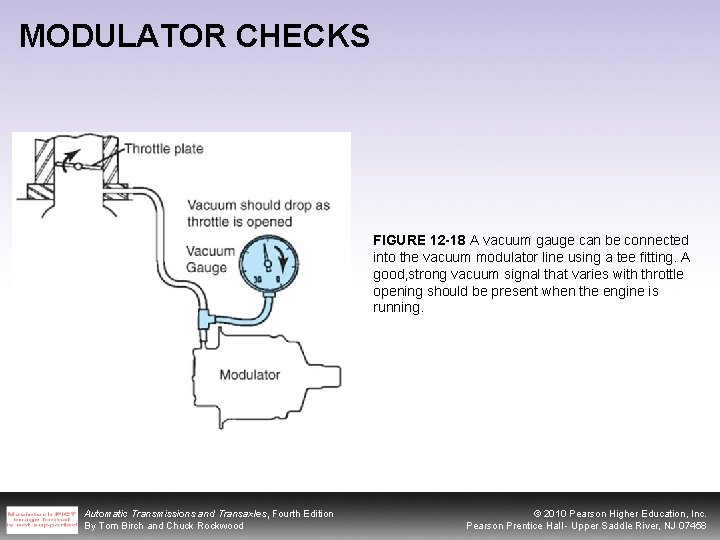
MODULATOR CHECKS FIGURE 12 -18 A vacuum gauge can be connected into the vacuum modulator line using a tee fitting. A good, strong vacuum signal that varies with throttle opening should be present when the engine is running. Automatic Transmissions and Transaxles, Fourth Edition By Tom Birch and Chuck Rockwood © 2010 Pearson Higher Education, Inc. Pearson Prentice Hall - Upper Saddle River, NJ 07458
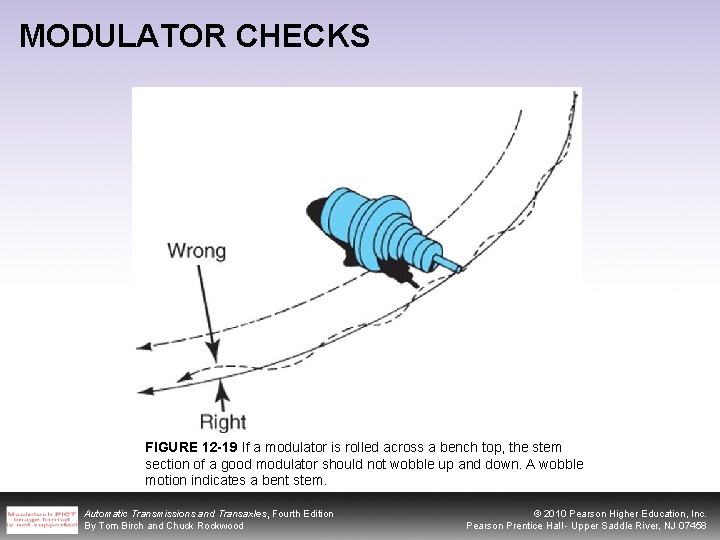
MODULATOR CHECKS FIGURE 12 -19 If a modulator is rolled across a bench top, the stem section of a good modulator should not wobble up and down. A wobble motion indicates a bent stem. Automatic Transmissions and Transaxles, Fourth Edition By Tom Birch and Chuck Rockwood © 2010 Pearson Higher Education, Inc. Pearson Prentice Hall - Upper Saddle River, NJ 07458
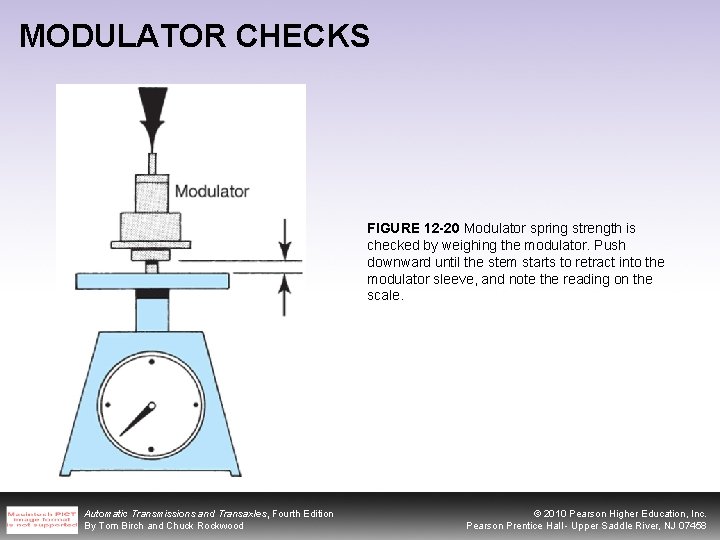
MODULATOR CHECKS FIGURE 12 -20 Modulator spring strength is checked by weighing the modulator. Push downward until the stem starts to retract into the modulator sleeve, and note the reading on the scale. Automatic Transmissions and Transaxles, Fourth Edition By Tom Birch and Chuck Rockwood © 2010 Pearson Higher Education, Inc. Pearson Prentice Hall - Upper Saddle River, NJ 07458
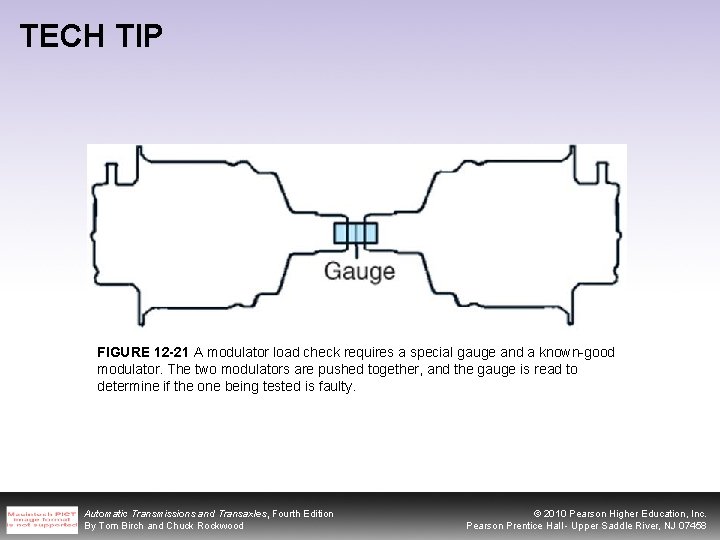
TECH TIP FIGURE 12 -21 A modulator load check requires a special gauge and a known-good modulator. The two modulators are pushed together, and the gauge is read to determine if the one being tested is faulty. Automatic Transmissions and Transaxles, Fourth Edition By Tom Birch and Chuck Rockwood © 2010 Pearson Higher Education, Inc. Pearson Prentice Hall - Upper Saddle River, NJ 07458
STALL TESTS • Stall tests are used to check the stator one-way clutch and the strength of the apply devices. • A band clutch application chart is used when making a stall test to verify which clutch or band is applied in each gear range. – Caution should be exercised when performing a stall test for several reasons: personal safety, the safety of those around you, and the chance of possible damage to the vehicle and transmission. Automatic Transmissions and Transaxles, Fourth Edition By Tom Birch and Chuck Rockwood © 2010 Pearson Higher Education, Inc. Pearson Prentice Hall - Upper Saddle River, NJ 07458
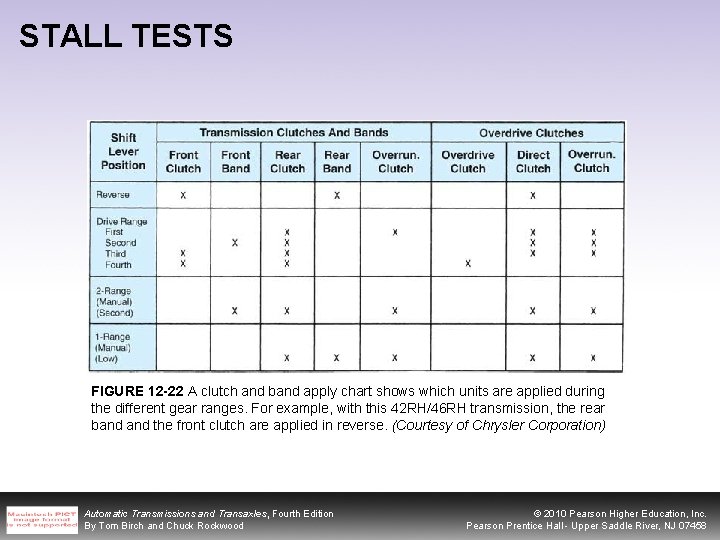
STALL TESTS FIGURE 12 -22 A clutch and band apply chart shows which units are applied during the different gear ranges. For example, with this 42 RH/46 RH transmission, the rear band the front clutch are applied in reverse. (Courtesy of Chrysler Corporation) Automatic Transmissions and Transaxles, Fourth Edition By Tom Birch and Chuck Rockwood © 2010 Pearson Higher Education, Inc. Pearson Prentice Hall - Upper Saddle River, NJ 07458
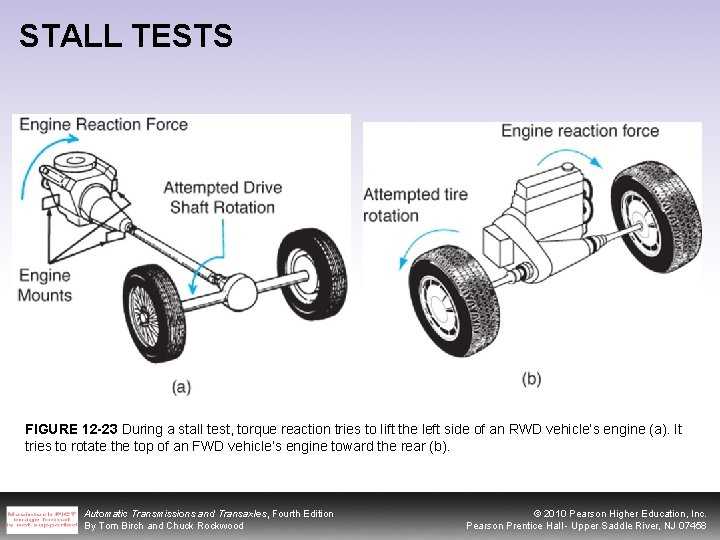
STALL TESTS FIGURE 12 -23 During a stall test, torque reaction tries to lift the left side of an RWD vehicle’s engine (a). It tries to rotate the top of an FWD vehicle’s engine toward the rear (b). Automatic Transmissions and Transaxles, Fourth Edition By Tom Birch and Chuck Rockwood © 2010 Pearson Higher Education, Inc. Pearson Prentice Hall - Upper Saddle River, NJ 07458
STALL TESTS • Most manufacturers publish stall speed specifications for their engine-transmission combinations. • This allows for an easy comparison between your readings and the specifications. • If specifications are not available, you can compare the readings between gear ranges; stall speed should be the same in each gear. – To perform a stall test, you should: • Interpreting Stall Test Readings Automatic Transmissions and Transaxles, Fourth Edition By Tom Birch and Chuck Rockwood © 2010 Pearson Higher Education, Inc. Pearson Prentice Hall - Upper Saddle River, NJ 07458
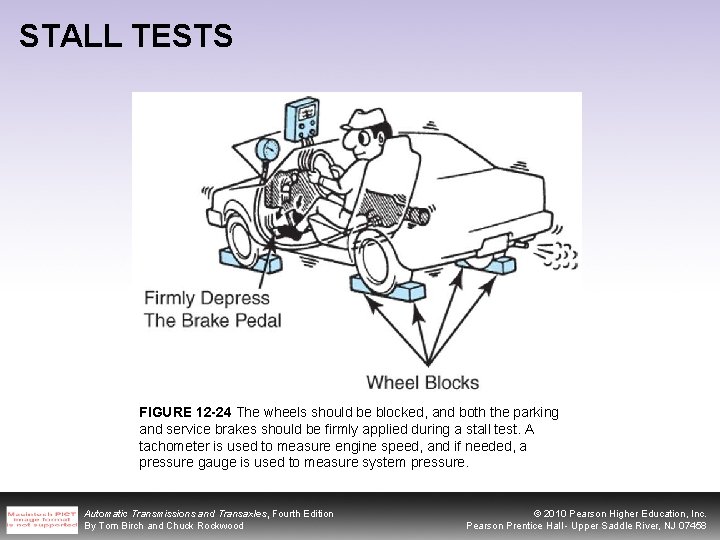
STALL TESTS FIGURE 12 -24 The wheels should be blocked, and both the parking and service brakes should be firmly applied during a stall test. A tachometer is used to measure engine speed, and if needed, a pressure gauge is used to measure system pressure. Automatic Transmissions and Transaxles, Fourth Edition By Tom Birch and Chuck Rockwood © 2010 Pearson Higher Education, Inc. Pearson Prentice Hall - Upper Saddle River, NJ 07458
OIL PAN DEBRIS CHECK • When it has been determined something is wrong with the transmission, the next step is to drain the oil and remove the pan for inspection. • The debris in the pan can give a good indication of what is occurring in the transmission. Automatic Transmissions and Transaxles, Fourth Edition By Tom Birch and Chuck Rockwood © 2010 Pearson Higher Education, Inc. Pearson Prentice Hall - Upper Saddle River, NJ 07458
AIR TESTING • Air tests often are made with the valve body removed. • With it removed, the passages to the apply devices are easily accessible. • Many manufacturers provide illustrations in their service information that identifies these passages. – To perform an air test, you should: Automatic Transmissions and Transaxles, Fourth Edition By Tom Birch and Chuck Rockwood © 2010 Pearson Higher Education, Inc. Pearson Prentice Hall - Upper Saddle River, NJ 07458
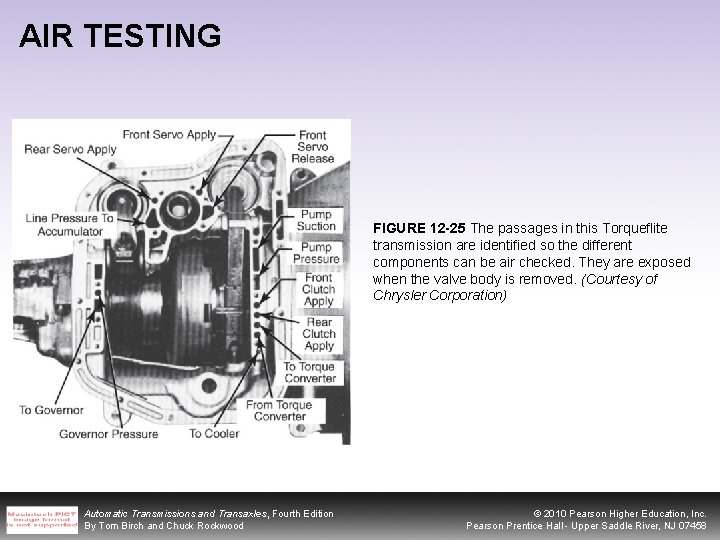
AIR TESTING FIGURE 12 -25 The passages in this Torqueflite transmission are identified so the different components can be air checked. They are exposed when the valve body is removed. (Courtesy of Chrysler Corporation) Automatic Transmissions and Transaxles, Fourth Edition By Tom Birch and Chuck Rockwood © 2010 Pearson Higher Education, Inc. Pearson Prentice Hall - Upper Saddle River, NJ 07458
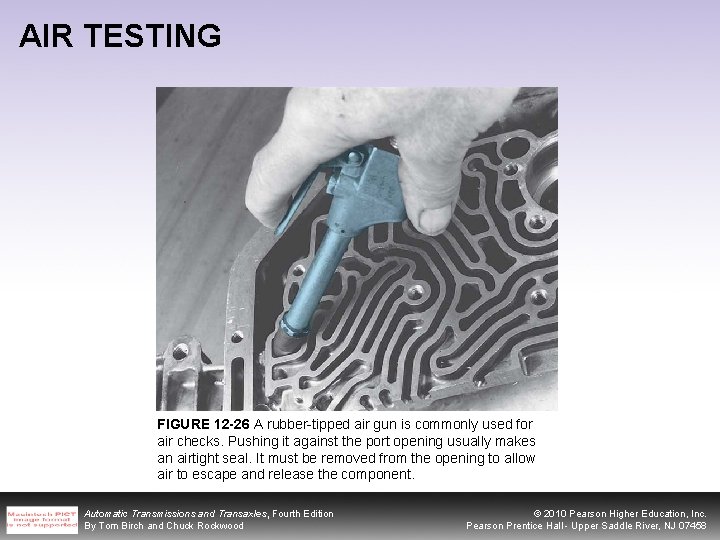
AIR TESTING FIGURE 12 -26 A rubber-tipped air gun is commonly used for air checks. Pushing it against the port opening usually makes an airtight seal. It must be removed from the opening to allow air to escape and release the component. Automatic Transmissions and Transaxles, Fourth Edition By Tom Birch and Chuck Rockwood © 2010 Pearson Higher Education, Inc. Pearson Prentice Hall - Upper Saddle River, NJ 07458
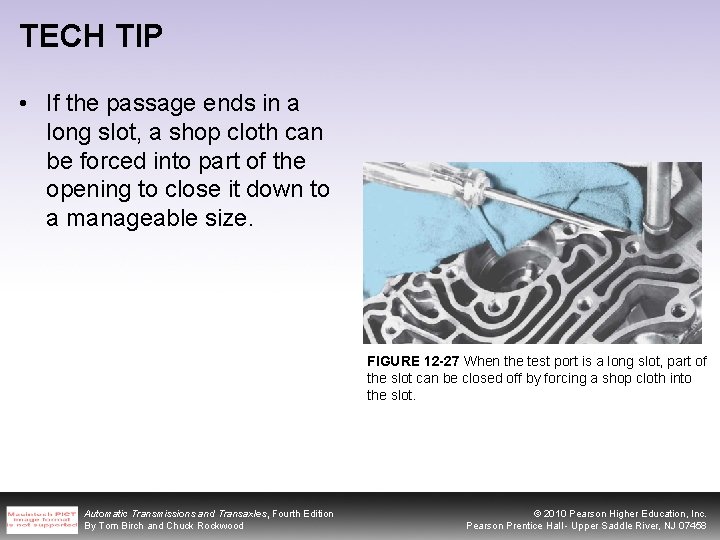
TECH TIP • If the passage ends in a long slot, a shop cloth can be forced into part of the opening to close it down to a manageable size. FIGURE 12 -27 When the test port is a long slot, part of the slot can be closed off by forcing a shop cloth into the slot. Automatic Transmissions and Transaxles, Fourth Edition By Tom Birch and Chuck Rockwood © 2010 Pearson Higher Education, Inc. Pearson Prentice Hall - Upper Saddle River, NJ 07458
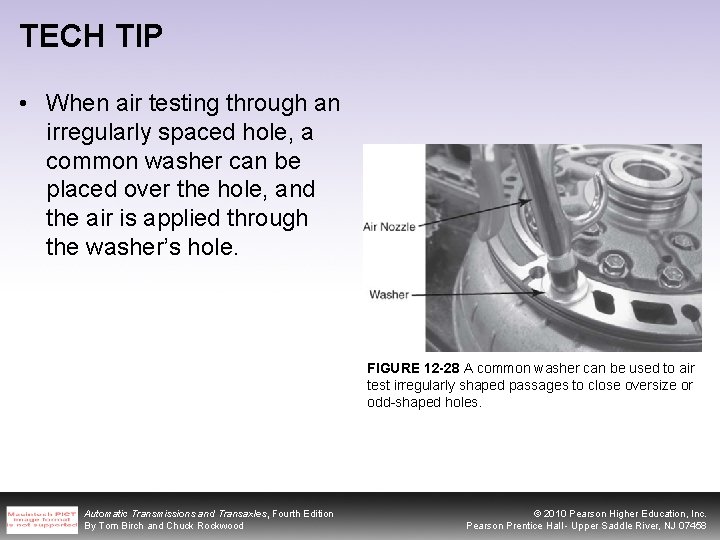
TECH TIP • When air testing through an irregularly spaced hole, a common washer can be placed over the hole, and the air is applied through the washer’s hole. FIGURE 12 -28 A common washer can be used to air test irregularly shaped passages to close oversize or odd-shaped holes. Automatic Transmissions and Transaxles, Fourth Edition By Tom Birch and Chuck Rockwood © 2010 Pearson Higher Education, Inc. Pearson Prentice Hall - Upper Saddle River, NJ 07458
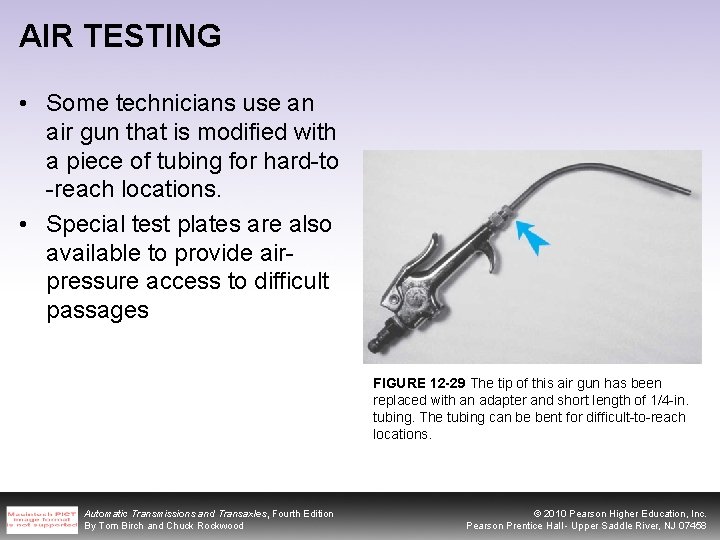
AIR TESTING • Some technicians use an air gun that is modified with a piece of tubing for hard-to -reach locations. • Special test plates are also available to provide airpressure access to difficult passages FIGURE 12 -29 The tip of this air gun has been replaced with an adapter and short length of 1/4 -in. tubing. The tubing can be bent for difficult-to-reach locations. Automatic Transmissions and Transaxles, Fourth Edition By Tom Birch and Chuck Rockwood © 2010 Pearson Higher Education, Inc. Pearson Prentice Hall - Upper Saddle River, NJ 07458
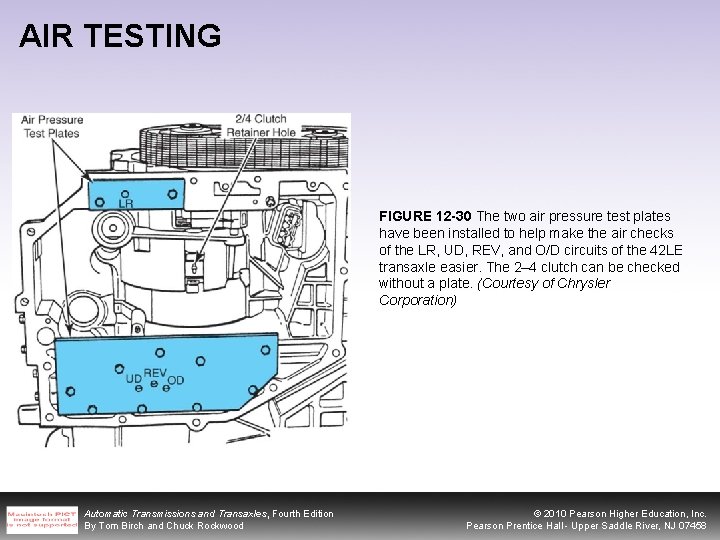
AIR TESTING FIGURE 12 -30 The two air pressure test plates have been installed to help make the air checks of the LR, UD, REV, and O/D circuits of the 42 LE transaxle easier. The 2– 4 clutch can be checked without a plate. (Courtesy of Chrysler Corporation) Automatic Transmissions and Transaxles, Fourth Edition By Tom Birch and Chuck Rockwood © 2010 Pearson Higher Education, Inc. Pearson Prentice Hall - Upper Saddle River, NJ 07458
AIR TESTING • Wet Air Checks – To perform a wet air test, you should • Isolating Valve Body Problems Automatic Transmissions and Transaxles, Fourth Edition By Tom Birch and Chuck Rockwood © 2010 Pearson Higher Education, Inc. Pearson Prentice Hall - Upper Saddle River, NJ 07458
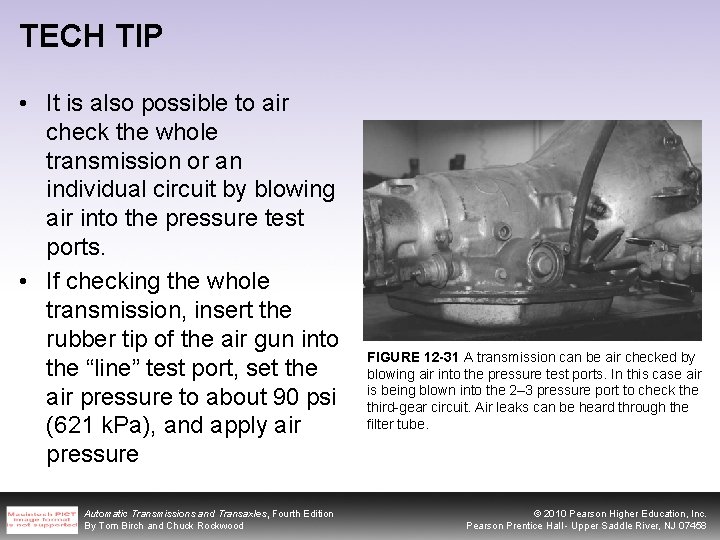
TECH TIP • It is also possible to air check the whole transmission or an individual circuit by blowing air into the pressure test ports. • If checking the whole transmission, insert the rubber tip of the air gun into the “line” test port, set the air pressure to about 90 psi (621 k. Pa), and apply air pressure Automatic Transmissions and Transaxles, Fourth Edition By Tom Birch and Chuck Rockwood FIGURE 12 -31 A transmission can be air checked by blowing air into the pressure test ports. In this case air is being blown into the 2– 3 pressure port to check the third-gear circuit. Air leaks can be heard through the filter tube. © 2010 Pearson Higher Education, Inc. Pearson Prentice Hall - Upper Saddle River, NJ 07458
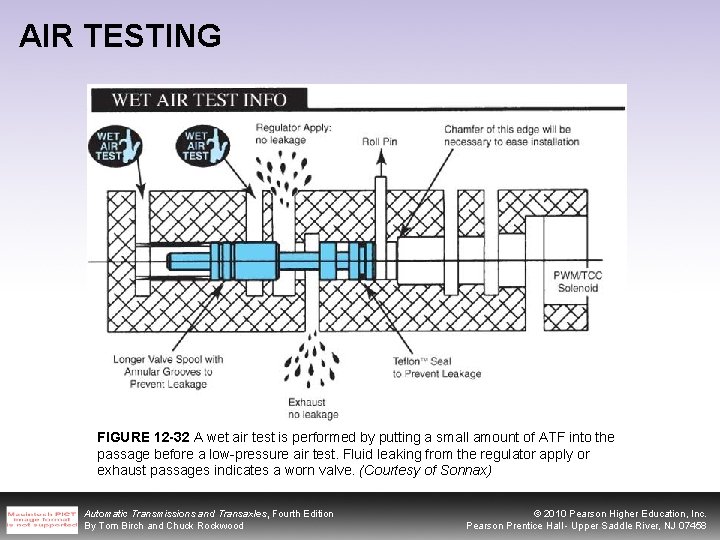
AIR TESTING FIGURE 12 -32 A wet air test is performed by putting a small amount of ATF into the passage before a low-pressure air test. Fluid leaking from the regulator apply or exhaust passages indicates a worn valve. (Courtesy of Sonnax) Automatic Transmissions and Transaxles, Fourth Edition By Tom Birch and Chuck Rockwood © 2010 Pearson Higher Education, Inc. Pearson Prentice Hall - Upper Saddle River, NJ 07458
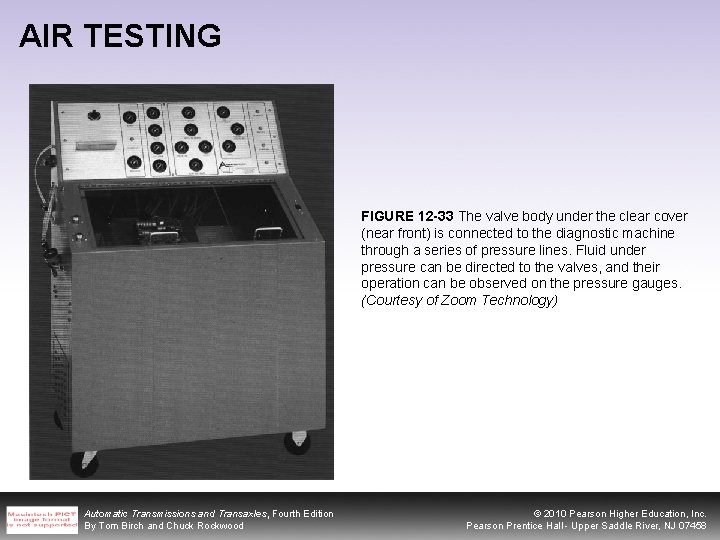
AIR TESTING FIGURE 12 -33 The valve body under the clear cover (near front) is connected to the diagnostic machine through a series of pressure lines. Fluid under pressure can be directed to the valves, and their operation can be observed on the pressure gauges. (Courtesy of Zoom Technology) Automatic Transmissions and Transaxles, Fourth Edition By Tom Birch and Chuck Rockwood © 2010 Pearson Higher Education, Inc. Pearson Prentice Hall - Upper Saddle River, NJ 07458
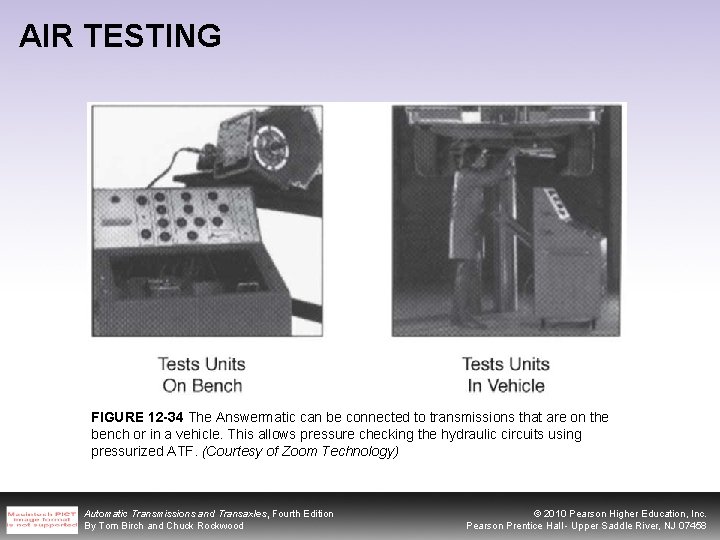
AIR TESTING FIGURE 12 -34 The Answermatic can be connected to transmissions that are on the bench or in a vehicle. This allows pressure checking the hydraulic circuits using pressurized ATF. (Courtesy of Zoom Technology) Automatic Transmissions and Transaxles, Fourth Edition By Tom Birch and Chuck Rockwood © 2010 Pearson Higher Education, Inc. Pearson Prentice Hall - Upper Saddle River, NJ 07458
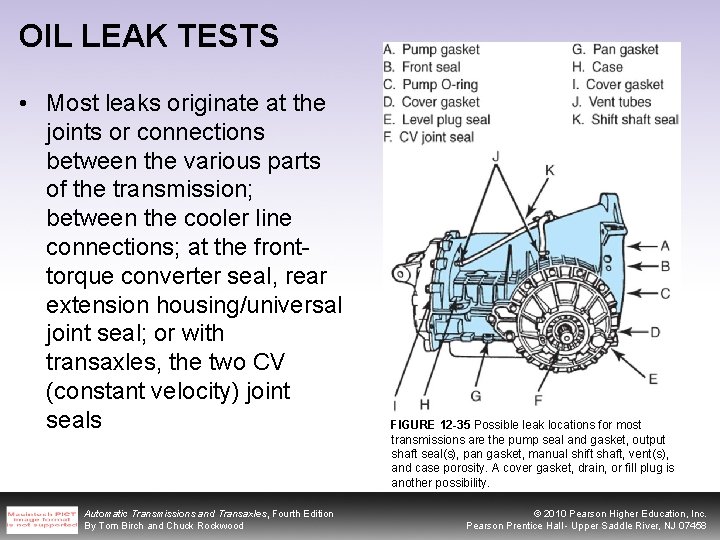
OIL LEAK TESTS • Most leaks originate at the joints or connections between the various parts of the transmission; between the cooler line connections; at the fronttorque converter seal, rear extension housing/universal joint seal; or with transaxles, the two CV (constant velocity) joint seals Automatic Transmissions and Transaxles, Fourth Edition By Tom Birch and Chuck Rockwood FIGURE 12 -35 Possible leak locations for most transmissions are the pump seal and gasket, output shaft seal(s), pan gasket, manual shift shaft, vent(s), and case porosity. A cover gasket, drain, or fill plug is another possibility. © 2010 Pearson Higher Education, Inc. Pearson Prentice Hall - Upper Saddle River, NJ 07458
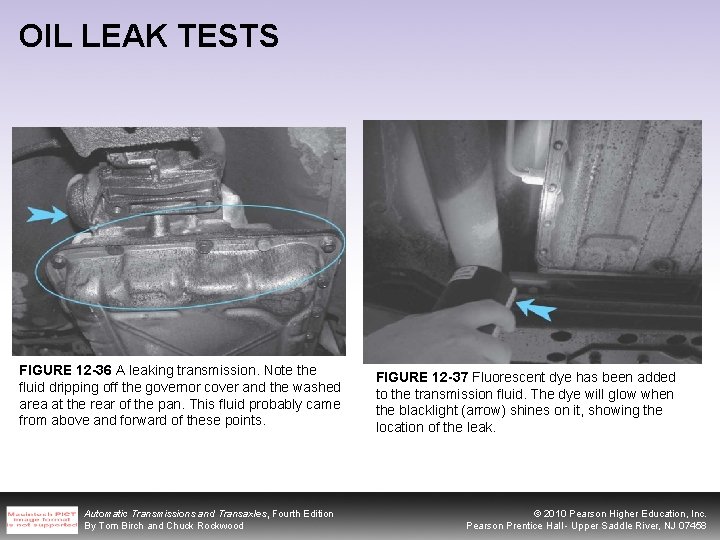
OIL LEAK TESTS FIGURE 12 -36 A leaking transmission. Note the fluid dripping off the governor cover and the washed area at the rear of the pan. This fluid probably came from above and forward of these points. Automatic Transmissions and Transaxles, Fourth Edition By Tom Birch and Chuck Rockwood FIGURE 12 -37 Fluorescent dye has been added to the transmission fluid. The dye will glow when the blacklight (arrow) shines on it, showing the location of the leak. © 2010 Pearson Higher Education, Inc. Pearson Prentice Hall - Upper Saddle River, NJ 07458
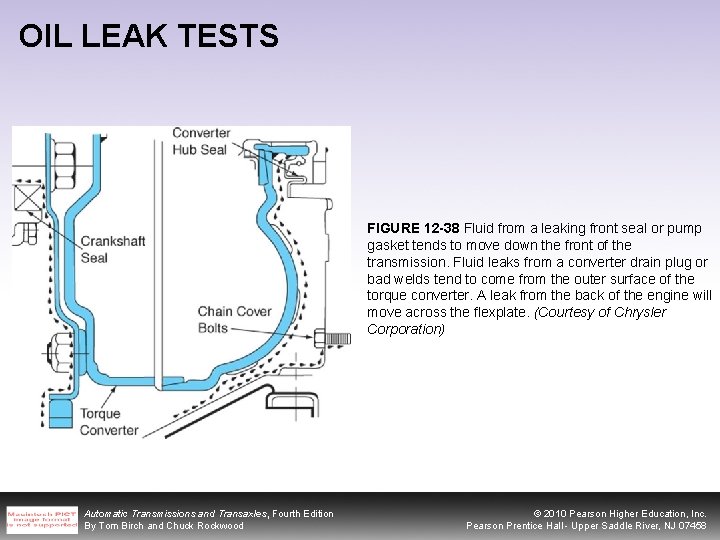
OIL LEAK TESTS FIGURE 12 -38 Fluid from a leaking front seal or pump gasket tends to move down the front of the transmission. Fluid leaks from a converter drain plug or bad welds tend to come from the outer surface of the torque converter. A leak from the back of the engine will move across the flexplate. (Courtesy of Chrysler Corporation) Automatic Transmissions and Transaxles, Fourth Edition By Tom Birch and Chuck Rockwood © 2010 Pearson Higher Education, Inc. Pearson Prentice Hall - Upper Saddle River, NJ 07458
NOISE, VIBRATION, AND HARSHNESS (NVH) • NVH has become the automotive repair trade term for noise, vibration, and harshness problems. – To make an NVH road test, you should: • Noise Checks – Noise problems are closely related to vibration; they often accompany each other. – To locate the cause of a transmission noise, you should: • Vibration Checks Automatic Transmissions and Transaxles, Fourth Edition By Tom Birch and Chuck Rockwood © 2010 Pearson Higher Education, Inc. Pearson Prentice Hall - Upper Saddle River, NJ 07458
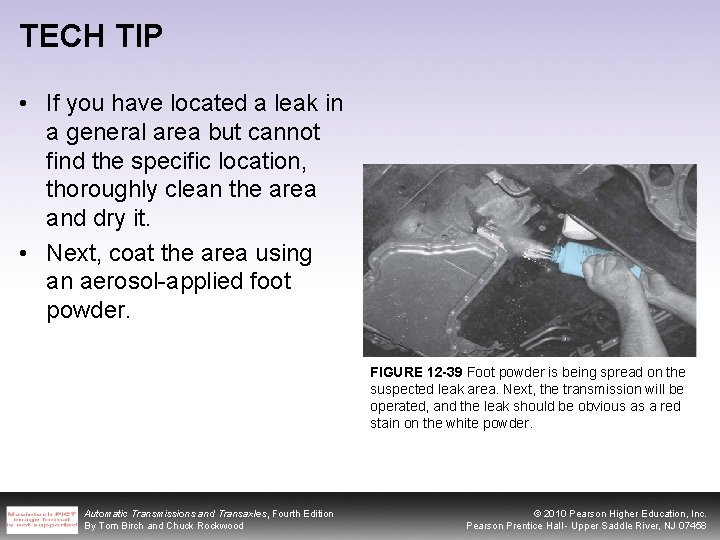
TECH TIP • If you have located a leak in a general area but cannot find the specific location, thoroughly clean the area and dry it. • Next, coat the area using an aerosol-applied foot powder. FIGURE 12 -39 Foot powder is being spread on the suspected leak area. Next, the transmission will be operated, and the leak should be obvious as a red stain on the white powder. Automatic Transmissions and Transaxles, Fourth Edition By Tom Birch and Chuck Rockwood © 2010 Pearson Higher Education, Inc. Pearson Prentice Hall - Upper Saddle River, NJ 07458
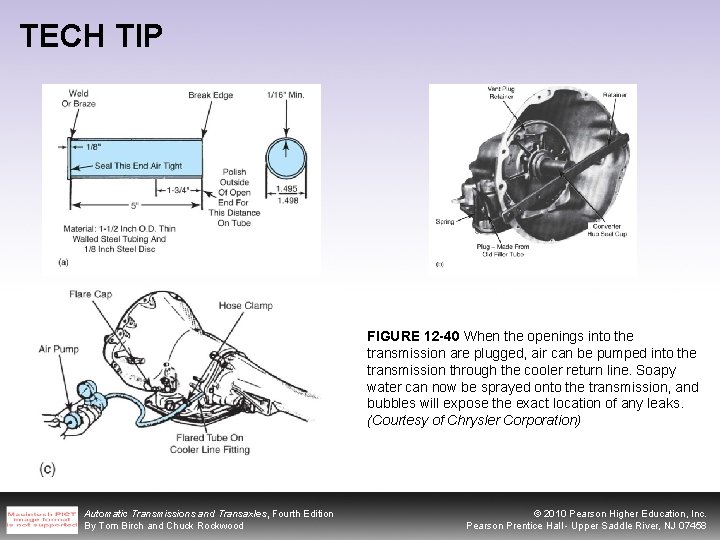
TECH TIP FIGURE 12 -40 When the openings into the transmission are plugged, air can be pumped into the transmission through the cooler return line. Soapy water can now be sprayed onto the transmission, and bubbles will expose the exact location of any leaks. (Courtesy of Chrysler Corporation) Automatic Transmissions and Transaxles, Fourth Edition By Tom Birch and Chuck Rockwood © 2010 Pearson Higher Education, Inc. Pearson Prentice Hall - Upper Saddle River, NJ 07458
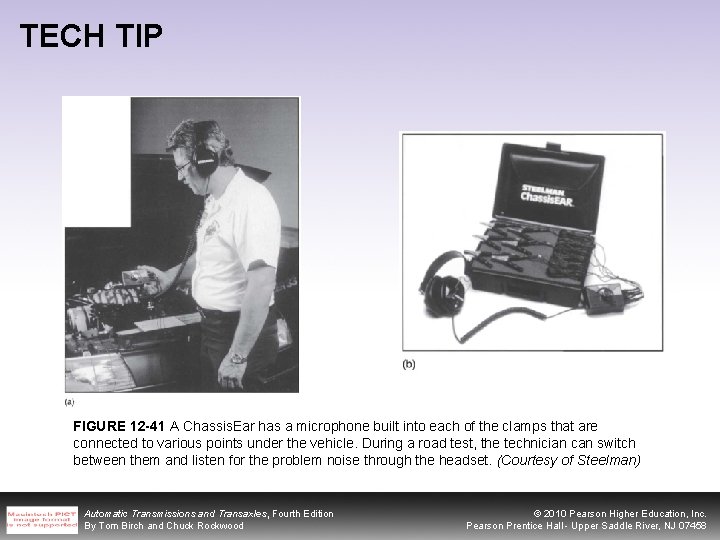
TECH TIP FIGURE 12 -41 A Chassis. Ear has a microphone built into each of the clamps that are connected to various points under the vehicle. During a road test, the technician can switch between them and listen for the problem noise through the headset. (Courtesy of Steelman) Automatic Transmissions and Transaxles, Fourth Edition By Tom Birch and Chuck Rockwood © 2010 Pearson Higher Education, Inc. Pearson Prentice Hall - Upper Saddle River, NJ 07458
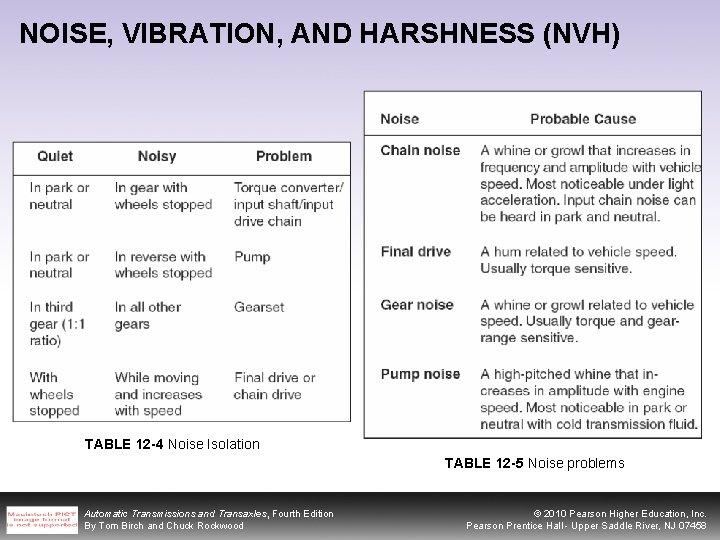
NOISE, VIBRATION, AND HARSHNESS (NVH) TABLE 12 -4 Noise Isolation TABLE 12 -5 Noise problems Automatic Transmissions and Transaxles, Fourth Edition By Tom Birch and Chuck Rockwood © 2010 Pearson Higher Education, Inc. Pearson Prentice Hall - Upper Saddle River, NJ 07458
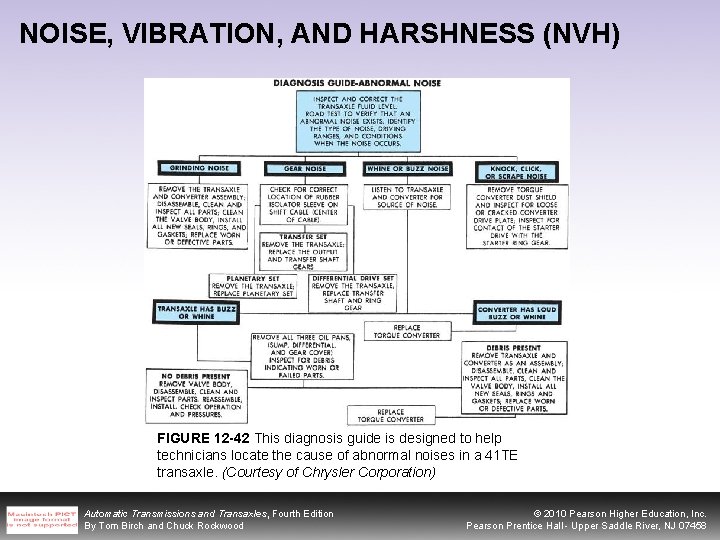
NOISE, VIBRATION, AND HARSHNESS (NVH) FIGURE 12 -42 This diagnosis guide is designed to help technicians locate the cause of abnormal noises in a 41 TE transaxle. (Courtesy of Chrysler Corporation) Automatic Transmissions and Transaxles, Fourth Edition By Tom Birch and Chuck Rockwood © 2010 Pearson Higher Education, Inc. Pearson Prentice Hall - Upper Saddle River, NJ 07458
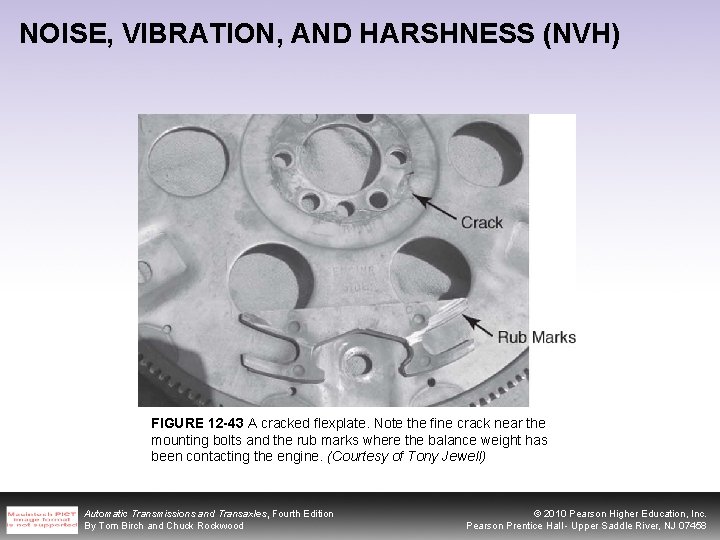
NOISE, VIBRATION, AND HARSHNESS (NVH) FIGURE 12 -43 A cracked flexplate. Note the fine crack near the mounting bolts and the rub marks where the balance weight has been contacting the engine. (Courtesy of Tony Jewell) Automatic Transmissions and Transaxles, Fourth Edition By Tom Birch and Chuck Rockwood © 2010 Pearson Higher Education, Inc. Pearson Prentice Hall - Upper Saddle River, NJ 07458
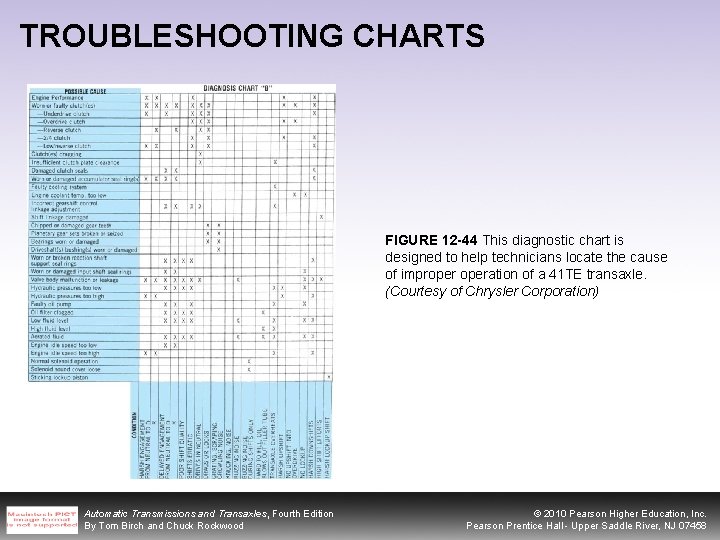
TROUBLESHOOTING CHARTS FIGURE 12 -44 This diagnostic chart is designed to help technicians locate the cause of improperation of a 41 TE transaxle. (Courtesy of Chrysler Corporation) Automatic Transmissions and Transaxles, Fourth Edition By Tom Birch and Chuck Rockwood © 2010 Pearson Higher Education, Inc. Pearson Prentice Hall - Upper Saddle River, NJ 07458
SUMMARY 1. Before removing a transmission from a vehicle or disassembling a transmission, the problem should be evaluated to determine the exact fault with the transmission. 2. There are many tests and checks that can be used to determine the exact cause of an automatic transmission problem. 3. A technician should become familiar with how and when to perform the transmission tests to determine the cause of common problems. Automatic Transmissions and Transaxles, Fourth Edition By Tom Birch and Chuck Rockwood © 2010 Pearson Higher Education, Inc. Pearson Prentice Hall - Upper Saddle River, NJ 07458
SUMMARY 4. Experienced technicians determine which tests are needed for a particular problem and will perform the checks in the most logical order. 5. Following a systematic diagnostic approach to a problem quickly leads to the correct repair. Automatic Transmissions and Transaxles, Fourth Edition By Tom Birch and Chuck Rockwood © 2010 Pearson Higher Education, Inc. Pearson Prentice Hall - Upper Saddle River, NJ 07458
REVIEW QUESTIONS 1. The following is a series of tests and checks that can be used to help determine the exact cause of problems. Fill in the blanks to complete the description of the tests or checks. a. b. c. d. e. f. g. h. i. j. k. l. m. A visual inspection is a quick, preliminary overall check of _____ factors that affect operation. A fluid check is an inspection of the fluid to ensure the correct _____ and _____. A _________ gives the technician the opportunity to check the actual operation of the transmission. A torque converter clutch test is used to determine if the _____ is operating properly. Hydraulic _____ tests are used to check the hydraulic system pressures. Modulator checks are used to check the operation of the vacuum _____ valve system. _____ system checks are used to check the properation of the electronic controls. The _____ test loads the clutches and bands to check for slippage and also checks the torque converter stator oneway clutch. Leak checks are used to locate the source of a _____ leak. Debris checks determine if an abnormal amount of debris is present in the _________ and, if so, the nature of the debris. Air tests are made to determine if the seals, _____, and gaskets in the hydraulic circuits are operating correctly. A more precise air test to locate the exact location or severity of a leak is called a _________. Checks to locate the cause of a noise, vibration, or harshness are known as _____ checks. Automatic Transmissions and Transaxles, Fourth Edition By Tom Birch and Chuck Rockwood © 2010 Pearson Higher Education, Inc. Pearson Prentice Hall - Upper Saddle River, NJ 07458
REVIEW QUESTIONS 2. 3. 4. 5. Diagnosing a problem with an automatic transmission should always begin by _____ the problem. All transmission diagnosis should begin with a check of the _________ and _____. It is advisable to always _____ drive a vehicle before and after any repairs. Below are throttle positions that a technician should use while test driving a vehicle. List the term that fits the description of the driving condition or the throttle position. a. b. c. d. e. f. g. h. The throttle is about three-fourths open. A complete release of the throttle, which results in coasting. The least throttle opening that produces acceleration. WOT, which forces a downshift. A manual downshift with zero throttle to produce a condition where engine compression slows the vehicle. The throttle is about one-fourth open. Fully opened throttle without forcing a downshift. The throttle is about one-half open. Automatic Transmissions and Transaxles, Fourth Edition By Tom Birch and Chuck Rockwood © 2010 Pearson Higher Education, Inc. Pearson Prentice Hall - Upper Saddle River, NJ 07458
REVIEW QUESTIONS 6. A student is testing a torque converter using a pressure gauge. The pressure changed when the clutch was to apply, but the clutch does not apply. The problem is in the _________. 7. A transmission only has one pressure test port. When checking hydraulic pressure at that port you would be monitoring _____ pressure. 8. A technician is testing line pressure and notices that line pressure reads lower in some of the gear ranges. His or her diagnosis is that there is a _____ problem in the hydraulic circuit for the ranges with low pressure. 9. A good-operating governor is indicated during a governor pressure check by a steadily rising pressure that is relative to _________. 10. If a transmission does not have a governor pressure test port, governor operation can be monitored by watching mainline pressure for a _____ in pressure due to governor _____. 11. When testing a vacuum modulator, the modulator should have _____ inches of mercury available to it, and it should be able to hold a vacuum for _____ seconds. 12. A stall test can be used to detect problems with the torque converter _________ and for _____ apply devices. Automatic Transmissions and Transaxles, Fourth Edition By Tom Birch and Chuck Rockwood © 2010 Pearson Higher Education, Inc. Pearson Prentice Hall - Upper Saddle River, NJ 07458
REVIEW QUESTIONS 13. If all of the stall speeds during a stall test are equal but low, the _________ clutch has failed or the _____ is weak. If they are all high, the problem is _____ apply devices. 14. Brass or bronze debris in the transmission oil pan indicates that a _____ or _____ has failed. 15. Air tests are used to check operation of the _________, and/or _____. 16. When doing an air pressure test on an automatic transmission, air pressure used for testing should be set to _____ psi. 17. To locate those hard-to-find leaks, a _____ light and a special _____ can be used. 18. NVH is the trade term for _________, and _____. 19. The three most common sources of noise in most automatic transmissions are _________, and the _____ system. 20. A drive line clunk during garage shifts is most likely the _________ bushing or the _____ joint. Automatic Transmissions and Transaxles, Fourth Edition By Tom Birch and Chuck Rockwood © 2010 Pearson Higher Education, Inc. Pearson Prentice Hall - Upper Saddle River, NJ 07458
CHAPTER QUIZ 1. Student A says that you should begin by checking the fluid when you are diagnosing a transmission problem. Student B says to use a pressure gauge to start diagnosing a transmission problem. Who is correct? a) b) c) d) Student A Student B Both A and B Neither A nor B Automatic Transmissions and Transaxles, Fourth Edition By Tom Birch and Chuck Rockwood © 2010 Pearson Higher Education, Inc. Pearson Prentice Hall - Upper Saddle River, NJ 07458
CHAPTER QUIZ 1. Student A says that you should begin by checking the fluid when you are diagnosing a transmission problem. Student B says to use a pressure gauge to start diagnosing a transmission problem. Who is correct? a) b) c) d) Student A Student B Both A and B Neither A nor B Automatic Transmissions and Transaxles, Fourth Edition By Tom Birch and Chuck Rockwood © 2010 Pearson Higher Education, Inc. Pearson Prentice Hall - Upper Saddle River, NJ 07458
CHAPTER QUIZ 2. Student A says that when diagnosing an automatic transmission you should do only the diagnostic checks that are necessary to locate the problem. Student B says that you need to do all of the diagnostic tests to fully evaluate the transmission before starting any repairs. Who is correct? a) b) c) d) Student A Student B Both A and B Neither A nor B Automatic Transmissions and Transaxles, Fourth Edition By Tom Birch and Chuck Rockwood © 2010 Pearson Higher Education, Inc. Pearson Prentice Hall - Upper Saddle River, NJ 07458
CHAPTER QUIZ 2. Student A says that when diagnosing an automatic transmission you should do only the diagnostic checks that are necessary to locate the problem. Student B says that you need to do all of the diagnostic tests to fully evaluate the transmission before starting any repairs. Who is correct? a) b) c) d) Student A Student B Both A and B Neither A nor B Automatic Transmissions and Transaxles, Fourth Edition By Tom Birch and Chuck Rockwood © 2010 Pearson Higher Education, Inc. Pearson Prentice Hall - Upper Saddle River, NJ 07458
CHAPTER QUIZ 3. Student A says that you should verify the customer concern before making any check of the vehicle. Student B says that you should check the fluid level and condition before going on a road test. Who is correct? a) b) c) d) Student A Student B Both A and B Neither A nor B Automatic Transmissions and Transaxles, Fourth Edition By Tom Birch and Chuck Rockwood © 2010 Pearson Higher Education, Inc. Pearson Prentice Hall - Upper Saddle River, NJ 07458
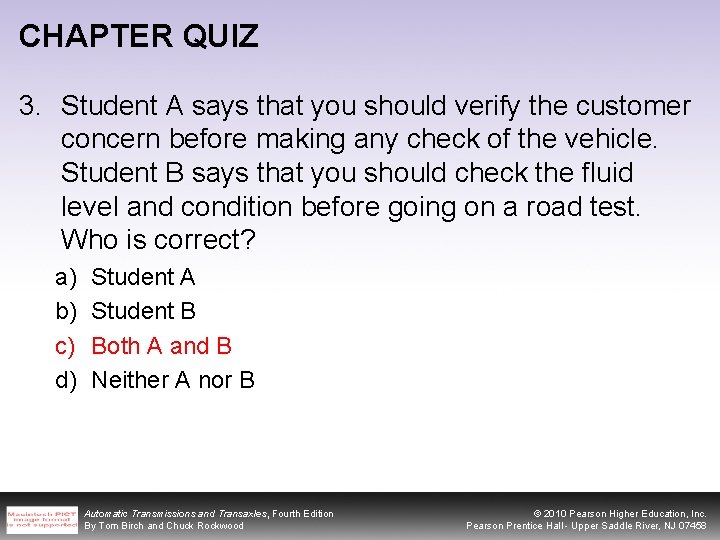
CHAPTER QUIZ 3. Student A says that you should verify the customer concern before making any check of the vehicle. Student B says that you should check the fluid level and condition before going on a road test. Who is correct? a) b) c) d) Student A Student B Both A and B Neither A nor B Automatic Transmissions and Transaxles, Fourth Edition By Tom Birch and Chuck Rockwood © 2010 Pearson Higher Education, Inc. Pearson Prentice Hall - Upper Saddle River, NJ 07458
CHAPTER QUIZ 4. Student A says that ATF in a modulator vacuum hose is a sign of a bad modulator. Student B says that the engine should run differently if you pull the vacuum hose off the modulator. Who is correct? a) b) c) d) Student A Student B Both A and B Neither A nor B Automatic Transmissions and Transaxles, Fourth Edition By Tom Birch and Chuck Rockwood © 2010 Pearson Higher Education, Inc. Pearson Prentice Hall - Upper Saddle River, NJ 07458
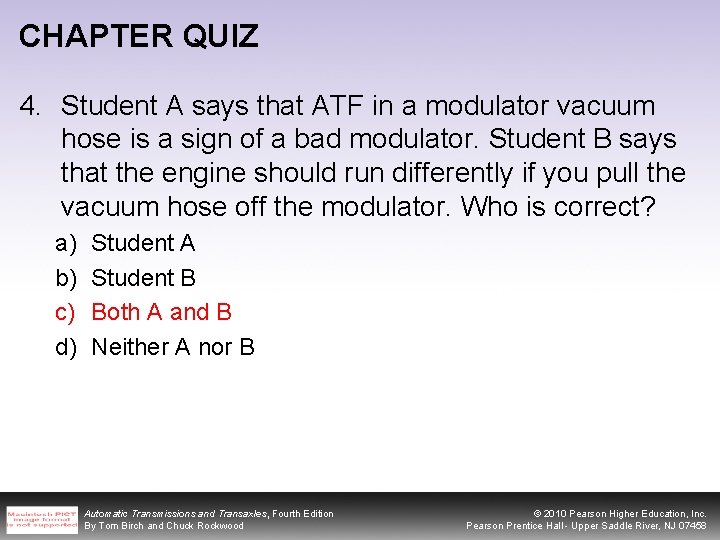
CHAPTER QUIZ 4. Student A says that ATF in a modulator vacuum hose is a sign of a bad modulator. Student B says that the engine should run differently if you pull the vacuum hose off the modulator. Who is correct? a) b) c) d) Student A Student B Both A and B Neither A nor B Automatic Transmissions and Transaxles, Fourth Edition By Tom Birch and Chuck Rockwood © 2010 Pearson Higher Education, Inc. Pearson Prentice Hall - Upper Saddle River, NJ 07458
CHAPTER QUIZ 5. When making a road test, particular attention should be paid to a) b) c) d) the quality of the garage shifts. the timing of the upshifts and downshifts. any unusual noises that might occur. All of these Automatic Transmissions and Transaxles, Fourth Edition By Tom Birch and Chuck Rockwood © 2010 Pearson Higher Education, Inc. Pearson Prentice Hall - Upper Saddle River, NJ 07458
CHAPTER QUIZ 5. When making a road test, particular attention should be paid to a) b) c) d) the quality of the garage shifts. the timing of the upshifts and downshifts. any unusual noises that might occur. All of these Automatic Transmissions and Transaxles, Fourth Edition By Tom Birch and Chuck Rockwood © 2010 Pearson Higher Education, Inc. Pearson Prentice Hall - Upper Saddle River, NJ 07458
CHAPTER QUIZ 6. Student A says that a minimum-throttle 1– 2 upshift should be smooth and soft and occur at about 20 mph. Student B says that a harsh light-throttle upshift could be caused by a sticky modulator. Who is correct? a) b) c) d) Student A Student B Both A and B Neither A nor B Automatic Transmissions and Transaxles, Fourth Edition By Tom Birch and Chuck Rockwood © 2010 Pearson Higher Education, Inc. Pearson Prentice Hall - Upper Saddle River, NJ 07458
CHAPTER QUIZ 6. Student A says that a minimum-throttle 1– 2 upshift should be smooth and soft and occur at about 20 mph. Student B says that a harsh light-throttle upshift could be caused by a sticky modulator. Who is correct? a) b) c) d) Student A Student B Both A and B Neither A nor B Automatic Transmissions and Transaxles, Fourth Edition By Tom Birch and Chuck Rockwood © 2010 Pearson Higher Education, Inc. Pearson Prentice Hall - Upper Saddle River, NJ 07458
CHAPTER QUIZ 7. Student A says that both a tachometer and an oil pressure gauge are necessary to diagnose torque converter clutch problems. Student B says that a tap of the brake pedal causes the converter clutch to release. Who is correct? a) b) c) d) Student A Student B Both A and B Neither A nor B Automatic Transmissions and Transaxles, Fourth Edition By Tom Birch and Chuck Rockwood © 2010 Pearson Higher Education, Inc. Pearson Prentice Hall - Upper Saddle River, NJ 07458
CHAPTER QUIZ 7. Student A says that both a tachometer and an oil pressure gauge are necessary to diagnose torque converter clutch problems. Student B says that a tap of the brake pedal causes the converter clutch to release. Who is correct? a) b) c) d) Student A Student B Both A and B Neither A nor B Automatic Transmissions and Transaxles, Fourth Edition By Tom Birch and Chuck Rockwood © 2010 Pearson Higher Education, Inc. Pearson Prentice Hall - Upper Saddle River, NJ 07458
CHAPTER QUIZ 8. If a transmission has a single pressure test port, it will be for a) b) c) d) governor pressure. modulator pressure. line pressure. None of these Automatic Transmissions and Transaxles, Fourth Edition By Tom Birch and Chuck Rockwood © 2010 Pearson Higher Education, Inc. Pearson Prentice Hall - Upper Saddle River, NJ 07458
CHAPTER QUIZ 8. If a transmission has a single pressure test port, it will be for a) b) c) d) governor pressure. modulator pressure. line pressure. None of these Automatic Transmissions and Transaxles, Fourth Edition By Tom Birch and Chuck Rockwood © 2010 Pearson Higher Education, Inc. Pearson Prentice Hall - Upper Saddle River, NJ 07458
CHAPTER QUIZ 9. Student A says that low fluid pressure in all forward ranges could be caused by a faulty pump or plugged filter. Student B says that fluid pressures should increase when the gear selector is moved to reverse. Who is correct? a) b) c) d) Student A Student B Both A and B Neither A nor B Automatic Transmissions and Transaxles, Fourth Edition By Tom Birch and Chuck Rockwood © 2010 Pearson Higher Education, Inc. Pearson Prentice Hall - Upper Saddle River, NJ 07458
CHAPTER QUIZ 9. Student A says that low fluid pressure in all forward ranges could be caused by a faulty pump or plugged filter. Student B says that fluid pressures should increase when the gear selector is moved to reverse. Who is correct? a) b) c) d) Student A Student B Both A and B Neither A nor B Automatic Transmissions and Transaxles, Fourth Edition By Tom Birch and Chuck Rockwood © 2010 Pearson Higher Education, Inc. Pearson Prentice Hall - Upper Saddle River, NJ 07458
CHAPTER QUIZ 10. When making a stall test, you should a) connect a tachometer to the engine. b) completely apply the parking and service brakes. c) make sure there is no one in front of or behind the vehicle. d) Do all of these Automatic Transmissions and Transaxles, Fourth Edition By Tom Birch and Chuck Rockwood © 2010 Pearson Higher Education, Inc. Pearson Prentice Hall - Upper Saddle River, NJ 07458
CHAPTER QUIZ 10. When making a stall test, you should a) connect a tachometer to the engine. b) completely apply the parking and service brakes. c) make sure there is no one in front of or behind the vehicle. d) Do all of these Automatic Transmissions and Transaxles, Fourth Edition By Tom Birch and Chuck Rockwood © 2010 Pearson Higher Education, Inc. Pearson Prentice Hall - Upper Saddle River, NJ 07458
CHAPTER QUIZ 11. During a stall test, the stall speed is high in drive-1 but normal in manual-1 and reverse. Student A says that this indicates a faulty forward clutch. Student B says that it could be caused by a bad one-way clutch. Who is correct? a) b) c) d) Student A Student B Both A and B Neither A nor B Automatic Transmissions and Transaxles, Fourth Edition By Tom Birch and Chuck Rockwood © 2010 Pearson Higher Education, Inc. Pearson Prentice Hall - Upper Saddle River, NJ 07458
CHAPTER QUIZ 11. During a stall test, the stall speed is high in drive-1 but normal in manual-1 and reverse. Student A says that this indicates a faulty forward clutch. Student B says that it could be caused by a bad one-way clutch. Who is correct? a) b) c) d) Student A Student B Both A and B Neither A nor B Automatic Transmissions and Transaxles, Fourth Edition By Tom Birch and Chuck Rockwood © 2010 Pearson Higher Education, Inc. Pearson Prentice Hall - Upper Saddle River, NJ 07458
CHAPTER QUIZ 12. A Simpson gear train transmission has a slipping second gear but the fluid pressures are normal. Student A says that this problem could be caused by a loose intermediate-band adjustment. Student B says that it is a leaking intermediate servo. Who is correct? a) b) c) d) Student A Student B Both A and B Neither A nor B Automatic Transmissions and Transaxles, Fourth Edition By Tom Birch and Chuck Rockwood © 2010 Pearson Higher Education, Inc. Pearson Prentice Hall - Upper Saddle River, NJ 07458
CHAPTER QUIZ 12. A Simpson gear train transmission has a slipping second gear but the fluid pressures are normal. Student A says that this problem could be caused by a loose intermediate-band adjustment. Student B says that it is a leaking intermediate servo. Who is correct? a) b) c) d) Student A Student B Both A and B Neither A nor B Automatic Transmissions and Transaxles, Fourth Edition By Tom Birch and Chuck Rockwood © 2010 Pearson Higher Education, Inc. Pearson Prentice Hall - Upper Saddle River, NJ 07458
CHAPTER QUIZ 13. A transmission has no high gear or reverse, but all other gears are normal. Student A says you could confirm the problem by dropping the pan and valve body to air check the high-reverse clutch. Student B says that you could make a complete oil pressure check before removing the pan to confirm the problem is in the high/reverse clutch circuit. Who is correct? a) b) c) d) Student A Student B Both A and B Neither A nor B Automatic Transmissions and Transaxles, Fourth Edition By Tom Birch and Chuck Rockwood © 2010 Pearson Higher Education, Inc. Pearson Prentice Hall - Upper Saddle River, NJ 07458
CHAPTER QUIZ 13. A transmission has no high gear or reverse, but all other gears are normal. Student A says you could confirm the problem by dropping the pan and valve body to air check the high-reverse clutch. Student B says that you could make a complete oil pressure check before removing the pan to confirm the problem is in the high/reverse clutch circuit. Who is correct? a) b) c) d) Student A Student B Both A and B Neither A nor B Automatic Transmissions and Transaxles, Fourth Edition By Tom Birch and Chuck Rockwood © 2010 Pearson Higher Education, Inc. Pearson Prentice Hall - Upper Saddle River, NJ 07458
CHAPTER QUIZ 14. When checking the pan contents, a) a small amount of metal particles is considered normal. b) a golden-brown coating is a sign of a needed fluid change. c) metal or melted plastic debris indicates a need for a transmission overhaul. d) All of these Automatic Transmissions and Transaxles, Fourth Edition By Tom Birch and Chuck Rockwood © 2010 Pearson Higher Education, Inc. Pearson Prentice Hall - Upper Saddle River, NJ 07458
CHAPTER QUIZ 14. When checking the pan contents, a) a small amount of metal particles is considered normal. b) a golden-brown coating is a sign of a needed fluid change. c) metal or melted plastic debris indicates a need for a transmission overhaul. d) All of these Automatic Transmissions and Transaxles, Fourth Edition By Tom Birch and Chuck Rockwood © 2010 Pearson Higher Education, Inc. Pearson Prentice Hall - Upper Saddle River, NJ 07458
CHAPTER QUIZ 15. Student A says that you should be able to hear a clutch apply and release when you apply air pressure to test it. Student B says that an excessive air leak is an indication of bad seals. Who is correct? a) b) c) d) Student A Student B Both A and B Neither A nor B Automatic Transmissions and Transaxles, Fourth Edition By Tom Birch and Chuck Rockwood © 2010 Pearson Higher Education, Inc. Pearson Prentice Hall - Upper Saddle River, NJ 07458
CHAPTER QUIZ 15. Student A says that you should be able to hear a clutch apply and release when you apply air pressure to test it. Student B says that an excessive air leak is an indication of bad seals. Who is correct? a) b) c) d) Student A Student B Both A and B Neither A nor B Automatic Transmissions and Transaxles, Fourth Edition By Tom Birch and Chuck Rockwood © 2010 Pearson Higher Education, Inc. Pearson Prentice Hall - Upper Saddle River, NJ 07458
CHAPTER QUIZ 16. Student A says that you can use foot powder to trace the location of a transmission leak. Student B says that the actual location of a leak is usually slightly forward of where the fluid is found. Who is correct? a) b) c) d) Student A Student B Both A and B Neither A nor B Automatic Transmissions and Transaxles, Fourth Edition By Tom Birch and Chuck Rockwood © 2010 Pearson Higher Education, Inc. Pearson Prentice Hall - Upper Saddle River, NJ 07458
CHAPTER QUIZ 16. Student A says that you can use foot powder to trace the location of a transmission leak. Student B says that the actual location of a leak is usually slightly forward of where the fluid is found. Who is correct? a) b) c) d) Student A Student B Both A and B Neither A nor B Automatic Transmissions and Transaxles, Fourth Edition By Tom Birch and Chuck Rockwood © 2010 Pearson Higher Education, Inc. Pearson Prentice Hall - Upper Saddle River, NJ 07458
CHAPTER QUIZ 17. Which of the following is a handy tool for locating transmission leaks? a) b) c) d) Foot powder Blacklight and dye Air test All of the above Automatic Transmissions and Transaxles, Fourth Edition By Tom Birch and Chuck Rockwood © 2010 Pearson Higher Education, Inc. Pearson Prentice Hall - Upper Saddle River, NJ 07458
CHAPTER QUIZ 17. Which of the following is a handy tool for locating transmission leaks? a) b) c) d) Foot powder Blacklight and dye Air test All of the above Automatic Transmissions and Transaxles, Fourth Edition By Tom Birch and Chuck Rockwood © 2010 Pearson Higher Education, Inc. Pearson Prentice Hall - Upper Saddle River, NJ 07458
CHAPTER QUIZ 18. A vehicle vibrates rather violently just before a fullthrottle 1– 2 or 2– 3 shift. Student A says that this can be caused by a faulty extension housing bushing or universal joint. Student B says that this can be caused by an engine problem or unbalanced torque converter. Who is correct? a) b) c) d) Student A Student B Both A and B Neither A nor B Automatic Transmissions and Transaxles, Fourth Edition By Tom Birch and Chuck Rockwood © 2010 Pearson Higher Education, Inc. Pearson Prentice Hall - Upper Saddle River, NJ 07458
CHAPTER QUIZ 18. A vehicle vibrates rather violently just before a fullthrottle 1– 2 or 2– 3 shift. Student A says that this can be caused by a faulty extension housing bushing or universal joint. Student B says that this can be caused by an engine problem or unbalanced torque converter. Who is correct? a) b) c) d) Student A Student B Both A and B Neither A nor B Automatic Transmissions and Transaxles, Fourth Edition By Tom Birch and Chuck Rockwood © 2010 Pearson Higher Education, Inc. Pearson Prentice Hall - Upper Saddle River, NJ 07458
CHAPTER QUIZ 19. When diagnosing transmission noise problems, it is important to note a) b) c) d) when the noise occurs. the frequency or pitch of the noise. if the noise changes with the load on the car. All of these Automatic Transmissions and Transaxles, Fourth Edition By Tom Birch and Chuck Rockwood © 2010 Pearson Higher Education, Inc. Pearson Prentice Hall - Upper Saddle River, NJ 07458
CHAPTER QUIZ 19. When diagnosing transmission noise problems, it is important to note a) b) c) d) when the noise occurs. the frequency or pitch of the noise. if the noise changes with the load on the car. All of these Automatic Transmissions and Transaxles, Fourth Edition By Tom Birch and Chuck Rockwood © 2010 Pearson Higher Education, Inc. Pearson Prentice Hall - Upper Saddle River, NJ 07458
CHAPTER QUIZ 20. Student A says that troubleshooting noise-related problems can be done on a road test. Student B says that noise and vibration problems are not normally a concern of the automatic transmission student. Who is correct? a) b) c) d) Student A Student B Both A and B Neither A nor B Automatic Transmissions and Transaxles, Fourth Edition By Tom Birch and Chuck Rockwood © 2010 Pearson Higher Education, Inc. Pearson Prentice Hall - Upper Saddle River, NJ 07458
CHAPTER QUIZ 20. Student A says that troubleshooting noise-related problems can be done on a road test. Student B says that noise and vibration problems are not normally a concern of the automatic transmission student. Who is correct? a) b) c) d) Student A Student B Both A and B Neither A nor B Automatic Transmissions and Transaxles, Fourth Edition By Tom Birch and Chuck Rockwood © 2010 Pearson Higher Education, Inc. Pearson Prentice Hall - Upper Saddle River, NJ 07458
- Slides: 111