
OBJECTIVES 10 QUESTIONS Review andor develop screening and

OBJECTIVES (10 QUESTIONS) Review and/or develop screening and immunization programs Provide counseling, follow-up, work restriction recommendations related to communicable disease or following exposures Assist with analysis and trending of occupational exposure incidents and information exchange between occupational health and infection prevention and control departments Assess risk for occupational exposure to infectious diseases (eg, TB, bloodborne pathogens)
EMPLOYEE/OCCUPATIONAL HEALTH PROGRAMS
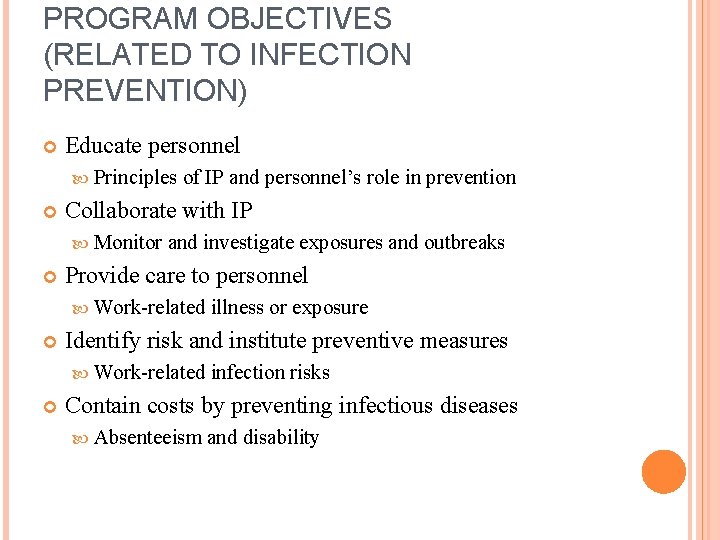
PROGRAM OBJECTIVES (RELATED TO INFECTION PREVENTION) Educate personnel Principles Collaborate with IP Monitor of IP and personnel’s role in prevention and investigate exposures and outbreaks Provide care to personnel Work-related Identify risk and institute preventive measures Work-related illness or exposure infection risks Contain costs by preventing infectious diseases Absenteeism and disability
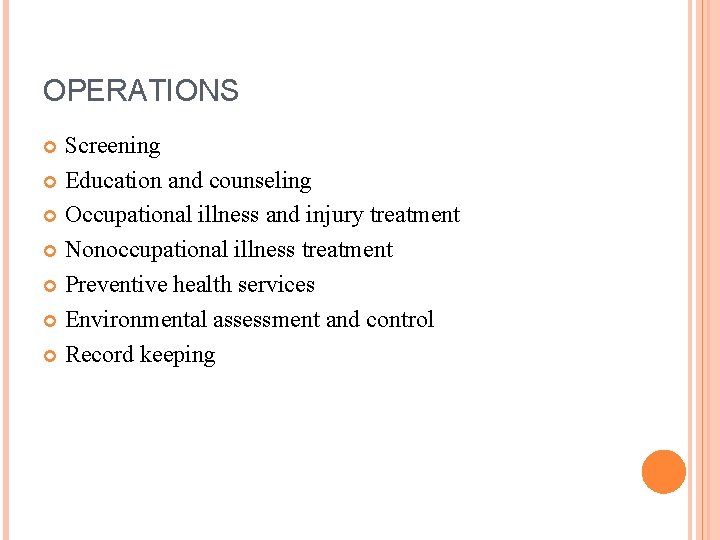
OPERATIONS Screening Education and counseling Occupational illness and injury treatment Nonoccupational illness treatment Preventive health services Environmental assessment and control Record keeping
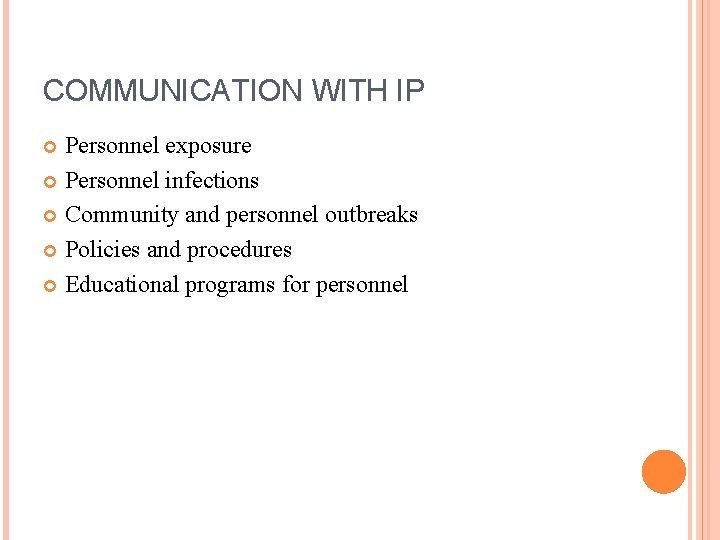
COMMUNICATION WITH IP Personnel exposure Personnel infections Community and personnel outbreaks Policies and procedures Educational programs for personnel
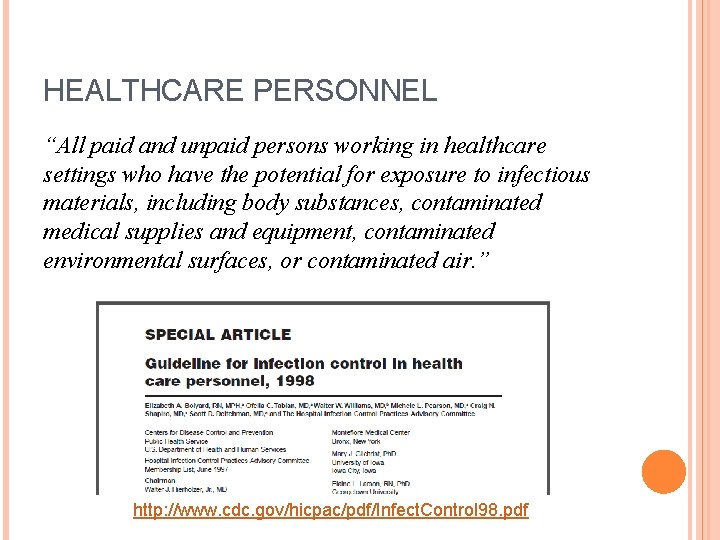
HEALTHCARE PERSONNEL “All paid and unpaid persons working in healthcare settings who have the potential for exposure to infectious materials, including body substances, contaminated medical supplies and equipment, contaminated environmental surfaces, or contaminated air. ” http: //www. cdc. gov/hicpac/pdf/Infect. Control 98. pdf
POLICIES & PROCEDURES Work restrictions Authority to remove personnel from duty Criteria for exposure and prophylaxis Screening procedures Illness reporting system Methods of detecting, preventing, & controlling disease Protocols for treatment Occupational injuries and illnesses Nonoccupational illness
EDUCATION New employee orientation & annual updates Postexposure counseling (Bloodborne Pathogens) TB screening and positive conversions Worker’s comp issues Pregnant worker concerns Community-acquired infections Influenza prevention MMR & Varicella protection and prevention Screening test results Guidelines for illness
ACTION PLAN: DETECTION History of disease Symptoms Labs Reporting cases to health department
ACTION PLAN: PREVENTION & CONTROL Isolation precautions for patients Work restrictions for personnel Prophylaxis of patients and personnel Educate patients and personnel Screening tests postexposure Follow up Secondary cases Delayed outbreak
SCREENING PROGRAMS
DECIDING TO SCREEN Disease in local population Risk of significant exposure Cost of screening Implication of the screening results
WHEN TO SCREEN Preemployment Medical history, immunization status Pregnancy, compromised immune status, infectious disease Periodical Changes in health status Illness during employment Outbreak/Exposure Evaluation of susceptibility Type and duration of exposure Prophylaxis
WHAT TO DO AT A SCREENING Medical history Health assessment Lab work TB screening Immunizations This information is confidential!
COMMUNICABLE DISEASES TO SCREEN FOR Tuberculosis (TB) Rubella OB & Pediatrics rubella, varicella, pertussis Blood/Body fluid exposures hepatitis B
TUBERCULOSIS Includes essentially all healthcare personnel, even those entering patient or treatment rooms whether a patient is present or not. Full time, part time, PRN, contract TB testing protocols based on TB risk assessment Recent exposures and/or conversions Community population http: //www. cdc. gov/tb/publications/guidelines/infectioncontrol. htm
TB SCREENING METHODS Purified protein derivative (PPD) skin testing Before employment and at intervals Two-step if no documented negative PPD within past year Interpret according to CDC guidelines Quanti. FERON-TB (QFT) serum testing One-step, either + or - Chest radiograph Risk factors identified New positive reactors (repeat at intervals) History of symptoms Cough, weight loss, night sweats, etc
BLOODBORNE PATHOGENS exposure plan and immunization
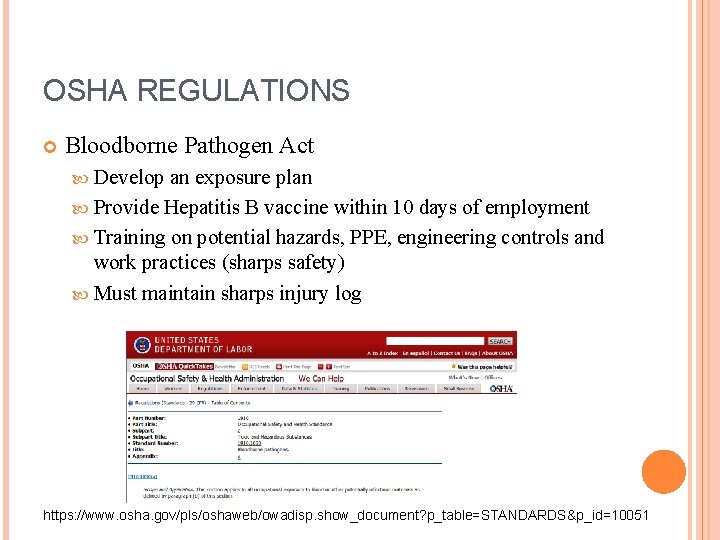
OSHA REGULATIONS Bloodborne Pathogen Act Develop an exposure plan Provide Hepatitis B vaccine within 10 days of employment Training on potential hazards, PPE, engineering controls and work practices (sharps safety) Must maintain sharps injury log https: //www. osha. gov/pls/oshaweb/owadisp. show_document? p_table=STANDARDS&p_id=10051
EXPOSURE PROCEDURES 1. 2. 3. 4. 5. 6. Seek first aid (wash with soap & water, ER) Notify immediate supervisor Obtain baseline labs for HIV, Hepatitis B & C Follow requirements for consent to obtain labs from source patient HIV, Hepatitis B & C Document exposure ASAP per reporting methods Follow up with occupational health for postexposure testing and counseling
POSTEXPOSURE COUNSELING Risk of infection Signs and symptoms of infection Prophylaxis Testing Side effects of medications Interim precautions Risk reduction measures
RESPIRATORY PROTECTION PROGRAM
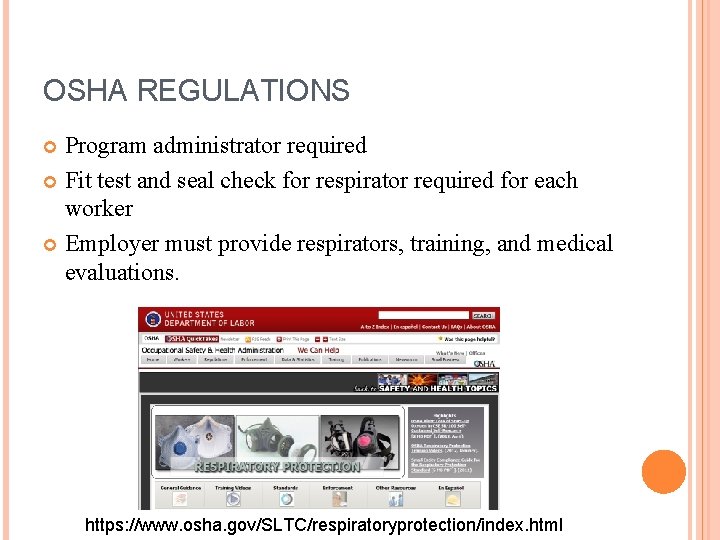
OSHA REGULATIONS Program administrator required Fit test and seal check for respirator required for each worker Employer must provide respirators, training, and medical evaluations. https: //www. osha. gov/SLTC/respiratoryprotection/index. html
FIT TEST Qualitative Pass/Fail Adequacy of fit Quantitative Adequacy of fit Measures amount of leakage Not required for PAPR (Powered air-purifying respirator)
WORK RESTRICTIONS active infections and post-exposure
WORK RESTRICTIONS List which illnesses and conditions should be reported to occupational health in policies and procedures Communicate this to personnel and management Personnel who impose work restrictions should have their authority written in P&P Restriction should no penalize the personnel…or this will undermine reporting
DECIDING WORK RESTRICTIONS Consider the following: Agent Mode of transmission Method of interruption of transmission Population at risk and susceptibility Educability and compliance of personnel Clinical status (signs & symptoms) Degree and type of patient and staff contact
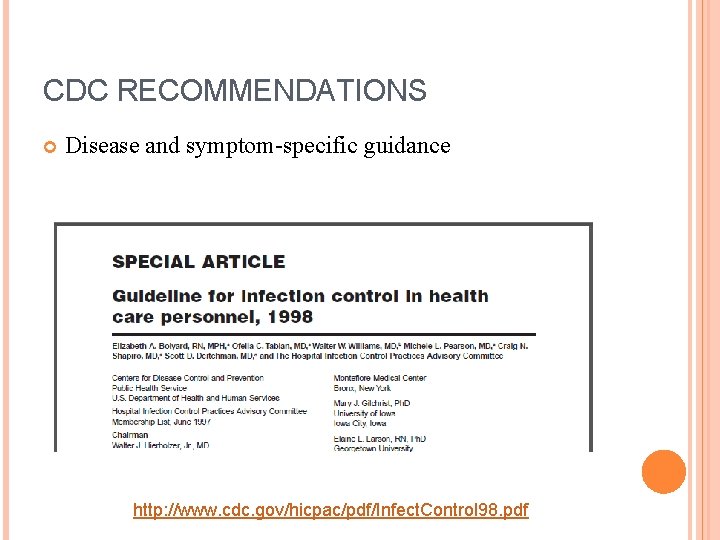
CDC RECOMMENDATIONS Disease and symptom-specific guidance http: //www. cdc. gov/hicpac/pdf/Infect. Control 98. pdf

POST-EXPOSURE
DISEASES WITH NO POST-EXPOSURE TREATMENT Herpes simplex Cytomegalovirus Meningitis other than N. meningitidis RSV Rotavirus Hepatitis C (Controversial)
POST-EXPOSURE: HEPATITIS C Refer to specialist treatment controversial, there is no guideline Exposure considered for HCV-positive source Baseline testing for anti-HCV and ALT May test in 4 -6 weeks post-exposure for HCV RNA if desired Retest in 4 -6 months post-exposure for anti-HCV and ALT
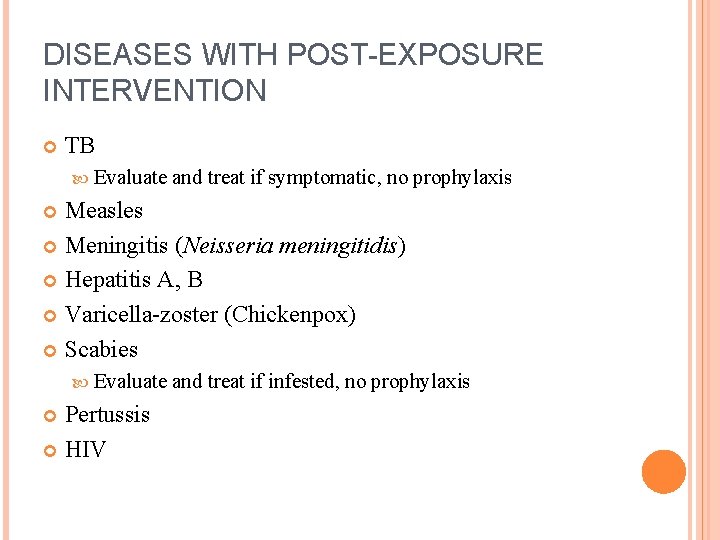
DISEASES WITH POST-EXPOSURE INTERVENTION TB Evaluate and treat if symptomatic, no prophylaxis Measles Meningitis (Neisseria meningitidis) Hepatitis A, B Varicella-zoster (Chickenpox) Scabies Evaluate Pertussis HIV and treat if infested, no prophylaxis
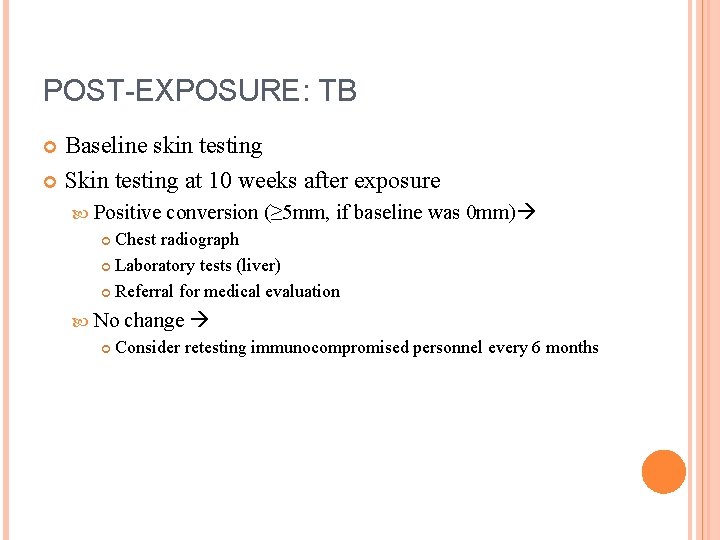
POST-EXPOSURE: TB Baseline skin testing Skin testing at 10 weeks after exposure Positive conversion (≥ 5 mm, if baseline was 0 mm) Chest radiograph Laboratory tests (liver) Referral for medical evaluation No change Consider retesting immunocompromised personnel every 6 months
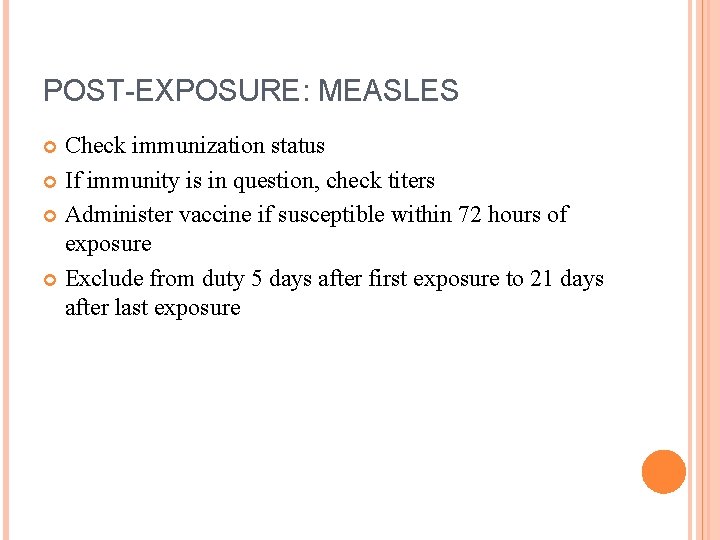
POST-EXPOSURE: MEASLES Check immunization status If immunity is in question, check titers Administer vaccine if susceptible within 72 hours of exposure Exclude from duty 5 days after first exposure to 21 days after last exposure
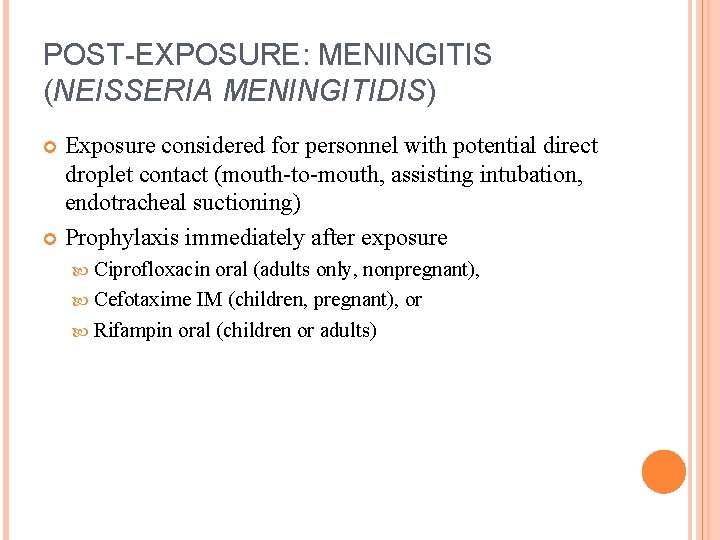
POST-EXPOSURE: MENINGITIS (NEISSERIA MENINGITIDIS) Exposure considered for personnel with potential direct droplet contact (mouth-to-mouth, assisting intubation, endotracheal suctioning) Prophylaxis immediately after exposure Ciprofloxacin oral (adults only, nonpregnant), Cefotaxime IM (children, pregnant), or Rifampin oral (children or adults)
POST-EXPOSURE: HEPATITIS B Exposure considered if source is Hbs. Ag positive or unknown Perform baseline anti-HBs only if exposed person is vaccinated, but titers have not been checked If unvaccinated, begin vaccine series at time of exposure and give HBIG (hepatitis B immune globulin) within 24 hours of exposure
POST-EXPOSURE: HIV Immediately test personnel and source for HIV-AB status Baseline testing and follow up for 6 months 6 weeks, 3 months, and 6 months Postexposure prophylaxis (PEP) and counseling ASAP, if source is HIV-negative stop PEP Consult OB physician for pregnancy (not contraindicated but is complex) http: //www. jstor. org/stable/pdfplus/10. 1086/672271. pdf? accept. TC=true
IMMUNIZATIONS
VACCINE PREVENTABLE DISEASES Hepatitis A and B Influenza Measles Mumps Rubella Tetanus and diphtheria Pertussis Polio Varicella-zoster (Chickenpox)
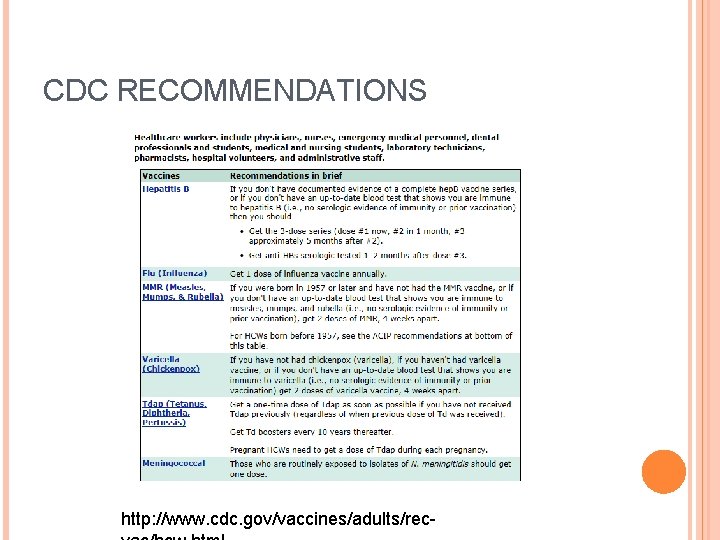
CDC RECOMMENDATIONS http: //www. cdc. gov/vaccines/adults/rec-
PERFORMANCE IMPROVEMENT MEASURES
- Slides: 44