
Objectives 1 To demonstrate knowledge of broadcasting through
Objectives 1. To demonstrate knowledge of broadcasting through script writing and production. 2. To understand the history and impact of radio broadcasting. 3. To evaluate the regulations and agencies which monitor broadcasting standards. 4. To distinguish between the different types of radio networks and programs. 5. To display knowledge of basic radio techniques and delivery skills. 2
What is Radio Broadcasting? • Radio broadcasting- the distribution of information by way of audio or visual signals which is carried to a number of “listeners” who belong to a given network. • Radio Broadcasting can be transmitted: – to public or private audiences – to local or national viewers – as a service or paid subscription 3
History of Radio Broadcasting 1897. Electrical engineering professor William Gladson of the University of Arkansas is said to have constructed an experimental wireless transmitter. 1898. Notre Dame Professor, Jerome Green, sent a message the distance of about a mile, by wireless telegraphy. 1900. The Canadian-American physicist, Professor Reginald Aubrey Fessenden, transmitted speech using a spark-gap transmitter. His voice was the first ever to be transmitted by radio waves and heard by another person. 4
History of Radio Broadcasting 1909. The word "broadcast" appeared in the Boston Globe in an article entitled "Experiment with Wireless". 1910. The world's first radio opera broadcast was disseminated to several listeners in New York using two microphones and a 500 -watt transmitter. 1911. The first U. S. radio license was issued to George Hill Lewis of Cincinnati. 5
History of Radio Broadcasting 1912. Experimental station at the University of Minnesota attempted to air football games using a spark transmitter and regular telegraph signals. 1915. Weather and crop reports were broadcast from the University of Texas. 1918. The U. S. government acquired all wireless land stations except for a few highpowered stations. 1920. The first college radio station went on the air. 6
History of Radio Broadcasting 1921. The first religious service was broadcast by the Calvary Episcopal Church in Pittsburgh. 1922. The Jersey Review broadcast a onehour New Year's program from midnight to 1 a. m. , sometimes considered the first commercial program. – AT&T enters the public broadcasting arena. 7
History of Radio Broadcasting 1922. The first political debate is heard on the radio when two debaters from Washington, D. C. argued the topic of Daylight Savings Time and the listeners served as the judge. 1923. The AM broadcast band was opened. – The first Presidential message was broadcast when President Calvin Coolidge delivered a message to a joint session of Congress. His voice was received over telephone wires. 8
History of Radio Broadcasting 1927. President Coolidge signed the Radio Act of 1927, ultimately creating the Federal Radio Commission regulatory agency. – The first International Broadcasting License was issued by the Federal Communications Commission (FCC). 9
Types of Broadcasts • • News segments Sports programming Talk radio Documentaries Public service announcements Commercials and advertisements Music or additional programming 10
Types of Broadcasts • News segments and programming – includes short, live updates, based on news information • Sports commentaries – includes a written or oral analysis of sports highlights or full-length events • Talk radio – consists of a specific segment or conversation topic – includes a host and listener or guest participation 11
Types of Broadcasts • Documentaries – includes programming devoted to covering a particular topic in great – includes a mixture of commentary and sound pictures 12
Types of Broadcasts • Public service announcements – consists of a non-commercial advertisement used to modify public attitudes or awareness about specific issues – are usually created by non-profit or government agencies – includes 10, 30, 60 or 90 seconds segments 13
Types of Broadcasts • Public service announcements – include the following type of campaigns: • Got Milk? • The Incredible Egg • Beef: It’s what’s for dinner 14
Types of Broadcasts • Commercials and advertisements – are a form of paid promotion used to attract attention to a product or business – examples include: • Cache Valley cheese • Tyson chicken • Cummins harvester 15
Types of Broadcasts • Music or additional programming – includes specialized segments, such as: • music from the 70’s, 80’s and 90’s • home improvement or lawn-care shows • kids programming • fundraisers • local hero highlights • weather or traffic reports 16
Broadcasting Channels • • AM Radio FM Radio Sirius XM satellite radio 17
AM & FM • Both AM and FM signals transmit information using radio waves • AM- Amplitude Modulation – transmits at set frequencies between 535 k. Hz and 1, 605 k. Hz – is affected by physical interference, such as lightning or machinery – consists of a lower frequency 18
AM & FM • FM- Frequency Modulation – transmits sound by adjusting the frequency of the radio wave – consist of stations from 88 to 108 MHz – is the most popular form of radio listening 19
XM & Sirius Radio • Is a radio service sent via satellite to subscribers who have a corresponding receiver • Is a digital satellite program which: – transmits more than 100 channels of specialized radio programming – is usually commercial free – requires subscribers to pay a monthly service fee – transmits to cars, homes, computers and public locations 20
Benefits of Radio on Agriculture • Increased number of agricultural Public Service Announcements • Increased number of agriculturalbased talk shows and service programs • Enhanced coverage and marketing venues due to XM and Satellite programming • Increased number of agriculture stations available to the common listener 21
Preparing a Radio Broadcast 22
Items needed for a Radio Broadcast • Scripts • Sound equipment • Recording equipment 23
Radio Scripts • Are a detailed outline, which include: – specific narration – required sound effects – precise length and timing of the segment or advertisement • Help with the following: – guiding a production – enhancing preparation – evoking reactions from the listeners 24
Elements of a Radio Script • Title of the segment or commercial • Page number • Numbered lines • Character names or titles • Sentences and exact wordage • Sound effects and pacing instructions 25
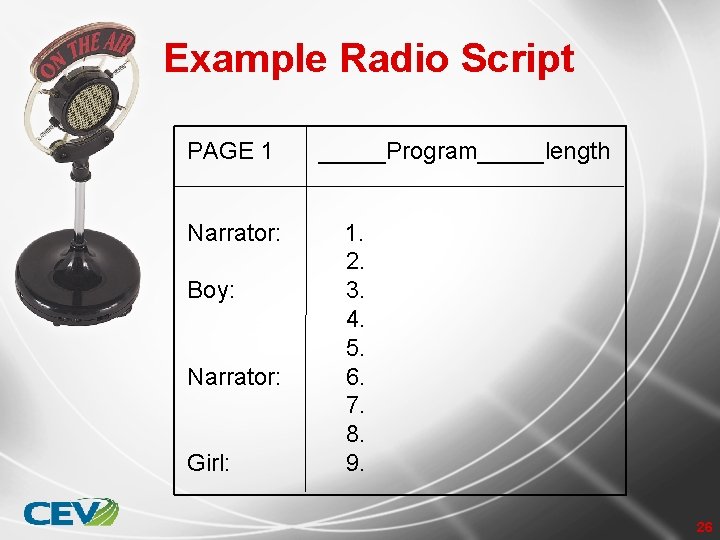
Example Radio Script PAGE 1 Narrator: Boy: Narrator: Girl: _____Program_____length 1. 2. 3. 4. 5. 6. 7. 8. 9. 26
How to Write a Radio Script 1. Create a title or heading 2. Insert the appropriate page number 3. Produce the basic content, dialogue and narration 4. Include script cues, such as: A. music B. sound effects C. narrator pacing D. dialogue cues 5. Compose production notes 6. Edit and revise 7. Submit for approval 27
Tips for Radio Writing • Radio scripts should include: – metaphors • a comparison between two unrelated subjects without using the words “like” or “as” – “The world is a stage” – “ He was a bull” – jargon • specialized terminology used by members of a specific group or organization 28
Tips for Radio Writing – pomposity • phrases full of high-sounding or confident innuendos – “I’m 100% certain” – “You know I’m right” – absolute words • words which cannot be compared, such as: – perfect – never – always – only 29
Tips for Radio Writing – clichés • a popular phrase or expression – “When life hands you lemons, make lemonade” – “It’s the top of the hour” – “I’d like to make a shout out” 30
Tips for Radio Writing • Normal radio scripts should be: – clear – creative – catchy – easy to listen to – written for the common listener – written for your “own voice” 31
Conversational Scripts • Are used to attract the listeners attention • Are different from “normal” newsbased scripts 32
Conversational Scripts • Should: – avoid highly specialized or scientific terms – use precise and clear language – use short sentences – use pauses – use the present tense as much as possible – expand elaborate on important issues – use transitions between topics 33
Using an Active or Passive Voice • Active voice- the emphasis is placed on the subject performing the action – Example: The man fed the cows. • Passive Voice- the emphasis is placed on the subject receiving the action – Example: The cows were fed by the man. 34
Length of Radio Scripts • Advertisements, commercials or public service announcements – are usually 30 or 60 seconds in length • News, weather or traffic segments – are usually short and concise • Commentary segments – are usually long, detailed and elaborate 35
Editing Radio Scripts • Read the script aloud • Evaluate transitions and flow • Verify the content and accuracy of the information • Check for grammar, spelling or punctuation errors • Use the Associated Press Stylebook to verify content 36
Associated Press Style Guide • Is the standard tool used to evaluate news writing • Is known and accepted worldwide • Details the appropriate writing standards for: – – – grammar punctuation capitalization abbreviations word and numerical usage 37
Importance of Editing • Improving readability and ease of use • Obtaining listener acceptance • Maintaining professionalism • Upholding legal requirements, such as: – copyrights – accurate information – use of sources 38
Radio Delivery • Reading a radio script requires appropriate: – tone – speed and pacing – delivery – voice inflections – enunciation – energy and personality 39
Radio Delivery Techniques • Tone – is the quality of a person’s voice – should be smooth, controlled and easy to understand • Pitch – is the property of sound which creates frequent variation – can be high or low – should be altered frequently – is used to create excitement and variation 40
Radio Delivery Techniques • Enunciation – is speaking or pronouncing words in an articulate style – consists of stating words in a clear and precise manner • Pacing – is the speed of delivery or presentation timing – includes the use of pauses and acceleration 41
Producing a Radio Broadcast • Production members include: – deejays (DJ) – production coordinators – programming director – news correspondent – producer or manager 42
Producing a Radio Broadcast • Production responsibilities include: – recording interviews, voice tracks and sound effects – editing commercials and public service announcements – downloading promotional materials – creating special programs or introductory music – preparing scripts or show outline – delivering on-air messages and programming 43
Types of Recording Equipment • • Microphones Tape recorders Sound effects Transmitters Antennas CD’s or audio cassettes Computers Scripts 44
Types of Microphones • Omni-directional – are sensitive to sounds from all directions • Bidirectional – are sensitive to sounds from two directions • Unidirectional – are sensitive to sound from one straight path 45
Tips for Audio Production • Speak directly into the microphone • Always use a recording device to document interviews • Wear headphones • Check to make ensure all microphones are turned on • Point microphones six-inches away from a speaker's mouth 46
Tips in Audio Recording • • Smile Drink water Use vocal variations Use humor when appropriate Speak in short sentences Emphasize your words Avoid “p” pops or smacking of the lips Avoid hissing or placing too much emphasis on “s” words 47
Music & Sound Considerations • Music should be based on: – – the audience current trends and popularity musical requests the quality of the music • Sound effects should be based on: – – entertainment appropriateness quality and value programming needs 48
The Future of Radio • Conversion from analog to digital broadcasting • Increased popularity for satellite radio programming • Larger audiences and market reach • Increased technology • Greater emphasis on local stations 49
Radio Broadcasting Considerations • • Station requirements Technology Government regulations Competition and new markets 50
Station Requirements • Deadlines • Community outreach programs • Special events attendance 51
Technology • Digital satellite radio • Enhanced sound quality • Internet Streaming – transferring video or sound data to a listener without lengthy downloads – streaming small sections of information over the internet for users to access the moment it is received 52
Government Regulations • The Federal Communications Commission – monitors and regulates radio broadcasts – assess fines for obscene or offensive language – discourages sexual programming for child-oriented stations 53
Increased Competition & New Markets • The Telecommunications Act of 1996 – eliminated restrictions on radio ownerships – allowed companies to use “national programming” methods – increased radio competition and improved customer services • Growing Markets include: – – Hispanic and Latin stations rural and agricultural markets satellite radio customers I-pod’s and MP 3 players 54
ACTIVITY • #1. Record a news story or short radio script for a professional broadcast. • #2. Record a 30, 60 or 90 second public service announcement for an agricultural product or company of your choice. 55
Assessment 1. List at least three types of radio broadcasts. 2. List two items needed on a radio script. 3. Give an example of a cliché. 56
Assessment 4. How long are most radio ads or public service announcements? 5. What is the AP style guide? 6. What is a “P” pop? 57
Assessment 7. T or F AM radio transmits at frequencies between 88 and 108 MHZ. 8. T or F XM radio is a form of digital satellite programming. 9. T or F Jargon refers to the basic terminology used by most people. 10. T or F Omni-directional is a specific type of microphone. 58
References • Citadel Broadcasting www. citadelcommunications. com • National Public Radio www. npr. com • High Definition Radio www. hdradio. com • Station Resource Group www. srg. org • Sirius Radio www. sirius. com 59
References • XM Radio www. xmradio. com • Clear Channel Communications www. clearchannel. com • Farm Radio Network www. farmradio. org • http: //www. drawgroup. org/~jyu/writing/Sci. B ug/AMFM. html • http: //www. internetcampus. com/frtv 017. htm 60
References • http: //members. aol. com/jeff 560/chrono 1. ht ml • http: //www. skillset. org/uploads/pdf/asset_96 7. pdf? 1 • http: //www. ehow. com/how_2002078_writeradio-script. html • www. acecopyediting. com/ACEcopyediting %20 -%20 Self-Help%20 Guide. htm • www. itrainonline. org/itrainonlin/mmtk _scripting_handout. doc 61
Acknowledgements Collaborator Kyle Mc. Gregor, Ph. D. Tarleton State University Production Coordinators Amy Baker Kady Mayfield Graphics Designer Clayton Franklin Production Manager Dusty Moore Executive Producers Gordon Davis, Ph. D. ©MMVII CEV Multimedia. Ltd. Jeff Lansdell 62
- Slides: 62