
Objective To define and explain the meanings of
Objective: To define and explain the meanings of imperialism, isolationism, nationalism and internationalism.
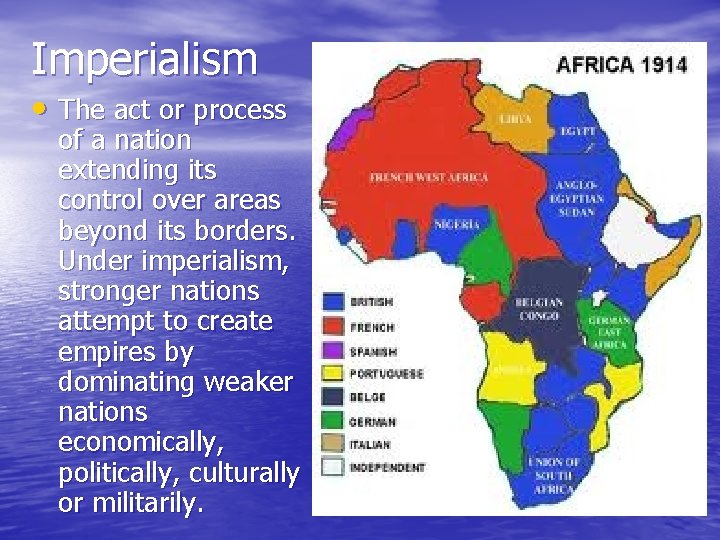
Imperialism • The act or process of a nation extending its control over areas beyond its borders. Under imperialism, stronger nations attempt to create empires by dominating weaker nations economically, politically, culturally or militarily.
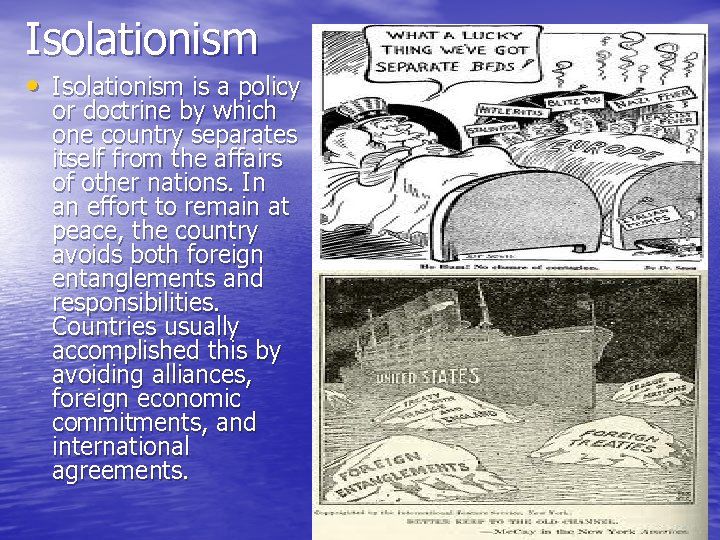
Isolationism • Isolationism is a policy or doctrine by which one country separates itself from the affairs of other nations. In an effort to remain at peace, the country avoids both foreign entanglements and responsibilities. Countries usually accomplished this by avoiding alliances, foreign economic commitments, and international agreements.
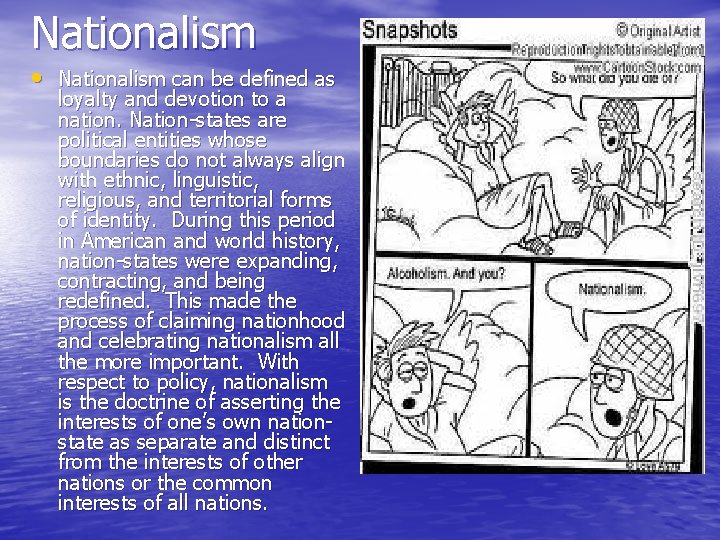
Nationalism • Nationalism can be defined as loyalty and devotion to a nation. Nation-states are political entities whose boundaries do not always align with ethnic, linguistic, religious, and territorial forms of identity. During this period in American and world history, nation-states were expanding, contracting, and being redefined. This made the process of claiming nationhood and celebrating nationalism all the more important. With respect to policy, nationalism is the doctrine of asserting the interests of one’s own nationstate as separate and distinct from the interests of other nations or the common interests of all nations.

Internationalism • This is a broad term that generally states that nations should cooperate in economic and political matter. For the purposes of this unit it refers to the belief by some influential Americans in the late 19 th/early 20 th century that the United States needed to move beyond its continental boundaries to both protect itself and help enlighten other people who would otherwise fall under the control of predatory European powers.
- Slides: 5