
Objective Structural Design and Stress Analysis All load
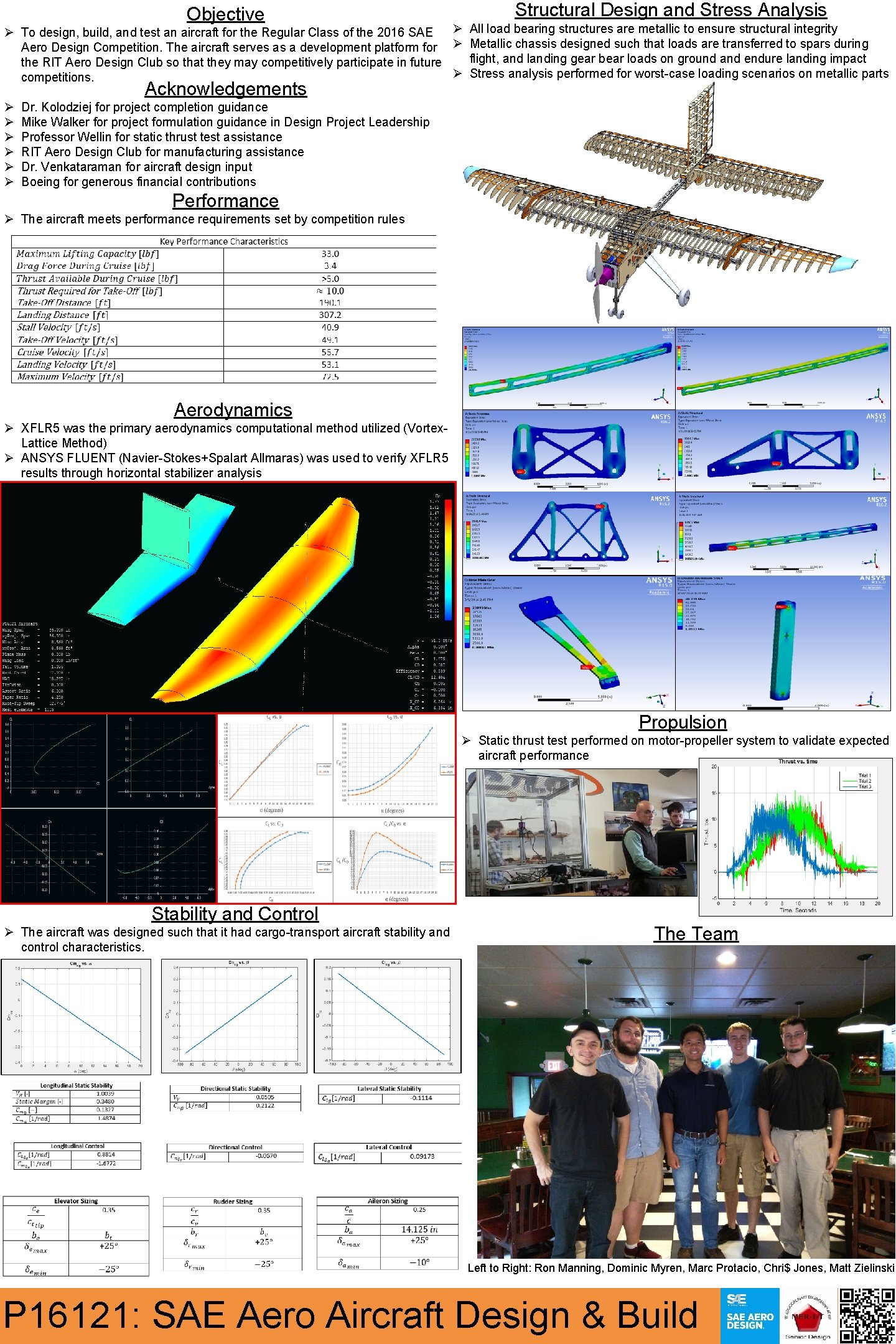
Objective Structural Design and Stress Analysis Ø All load bearing structures are metallic to ensure structural integrity Ø To design, build, and test an aircraft for the Regular Class of the 2016 SAE Aero Design Competition. The aircraft serves as a development platform for Ø Metallic chassis designed such that loads are transferred to spars during flight, and landing gear bear loads on ground and endure landing impact the RIT Aero Design Club so that they may competitively participate in future Ø Stress analysis performed for worst-case loading scenarios on metallic parts competitions. Acknowledgements Ø Ø Ø Dr. Kolodziej for project completion guidance Mike Walker for project formulation guidance in Design Project Leadership Professor Wellin for static thrust test assistance RIT Aero Design Club for manufacturing assistance Dr. Venkataraman for aircraft design input Boeing for generous financial contributions Performance Ø The aircraft meets performance requirements set by competition rules Aerodynamics Ø XFLR 5 was the primary aerodynamics computational method utilized (Vortex. Lattice Method) Ø ANSYS FLUENT (Navier-Stokes+Spalart Allmaras) was used to verify XFLR 5 results through horizontal stabilizer analysis Propulsion Ø Static thrust test performed on motor-propeller system to validate expected aircraft performance Stability and Control Ø The aircraft was designed such that it had cargo-transport aircraft stability and control characteristics. The Team Left to Right: Ron Manning, Dominic Myren, Marc Protacio, Chri$ Jones, Matt Zielinski P 16121: SAE Aero Aircraft Design & Build
- Slides: 2