
Objective Revision of data structures and their implementation
Objective • Revision of data structures and their implementation.
Assessment First exam Second exam Participation and attendance 20 20 10
Introduction · Throughout this course examples will be given in C++. Most of the time its non-object-oriented features will be used and only in the few problems that will have to be implemented as classes, its object-oriented features will be used. • The language is only being used as a means of expressing the algorithms. It should be realized that implementation could be in any modern high level language as they all tend to have equivalent features.
Introduction · It should also be pointed out that in the examples concentration is on the algorithms and not the specific details required for execution. Thus the pre-processor directives and the variable declaratives will not be included in the examples except where necessary.
Introduction · As a C/C++ programmer , you are already familiar with data types like int, char, float etc. These are basic building blocks of a programming language. For real world programming problems, it would not be possible to use basic data types alone. · For example consider the following C++ program which reads 5 integer numbers using cin and then print them out using cout.
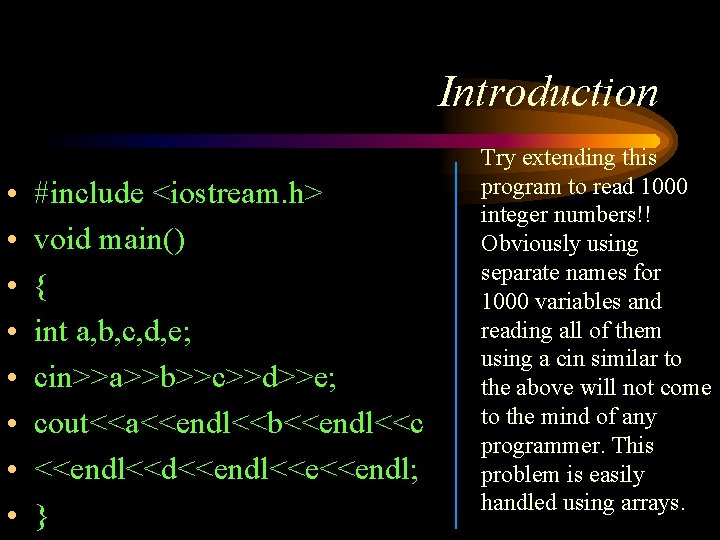
Introduction • • #include <iostream. h> void main() { int a, b, c, d, e; cin>>a>>b>>c>>d>>e; cout<<a<<endl<<b<<endl<<c <<endl<<d<<endl<<e<<endl; } Try extending this program to read 1000 integer numbers!! Obviously using separate names for 1000 variables and reading all of them using a cin similar to the above will not come to the mind of any programmer. This problem is easily handled using arrays.
![Introduction • • • #include <iostream. h> void main() { int a[1000], i; for](http://slidetodoc.com/presentation_image_h2/d837216067f4c02b95f9fe92c4dd741c/image-7.jpg "Introduction • • • #include <iostream. h> void main() { int a[1000], i; for")
Introduction • • • #include <iostream. h> void main() { int a[1000], i; for (i=0; i<10000; i++) { cin>>a[i]; } for (i=0; i<10000; i++) { cout<<a[i]<<endl; } } Program=Algorithms +data structures
C-DATA TYPES AND DATA STRUCTURE CLASSIFICATION • Basic data types Internal level: bits, bytes (8 bits) and Words (typically 32 bits) Program level: char (signed/unsigned) float (signed/unsigned) double(signed/unsigned) int (signed/unsigned) short int (signed/unsigned) long int (signed/unsigned) pointers (short/far)
Data structures Non-user defined (supported directly by C) arrays, enum, struct, union, files User defined: stacks, queues, trees, linked lists, graphs, heaps, . . .
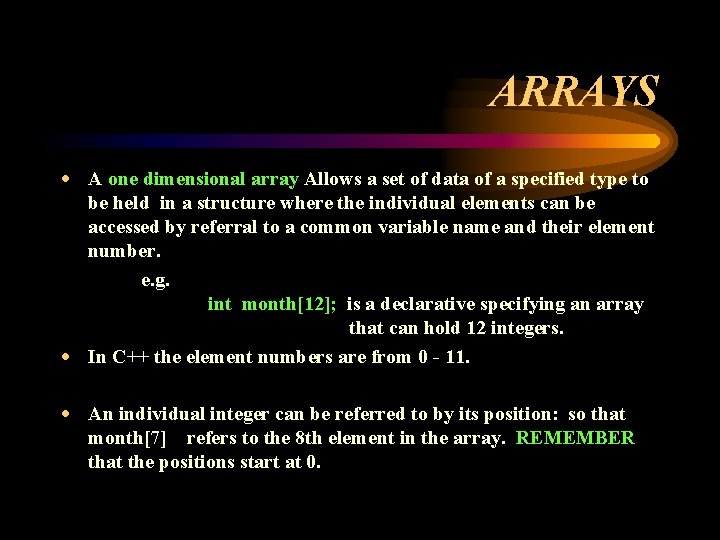
ARRAYS · A one dimensional array Allows a set of data of a specified type to be held in a structure where the individual elements can be accessed by referral to a common variable name and their element number. e. g. int month[12]; is a declarative specifying an array that can hold 12 integers. · In C++ the element numbers are from 0 - 11. · An individual integer can be referred to by its position: so that month[7] refers to the 8 th element in the array. REMEMBER that the positions start at 0.
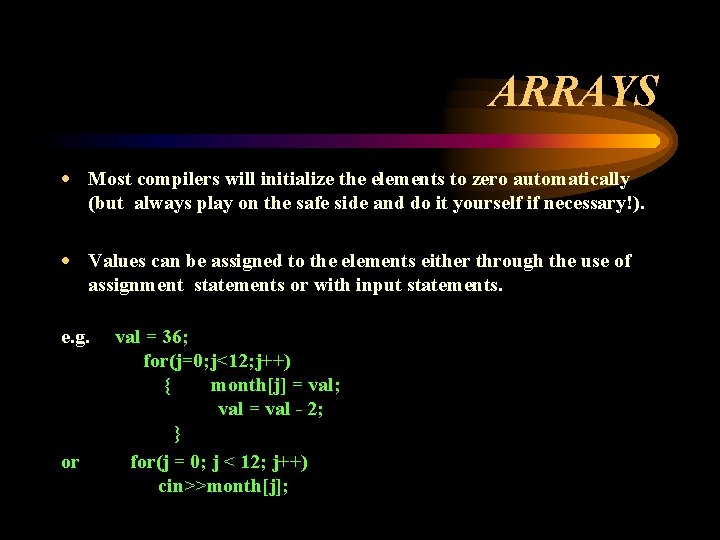
ARRAYS · Most compilers will initialize the elements to zero automatically (but always play on the safe side and do it yourself if necessary!). · Values can be assigned to the elements either through the use of assignment statements or with input statements. e. g. or val = 36; for(j=0; j<12; j++) { month[j] = val; val = val - 2; } for(j = 0; j < 12; j++) cin>>month[j];
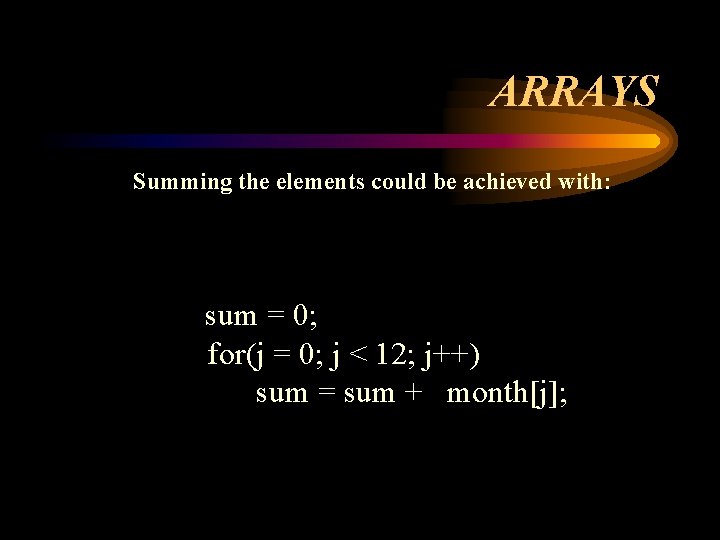
ARRAYS Summing the elements could be achieved with: sum = 0; for(j = 0; j < 12; j++) sum = sum + month[j];
![ARRAYS • A double dimension array can be declared as : int sales[5][12] The](http://slidetodoc.com/presentation_image_h2/d837216067f4c02b95f9fe92c4dd741c/image-13.jpg "ARRAYS • A double dimension array can be declared as : int sales[5][12] The")
ARRAYS • A double dimension array can be declared as : int sales[5][12] The above declaration defines an array with 5 rows and 12 columns. Input could be: for(i = 0; i < 5; i++) { cout<<"Input the monthly sales for salesperson "<<i+1<<endl; for(j = 0; j < 12; j++) { cout<<"Month "<<j+1; cin>>sales[i][j]; } }
![ARRAYS • Adding all the columns could be: • int sumcol[12]; for(j=0; j<12; j++)](http://slidetodoc.com/presentation_image_h2/d837216067f4c02b95f9fe92c4dd741c/image-14.jpg "ARRAYS • Adding all the columns could be: • int sumcol[12]; for(j=0; j<12; j++)")
ARRAYS • Adding all the columns could be: • int sumcol[12]; for(j=0; j<12; j++) { sumcol[j] = 0; for (i=0; i<5; i++) sumcol[j] = sumcol[j] + sales[i][j]; } • Note that this routine puts the column sums into the array sumcol.
![ARRAYS • Searching for a target: • int num[10], flag=0, target, i; • cin>>target;](http://slidetodoc.com/presentation_image_h2/d837216067f4c02b95f9fe92c4dd741c/image-15.jpg "ARRAYS • Searching for a target: • int num[10], flag=0, target, i; • cin>>target;")
ARRAYS • Searching for a target: • int num[10], flag=0, target, i; • cin>>target; for (i=0; i<10; i++) { • if (nums[i] == target) • {flag = 1; break; } • if (flag == 1) cout<<"Target found"; else cout<<"Target not found";
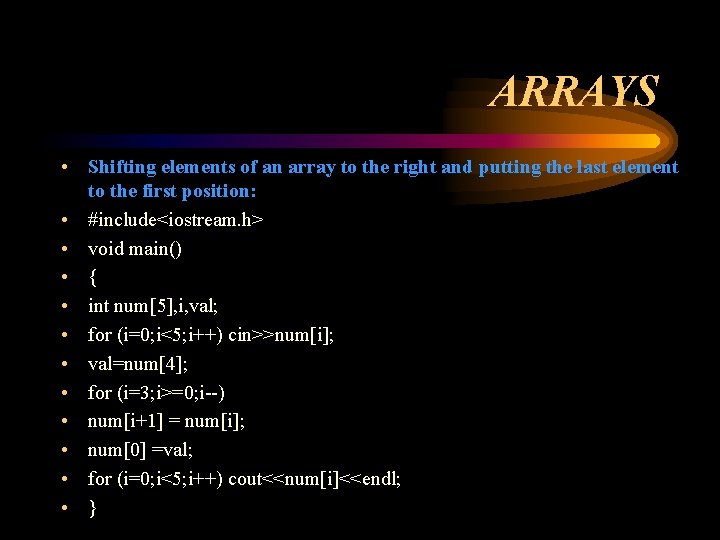
ARRAYS • Shifting elements of an array to the right and putting the last element to the first position: • #include<iostream. h> • void main() • { • int num[5], i, val; • for (i=0; i<5; i++) cin>>num[i]; • val=num[4]; • for (i=3; i>=0; i--) • num[i+1] = num[i]; • num[0] =val; • for (i=0; i<5; i++) cout<<num[i]<<endl; • }
- Slides: 16