
OBJECTIVE QUESTIONS FOR NEET AIIMS JIPMER www wisedane

OBJECTIVE QUESTIONS FOR NEET AIIMS JIPMER www. wisedane. com
BIOLOGY RESPIRATION IN PLANTS SET 2 MCQ’s www. wisedane. com
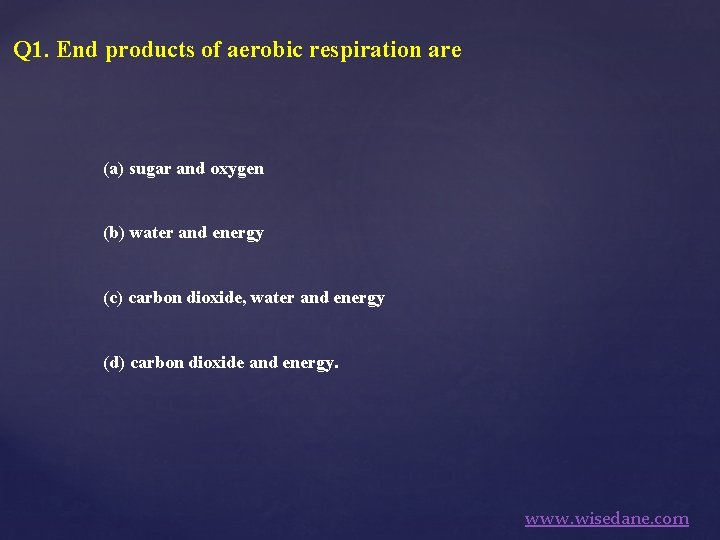
Q 1. End products of aerobic respiration are (a) sugar and oxygen (b) water and energy (c) carbon dioxide, water and energy (d) carbon dioxide and energy. www. wisedane. com
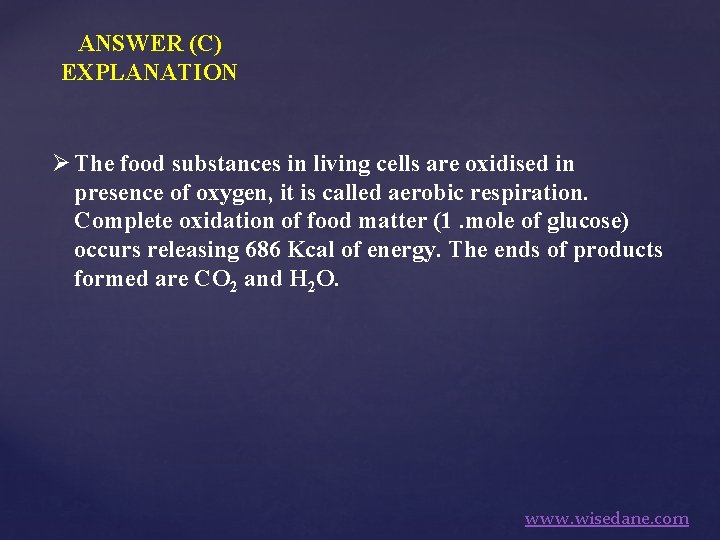
ANSWER (C) EXPLANATION Ø The food substances in living cells are oxidised in presence of oxygen, it is called aerobic respiration. Complete oxidation of food matter (1. mole of glucose) occurs releasing 686 Kcal of energy. The ends of products formed are CO 2 and H 2 O. www. wisedane. com
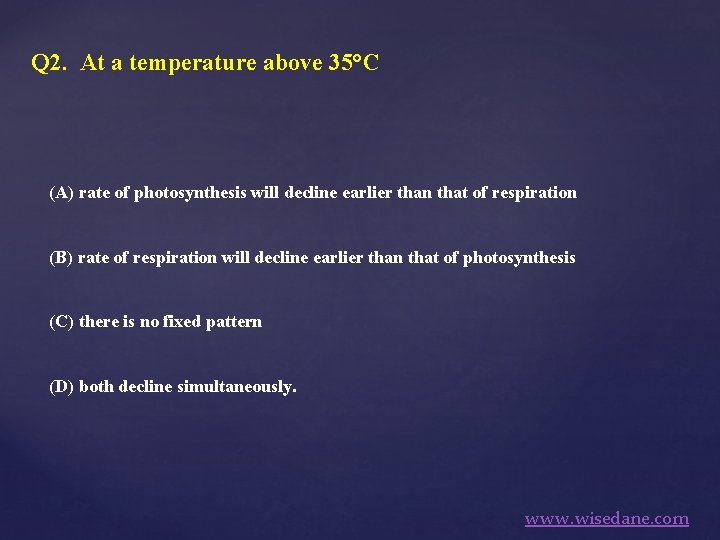
Q 2. At a temperature above 35°C (A) rate of photosynthesis will decline earlier than that of respiration (B) rate of respiration will decline earlier than that of photosynthesis (C) there is no fixed pattern (D) both decline simultaneously. www. wisedane. com
ANSWER (A) EXPLANATION Ø The plants can perform photosynthesis on a range of temperature, while some cryophytes can do photosynthesis at 35°C. Usually the plants can perform photosynthesis between 10°C – 40°C. The optimum temperature ranges between 25°C – 30°C. At high temperature the enzymes are denatured and hence the photosynthetic rate declines. www. wisedane. com
Q 3. Oxidative phosphorylation is production of (a) ATP in photosynthesis (b) NADPH in photosynthesis (c) ATP in respiration (d) NADH in respiration. www. wisedane. com
ANSWER (C) EXPLANATION • In electron transport system the hydrogen donated by succinate is accepted by FAD which is reduced to FADH 2. • This hydrogen dissociates into electrons and protons and then passes through a series of carriers involving the phenomenon of oxidation and reduction. During this flow, ATP synthesis occurs at different steps and the phenomenon is called as oxidative phosphorylation. www. wisedane. com
Q 5. Apparatus to measure rate of respiration and R. Q. is (A) Auxanometer (B) Potometer (C) Respirometer (D) Manometer. www. wisedane. com
ANSWER (C) EXPLANATION Ø Respirometer is an instrument used for measuring R. Q and rate of respiration. Ø The apparatus consists of a graduated tube attached at right angles to a bulbous respiratory chamber in its upper end. Desired plant material who’s R. Q is to be determined is placed in the respiratory chamber. www. wisedane. com
Q 6. End product of citric acid cycle/Krebs cycle is (a) citric acid (b) lactic acid (c) pyruvic acid (d) CO 2 + H 2 O. www. wisedane. com
ANSWER (D) EXPLANATION Ø The end product of glycolysis is pyruvic acid whereas acetyl Co. A is the connecting link between glycolysis and Krebs cycle. Ø The TCA cycle was first described by Krebs, 1937 as a cyclic process in which acetyl co. A is oxidised to C 02 and water. Acetyl Co. A combines with oxalo acetic acid to form citric acid. After a series of cyclic reactions OAA is recycled back. www. wisedane. com
Q 7. Out of 38 ATP molecules produced per glucose, 32 ATP molecules are formed from NADH/FADH 2 in (a) respiratory chain (b) Krebs cycle (c) oxidative decarboxylation (d) EMP. www. wisedane. com
ANSWER (A) EXPLANATION Ø During respiratory chain, complete degradation of one glucose molecule produced 38 ATP molecules. NAD and FAD is reduced to NADH/FADH 2. www. wisedane. com
Q 8. Life without air would be (a) reductional (b) free from oxidative damage (c) impossible (d) anaerobic. www. wisedane. com
ANSWER (D) EXPLANATION Ø Anaerobic respiration (absence of oxygen) takes place in anaerobic bacteria and in plant seeds. Ø Anaerobic respiration occurs in the organism which can live without oxygen. In this respiration, only glycolysis takes place due to the absence of oxygen. www. wisedane. com
Q 9. The First phase in the breakdown of glucose, in animal cell, is (a) fermentation (b) Krebs cycle (c) glycolysis (d) E. T. S. www. wisedane. com
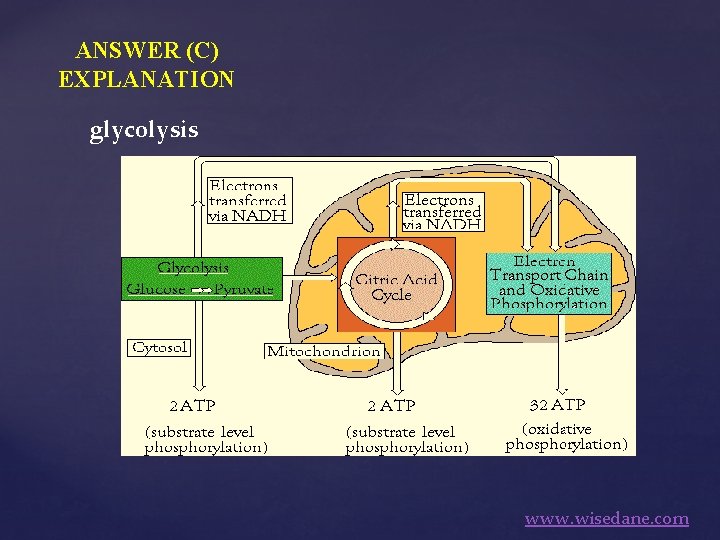
ANSWER (C) EXPLANATION glycolysis www. wisedane. com
Q 10. When yeast ferments glucose, the products obtained are (a) ethanol and CO 2 (b) methanol and CO 2 (c) ethanol and water (d) water and CO 2. www. wisedane. com
ANSWER (A) EXPLANATION Ø Ethanol and CO 2 www. wisedane. com
Q 11. Which of the molecules listed below is a product of fermentation of glucose by yeast? A. (C 6 H 10 O 5)n B. C 2 H 5 OH C. C 6 H 12 O 6 D. CH 3 OH www. wisedane. com
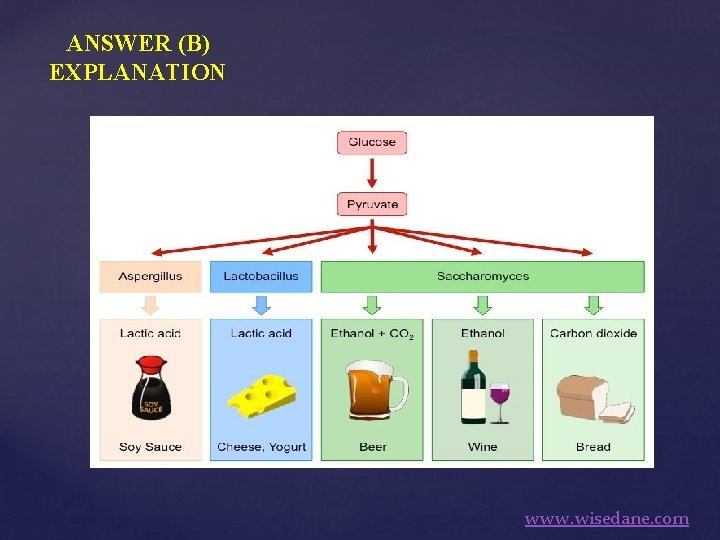
ANSWER (B) EXPLANATION www. wisedane. com
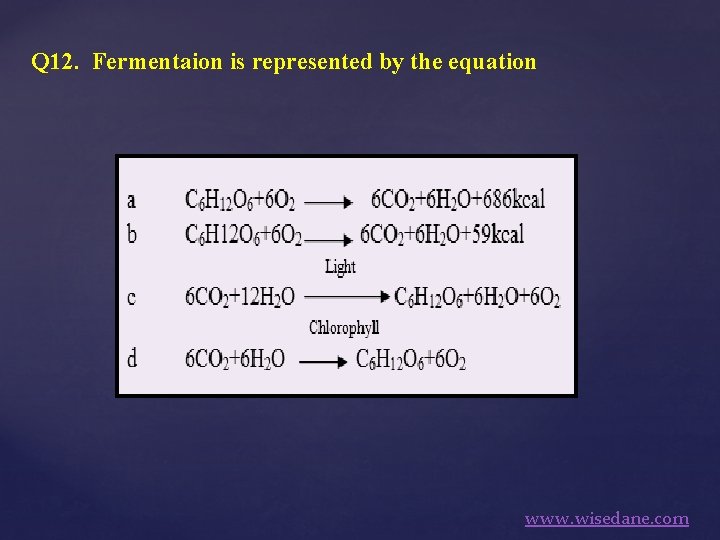
Q 12. Fermentaion is represented by the equation www. wisedane. com
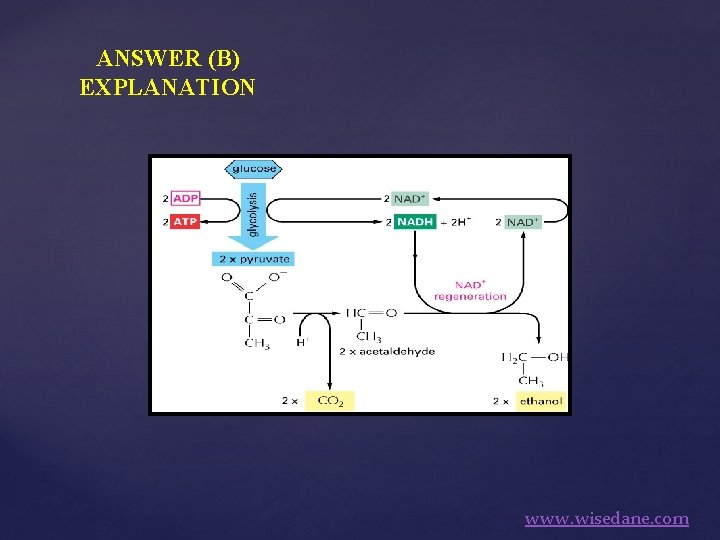
ANSWER (B) EXPLANATION www. wisedane. com
Q 13. Which of the following describes significance of fermentation? (i) Production of alcohol in brewing industry. (ii) Making of dough in baking industry. (iii) Curing of tea and tobacco. (iv) Production of vinegar by acetic acid bacteria. A. (i), (ii) and (iii) B. (i), (ii) and (iv) C. (ii), (iii) and (iv) D. (i), (iii) and (iv) www. wisedane. com
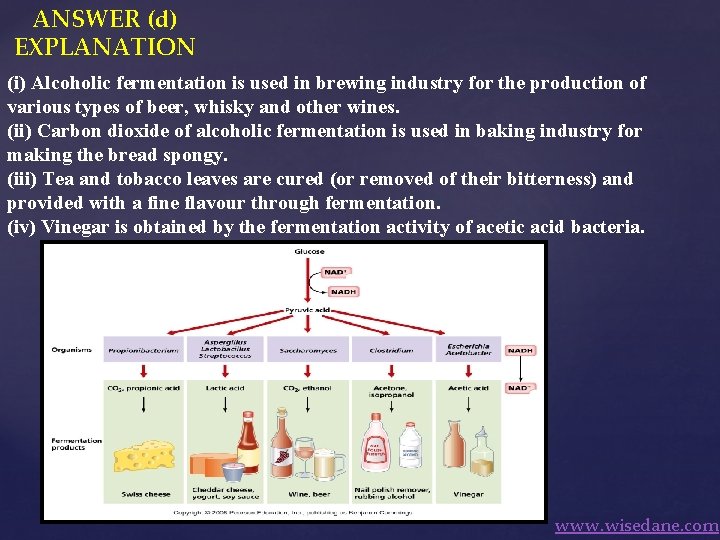
ANSWER (d) EXPLANATION (i) Alcoholic fermentation is used in brewing industry for the production of various types of beer, whisky and other wines. (ii) Carbon dioxide of alcoholic fermentation is used in baking industry for making the bread spongy. (iii) Tea and tobacco leaves are cured (or removed of their bitterness) and provided with a fine flavour through fermentation. (iv) Vinegar is obtained by the fermentation activity of acetic acid bacteria. www. wisedane. com
Q 14. A test tube containing molasses solution and yeast is kept in a warm place overnight. The gas collected from this mixture A. extinguishes the flame B. bursts into flame when ignited C. turns lime water milky D. both (a) and (c). www. wisedane. com
ANSWER (d) EXPLANATION Ø Given process is an example of alcoholic fermentation, thus the gas produced is CO 2 www. wisedane. com
Q 15. Dough kept overnight in warm weather becomes soft and spongy due to A. abasorption of CO 2 from atmospherre B. imbibition C. fermentation D. all of these. www. wisedane. com
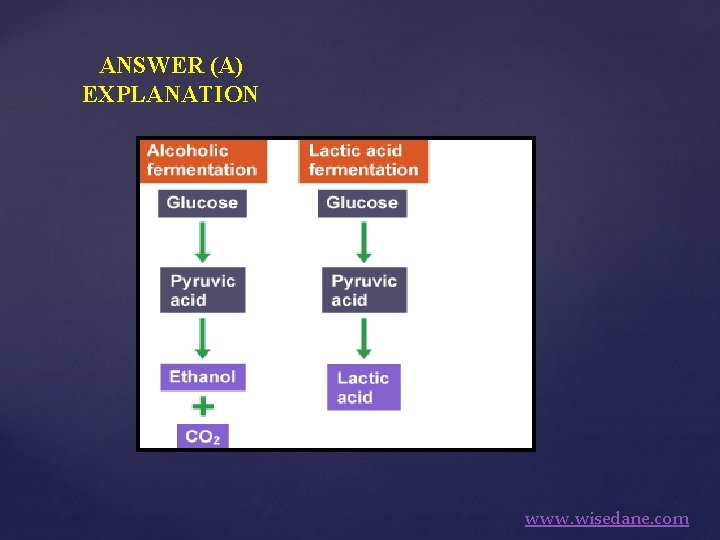
ANSWER (C) EXPLANATION Ø Fermentation is a metabolic process that converts sugar to acids, gases, or alcohol. Ø It occurs in yeast and bacteria, and also in oxygen-starved muscle cells, as in the case of lactic acid fermentation. Ø Fermentation is also used more broadly to refer to the bulk growth of microorganisms on a growth medium, often with the goal of producing a specific chemical product www. wisedane. com
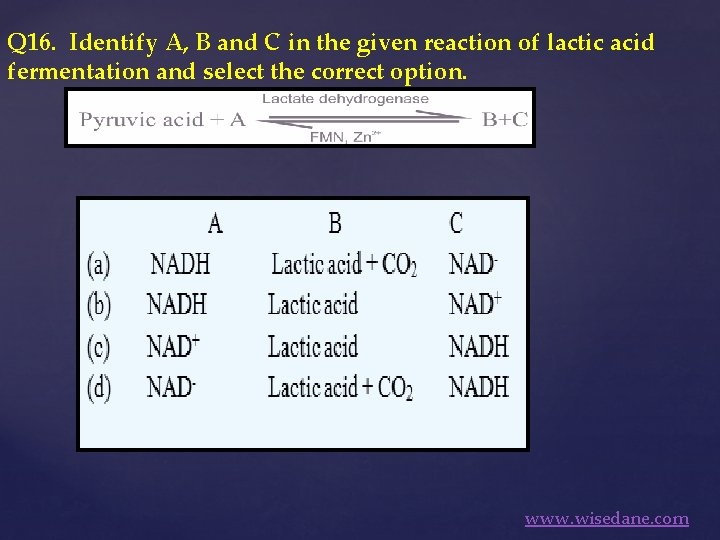
Q 16. Identify A, B and C in the given reaction of lactic acid fermentation and select the correct option. www. wisedane. com
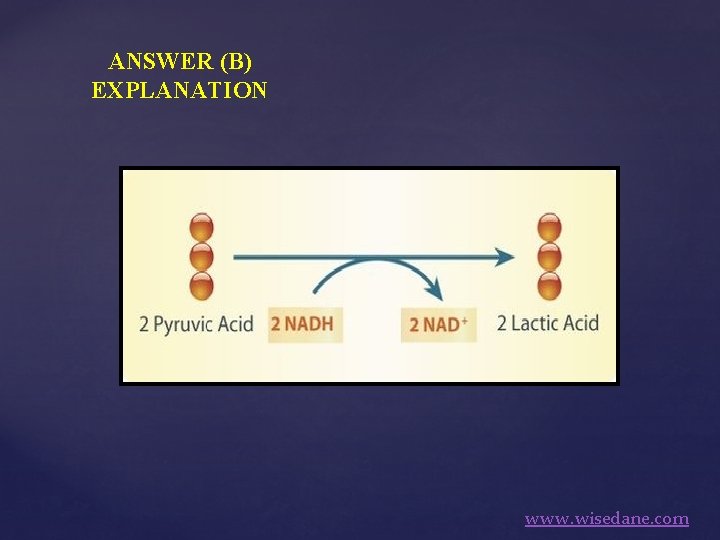
ANSWER (B) EXPLANATION www. wisedane. com
Q 17. Ethyl alcohol fermentation occurs in A. Lactobacillus B. muscles of humans C. Rhizopus D. all of these. www. wisedane. com
ANSWER (C) EXPLANATION Ø Rhizopus oligosporus is a fungus of the family Mucoraceae and is a widely used starter culture for the production of tempeh at home and industrially. Ø As the mold grows it produces fluffy, white mycelia, binding the beans together to create an edible "cake" of partly catabolized soybeans Ø Outcompete other molds and gram-positive bacteria, including the potentially harmful Aspergillus flavus and Staphylococcus aureus www. wisedane. com
Q 18. Anaerobic respiration takes place in A. mitochondrion B. nucleus C. cytoplasm D. vacuble. www. wisedane. com
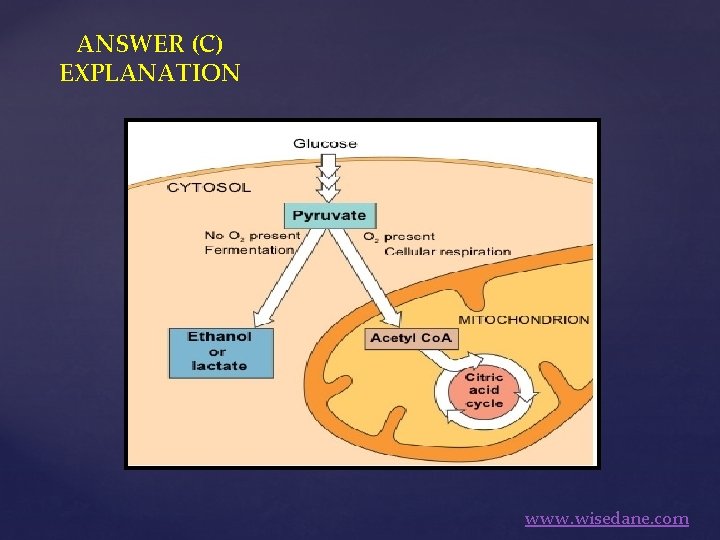
ANSWER (C) EXPLANATION www. wisedane. com
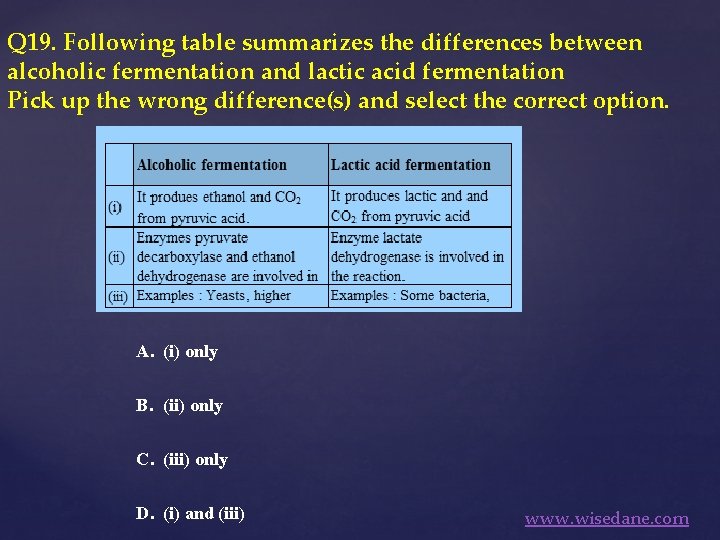
Q 19. Following table summarizes the differences between alcoholic fermentation and lactic acid fermentation Pick up the wrong difference(s) and select the correct option. A. (i) only B. (ii) only C. (iii) only D. (i) and (iii) www. wisedane. com
ANSWER (A) EXPLANATION www. wisedane. com
Q 20. When one molecule of ATP is disintegrated, what amount of energy is liberated? (a) 8 kcal (b) 38 kcal (c) 7 kcal (d) 4. 5 kcal. www. wisedane. com
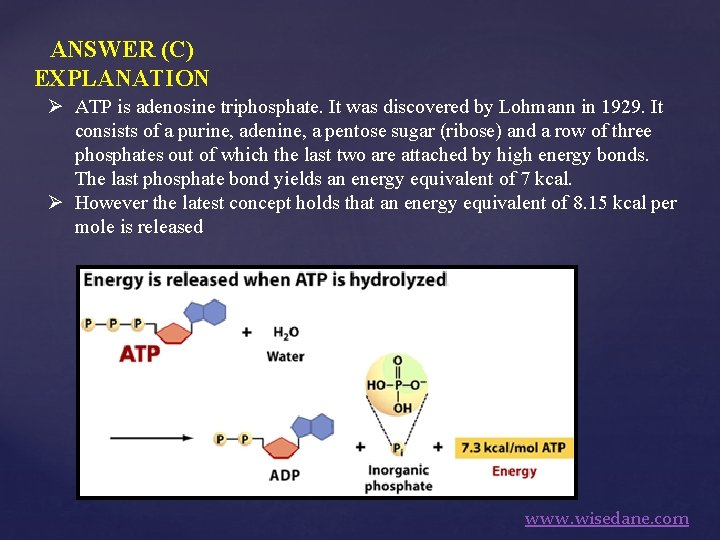
ANSWER (C) EXPLANATION Ø ATP is adenosine triphosphate. It was discovered by Lohmann in 1929. It consists of a purine, adenine, a pentose sugar (ribose) and a row of three phosphates out of which the last two are attached by high energy bonds. The last phosphate bond yields an energy equivalent of 7 kcal. Ø However the latest concept holds that an energy equivalent of 8. 15 kcal per mole is released www. wisedane. com

More Mcq’s For All Subject Please Log on to http: //www. wisedane. com/ Exclusive Portal For Online Coaching NEET AIIMS JIPMER
- Slides: 41