
OBJECTIVE QUESTIONS FOR NEET AIIMS JIPMER www wisedane

OBJECTIVE QUESTIONS FOR NEET AIIMS JIPMER www. wisedane. com
CHEMISTRY ATOMIC STRUCTURE MCQ’S SET 1 www. wisedane. com
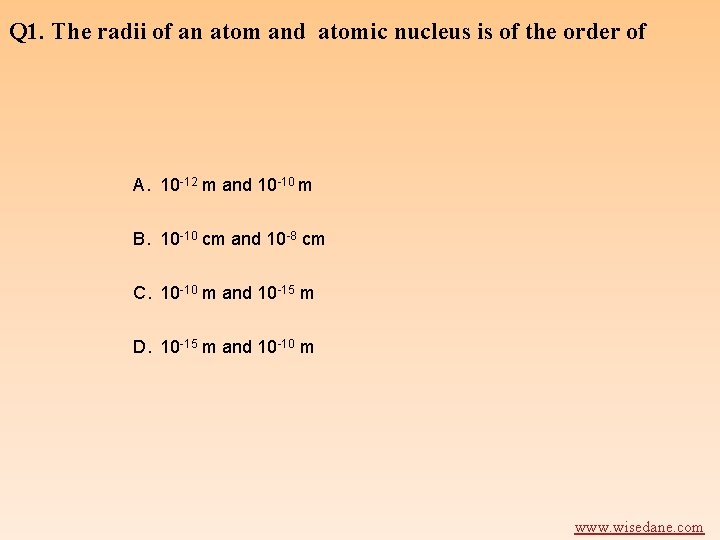
Q 1. The radii of an atom and atomic nucleus is of the order of A. 10 -12 m and 10 -10 m B. 10 -10 cm and 10 -8 cm C. 10 -10 m and 10 -15 m D. 10 -15 m and 10 -10 m www. wisedane. com
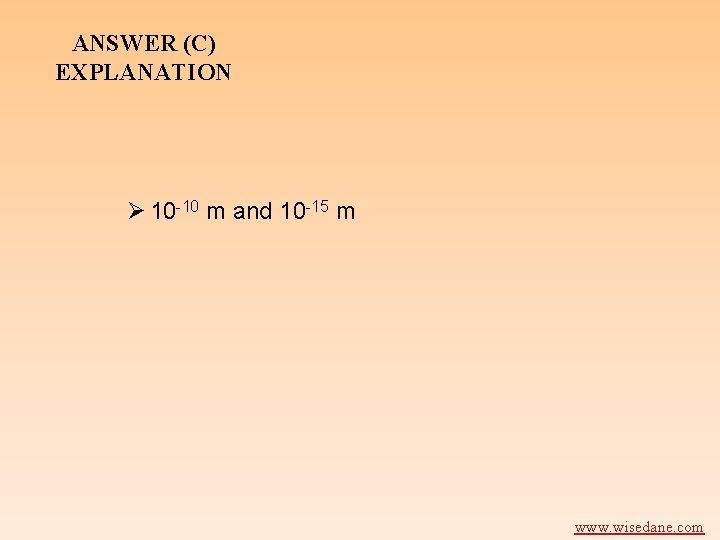
ANSWER (C) EXPLANATION Ø 10 -10 m and 10 -15 m www. wisedane. com
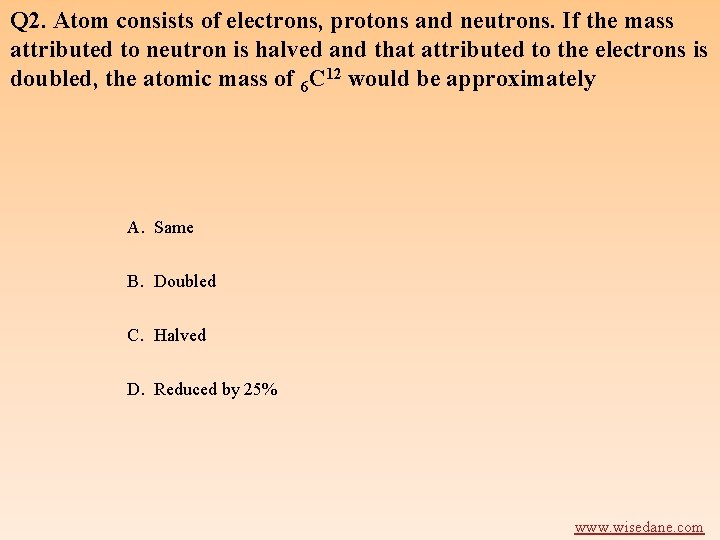
Q 2. Atom consists of electrons, protons and neutrons. If the mass attributed to neutron is halved and that attributed to the electrons is doubled, the atomic mass of 6 C 12 would be approximately A. Same B. Doubled C. Halved D. Reduced by 25% www. wisedane. com
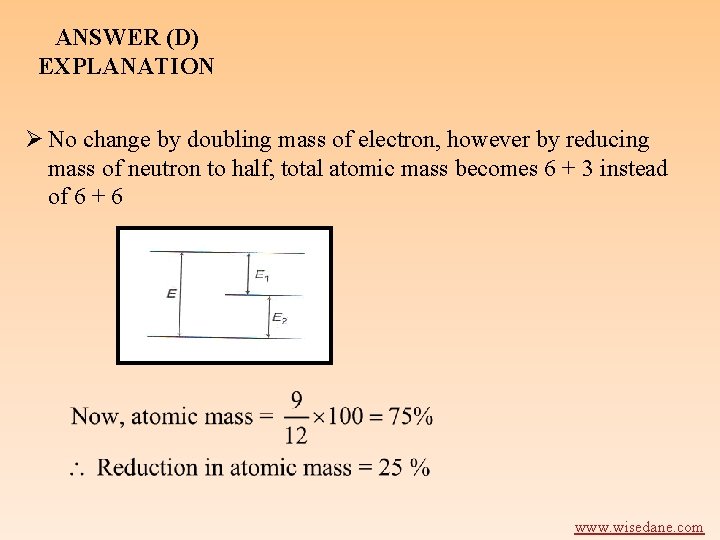
ANSWER (D) EXPLANATION Ø No change by doubling mass of electron, however by reducing mass of neutron to half, total atomic mass becomes 6 + 3 instead of 6 + 6 www. wisedane. com
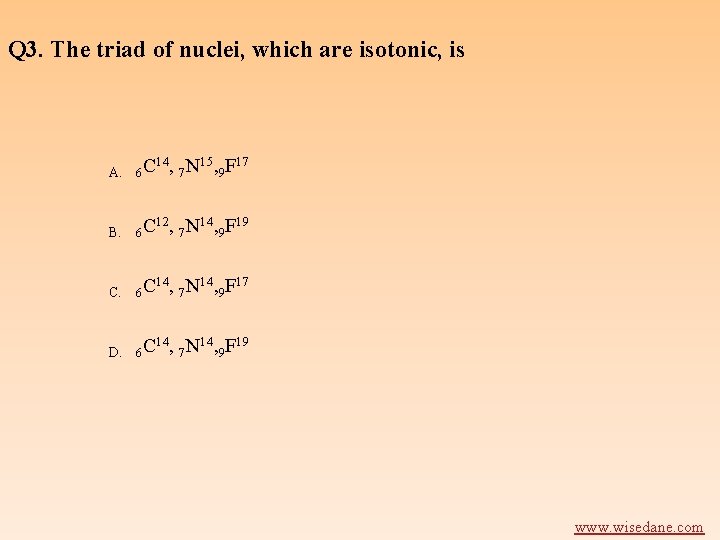
Q 3. The triad of nuclei, which are isotonic, is A. 6 C 14, 7 N 15, 9 F 17 B. 6 C 12, 7 N 14, 19 C. 6 C 14, 7 N 14, 17 D. 6 C 14, 7 N 14, 19 9 F 9 F 9 F www. wisedane. com
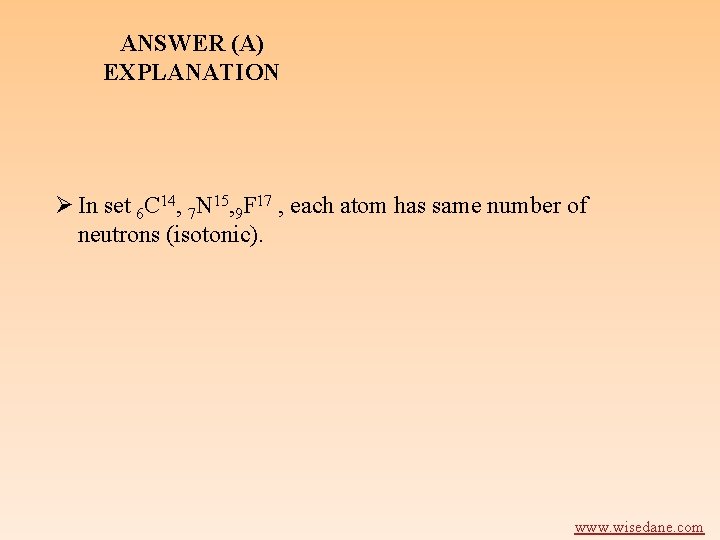
ANSWER (A) EXPLANATION Ø In set 6 C 14, 7 N 15, 9 F 17 , each atom has same number of neutrons (isotonic). www. wisedane. com
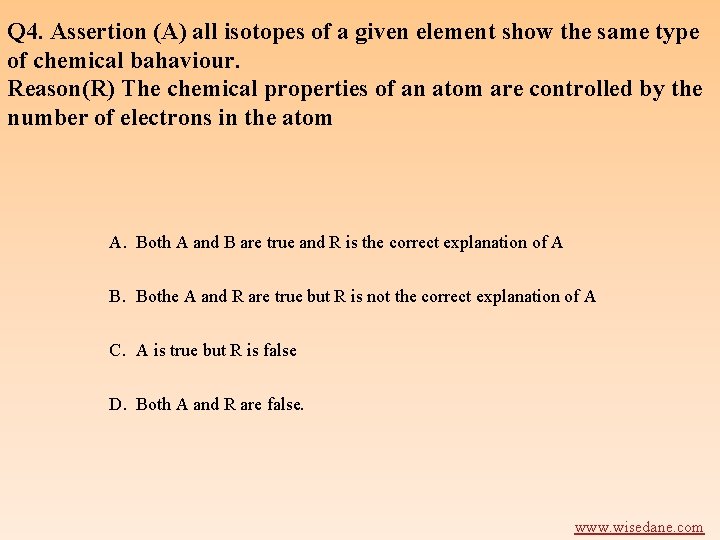
Q 4. Assertion (A) all isotopes of a given element show the same type of chemical bahaviour. Reason(R) The chemical properties of an atom are controlled by the number of electrons in the atom A. Both A and B are true and R is the correct explanation of A B. Bothe A and R are true but R is not the correct explanation of A C. A is true but R is false D. Both A and R are false. www. wisedane. com
ANSWER (A) EXPLANATION Ø Isotopes have the same atomic number i. e. same number of electrons which are responsible for their chemical behavior. Hence, these exhibit similar chemical properties. www. wisedane. com
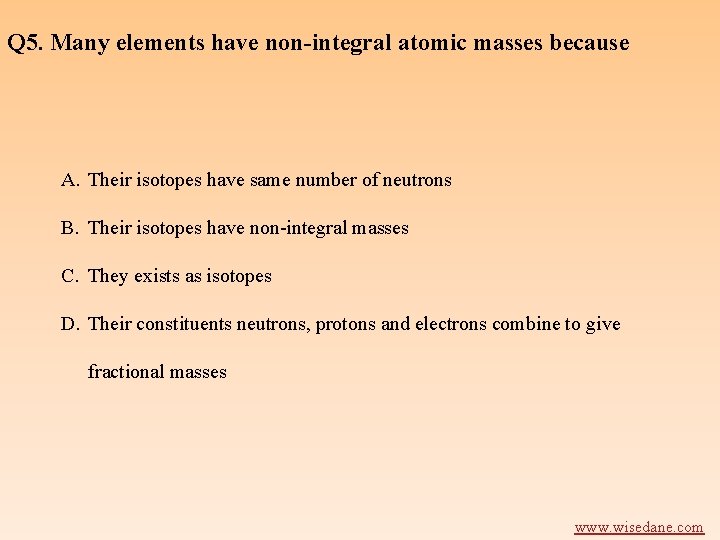
Q 5. Many elements have non-integral atomic masses because A. Their isotopes have same number of neutrons B. Their isotopes have non-integral masses C. They exists as isotopes D. Their constituents neutrons, protons and electrons combine to give fractional masses www. wisedane. com
ANSWER (C) EXPLANATION Ø Many elements have several isotopes, for such elements atomic mass is average of the atomic masses of different isotopes, which is usually non – integral. www. wisedane. com
www. wisedane. com
ANSWER (C) EXPLANATION www. wisedane. com
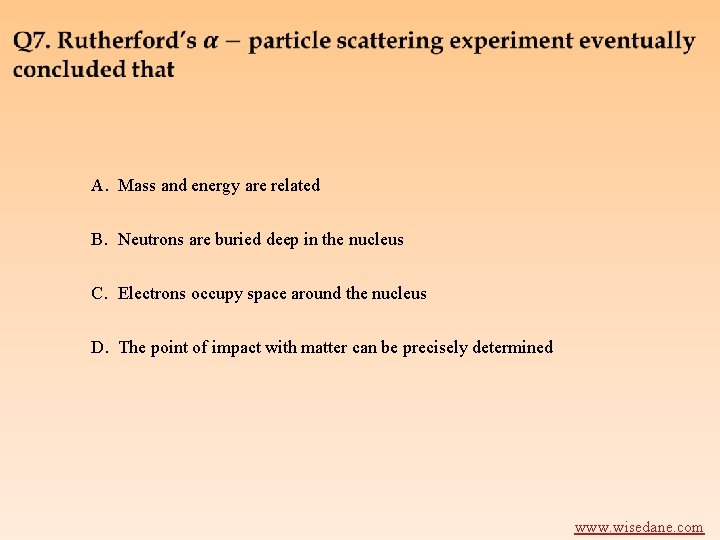
A. Mass and energy are related B. Neutrons are buried deep in the nucleus C. Electrons occupy space around the nucleus D. The point of impact with matter can be precisely determined www. wisedane. com
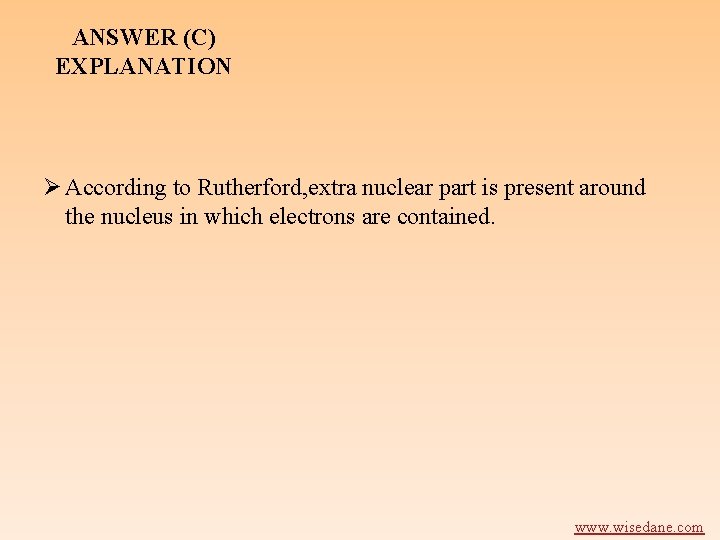
ANSWER (C) EXPLANATION Ø According to Rutherford, extra nuclear part is present around the nucleus in which electrons are contained. www. wisedane. com
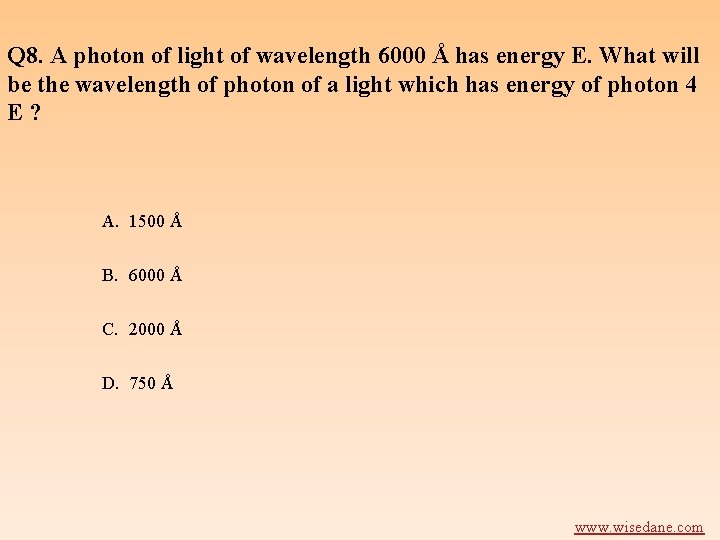
Q 8. A photon of light of wavelength 6000 Å has energy E. What will be the wavelength of photon of a light which has energy of photon 4 E? A. 1500 Å B. 6000 Å C. 2000 Å D. 750 Å www. wisedane. com
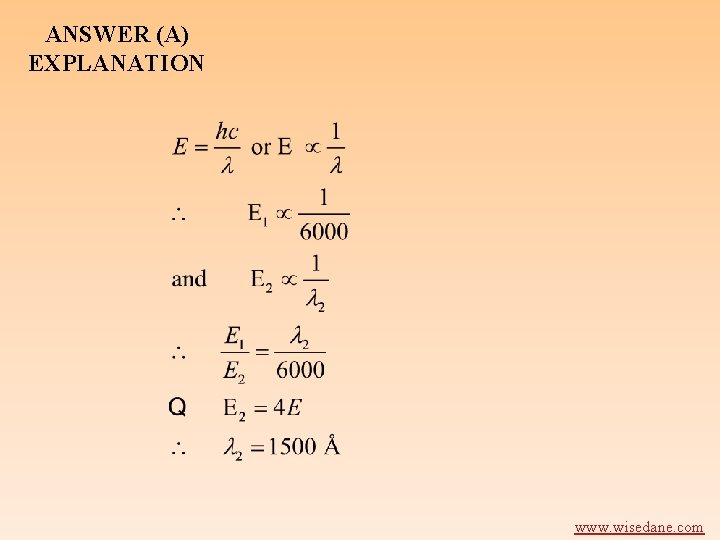
ANSWER (A) EXPLANATION www. wisedane. com
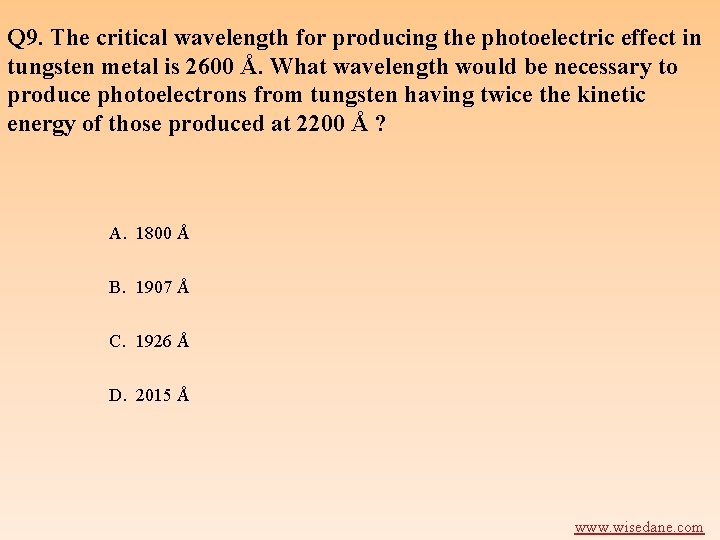
Q 9. The critical wavelength for producing the photoelectric effect in tungsten metal is 2600 Å. What wavelength would be necessary to produce photoelectrons from tungsten having twice the kinetic energy of those produced at 2200 Å ? A. 1800 Å B. 1907 Å C. 1926 Å D. 2015 Å www. wisedane. com
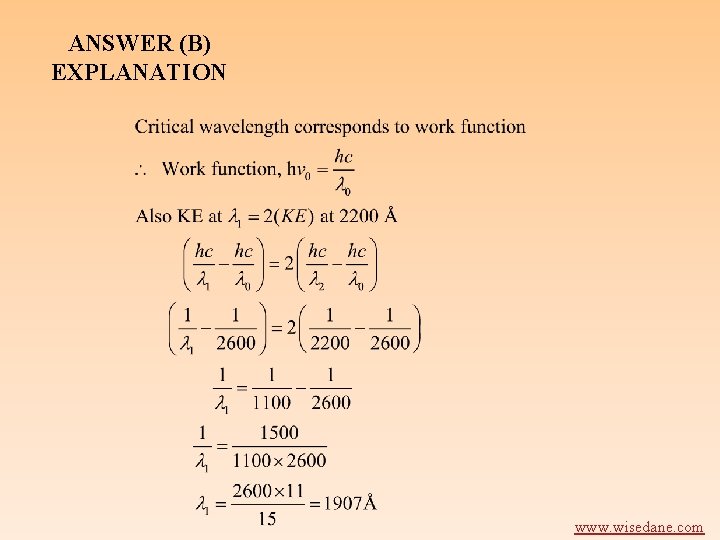
ANSWER (B) EXPLANATION www. wisedane. com
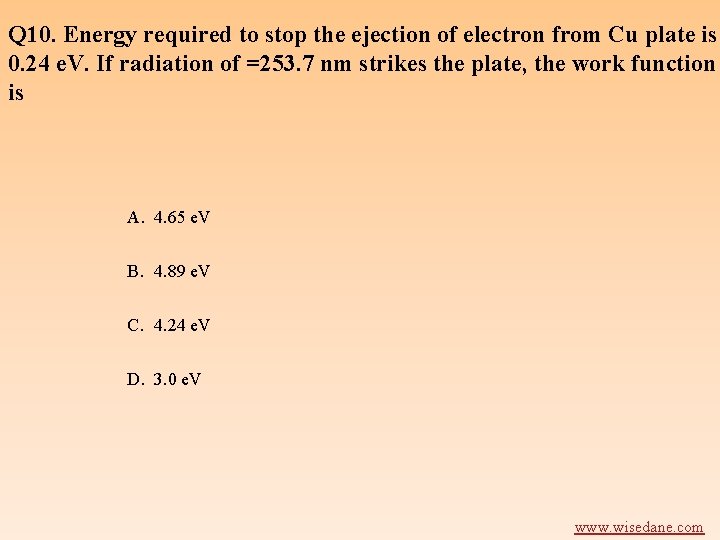
Q 10. Energy required to stop the ejection of electron from Cu plate is 0. 24 e. V. If radiation of =253. 7 nm strikes the plate, the work function is A. 4. 65 e. V B. 4. 89 e. V C. 4. 24 e. V D. 3. 0 e. V www. wisedane. com
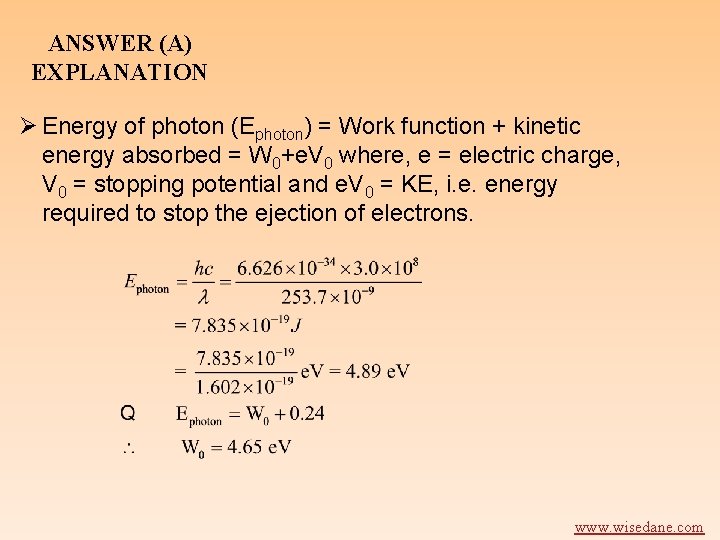
ANSWER (A) EXPLANATION Ø Energy of photon (Ephoton) = Work function + kinetic energy absorbed = W 0+e. V 0 where, e = electric charge, V 0 = stopping potential and e. V 0 = KE, i. e. energy required to stop the ejection of electrons. www. wisedane. com
www. wisedane. com
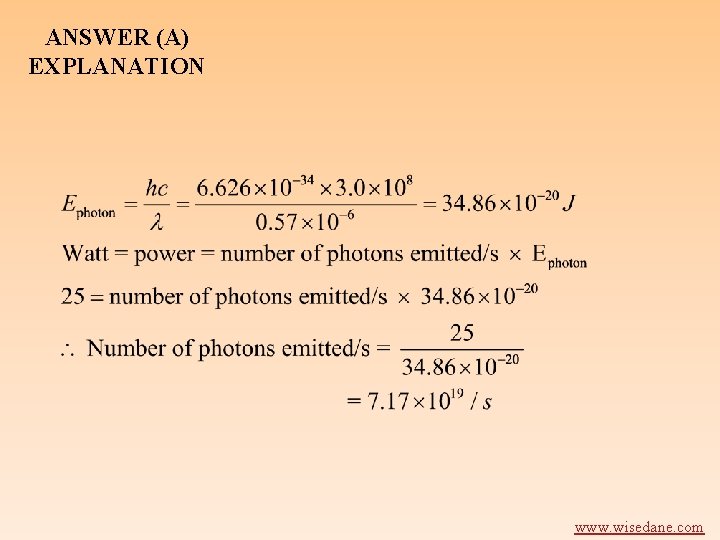
ANSWER (A) EXPLANATION www. wisedane. com
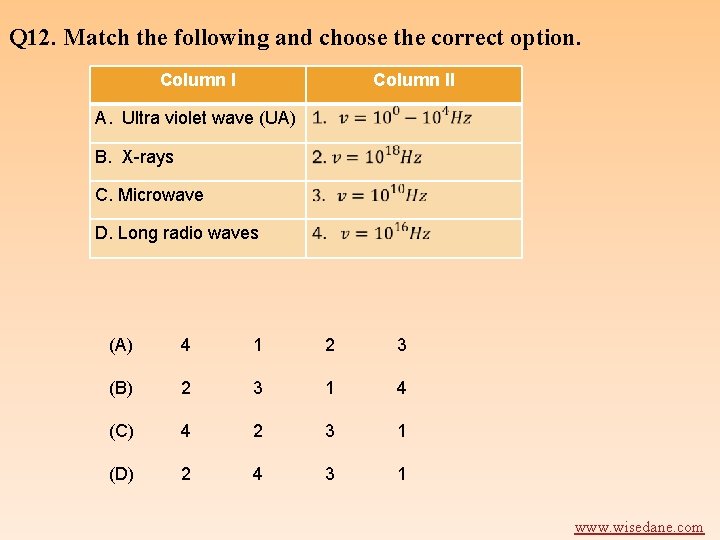
Q 12. Match the following and choose the correct option. Column II A. Ultra violet wave (UA) B. X-rays C. Microwave D. Long radio waves (A) 4 1 2 3 (B) 2 3 1 4 (C) 4 2 3 1 (D) 2 4 3 1 www. wisedane. com
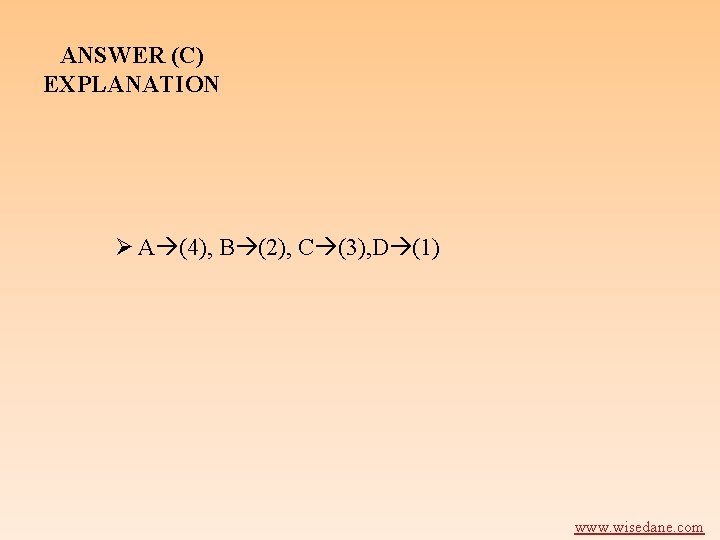
ANSWER (C) EXPLANATION Ø A (4), B (2), C (3), D (1) www. wisedane. com
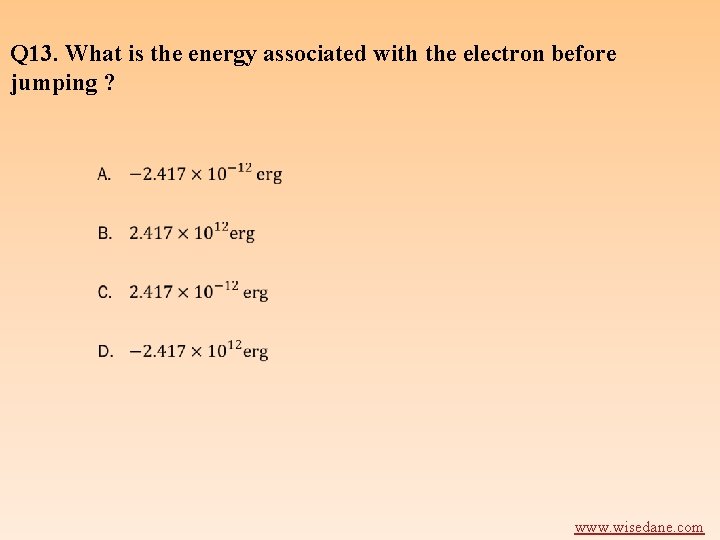
Q 13. What is the energy associated with the electron before jumping ? www. wisedane. com
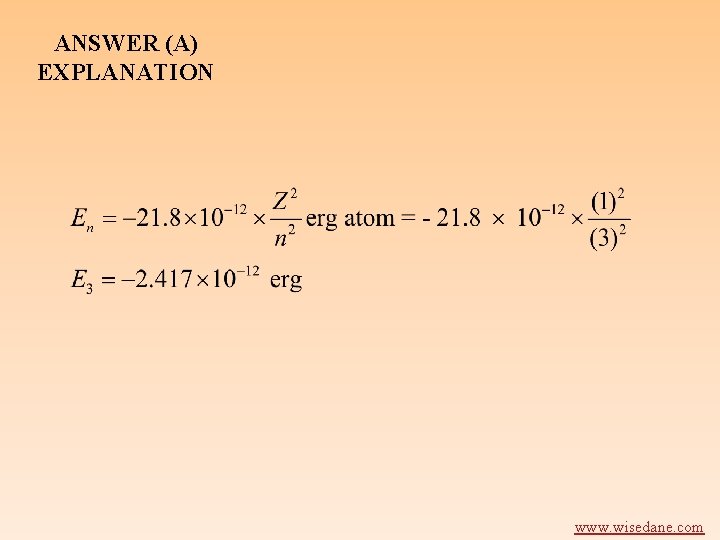
ANSWER (A) EXPLANATION www. wisedane. com
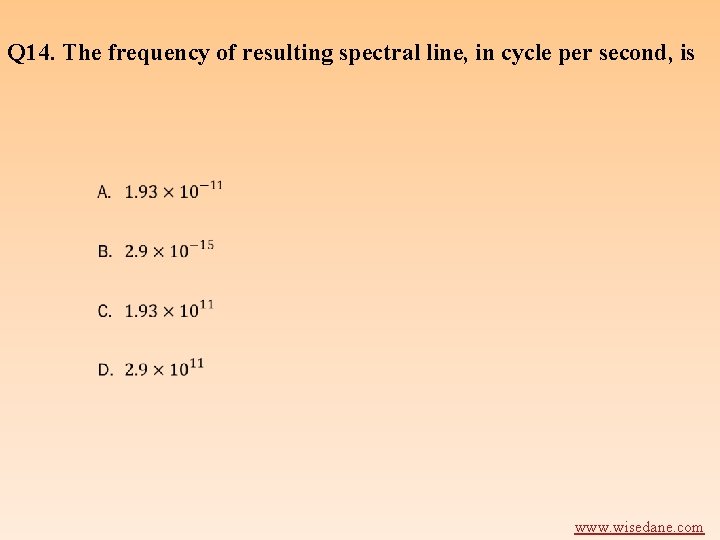
Q 14. The frequency of resulting spectral line, in cycle per second, is www. wisedane. com
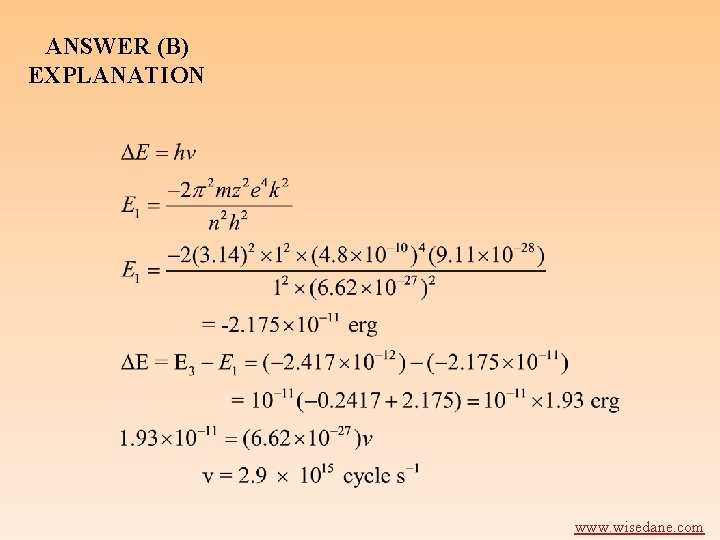
ANSWER (B) EXPLANATION www. wisedane. com
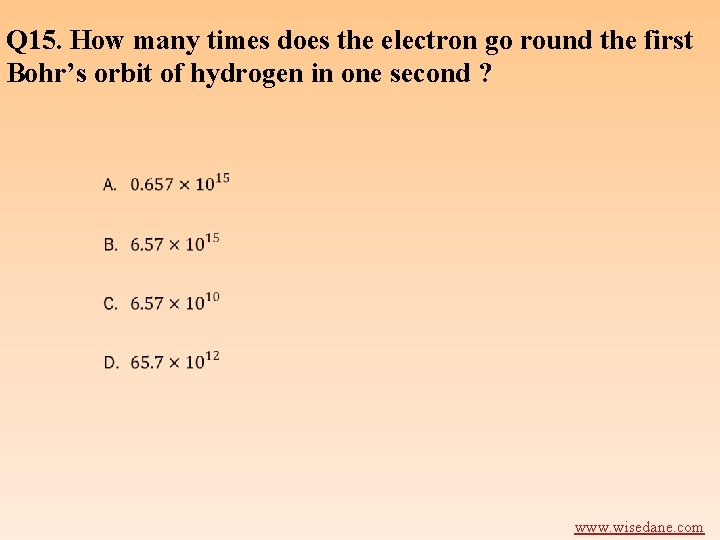
Q 15. How many times does the electron go round the first Bohr’s orbit of hydrogen in one second ? www. wisedane. com
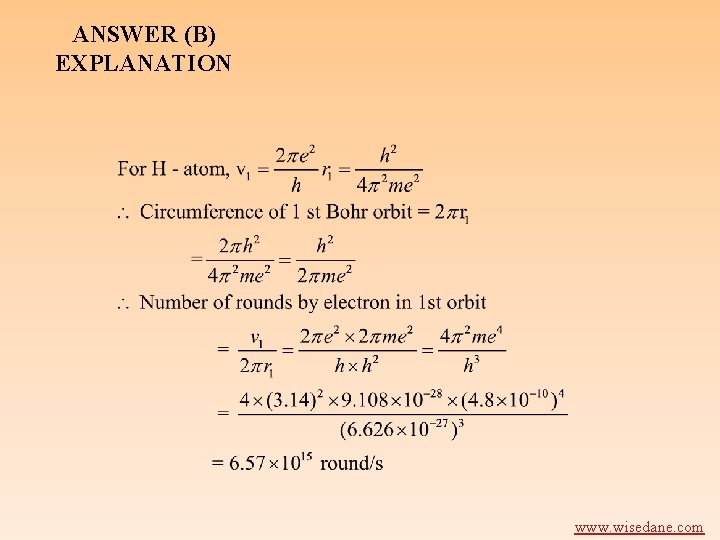
ANSWER (B) EXPLANATION www. wisedane. com
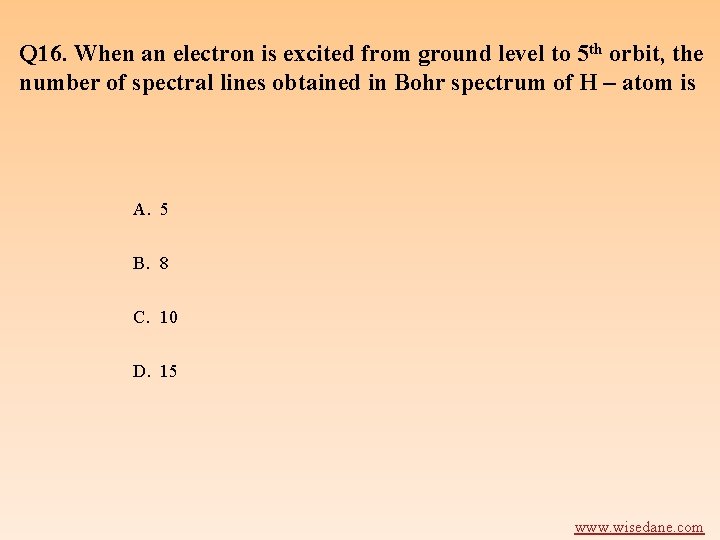
Q 16. When an electron is excited from ground level to 5 th orbit, the number of spectral lines obtained in Bohr spectrum of H – atom is A. 5 B. 8 C. 10 D. 15 www. wisedane. com
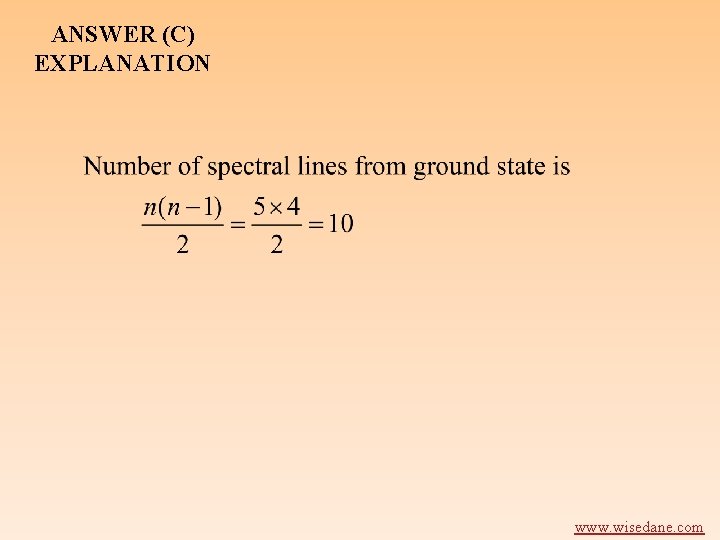
ANSWER (C) EXPLANATION www. wisedane. com
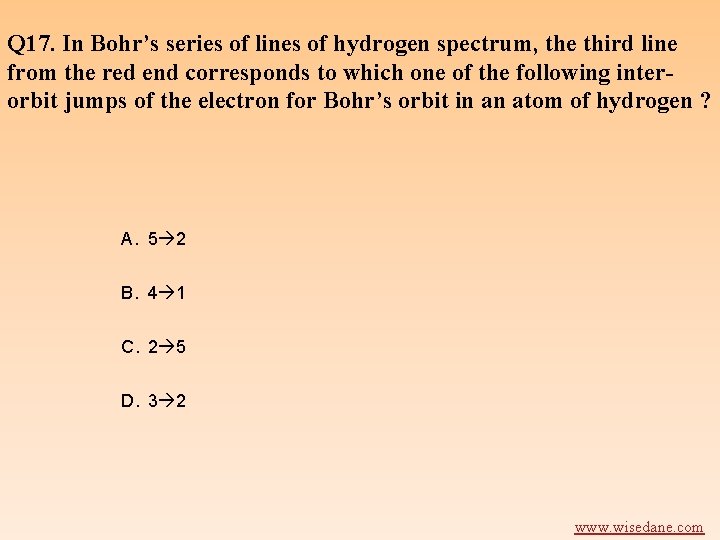
Q 17. In Bohr’s series of lines of hydrogen spectrum, the third line from the red end corresponds to which one of the following interorbit jumps of the electron for Bohr’s orbit in an atom of hydrogen ? A. 5 2 B. 4 1 C. 2 5 D. 3 2 www. wisedane. com
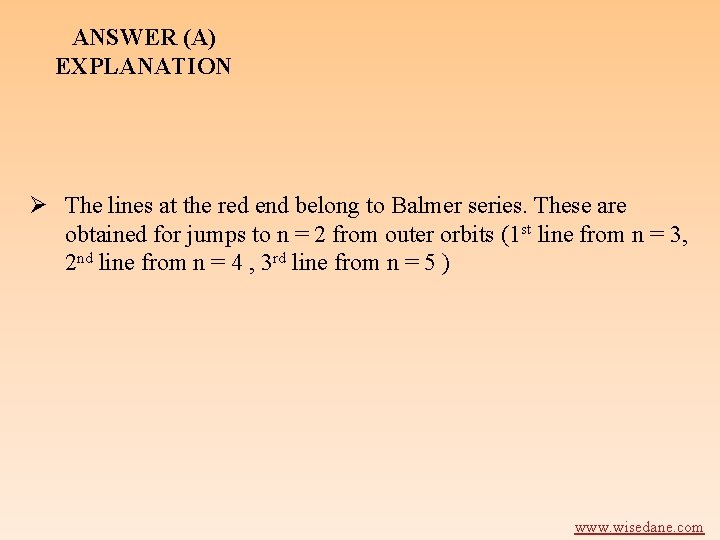
ANSWER (A) EXPLANATION Ø The lines at the red end belong to Balmer series. These are obtained for jumps to n = 2 from outer orbits (1 st line from n = 3, 2 nd line from n = 4 , 3 rd line from n = 5 ) www. wisedane. com
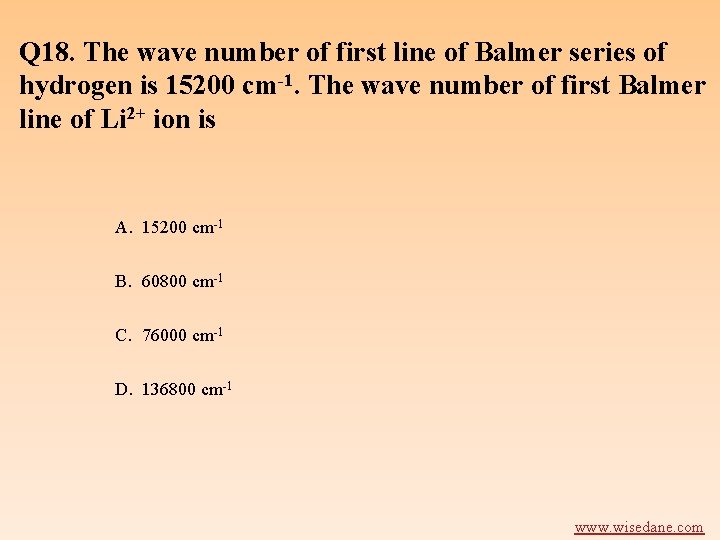
Q 18. The wave number of first line of Balmer series of hydrogen is 15200 cm-1. The wave number of first Balmer line of Li 2+ ion is A. 15200 cm-1 B. 60800 cm-1 C. 76000 cm-1 D. 136800 cm-1 www. wisedane. com
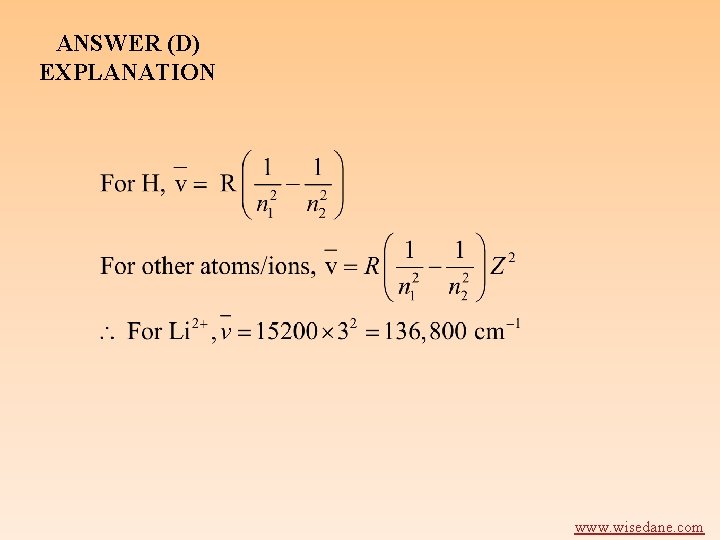
ANSWER (D) EXPLANATION www. wisedane. com
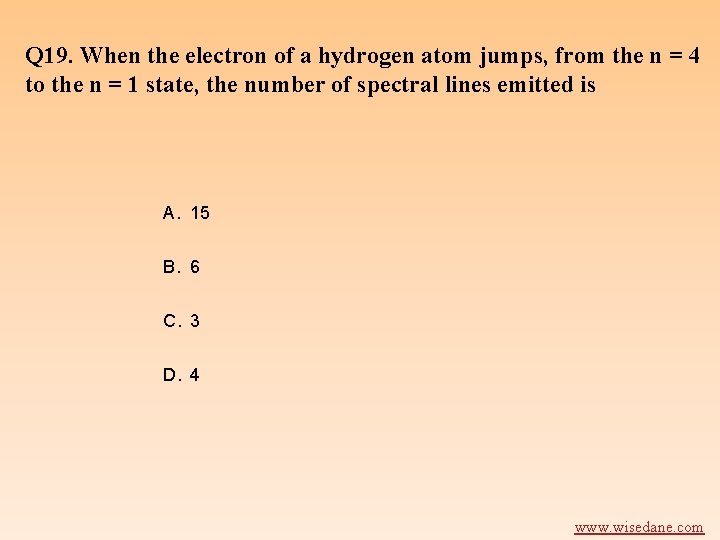
Q 19. When the electron of a hydrogen atom jumps, from the n = 4 to the n = 1 state, the number of spectral lines emitted is A. 15 B. 6 C. 3 D. 4 www. wisedane. com
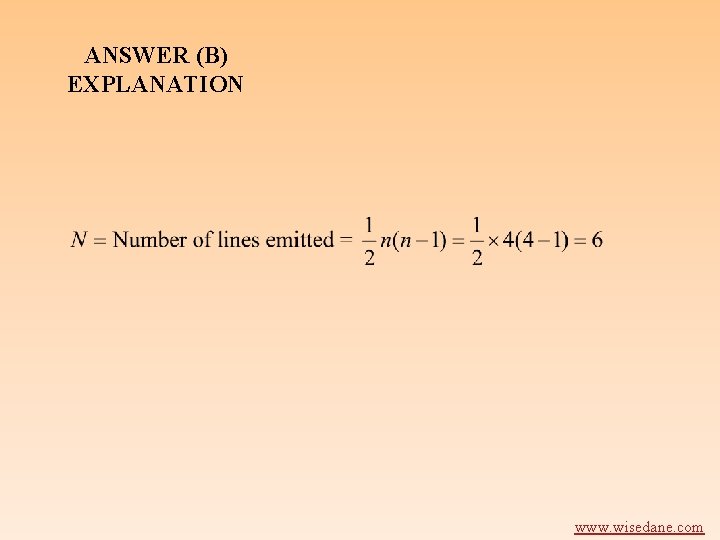
ANSWER (B) EXPLANATION www. wisedane. com
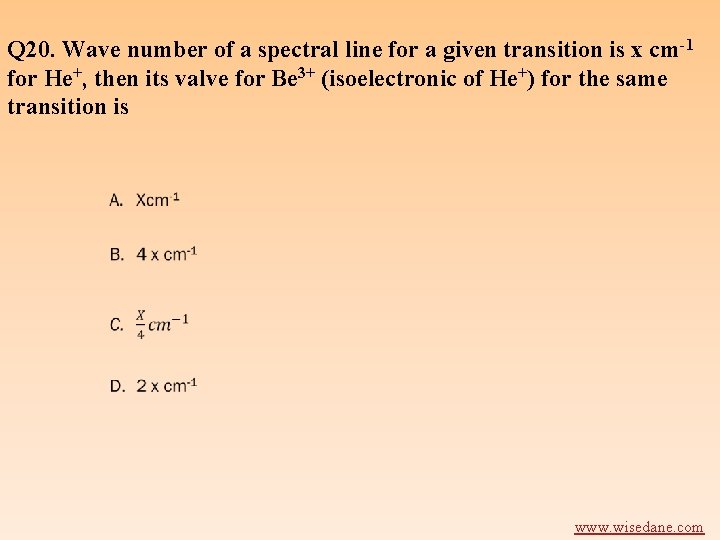
Q 20. Wave number of a spectral line for a given transition is x cm-1 for He+, then its valve for Be 3+ (isoelectronic of He+) for the same transition is www. wisedane. com
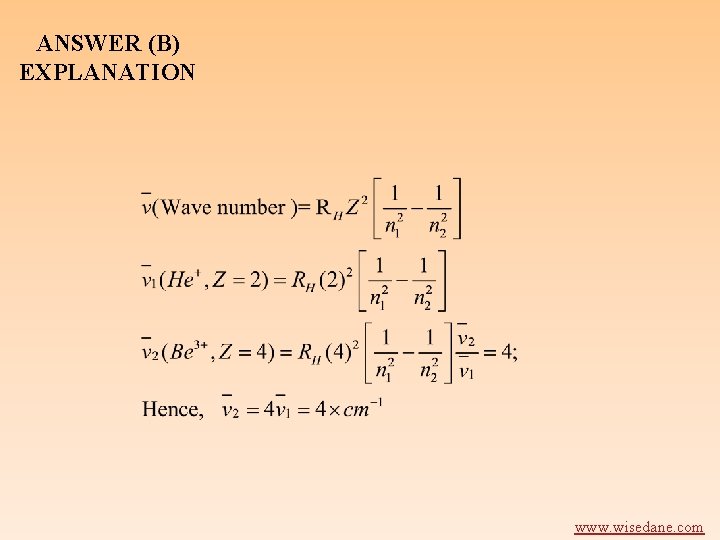
ANSWER (B) EXPLANATION www. wisedane. com
- Slides: 42