
Objective Name and label cell organelles on diagrams
Objective • Name and label cell organelles on diagrams and models • List membranous and non-membranous organelles • Match or select from a given list, functions of cell organelles • Describe membrane transport processes • Interpret the role of the transport processes in cell homeostasis in your own words • Sequence and describe the phases of the Cell cycle and Somatic cell division ; match and select from a list with 100% accuracy • Name and label diagrams Copyright © 2006 Pearson Education, Inc. , publishing as Benjamin Cummings
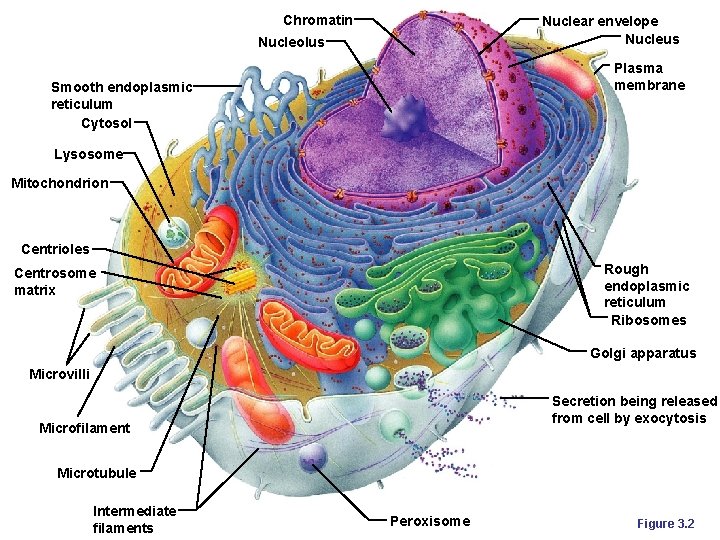
Chromatin Nuclear envelope Nucleus Nucleolus Plasma membrane Smooth endoplasmic reticulum Cytosol Lysosome Mitochondrion Centrioles Rough endoplasmic reticulum Ribosomes Centrosome matrix Golgi apparatus Microvilli Secretion being released from cell by exocytosis Microfilament Microtubule Intermediate filaments Copyright © 2006 Pearson Education, Inc. , publishing as Benjamin Cummings Peroxisome Figure 3. 2

Plasma Membrane § Separates intracellular fluids from extracellular fluids § Contains glycoprotein that provides: § Highly specific biological markers § These markers function in cells-cell recognition Copyright © 2006 Pearson Education, Inc. , publishing as Benjamin Cummings
Fluid Mosaic Model of the Plasma Membrane § Double bilayer of lipids § With imbedded, dispersed proteins § Bilayer lipid consists of: § § Phospholipids: have (bipoles): § hydrophobic tail (fatty acids) § hydrophilic head (phosphate-containing) Glycolipids: § § lipids with bound carbohydrate Cholesterol Copyright © 2006 Pearson Education, Inc. , publishing as Benjamin Cummings
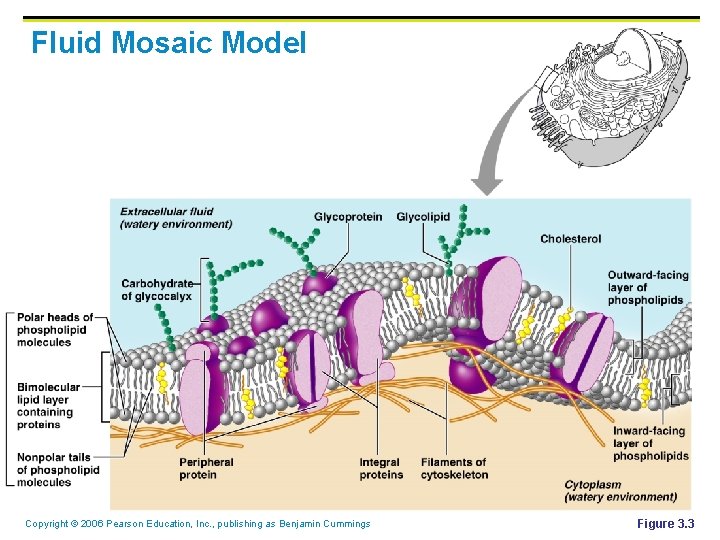
Fluid Mosaic Model Copyright © 2006 Pearson Education, Inc. , publishing as Benjamin Cummings Figure 3. 3
Types of membrane proteins 1 - Integral Proteins: § Firmly inserted into the bilayer § Most are transmembraneous (protrude on both sides) § All have both hydrophilic & hydrophobic regions enabling them to interact with: § Nonpolar inner lipid tails § Water on both sides of the bilayer Copyright © 2006 Pearson Education, Inc. , publishing as Benjamin Cummings
Types of membrane proteins 2 - Peripheral Proteins: § Not embedded in the lipid § Losely attached to: § § § Integral proteins, or § Membrane lipids Easily removed w/out membrane disruption Include a network of filaments that support the cell membrane from the cytoplasmic side Copyright © 2006 Pearson Education, Inc. , publishing as Benjamin Cummings
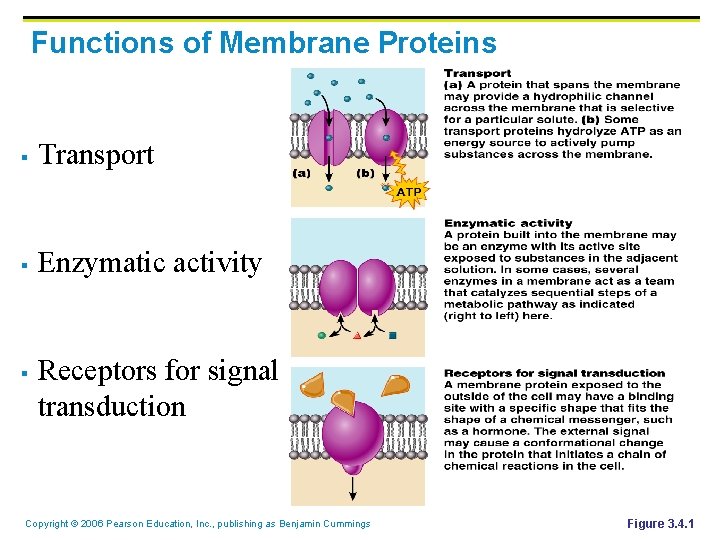
Functions of Membrane Proteins § Transport § Enzymatic activity § Receptors for signal transduction Copyright © 2006 Pearson Education, Inc. , publishing as Benjamin Cummings Figure 3. 4. 1
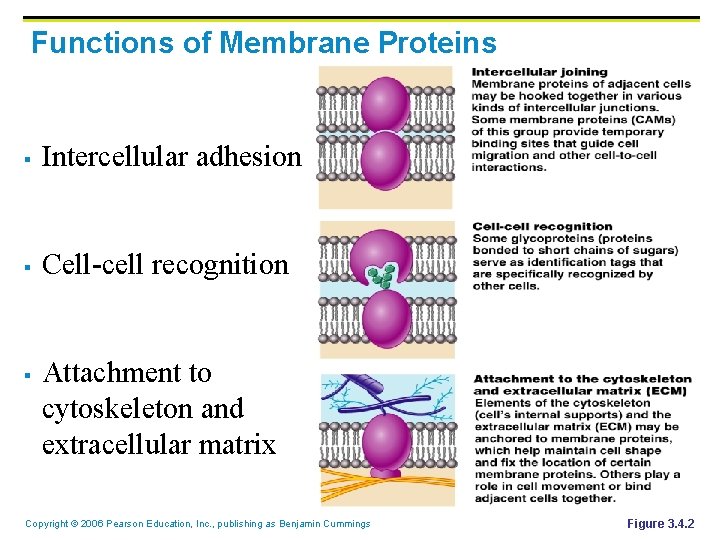
Functions of Membrane Proteins § Intercellular adhesion § Cell-cell recognition § Attachment to cytoskeleton and extracellular matrix Copyright © 2006 Pearson Education, Inc. , publishing as Benjamin Cummings Figure 3. 4. 2

Cytoplasm § § Material between the plasma membrane and the nucleus. Includes: § Cytosol § Organelles § Inclusions Copyright © 2006 Pearson Education, Inc. , publishing as Benjamin Cummings

Cytoplasm § Cytosol: § § Cytoplasmic organelles: § § largely water with dissolved protein, salts, sugars, and other solutes metabolic machinery of the cell Inclusions: § chemical substances such as glycosomes (glycogen granules) and pigments Copyright © 2006 Pearson Education, Inc. , publishing as Benjamin Cummings
Cytoplasmic Organelles § Specialized cellular compartments § Membranous organelles: § § Mitochondria, peroxisomes, lysosomes, endoplasmic reticulum, and Golgi apparatus Nonmembranous organelles: § Cytoskeleton, centrioles, and ribosomes Copyright © 2006 Pearson Education, Inc. , publishing as Benjamin Cummings
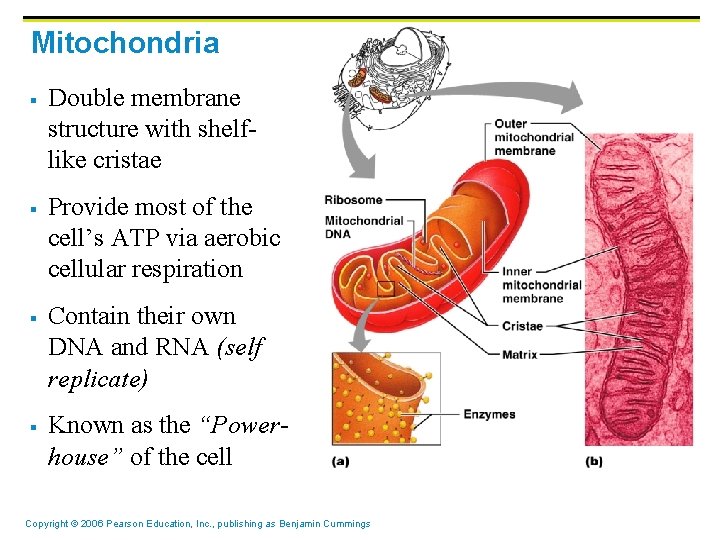
Mitochondria § § Double membrane structure with shelflike cristae Provide most of the cell’s ATP via aerobic cellular respiration Contain their own DNA and RNA (self replicate) Known as the “Powerhouse” of the cell Copyright © 2006 Pearson Education, Inc. , publishing as Benjamin Cummings
Ribosomes § Granules composed of protein and an RNA (r. RNA) § Made of two subunits (large and small subunits) § Site of protein synthesis § Found in two forms: § Free ribosomes: § § Synthesize soluble proteins that function in cytosol Membrane-bound ribosomes: § Synthesize proteins to be: § Part of the membranes, or § Exported from the cell. Copyright © 2006 Pearson Education, Inc. , publishing as Benjamin Cummings
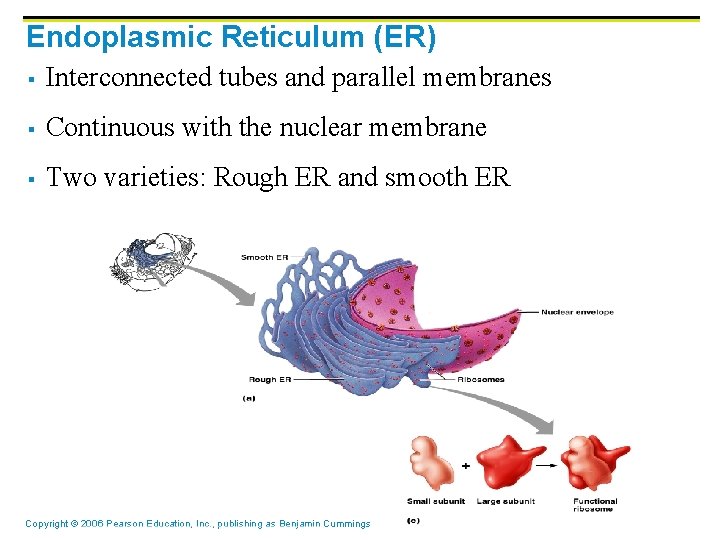
Endoplasmic Reticulum (ER) § Interconnected tubes and parallel membranes § Continuous with the nuclear membrane § Two varieties: Rough ER and smooth ER Copyright © 2006 Pearson Education, Inc. , publishing as Benjamin Cummings
Rough (ER) § External surface studded with ribosomes § Its ribosomes manufacture proteins § Storage and transport site for newly synthesized protein § It is, therefore, called cell’s “membrane factory” Copyright © 2006 Pearson Education, Inc. , publishing as Benjamin Cummings
Smooth ER § Looping network of tubules communication with r. ER § Does not participate in protein synthesis § Its enzymes catalyze reactions in various organs including : § Liver, testes, intestine, kidneys, & muscles § In the liver § Lipid and cholesterol metabolism § Breakdown of glycogen § Detoxification of drugs (also in the kidneys) Copyright © 2006 Pearson Education, Inc. , publishing as Benjamin Cummings
Golgi Apparatus § Stacked and flattened membranous sacs § Receives ER transport vesicles that fuse at its cis face § Modifies, concentrates, and packages proteins into membranous vesicles § Delivers processed proteins through its trans face § Secretory vesicles leave trans face to 1 of 3 pathways: § Release of content from the cell § Incorporation into the plasma membrane § Formation of lysosomes Copyright © 2006 Pearson Education, Inc. , publishing as Benjamin Cummings
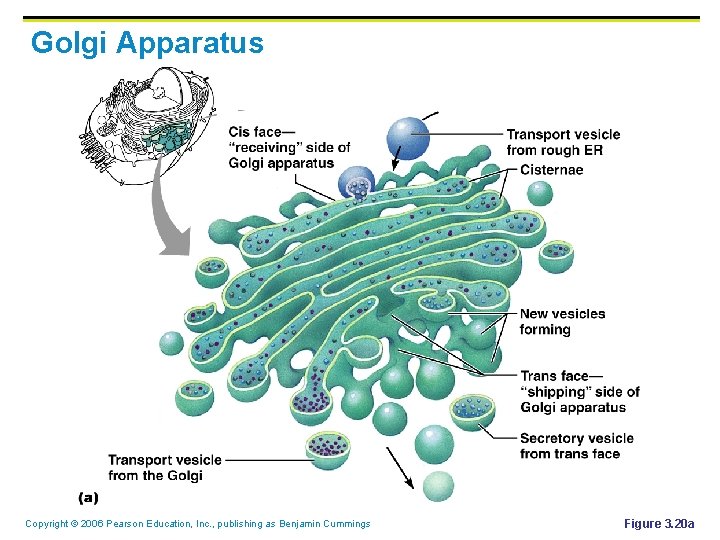
Golgi Apparatus Copyright © 2006 Pearson Education, Inc. , publishing as Benjamin Cummings Figure 3. 20 a
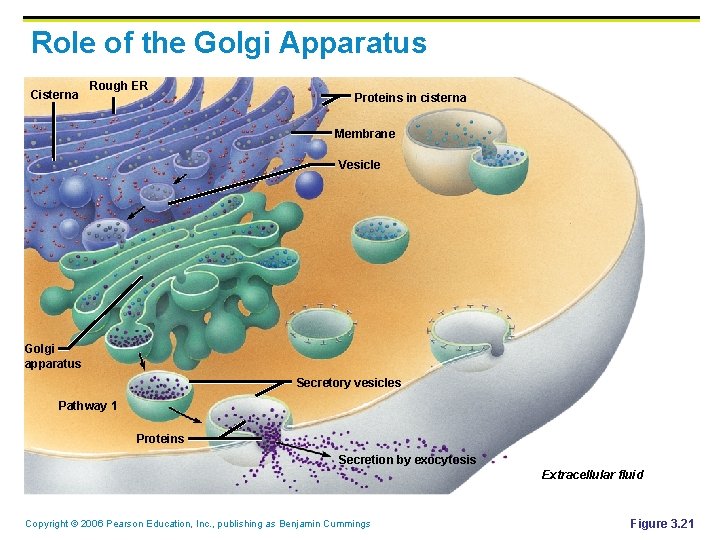
Role of the Golgi Apparatus Cisterna Rough ER Proteins in cisterna Membrane Vesicle Golgi apparatus Secretory vesicles Pathway 1 Proteins Secretion by exocytosis Extracellular fluid Copyright © 2006 Pearson Education, Inc. , publishing as Benjamin Cummings Figure 3. 21
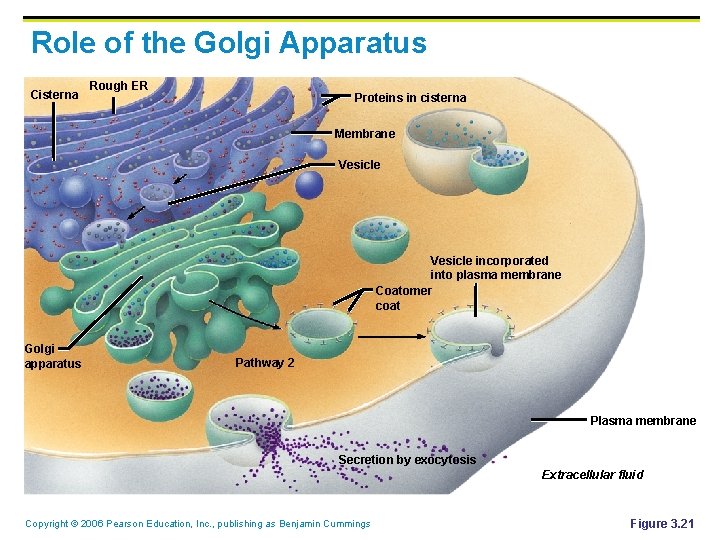
Role of the Golgi Apparatus Cisterna Rough ER Proteins in cisterna Membrane Vesicle incorporated into plasma membrane Coatomer coat Golgi apparatus Pathway 2 Plasma membrane Secretion by exocytosis Extracellular fluid Copyright © 2006 Pearson Education, Inc. , publishing as Benjamin Cummings Figure 3. 21
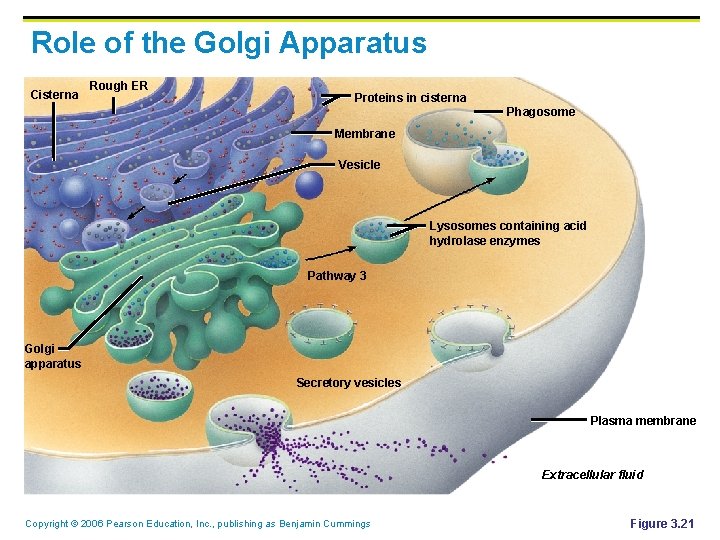
Role of the Golgi Apparatus Cisterna Rough ER Proteins in cisterna Phagosome Membrane Vesicle Lysosomes containing acid hydrolase enzymes Pathway 3 Golgi apparatus Secretory vesicles Plasma membrane Extracellular fluid Copyright © 2006 Pearson Education, Inc. , publishing as Benjamin Cummings Figure 3. 21
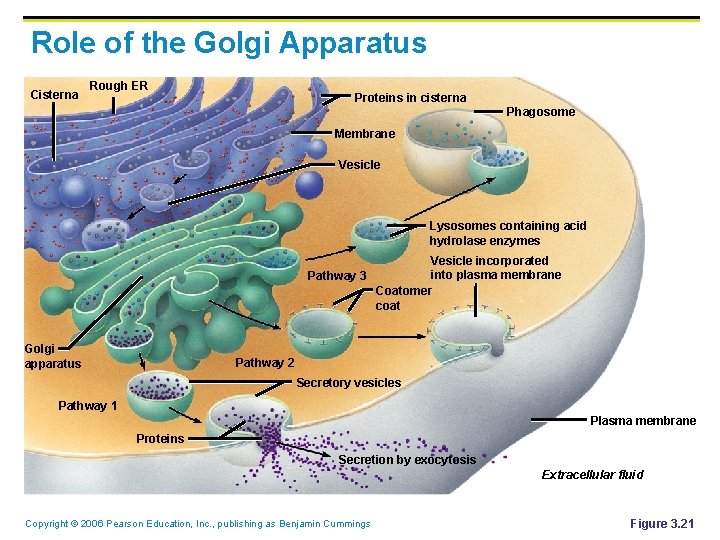
Role of the Golgi Apparatus Cisterna Rough ER Proteins in cisterna Phagosome Membrane Vesicle Lysosomes containing acid hydrolase enzymes Pathway 3 Golgi apparatus Vesicle incorporated into plasma membrane Coatomer coat Pathway 2 Secretory vesicles Pathway 1 Plasma membrane Proteins Secretion by exocytosis Extracellular fluid Copyright © 2006 Pearson Education, Inc. , publishing as Benjamin Cummings Figure 3. 21
Lysosomes § Spherical membranous bags containing digestive enzymes § Perform metabolic functions (glycogen breakdown) § Digest ingested bacteria, viruses, and toxins § Degrade nonfunctional organelles and nonuseful tissue § Breakdown bone to release Ca 2+ § If leaked can destroy the cell § Referred to as “suicide sacs” or “graveyard of the cell” Copyright © 2006 Pearson Education, Inc. , publishing as Benjamin Cummings
Peroxisomes § Membranous sacs containing oxidases and catalases § Particularly abundant in liver and kidney cells § Oxidases detoxify harmful and toxic substances § They convert dangerous free radicals to H 2 O 2 § Catalases convert H 2 O 2 to water § Free radicals: § Highly reactive chemicals with free electrons (O 2–) § They can scramble structure of biological molecules § Normal by-products of cellular metabolism Copyright © 2006 Pearson Education, Inc. , publishing as Benjamin Cummings
Cytoskeleton § The “skeleton” of the cell § Dynamic, elaborate series of rods § Run through the cytosol § Consists of: § Microtubules § Microfilaments § Intermediate filaments Copyright © 2006 Pearson Education, Inc. , publishing as Benjamin Cummings
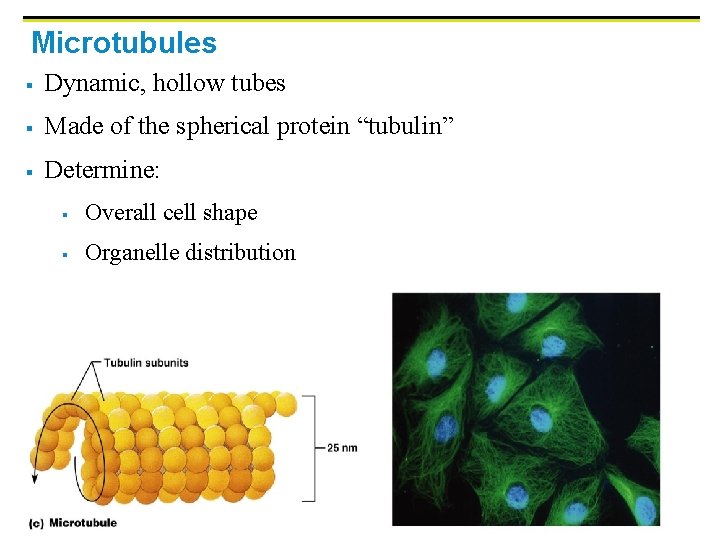
Microtubules § Dynamic, hollow tubes § Made of the spherical protein “tubulin” § Determine: § Overall cell shape § Organelle distribution Copyright © 2006 Pearson Education, Inc. , publishing as Benjamin Cummings
Intermediate Micro and Filaments § § Intermediate fillaments: § Tough, insoluble protein fibers § With high tensile strength § Resist pulling forces on the cell Microfilaments: § § § Dynamic strands of the protein “actin” Attached to the cytoplasmic side of the plasma membrane Braces and strengthens the cell surface Copyright © 2006 Pearson Education, Inc. , publishing as Benjamin Cummings
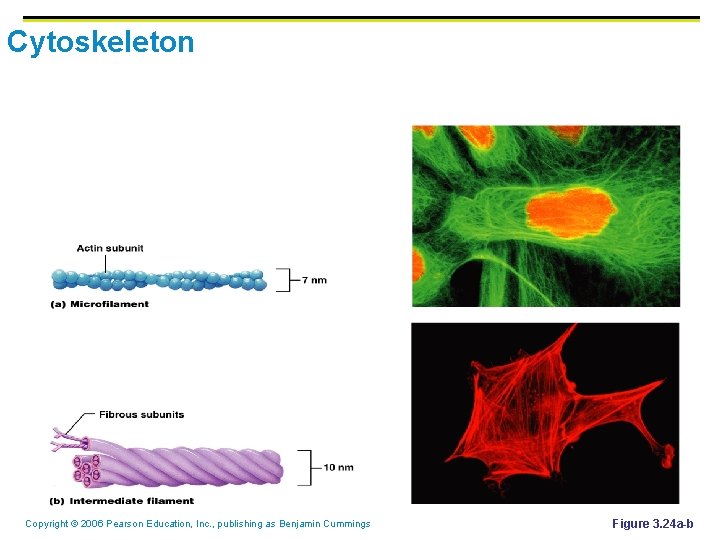
Cytoskeleton Copyright © 2006 Pearson Education, Inc. , publishing as Benjamin Cummings Figure 3. 24 a-b
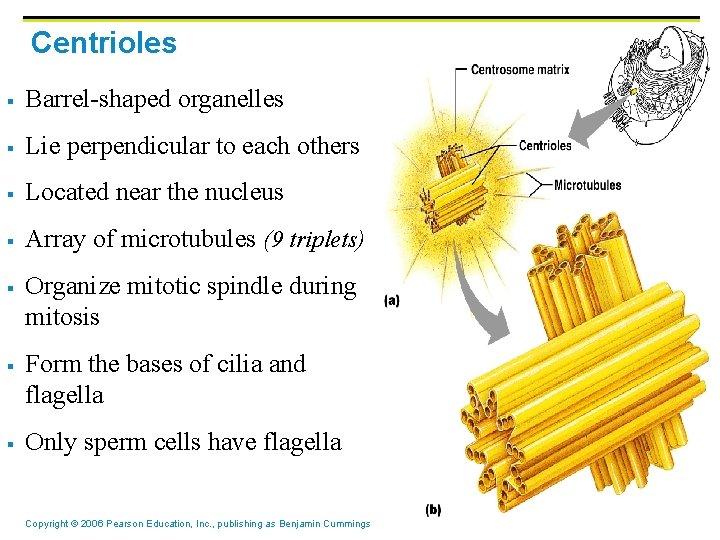
Centrioles § Barrel-shaped organelles § Lie perpendicular to each others § Located near the nucleus § Array of microtubules (9 triplets) § § § Organize mitotic spindle during mitosis Form the bases of cilia and flagella Only sperm cells have flagella Copyright © 2006 Pearson Education, Inc. , publishing as Benjamin Cummings
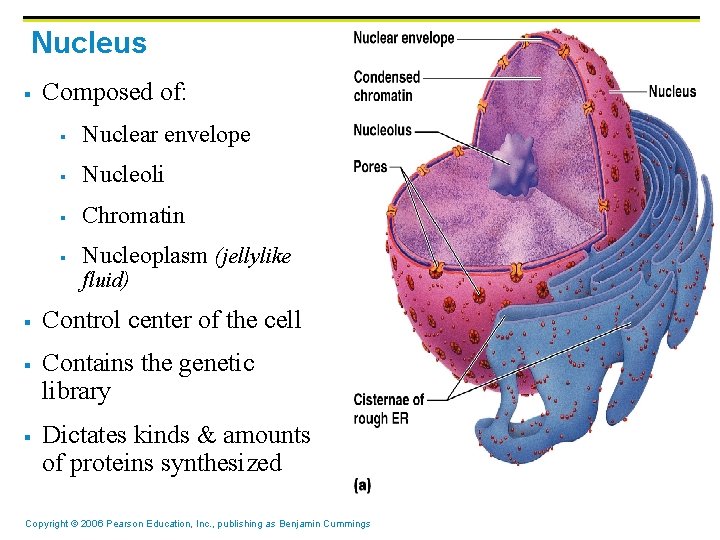
Nucleus § Composed of: § Nuclear envelope § Nucleoli § Chromatin § Nucleoplasm (jellylike fluid) § § § Control center of the cell Contains the genetic library Dictates kinds & amounts of proteins synthesized Copyright © 2006 Pearson Education, Inc. , publishing as Benjamin Cummings
Nuclear Envelope § Selectively permeable double membrane barrier § Contains pores lined with complex proteins § Outer membrane is: § § Continuous with the rough ER § Studded with ribosomes Inner membrane is: § Lined with the nuclear protein (maintains nucleus shape) § Encloses jellylike fluid called nucleoplasm Copyright © 2006 Pearson Education, Inc. , publishing as Benjamin Cummings
Nucleoli § Spherical bodies within the nucleus § Not membrane bound § Typically one or two per nucleus (can be more) § Site of ribosome production Copyright © 2006 Pearson Education, Inc. , publishing as Benjamin Cummings
Chromatin § § Threadlike strands composed of: § DNA (30%) § Histone proteins (60%) § Newly formed RNA (10%) When the nucleus starts to divide, it forms: § Condensed, barlike bodies called chromosomes Copyright © 2006 Pearson Education, Inc. , publishing as Benjamin Cummings Figure 3. 29
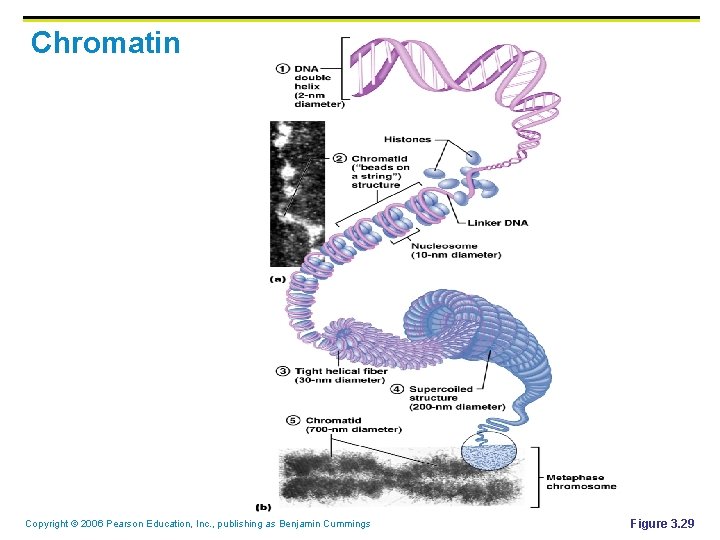
Chromatin Copyright © 2006 Pearson Education, Inc. , publishing as Benjamin Cummings Figure 3. 29
Break Silde Biol 2401. 5039 Sep 12, ’ 12 Copyright © 2006 Pearson Education, Inc. , publishing as Benjamin Cummings
- Slides: 36