
OBJECTIVE IDENTIFY TYPES OF CORRECTIVE LENSES USED TO
OBJECTIVE IDENTIFY TYPES OF CORRECTIVE LENSES USED TO CORRECT SIGHT PROBLEMS [COS 5, SAT 10]

OBJECTIVE IDENTIFY TYPES OF CORRECTIVE LENSES USED TO CORRECT SIGHT PROBLEMS

CORRECTIVE LENSES w. EYE GLASSES w. CONTACTS

CONVEX LENSES w DEFINITION: Convex Lenses are corrective lenses used to help those who are farsighted.
CONVEX LENSES w Convex lenses are thicker in the middle than at the edges. w When light passes thorough a convex lens, the rays bend toward each other. w Glasses or contacts with convex lenses magnify the print, allowing these people to read more easily.
FARSIGHTEDNESS
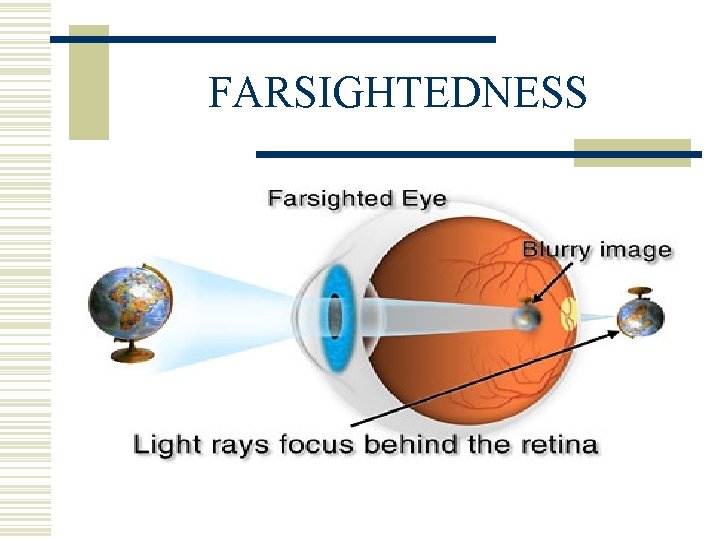
FARSIGHTEDNESS Farsightedness, is a focusing problem, which occurs when the cornea is not curved enough, or the eye is shorter than normal. The reduced length means the light rays focus behind the retina, producing a blurred image.
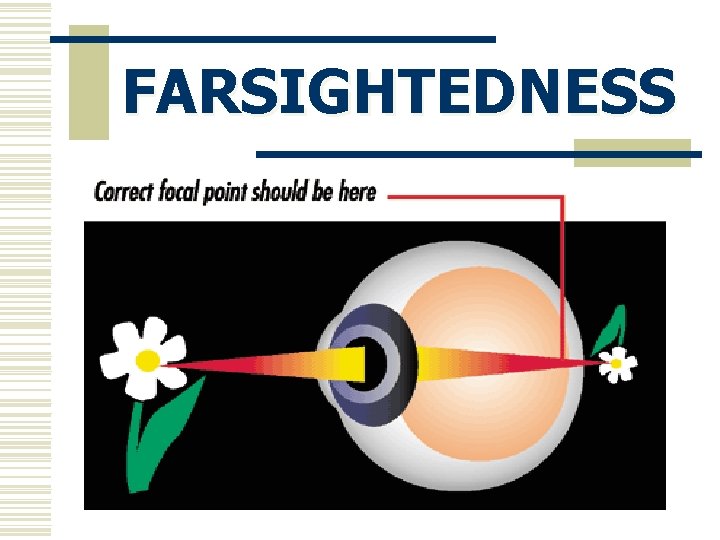
FARSIGHTEDNESS
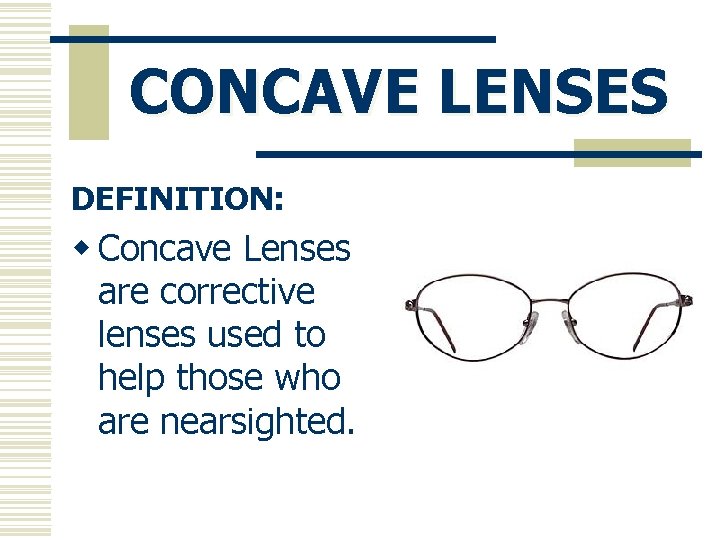
CONCAVE LENSES DEFINITION: w Concave Lenses are corrective lenses used to help those who are nearsighted.
CONCAVE LENSES w Concave lenses are thicker around the edges than in the middle. w When light passes through a concave lens, they bend away from each other. w These lenses bend outward just enough to make distant objects seem closer.
NEARSIGHTEDNESS w In a nearsighted person the cornea is too steep or the eye is too long and the focal point is in front of the retina resulting in blurred distance vision. For a farsighted person the focus of the eye is behind the retina. People who are farsighted can have trouble seeing at distance.

Contact Lenses Like eyeglasses, contact lenses change the path of light. But with contact lenses, concave lenses are used for both nearsighted and farsighted people. Because contact lenses are so close to the eye, they don’t need to be thick to bend the light enough to correct a person’s version.
OBJECTIVE IDENTIFY TYPES OF CORRECTIVE LENSES USED TO CORRECT SIGHT PROBLEMS
CORRECTIVE LENSES w. EYE GLASSES w. CONTACTS Convex and Concave Lenses
- Slides: 14