
Objective Define Reynolds Navier Stokes Equations RANS Start
Objective • Define Reynolds Navier Stokes Equations (RANS) • Start with Numerics
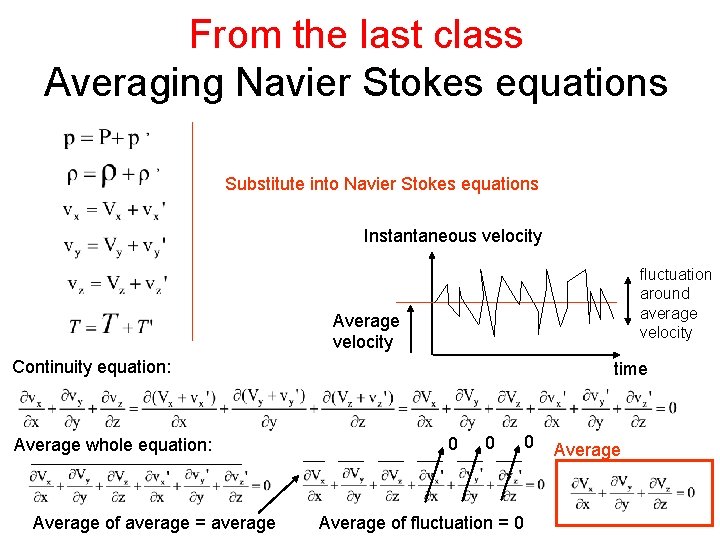
From the last class Averaging Navier Stokes equations Substitute into Navier Stokes equations Instantaneous velocity fluctuation around average velocity Average velocity Continuity equation: Average whole equation: Average of average = average time 0 0 Average of fluctuation = 0 0 Average
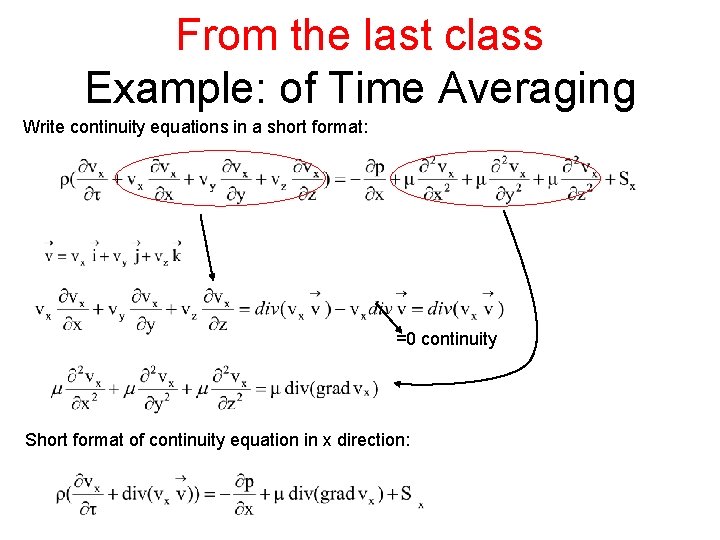
From the last class Example: of Time Averaging Write continuity equations in a short format: =0 continuity Short format of continuity equation in x direction:
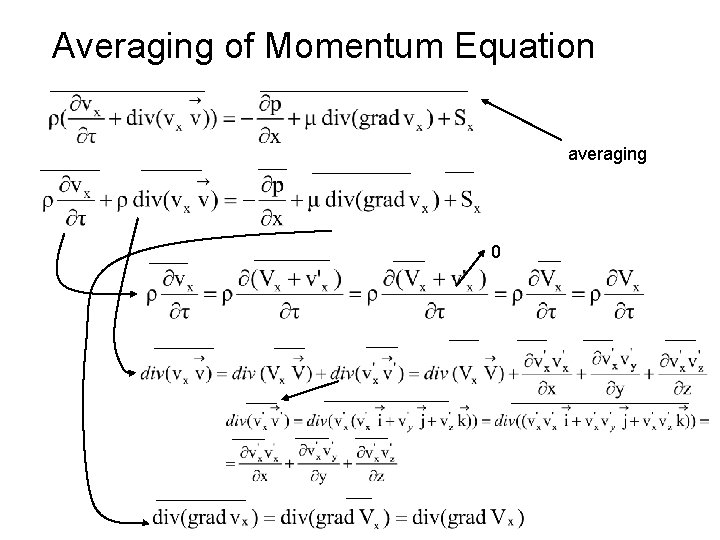
Averaging of Momentum Equation averaging 0
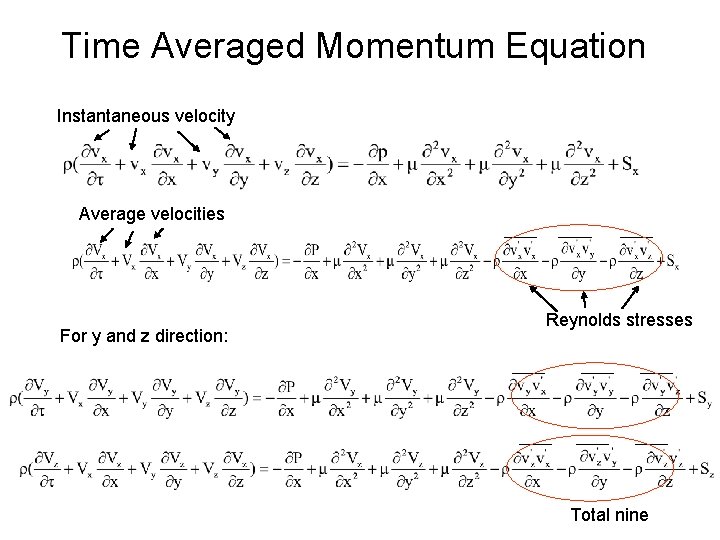
Time Averaged Momentum Equation Instantaneous velocity Average velocities For y and z direction: Reynolds stresses Total nine
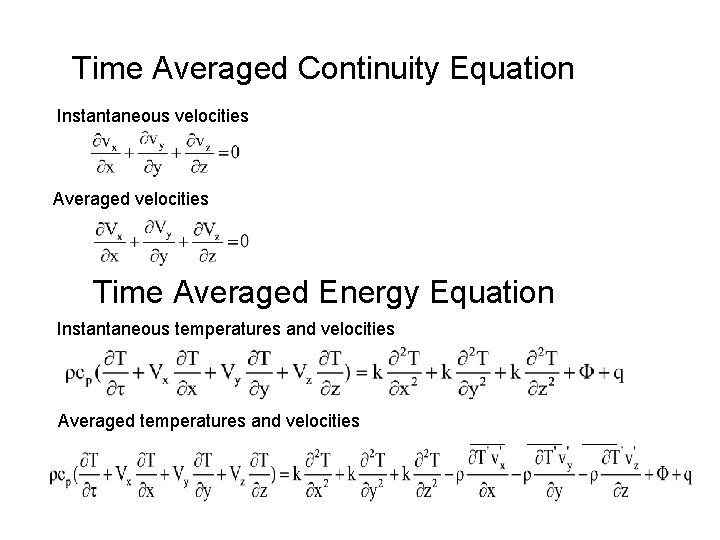
Time Averaged Continuity Equation Instantaneous velocities Averaged velocities Time Averaged Energy Equation Instantaneous temperatures and velocities Averaged temperatures and velocities
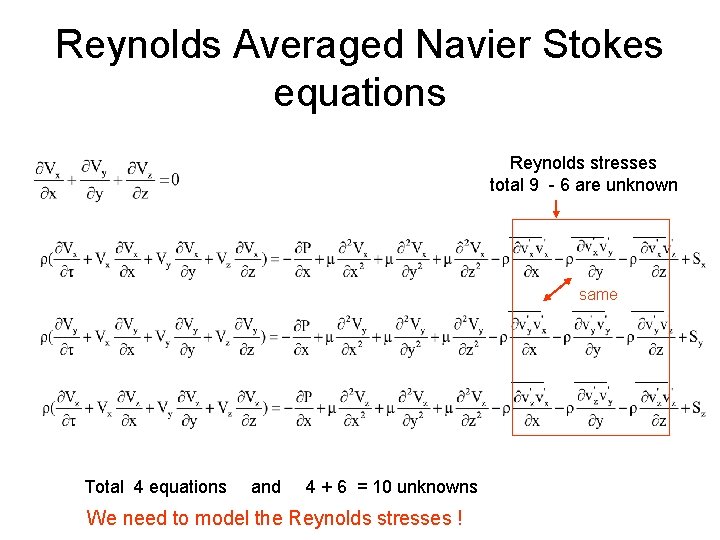
Reynolds Averaged Navier Stokes equations Reynolds stresses total 9 - 6 are unknown same Total 4 equations and 4 + 6 = 10 unknowns We need to model the Reynolds stresses !
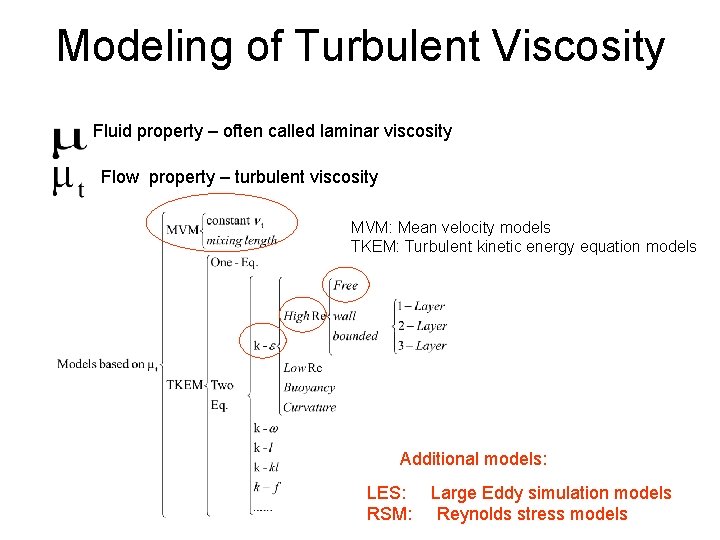
Modeling of Turbulent Viscosity Fluid property – often called laminar viscosity Flow property – turbulent viscosity MVM: Mean velocity models TKEM: Turbulent kinetic energy equation models Additional models: LES: RSM: Large Eddy simulation models Reynolds stress models
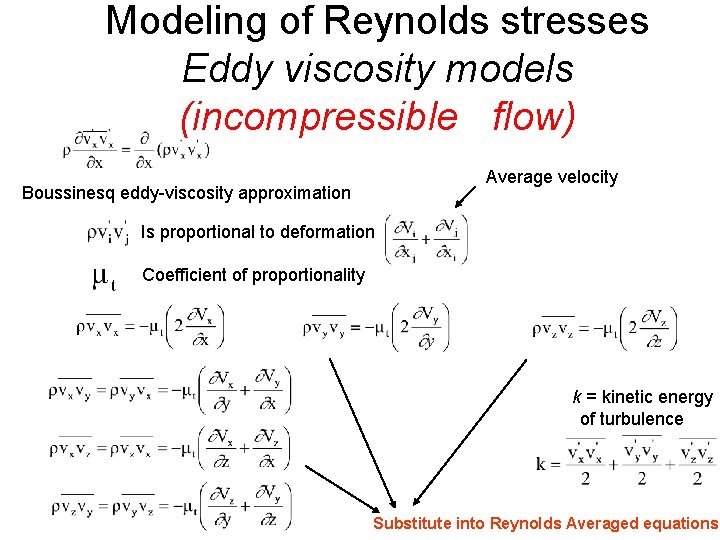
Modeling of Reynolds stresses Eddy viscosity models (incompressible flow) Average velocity Boussinesq eddy-viscosity approximation Is proportional to deformation Coefficient of proportionality k = kinetic energy of turbulence Substitute into Reynolds Averaged equations
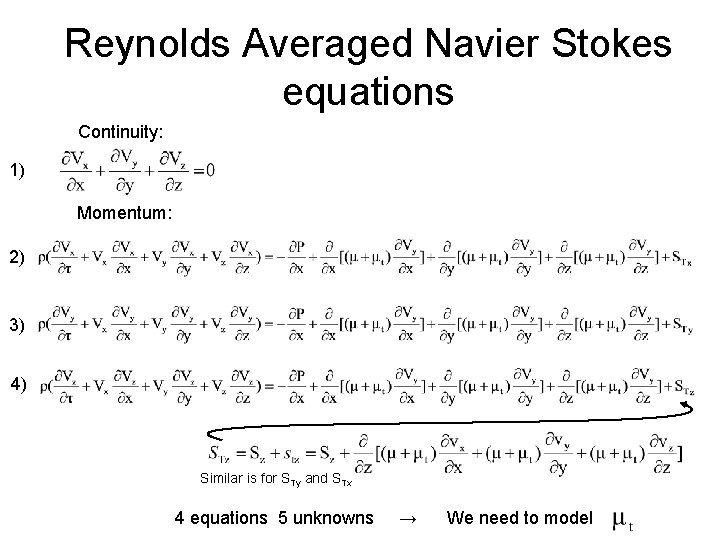
Reynolds Averaged Navier Stokes equations Continuity: 1) Momentum: 2) 3) 4) Similar is for STy and STx 4 equations 5 unknowns → We need to model
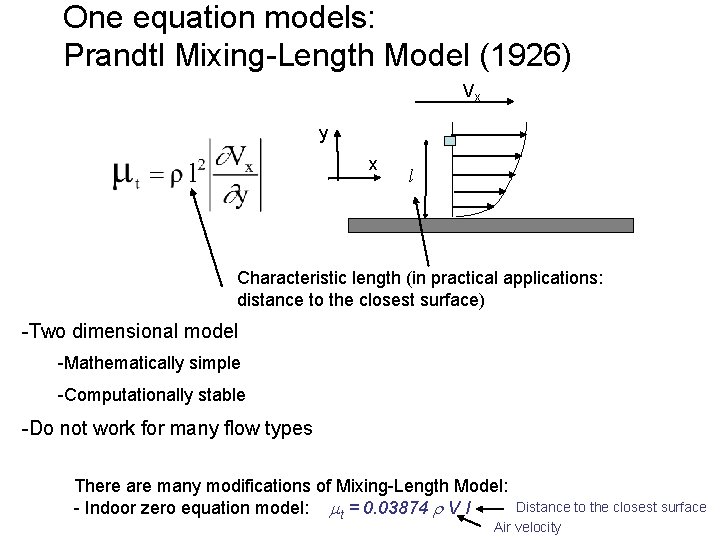
One equation models: Prandtl Mixing-Length Model (1926) Vx y x l Characteristic length (in practical applications: distance to the closest surface) -Two dimensional model -Mathematically simple -Computationally stable -Do not work for many flow types There are many modifications of Mixing-Length Model: - Indoor zero equation model: t = 0. 03874 V l Distance to the closest surface Air velocity
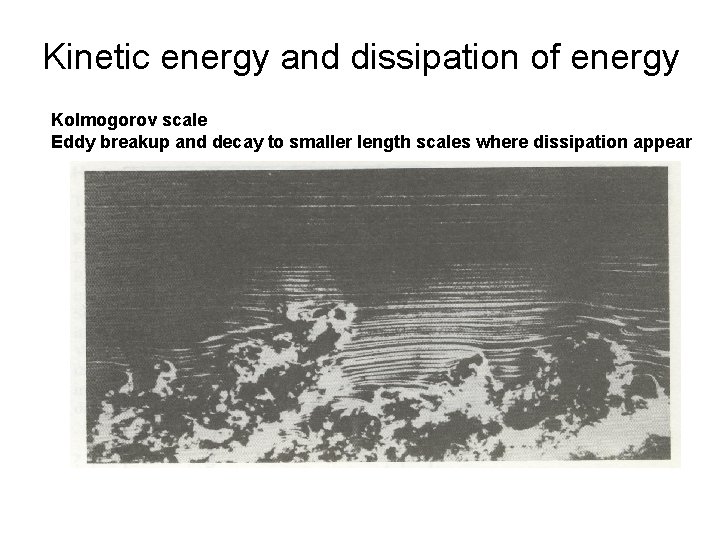
Kinetic energy and dissipation of energy Kolmogorov scale Eddy breakup and decay to smaller length scales where dissipation appear
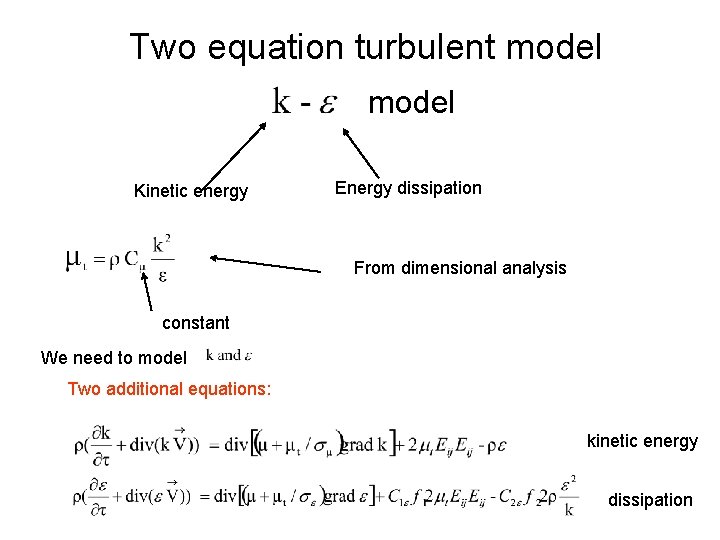
Two equation turbulent model Kinetic energy Energy dissipation From dimensional analysis constant We need to model Two additional equations: kinetic energy dissipation
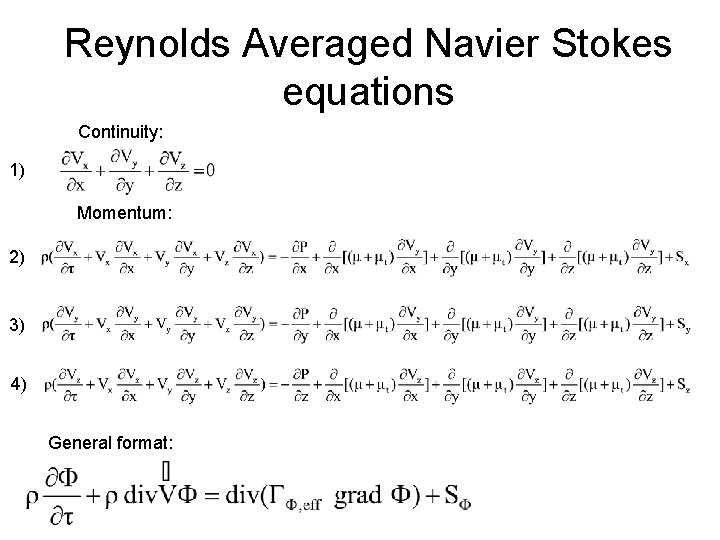
Reynolds Averaged Navier Stokes equations Continuity: 1) Momentum: 2) 3) 4) General format:
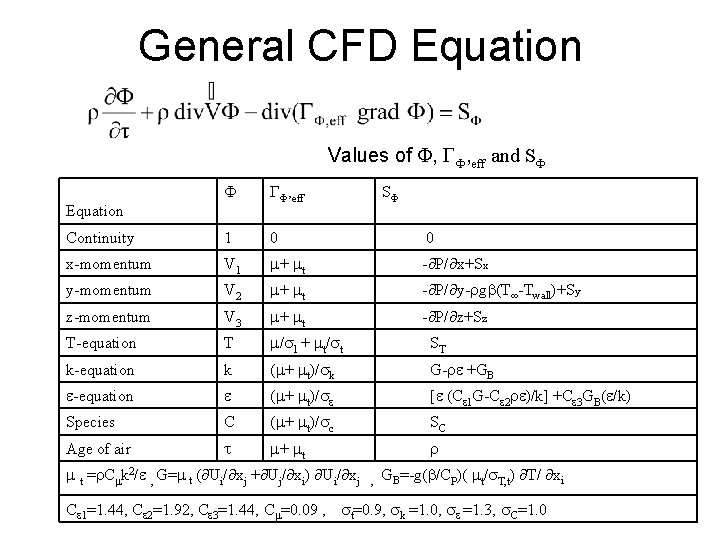
General CFD Equation Values of , , eff and S , eff Continuity 1 0 0 x-momentum V 1 + t - P/ x+Sx y-momentum V 2 + t - P/ y- g (T∞-Twall)+Sy z-momentum V 3 + t - P/ z+Sz T-equation T / l + t/ t ST k-equation k ( + t)/ k G- +GB -equation ( + t)/ [ (C 1 G-C 2 )/k] +C 3 GB( /k) Species C ( + t)/ c SC Age of air t + t Equation t = C k 2/ , G= t ( Ui/ xj + Uj/ xi) Ui/ xj S , GB=-g( /CP)( t/ T, t) T/ xi C 1=1. 44, C 2=1. 92, C 3=1. 44, C =0. 09 , t=0. 9, k =1. 0, =1. 3, C=1. 0
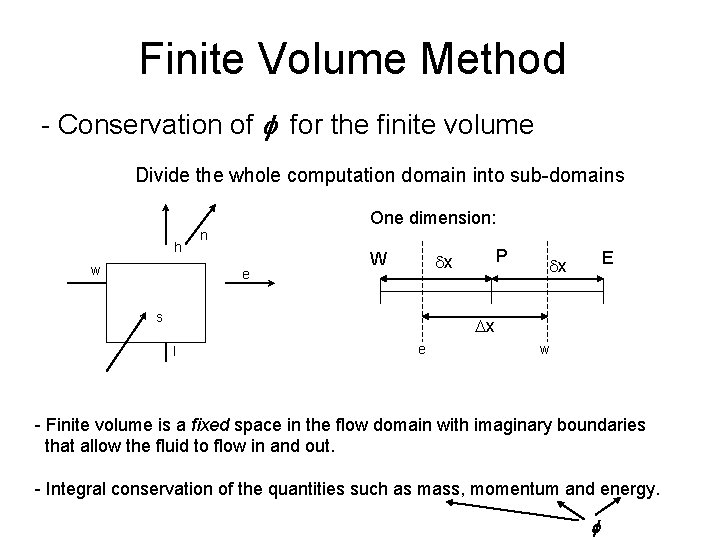
Finite Volume Method - Conservation of f for the finite volume Divide the whole computation domain into sub-domains h w One dimension: n e W P dx s E dx Dx l e w - Finite volume is a fixed space in the flow domain with imaginary boundaries that allow the fluid to flow in and out. - Integral conservation of the quantities such as mass, momentum and energy. f
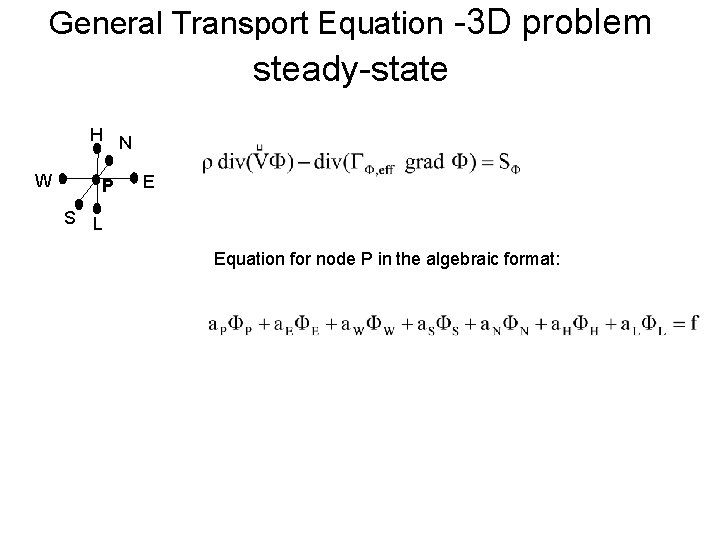
General Transport Equation -3 D problem steady-state H N W P E S L Equation for node P in the algebraic format:
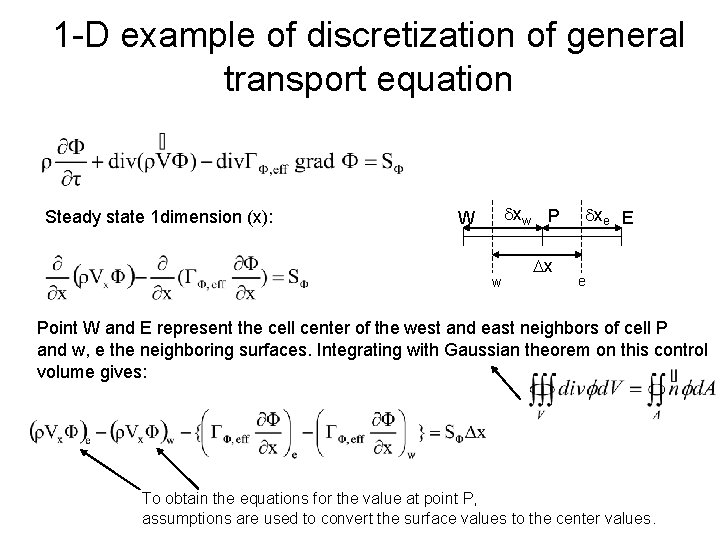
1 -D example of discretization of general transport equation Steady state 1 dimension (x): dxw P W w Dx dxe E e Point W and E represent the cell center of the west and east neighbors of cell P and w, e the neighboring surfaces. Integrating with Gaussian theorem on this control volume gives: To obtain the equations for the value at point P, assumptions are used to convert the surface values to the center values.
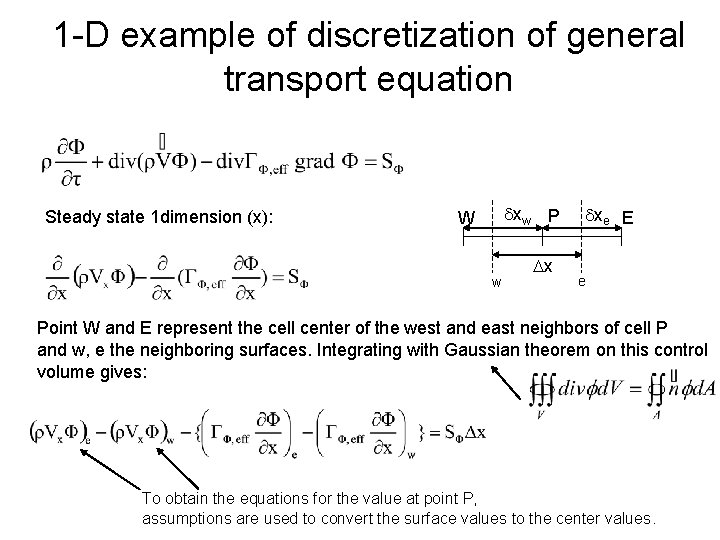
1 -D example of discretization of general transport equation Steady state 1 dimension (x): dxw P W w Dx dxe E e Point W and E represent the cell center of the west and east neighbors of cell P and w, e the neighboring surfaces. Integrating with Gaussian theorem on this control volume gives: To obtain the equations for the value at point P, assumptions are used to convert the surface values to the center values.
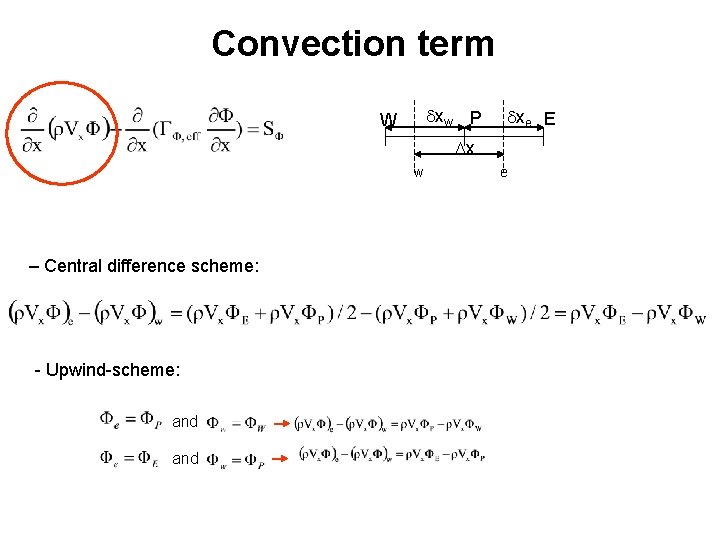
Convection term dxw P W dxe E Dx w – Central difference scheme: - Upwind-scheme: and e
- Slides: 20