
Objective Crew Served Weapons OCSW XM 307 Program
Objective Crew Served Weapons (OCSW) XM 307 Program Reliability Growth, Ammunition Development and Advanced Technology Demonstration Tests 2003 Small Arms Symposium & Exhibition National Defense Industrial Association May 13, 2003 Ralph Mazeski, Ammo IPT Leader US Army TACOM-ARDEC Dave Steimke, XM 307/XM 312 Lead Engineer General Dynamics Armament & Technical Products May 13, 2003 1
XM 307/XM 312 Family of Weapons l XM 307 ä Lightweight 25 mm ä 30 x Lethality over Legacy Weapons ä Application: Light Infantry, Vehicle, Aircraft l XM 312 ä Lightweight. 50 Cal ä 8 x Lethality of M 240 & M 2 ä Application: Light Infantry, Vehicle, Aircraft May 13, 2003 2
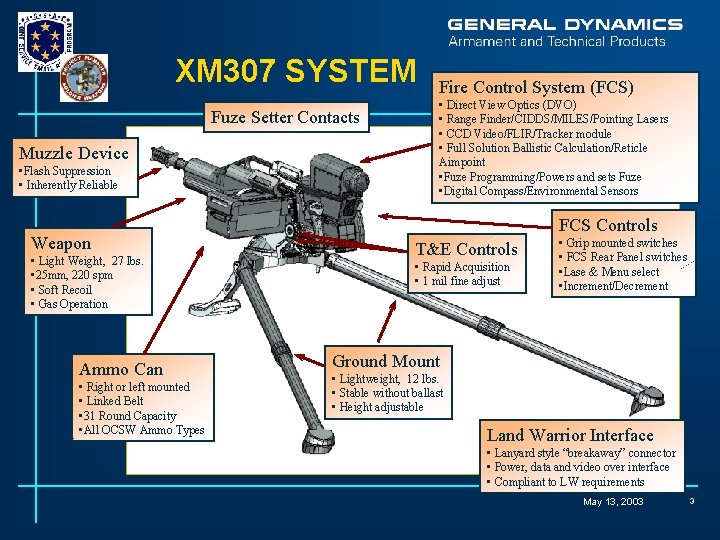
XM 307 SYSTEM Fuze Setter Contacts Muzzle Device • Flash Suppression • Inherently Reliable Weapon • Light Weight, 27 lbs. • 25 mm, 220 spm • Soft Recoil • Gas Operation Ammo Can • Right or left mounted • Linked Belt • 31 Round Capacity • All OCSW Ammo Types Fire Control System (FCS) • Direct View Optics (DVO) • Range Finder/CIDDS/MILES/Pointing Lasers • CCD Video/FLIR/Tracker module • Full Solution Ballistic Calculation/Reticle Aimpoint • Fuze Programming/Powers and sets Fuze • Digital Compass/Environmental Sensors T&E Controls • Rapid Acquisition T&E • 1 mil Controls fine adjust • Rapid Acquisition • 1 mil fine adjust FCS Controls • Grip mounted switches • FCS Rear Panel switches • Lase & Menu select • Increment/Decrement Ground Mount • Lightweight, 12 lbs. • Stable without ballast • Height adjustable Land Warrior Interface • Lanyard style “breakaway” connector • Power, data and video over interface • Compliant to LW requirements May 13, 2003 3
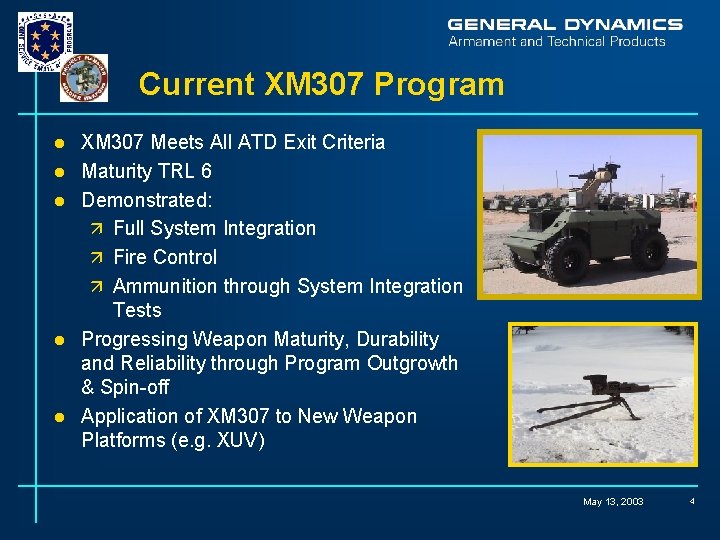
Current XM 307 Program l l l XM 307 Meets All ATD Exit Criteria Maturity TRL 6 Demonstrated: ä Full System Integration ä Fire Control ä Ammunition through System Integration Tests Progressing Weapon Maturity, Durability and Reliability through Program Outgrowth & Spin-off Application of XM 307 to New Weapon Platforms (e. g. XUV) May 13, 2003 4
XM 307 Reliability and Durability Growth l System Integration Tests (SIT) indicates Weapon Maturity, Reliability and Durability Progress l MRBF Improvements l Parts Durability l SIT Demonstrated: Ø Weapon/Fire Control Integration Ø Ballistic Algorithm Ø Accurate Ballistic Reticle Ø Reliable Fuze Setting in Full Auto May 13, 2003 5
XM 312 Outgrowth and Spin-off l Necessity is the mother of invention l How to mature the weapon reliability & durability at reduced cost to the program l Baseline XM 307 used. 50 Cal impulse loads l Utilize. 50 Cal ammo to mature weapon and reduce required ammo unit costs l XM 307. 50 Cal variant becomes basis of new lightweight. 50 Cal XM 312 gun May 13, 2003 6
Develop Gun Technology with Similar Impulse/Size Munitions XM 307 Similarities. 50 Cal ä Cartridge Length 4. 7 Vs 5. 4 ä Similar Impulse 13. 4 lb-sec Vs 12. 0 lb-sec ä Peak Bolt Face Load 24, 000 lbs 22, 000 lb ä Requires 5 XM 307 Parts to be modified all others remain the same ä Barrel Length 25. 11 Vs 33 ä Maintain 40 spm sustain rates ä Requires the M 15 A 2 side stripping link l XM 307 has demonstrated capable of impulse variation l XM 307 demonstrated feeding 5. 1 inch rounds l May 13, 2003 7
XM 307/XM 312 Implementation Strategy l XM 312 Reduces Overall Cost to XM 307 Reliability Program l Uses. 50 Cal Ammunition to Increase Weapon Reliability ä All Parts (5) that Handle the Projectile were Modified ä Same Impulse & Breech Loads l Reaching Higher Reliability Level for XM 307 Program ä Family of Weapons in 25 mm and. 50 Cal ä 95% commonality in parts l Leverages the Accuracy and Light Weight Characteristics of the 25 mm Weapon to Provide a Highly Accurate Lightweight. 50 Cal Weapon May 13, 2003 8
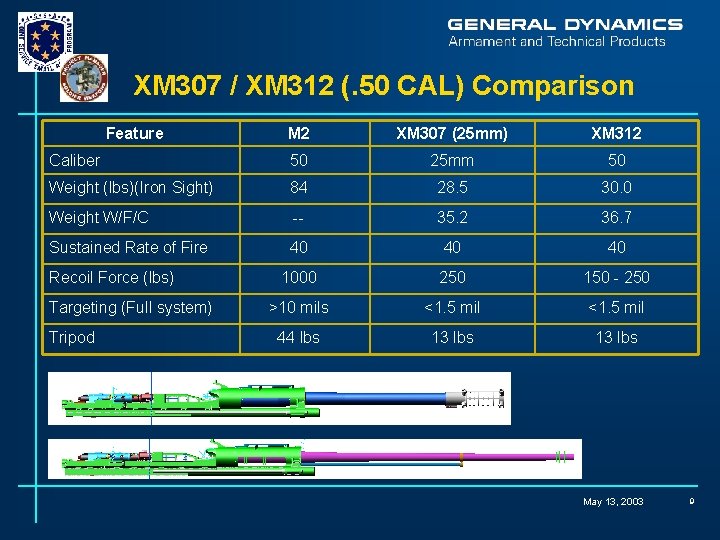
XM 307 / XM 312 (. 50 CAL) Comparison Feature M 2 XM 307 (25 mm) XM 312 Caliber 50 25 mm 50 Weight (lbs)(Iron Sight) 84 28. 5 30. 0 Weight W/F/C -- 35. 2 36. 7 Sustained Rate of Fire 40 40 40 1000 250 150 - 250 >10 mils <1. 5 mil 44 lbs 13 lbs Recoil Force (lbs) Targeting (Full system) Tripod May 13, 2003 9
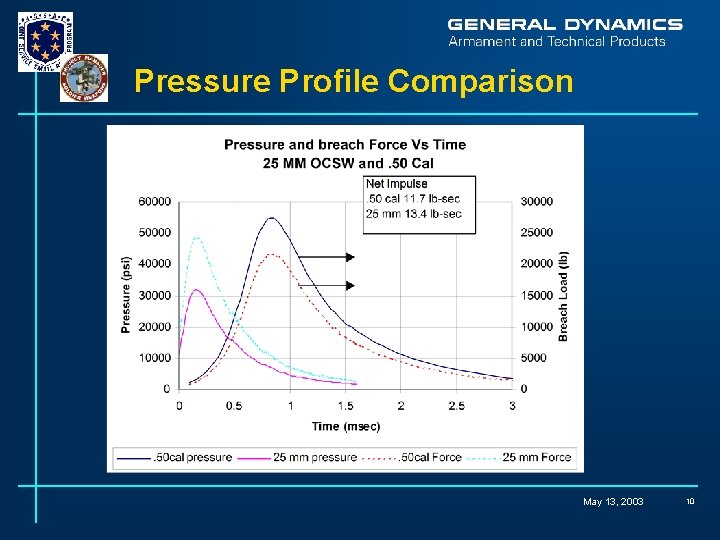
Pressure Profile Comparison May 13, 2003 10
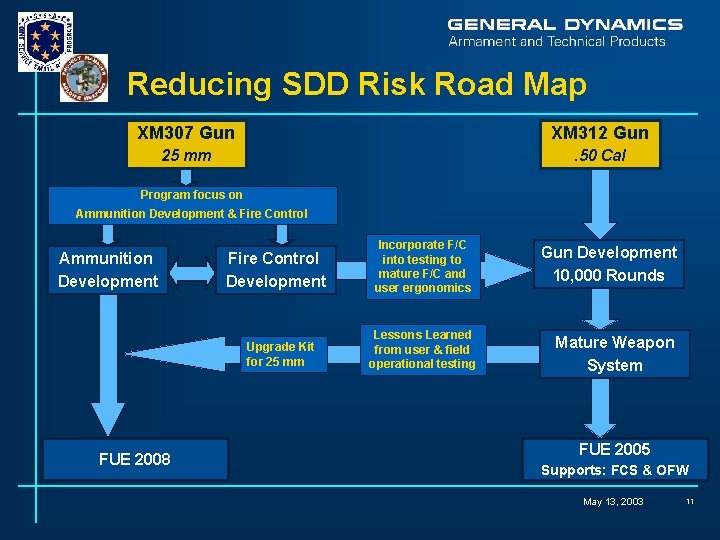
Reducing SDD Risk Road Map XM 307 Gun XM 312 Gun 25 mm . 50 Cal Program focus on Ammunition Development & Fire Control Ammunition Development Fire Control Development Upgrade Kit for 25 mm FUE 2008 Incorporate F/C into testing to mature F/C and user ergonomics Lessons Learned from user & field operational testing Gun Development 10, 000 Rounds Mature Weapon System FUE 2005 Supports: FCS & OFW May 13, 2003 11
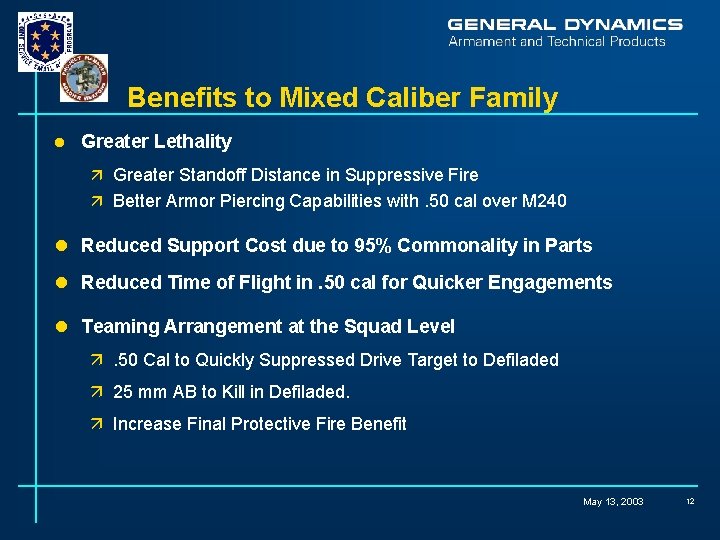
Benefits to Mixed Caliber Family l Greater Lethality ä Greater Standoff Distance in Suppressive Fire ä Better Armor Piercing Capabilities with. 50 cal over M 240 l Reduced Support Cost due to 95% Commonality in Parts l Reduced Time of Flight in. 50 cal for Quicker Engagements l Teaming Arrangement at the Squad Level ä. 50 Cal to Quickly Suppressed Drive Target to Defiladed ä 25 mm AB to Kill in Defiladed. ä Increase Final Protective Fire Benefit May 13, 2003 12
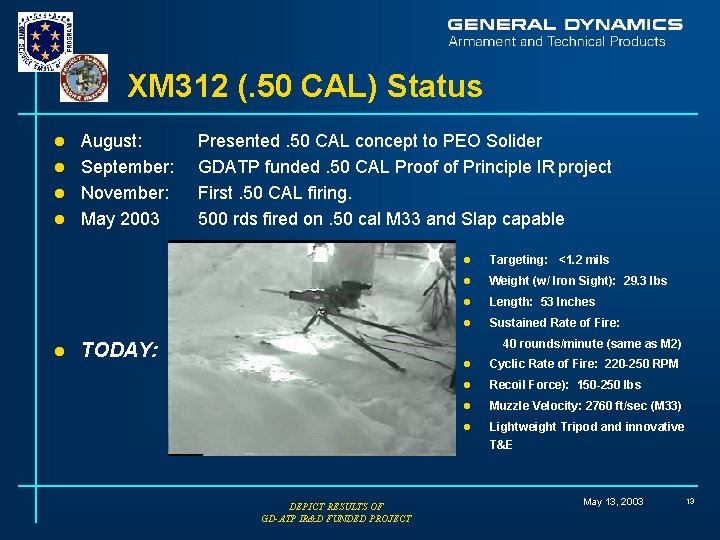
XM 312 (. 50 CAL) Status August: l September: l November: l May 2003 l l Presented. 50 CAL concept to PEO Solider GDATP funded. 50 CAL Proof of Principle IR project First. 50 CAL firing. 500 rds fired on. 50 cal M 33 and Slap capable l Targeting: <1. 2 mils l Weight (w/ Iron Sight): 29. 3 lbs l Length: 53 Inches l Sustained Rate of Fire: 40 rounds/minute (same as M 2) TODAY: DEPICT RESULTS OF GD-ATP IR&D FUNDED PROJECT l Cyclic Rate of Fire: 220 -250 RPM l Recoil Force): 150 -250 lbs l Muzzle Velocity: 2760 ft/sec (M 33) l Lightweight Tripod and innovative T&E May 13, 2003 13
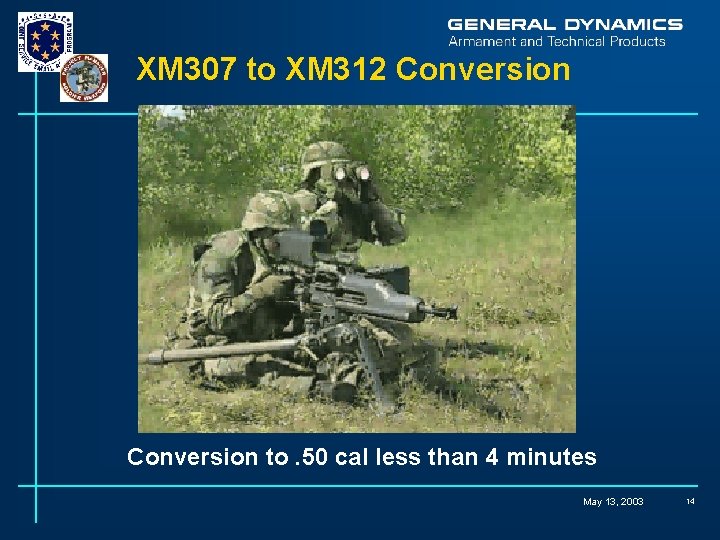
XM 307 to XM 312 Conversion to. 50 cal less than 4 minutes May 13, 2003 14
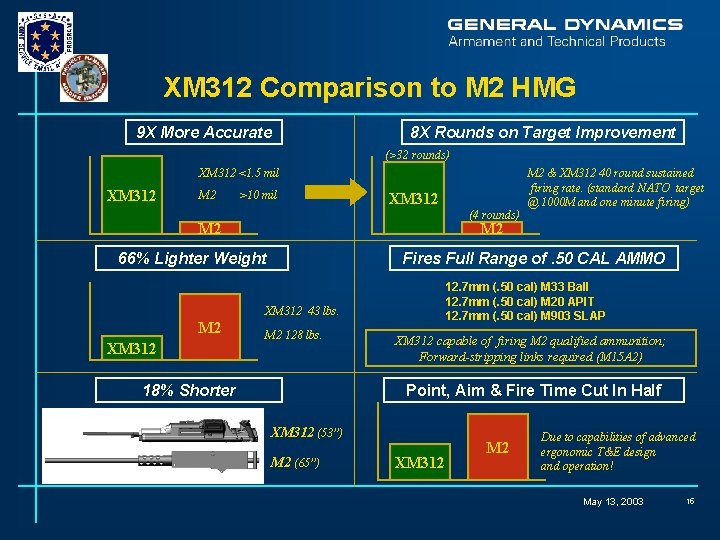
XM 312 Comparison to M 2 HMG 9 X More Accurate 8 X Rounds on Target Improvement (>32 rounds) XM 312 <1. 5 mil XM 312 M 2 >10 mil XM 312 (4 rounds) M 2 66% Lighter Weight Fires Full Range of. 50 CAL AMMO XM 312 43 lbs. M 2 XM 312 M 2 & XM 312 40 round sustained firing rate. (standard NATO target @ 1000 M and one minute firing) M 2 128 lbs. 18% Shorter 12. 7 mm (. 50 cal) M 33 Ball 12. 7 mm (. 50 cal) M 20 APIT 12. 7 mm (. 50 cal) M 903 SLAP XM 312 capable of firing M 2 qualified ammunition; Forward-stripping links required (M 15 A 2) Point, Aim & Fire Time Cut In Half XM 312 (53”) M 2 (65”) XM 312 M 2 Due to capabilities of advanced ergonomic T&E design and operation! May 13, 2003 15
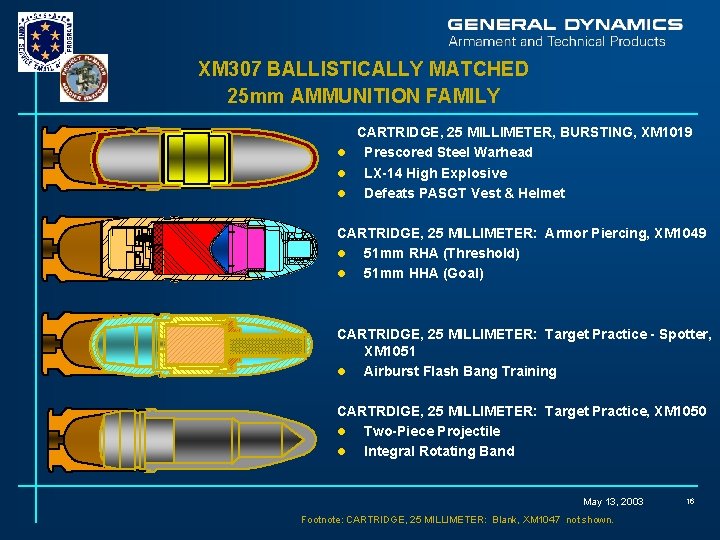
XM 307 BALLISTICALLY MATCHED 25 mm AMMUNITION FAMILY CARTRIDGE, 25 MILLIMETER, BURSTING, XM 1019 l Prescored Steel Warhead l LX-14 High Explosive l Defeats PASGT Vest & Helmet CARTRIDGE, 25 MILLIMETER: Armor Piercing, XM 1049 l 51 mm RHA (Threshold) l 51 mm HHA (Goal) CARTRIDGE, 25 MILLIMETER: Target Practice - Spotter, XM 1051 l Airburst Flash Bang Training CARTRDIGE, 25 MILLIMETER: Target Practice, XM 1050 l Two-Piece Projectile l Integral Rotating Band May 13, 2003 Footnote: CARTRIDGE, 25 MILLIMETER: Blank, XM 1047 not shown. 16
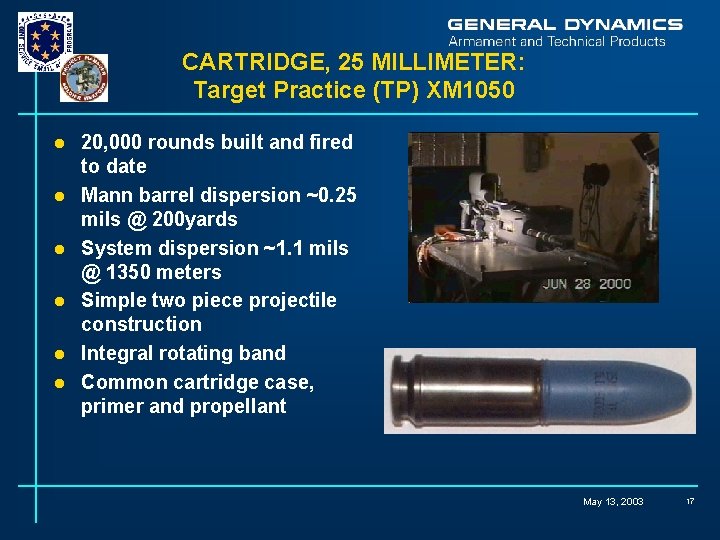
CARTRIDGE, 25 MILLIMETER: Target Practice (TP) XM 1050 l l l 20, 000 rounds built and fired to date Mann barrel dispersion ~0. 25 mils @ 200 yards System dispersion ~1. 1 mils @ 1350 meters Simple two piece projectile construction Integral rotating band Common cartridge case, primer and propellant May 13, 2003 17
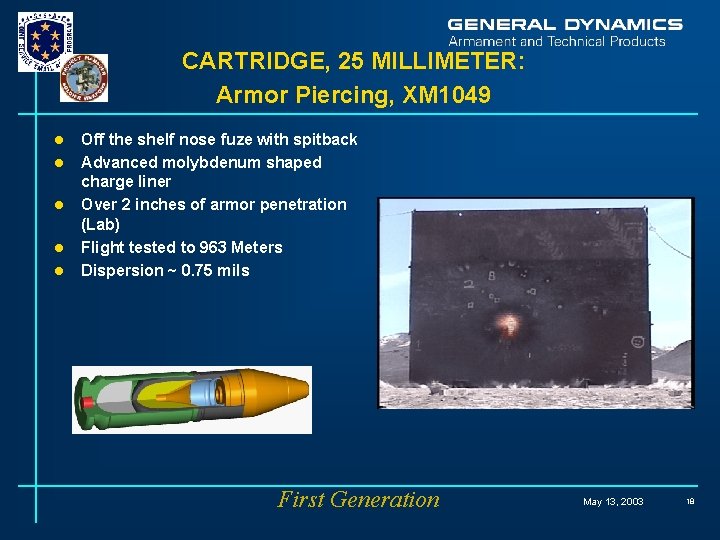
CARTRIDGE, 25 MILLIMETER: Armor Piercing, XM 1049 l l l Off the shelf nose fuze with spitback Advanced molybdenum shaped charge liner Over 2 inches of armor penetration (Lab) Flight tested to 963 Meters Dispersion ~ 0. 75 mils First Generation May 13, 2003 18
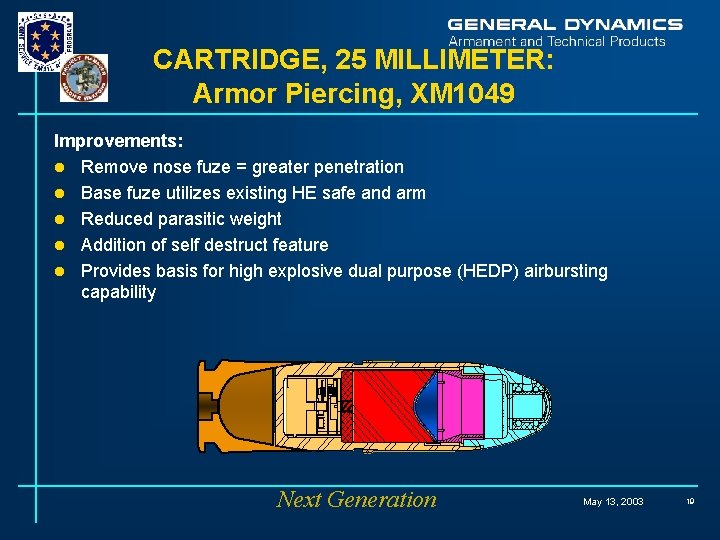
CARTRIDGE, 25 MILLIMETER: Armor Piercing, XM 1049 Improvements: l Remove nose fuze = greater penetration l Base fuze utilizes existing HE safe and arm l Reduced parasitic weight l Addition of self destruct feature l Provides basis for high explosive dual purpose (HEDP) airbursting capability Next Generation May 13, 2003 19
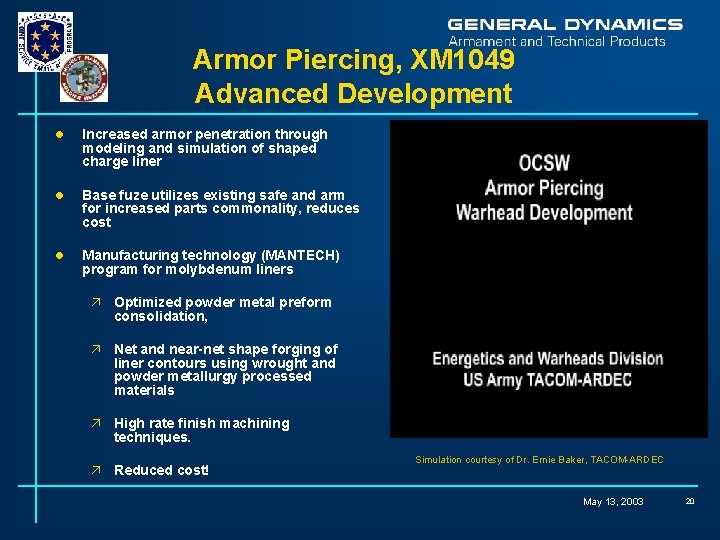
Armor Piercing, XM 1049 Advanced Development l Increased armor penetration through modeling and simulation of shaped charge liner l Base fuze utilizes existing safe and arm for increased parts commonality, reduces cost l Manufacturing technology (MANTECH) program for molybdenum liners ä Optimized powder metal preform consolidation, ä Net and near-net shape forging of liner contours using wrought and powder metallurgy processed materials ä High rate finish machining techniques. ä Reduced cost! Simulation courtesy of Dr. Ernie Baker, TACOM-ARDEC May 13, 2003 20
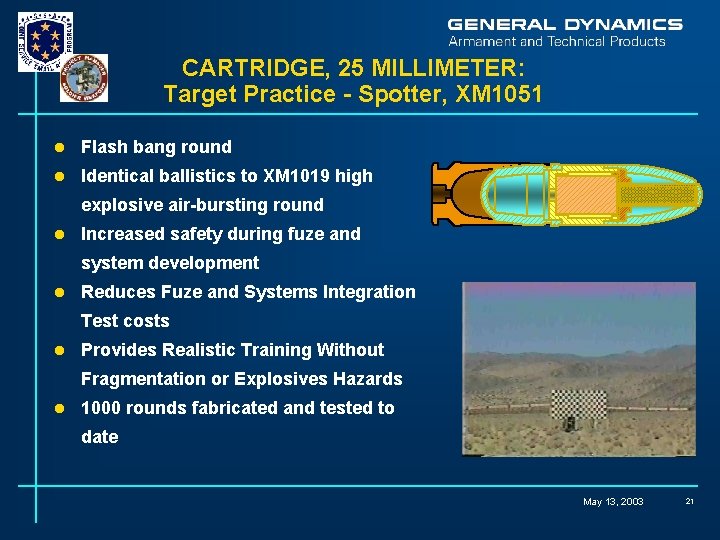
CARTRIDGE, 25 MILLIMETER: Target Practice - Spotter, XM 1051 l Flash bang round l Identical ballistics to XM 1019 high explosive air-bursting round l Increased safety during fuze and system development l Reduces Fuze and Systems Integration Test costs l Provides Realistic Training Without Fragmentation or Explosives Hazards l 1000 rounds fabricated and tested to date May 13, 2003 21
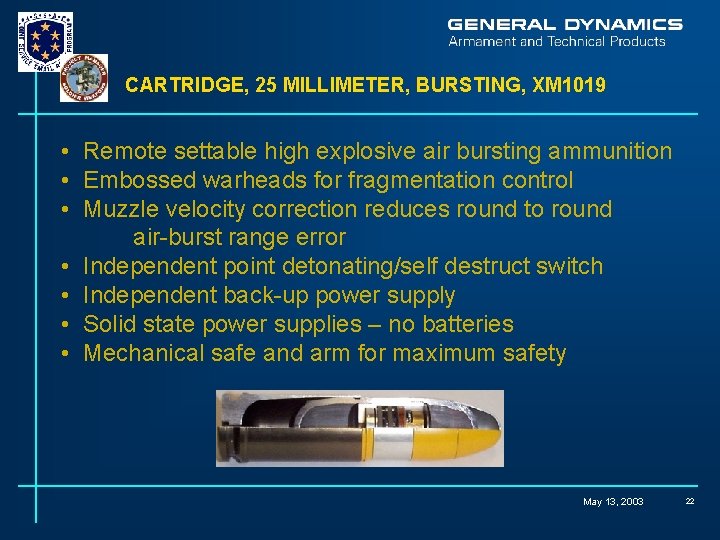
CARTRIDGE, 25 MILLIMETER, BURSTING, XM 1019 • Remote settable high explosive air bursting ammunition • Embossed warheads for fragmentation control • Muzzle velocity correction reduces round to round air-burst range error • Independent point detonating/self destruct switch • Independent back-up power supply • Solid state power supplies – no batteries • Mechanical safe and arm for maximum safety May 13, 2003 22
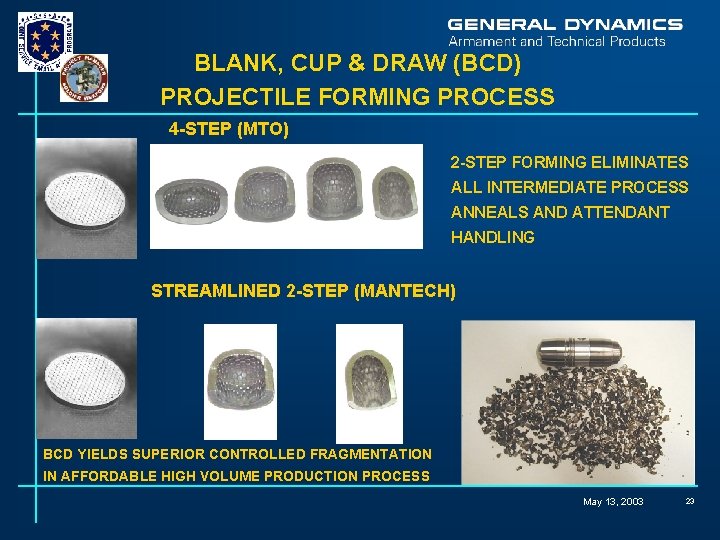
BLANK, CUP & DRAW (BCD) PROJECTILE FORMING PROCESS 4 -STEP (MTO) 2 -STEP FORMING ELIMINATES ALL INTERMEDIATE PROCESS ANNEALS AND ATTENDANT HANDLING STREAMLINED 2 -STEP (MANTECH) BCD YIELDS SUPERIOR CONTROLLED FRAGMENTATION IN AFFORDABLE HIGH VOLUME PRODUCTION PROCESS May 13, 2003 23
System Integration Tests #1 - #5 l Objectives ä Overall System performance and integration n System performance determined by radar and high-speed video (HSV) data. ä Target Acquisition System (TAS) performance and functionality n n n Menu operation and functionality Durability during firing Ability to program fuzes statically and dynamically (at firing rate) Laser ranging and offset reticle accuracy Proper ballistic solution algorithm (BSA) input and output ä Weapon performance and functionality n n Reliability/Durability Weapon dispersion and cyclic rate ä Precision Air-Burst (PAB) of the TP‑S (spotter) out to 2 KM n n Trajectory of the TP, and TP-S out to 2 KM Time of Flight (TOF) Airburst Spatial position of TP-S projectile TP-S and TP Dispersion May 13, 2003 24
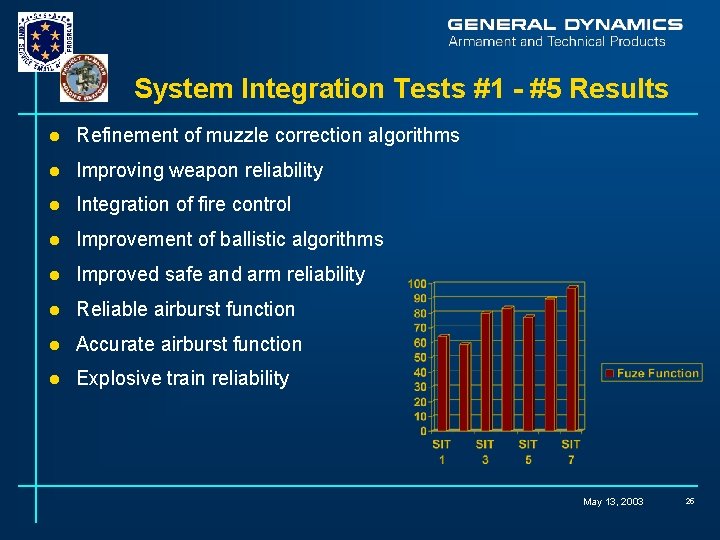
System Integration Tests #1 - #5 Results l Refinement of muzzle correction algorithms l Improving weapon reliability l Integration of fire control l Improvement of ballistic algorithms l Improved safe and arm reliability l Reliable airburst function l Accurate airburst function l Explosive train reliability May 13, 2003 25
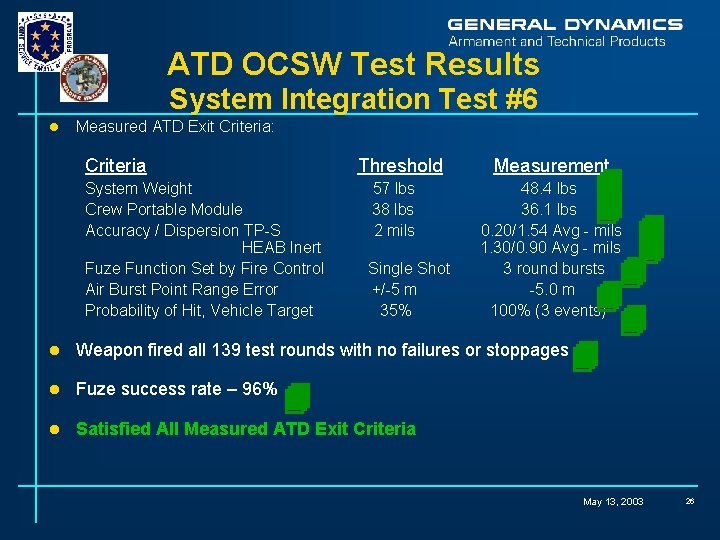
ATD OCSW Test Results System Integration Test #6 l Measured ATD Exit Criteria: Criteria System Weight Crew Portable Module Accuracy / Dispersion TP-S HEAB Inert Fuze Function Set by Fire Control Air Burst Point Range Error Probability of Hit, Vehicle Target l l l Threshold 57 lbs 38 lbs 2 mils Measurement 48. 4 lbs 36. 1 lbs 0. 20/1. 54 Avg - mils 1. 30/0. 90 Avg - mils 3 round bursts -5. 0 m 100% (3 events) Single Shot +/-5 m 35% Weapon fired all 139 test rounds with no failures or stoppages Fuze success rate – 96% Satisfied All Measured ATD Exit Criteria May 13, 2003 26
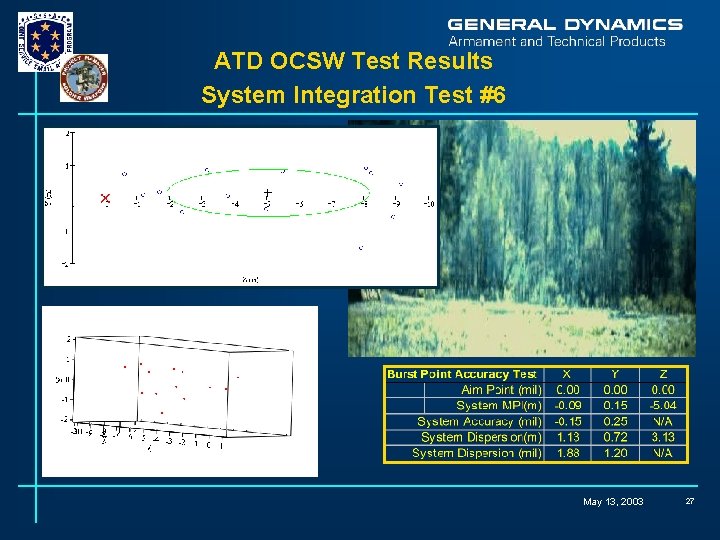
ATD OCSW Test Results System Integration Test #6 May 13, 2003 27
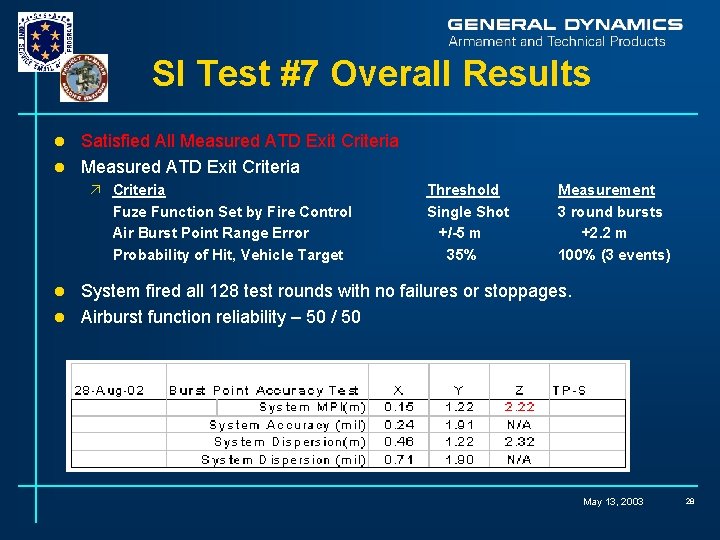
SI Test #7 Overall Results Satisfied All Measured ATD Exit Criteria l ä Criteria Fuze Function Set by Fire Control Air Burst Point Range Error Probability of Hit, Vehicle Target Threshold Single Shot +/-5 m 35% Measurement 3 round bursts +2. 2 m 100% (3 events) System fired all 128 test rounds with no failures or stoppages. l Airburst function reliability – 50 / 50 l May 13, 2003 28
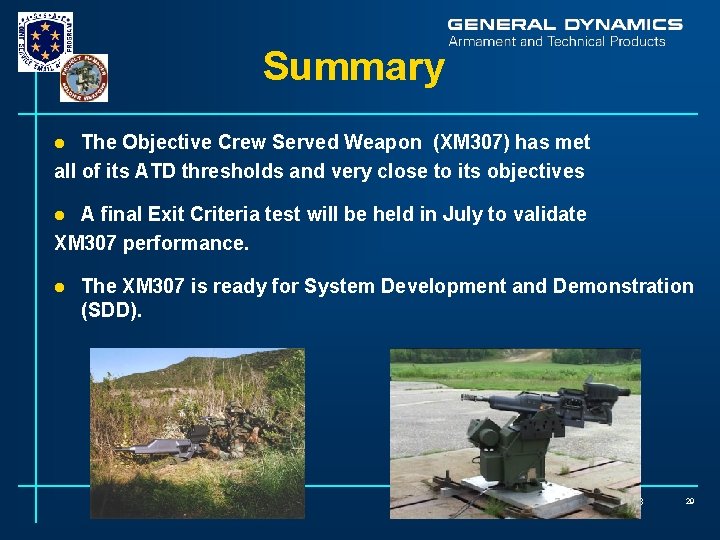
Summary The Objective Crew Served Weapon (XM 307) has met all of its ATD thresholds and very close to its objectives l A final Exit Criteria test will be held in July to validate XM 307 performance. l l The XM 307 is ready for System Development and Demonstration (SDD). May 13, 2003 29
- Slides: 29