
Objective 6 01 Organize knowledge of structures of
Objective 6. 01 Organize knowledge of structures of living organisms.
Essential Questions What are anatomy, physiology, and pathology? What are the structural units of living things? What are the functions of cells? What are the types and phases of cell division?
Basic Cell Terminology Anatomy ◦ study of internal and external body structure Physiology ◦ study of the functions of those structures and how they work Pathology ◦ study of disease processes Cells ◦ basic structural unit of living things ◦ Come in many shapes and sizes ◦ Each type of cell has a unique function
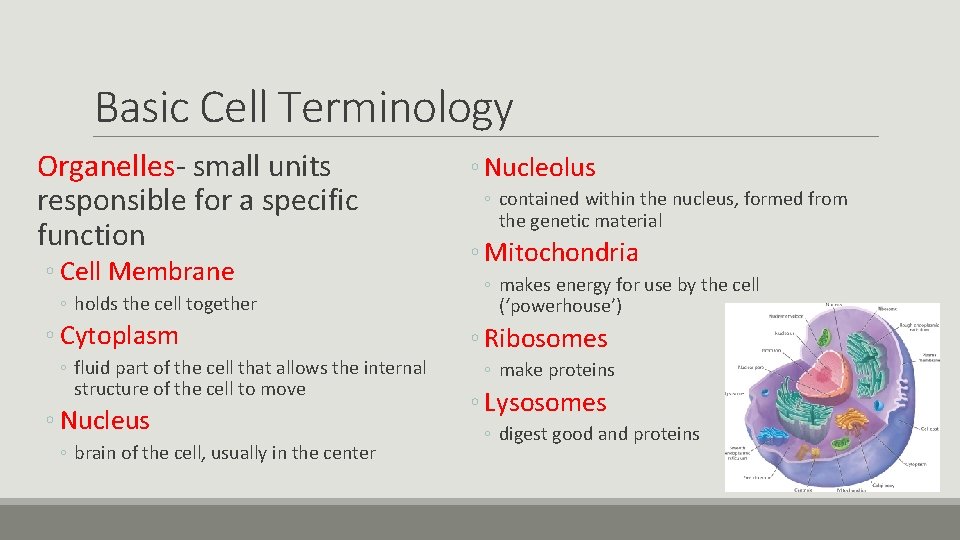
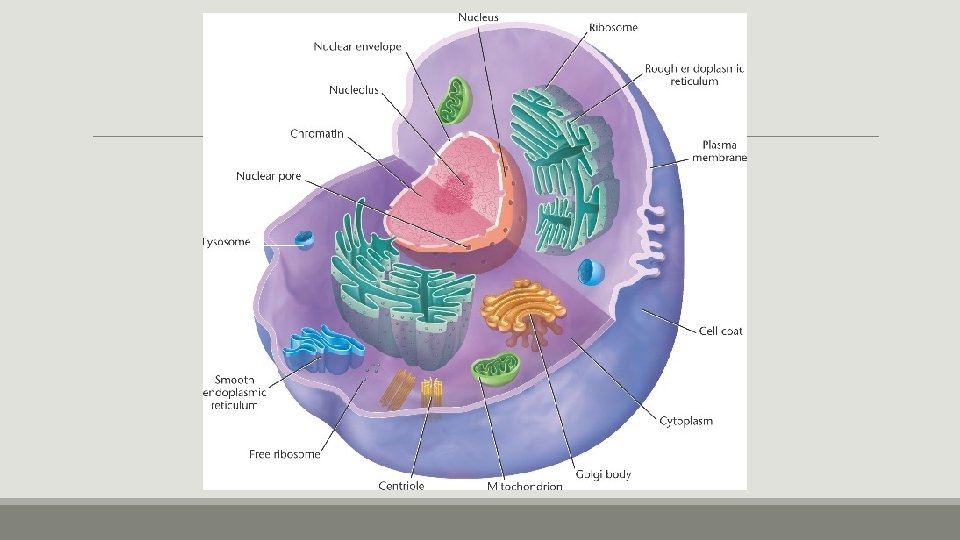
Basic Cell Terminology Organelles- small units responsible for a specific function ◦ Cell Membrane ◦ holds the cell together ◦ Cytoplasm ◦ fluid part of the cell that allows the internal structure of the cell to move ◦ Nucleus ◦ brain of the cell, usually in the center ◦ Nucleolus ◦ contained within the nucleus, formed from the genetic material ◦ Mitochondria ◦ makes energy for use by the cell (‘powerhouse’) ◦ Ribosomes ◦ make proteins ◦ Lysosomes ◦ digest good and proteins
Cell Functions Active Transport ◦ process in which substances found in lower concentration areas will be moved to higher concentration areas Anabolism ◦ process in which smaller particles combine to form larger particles Catabolism ◦ process in which larger particles are broken down into smaller particles Diffusion ◦ process in which a substance moves from areas of high concentration to low concentrations
Cell Functions Endocytosis ◦ process in which a cell takes a particle in Extra cellular fluid (ECF) ◦ fluid found outside the cell (blood) Homeostasis ◦ maintenance and balance of body processes Osmosis ◦ movement of a substance along a diffusion gradient across cell membranes Phagocytosis ◦ process by which dead cells and waste materials are eaten or removed from the body
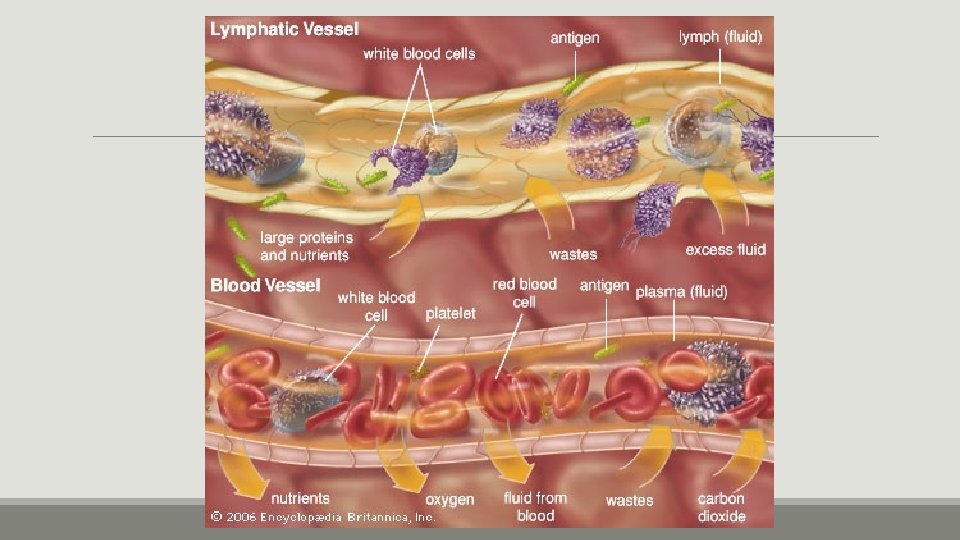
Metabolism All of the chemical reactions within the body that break down or build new chemicals
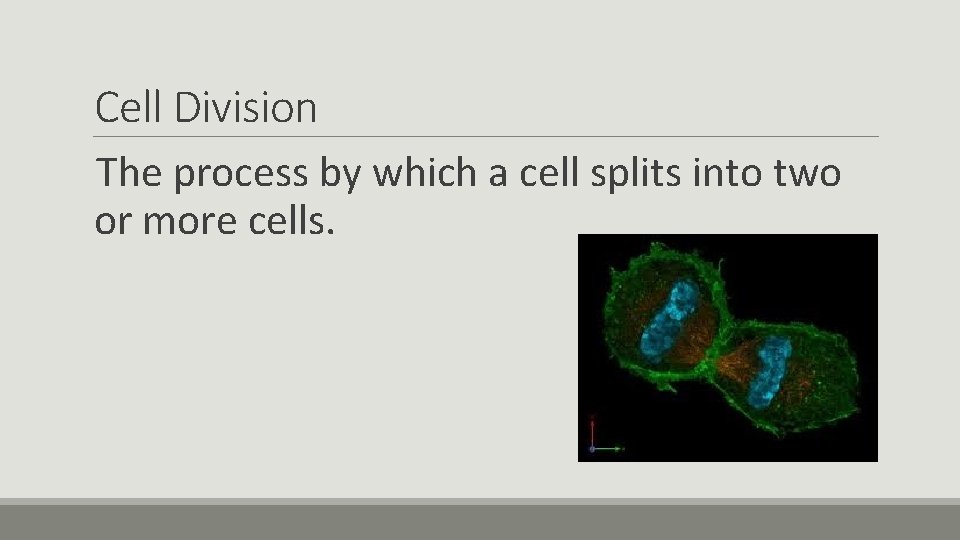
Cell Division The process by which a cell splits into two or more cells.
Mitosis Type of cell division which allows for growth and regeneration of body cells (somatic cells) ◦ Each daughter cell is identical to the original cell ◦ Phases ◦ Interphase- the cells are in their normal state ◦ the nucleus and nuclear membrane are distinct ◦ chromosomes are in a thread like mass inside the nucleus ◦ Prophase- Chromatin forms and begins to take an X shape ◦ Centrioles begin to move toward opposite poles creating fibers between them ◦ Chromosomes begin to condense ◦ Nuclear membrane is less distinct
Mitosis (continued…) ◦ Metaphase- spindle fibers are formed at the center of the cell. Chromosomes begin to attach to the fibers between the centrioles in the center of the cell ◦ Anaphase- chromosomes split and move to opposite poles as the spindle fibers shorten ◦ Telophase- divides to create 2 or 4 new cells ◦ Nuclear membrane begins to reform
Meiosis Cell division for breeding and reproductive cells (gametes) ◦ Each daughter cell is unique, and has half the number of chromosomes of the parent cell ◦ Male gametes (sperm cells) unite with female gametes (egg cells) at fertilization to provide a full complement of chromosomes for the offspring
Phases of Meiosis I Prophase I ◦ Chromosome begin to condense ◦ Chromosomes similar in structure pair and cross over ◦ Cross over provides increased genetic diversity Metaphase I ◦ spindle fibers are formed at the center of the cell. ◦ Chromosomes begin to attach to the fibers between the centrioles Anaphase I ◦ chromosomes split and move to opposite poles Telophase I ◦ chromosomes reach opposite ends of cell Nuclear membrane reforms Cytokinesis ◦ cell division occurs producing 2 identical cells
Phases of Meiosis II Prophase II ◦ Chromosome begin to condense Metaphase II ◦ spindle fibers are formed at the center of the cell. ◦ Chromosomes begin to attach to the fibers between the centrioles. Anaphase II ◦ Centromeres divide and sister chromatids move to opposite ends of the cell as spindle fibers shorten. Telophase II ◦ chromosomes reach opposite ends of cell. Nuclear membrane reforms Cytokinesis ◦ cell division occurs producing 4 cells with half the chromosomes of the original parent cell
Cell Organization Tissue- group of cells that are alike in structure ◦ Perform specific functions ◦ Histology- study of tissues 4 types of tissue ◦ Epithelial- covers the body’s surface and lines the internal organ structures and protects structures. Ex: skin, epicardium ◦ Connective- holds and supports body structures. Ex: tendons, ligaments ◦ Muscular- allows movements of body parts ◦ Nervous- respond to stimulus and cause a reaction in the body Organ- group of similar tissues that perform a specific function Ex: liver, kidney, etc Organ System ◦ group of organs working together to perform body functions
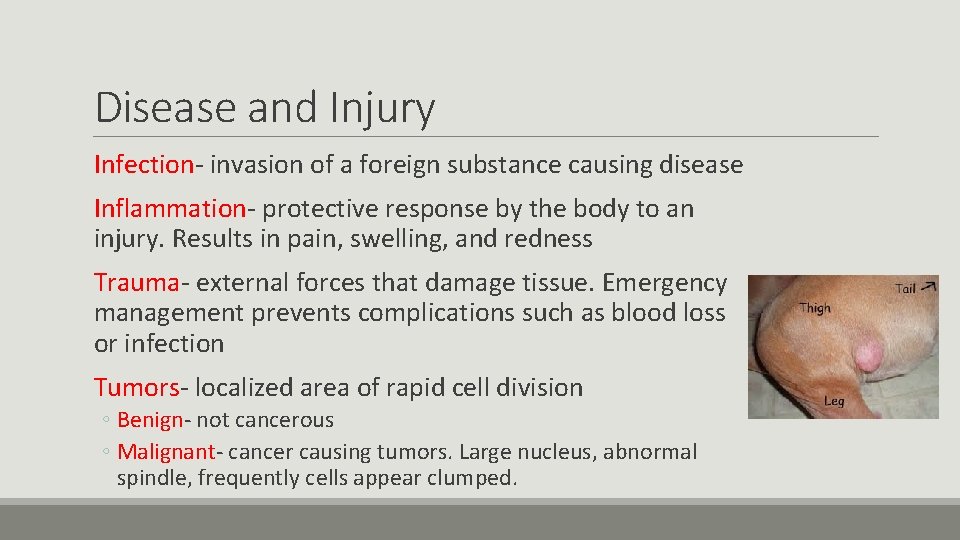
Disease and Injury Infection- invasion of a foreign substance causing disease Inflammation- protective response by the body to an injury. Results in pain, swelling, and redness Trauma- external forces that damage tissue. Emergency management prevents complications such as blood loss or infection Tumors- localized area of rapid cell division ◦ Benign- not cancerous ◦ Malignant- cancer causing tumors. Large nucleus, abnormal spindle, frequently cells appear clumped.
- Slides: 17