
Objective 3 01 Understanding Diagnostic and Therapeutic Services
Objective 3. 01 Understanding Diagnostic and Therapeutic Services
Essential Question • What are the responsibilities of diagnostic and therapeutic services personnel? 3. 01 Understand Diagnostic and Therapeutic Services 2

Diagnostic Services professionals create a picture of the health status of patients at a single point in time. Laboratory Services Laboratory Technologist Medical Technologist Imaging Services Radiologic Technologist Diagnostic and 3 CT/MRI 3. 01 Understand Therapeutic Services
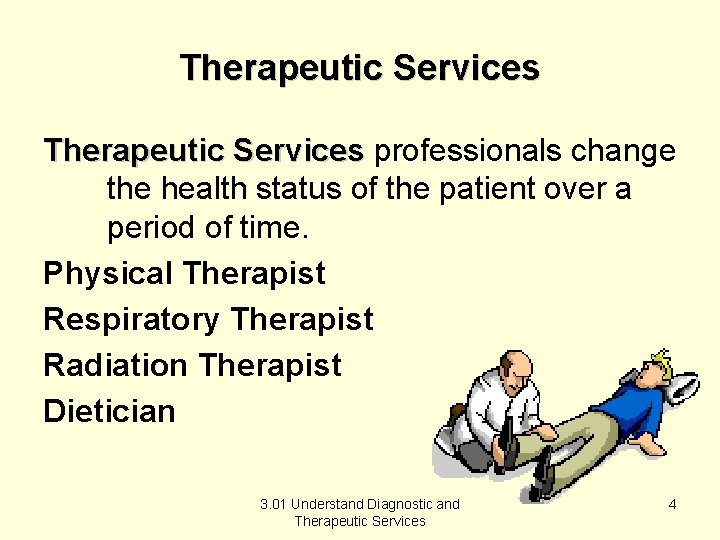
Therapeutic Services professionals change the health status of the patient over a period of time. Physical Therapist Respiratory Therapist Radiation Therapist Dietician 3. 01 Understand Diagnostic and Therapeutic Services 4
What is the difference? • What is the difference between diagnostic and therapeutic? – Diagnostic services discover what is wrong • Diagnose the patient – Therapeutic services focus on the treatment for what is diagnosed • Treat the patient 3. 01 Understand Diagnostic and Therapeutic Services 5
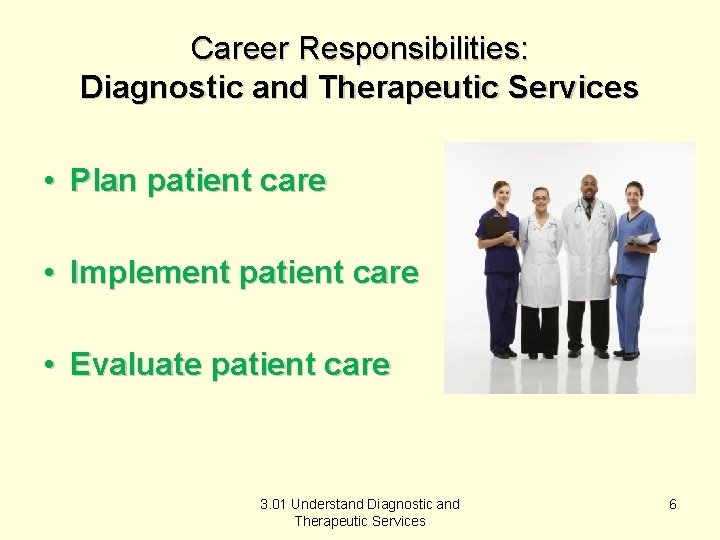
Career Responsibilities: Diagnostic and Therapeutic Services • Plan patient care • Implement patient care • Evaluate patient care 3. 01 Understand Diagnostic and Therapeutic Services 6
Career Responsibilities: Diagnostic and Therapeutic Services Plan patient care • Work within scope of practice for career area • Determine if a request is appropriate for patient • Include patient in plan of care • Develop a plan to meet patient’s needs • Assemble appropriate materials 3. 01 Understand Diagnostic and Therapeutic Services 7
Career Responsibilities: Diagnostic and Therapeutic Services Implement care • • • Check physician’s order Verify patient identification Evaluate for contraindications Obtain patient’s consent Properly prepare patient Perform care in an orderly manner Perform procedure according to standards Use equipment as recommended by manufacturer Monitor patient’s condition throughout procedure Modify care as required for patient 3. 01 Understand Diagnostic and Therapeutic Services 8
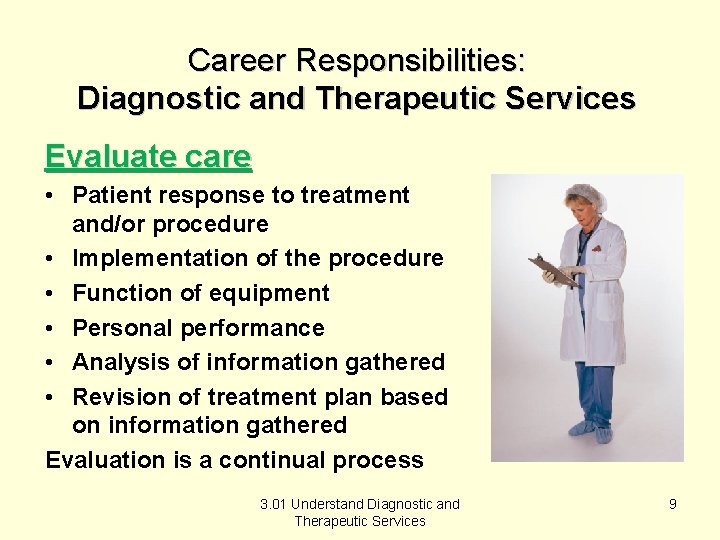
Career Responsibilities: Diagnostic and Therapeutic Services Evaluate care • Patient response to treatment and/or procedure • Implementation of the procedure • Function of equipment • Personal performance • Analysis of information gathered • Revision of treatment plan based on information gathered Evaluation is a continual process 3. 01 Understand Diagnostic and Therapeutic Services 9
Objective 3. 01 Collect Patient Data
Essential Question • How is patient data collected and reported? 3. 01 Understand Diagnostic and Therapeutic Services 11
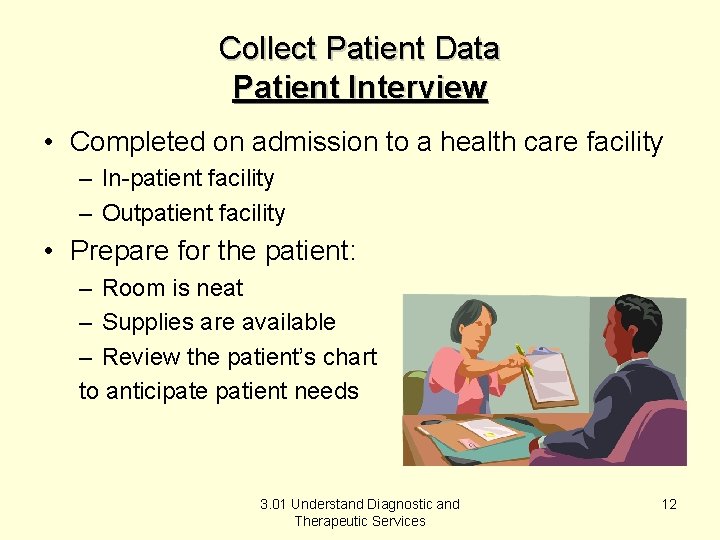
Collect Patient Data Patient Interview • Completed on admission to a health care facility – In-patient facility – Outpatient facility • Prepare for the patient: – Room is neat – Supplies are available – Review the patient’s chart to anticipate patient needs 3. 01 Understand Diagnostic and Therapeutic Services 12
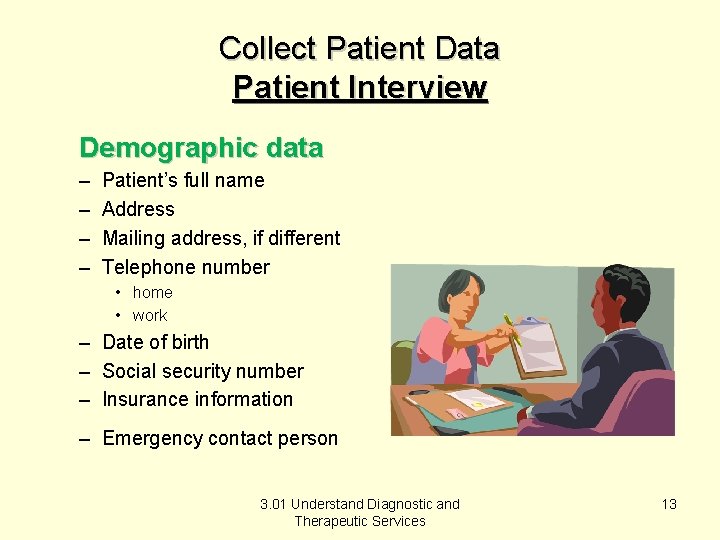
Collect Patient Data Patient Interview Demographic data – – Patient’s full name Address Mailing address, if different Telephone number • home • work – Date of birth – Social security number – Insurance information – Emergency contact person 3. 01 Understand Diagnostic and Therapeutic Services 13
Collect Patient Data Patient Interview Financial information Financial policy of the practice – Billing – Insurance billing – Co-payments – Finance charges 3. 01 Understand Diagnostic and Therapeutic Services 14
Collect Patient Data Patient Interview Privacy information HIPPA - Privacy rule limiting the release of patient information Information given to patient must include: – Statement of patient rights – Facility’s practices related to privacy – Where and how to file a complaint Receipt of information must be signed by patient. 3. 01 Understand Diagnostic and Therapeutic Services 15
Collect Patient Data Patient Interview Release of information To request information from previous providers to obtain past medical records To allow sharing of information with family members at patient’s request 3. 01 Understand Diagnostic and Therapeutic Services 16
Collect Patient Data Patient Interview Medical history – Chief complaint – Present illness – Medical history – Family history – Social history – Review of systems 3. 01 Understand Diagnostic and Therapeutic Services 17
Collect Patient Data Patient Assessment 3. 01 Understand Diagnostic and Therapeutic Services 18
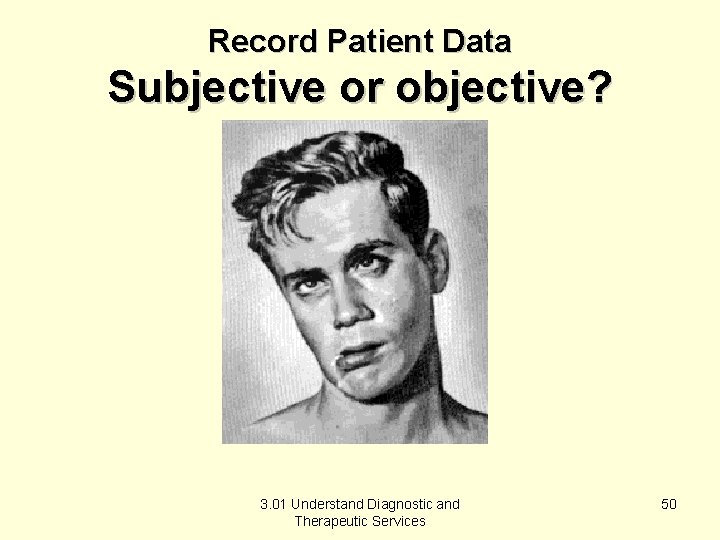
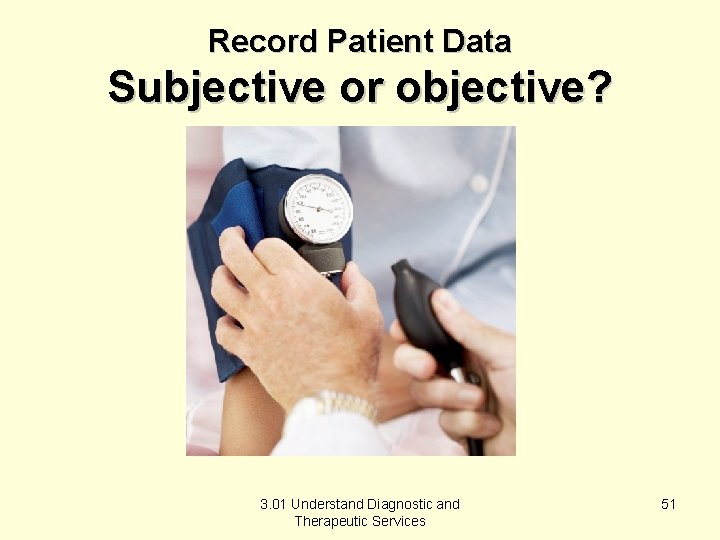
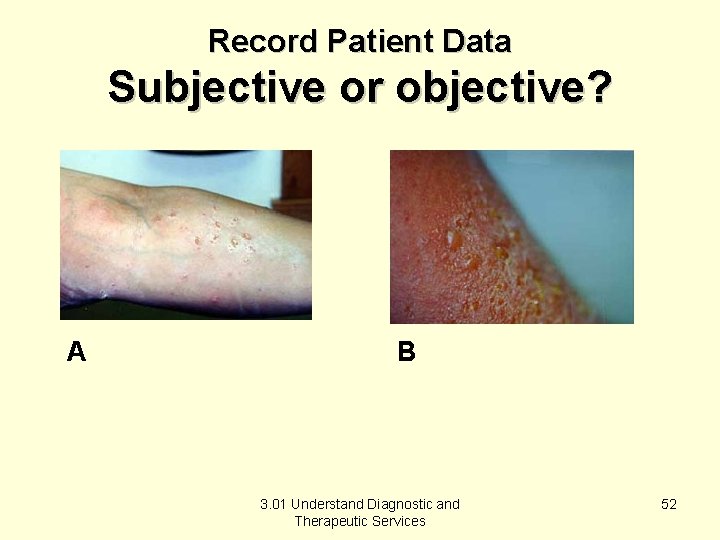
Collect Patient Data Patient Assessment Objective Measurable – vital signs – weight and height – test results Disease symptoms that can be observed by somebody other than the person who is ill Subjective perceived to exist only by the patient and is not recognizable to anyone else 3. 01 Understand Diagnostic and Therapeutic Services 19
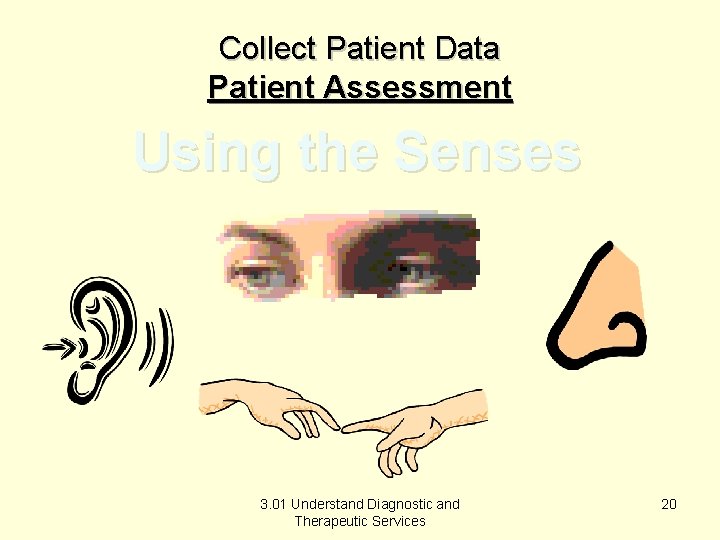
Collect Patient Data Patient Assessment Using the Senses 3. 01 Understand Diagnostic and Therapeutic Services 20
Collect Patient Data Patient Assessment What the health care professional can: • See (observation) • Smell • Touch (palpation) • Hear (auscultation, percussion) 3. 01 Understand Diagnostic and Therapeutic Services 21
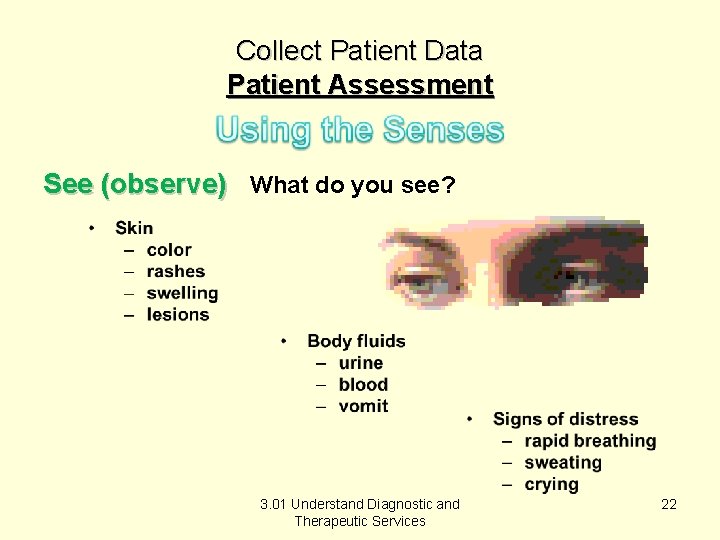
Collect Patient Data Patient Assessment See (observe) What do you see? 3. 01 Understand Diagnostic and Therapeutic Services 22
Collect Patient Data Patient Assessment SMELL What do you smell? • unusual odors – body – breath – wounds – body fluids 3. 01 Understand Diagnostic and Therapeutic Services 23
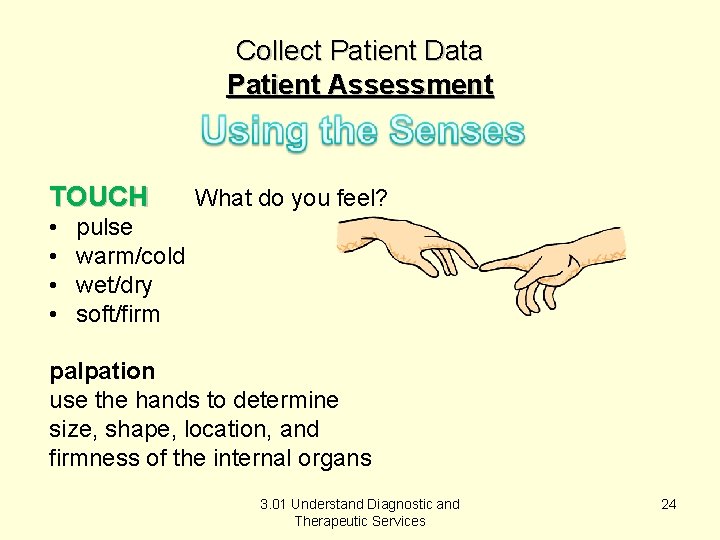
Collect Patient Data Patient Assessment TOUCH • • What do you feel? pulse warm/cold wet/dry soft/firm palpation use the hands to determine size, shape, location, and firmness of the internal organs 3. 01 Understand Diagnostic and Therapeutic Services 24
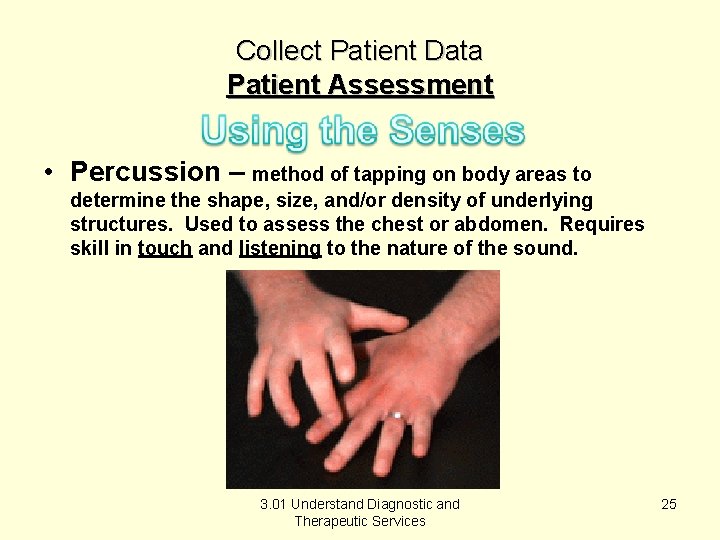
Collect Patient Data Patient Assessment • Percussion – method of tapping on body areas to determine the shape, size, and/or density of underlying structures. Used to assess the chest or abdomen. Requires skill in touch and listening to the nature of the sound. 3. 01 Understand Diagnostic and Therapeutic Services 25
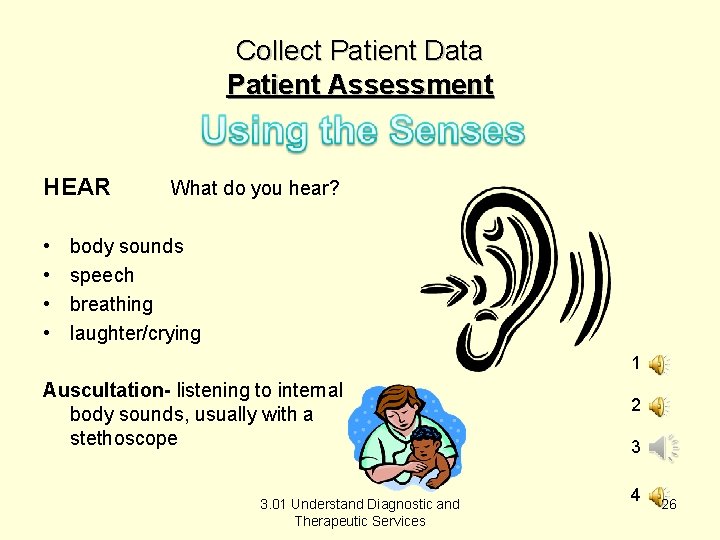
Collect Patient Data Patient Assessment HEAR • • What do you hear? body sounds speech breathing laughter/crying 1 Auscultation- listening to internal body sounds, usually with a stethoscope 3. 01 Understand Diagnostic and Therapeutic Services 2 3 4 26
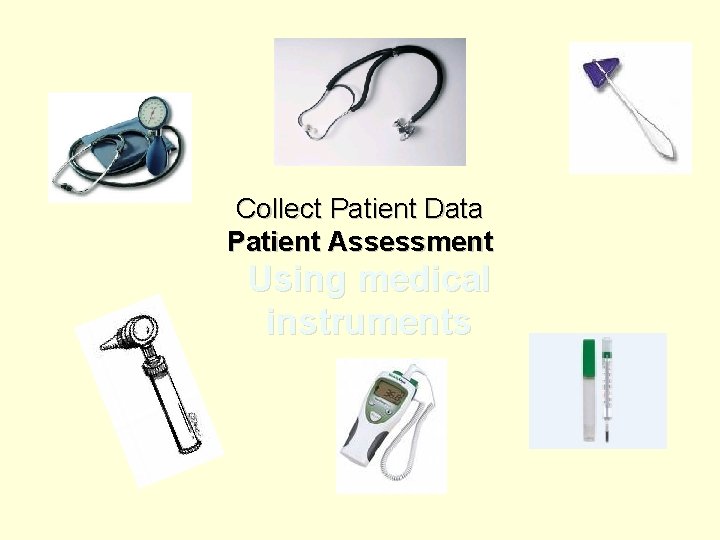
Collect Patient Data Patient Assessment Using medical instruments
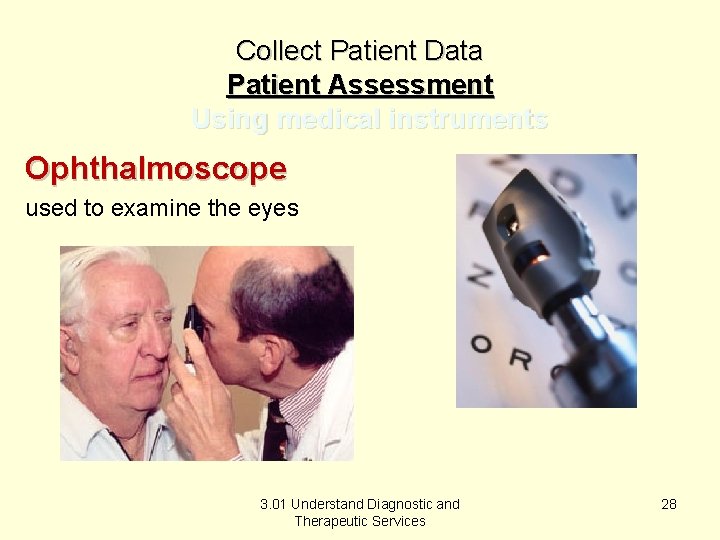
Collect Patient Data Patient Assessment Using medical instruments Ophthalmoscope used to examine the eyes 3. 01 Understand Diagnostic and Therapeutic Services 28
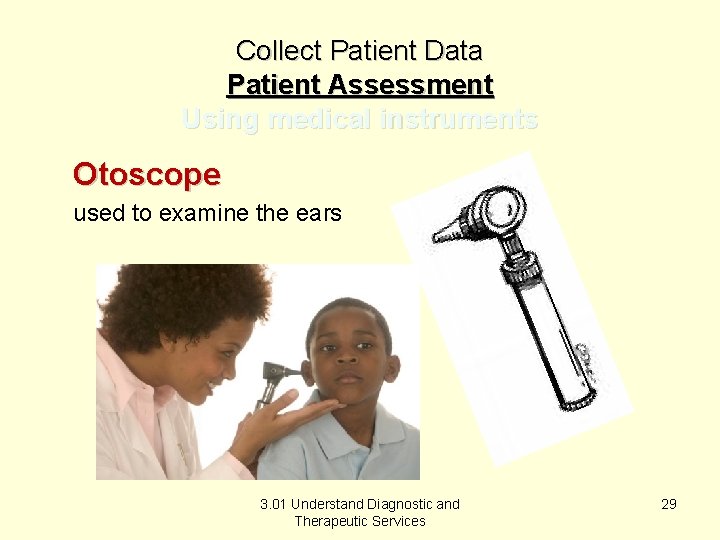
Collect Patient Data Patient Assessment Using medical instruments Otoscope used to examine the ears 3. 01 Understand Diagnostic and Therapeutic Services 29
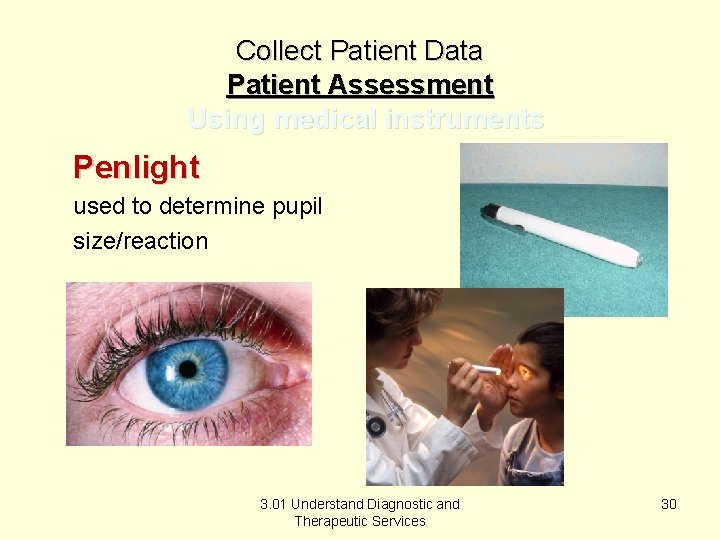
Collect Patient Data Patient Assessment Using medical instruments Penlight used to determine pupil size/reaction 3. 01 Understand Diagnostic and Therapeutic Services 30
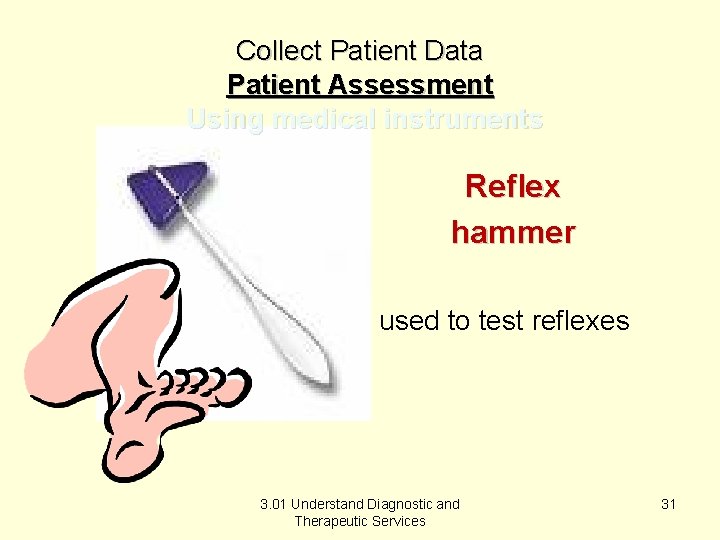
Collect Patient Data Patient Assessment Using medical instruments Reflex hammer used to test reflexes 3. 01 Understand Diagnostic and Therapeutic Services 31
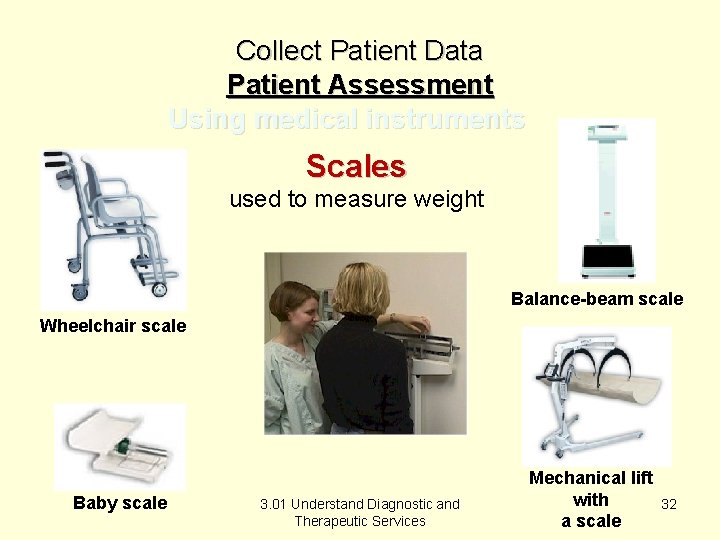
Collect Patient Data Patient Assessment Using medical instruments Scales used to measure weight Balance-beam scale Wheelchair scale Baby scale 3. 01 Understand Diagnostic and Therapeutic Services Mechanical lift with a scale 32
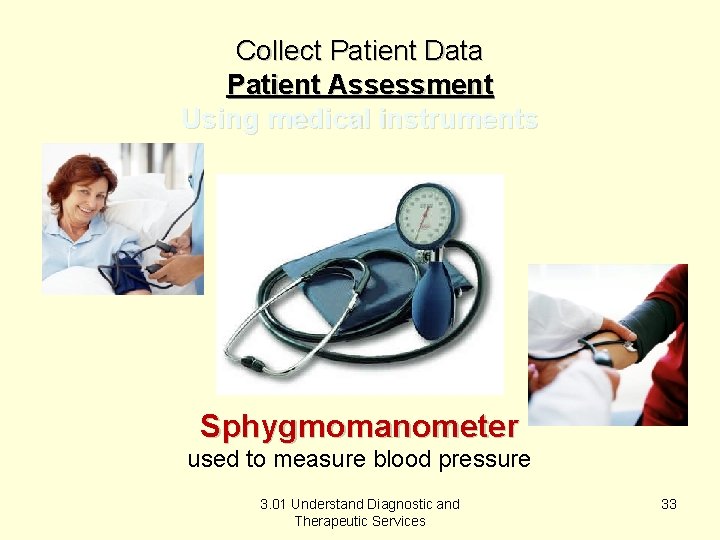
Collect Patient Data Patient Assessment Using medical instruments Sphygmomanometer used to measure blood pressure 3. 01 Understand Diagnostic and Therapeutic Services 33
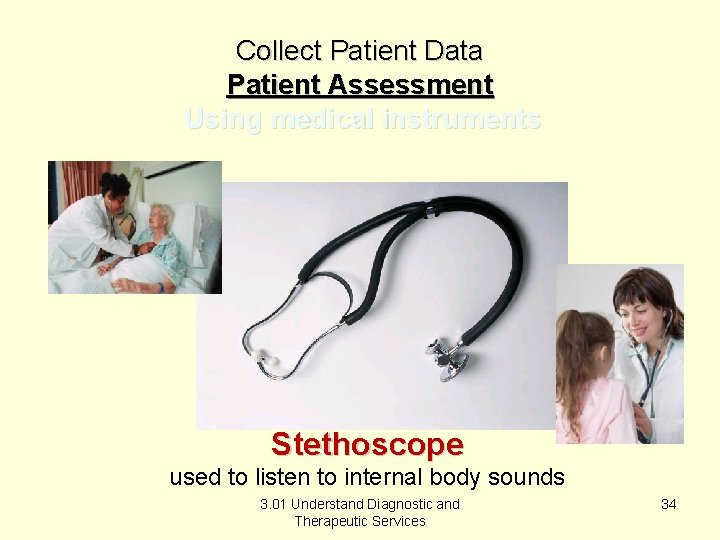
Collect Patient Data Patient Assessment Using medical instruments Stethoscope used to listen to internal body sounds 3. 01 Understand Diagnostic and Therapeutic Services 34
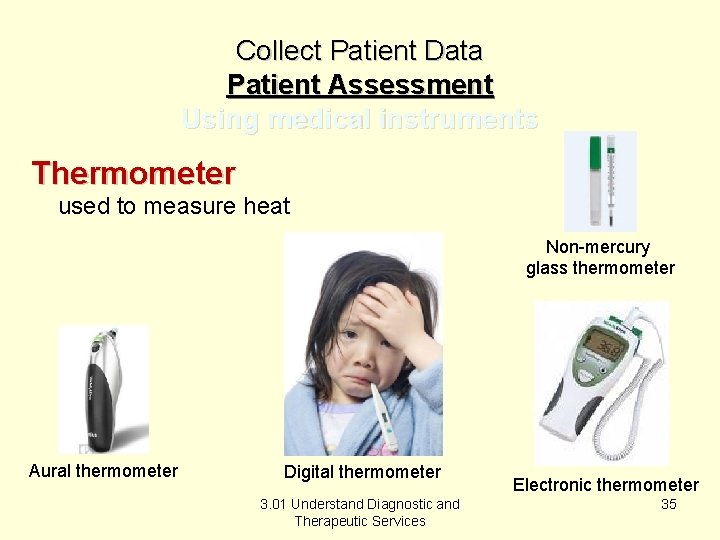
Collect Patient Data Patient Assessment Using medical instruments Thermometer used to measure heat Non-mercury glass thermometer Aural thermometer Digital thermometer 3. 01 Understand Diagnostic and Therapeutic Services Electronic thermometer 35
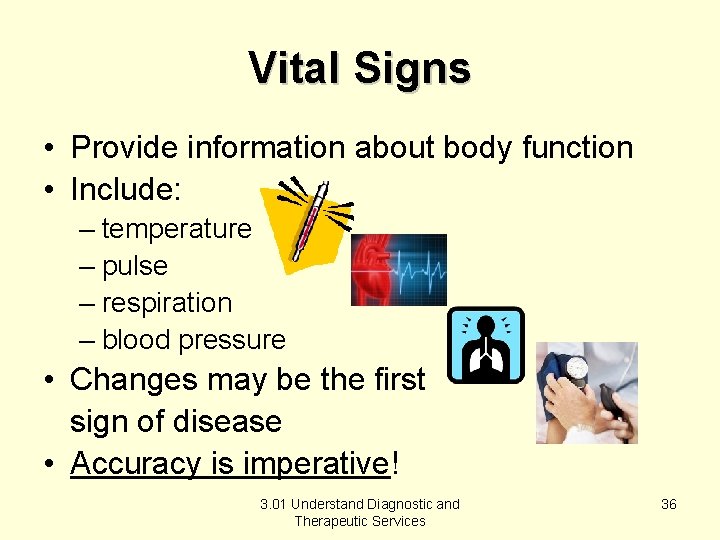
Vital Signs • Provide information about body function • Include: – temperature – pulse – respiration – blood pressure • Changes may be the first sign of disease • Accuracy is imperative! 3. 01 Understand Diagnostic and Therapeutic Services 36
Vital Signs Temperature Measurement of the balance between heat lost and heat produced Heat lost through: • • • Perspiration Respiration Excretion Heat produced by: • Metabolism of food • Muscle and gland activity 3. 01 Understand Diagnostic and Therapeutic Services 37
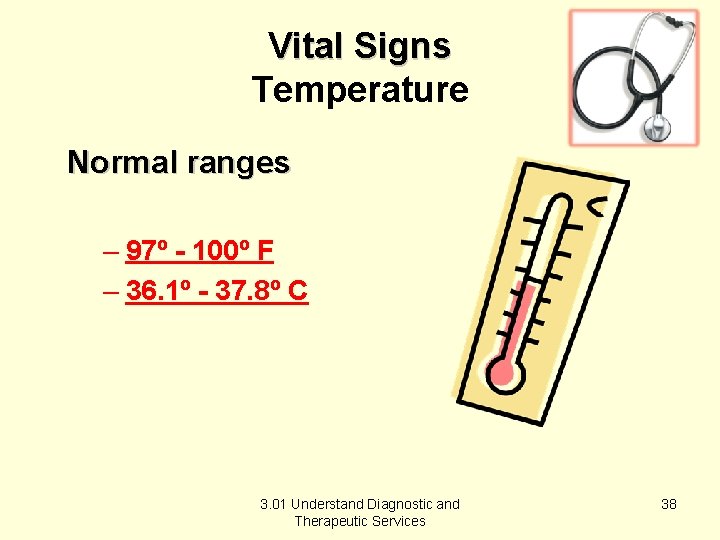
Vital Signs Temperature Normal ranges – 97º - 100º F – 36. 1º - 37. 8º C 3. 01 Understand Diagnostic and Therapeutic Services 38
Objective 3. 01 Record and Report Patient Data 3. 01 Understand Diagnostic and Therapeutic Services 39
Record Patient Data • • Patient data must be recorded accurately. Document procedures as you do them. Use the proper format and appropriate forms. Record results in BLUE or BLACK ink. 3. 01 Understand Diagnostic and Therapeutic Services 40
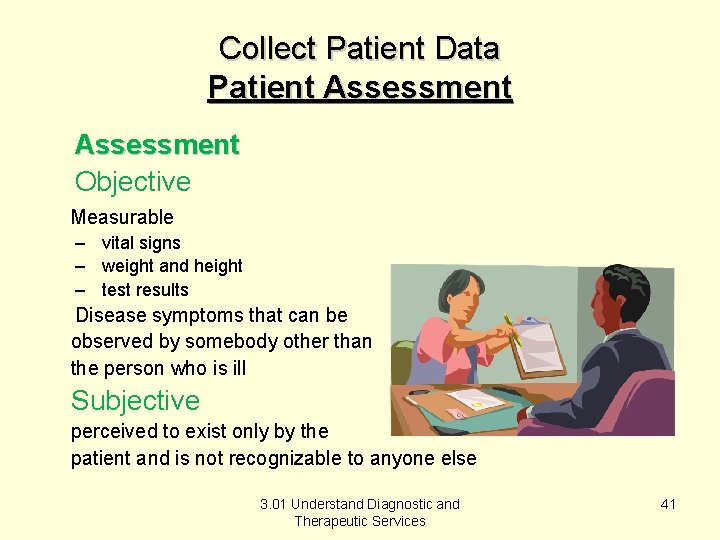
Collect Patient Data Patient Assessment Objective Measurable – vital signs – weight and height – test results Disease symptoms that can be observed by somebody other than the person who is ill Subjective perceived to exist only by the patient and is not recognizable to anyone else 3. 01 Understand Diagnostic and Therapeutic Services 41
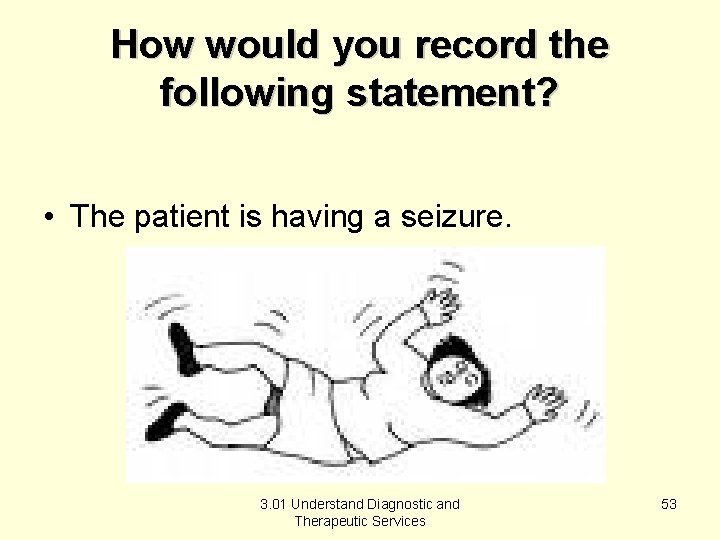
Record Patient Data SOAP Notes • Subjective observations: what the patient states (symptoms) • Objective observations: what is seen or measured (signs) • Assessment: normal versus abnormal • Plan: what will be done 3. 01 Understand Diagnostic and Therapeutic Services 42
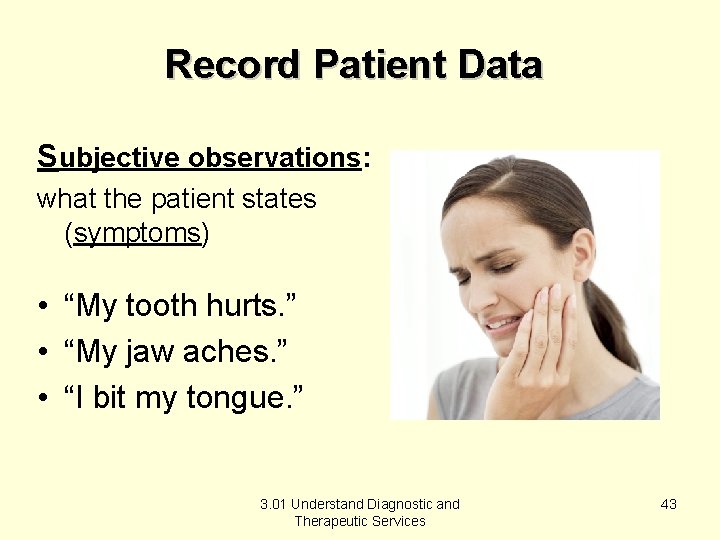
Record Patient Data Subjective observations: what the patient states (symptoms) • “My tooth hurts. ” • “My jaw aches. ” • “I bit my tongue. ” 3. 01 Understand Diagnostic and Therapeutic Services 43
Record Patient Data Objective observations: what is seen or measured (signs) tem per atu re color bloo d pr essu re amoun t or siz e location 44
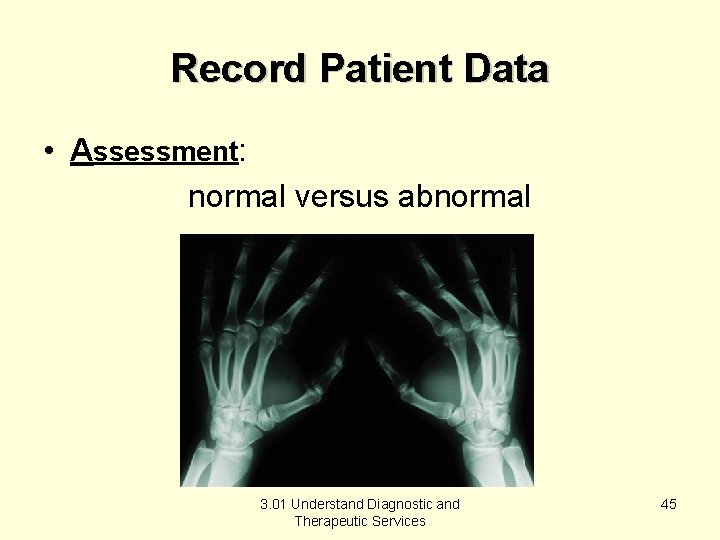
Record Patient Data • Assessment: normal versus abnormal 3. 01 Understand Diagnostic and Therapeutic Services 45
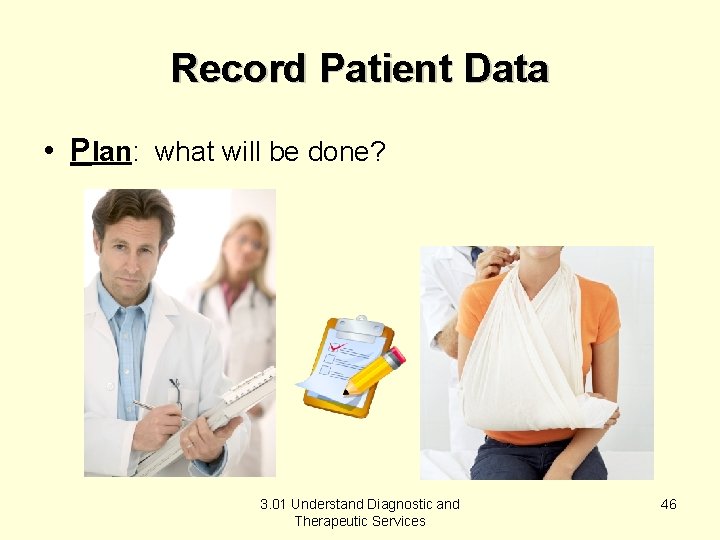
Record Patient Data • Plan: what will be done? 3. 01 Understand Diagnostic and Therapeutic Services 46
Record Patient Data SOAP Notes • Subjective observations: what the patient states (symptoms) • Objective observations: what is seen or measured (signs) • Assessment: normal versus abnormal • Plan: what will be done 3. 01 Understand Diagnostic and Therapeutic Services 47
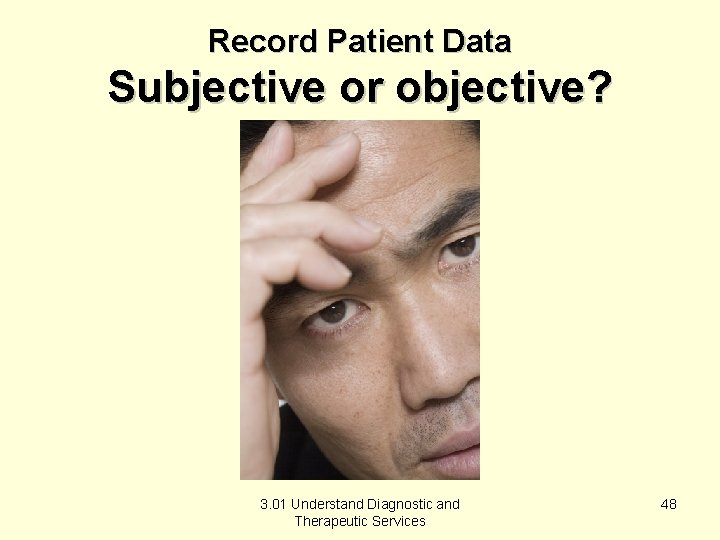
Record Patient Data Subjective or objective? 3. 01 Understand Diagnostic and Therapeutic Services 48
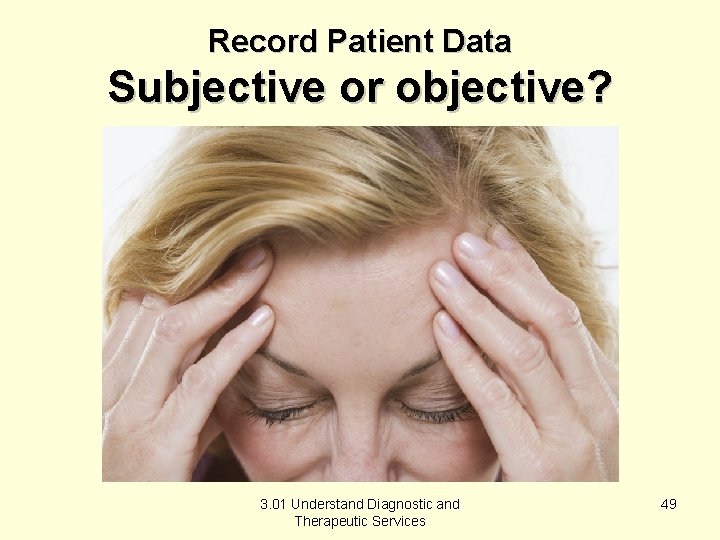
Record Patient Data Subjective or objective? 3. 01 Understand Diagnostic and Therapeutic Services 49
Record Patient Data Subjective or objective? 3. 01 Understand Diagnostic and Therapeutic Services 50
Record Patient Data Subjective or objective? 3. 01 Understand Diagnostic and Therapeutic Services 51
Record Patient Data Subjective or objective? A B 3. 01 Understand Diagnostic and Therapeutic Services 52
How would you record the following statement? • The patient is having a seizure. 3. 01 Understand Diagnostic and Therapeutic Services 53
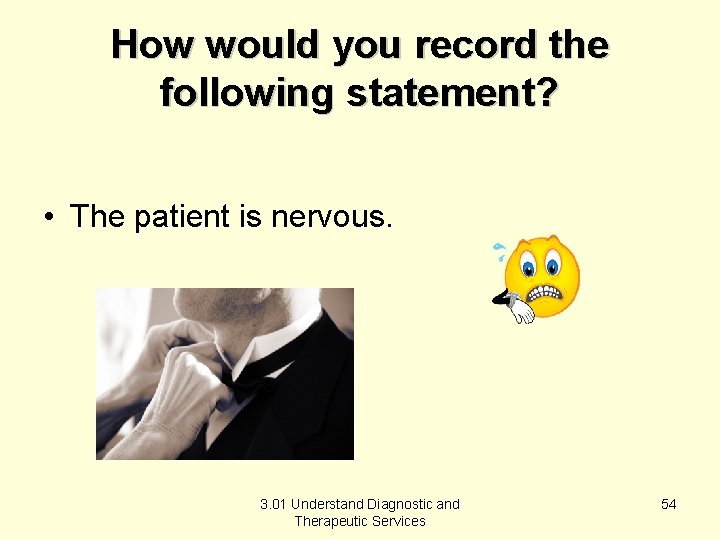
How would you record the following statement? • The patient is nervous. 3. 01 Understand Diagnostic and Therapeutic Services 54
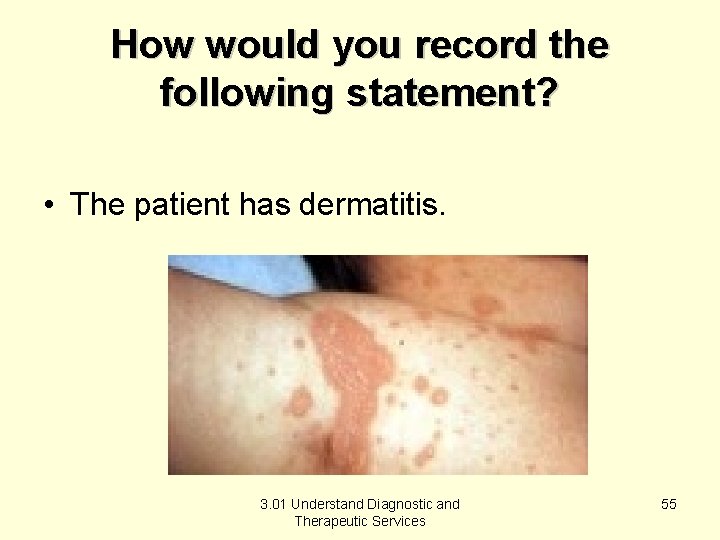
How would you record the following statement? • The patient has dermatitis. 3. 01 Understand Diagnostic and Therapeutic Services 55
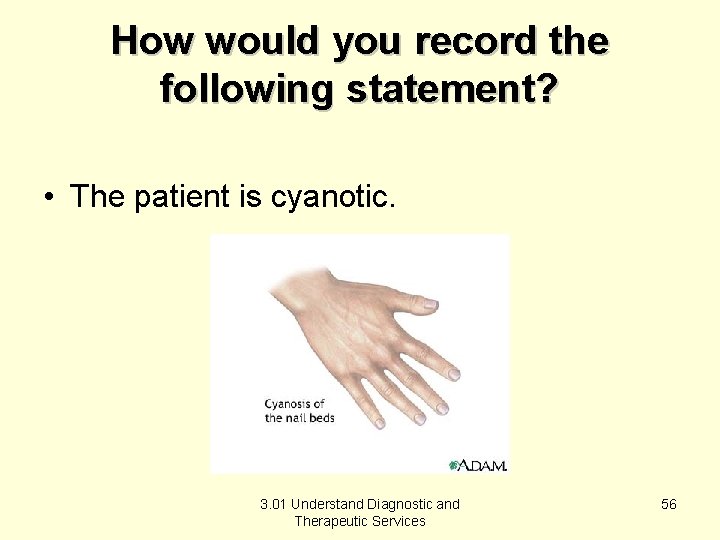
How would you record the following statement? • The patient is cyanotic. 3. 01 Understand Diagnostic and Therapeutic Services 56
Report Patient Data 3. 01 Understand Diagnostic and Therapeutic Services 57
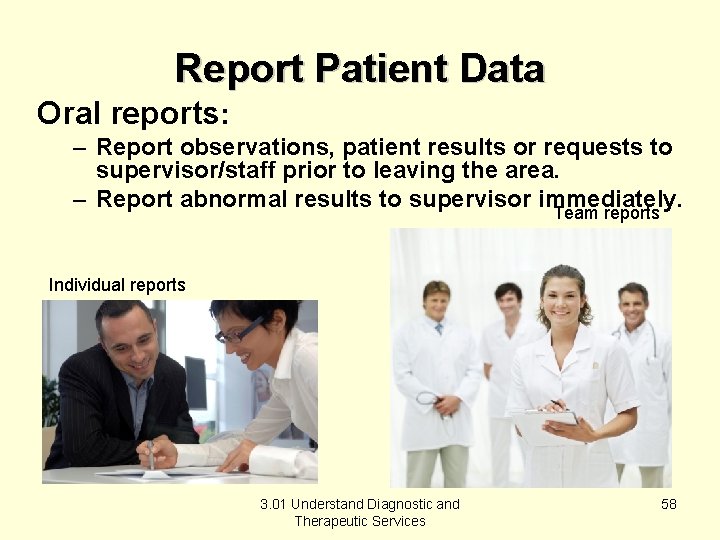
Report Patient Data Oral reports: – Report observations, patient results or requests to supervisor/staff prior to leaving the area. – Report abnormal results to supervisor immediately. Team reports Individual reports 3. 01 Understand Diagnostic and Therapeutic Services 58
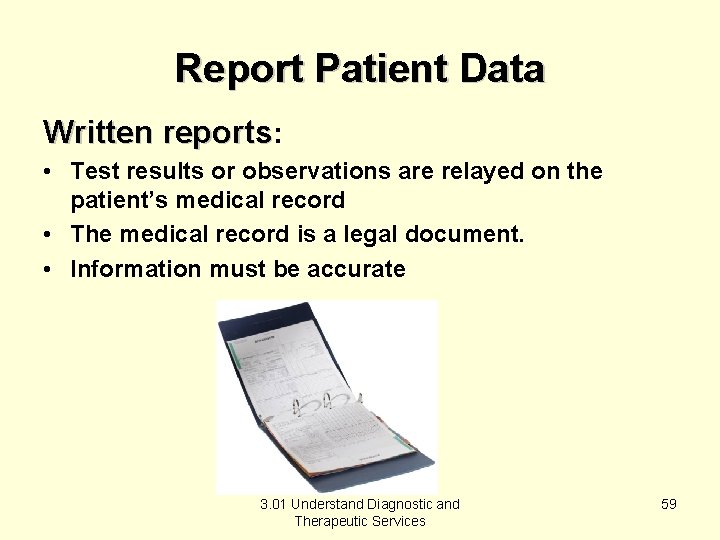
Report Patient Data Written reports: • Test results or observations are relayed on the patient’s medical record • The medical record is a legal document. • Information must be accurate 3. 01 Understand Diagnostic and Therapeutic Services 59
Summary: Collect, Record, Report Patient Data • Choose appropriate tool to assess patient’s treatment plan • Analyze information gathered • Evaluate patient response to treatment and/or procedure • Revise treatment plan based on information gathered • Record and report accurately, in a timely manner 3. 01 Understand Diagnostic and Therapeutic Services 60
Vital Signs Temperature Hypothermia • Temperature below 95º F • Death can occur if below 93º F 3. 01 Understand Diagnostic and Therapeutic Services 61
Vital Signs Temperature Hypothermia Temperature decreases with: – – – environment exposure to cold inactivity sleep starvation Symptoms: – shivering – cold skin – confusion 3. 01 Understand Diagnostic and Therapeutic Services 62
Vital Signs Temperature Hyperthermia • Temperature 100 -104º F • Temperature above 104º F is life-threatening • Prolonged hyperthermia may cause brain injury. 3. 01 Understand Diagnostic and Therapeutic Services 63
Vital Signs Temperature Hyperthermia Temperature increases with: – – environment exercise illness, infection, injury stress Symptoms: – – hot, dry, red skin nausea/vomiting headache low blood pressure 3. 01 Understand Diagnostic and Therapeutic Services 64
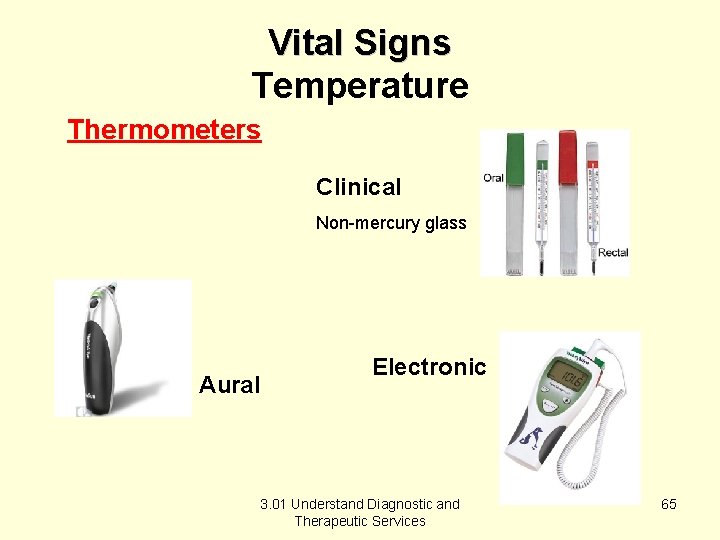
Vital Signs Temperature Thermometers Clinical Non-mercury glass Aural Electronic 3. 01 Understand Diagnostic and Therapeutic Services 65
Vital Signs Temperature Sites to measure temperature: • Aural – auditory canal (Tympanic) • Axillary – armpit (AX) • Oral – mouth (O) • Rectal – rectum (R) 3. 01 Understand Diagnostic and Therapeutic Services 66
Vital Signs Temperature To record temperature: – Oral 98. 6º (O) – Rectal 99. 6º (R) – Axillary 97. 6º (ax) – Aural 98. 6º (T) 3. 01 Understand Diagnostic and Therapeutic Services 67
Vital Signs Temperature Measurement Oral • Ask the patient if they have ingested hot or cold food or drink, or smoked within the last ½ hour • If yes, wait at least 15 minutes before measuring the oral temperature 3. 01 Understand Diagnostic and Therapeutic Services 68
Vital Signs Temperature Measurement • Aural • Pros: – Measures core body temperature – Fast and convenient • Con: – Inaccurate if not placed correctly in the ear canal – Ear infection – Ear wax 3. 01 Understand Diagnostic and Therapeutic Services 69
Vital Signs REPORT ABNORMAL RESULTS OF ANY VITAL SIGN IMMEDIATELY 3. 01 Understand Diagnostic and Therapeutic Services 70
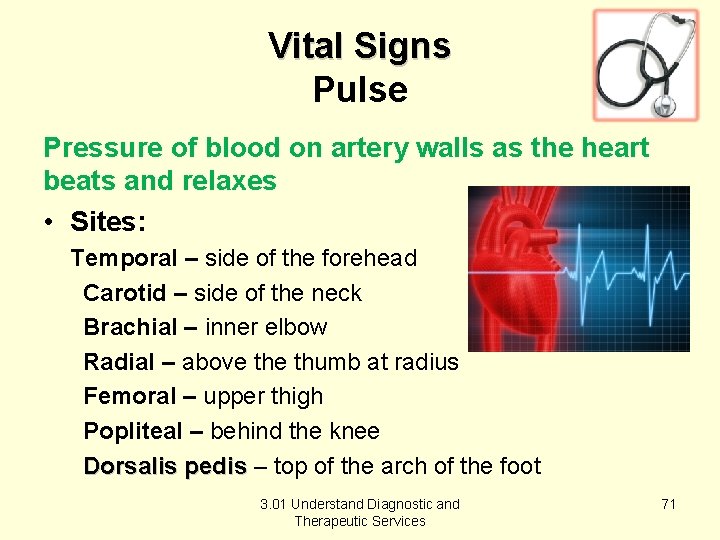
Vital Signs Pulse Pressure of blood on artery walls as the heart beats and relaxes • Sites: Temporal – side of the forehead Carotid – side of the neck Brachial – inner elbow Radial – above thumb at radius Femoral – upper thigh Popliteal – behind the knee Dorsalis pedis – top of the arch of the foot 3. 01 Understand Diagnostic and Therapeutic Services 71
Vital Signs Pulse Normal rate adult 60 – 90 beats per minute children (over 7) 70 – 100 beats per minute children (1 – 7) 80 – 110 beats per minute infants (less than 1 year) 100 – 160 beats per minute Rhythm regular or irregular Volume strength of the pulse 3. 01 Understand Diagnostic and Therapeutic Services 72
Vital Signs Pulse • Pulse can be increased by: – exercise – stimulant drugs – excitement – fever – shock – nervousness 3. 01 Understand Diagnostic and Therapeutic Services 73
Vital Signs Pulse • Pulse can be decreased by: – sleep – depressant drugs – heart disease – coma 3. 01 Understand Diagnostic and Therapeutic Services 74
Vital Signs Apical Pulse • Pulse count taken with the stethoscope. • Use if the patient has: – Irregular heartbeat – Arteriosclerosis – Weak or rapid radial pulse – Infants and children 3. 01 Understand Diagnostic and Therapeutic Services 75
Vital Signs REPORT ABNORMAL RESULTS OF ANY VITAL SIGN IMMEDIATELY 3. 01 Understand Diagnostic and Therapeutic Services 76
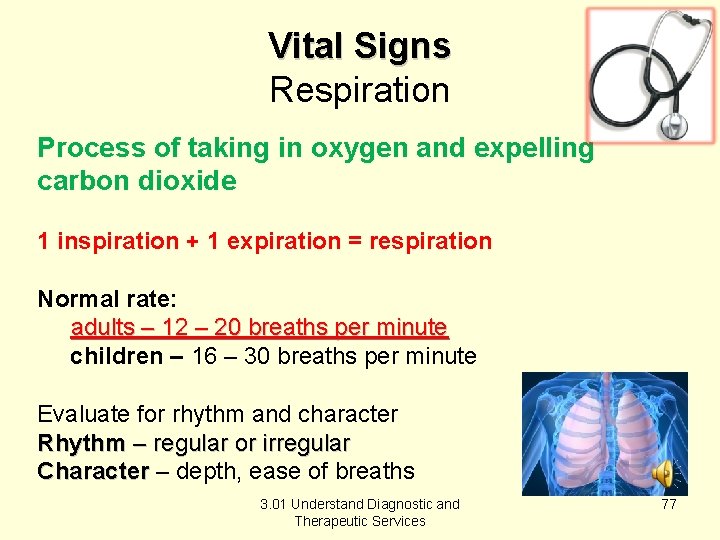
Vital Signs Respiration Process of taking in oxygen and expelling carbon dioxide 1 inspiration + 1 expiration = respiration Normal rate: adults – 12 – 20 breaths per minute children – 16 – 30 breaths per minute Evaluate for rhythm and character Rhythm – regular or irregular Character – depth, ease of breaths 3. 01 Understand Diagnostic and Therapeutic Services 77
Vital Signs Respiration • Abnormal respiratory patterns üApnea – periods of absent breathing üCheyne-stokes – periods of apnea and dyspnea üDyspnea – difficult breathing 3. 01 Understand Diagnostic and Therapeutic Services 78
Vital Signs REPORT ABNORMAL RESULTS OF ANY VITAL SIGN IMMEDIATELY 3. 01 Understand Diagnostic and Therapeutic Services 79
Vital Signs Combined Vital Signs TPR, BP Temperature: Aural and Oral Pulse: Radial and Apical Respiration 80
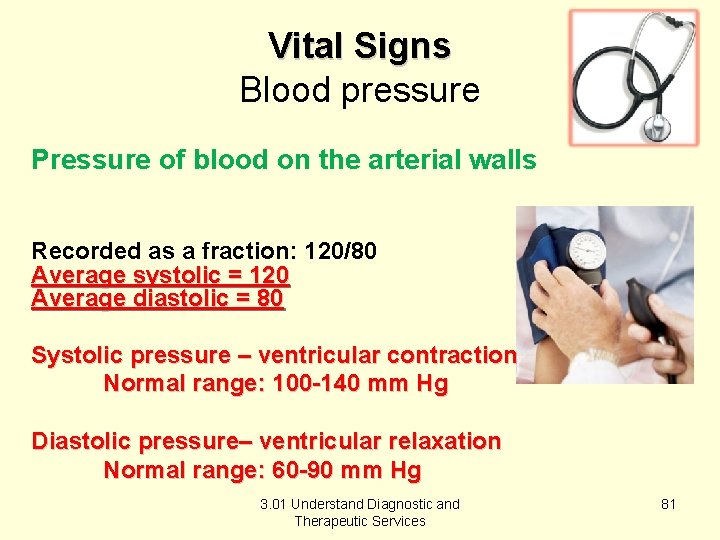
Vital Signs Blood pressure Pressure of blood on the arterial walls Recorded as a fraction: 120/80 Average systolic = 120 Average diastolic = 80 Systolic pressure – ventricular contraction Normal range: 100 -140 mm Hg Diastolic pressure– ventricular relaxation Normal range: 60 -90 mm Hg 3. 01 Understand Diagnostic and Therapeutic Services 81
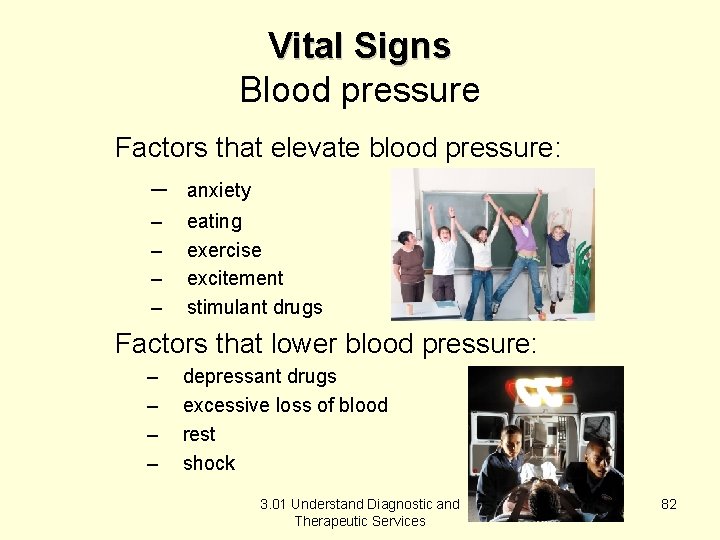
Vital Signs Blood pressure Factors that elevate blood pressure: – anxiety – – eating exercise excitement stimulant drugs Factors that lower blood pressure: – – depressant drugs excessive loss of blood rest shock 3. 01 Understand Diagnostic and Therapeutic Services 82
Vital Signs Blood Pressure Demonstrate the skill Provide for guided practice Provide for independent practice 3. 01 Understand Diagnostic and Therapeutic Services 83
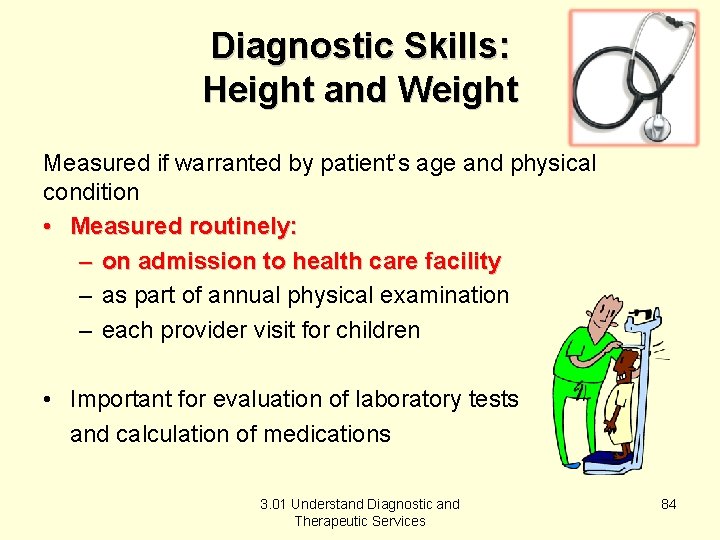
Diagnostic Skills: Height and Weight Measured if warranted by patient’s age and physical condition • Measured routinely: – on admission to health care facility – as part of annual physical examination – each provider visit for children • Important for evaluation of laboratory tests and calculation of medications 3. 01 Understand Diagnostic and Therapeutic Services 84
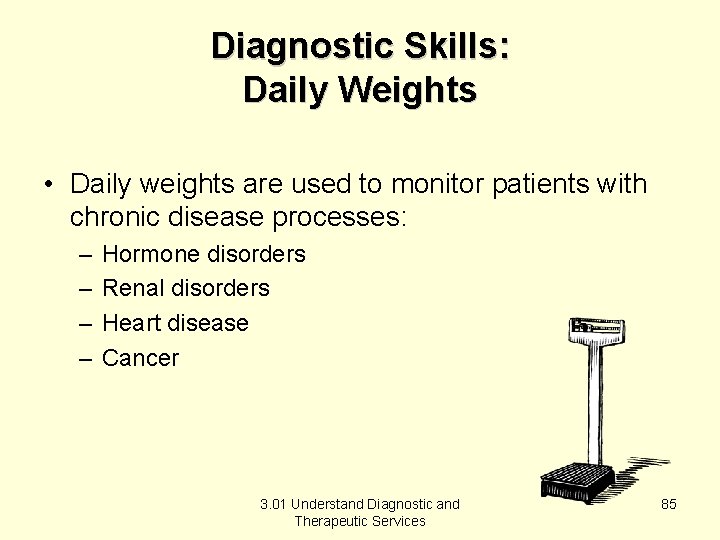
Diagnostic Skills: Daily Weights • Daily weights are used to monitor patients with chronic disease processes: – – Hormone disorders Renal disorders Heart disease Cancer 3. 01 Understand Diagnostic and Therapeutic Services 85
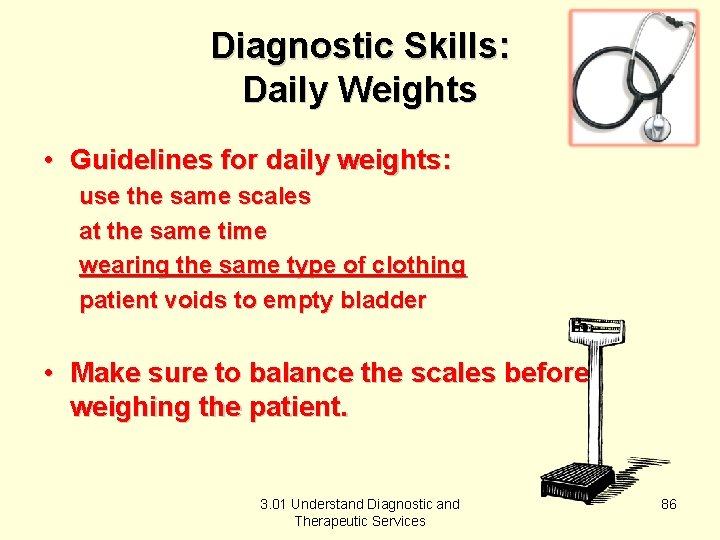
Diagnostic Skills: Daily Weights • Guidelines for daily weights: use the same scales at the same time wearing the same type of clothing patient voids to empty bladder • Make sure to balance the scales before weighing the patient. 3. 01 Understand Diagnostic and Therapeutic Services 86
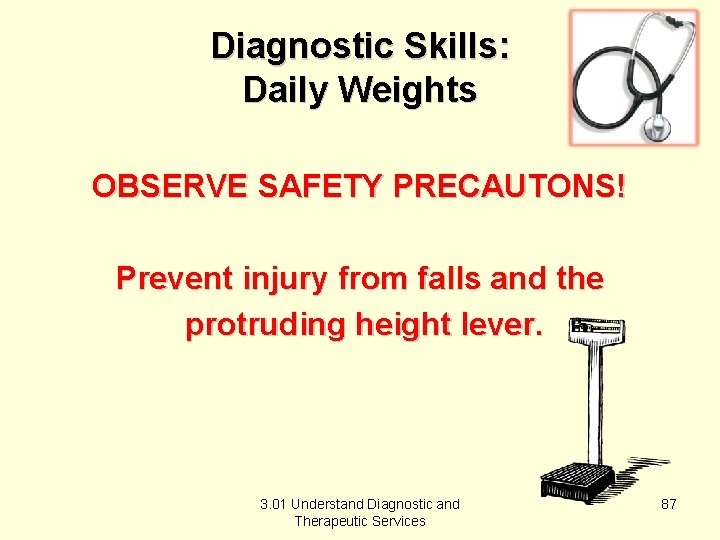
Diagnostic Skills: Daily Weights OBSERVE SAFETY PRECAUTONS! Prevent injury from falls and the protruding height lever. 3. 01 Understand Diagnostic and Therapeutic Services 87
Diagnostic Skills Measuring Height and Weight Demonstrate the skill Provide for guided practice Provide for independent practice 3. 01 Understand Diagnostic and Therapeutic Services 88
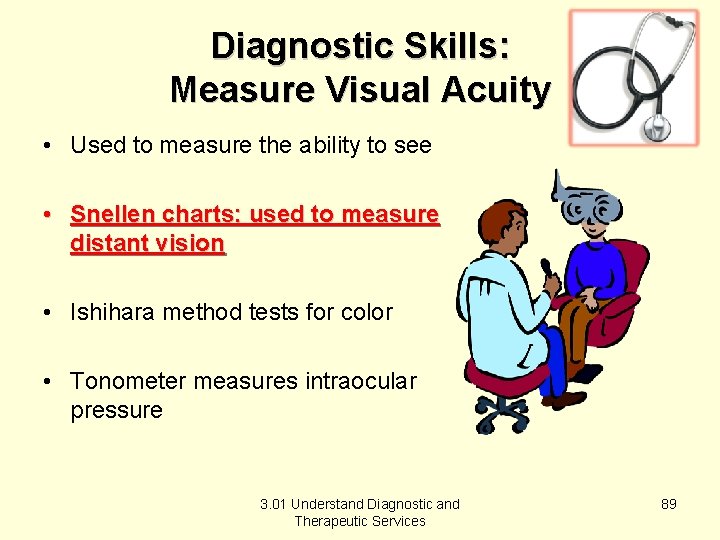
Diagnostic Skills: Measure Visual Acuity • Used to measure the ability to see • Snellen charts: used to measure distant vision • Ishihara method tests for color • Tonometer measures intraocular pressure 3. 01 Understand Diagnostic and Therapeutic Services 89
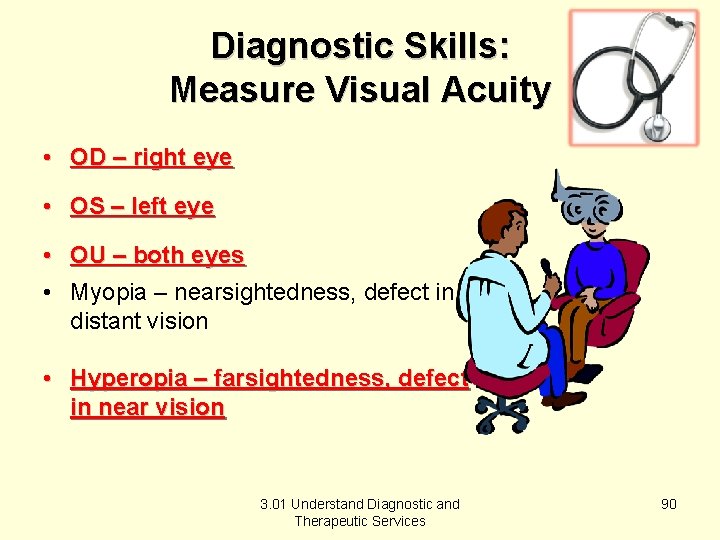
Diagnostic Skills: Measure Visual Acuity • OD – right eye • OS – left eye • OU – both eyes • Myopia – nearsightedness, defect in distant vision • Hyperopia – farsightedness, defect in near vision 3. 01 Understand Diagnostic and Therapeutic Services 90
Diagnostic Skills Measure Visual Acuity Demonstrate the skill Provide for guided practice Provide for independent practice 3. 01 Understand Diagnostic and Therapeutic Services 91
Positioning the Patient
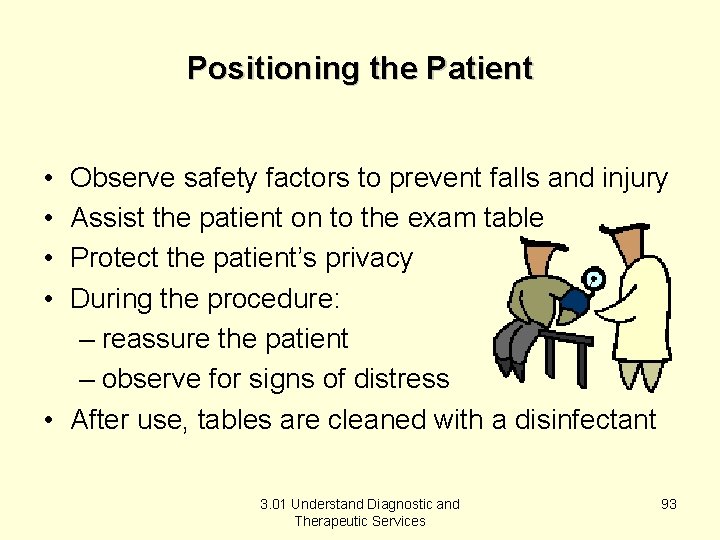
Positioning the Patient • • Observe safety factors to prevent falls and injury Assist the patient on to the exam table Protect the patient’s privacy During the procedure: – reassure the patient – observe for signs of distress • After use, tables are cleaned with a disinfectant 3. 01 Understand Diagnostic and Therapeutic Services 93
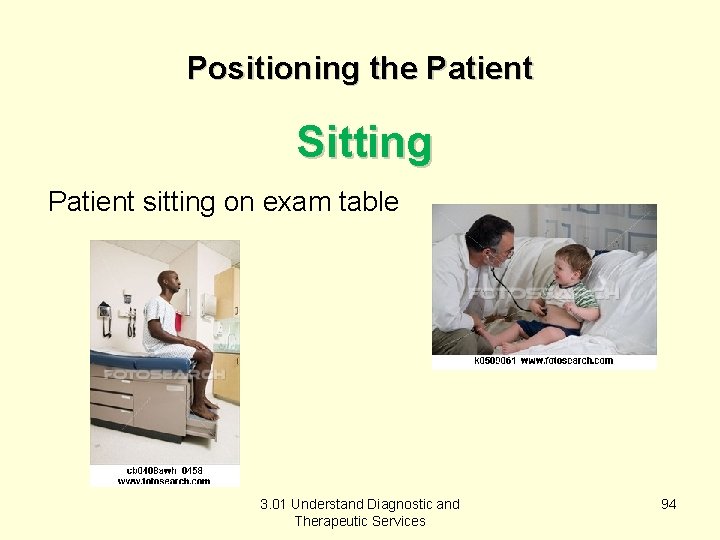
Positioning the Patient Sitting Patient sitting on exam table 3. 01 Understand Diagnostic and Therapeutic Services 94
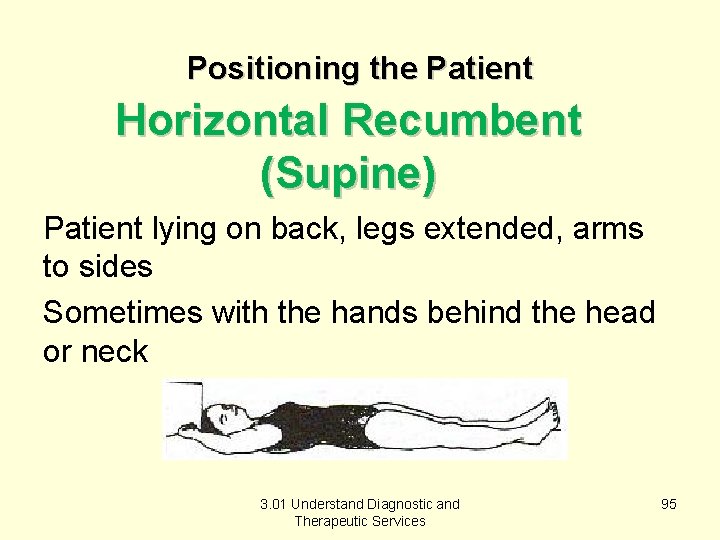
Positioning the Patient Horizontal Recumbent (Supine) Patient lying on back, legs extended, arms to sides Sometimes with the hands behind the head or neck 3. 01 Understand Diagnostic and Therapeutic Services 95
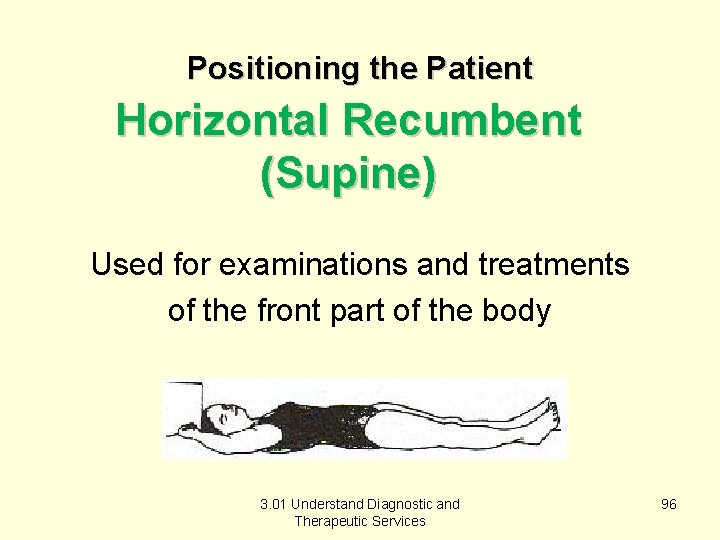
Positioning the Patient Horizontal Recumbent (Supine) Used for examinations and treatments of the front part of the body 3. 01 Understand Diagnostic and Therapeutic Services 96
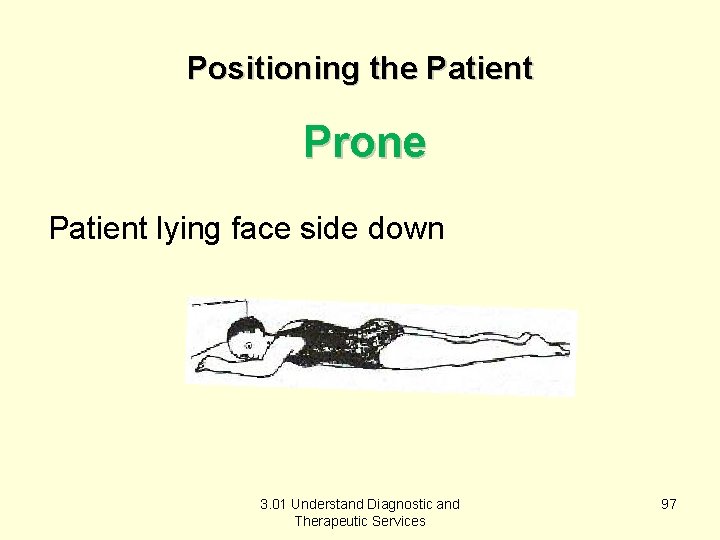
Positioning the Patient Prone Patient lying face side down 3. 01 Understand Diagnostic and Therapeutic Services 97
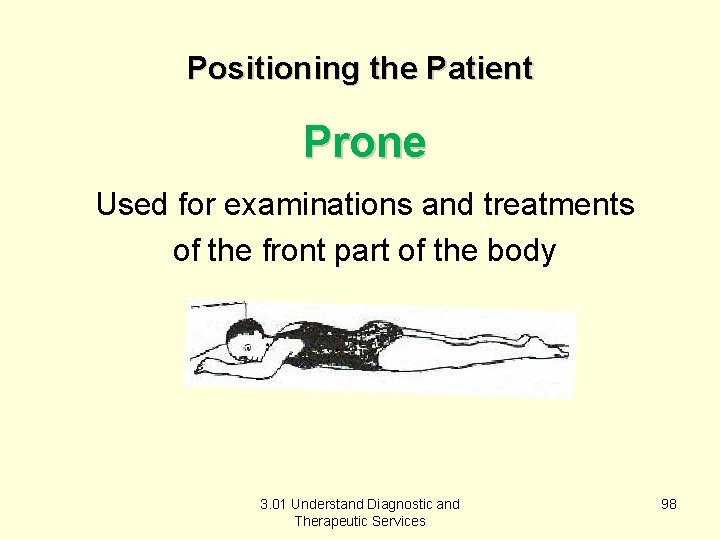
Positioning the Patient Prone Used for examinations and treatments of the front part of the body 3. 01 Understand Diagnostic and Therapeutic Services 98
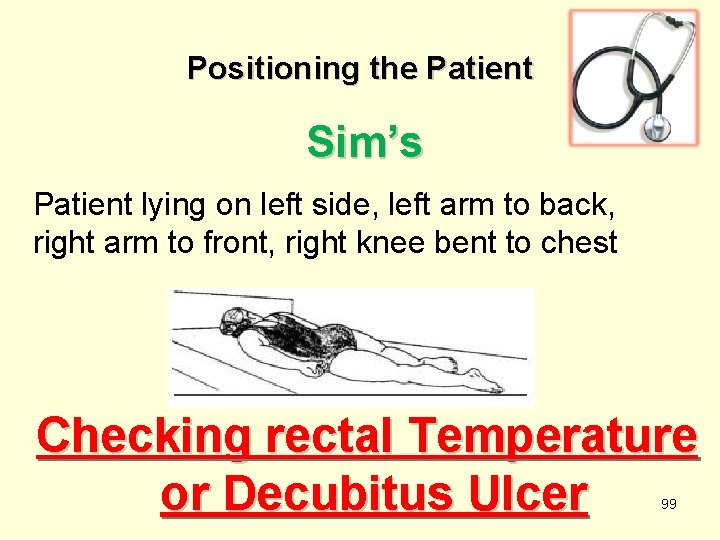
Positioning the Patient Sim’s Patient lying on left side, left arm to back, right arm to front, right knee bent to chest Checking rectal Temperature or Decubitus Ulcer 99
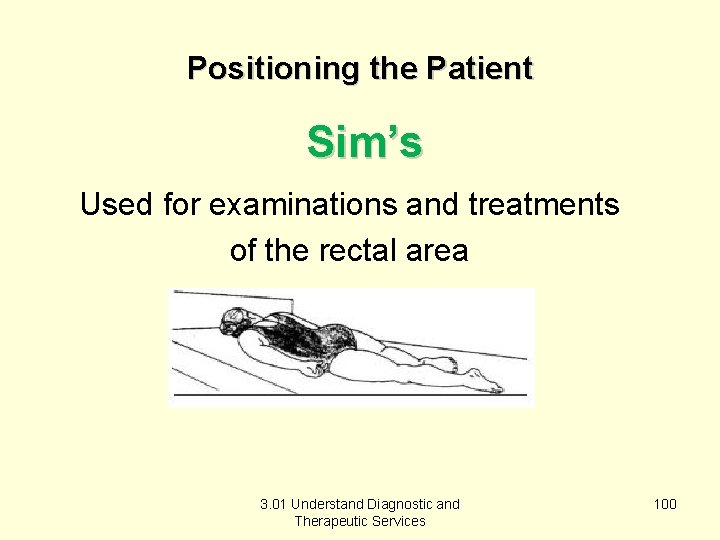
Positioning the Patient Sim’s Used for examinations and treatments of the rectal area 3. 01 Understand Diagnostic and Therapeutic Services 100
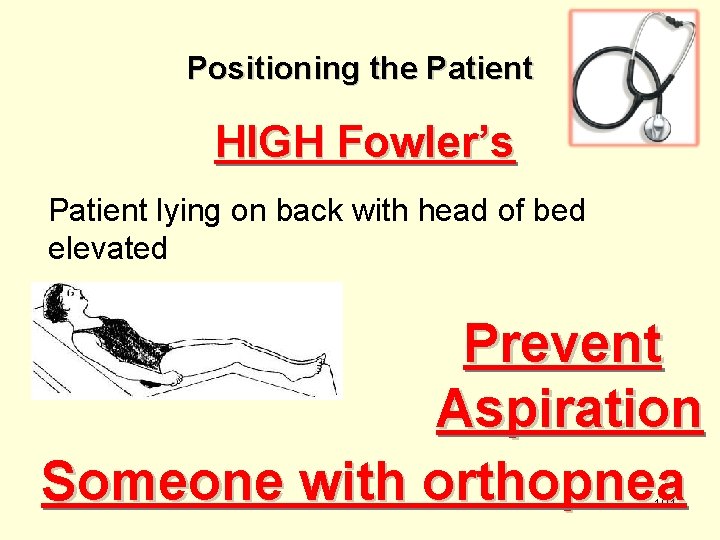
Positioning the Patient HIGH Fowler’s Patient lying on back with head of bed elevated Prevent Aspiration Someone with orthopnea 101

Positioning the Patient Fowler’s Used to facilitate breathing, promote drainage and for examinations of the neck 3. 01 Understand Diagnostic and Therapeutic Services 102
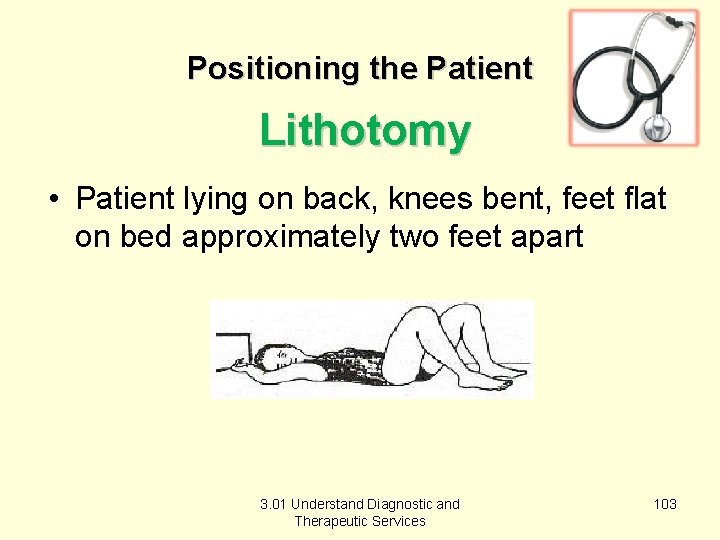
Positioning the Patient Lithotomy • Patient lying on back, knees bent, feet flat on bed approximately two feet apart 3. 01 Understand Diagnostic and Therapeutic Services 103

Positioning the Patient Lithotomy Used for: vaginal examinations Pap tests urinary exams and procedures Delivering a Baby pelvic surgery 3. 01 Understand Diagnostic and Therapeutic Services 104
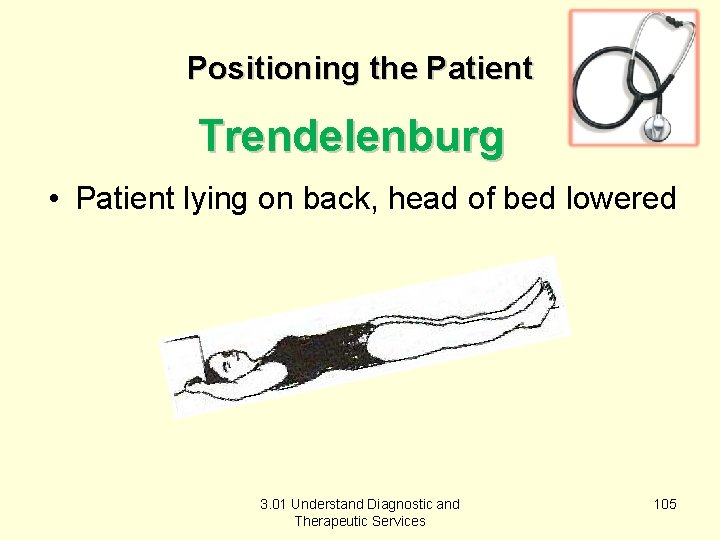
Positioning the Patient Trendelenburg • Patient lying on back, head of bed lowered 3. 01 Understand Diagnostic and Therapeutic Services 105
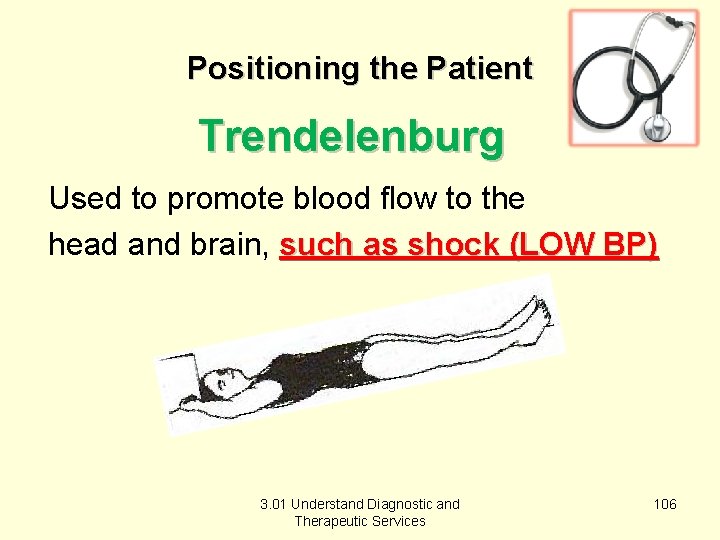
Positioning the Patient Trendelenburg Used to promote blood flow to the head and brain, such as shock (LOW BP) 3. 01 Understand Diagnostic and Therapeutic Services 106
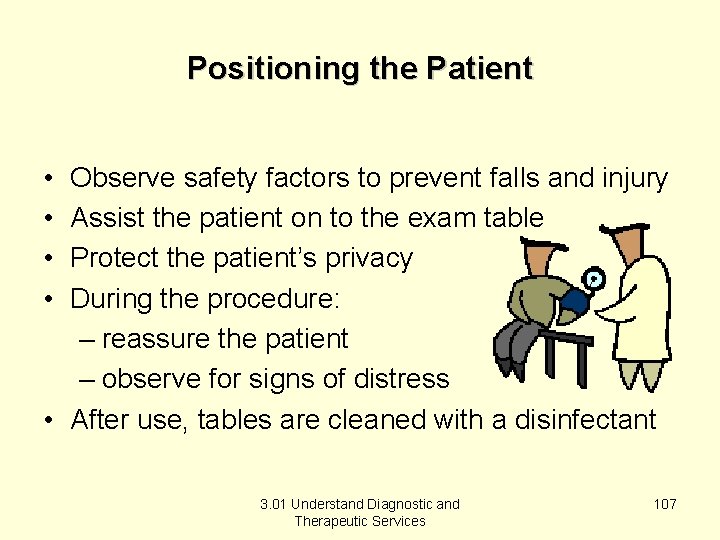
Positioning the Patient • • Observe safety factors to prevent falls and injury Assist the patient on to the exam table Protect the patient’s privacy During the procedure: – reassure the patient – observe for signs of distress • After use, tables are cleaned with a disinfectant 3. 01 Understand Diagnostic and Therapeutic Services 107
Positioning the Patient Demonstrate the skill Provide for guided practice Provide for independent practice Verify student passing

Testing Urine with a Urine Reagent Strip
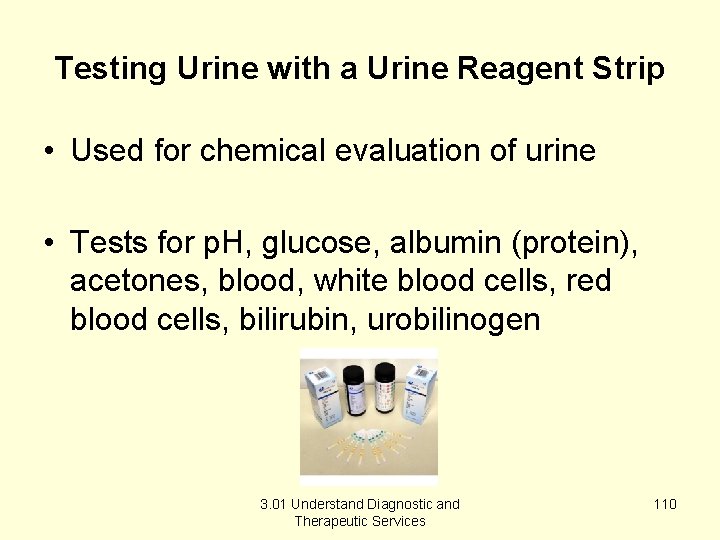
Testing Urine with a Urine Reagent Strip • Used for chemical evaluation of urine • Tests for p. H, glucose, albumin (protein), acetones, blood, white blood cells, red blood cells, bilirubin, urobilinogen 3. 01 Understand Diagnostic and Therapeutic Services 110

Testing Urine with a Urine Reagent Strip Demonstrate the skill Provide for guided practice Provide for independent practice Verify student passing
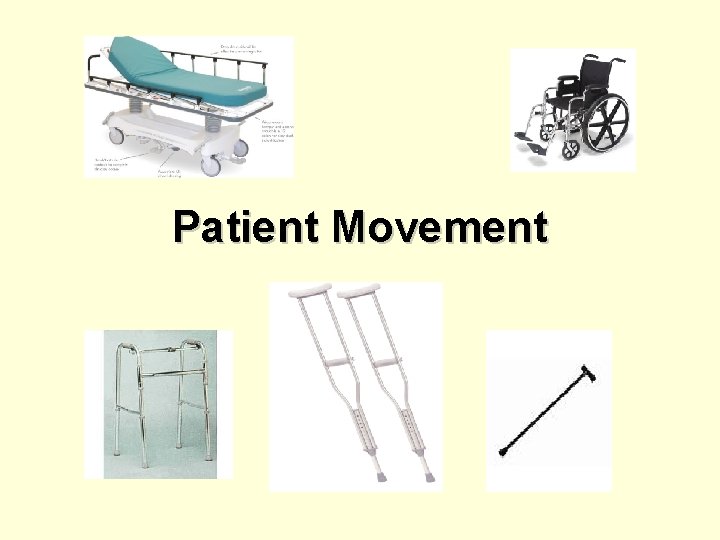
Patient Movement
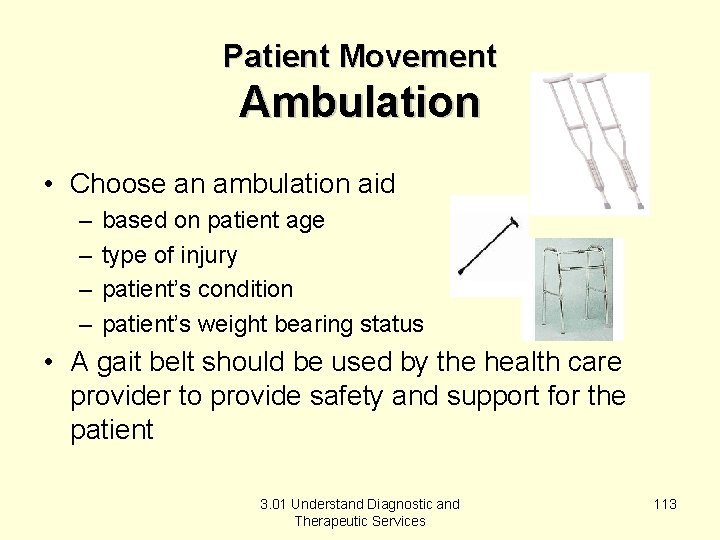
Patient Movement Ambulation • Choose an ambulation aid – – based on patient age type of injury patient’s condition patient’s weight bearing status • A gait belt should be used by the health care provider to provide safety and support for the patient 3. 01 Understand Diagnostic and Therapeutic Services 113
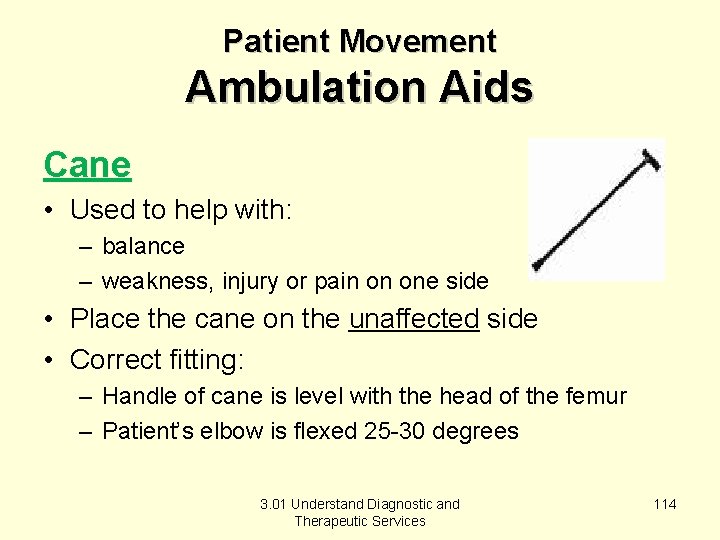
Patient Movement Ambulation Aids Cane • Used to help with: – balance – weakness, injury or pain on one side • Place the cane on the unaffected side • Correct fitting: – Handle of cane is level with the head of the femur – Patient’s elbow is flexed 25 -30 degrees 3. 01 Understand Diagnostic and Therapeutic Services 114
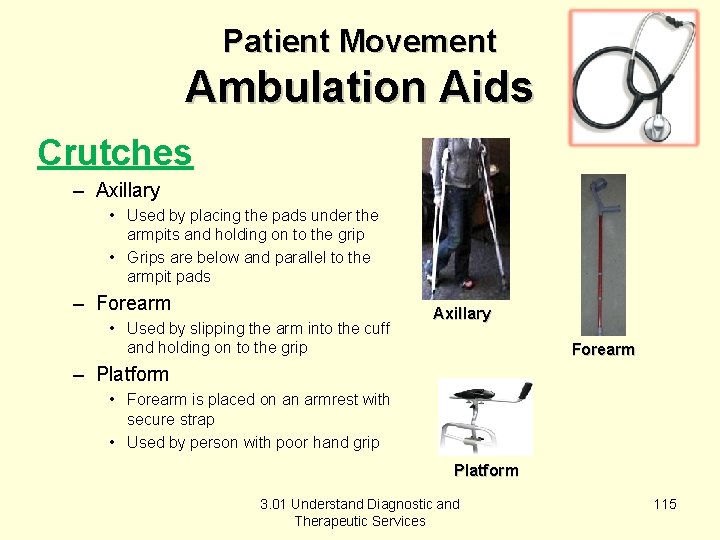
Patient Movement Ambulation Aids Crutches – Axillary • Used by placing the pads under the armpits and holding on to the grip • Grips are below and parallel to the armpit pads – Forearm • Used by slipping the arm into the cuff and holding on to the grip Axillary Forearm – Platform • Forearm is placed on an armrest with secure strap • Used by person with poor hand grip Platform 3. 01 Understand Diagnostic and Therapeutic Services 115
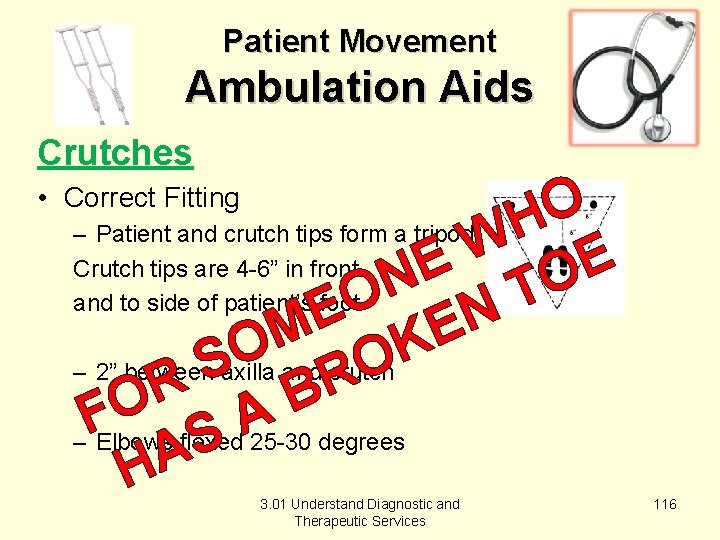
Patient Movement Ambulation Aids Crutches O – Patient and crutch tips form a tripod: H W Crutch tips are 4 -6” in front E E O N T and to side of patient’s foot. O E N E M K O – 2” between. S axilla and crutch O R R B O F A – Elbows flexed 25 -30 degrees S A H • Correct Fitting 3. 01 Understand Diagnostic and Therapeutic Services 116
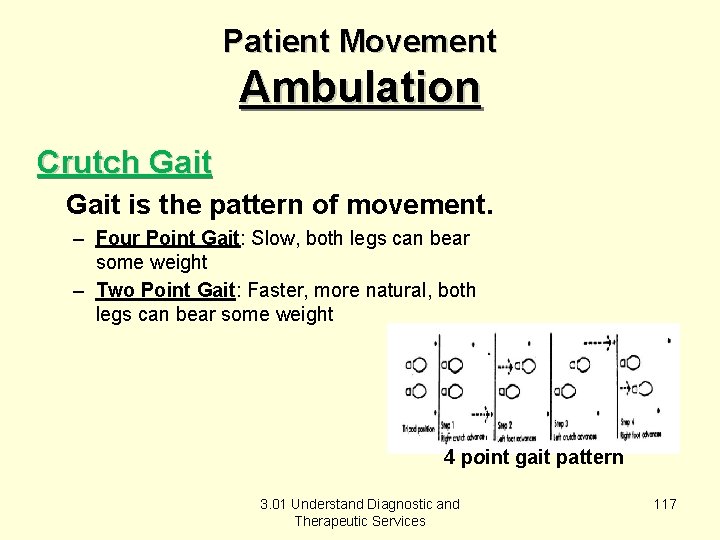
Patient Movement Ambulation Crutch Gait is the pattern of movement. – Four Point Gait: Slow, both legs can bear some weight – Two Point Gait: Faster, more natural, both legs can bear some weight 4 point gait pattern 3. 01 Understand Diagnostic and Therapeutic Services 117
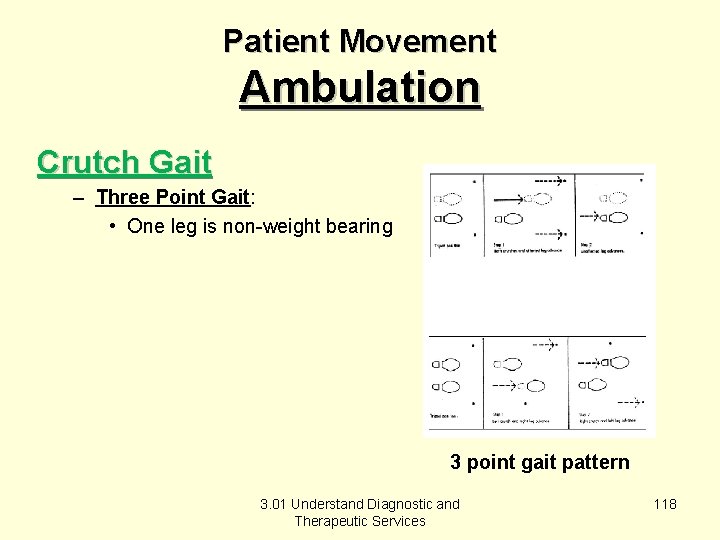
Patient Movement Ambulation Crutch Gait – Three Point Gait: • One leg is non-weight bearing 3 point gait pattern 3. 01 Understand Diagnostic and Therapeutic Services 118
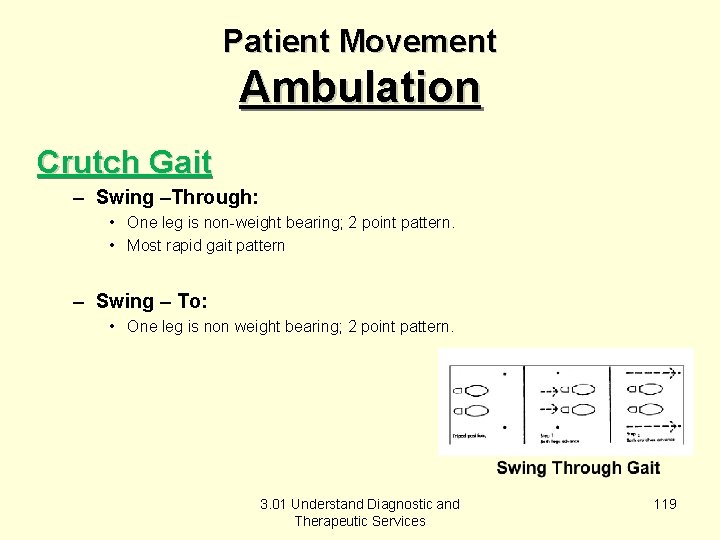
Patient Movement Ambulation Crutch Gait – Swing –Through: • One leg is non-weight bearing; 2 point pattern. • Most rapid gait pattern – Swing – To: • One leg is non weight bearing; 2 point pattern. 3. 01 Understand Diagnostic and Therapeutic Services 119
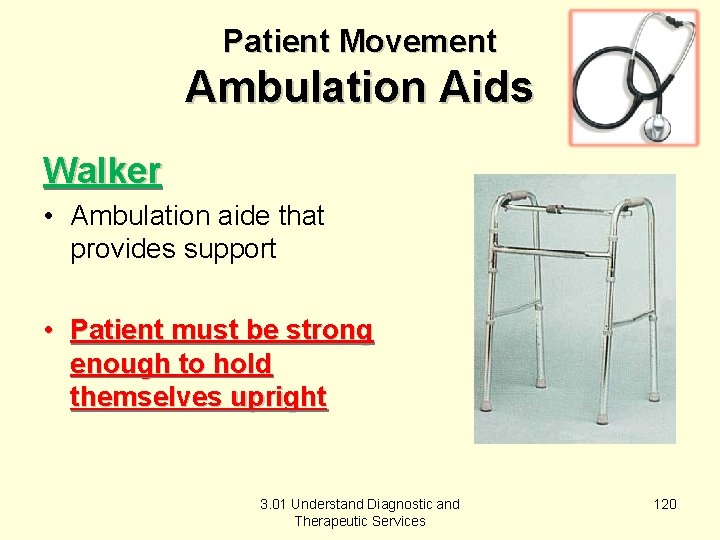
Patient Movement Ambulation Aids Walker • Ambulation aide that provides support • Patient must be strong enough to hold themselves upright 3. 01 Understand Diagnostic and Therapeutic Services 120
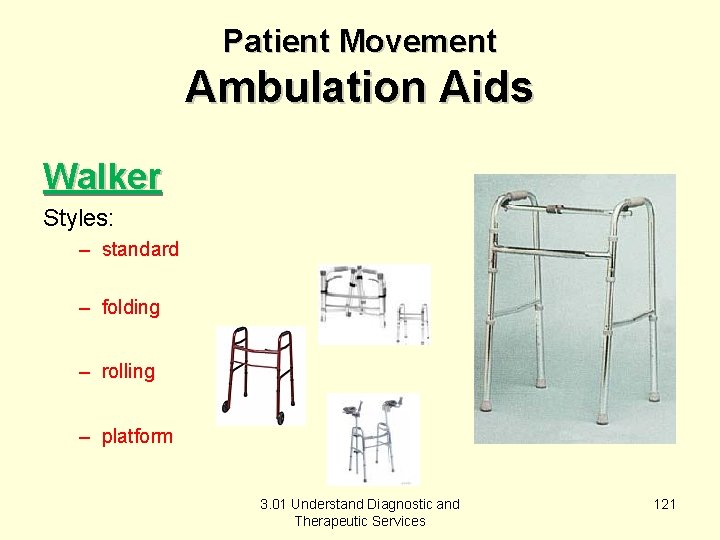
Patient Movement Ambulation Aids Walker Styles: – standard – folding – rolling – platform 3. 01 Understand Diagnostic and Therapeutic Services 121
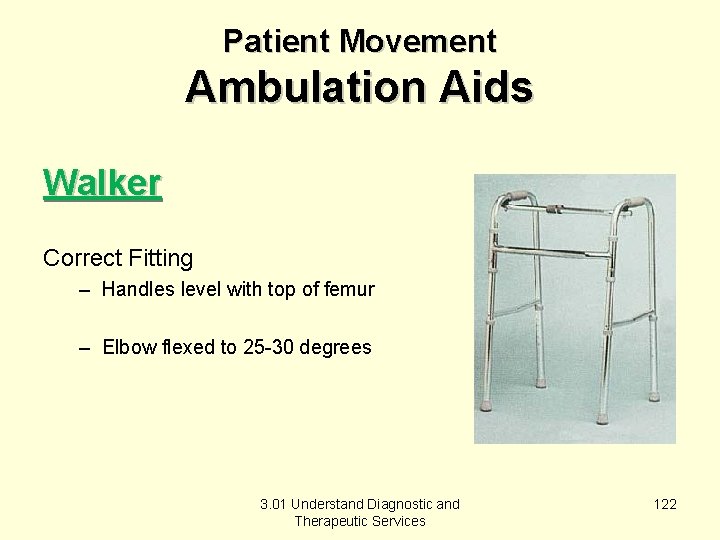
Patient Movement Ambulation Aids Walker Correct Fitting – Handles level with top of femur – Elbow flexed to 25 -30 degrees 3. 01 Understand Diagnostic and Therapeutic Services 122
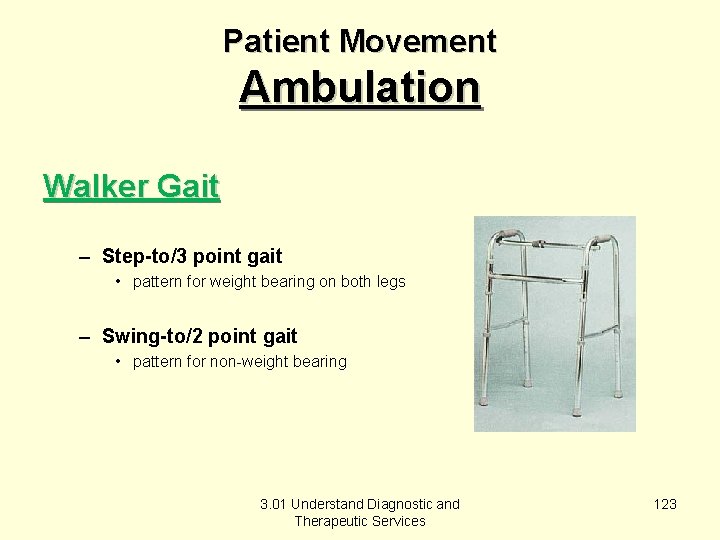
Patient Movement Ambulation Walker Gait – Step-to/3 point gait • pattern for weight bearing on both legs – Swing-to/2 point gait • pattern for non-weight bearing 3. 01 Understand Diagnostic and Therapeutic Services 123
Patient Movement Ambulation Demonstrate the skill Provide for guided practice Provide for independent practice Verify student passing
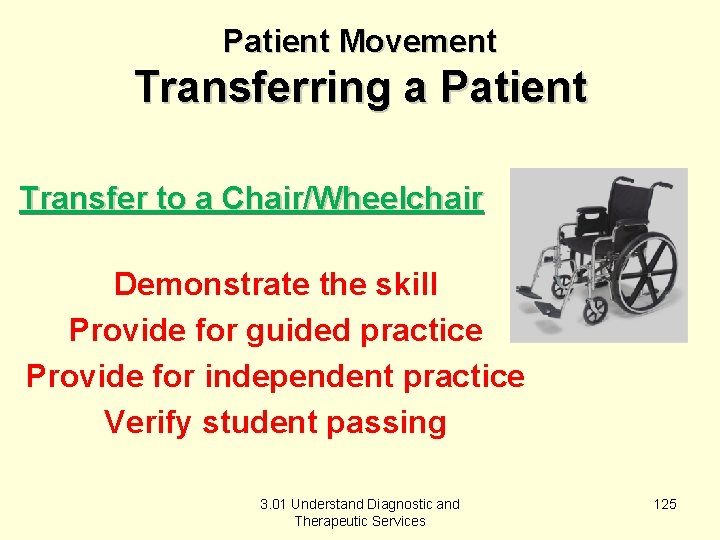
Patient Movement Transferring a Patient Transfer to a Chair/Wheelchair Demonstrate the skill Provide for guided practice Provide for independent practice Verify student passing 3. 01 Understand Diagnostic and Therapeutic Services 125
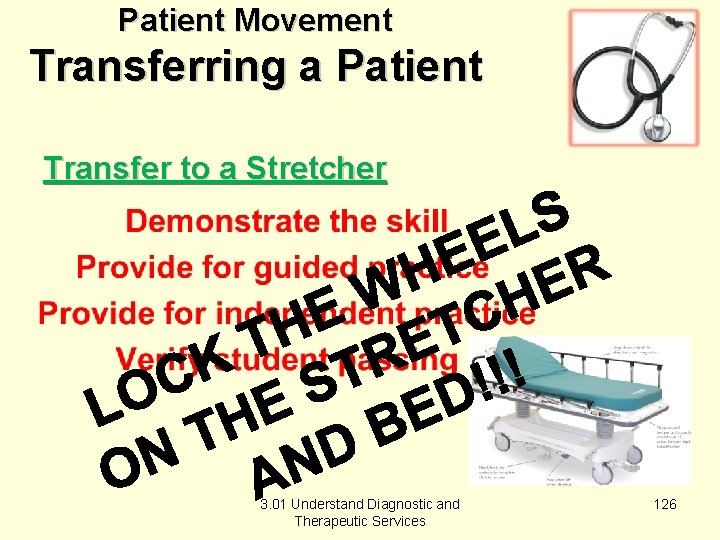
Patient Movement Transferring a Patient Transfer to a Stretcher 3. 01 Understand Diagnostic and Therapeutic Services 126

Massage Therapy 3. 01 Understand Diagnostic and Therapeutic Services 127

Massage Therapy • Massage is a form of passive exercise. – Increases circulation – Relieves tension and pain 3. 01 Understand Diagnostic and Therapeutic Services 128

Massage Therapy • Effleurage: (RELAXING) – used more than any other technique – involves gentle strokes that glide over the skin without attempting to move the deeper structures • Petrissage: Petrissage – involves a deeper massage – muscles are lifted and squeezed gently in a kneading or rolling action. 3. 01 Understand Diagnostic and Therapeutic Services 129

Massage Therapy 3. 01 Understand Diagnostic and Therapeutic Services 130
- Slides: 130