
Objective 206 01 5 Understand advanced production methods
Objective 206. 01 5% Understand advanced production methods for digital video.
Pre-Production ❑ Meet with the client to create a project plan: ☐ Determine the purpose of the video production. ☐ Define a target audience. ☐ Set overall goals of the video. ☐ Agree on deadlines for phases of the project. ☐ Create a budget for the production. ☐ Decide what equipment will be necessary to create the video project.
Pre-Production ❑ Script Writing ☐ Script is needed to tell the actors (both on screen and for a voiceover) what to say and when. The script also gives direction to set lighting, sound effects, and other components of the project. ❑ It is important to consider the following: ☐ The overall goals of the video project. ☐ The target audience of the project. ☐ The accepted vernacular of the target audience. ☐ The readers (performers) of the script.
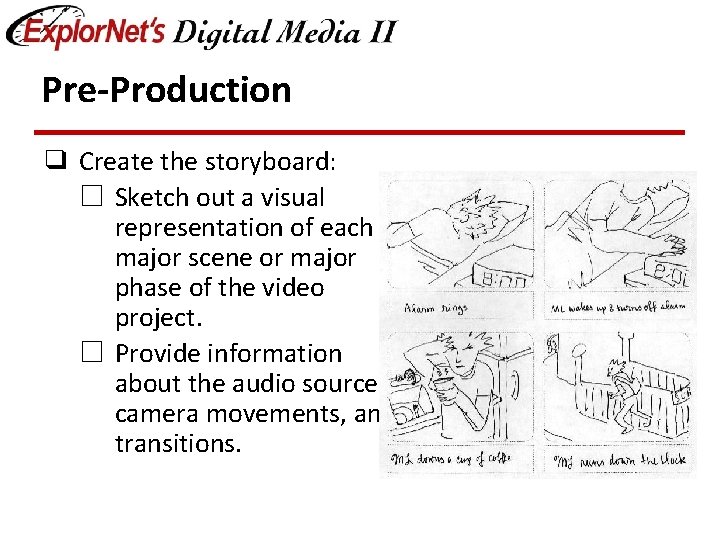
Pre-Production ❑ Create the storyboard: ☐ Sketch out a visual representation of each major scene or major phase of the video project. ☐ Provide information about the audio sources, camera movements, and transitions.
Pre-Production ❑ Create a shot list in the sequence of the storyboard for the camera operators. ❑ Get any actors or other on-camera participants to sign a talent release document. ❑ Gather and manage information and digital assets provided by the client. ❑ Create a file-naming convention to assure proper organization and storage. ❑ Save and organize files for easy and quick access.
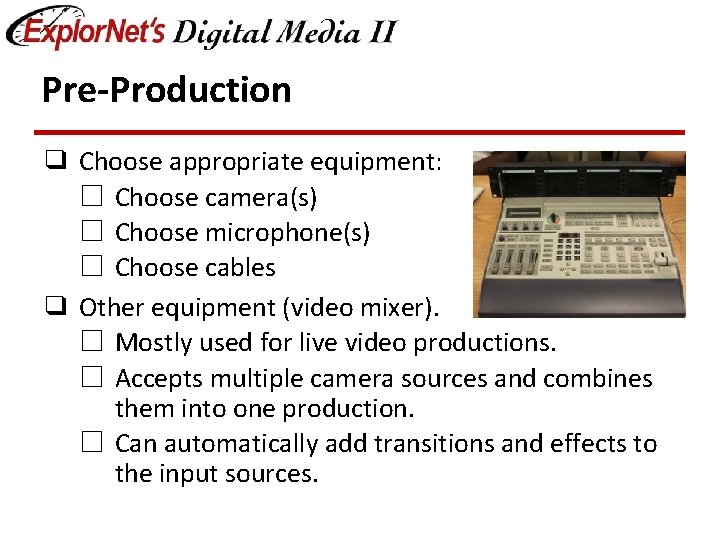
Pre-Production ❑ Choose appropriate equipment: ☐ Choose camera(s) ☐ Choose microphone(s) ☐ Choose cables ❑ Other equipment (video mixer). ☐ Mostly used for live video productions. ☐ Accepts multiple camera sources and combines them into one production. ☐ Can automatically add transitions and effects to the input sources.
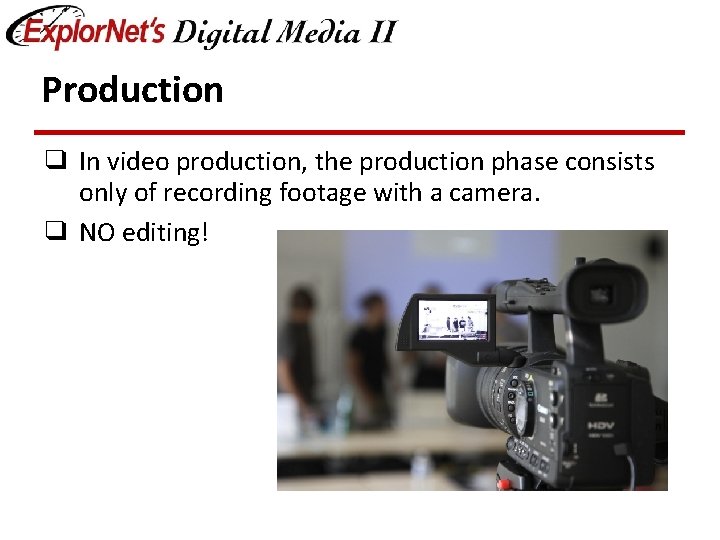
Production ❑ In video production, the production phase consists only of recording footage with a camera. ❑ NO editing!
Post-Production ❑ Capture and name video footage. ❑ Edit video footage to match project needs. ❑ Apply special effects. ❑ Add audio. ❑ Add transitions. ❑ Add titles. ❑ Export final video to selected format.
Post-Production ❑ Re-design the video production on client feedback (if necessary). ❑ Render the video and re-export after addressing feedback. ❑ Watch the exported video in its entirety to check for quality assurance.
Post-Production ❑ Optimize based on specific client needs: ☐ File Format Requirements • Video files also use codecs. ☐ File Size Requirements ☐ File Name Requirements
- Slides: 10