
Objective 2 Biology Cell and Cell Structures Cells
Objective 2 Biology
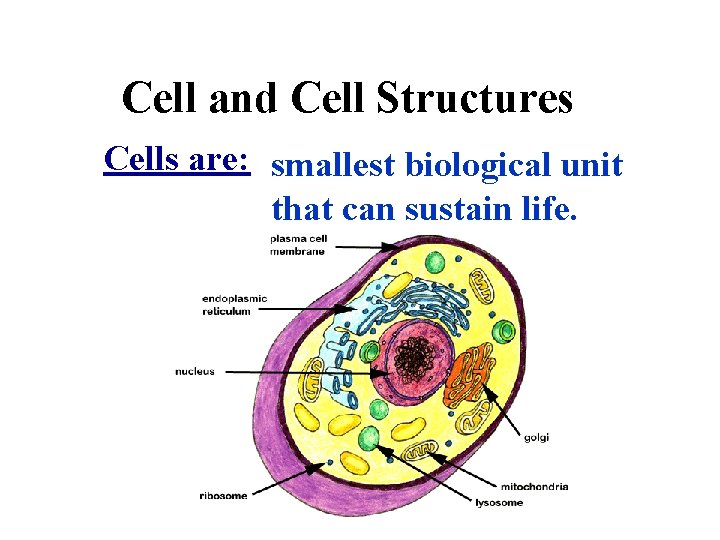
Cell and Cell Structures Cells are: smallest biological unit that can sustain life.
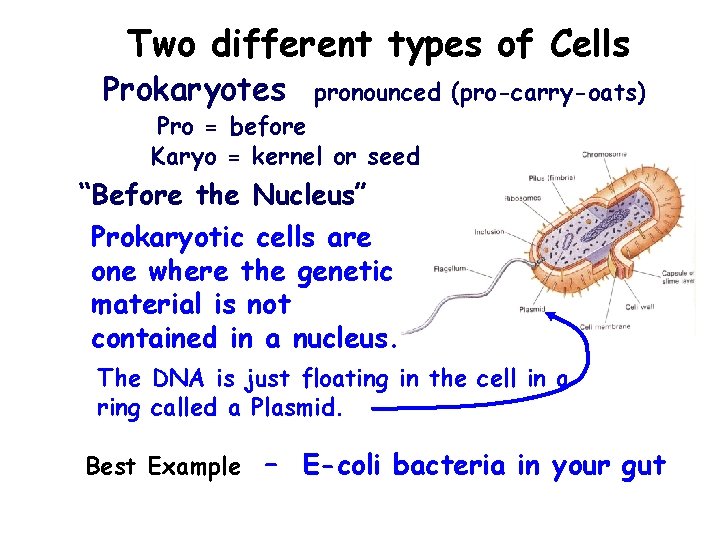
Two different types of Cells Prokaryotes pronounced (pro-carry-oats) Pro = before Karyo = kernel or seed “Before the Nucleus” Prokaryotic cells are one where the genetic material is not contained in a nucleus. The DNA is just floating in the cell in a ring called a Plasmid. Best Example – E-coli bacteria in your gut
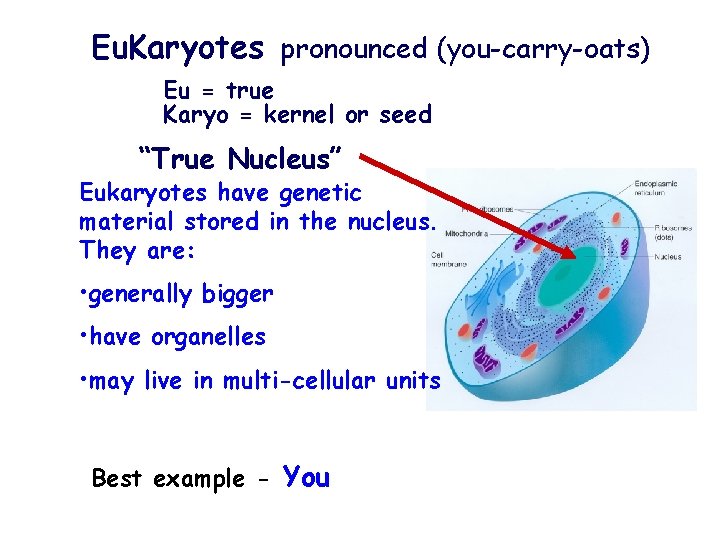
Eu. Karyotes pronounced (you-carry-oats) Eu = true Karyo = kernel or seed “True Nucleus” Eukaryotes have genetic material stored in the nucleus. They are: • generally bigger • have organelles • may live in multi-cellular units Best example - You

Diffusion: Things moving from high concentration to low concentration. Things will diffuse until they reach Equilibrium
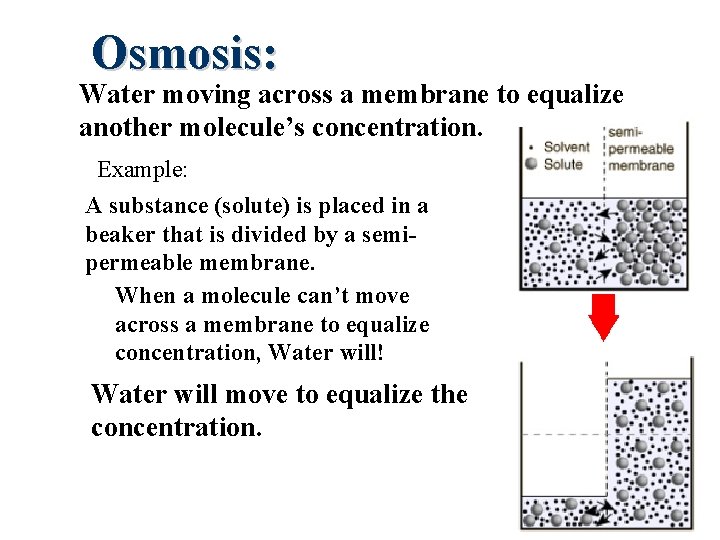
Osmosis: Water moving across a membrane to equalize another molecule’s concentration. Example: A substance (solute) is placed in a beaker that is divided by a semipermeable membrane. When a molecule can’t move across a membrane to equalize concentration, Water will! Water will move to equalize the concentration.
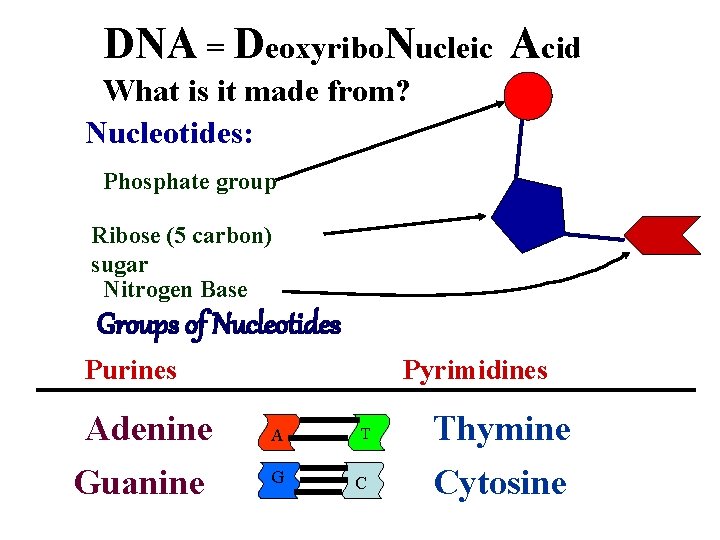
DNA = Deoxyribo. Nucleic Acid What is it made from? Nucleotides: Phosphate group Ribose (5 carbon) sugar Nitrogen Base Groups of Nucleotides Purines Adenine Guanine Pyrimidines A T G C Thymine Cytosine
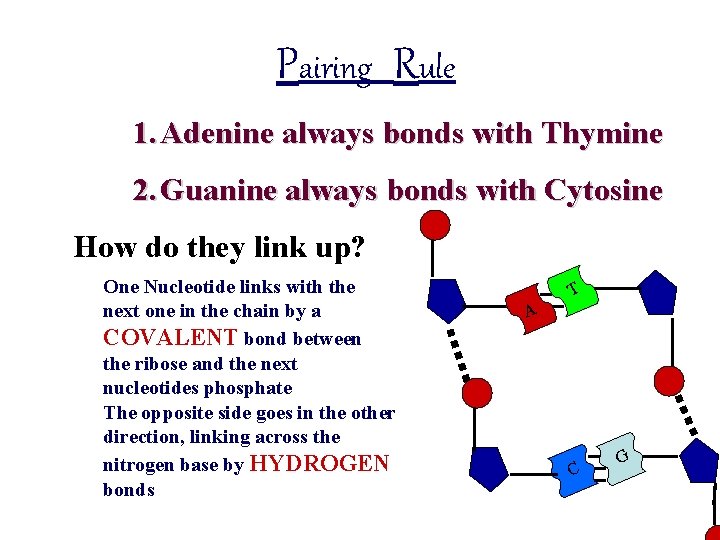
Pairing Rule 1. Adenine always bonds with Thymine 2. Guanine always bonds with Cytosine How do they link up? One Nucleotide links with the next one in the chain by a COVALENT bond between the ribose and the next nucleotides phosphate The opposite side goes in the other direction, linking across the nitrogen base by HYDROGEN bonds T A C G
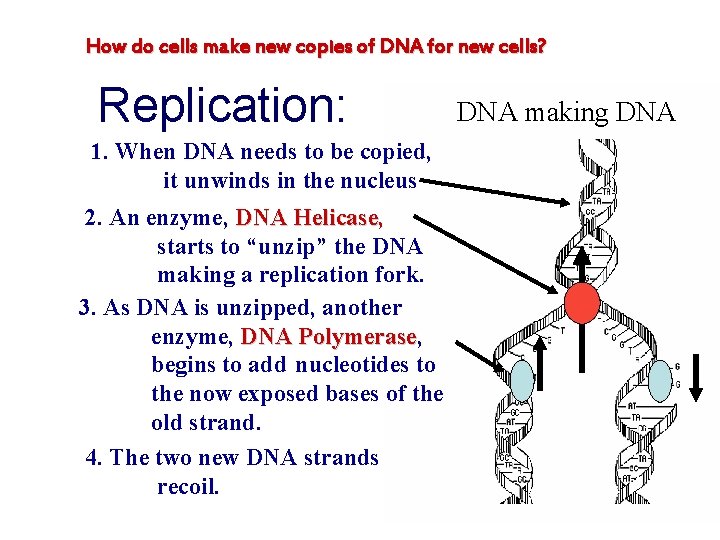
How do cells make new copies of DNA for new cells? Replication: 1. When DNA needs to be copied, it unwinds in the nucleus 2. An enzyme, DNA Helicase, Helicase starts to “unzip” the DNA making a replication fork. 3. As DNA is unzipped, another enzyme, DNA Polymerase, Polymerase begins to add nucleotides to the now exposed bases of the old strand. 4. The two new DNA strands recoil. DNA making DNA
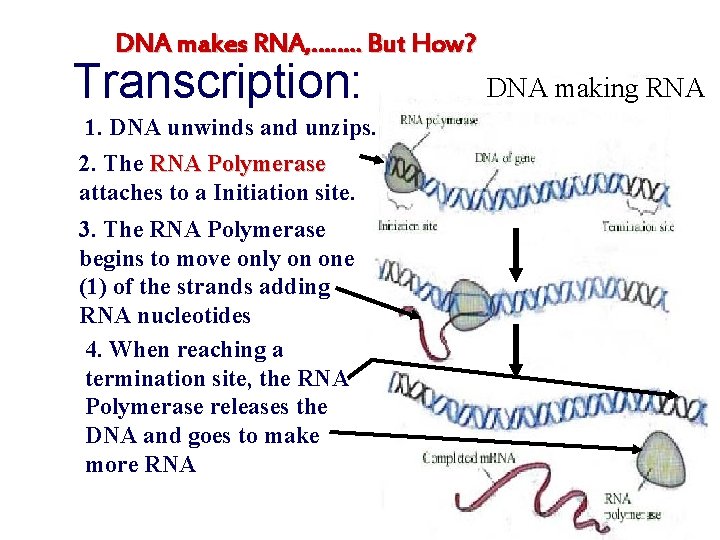
DNA makes RNA, ……. . But How? Transcription: 1. DNA unwinds and unzips. 2. The RNA Polymerase attaches to a Initiation site. 3. The RNA Polymerase begins to move only on one (1) of the strands adding RNA nucleotides 4. When reaching a termination site, the RNA Polymerase releases the DNA and goes to make more RNA DNA making RNA

Transcription occurs in the nucleus, but the Messenger RNA (m. RNA) m. RNA leaves the nucleus. It attaches to a Ribosome which begins to read the m. RNA It reads three (3) letter words called Codons Example: A a An m. RNA that attaches to the Ribosome c u a a a g c g u a u g c It reads ACU, then it moves down and reads AAA and so on…

The process of reading the m. RNA code and making Proteins is called: Translation The Ribosome doesn’t just read the m. RNA, it calls for Amino Acids for each Codon it reads. The codon “U G C” calls for the amino Acid Cysteine. U G C Hey! I need a Cysteine!! A little help here?
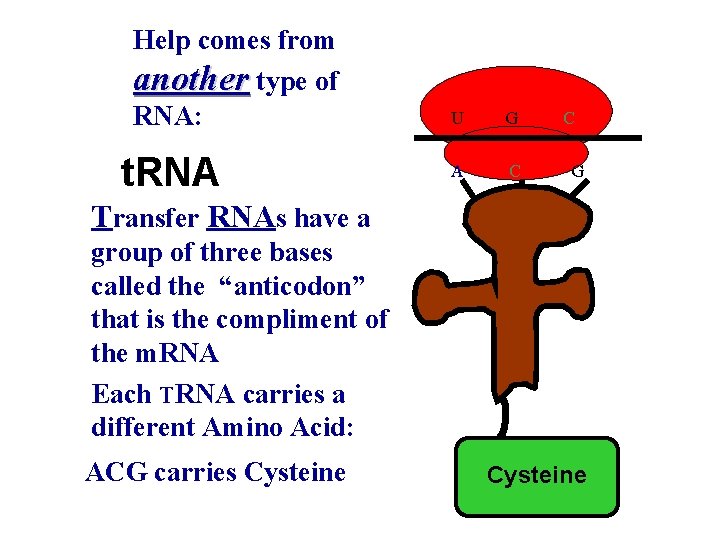
Help comes from another type of RNA: t. RNA U G A C C G Transfer RNAs have a group of three bases called the “anticodon” that is the compliment of the m. RNA Each TRNA carries a different Amino Acid: ACG carries Cysteine
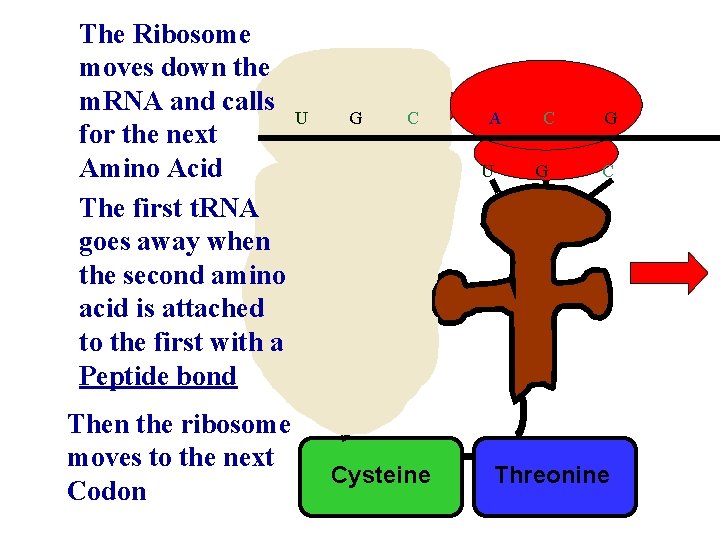
The Ribosome moves down the m. RNA and calls for the next Amino Acid The first t. RNA goes away when the second amino acid is attached to the first with a Peptide bond Then the ribosome moves to the next Codon U G A C C G Cysteine A U C G G C Threonine
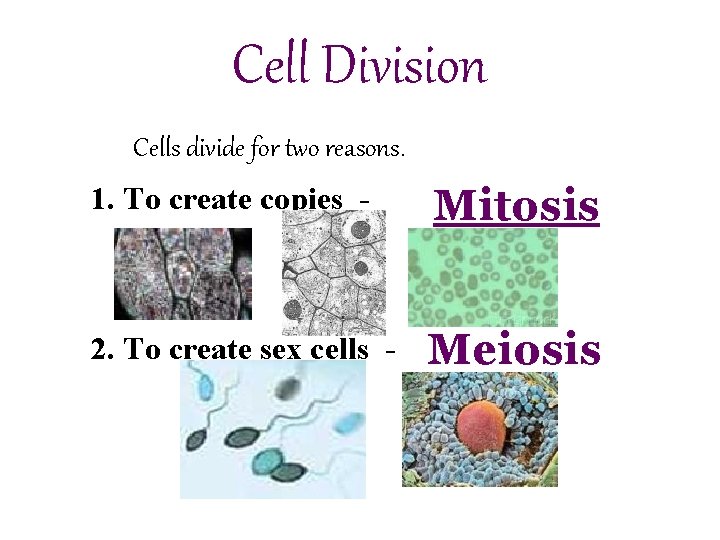
Cell Division Cells divide for two reasons. 1. To create copies - Mitosis 2. To create sex cells - Meiosis
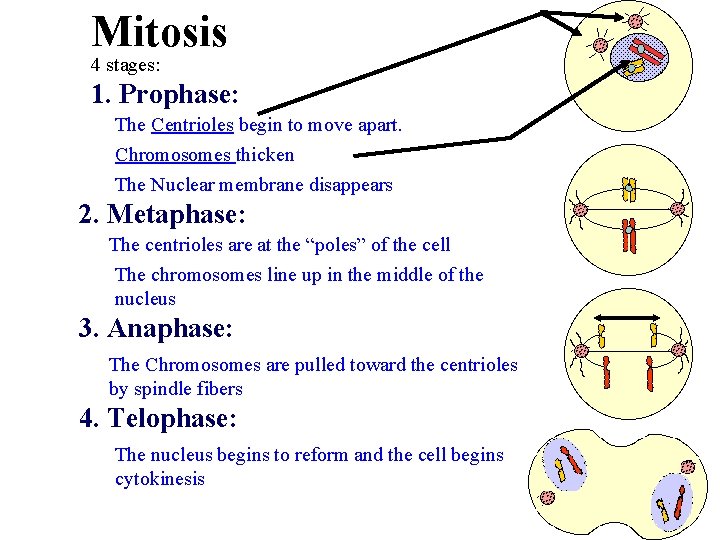
Mitosis 4 stages: 1. Prophase: The Centrioles begin to move apart. Chromosomes thicken The Nuclear membrane disappears 2. Metaphase: The centrioles are at the “poles” of the cell The chromosomes line up in the middle of the nucleus 3. Anaphase: The Chromosomes are pulled toward the centrioles by spindle fibers 4. Telophase: The nucleus begins to reform and the cell begins cytokinesis
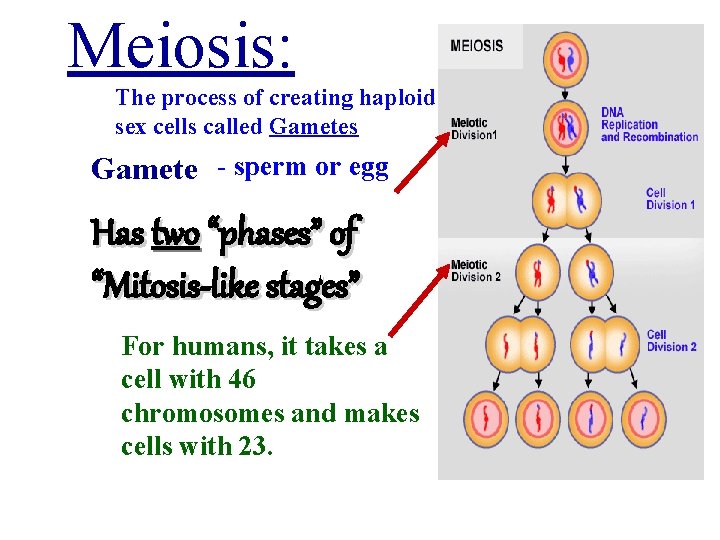
Meiosis: The process of creating haploid sex cells called Gametes Gamete - sperm or egg Has two “phases” of “Mitosis-like stages” For humans, it takes a cell with 46 chromosomes and makes cells with 23.
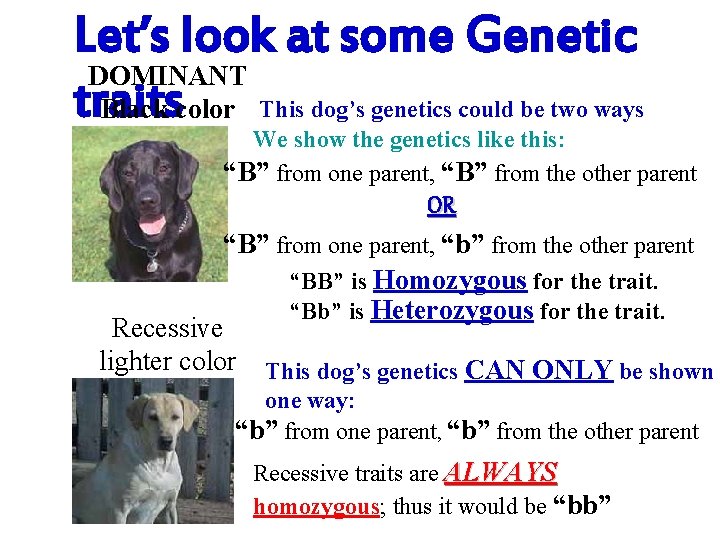
Let’s look at some Genetic DOMINANT traits Black color This dog’s genetics could be two ways We show the genetics like this: “B” from one parent, “B” from the other parent OR “B” from one parent, “b” from the other parent “BB” is Homozygous for the trait. “Bb” is Heterozygous for the trait. Recessive lighter color This dog’s genetics CAN ONLY be shown one way: “b” from one parent, “b” from the other parent Recessive traits are ALWAYS homozygous; thus it would be “bb”
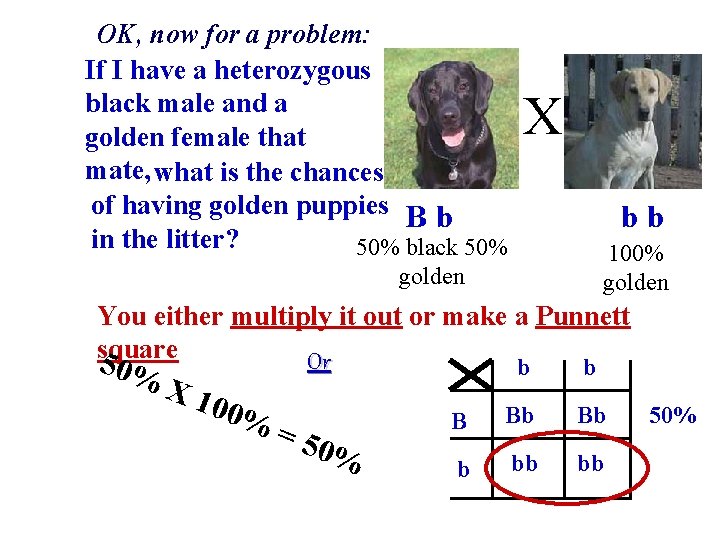
OK, now for a problem: If I have a heterozygous black male and a golden female that mate, what is the chances of having golden puppies B b in the litter? 50% black 50% X bb 100% golden You either multiply it out or make a Punnett square Or 5 0% X 1 00% = 50 % b b B Bb Bb b bb bb 50%
EVOLUTION Darwin’s Theory - Natural Selection Those organisms that are best “fit” to the environment will survive the environment. Adaptation – a characteristic that an organism has that allows it to survive. Extinction – all members of a population dying out due to not having beneficial adaptations.
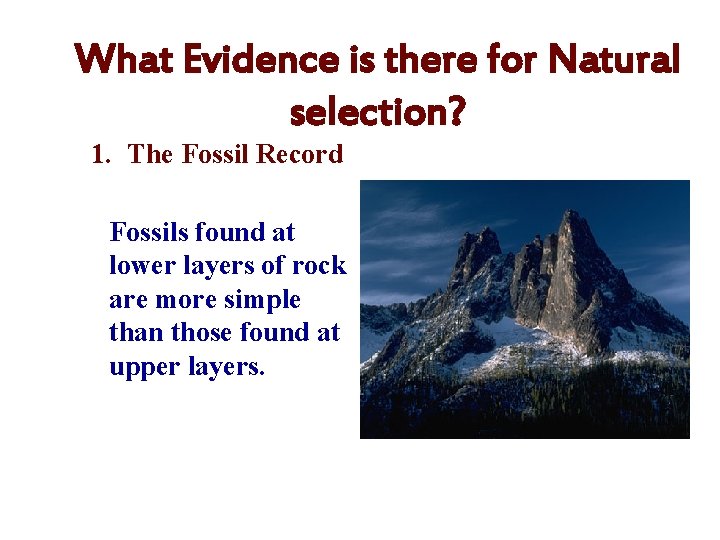
What Evidence is there for Natural selection? 1. The Fossil Record Fossils found at lower layers of rock are more simple than those found at upper layers.

2. Homologous Structures from one creature are similar to the structures from other creatures.
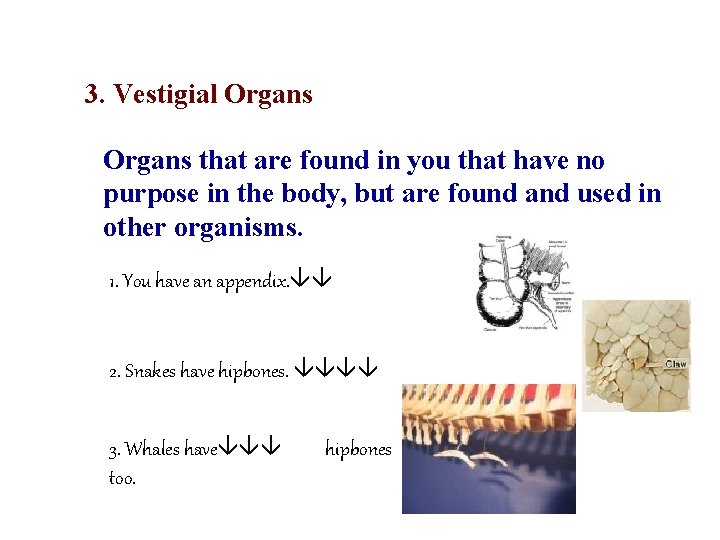
3. Vestigial Organs that are found in you that have no purpose in the body, but are found and used in other organisms. 1. You have an appendix. 2. Snakes have hipbones. 3. Whales have too. hipbones
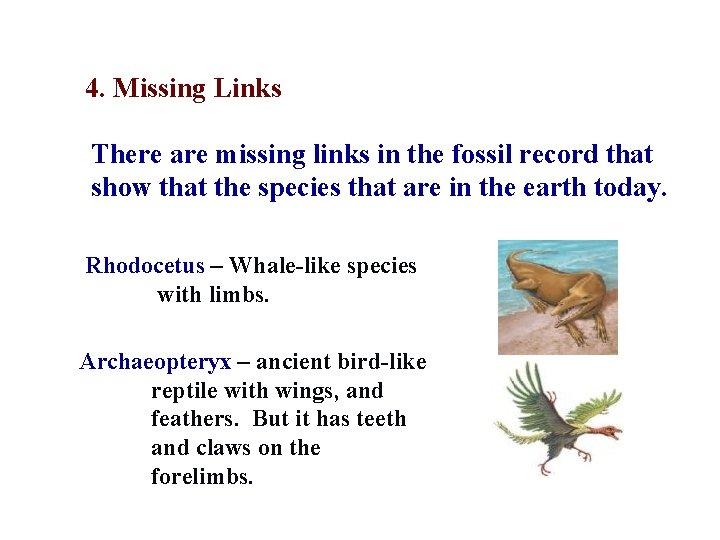
4. Missing Links There are missing links in the fossil record that show that the species that are in the earth today. Rhodocetus – Whale-like species with limbs. Archaeopteryx – ancient bird-like reptile with wings, and feathers. But it has teeth and claws on the forelimbs.
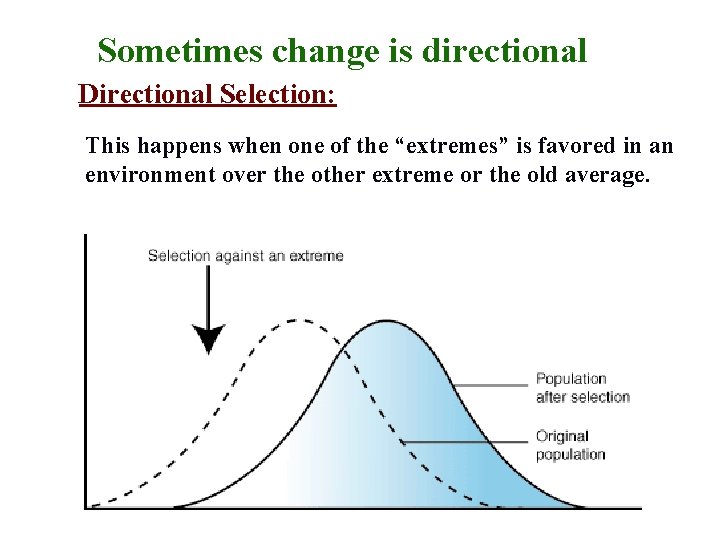
Sometimes change is directional Directional Selection: This happens when one of the “extremes” is favored in an environment over the other extreme or the old average.

Stabilizing Selection: Then the average is favored over either of the extremes in a population.
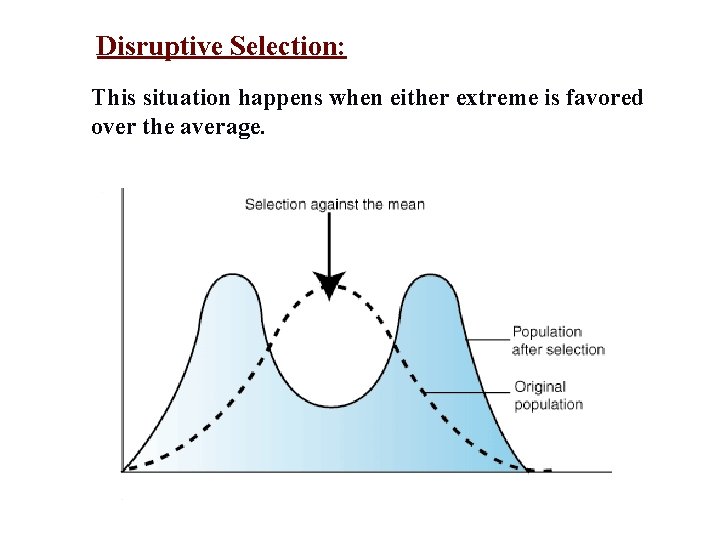
Disruptive Selection: This situation happens when either extreme is favored over the average.
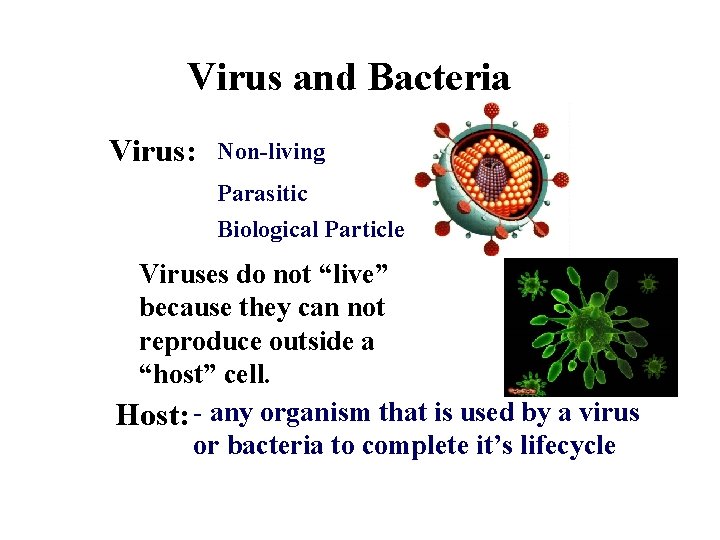
Virus and Bacteria Virus: Non-living Parasitic Biological Particle Viruses do not “live” because they can not reproduce outside a “host” cell. Host: - any organism that is used by a virus or bacteria to complete it’s lifecycle
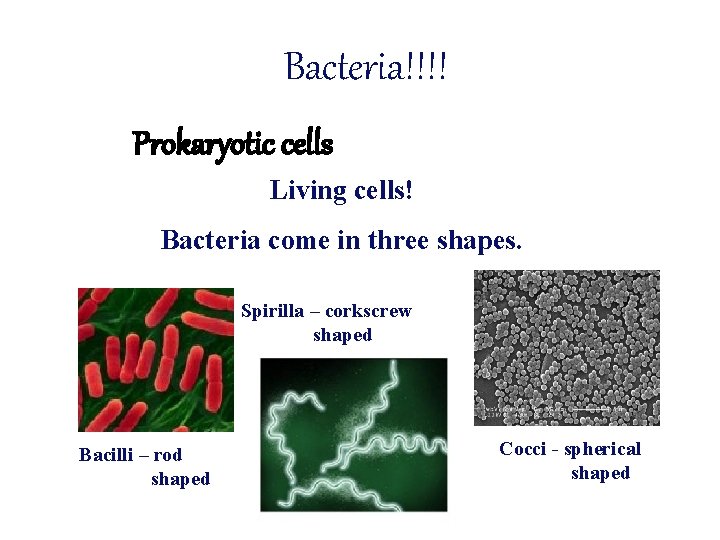
Bacteria!!!! Prokaryotic cells Living cells! Bacteria come in three shapes. Spirilla – corkscrew shaped Bacilli – rod shaped Cocci - spherical shaped
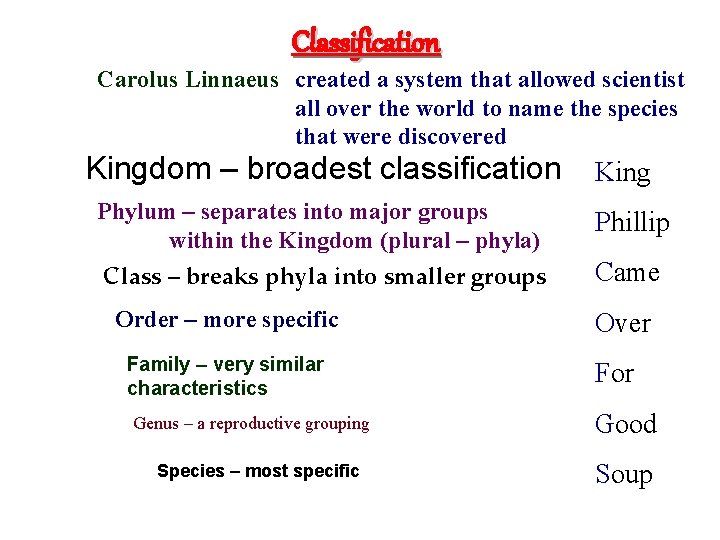
Classification Carolus Linnaeus created a system that allowed scientist all over the world to name the species that were discovered Kingdom – broadest classification King Phylum – separates into major groups within the Kingdom (plural – phyla) Phillip Class – breaks phyla into smaller groups Came Order – more specific Family – very similar characteristics Genus – a reproductive grouping Species – most specific Over For Good Soup
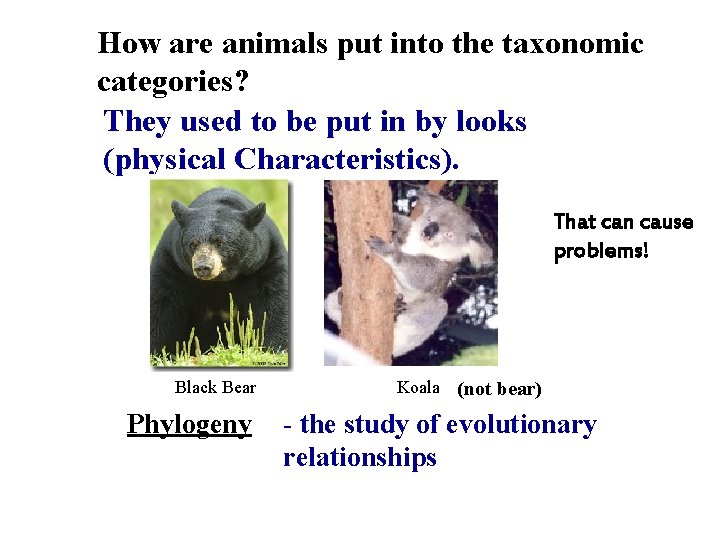
How are animals put into the taxonomic categories? They used to be put in by looks (physical Characteristics). That can cause problems! Black Bear Phylogeny Koala (not bear) - the study of evolutionary relationships
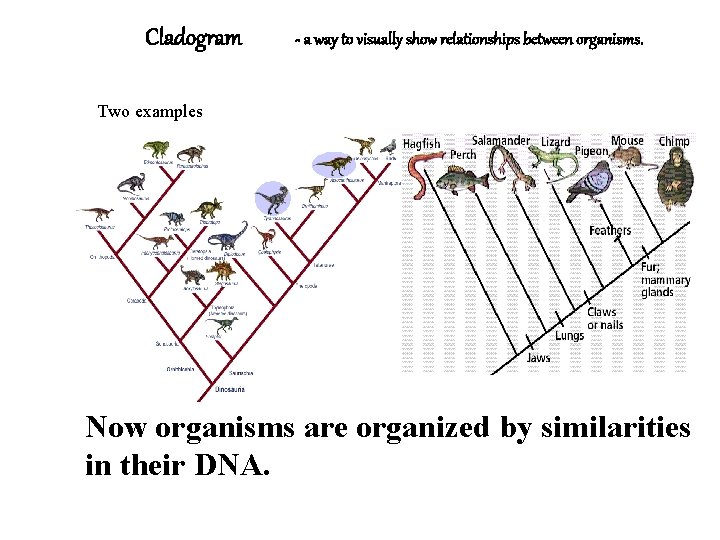
Cladogram - a way to visually show relationships between organisms. Two examples Now organisms are organized by similarities in their DNA.
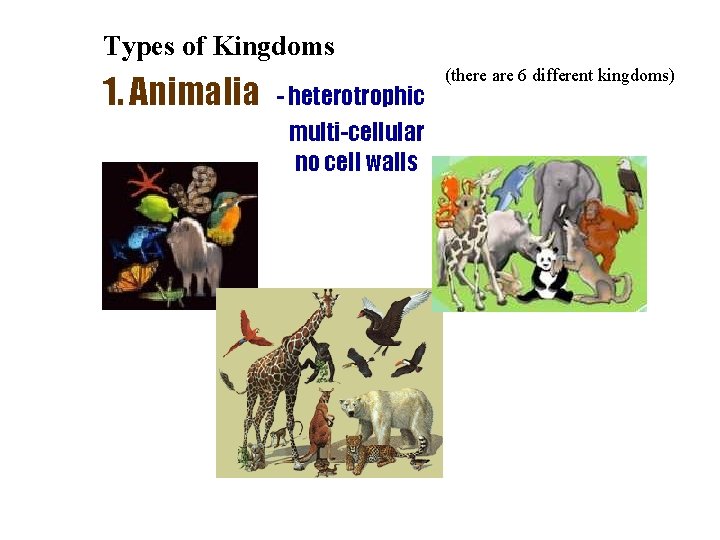
Types of Kingdoms 1. Animalia - heterotrophic multi-cellular no cell walls (there are 6 different kingdoms)
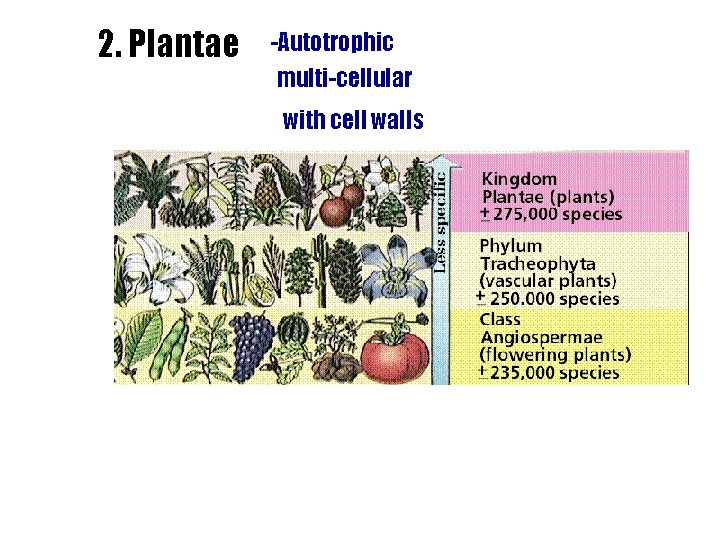
2. Plantae -Autotrophic multi-cellular with cell walls

3 Fungi - Heterotrophic multi-cellular with cell wall
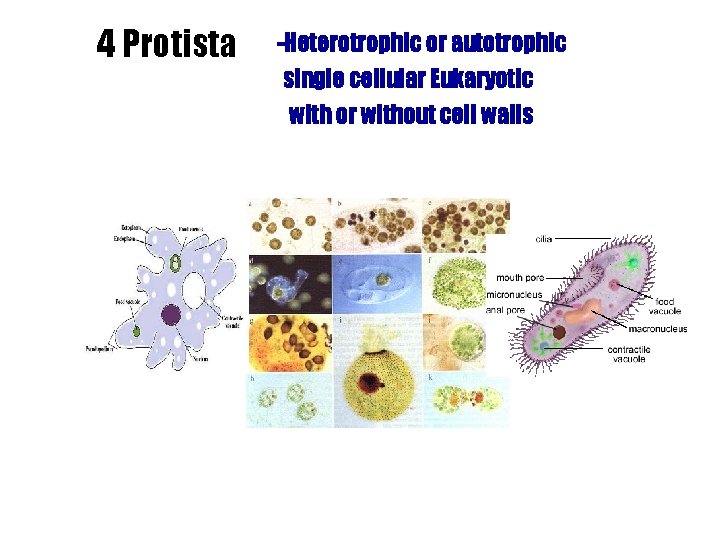
4 Protista -Heterotrophic or autotrophic single cellular Eukaryotic with or without cell walls
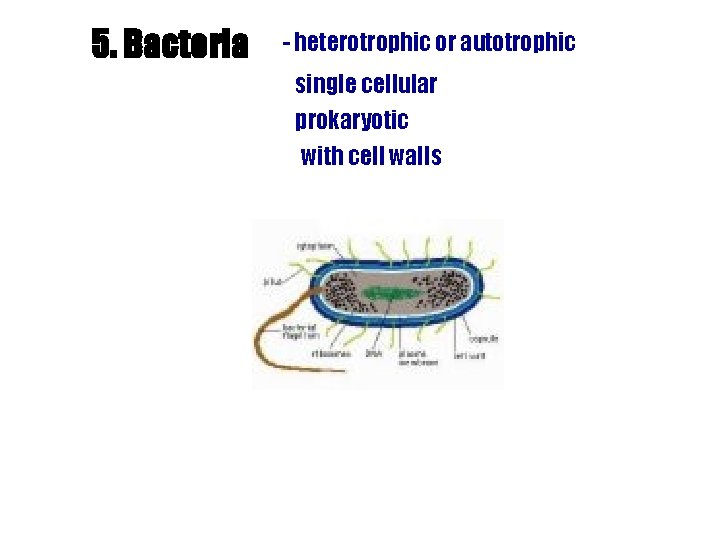
5. Bacteria - heterotrophic or autotrophic single cellular prokaryotic with cell walls
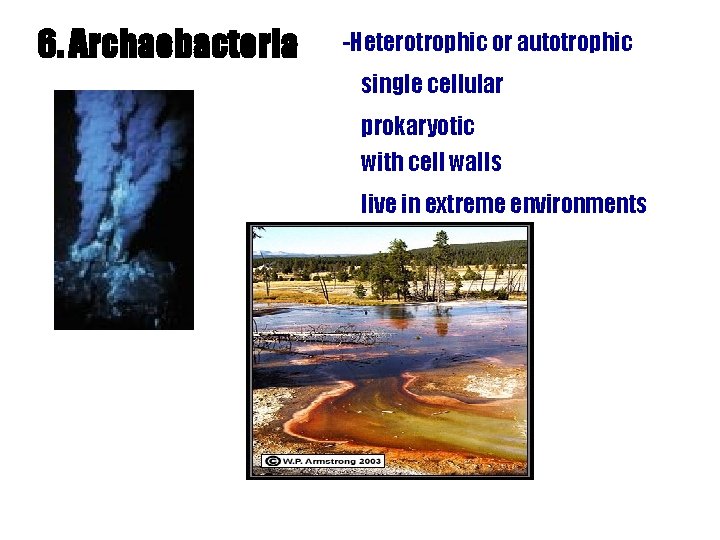
6. Archaebacteria -Heterotrophic or autotrophic single cellular prokaryotic with cell walls live in extreme environments
- Slides: 38