
Object recognition under varying illumination Lighting changes objects
Object recognition under varying illumination

Lighting changes objects appearance.
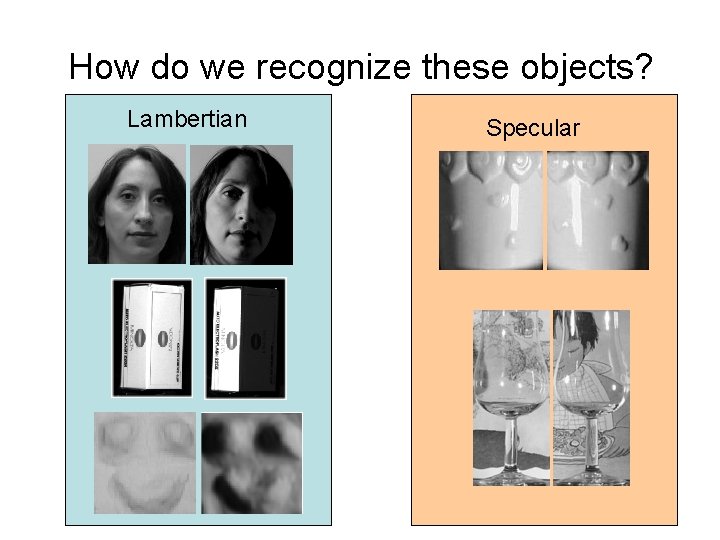
How do we recognize these objects? Lambertian Specular
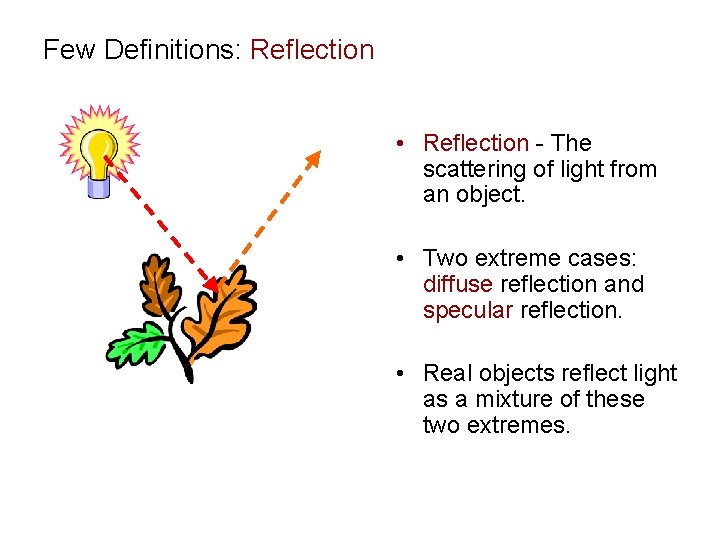
Few Definitions: Reflection • Reflection - The scattering of light from an object. • Two extreme cases: diffuse reflection and specular reflection. • Real objects reflect light as a mixture of these two extremes.

Few Definitions: Lambertian Reflection • Surface reflects equally in all directions. – Examples: chalk, clay, cloth, matte paint • Brightness doesn’t depend on viewpoint. • Amount of light striking surface proportional to cos θ. albedo intensity surface normal (light intensity)* (light direction)
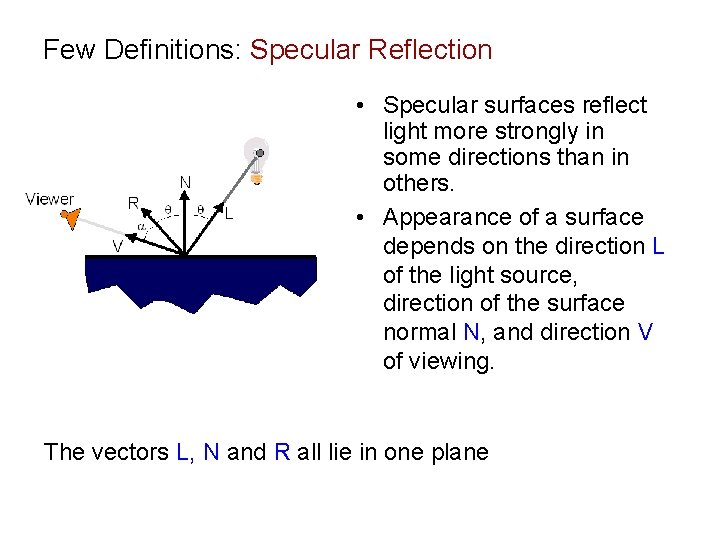
Few Definitions: Specular Reflection • Specular surfaces reflect light more strongly in some directions than in others. • Appearance of a surface depends on the direction L of the light source, direction of the surface normal N, and direction V of viewing. The vectors L, N and R all lie in one plane
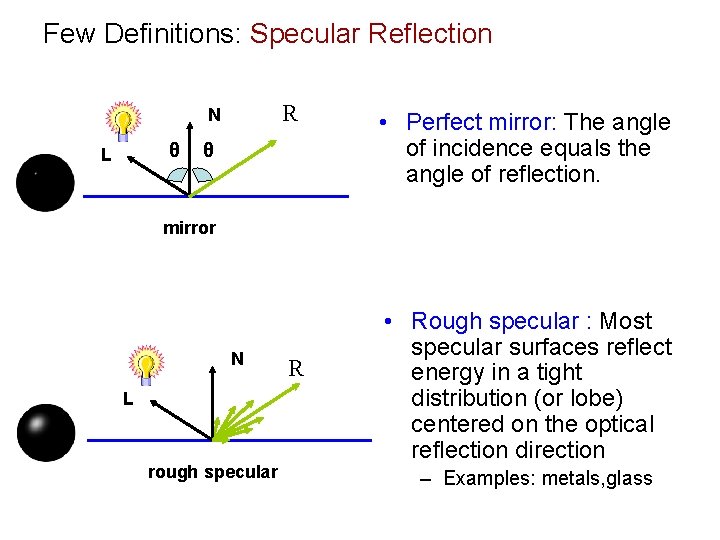
Few Definitions: Specular Reflection R N θ L θ • Perfect mirror: The angle of incidence equals the angle of reflection. mirror N L rough specular R • Rough specular : Most specular surfaces reflect energy in a tight distribution (or lobe) centered on the optical reflection direction – Examples: metals, glass
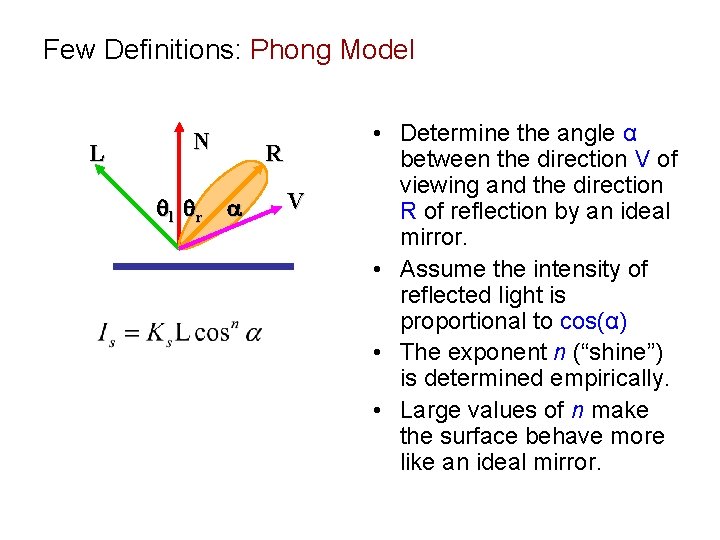
Few Definitions: Phong Model L N l r R V • Determine the angle α between the direction V of viewing and the direction R of reflection by an ideal mirror. • Assume the intensity of reflected light is proportional to cos(α) • The exponent n (“shine”) is determined empirically. • Large values of n make the surface behave more like an ideal mirror.
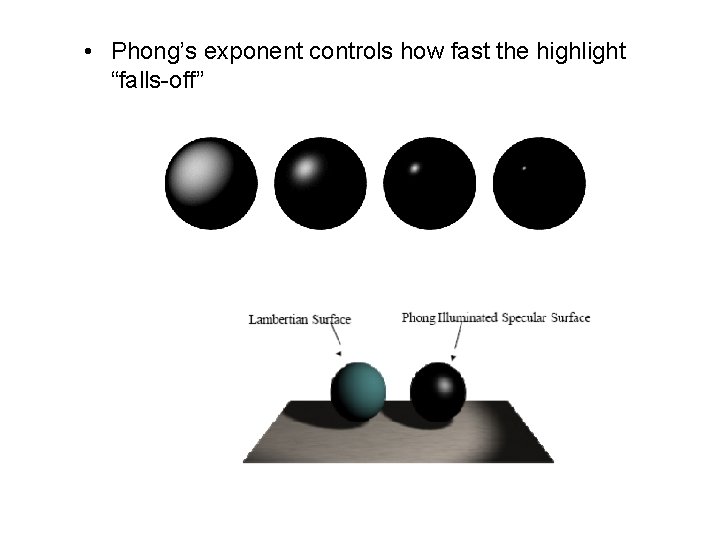
• Phong’s exponent controls how fast the highlight “falls-off”
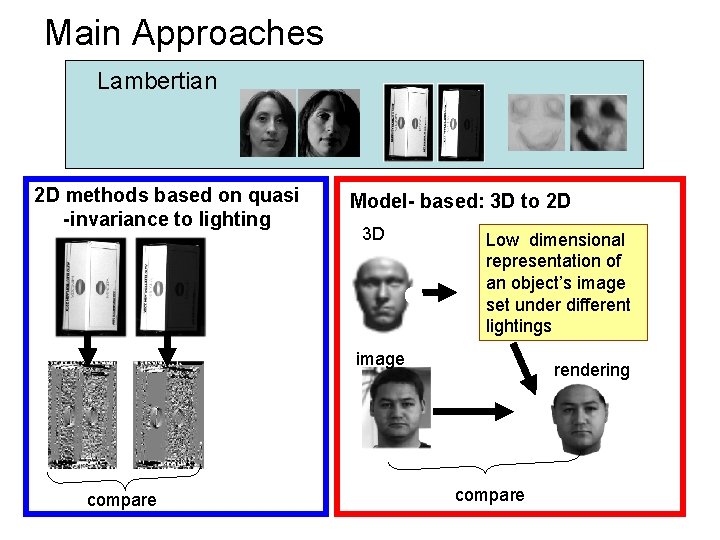
Main Approaches Lambertian 2 D methods based on quasi -invariance to lighting Model- based: 3 D to 2 D 3 D Low dimensional representation of an object’s image set under different lightings image compare rendering compare
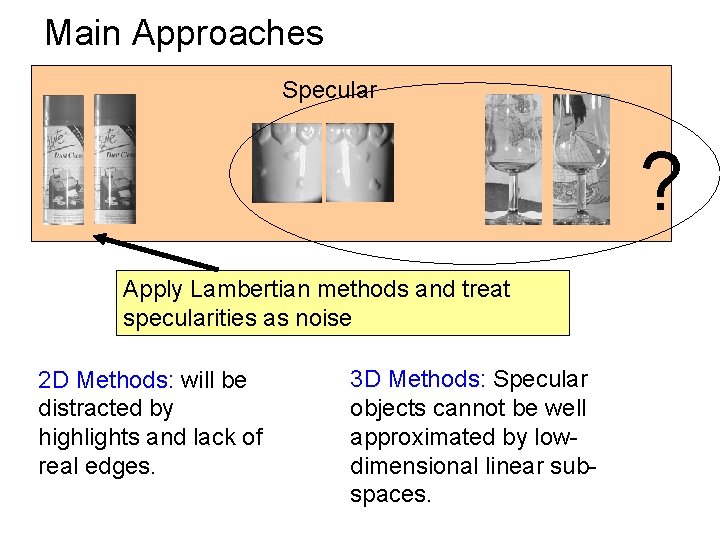
Main Approaches Specular ? Apply Lambertian methods and treat specularities as noise 2 D Methods: will be distracted by highlights and lack of real edges. 3 D Methods: Specular objects cannot be well approximated by lowdimensional linear subspaces.
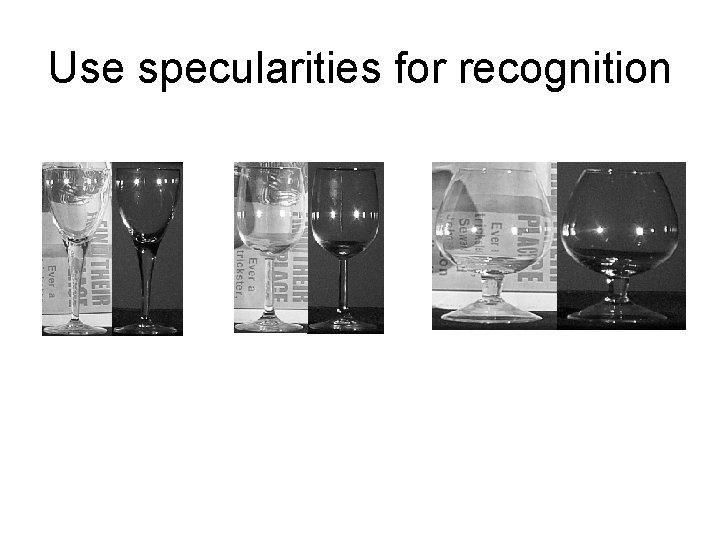
Use specularities for recognition
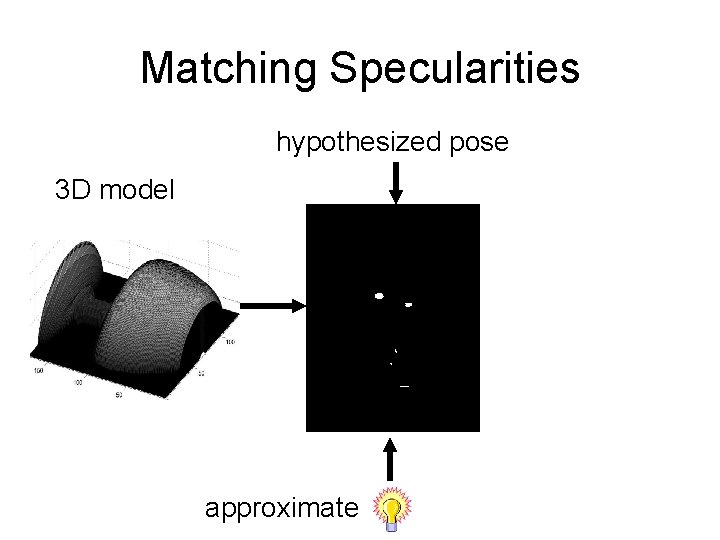
Matching Specularities hypothesized pose 3 D model approximate
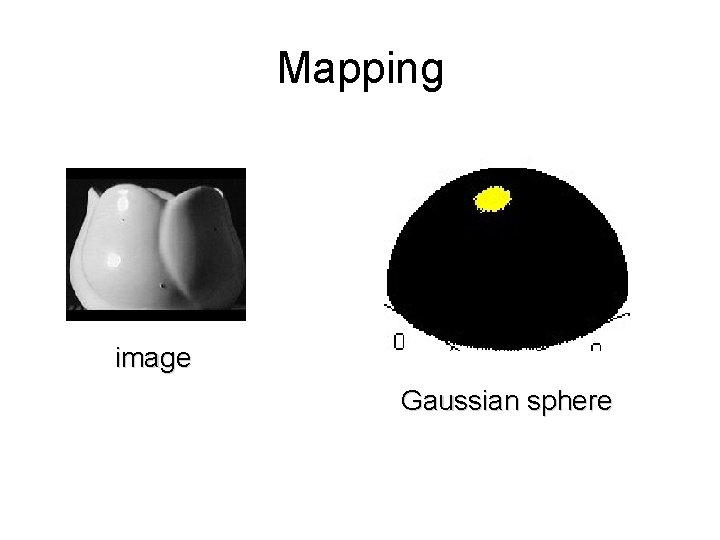
Mapping image Gaussian sphere
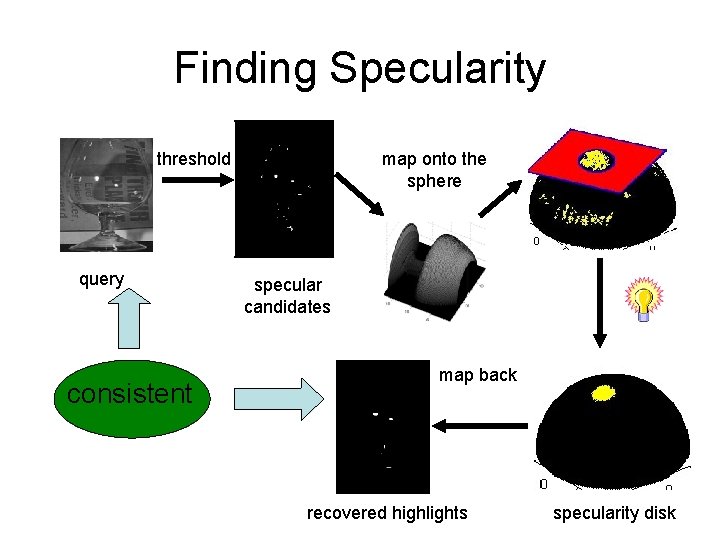
Finding Specularity map onto the sphere threshold query consistent specular candidates map back recovered highlights specularity disk
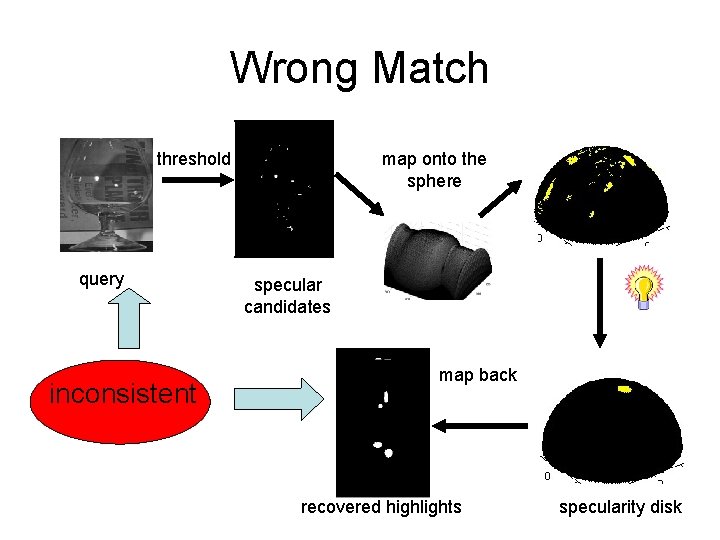
Wrong Match threshold query inconsistent map onto the sphere specular candidates map back recovered highlights specularity disk
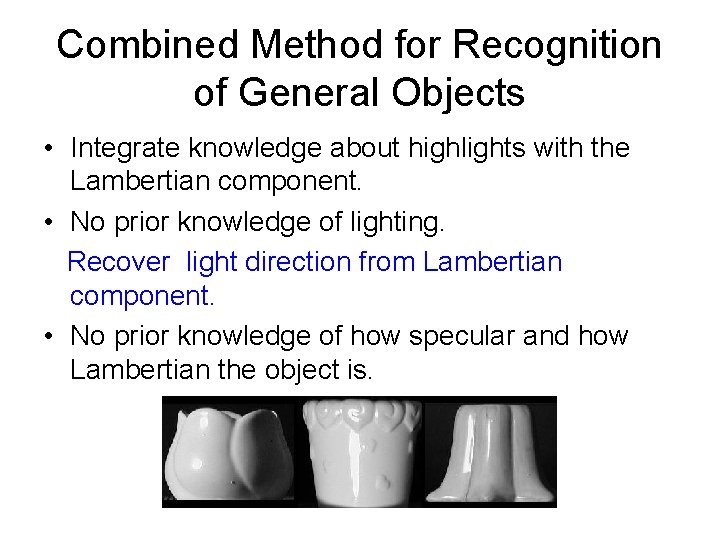
Combined Method for Recognition of General Objects • Integrate knowledge about highlights with the Lambertian component. • No prior knowledge of lighting. Recover light direction from Lambertian component. • No prior knowledge of how specular and how Lambertian the object is.
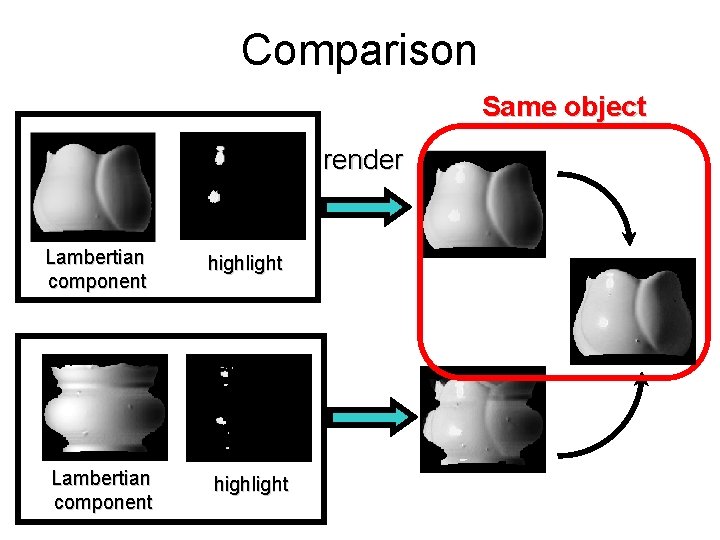
Comparison Same object render Lambertian component highlight
Uncontrolled Lighting • First step: allow multiple unknown light sources. – Extend the highlight recovery to work with known multiple light sources. – Detect multiple light source directions from the Lambertian component. – Use both Lambertian and specular parts to more robust detection of light sources.
PROJECT 5 Extend the specular recognition algorithm* to multiple light sources. Collect a test set of several rotationally symmetric glass objects: - Take images of these objects filled with opaque liquid for 3 D model construction. - Take 3 images of each object with 2 and 3 light sources and different backgrounds. Test the algorithm on these objects. *M. Osadchy, D. W. Jacobs and R. Ramamoorthi, Using specularities for recognition, IEEE International Conference on Computer Vision (ICCV), 2003
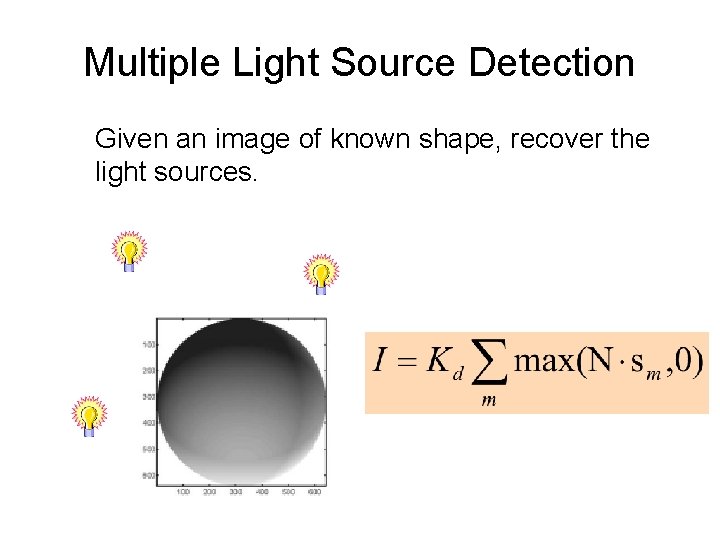
Multiple Light Source Detection Given an image of known shape, recover the light sources.
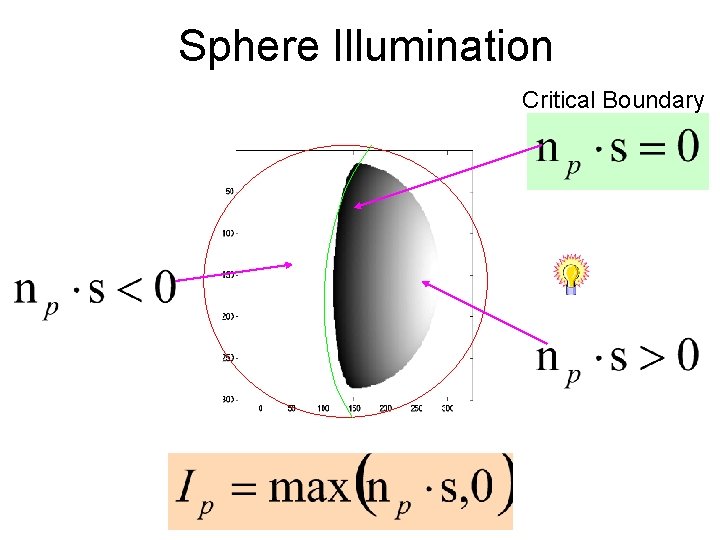
Sphere Illumination Critical Boundary
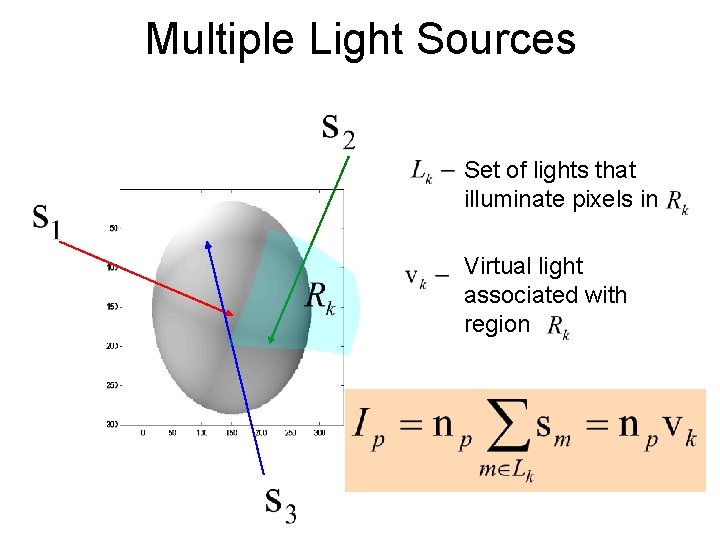
Multiple Light Sources Set of lights that illuminate pixels in Virtual light associated with region
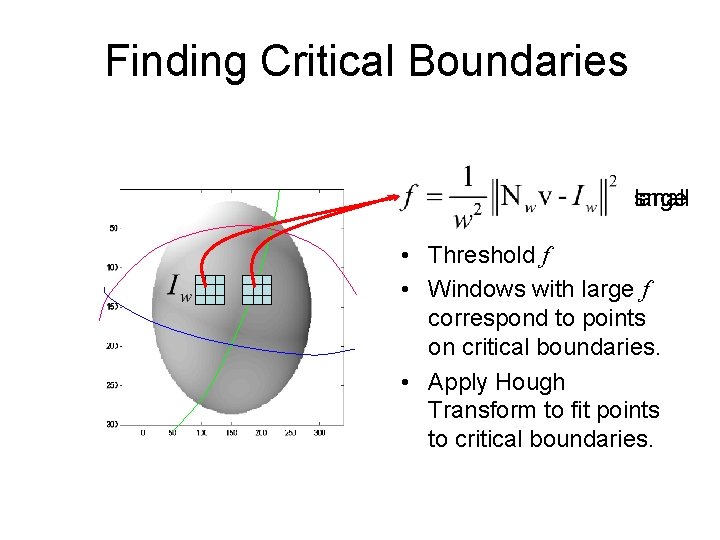
Finding Critical Boundaries large small • Threshold f • Windows with large f correspond to points on critical boundaries. • Apply Hough Transform to fit points to critical boundaries.
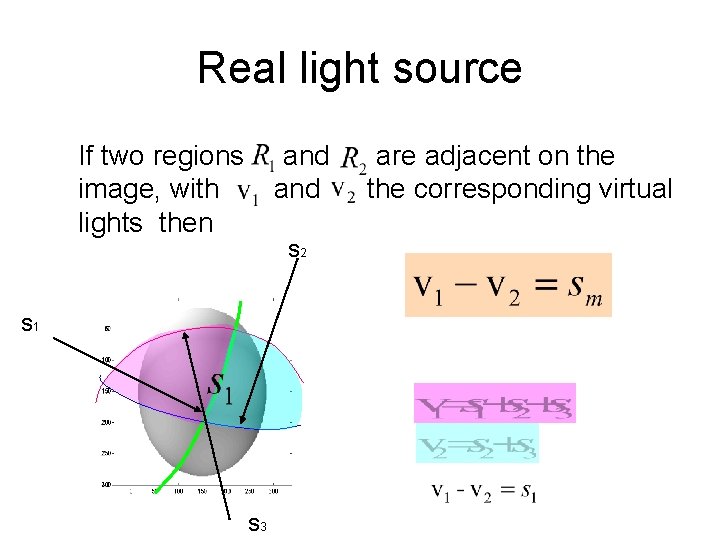
Real light source If two regions and are adjacent on the image, with and the corresponding virtual lights then s 2 s 1 s 3
PROJECTS 6 • Implement V 2 R algorithm* on sphere with 3 light sources (no opposite lights). • Extend V 2 R algorithm to textured spherical objects. • Large bonus: extend this algorithm to run on arbitrary convex objects. *Christos-Savvas Bouganis, Mike Brookes. "Multiple Light Source Detection, " IEEE Transactions on Pattern Analysis and Machine Intelligence, vol. 26, no. 4, pp. 509 -514, April, 2004.
- Slides: 26