
Object Oriented Programming OOP Lecture No 12 Review
Object Oriented Programming (OOP) Lecture No. 12
Review ► Constant data members ► Constant objects ► Static data members
Static Data Member Definition “A variable that is part of a class, yet is not part of an object of that class, is called static data member”
Static Data Member ►They are shared by all instances of the class ►They do not belong to any particular instance of a class
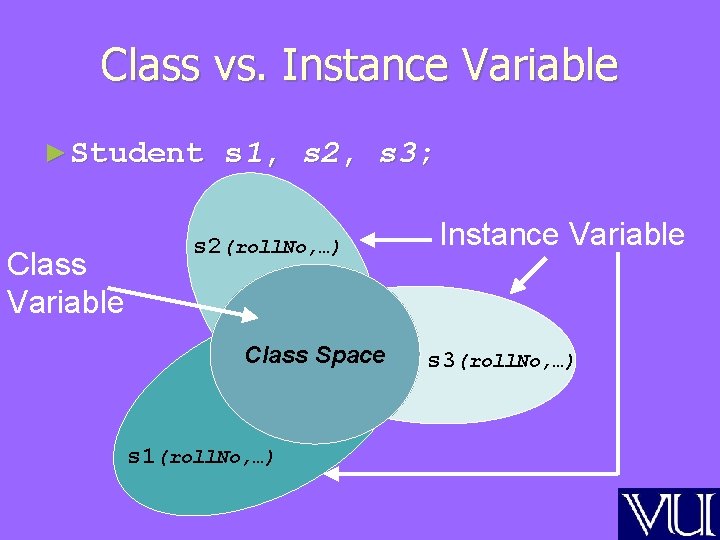
Class vs. Instance Variable ► Student Class Variable s 1, s 2, s 3; s 2(roll. No, …) Class Space s 1(roll. No, …) Instance Variable s 3(roll. No, …)
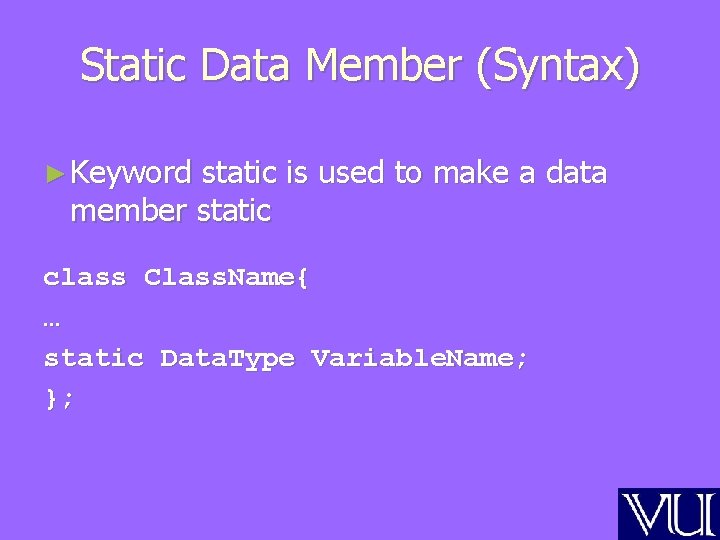
Static Data Member (Syntax) ► Keyword static is used to make a data member static class Class. Name{ … static Data. Type Variable. Name; };
Defining Static Data Member ► Static data member is declared inside the class ► But they are defined outside the class
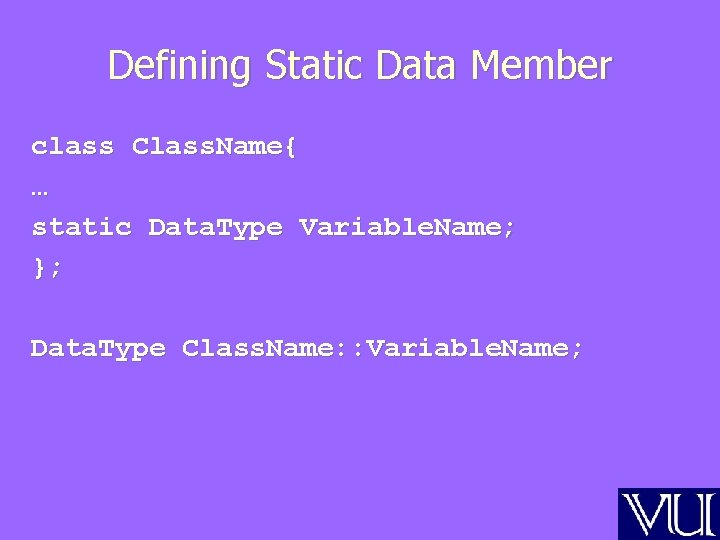
Defining Static Data Member class Class. Name{ … static Data. Type Variable. Name; }; Data. Type Class. Name: : Variable. Name;

Initializing Static Data Member ►Static data members should be initialized once at file scope ►They are initialized at the time of definition
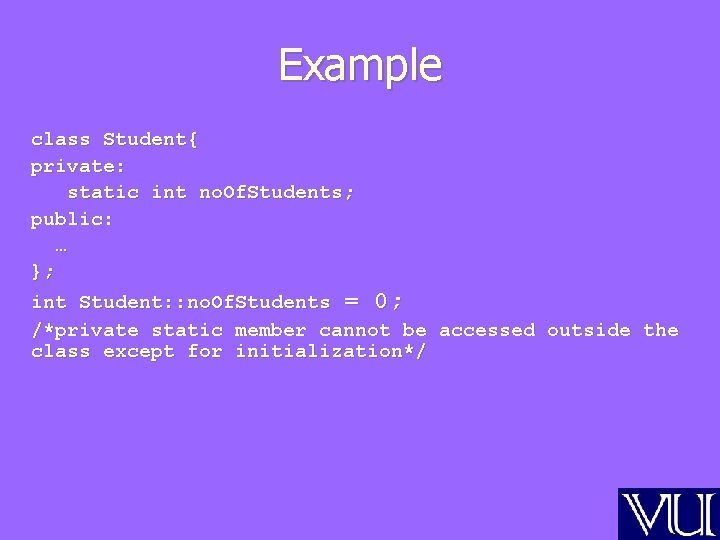
Example class Student{ private: static int no. Of. Students; public: … }; int Student: : no. Of. Students = 0; /*private static member cannot be accessed outside the class except for initialization*/
Initializing Static Data Member ►If static data members are not explicitly initialized at the time of definition they are initialized to 0
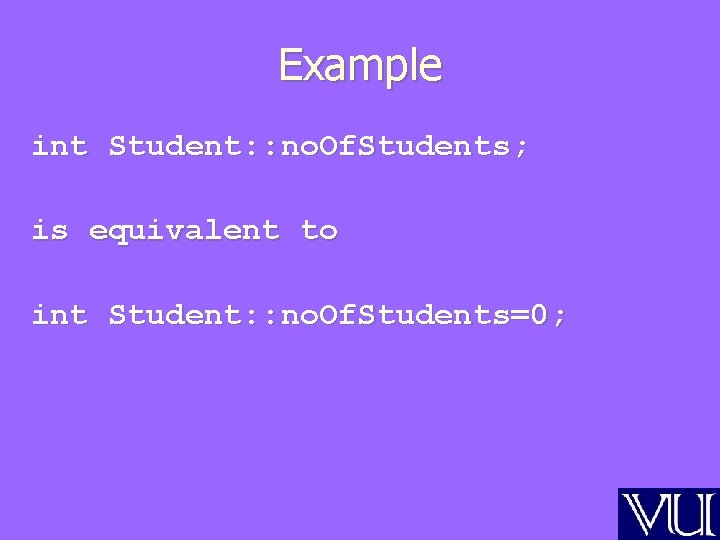
Example int Student: : no. Of. Students; is equivalent to int Student: : no. Of. Students=0;

Accessing Static Data Member ► To access a static data member there are two ways § Access like a normal data member § Access using a scope resolution operator ‘: : ’
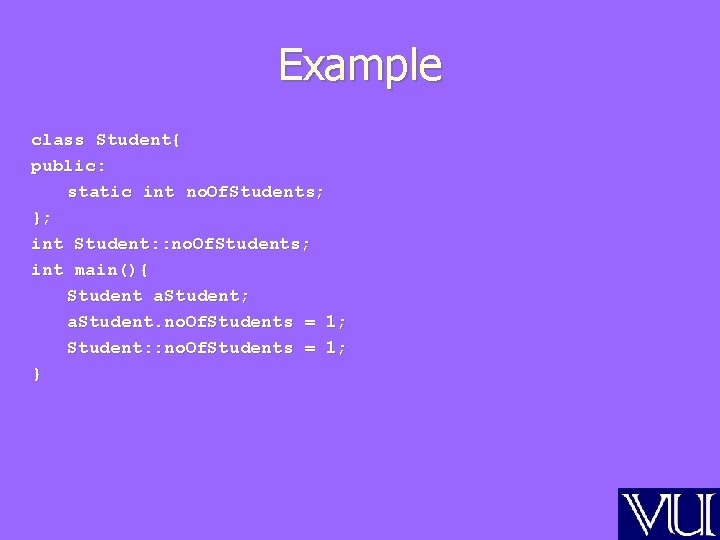
Example class Student{ public: static int no. Of. Students; }; int Student: : no. Of. Students; int main(){ Student a. Student; a. Student. no. Of. Students = 1; Student: : no. Of. Students = 1; }

Life of Static Data Member ► They are created even when there is no object of a class ► They remain in memory even when all objects of a class are destroyed
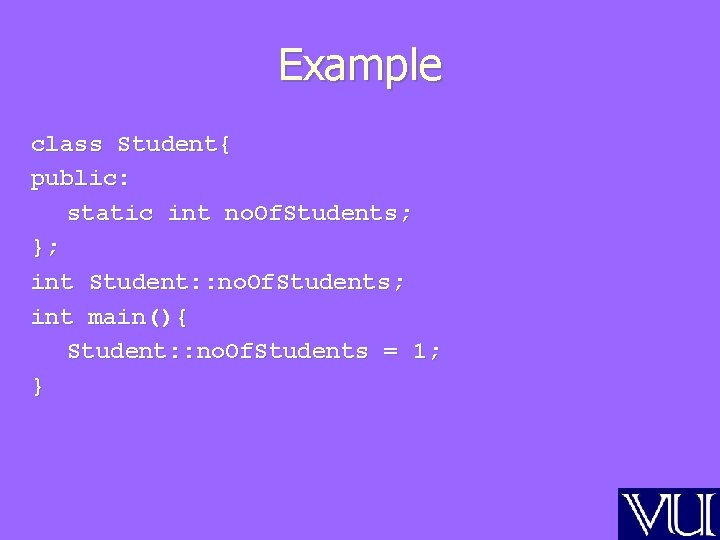
Example class Student{ public: static int no. Of. Students; }; int Student: : no. Of. Students; int main(){ Student: : no. Of. Students = 1; }
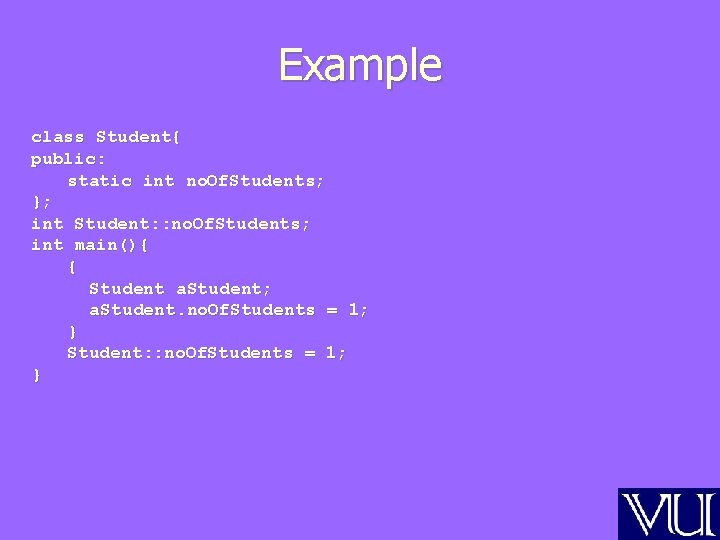
Example class Student{ public: static int no. Of. Students; }; int Student: : no. Of. Students; int main(){ { Student a. Student; a. Student. no. Of. Students = 1; } Student: : no. Of. Students = 1; }

Uses ►They can be used to store information that is required by all objects, like global variables
Example ►Modify the class Student such that one can know the number of student created in a system
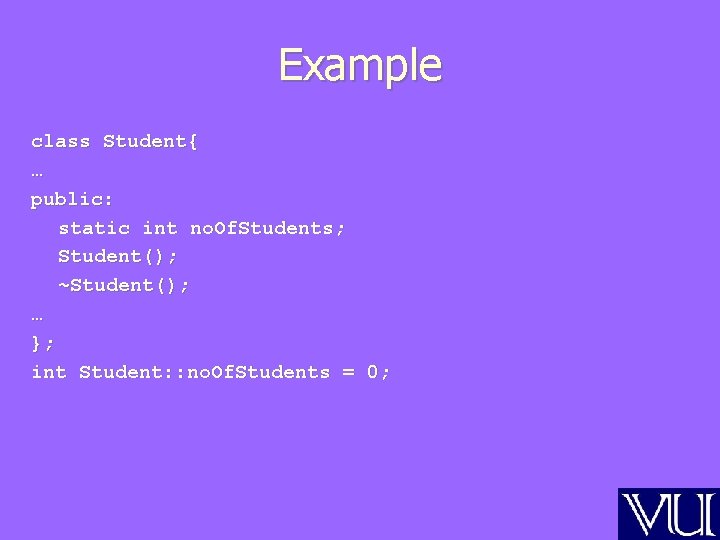
Example class Student{ … public: static int no. Of. Students; Student(); ~Student(); … }; int Student: : no. Of. Students = 0;
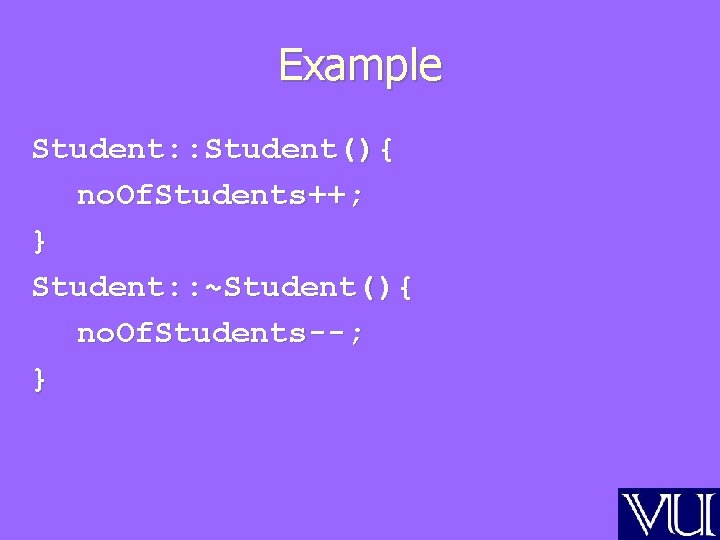
Example Student: : Student(){ no. Of. Students++; } Student: : ~Student(){ no. Of. Students--; }
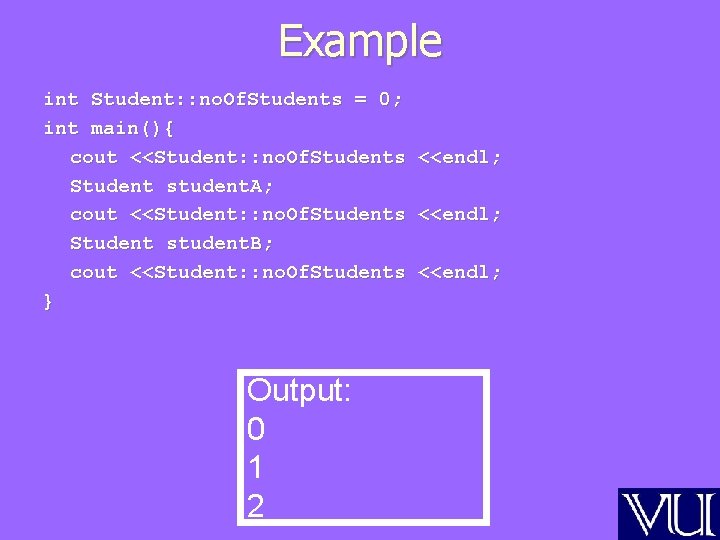
Example int Student: : no. Of. Students = 0; int main(){ cout <<Student: : no. Of. Students <<endl; Student student. A; cout <<Student: : no. Of. Students <<endl; Student student. B; cout <<Student: : no. Of. Students <<endl; } Output: 0 1 2
Problem ► no. Of. Students is accessible outside the class ► Bad design as the local data member is kept public
Static Member Function Definition: “The function that needs access to the members of a class, yet does not need to be invoked by a particular object, is called static member function”
Static Member Function ► They are used to access static data members ► Access mechanism for static member functions is same as that of static data members ► They cannot access any non-static members
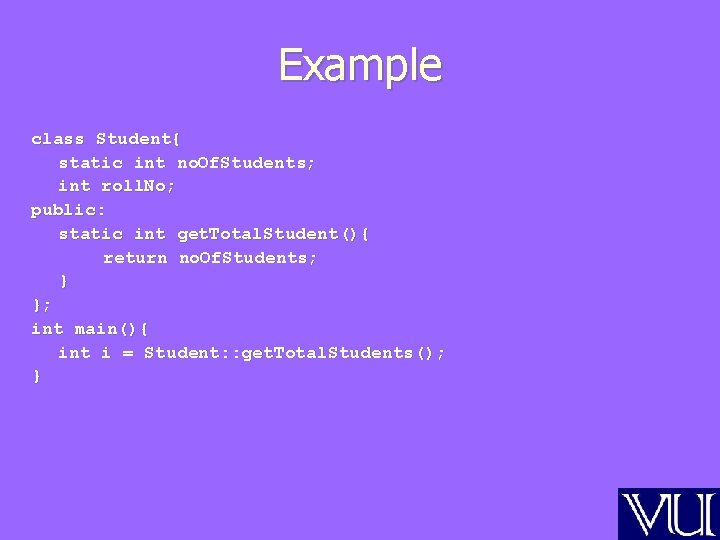
Example class Student{ static int no. Of. Students; int roll. No; public: static int get. Total. Student(){ return no. Of. Students; } }; int main(){ int i = Student: : get. Total. Students(); }
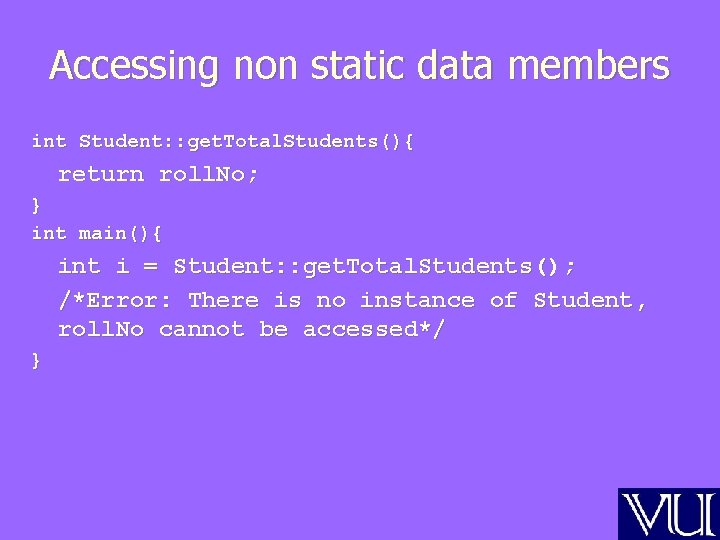
Accessing non static data members int Student: : get. Total. Students(){ return roll. No; } int main(){ int i = Student: : get. Total. Students(); /*Error: There is no instance of Student, roll. No cannot be accessed*/ }
this Pointer ► this pointer is passed implicitly to member functions ► this pointer is not passed to static member functions ► Reason is static member functions cannot access non static data members

Global Variable vs. Static Members ►Alternative to static member is to use global variable ►Global variables are accessible to all entities of the program § Against information hiding
Array of Objects ► Array of objects can only be created if an object can be created without supplying an explicit initializer ► There must always be a default constructor if we want to create array of objects
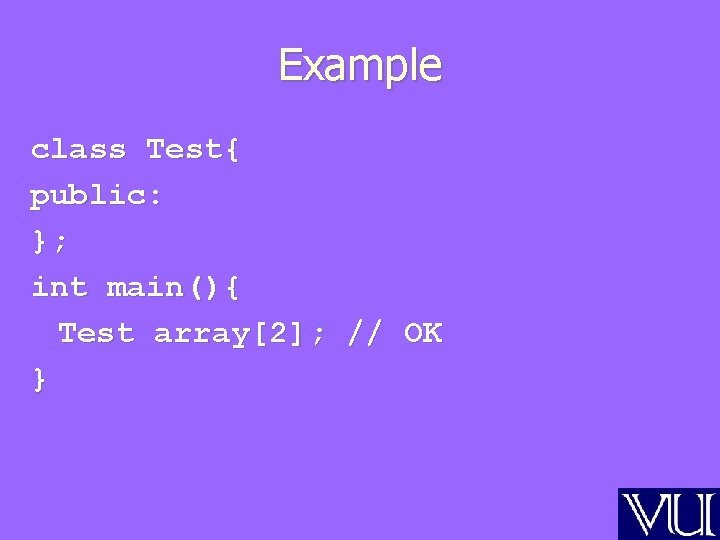
Example class Test{ public: }; int main(){ Test array[2]; // OK }
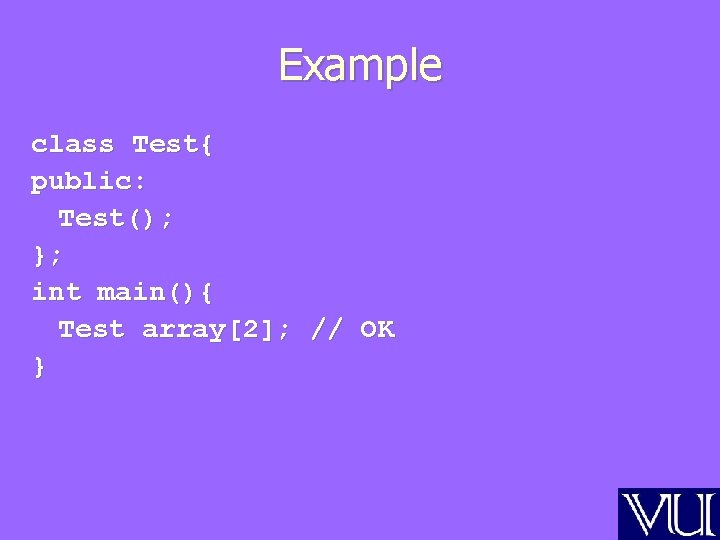
Example class Test{ public: Test(); }; int main(){ Test array[2]; // OK }
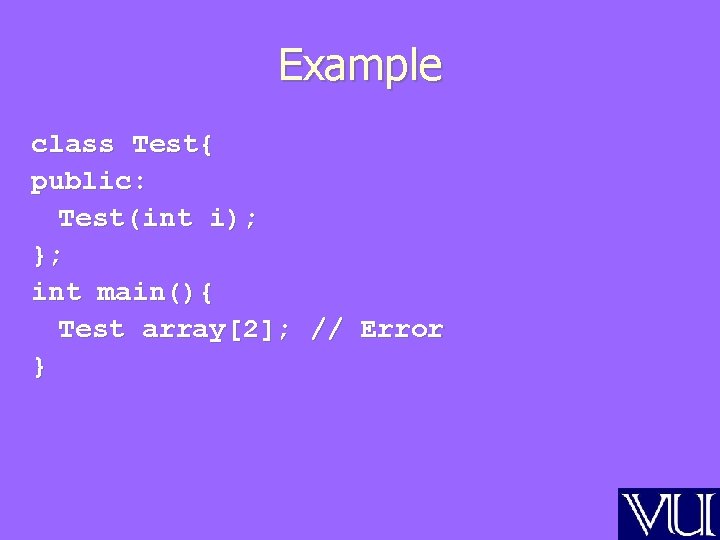
Example class Test{ public: Test(int i); }; int main(){ Test array[2]; // Error }
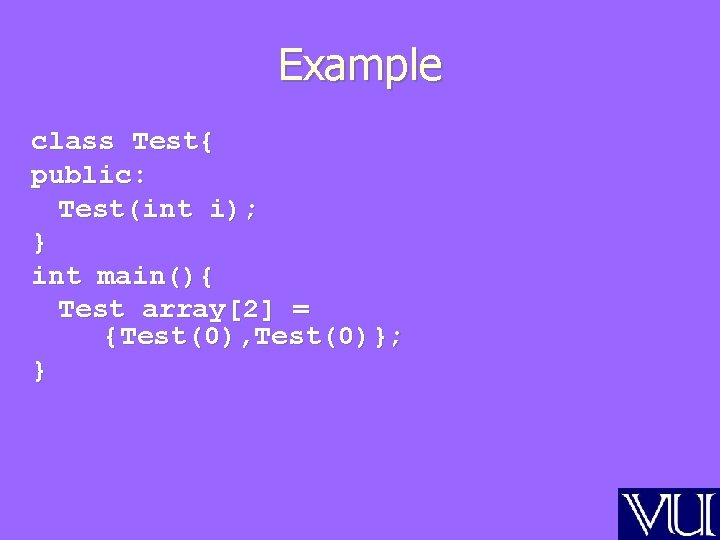
Example class Test{ public: Test(int i); } int main(){ Test array[2] = {Test(0), Test(0)}; }
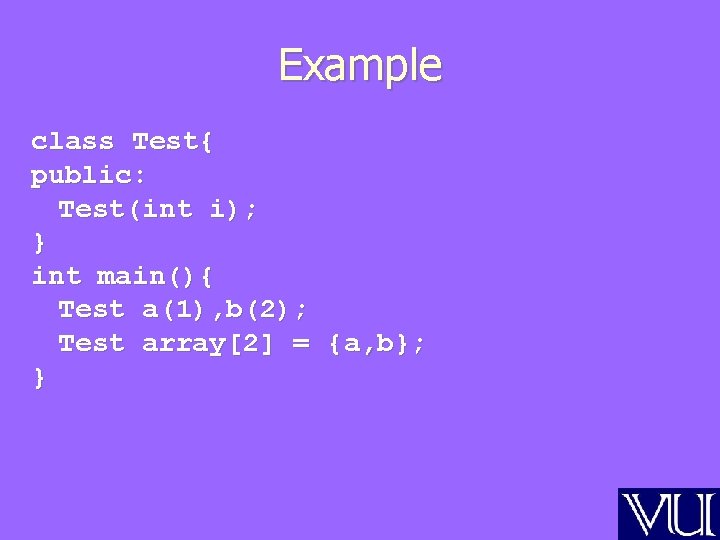
Example class Test{ public: Test(int i); } int main(){ Test a(1), b(2); Test array[2] = {a, b}; }
- Slides: 35