
Object Oriented Programming in C Presented by Errol
Object Oriented Programming in C++ Presented by Errol Russell 4/23/08 CS 331 – OOP Group 1
History of C++ • Created by Bjarne Stroustrup in 1979 at Bell Labs • Desire to add class constructs to the already popular C language. • “C with Classes” • Provides a number of features that “spruce up” the C language. • Old C language with Classes/OOP added into the mix. • Provides the capabilities for object-oriented programming. 4/23/08 CS 331 – OOP Group 2
History of C++ • 1986: Bjarne Stroustrup releases his book The C++ Programming Language • 1998: Standard ratified as ISO/IEC 14882: 1998 • 1999: Draft standard ISO/IEC 14882: 1999 • 2003: Current version is the 2003 version, ISO/IEC 14882: 2003. • 200 X: A new version of the standard (C++0 x) is currently being developed. Will probably be ISO/IEC 14882: 2009 4/23/08 CS 331 – OOP Group 3
The C++ Paradigm • A programming paradigm is a fundamental style of programming. • C++ is a multi-paradigm language – Does not strictly adhere to one paradigm over another – Incorporates multiple paradigms together 4/23/08 CS 331 – OOP Group 4

The C++ Paradigm • Procedural Programming Paradigm – Procedures • Series of computational steps to be carried out, called at any point during a program's execution. • Abstraction Paradigm – Control Abstraction – Data Abstraction • Generic Programming Paradigm – Think templates 4/23/08 CS 331 – OOP Group 5
The C++ Paradigm • Object Oriented Programming (OOP) Paradigm – A notable paradigm in C++ that was not in C, and the focus of the rest of this talk – "objects" and their interactions to design applications and computer programs. – Based on several techniques • • 4/23/08 Encapsulation Modularity Polymorphism Inheritance CS 331 – OOP Group 6
Specific Enhancements to C • Templates – Write code without having to consider a specific data type. Used heavily when creating Abstract Data Types • Exception Handling – Helps avoid problems that would disrupt the normal flow of execution. “Catch” problems before they happen. • Polymorphism – Can assign different meanings/usages to an object based on context. For example, you could use an integer as a Boolean in some cases. 4/23/08 CS 331 – OOP Group 7
Specific Enhancements to C • Operator Overloading – Operators can be re-written to perform different tasks • Multiple Inheritance – One class can inherit from multiple classes • “Diamond Problem” solved with virtual inheritance • Classes – Constructs for objects • Virtual Functions – “. . . behavior is determined by the definition of a function with the same signature furthest in the inheritance lineage of the instantiated object on which it is called. ” – It “knows” which of the functions it needs to execute the code for 4/23/08 CS 331 – OOP Group 8
New Syntax in C++ • • • new – creates a new instance of an object delete – destroys an object The : operator used for inheritance this – self-referential object pointer Error handling – try – catch – throw 4/23/08 CS 331 – OOP Group 9
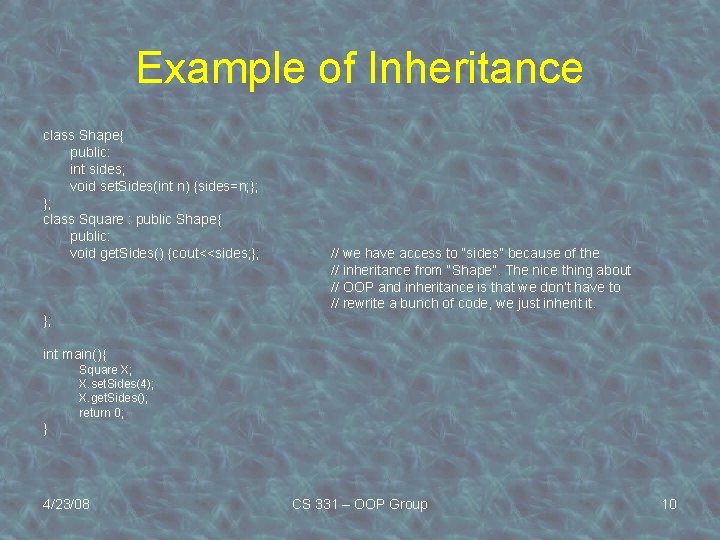
Example of Inheritance class Shape{ public: int sides; void set. Sides(int n) {sides=n; }; }; class Square : public Shape{ public: void get. Sides() {cout<<sides; }; // we have access to “sides” because of the // inheritance from “Shape”. The nice thing about // OOP and inheritance is that we don’t have to // rewrite a bunch of code, we just inherit it. }; int main(){ Square X; X. set. Sides(4); X. get. Sides(); return 0; } 4/23/08 CS 331 – OOP Group 10
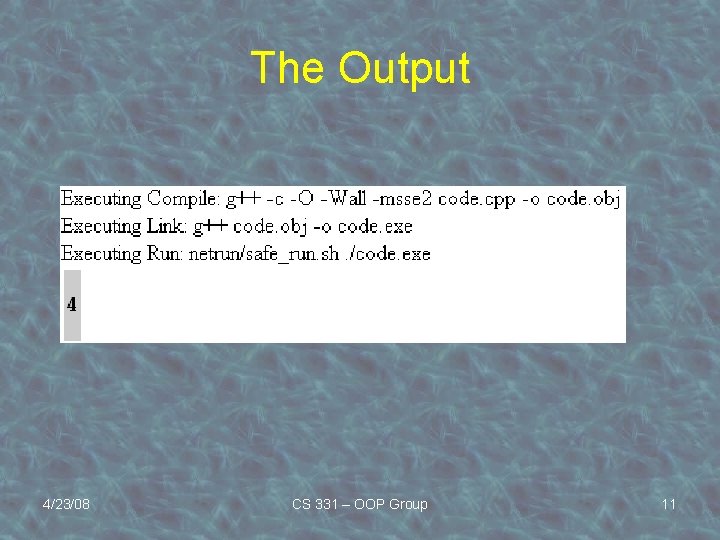
The Output 4/23/08 CS 331 – OOP Group 11
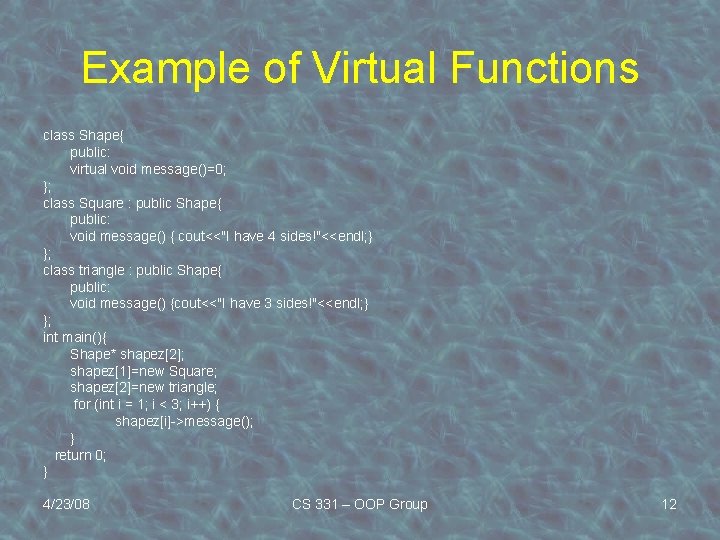
Example of Virtual Functions class Shape{ public: virtual void message()=0; }; class Square : public Shape{ public: void message() { cout<<"I have 4 sides!"<<endl; } }; class triangle : public Shape{ public: void message() {cout<<"I have 3 sides!"<<endl; } }; int main(){ Shape* shapez[2]; shapez[1]=new Square; shapez[2]=new triangle; for (int i = 1; i < 3; i++) { shapez[i]->message(); } return 0; } 4/23/08 CS 331 – OOP Group 12
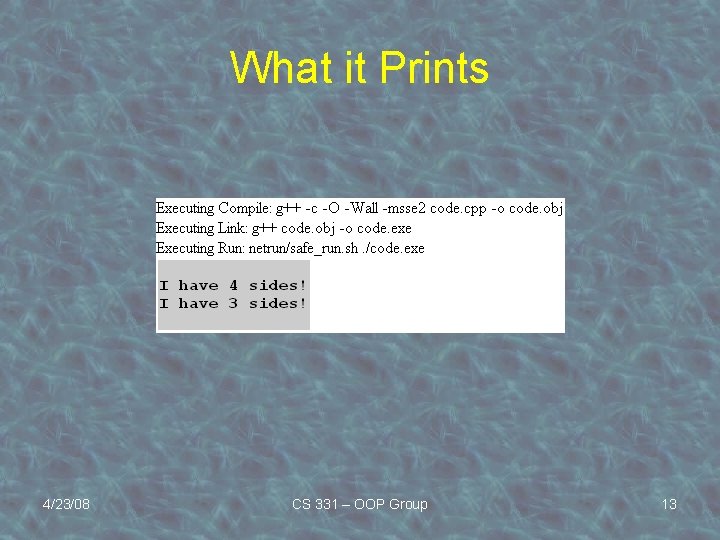
What it Prints 4/23/08 CS 331 – OOP Group 13
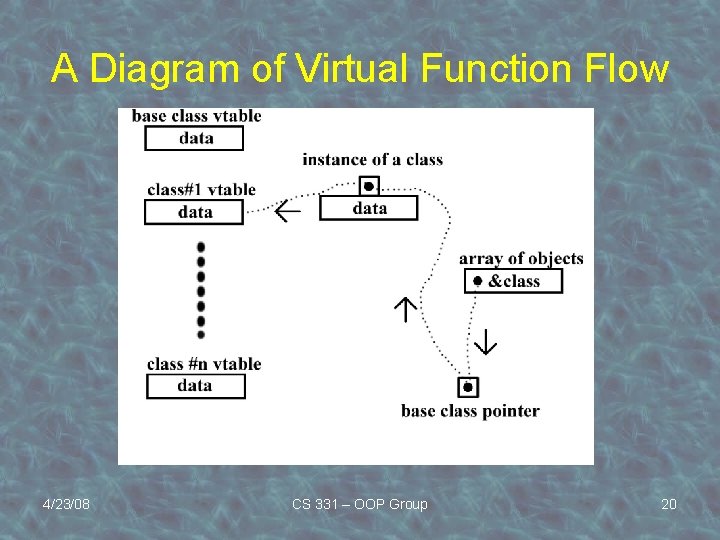
The Virtual Function Table • Dynamically bound methods can be called from any instance of a class or its derived classes • Methods stored only once in a virtual function table (vtable). • Function calls are represented as offsets from the beginning of the table. 4/23/08 CS 331 – OOP Group 14
Virtual Functions/Tables and Dynamic Binding • The program contains a base class and two derived classes. • The base class is abstract and defines a pure virtual function • Derived classes provide the appropriate implementation 4/23/08 CS 331 – OOP Group 15
Virtual Functions/Tables and Dynamic Binding • A virtual function table is a mechanism used in OOP language implementation in order to support dynamic run-time method binding. • That is, virtual functions and the virtual function table are used to support dynamic binding. 4/23/08 CS 331 – OOP Group 16
Virtual Functions/Tables and Dynamic Binding • The virtual functions in the previous program give an example of dynamic binding. • Dynamic binding happens when invoking a derived class's member function using a pointer to its super class. • The implementation of the derived class will be invoked instead of that of the base class. 4/23/08 CS 331 – OOP Group 17
Virtual Functions/Tables and Dynamic Binding • Languages like C++ separate the interface of objects from the implementation • They tend to use the virtual function table approach because it • Allows objects to use a different implementation by using a different set of method pointers. 4/23/08 CS 331 – OOP Group 18
Virtual Functions/Tables and Dynamic Binding • When the program calls the “sides” method on a Shape pointer (which can point to any of the base or derived classes) • Run-time environment must be able to determine which implementation to call, depending on the actual type of object Shape points to. 4/23/08 CS 331 – OOP Group 19
A Diagram of Virtual Function Flow 4/23/08 CS 331 – OOP Group 20
Strengths of C++ • “single, portable language that works better than any alternative in each of several areas” • “works well when [a more desirable language] is. . . not available, and because it interfaces easily with the libraries and the other languages you use” 4/23/08 CS 331 – OOP Group 21
Strengths of C++ • Execution speed • Multi-paradigm • C++ is like a “glue” – “well suited to tying together the various parts of a programming project” 4/23/08 CS 331 – OOP Group 22
Weaknesses of C++ • It is a "bloated" and complicated language – The ISO standard of the C++ language is about 310 pages (excluding library) • No language features to create multithreaded software – Can multithread when it interfaces with OS or 3 rd party applications, but creates portability concerns 4/23/08 CS 331 – OOP Group 23
My References • http: //www. research. att. com/~bs/books. ht mlhttp: //www. cantrip. org/realworld. html • Sebesta’s Programming Languages 8 th edition. • Deitel & Deitel’s How to Program C++ 5 th Edition • http: //www. java 2 s. com/Code/Cpp/Class/A simpleexampleofinheritance. htm 4/23/08 CS 331 – OOP Group 24
- Slides: 24