
Object Oriented Modeling and Design Agenda Some of
Object Oriented Modeling and Design Agenda Ø Some of the methodologies developed in the 1980 s &1990 s Ø Rumbaugh et. al. ’s Object Modeling Technique (OMT) v. An Object Model v. A dynamic model v. A functional model
Survey of Object Oriented Methodologies Some of the methodologies developed in the 1980 s &1990 s: ØMany methodologies are available for system development ØEach methodology is based on Modeling the business problem and Implementing in object-oriented fashion ØDiffers in Documentation of information and Modeling notations ØWe look at the methodologies developed by Rumbaugh et al. , Booch, and Jacobson which are the origins of the Unified Modeling Language (UML) and the bases of the UA
Survey of Object Oriented Methodologies Rumbaugh et. al. ’s Object Modeling Technique (OMT) : ØDescribes a method for the analysis, design, and implementation of a system using an object-oriented technique ØClass attributes, method, inheritance, and association can be expressed easily ØWell-suited for describing the object model or the static structure of the system ØOMT consists of four phases, which can be performed iteratively: v. Analysis: The results are object, dynamic and functional models. v. System design: The result is a structure of the basic architecture of the system
Survey of Object Oriented Methodologies Rumbaugh et. al. ’s Object Modeling Technique (OMT) : v. Object design: This phase produces a design document, consisting of detailed objects and dynamic and functional models v. Implementation: This activity produces reusable, extendible, and robust code ØOMT separates modeling into three different parts: v. An object model presented by the object model and the data dictionary v. A dynamic model presented by the state diagrams and event flow diagrams v. A functional model presented by data flow and constraints

Survey of Object Oriented Methodologies Rumbaugh et. al. ’s Object Modeling Technique (OMT) : OMT Object Model: ØDescribes the structure of objects in a system: v. Object’s identity v. Relationships to other objects v. Attributes and v. Operations ØRepresented graphically with an object diagram ØObject diagram contains classes interconnected by association lines ØThe association lines establish relationships among the classes
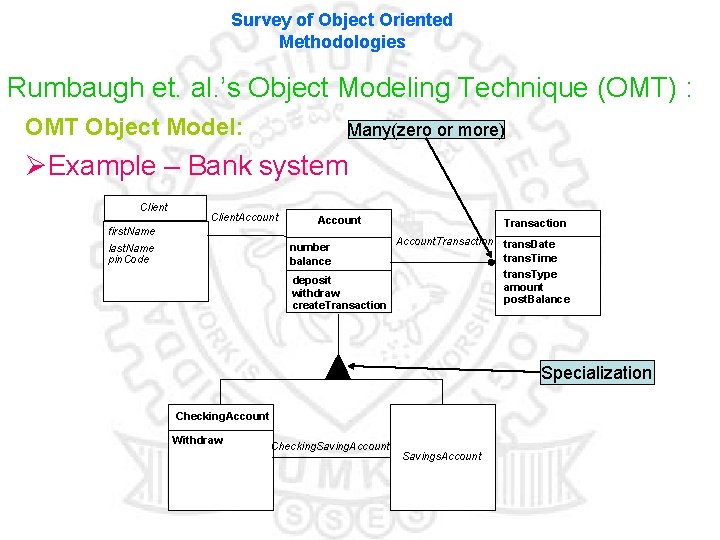
Survey of Object Oriented Methodologies Rumbaugh et. al. ’s Object Modeling Technique (OMT) : OMT Object Model: Many(zero or more) ØExample – Bank system Client. Account first. Name Account number balance last. Name pin. Code Transaction Account. Transaction trans. Date trans. Time trans. Type amount post. Balance deposit withdraw create. Transaction Specialization Checking. Account Withdraw Checking. Saving. Account Savings. Account
Survey of Object Oriented Methodologies Rumbaugh et. al. ’s Object Modeling Technique (OMT) : OMT Dynamic Model : ØProvides a detailed and comprehensive dynamic model ØUsed to depict states, transitions, events and actions ØRepresented by State Transition Diagram (STD) ØState diagram relates events and states ØState diagram is a graph whose nodes are states and whose directed arcs are transitions labeled by event names
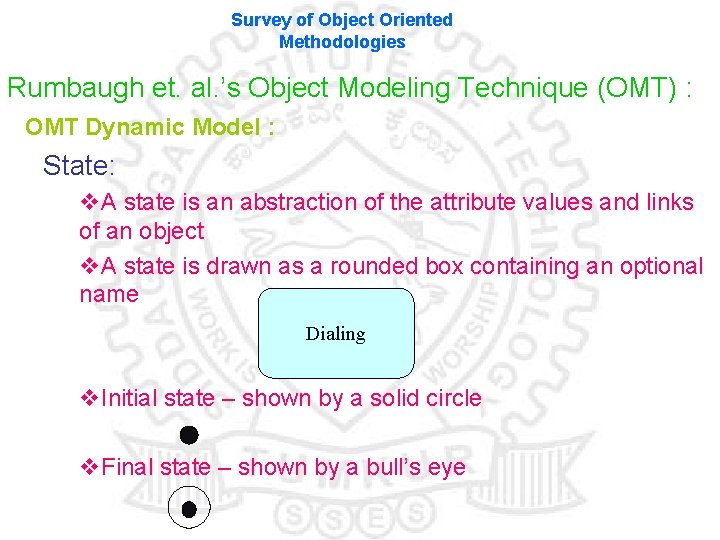
Survey of Object Oriented Methodologies Rumbaugh et. al. ’s Object Modeling Technique (OMT) : OMT Dynamic Model : State: v. A state is an abstraction of the attribute values and links of an object v. A state is drawn as a rounded box containing an optional name Dialing v. Initial state – shown by a solid circle v. Final state – shown by a bull’s eye
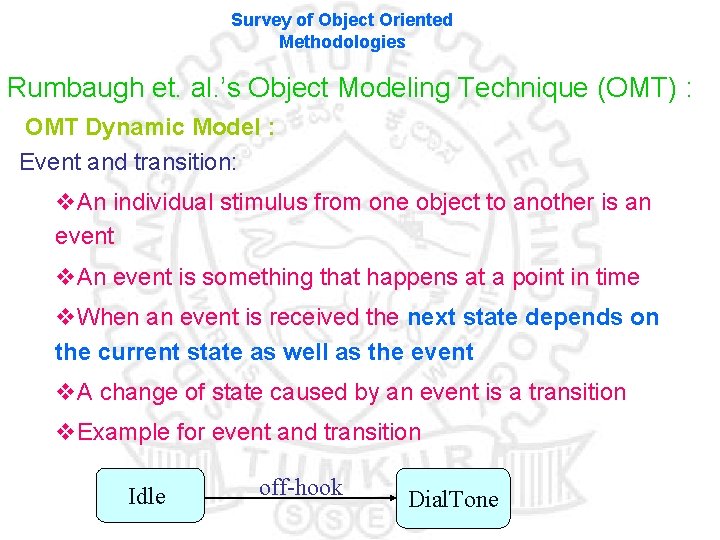
Survey of Object Oriented Methodologies Rumbaugh et. al. ’s Object Modeling Technique (OMT) : OMT Dynamic Model : Event and transition: v. An individual stimulus from one object to another is an event v. An event is something that happens at a point in time v. When an event is received the next state depends on the current state as well as the event v. A change of state caused by an event is a transition v. Example for event and transition Idle off-hook Dial. Tone
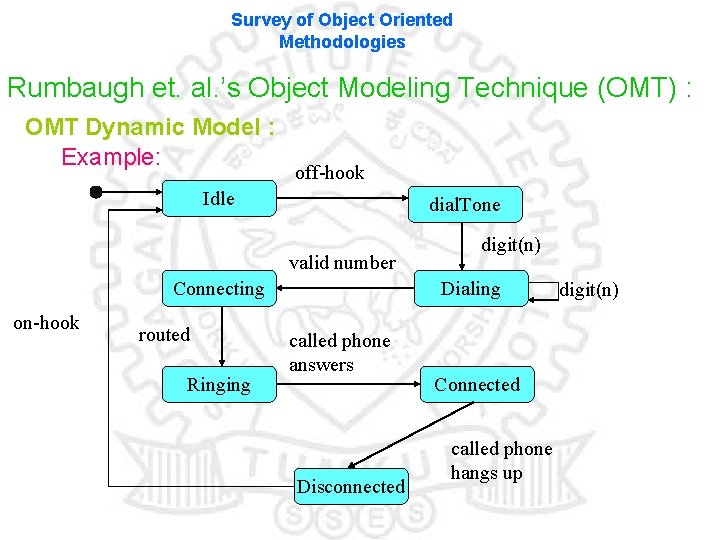
Survey of Object Oriented Methodologies Rumbaugh et. al. ’s Object Modeling Technique (OMT) : OMT Dynamic Model : Example: off-hook Idle dial. Tone valid number Connecting on-hook routed Ringing digit(n) Dialing called phone answers Disconnected Connected called phone hangs up digit(n)
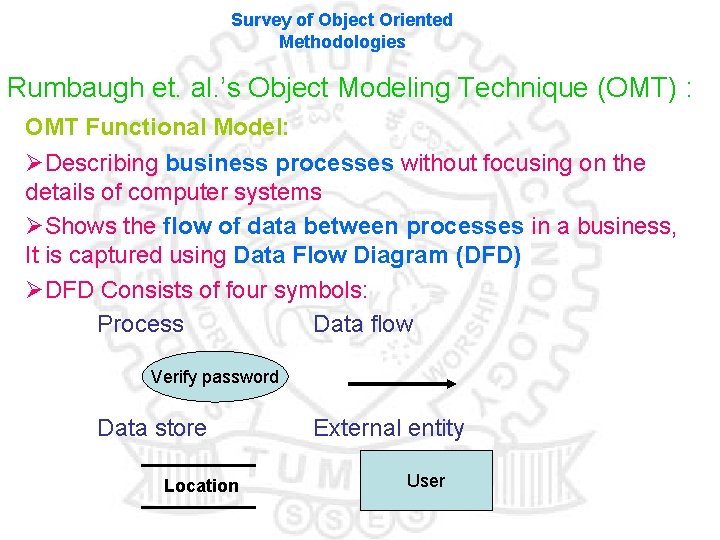
Survey of Object Oriented Methodologies Rumbaugh et. al. ’s Object Modeling Technique (OMT) : OMT Functional Model: ØDescribing business processes without focusing on the details of computer systems ØShows the flow of data between processes in a business, It is captured using Data Flow Diagram (DFD) ØDFD Consists of four symbols: Process Data flow Verify password Data store Location External entity User
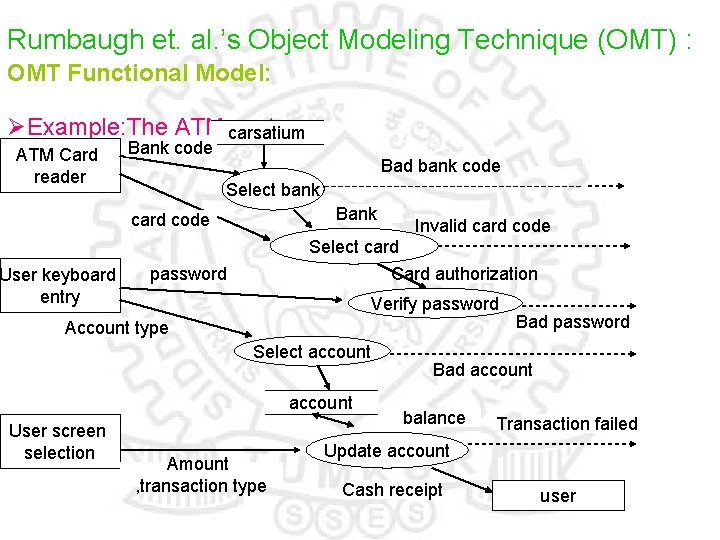
Rumbaugh et. al. ’s Object Modeling Technique (OMT) : OMT Functional Model: ØExample: The ATM carsatium system ATM Card reader Bank code Bad bank code Select bank Bank card code User keyboard entry Invalid card code Select card Card authorization password Verify password Account type Select account User screen selection Amount , transaction type Bad password Bad account balance Transaction failed Update account Cash receipt user
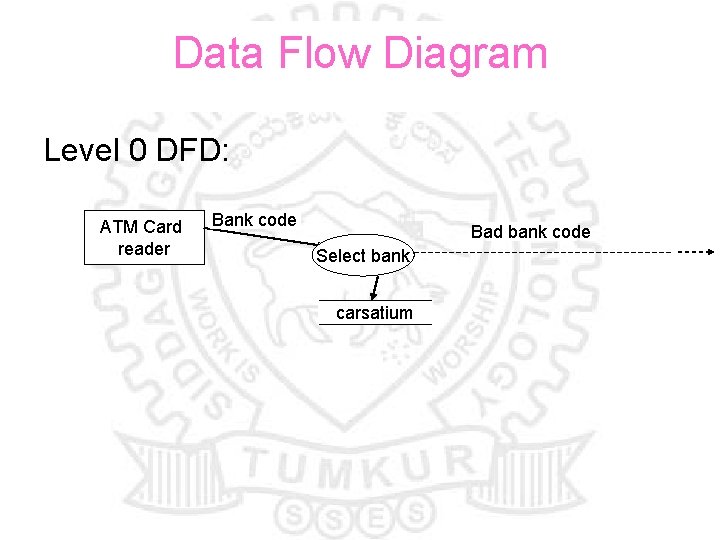
Data Flow Diagram Level 0 DFD: ATM Card reader Bank code Bad bank code Select bank carsatium
- Slides: 13