
Object Oriented Design Heuristics Dennis Mancl dmanclacm org
Object Oriented Design Heuristics Dennis Mancl dmancl@acm. org This work is licensed under a Creative Commons Attribution 4. 0 International License http: //creativecommons. org/licenses/by/4. 0 MSWX ◊ Mancl ◊ Software ◊ Experts ◊ http: //manclswx. com
Why Heuristics? • All software developers know how to code, but they are not all equally skilled in creating good designs for applications or subsystems • We all get training in programming languages, development tools, algorithms, data structures, and database tools • But most of us have never had a formal course in design – we learn “on the job” slide 2
Why Heuristics? • Design principles: good but complicated… • Modularization – divide a big design into small independent pieces (component / module) • Encapsulation – each component has a simple interface, hiding complex details (reduce the learning curve…) • Low coupling – minimize dependencies between components • Extensibility – components can be extended without changing the base code (making it easier to add new operations later…) • Design heuristics: easier to learn and apply • Simple “rules of thumb” • They help avoid design pitfalls • Use them in design brainstorming and design reviews slide 3
Heuristics for Object Oriented Design • We will talk about “object oriented design heuristics” today: • We want to define good classes (classes should encapsulate the right data and should have the right public interfaces) • A good distribution of responsibilities across a group of classes • Not too much “concentration of behavior” in one class • Many of our classes will “delegate” part of their work to other classes • Use inheritance / subtypes in a sensible way • Avoid major pitfalls in the use of inheritance slide 4
Design Heuristics can help • Designers have to avoid many pitfalls • building an “action-oriented” system instead of an object oriented system • creating god classes (too much concentration of data or operations) • underuse of containment relationships • inappropriate use of inheritance to model containment, common interface, and single objects • We will talk more about: • Action oriented: centralized control, single main procedure, uncontrolled data sharing • God class: one class controls everything, lots of complexity concentrated in one place slide 5
Arthur Riel’s Object Oriented Design Heuristics • Some good design heuristics: Object-Oriented Design Heuristics by Arthur Riel • This book lists 61 heuristics • these are “rules of thumb” • they are sometimes violated in designs that are considered good • but the heuristics help identify places where the design should be changed • These heuristics apply to many programming languages • C++, Java, Python, Java. Script… slide 6
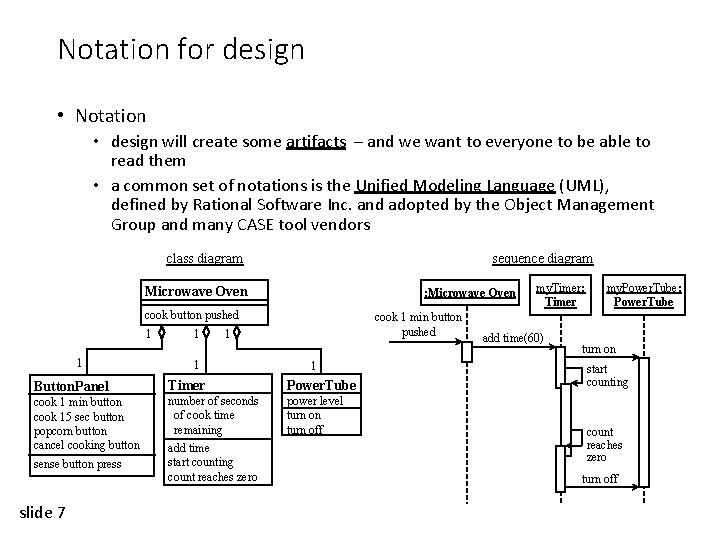
Notation for design • Notation • design will create some artifacts – and we want to everyone to be able to read them • a common set of notations is the Unified Modeling Language (UML), defined by Rational Software Inc. and adopted by the Object Management Group and many CASE tool vendors class diagram sequence diagram Microwave Oven : Microwave Oven cook button pushed 1 1 Button. Panel cook 1 min button cook 15 sec button popcorn button cancel cooking button sense button press slide 7 1 cook 1 min button pushed 1 1 1 Timer Power. Tube number of seconds of cook time remaining power level turn on turn off add time start counting count reaches zero my. Timer: Timer add time(60) my. Power. Tube: Power. Tube turn on start counting count reaches zero turn off
Categories of heuristics • Arthur Riel’s heuristics are organized into several categories: 1. Classes and objects: the basic structure of the building blocks of OO architecture 2. Object oriented “topology” (versus action-oriented topology): creating decentralized architectures 3. Designing the pattern of collaborations within a system of objects 4. The inheritance relationship: creating variations or extensions of an existing class 5. Miscellaneous heuristics: multiple inheritance, associations, use of class data and operations, and physical design considerations slide 8
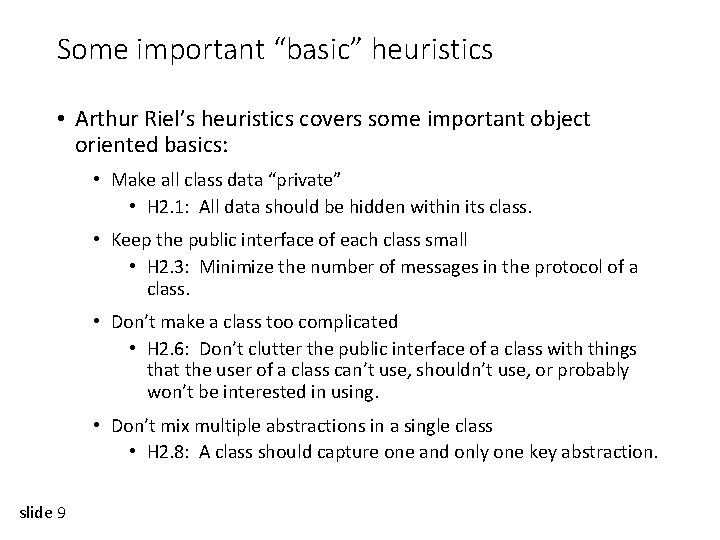
Some important “basic” heuristics • Arthur Riel’s heuristics covers some important object oriented basics: • Make all class data “private” • H 2. 1: All data should be hidden within its class. • Keep the public interface of each class small • H 2. 3: Minimize the number of messages in the protocol of a class. • Don’t make a class too complicated • H 2. 6: Don’t clutter the public interface of a class with things that the user of a class can’t use, shouldn’t use, or probably won’t be interested in using. • Don’t mix multiple abstractions in a single class • H 2. 8: A class should capture one and only one key abstraction. slide 9
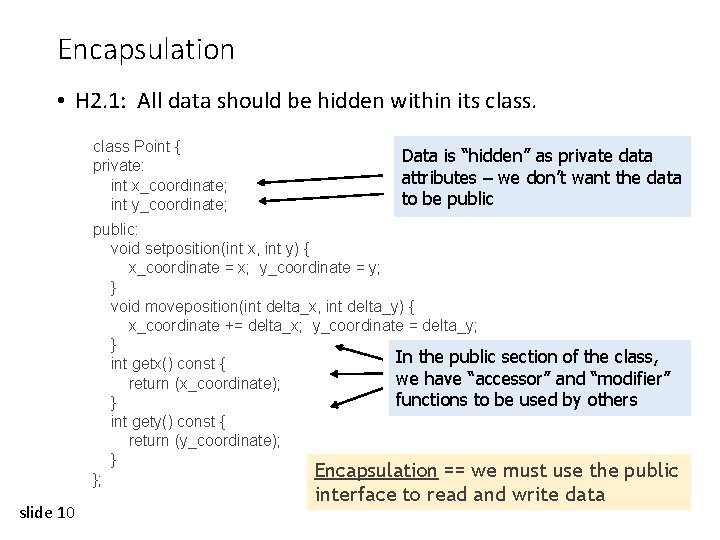
Encapsulation • H 2. 1: All data should be hidden within its class Point { private: int x_coordinate; int y_coordinate; Data is “hidden” as private data attributes – we don’t want the data to be public: void setposition(int x, int y) { x_coordinate = x; y_coordinate = y; } void moveposition(int delta_x, int delta_y) { x_coordinate += delta_x; y_coordinate = delta_y; } In the public section of the class, int getx() const { we have “accessor” and “modifier” return (x_coordinate); functions to be used by others } int gety() const { return (y_coordinate); } Encapsulation == we must use the public }; slide 10 interface to read and write data
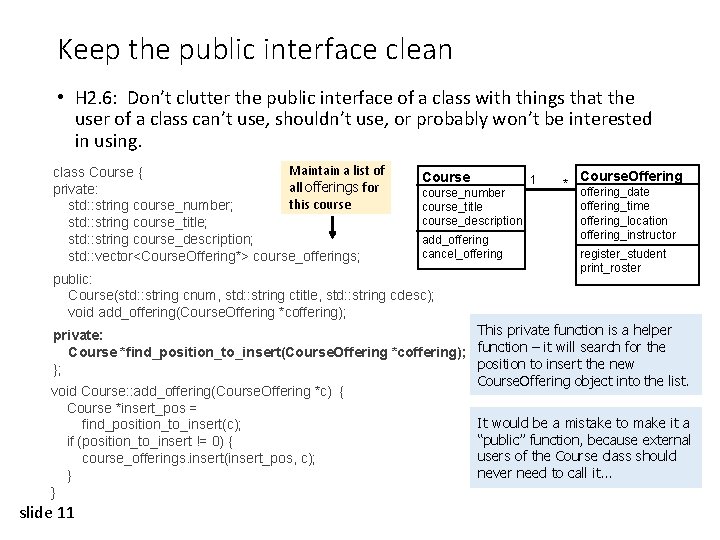
Keep the public interface clean • H 2. 6: Don’t clutter the public interface of a class with things that the user of a class can’t use, shouldn’t use, or probably won’t be interested in using. Maintain a list of class Course { all offerings for private: this course std: : string course_number; std: : string course_title; std: : string course_description; std: : vector<Course. Offering*> course_offerings; Course course_number course_title course_description add_offering cancel_offering public: Course(std: : string cnum, std: : string ctitle, std: : string cdesc); void add_offering(Course. Offering *coffering); 1 * Course. Offering offering_date offering_time offering_location offering_instructor register_student print_roster This private function is a helper private: Course *find_position_to_insert(Course. Offering *coffering); function – it will search for the position to insert the new }; Course. Offering object into the list. void Course: : add_offering(Course. Offering *c) { Course *insert_pos = It would be a mistake to make it a find_position_to_insert(c); “public” function, because external if (position_to_insert != 0) { users of the Course class should course_offerings. insert(insert_pos, c); never need to call it… } } slide 11
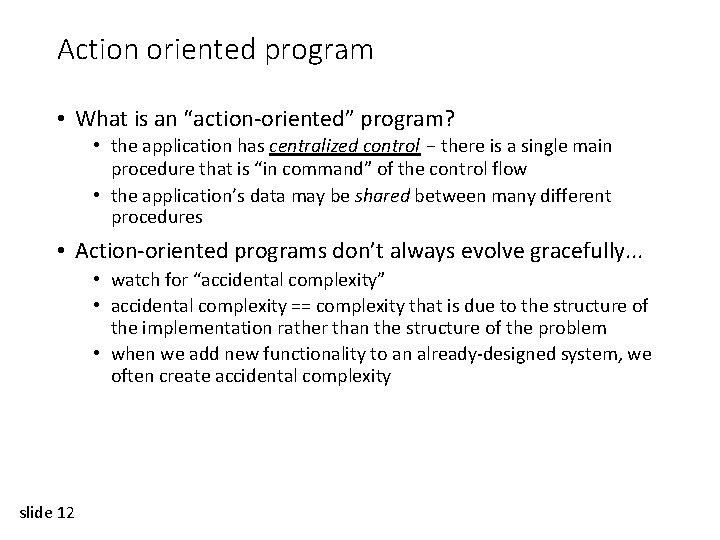
Action oriented program • What is an “action-oriented” program? • the application has centralized control - there is a single main procedure that is “in command” of the control flow • the application’s data may be shared between many different procedures • Action-oriented programs don’t always evolve gracefully. . . • watch for “accidental complexity” • accidental complexity == complexity that is due to the structure of the implementation rather than the structure of the problem • when we add new functionality to an already-designed system, we often create accidental complexity slide 12
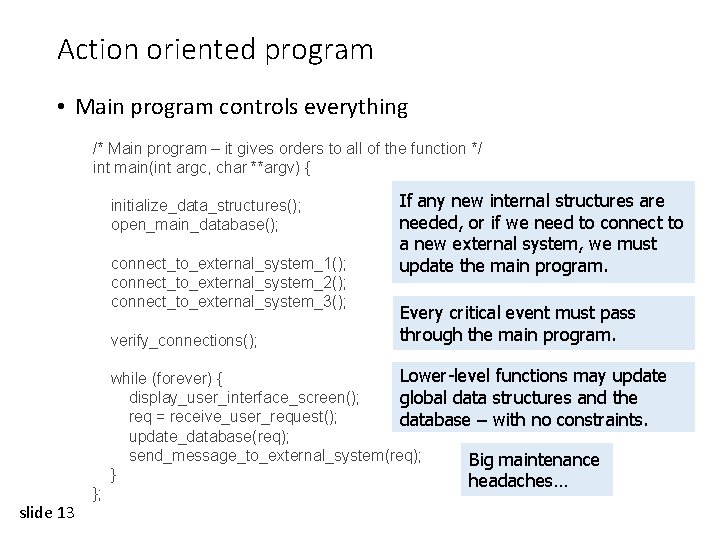
Action oriented program • Main program controls everything /* Main program – it gives orders to all of the function */ int main(int argc, char **argv) { initialize_data_structures(); open_main_database(); connect_to_external_system_1(); connect_to_external_system_2(); connect_to_external_system_3(); verify_connections(); slide 13 }; If any new internal structures are needed, or if we need to connect to a new external system, we must update the main program. Every critical event must pass through the main program. Lower-level functions may update while (forever) { display_user_interface_screen(); global data structures and the req = receive_user_request(); database – with no constraints. update_database(req); send_message_to_external_system(req); Big maintenance } headaches…
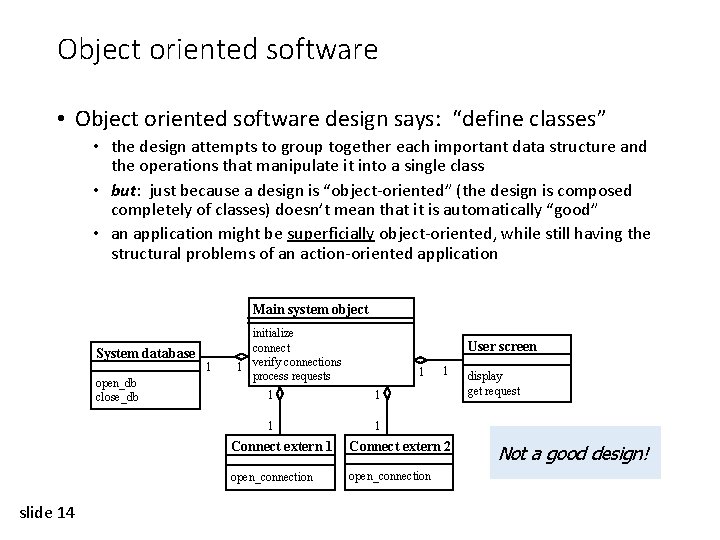
Object oriented software • Object oriented software design says: “define classes” • the design attempts to group together each important data structure and the operations that manipulate it into a single class • but: just because a design is “object-oriented” (the design is composed completely of classes) doesn’t mean that it is automatically “good” • an application might be superficially object-oriented, while still having the structural problems of an action-oriented application Main system object System database open_db close_db slide 14 1 initialize connect 1 verify connections process requests User screen 1 1 1 Connect extern 2 open_connection display get request Not a good design!
Two design problems • the “god class” problem • one class controls everything • the “proliferation of classes” problem • the functionality is spread out over too many small classes slide 15
Some heuristics These heuristics are from Chapter 3 of Riel’s book: • When you develop the main functionality of a system, use multiple classes • H 3. 1: Distribute system intelligence horizontally as uniformly as possible. • H 3. 2: Do not create god classes/objects in your system. • Watch out for classes with many “get” and “set” operations • H 3. 3: Beware of classes that have many accessor methods defined in their public interface. Having many accessor methods implies that related data and behavior are not being kept in one place. • Avoid big classes that “combine” multiple abstractions • H 3. 4: Beware of classes that have too much noncommunicating behavior (operations that operate on a proper subset of the data members of a class). slide 16
Central control versus object design • These four heuristics might be violated when a designer: • has a centrally-controlled architecture in mind at the beginning of the design process, and • tries to maintain that centrally-controlled structure during the initial design of the main classes in the system. • What’s going on? • The designer is still thinking in the action-oriented paradigm • But the designer is trying to recast the design in object-oriented terminology (without really making the transition to an object oriented architecture) slide 17
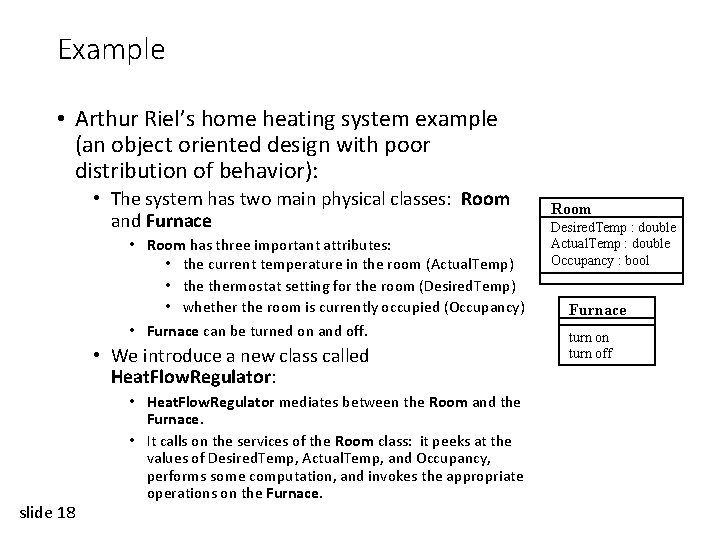
Example • Arthur Riel’s home heating system example (an object oriented design with poor distribution of behavior): • The system has two main physical classes: Room and Furnace • Room has three important attributes: • the current temperature in the room (Actual. Temp) • thermostat setting for the room (Desired. Temp) • whether the room is currently occupied (Occupancy) • Furnace can be turned on and off. • We introduce a new class called Heat. Flow. Regulator: slide 18 • Heat. Flow. Regulator mediates between the Room and the Furnace. • It calls on the services of the Room class: it peeks at the values of Desired. Temp, Actual. Temp, and Occupancy, performs some computation, and invokes the appropriate operations on the Furnace. Room Desired. Temp : double Actual. Temp : double Occupancy : bool Furnace turn on turn off
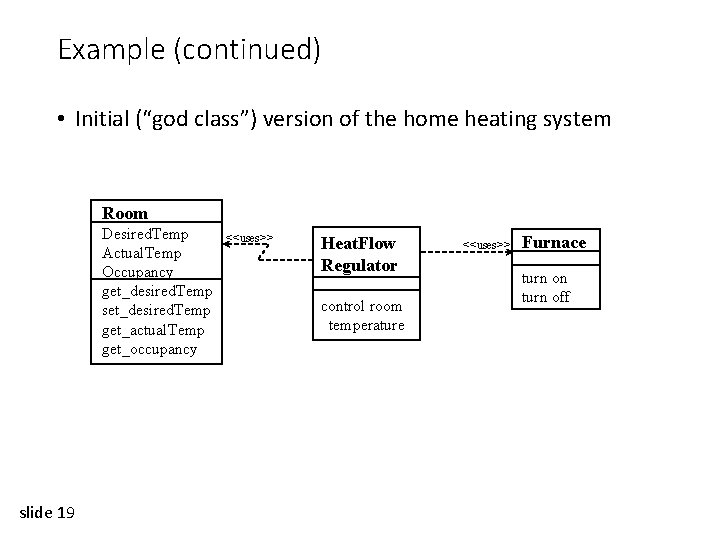
Example (continued) • Initial (“god class”) version of the home heating system Room Desired. Temp Actual. Temp Occupancy get_desired. Temp set_desired. Temp get_actual. Temp get_occupancy slide 19 <<uses>> Heat. Flow Regulator control room temperature <<uses>> Furnace turn on turn off
Questions about the example • Is this system “object-oriented”? • Sure, because we have put all of the data and control into classes. • Are there problems with this design? • Yes. The Heat. Flow. Regulator is a “god class”. It is the “omnipotent controller” that pulls in all of the information needed to make a decision, and then calls all of the operations that affect the physical objects. • Is there a better way? • Eliminate the “god class” by making the Room smarter. We are going to change the “distribution of responsibilities” The Room class will be “smarter” slide 20
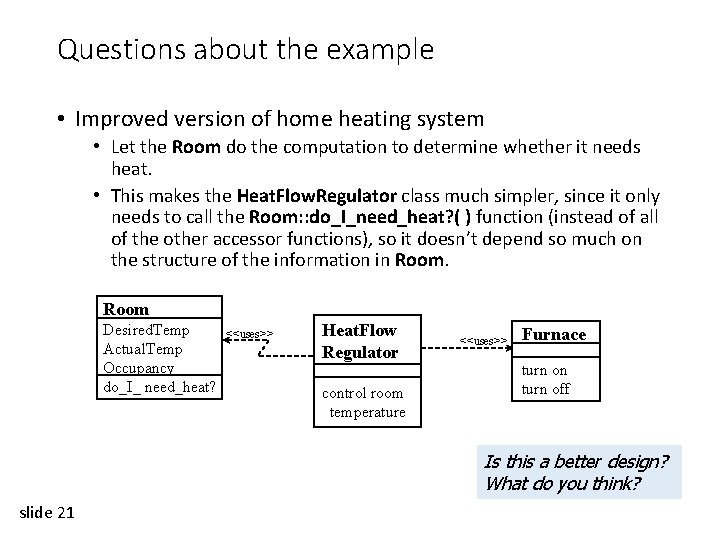
Questions about the example • Improved version of home heating system • Let the Room do the computation to determine whether it needs heat. • This makes the Heat. Flow. Regulator class much simpler, since it only needs to call the Room: : do_I_need_heat? ( ) function (instead of all of the other accessor functions), so it doesn’t depend so much on the structure of the information in Room Desired. Temp Actual. Temp Occupancy do_I_ need_heat? <<uses>> Heat. Flow Regulator control room temperature <<uses>> Furnace turn on turn off Is this a better design? What do you think? slide 21
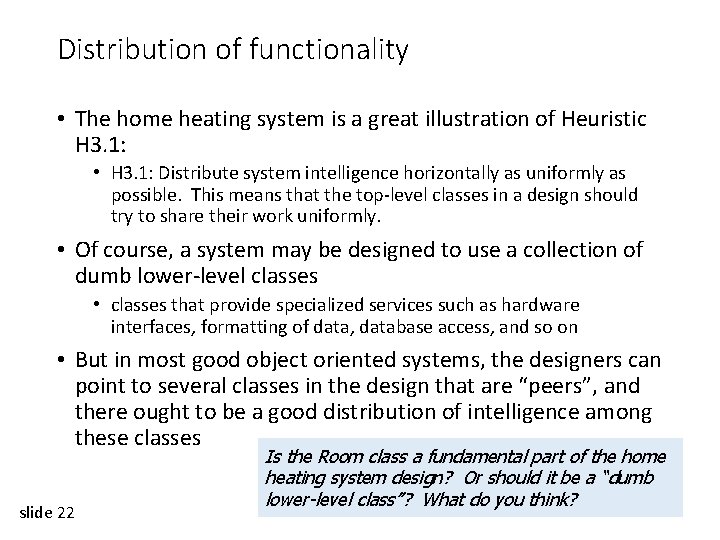
Distribution of functionality • The home heating system is a great illustration of Heuristic H 3. 1: • H 3. 1: Distribute system intelligence horizontally as uniformly as possible. This means that the top-level classes in a design should try to share their work uniformly. • Of course, a system may be designed to use a collection of dumb lower-level classes • classes that provide specialized services such as hardware interfaces, formatting of data, database access, and so on • But in most good object oriented systems, the designers can point to several classes in the design that are “peers”, and there ought to be a good distribution of intelligence among these classes slide 22 Is the Room class a fundamental part of the home heating system design? Or should it be a “dumb lower-level class”? What do you think?
What is a god class? • A “god class” indicates that there is a poor distribution of responsibility: • H 3. 2: no “god classes” • How can you tell if you have a god class? If a system has N classes, and you ask each developer which N-1 classes he or she would be willing to write, and if everyone avoids the same class - that’s a hint that you have a god class. Is a god class good or bad? Good for building the initial design quickly? Bad for long-term maintenance? Difficult to implement clean modifications and extensions? What do you think? slide 23
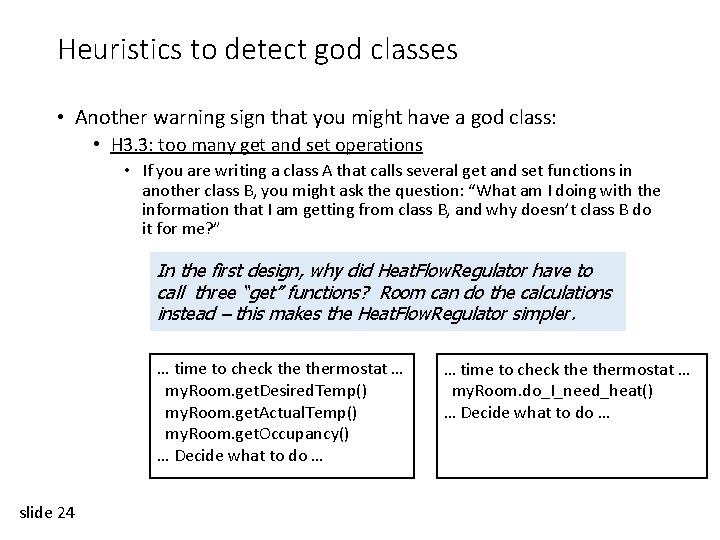
Heuristics to detect god classes • Another warning sign that you might have a god class: • H 3. 3: too many get and set operations • If you are writing a class A that calls several get and set functions in another class B, you might ask the question: “What am I doing with the information that I am getting from class B, and why doesn’t class B do it for me? ” In the first design, why did Heat. Flow. Regulator have to call three “get” functions? Room can do the calculations instead – this makes the Heat. Flow. Regulator simpler. … time to check thermostat … my. Room. get. Desired. Temp() my. Room. get. Actual. Temp() my. Room. get. Occupancy() … Decide what to do … slide 24 … time to check thermostat … my. Room. do_I_need_heat() … Decide what to do …
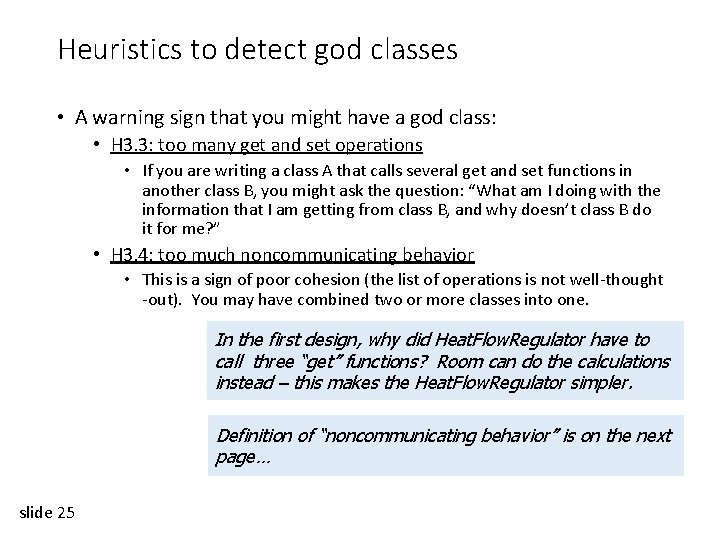
Heuristics to detect god classes • A warning sign that you might have a god class: • H 3. 3: too many get and set operations • If you are writing a class A that calls several get and set functions in another class B, you might ask the question: “What am I doing with the information that I am getting from class B, and why doesn’t class B do it for me? ” • H 3. 4: too much noncommunicating behavior • This is a sign of poor cohesion (the list of operations is not well-thought -out). You may have combined two or more classes into one. In the first design, why did Heat. Flow. Regulator have to call three “get” functions? Room can do the calculations instead – this makes the Heat. Flow. Regulator simpler. Definition of “noncommunicating behavior” is on the next page… slide 25
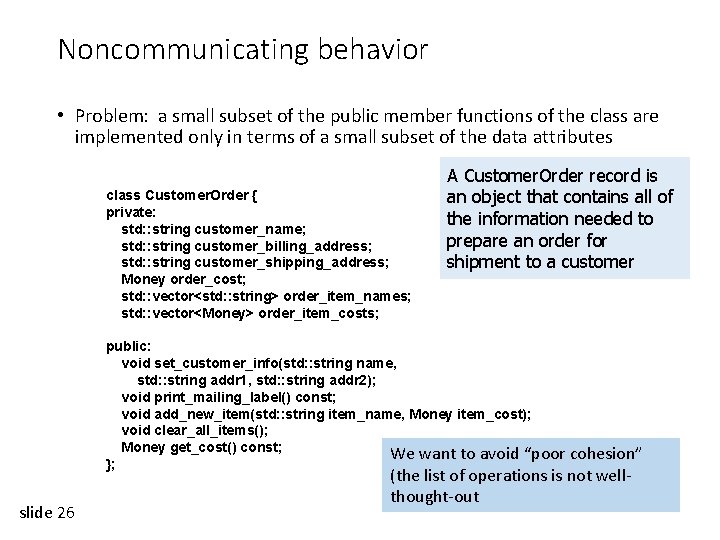
Noncommunicating behavior • Problem: a small subset of the public member functions of the class are implemented only in terms of a small subset of the data attributes class Customer. Order { private: std: : string customer_name; std: : string customer_billing_address; std: : string customer_shipping_address; Money order_cost; std: : vector<std: : string> order_item_names; std: : vector<Money> order_item_costs; A Customer. Order record is an object that contains all of the information needed to prepare an order for shipment to a customer public: void set_customer_info(std: : string name, std: : string addr 1, std: : string addr 2); void print_mailing_label() const; void add_new_item(std: : string item_name, Money item_cost); void clear_all_items(); Money get_cost() const; We want to avoid “poor cohesion” }; slide 26 (the list of operations is not wellthought-out
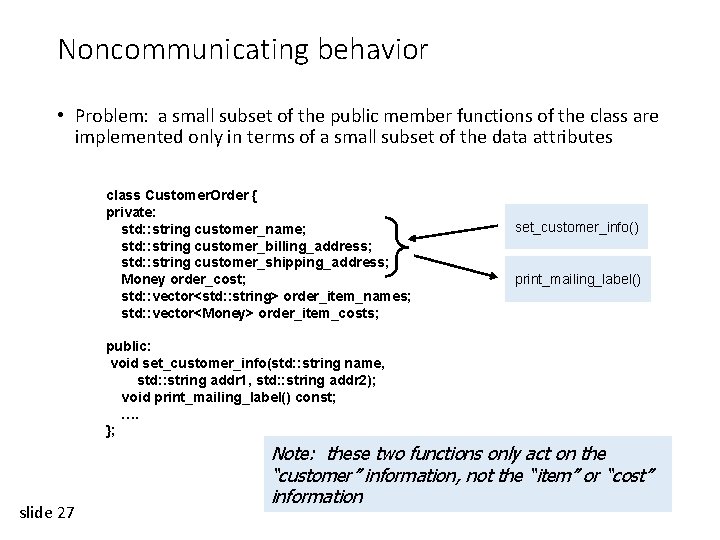
Noncommunicating behavior • Problem: a small subset of the public member functions of the class are implemented only in terms of a small subset of the data attributes class Customer. Order { private: std: : string customer_name; std: : string customer_billing_address; std: : string customer_shipping_address; Money order_cost; std: : vector<std: : string> order_item_names; std: : vector<Money> order_item_costs; set_customer_info() print_mailing_label() public: void set_customer_info(std: : string name, std: : string addr 1, std: : string addr 2); void print_mailing_label() const; …. }; slide 27 Note: these two functions only act on the “customer” information, not the “item” or “cost” information
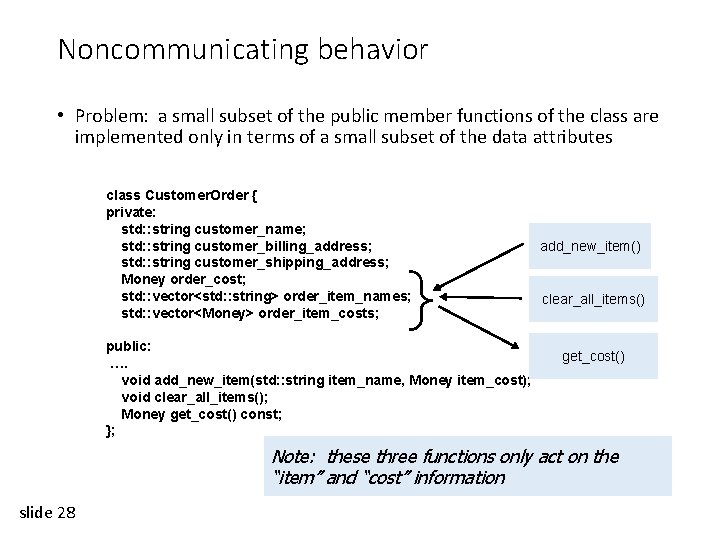
Noncommunicating behavior • Problem: a small subset of the public member functions of the class are implemented only in terms of a small subset of the data attributes class Customer. Order { private: std: : string customer_name; std: : string customer_billing_address; std: : string customer_shipping_address; Money order_cost; std: : vector<std: : string> order_item_names; std: : vector<Money> order_item_costs; public: …. void add_new_item(std: : string item_name, Money item_cost); void clear_all_items(); Money get_cost() const; }; add_new_item() clear_all_items() get_cost() Note: these three functions only act on the “item” and “cost” information slide 28
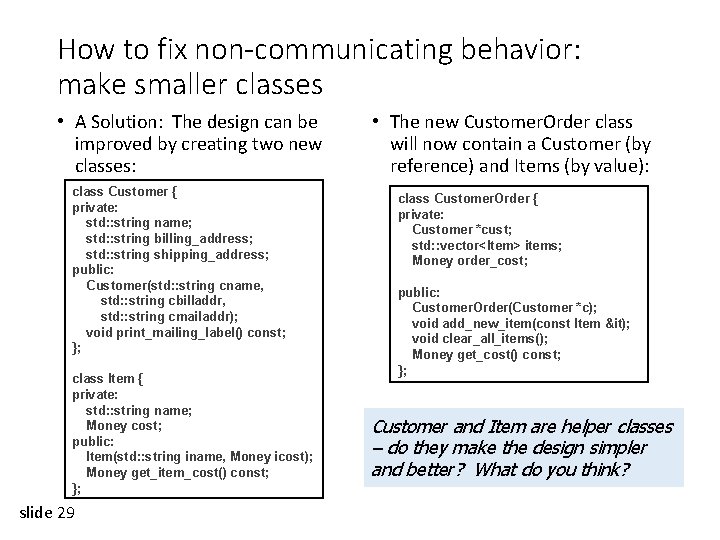
How to fix non-communicating behavior: make smaller classes • A Solution: The design can be improved by creating two new classes: class Customer { private: std: : string name; std: : string billing_address; std: : string shipping_address; public: Customer(std: : string cname, std: : string cbilladdr, std: : string cmailaddr); void print_mailing_label() const; }; class Item { private: std: : string name; Money cost; public: Item(std: : string iname, Money icost); Money get_item_cost() const; }; slide 29 • The new Customer. Order class will now contain a Customer (by reference) and Items (by value): class Customer. Order { private: Customer *cust; std: : vector<Item> items; Money order_cost; public: Customer. Order(Customer *c); void add_new_item(const Item &it); void clear_all_items(); Money get_cost() const; }; Customer and Item are helper classes – do they make the design simpler and better? What do you think?
When to violate the noncommunicating behavior heuristic • This is a heuristic – not a rule • Some classes just have a large number of attributes • but there are no logical classes that can be split off • Creating many small classes can create performance problems in some environments • for example, Java classes that need to be downloaded from the Web • When a designer decides to use a wrapper class approach, it is common to define a single class that describes a particular “interface” that communicates with other subsystems • this technique is commonly used with various forms of “component technology” slide 30
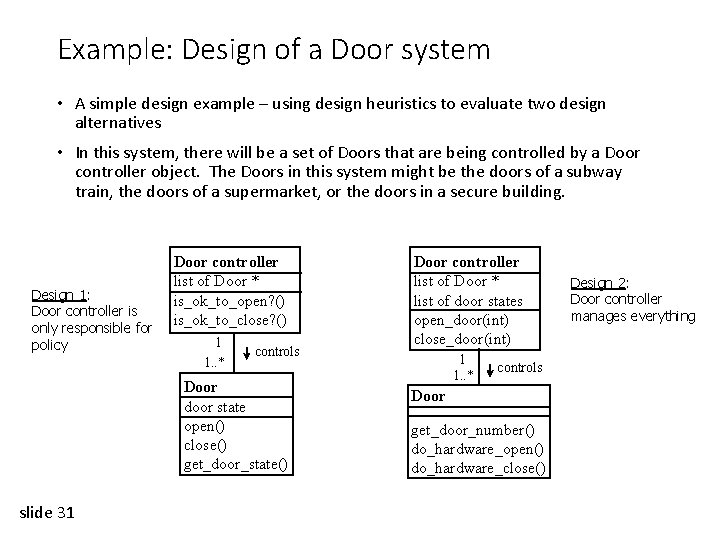
Example: Design of a Door system • A simple design example – using design heuristics to evaluate two design alternatives • In this system, there will be a set of Doors that are being controlled by a Door controller object. The Doors in this system might be the doors of a subway train, the doors of a supermarket, or the doors in a secure building. Design 1: Door controller is only responsible for policy Door controller list of Door * is_ok_to_open? () is_ok_to_close? () 1 1. . * controls Door door state open() close() get_door_state() slide 31 Door controller list of Door * list of door states open_door(int) close_door(int) 1 1. . * controls Door get_door_number() do_hardware_open() do_hardware_close() Design 2: Door controller manages everything
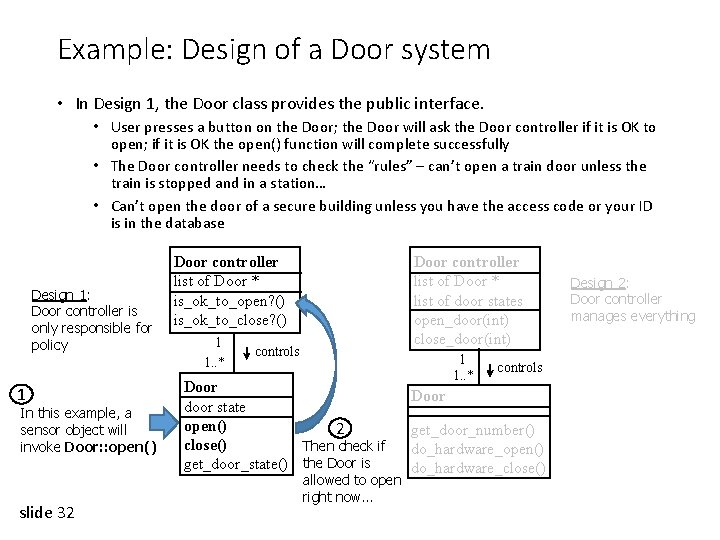
Example: Design of a Door system • In Design 1, the Door class provides the public interface. • User presses a button on the Door; the Door will ask the Door controller if it is OK to open; if it is OK the open() function will complete successfully • The Door controller needs to check the “rules” – can’t open a train door unless the train is stopped and in a station… • Can’t open the door of a secure building unless you have the access code or your ID is in the database Design 1: Door controller is only responsible for policy 1 In this example, a sensor object will invoke Door: : open() slide 32 Door controller list of Door * is_ok_to_open? () is_ok_to_close? () 1 1. . * Door controller list of Door * list of door states open_door(int) close_door(int) controls Door door state open() 2 close() Then check if get_door_state() the Door is allowed to open right now… 1 1. . * controls Door get_door_number() do_hardware_open() do_hardware_close() Design 2: Door controller manages everything
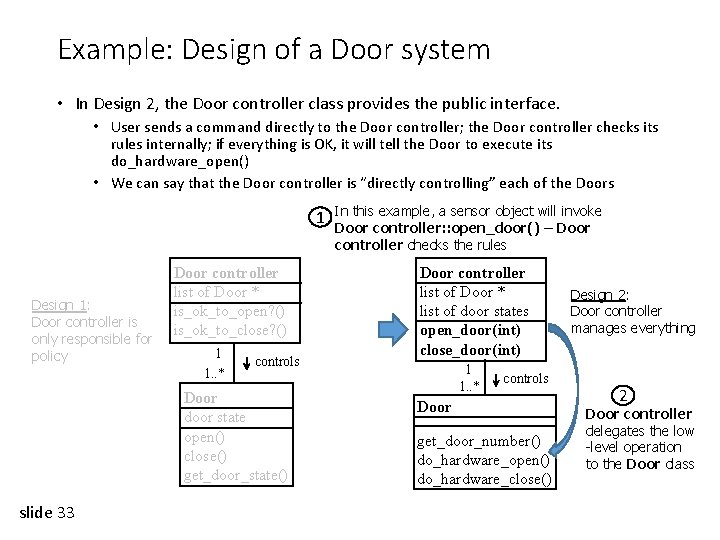
Example: Design of a Door system • In Design 2, the Door controller class provides the public interface. • User sends a command directly to the Door controller; the Door controller checks its rules internally; if everything is OK, it will tell the Door to execute its do_hardware_open() • We can say that the Door controller is “directly controlling” each of the Doors 1 Design 1: Door controller is only responsible for policy Door controller list of Door * is_ok_to_open? () is_ok_to_close? () 1 1. . * controls Door door state open() close() get_door_state() slide 33 In this example, a sensor object will invoke Door controller: : open_door() – Door controller checks the rules Door controller list of Door * list of door states open_door(int) close_door(int) 1 1. . * controls Door get_door_number() do_hardware_open() do_hardware_close() Design 2: Door controller manages everything 2 Door controller delegates the low -level operation to the Door class
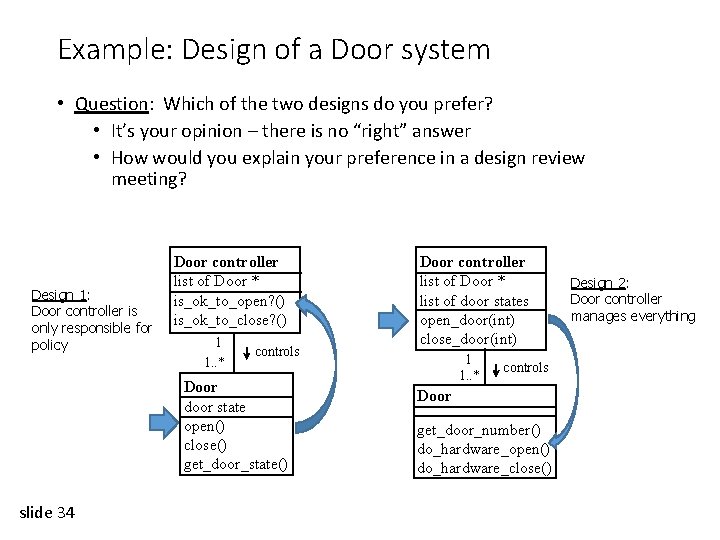
Example: Design of a Door system • Question: Which of the two designs do you prefer? • It’s your opinion – there is no “right” answer • How would you explain your preference in a design review meeting? Design 1: Door controller is only responsible for policy Door controller list of Door * is_ok_to_open? () is_ok_to_close? () 1 1. . * controls Door door state open() close() get_door_state() slide 34 Door controller list of Door * list of door states open_door(int) close_door(int) 1 1. . * controls Door get_door_number() do_hardware_open() do_hardware_close() Design 2: Door controller manages everything
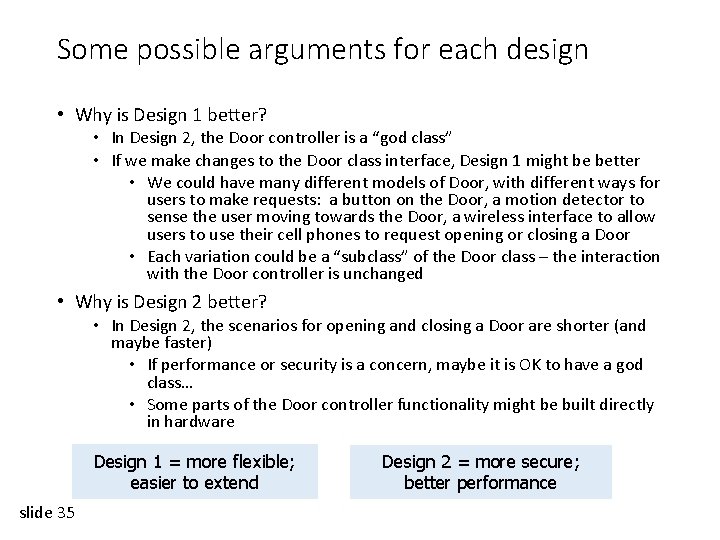
Some possible arguments for each design • Why is Design 1 better? • In Design 2, the Door controller is a “god class” • If we make changes to the Door class interface, Design 1 might be better • We could have many different models of Door, with different ways for users to make requests: a button on the Door, a motion detector to sense the user moving towards the Door, a wireless interface to allow users to use their cell phones to request opening or closing a Door • Each variation could be a “subclass” of the Door class – the interaction with the Door controller is unchanged • Why is Design 2 better? • In Design 2, the scenarios for opening and closing a Door are shorter (and maybe faster) • If performance or security is a concern, maybe it is OK to have a god class… • Some parts of the Door controller functionality might be built directly in hardware Design 1 = more flexible; easier to extend slide 35 Design 2 = more secure; better performance
Heuristics are a good way to discuss design alternatives • We had two possible design alternatives for the Door controller • In a design review, the participants need to talk about tradeoffs • When we see that our design has a god class, we might decide to change it – to keep the design flexible • On the other hand, if flexibility is less important than performance, we might choose the god class design – even though it violates one of the design heuristics • Design heuristics are not absolute rules: they are guidelines that help us think about design alternatives • The heuristics are sometimes violated in designs that are considered good slide 36
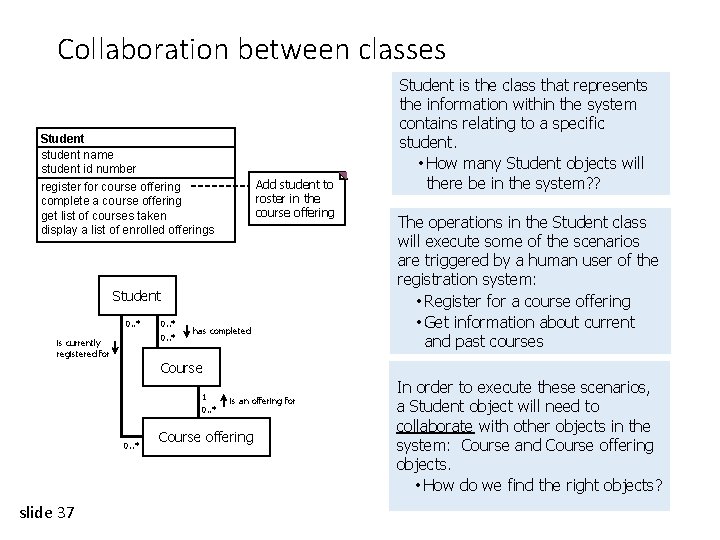
Collaboration between classes Student student name student id number register for course offering complete a course offering get list of courses taken display a list of enrolled offerings Add student to roster in the course offering Student 0. . * is currently registered for has completed The operations in the Student class will execute some of the scenarios are triggered by a human user of the registration system: • Register for a course offering • Get information about current and past courses Course 1 0. . * slide 37 Student is the class that represents the information within the system contains relating to a specific student. • How many Student objects will there be in the system? ? is an offering for Course offering In order to execute these scenarios, a Student object will need to collaborate with other objects in the system: Course and Course offering objects. • How do we find the right objects?
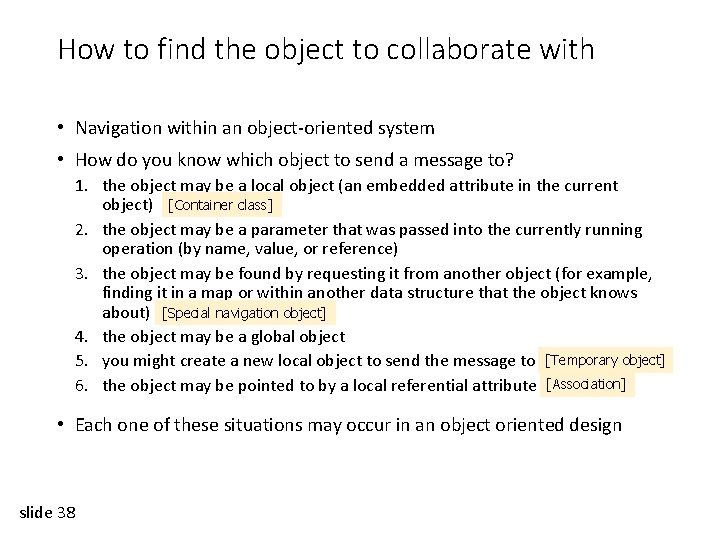
How to find the object to collaborate with • Navigation within an object-oriented system • How do you know which object to send a message to? 1. the object may be a local object (an embedded attribute in the current object) [Container class] 2. the object may be a parameter that was passed into the currently running operation (by name, value, or reference) 3. the object may be found by requesting it from another object (for example, finding it in a map or within another data structure that the object knows about) [Special navigation object] 4. the object may be a global object 5. you might create a new local object to send the message to [Temporary object] 6. the object may be pointed to by a local referential attribute [Association] • Each one of these situations may occur in an object oriented design slide 38
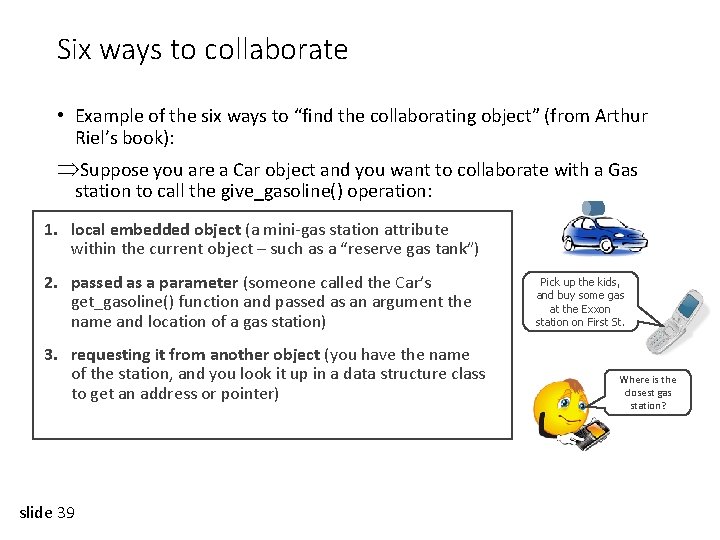
Six ways to collaborate • Example of the six ways to “find the collaborating object” (from Arthur Riel’s book): ÞSuppose you are a Car object and you want to collaborate with a Gas station to call the give_gasoline() operation: 1. local embedded object (a mini-gas station attribute within the current object – such as a “reserve gas tank”) 2. passed as a parameter (someone called the Car’s get_gasoline() function and passed as an argument the name and location of a gas station) 3. requesting it from another object (you have the name of the station, and you look it up in a data structure class to get an address or pointer) slide 39 Pick up the kids, and buy some gas at the Exxon station on First St. Where is the closest gas station?
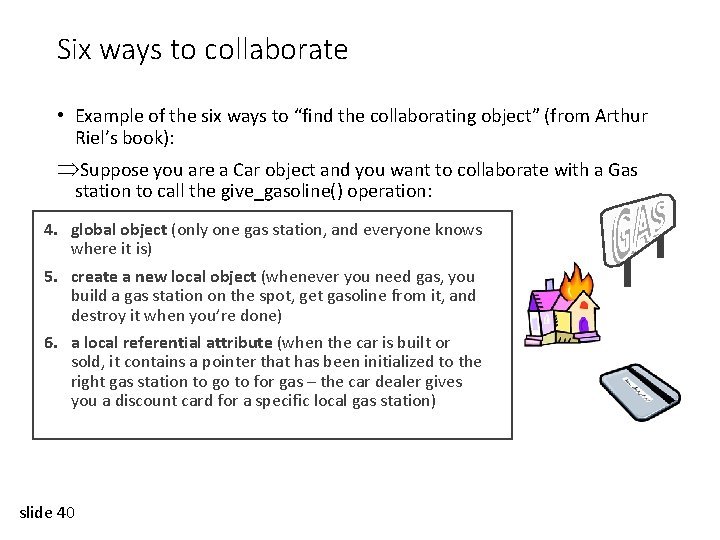
Six ways to collaborate • Example of the six ways to “find the collaborating object” (from Arthur Riel’s book): ÞSuppose you are a Car object and you want to collaborate with a Gas station to call the give_gasoline() operation: 4. global object (only one gas station, and everyone knows where it is) 5. create a new local object (whenever you need gas, you build a gas station on the spot, get gasoline from it, and destroy it when you’re done) 6. a local referential attribute (when the car is built or sold, it contains a pointer that has been initialized to the right gas station to go to for gas – the car dealer gives you a discount card for a specific local gas station) slide 40
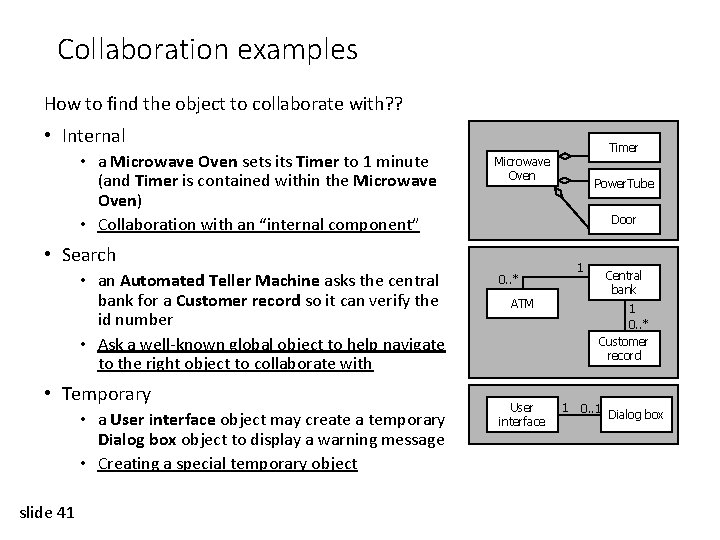
Collaboration examples How to find the object to collaborate with? ? • Internal • a Microwave Oven sets its Timer to 1 minute (and Timer is contained within the Microwave Oven) • Collaboration with an “internal component” Timer Microwave Oven Power. Tube Door • Search • an Automated Teller Machine asks the central bank for a Customer record so it can verify the id number • Ask a well-known global object to help navigate to the right object to collaborate with • Temporary • a User interface object may create a temporary Dialog box object to display a warning message • Creating a special temporary object slide 41 1 0. . * ATM User interface Central bank 1 0. . * Customer record 1 0. . 1 Dialog box
Some collaboration heuristics These heuristics are from Chapter 4 of Arthur Riel’s book: • H 4. 1: Minimize the number of classes with which another class collaborates. • H 4. 2: Minimize the number of message sends between a class and its collaborator. • H 4. 3: Minimize the amount of collaboration between a class and its collaborator, that is, the number of different messages sent. • H 4. 4: Minimize the fanout of a class, that is, the product of the number of messages defined by the class and the messages they send. Riel makes two observations about this set of heuristics: • Heuristic H 4. 1 is the most important of the four: the main factor in the “complexity” of a class is the number of other classes it needs to use • It is silly to set absolute limits for each of these metrics: it is better to exercising good judgment rather than blindly following an absolute rule slide 42
Controlling complexity • We use these four heuristics to help make the design simpler… • These four heuristics might be violated when a designer: • creates mega-classes with large numbers of unrelated responsibilities • creates a behavioral god class, which requires other classes to abdicate their responsibilities to the central class • breaks up a class too far, so that many of the algorithms require continually requesting information from another object • The designer is trying to create a set of cooperating classes, but the set of services offered by each class may be poorly coordinated with the other classes in the design. slide 43
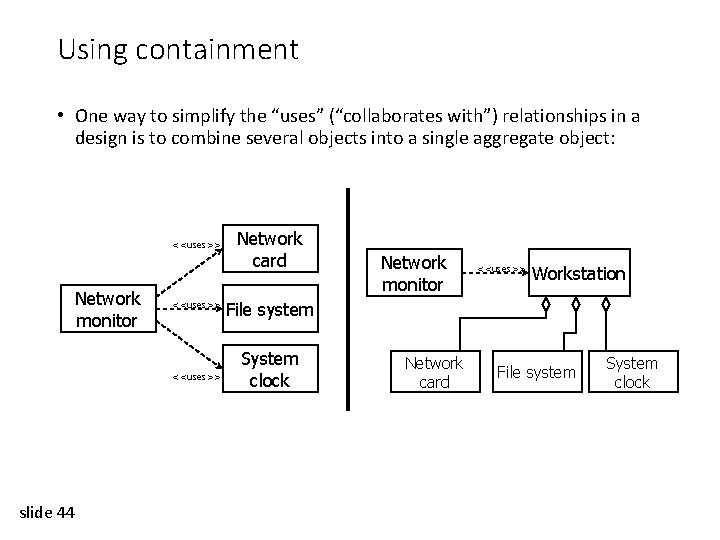
Using containment • One way to simplify the “uses” (“collaborates with”) relationships in a design is to combine several objects into a single aggregate object: <<uses>> Network monitor <<uses>> slide 44 Network card Network monitor <<uses>> Workstation File system System clock Network card File system System clock
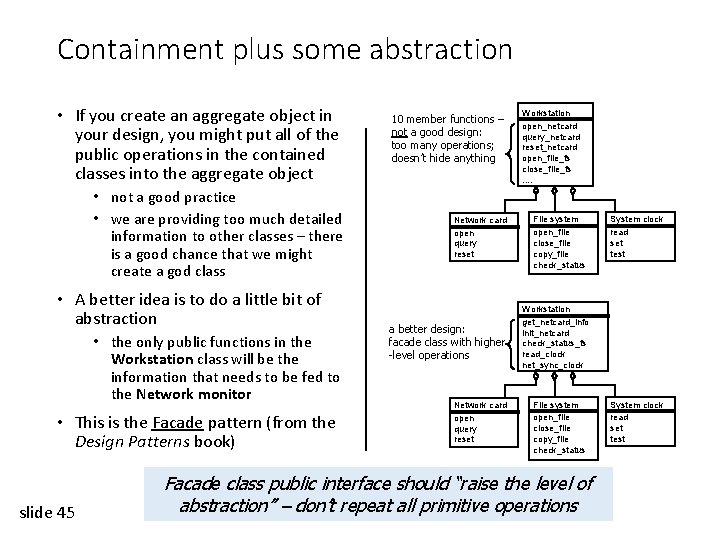
Containment plus some abstraction • If you create an aggregate object in your design, you might put all of the public operations in the contained classes into the aggregate object • not a good practice • we are providing too much detailed information to other classes – there is a good chance that we might create a god class • A better idea is to do a little bit of abstraction • the only public functions in the Workstation class will be the information that needs to be fed to the Network monitor • This is the Facade pattern (from the Design Patterns book) slide 45 10 member functions – not a good design: too many operations; doesn’t hide anything Network card open query reset a better design: facade class with higher -level operations Network card open query reset Workstation open_netcard query_netcard reset_netcard open_file_fs close_file_fs. . File system open_file close_file copy_file check_status System clock read set test Workstation get_netcard_info init_netcard check_status_fs read_clock net_sync_clock File system open_file close_file copy_file check_status Facade class public interface should “raise the level of abstraction” – don’t repeat all primitive operations System clock read set test
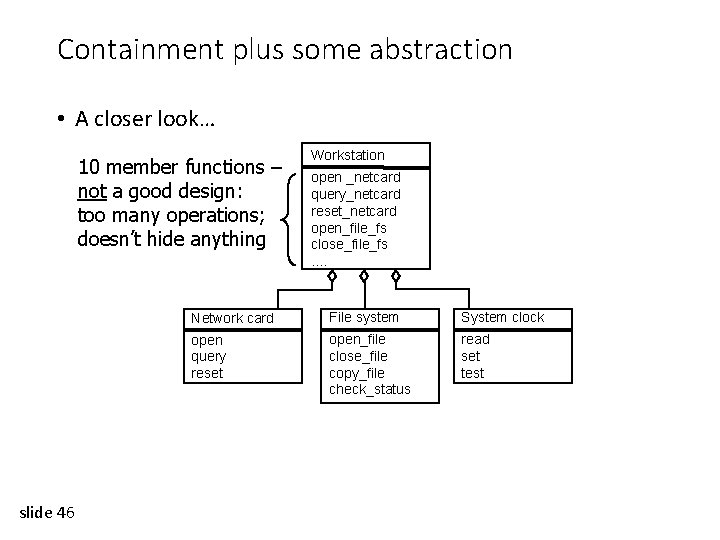
Containment plus some abstraction • A closer look… 10 member functions – not a good design: too many operations; doesn’t hide anything slide 46 Workstation open _netcard query_netcard reset_netcard open_file_fs close_file_fs. . Network card File system System clock open query reset open_file close_file copy_file check_status read set test
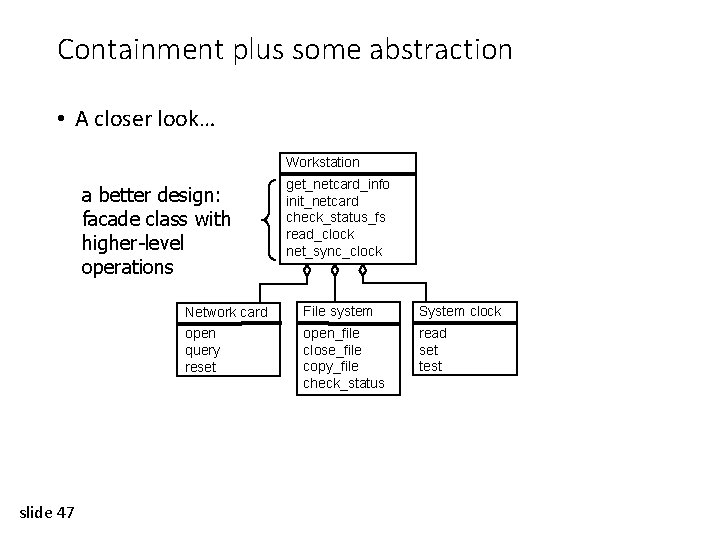
Containment plus some abstraction • A closer look… Workstation a better design: facade class with higher-level operations slide 47 get_netcard_info init_netcard check_status_fs read_clock net_sync_clock Network card File system System clock open query reset open_file close_file copy_file check_status read set test
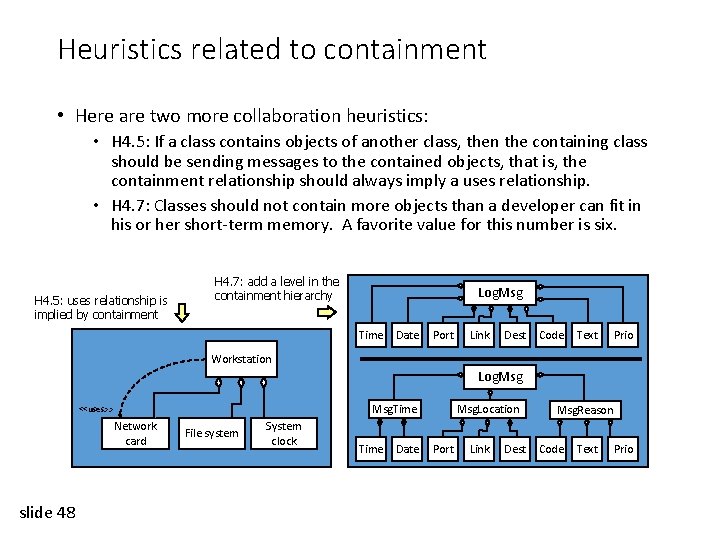
Heuristics related to containment • Here are two more collaboration heuristics: • H 4. 5: If a class contains objects of another class, then the containing class should be sending messages to the contained objects, that is, the containment relationship should always imply a uses relationship. • H 4. 7: Classes should not contain more objects than a developer can fit in his or her short-term memory. A favorite value for this number is six. H 4. 5: uses relationship is implied by containment H 4. 7: add a level in the containment hierarchy Log. Msg Time Date Port Link Dest Code Text Prio Workstation Log. Msg. Time <<uses>> Network card slide 48 File system System clock Time Date Msg. Location Port Link Dest Msg. Reason Code Text Prio
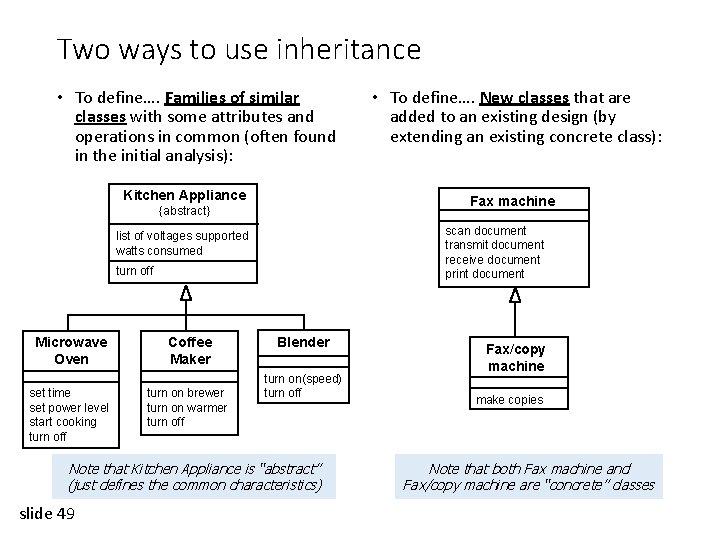
Two ways to use inheritance • To define…. Families of similar classes with some attributes and operations in common (often found in the initial analysis): Kitchen Appliance Fax machine {abstract} scan document transmit document receive document print document list of voltages supported watts consumed turn off Microwave Oven set time set power level start cooking turn off Coffee Maker turn on brewer turn on warmer turn off Blender turn on(speed) turn off Note that Kitchen Appliance is “abstract” (just defines the common characteristics) slide 49 • To define…. New classes that are added to an existing design (by extending an existing concrete class): Fax/copy machine make copies Note that both Fax machine and Fax/copy machine are “concrete” classes
The most important inheritance heuristic • The first heuristic in Chapter 5 of Arthur Riel’s book: • H 5. 1: Inheritance should be used only to model a specialization hierarchy. • H 5. 1 is a restatement of the Liskov Substitution Principle • Liskov Substitution Principle: Whenever you define a subtype, you should be able to safely substitute an object of the supertype with an object of the subtype. • In other words, although derived classes might have “extra” behavior, they must also implement the full set of base class behaviors. • This principle is sometime called the “is-a” rule. . . • This is a very important heuristic, because it affects other software designers that may want to add to an existing inheritance hierarchy • If you violate the “is-a” rule, existing code might be broken by the addition of new subclasses Barbara Liskov, computer science professor at MIT, inventor of the CLU programming language (with support for “data abstraction” and subtyping) slide 50
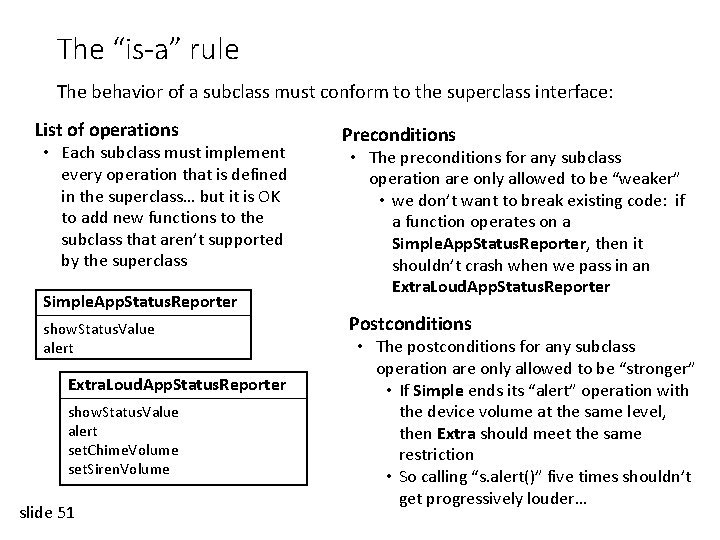
The “is-a” rule The behavior of a subclass must conform to the superclass interface: List of operations • Each subclass must implement every operation that is defined in the superclass… but it is OK to add new functions to the subclass that aren’t supported by the superclass Simple. App. Status. Reporter show. Status. Value alert Extra. Loud. App. Status. Reporter show. Status. Value alert set. Chime. Volume set. Siren. Volume slide 51 Preconditions • The preconditions for any subclass operation are only allowed to be “weaker” • we don’t want to break existing code: if a function operates on a Simple. App. Status. Reporter, then it shouldn’t crash when we pass in an Extra. Loud. App. Status. Reporter Postconditions • The postconditions for any subclass operation are only allowed to be “stronger” • If Simple ends its “alert” operation with the device volume at the same level, then Extra should meet the same restriction • So calling “s. alert()” five times shouldn’t get progressively louder…
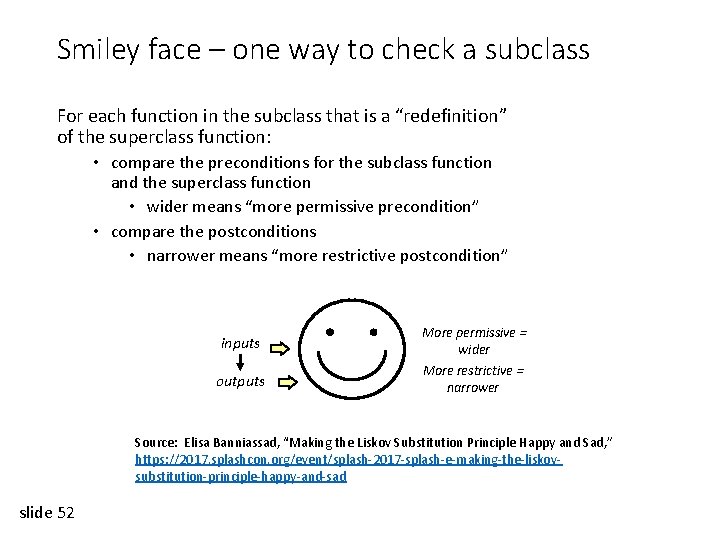
Smiley face – one way to check a subclass For each function in the subclass that is a “redefinition” of the superclass function: • compare the preconditions for the subclass function and the superclass function • wider means “more permissive precondition” • compare the postconditions • narrower means “more restrictive postcondition” inputs More permissive = wider outputs More restrictive = narrower Source: Elisa Banniassad, “Making the Liskov Substitution Principle Happy and Sad, ” https: //2017. splashcon. org/event/splash-2017 -splash-e-making-the-liskovsubstitution-principle-happy-and-sad slide 52
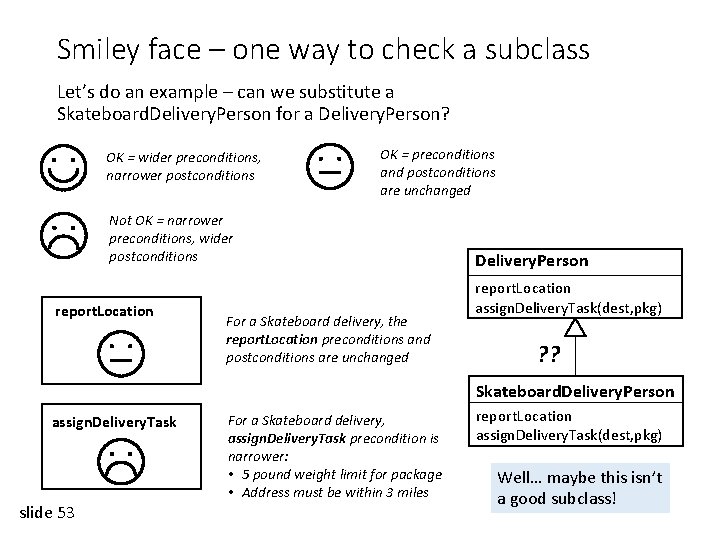
Smiley face – one way to check a subclass Let’s do an example – can we substitute a Skateboard. Delivery. Person for a Delivery. Person? OK = wider preconditions, narrower postconditions OK = preconditions and postconditions are unchanged Not OK = narrower preconditions, wider postconditions report. Location For a Skateboard delivery, the report. Location preconditions and postconditions are unchanged Delivery. Person report. Location assign. Delivery. Task(dest, pkg) ? ? Skateboard. Delivery. Person assign. Delivery. Task slide 53 For a Skateboard delivery, assign. Delivery. Task precondition is narrower: • 5 pound weight limit for package • Address must be within 3 miles report. Location assign. Delivery. Task(dest, pkg) Well… maybe this isn’t a good subclass!
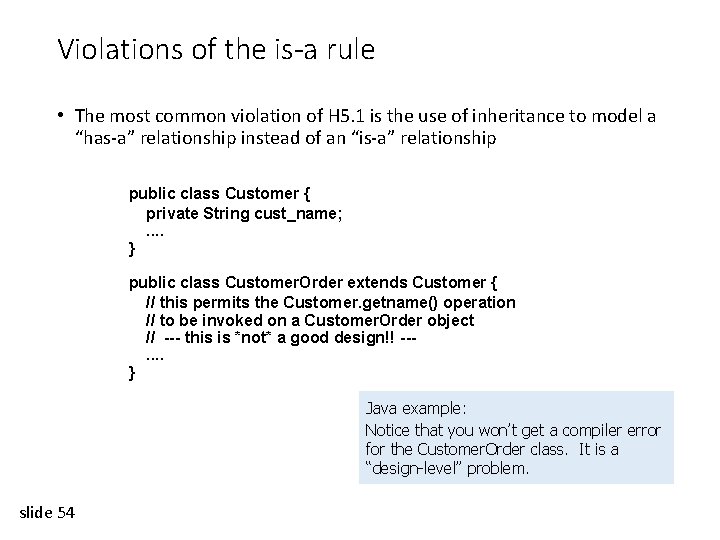
Violations of the is-a rule • The most common violation of H 5. 1 is the use of inheritance to model a “has-a” relationship instead of an “is-a” relationship public class Customer { private String cust_name; . . } public class Customer. Order extends Customer { // this permits the Customer. getname() operation // to be invoked on a Customer. Order object // --- this is *not* a good design!! --. . } Java example: Notice that you won’t get a compiler error for the Customer. Order class. It is a “design-level” problem. slide 54
Complexity and inheritance depth • Some thoughts on inheritance depth: • H 5. 4: In theory, inheritance hierarchies should be deep – the deeper the better. • H 5. 5: In practice, inheritance hierarchies should be no deeper than an average person can keep in his or her short-term memory. A popular value for this depth is six. • This isn’t an absolute rule: the warning flags should go up at six… Arthur Riel’s explanation for Heuristic 5. 5 (page 84): “Developers get lost in the levels if the hierarchy is too deep. This problem can be partly alleviated with support from tools (tools that let you see the entire public interface from a class, including inherited operations). ” The problem with deeply-nested class hierarchies: • there can be a big semantic difference between objects at different levels of the tree • subclasses may have special internal states and complicated rules slide 55
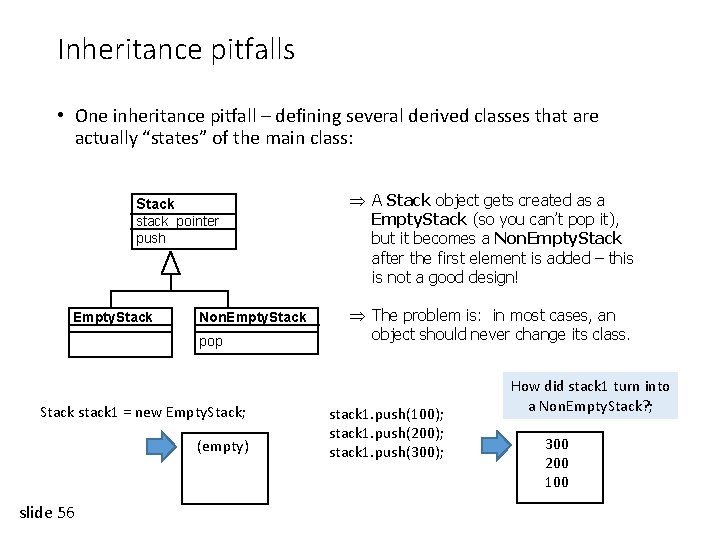
Inheritance pitfalls • One inheritance pitfall – defining several derived classes that are actually “states” of the main class: Stack stack_pointer push Empty. Stack Non. Empty. Stack pop Stack stack 1 = new Empty. Stack; (empty) slide 56 Þ A Stack object gets created as a Empty. Stack (so you can’t pop it), but it becomes a Non. Empty. Stack after the first element is added – this is not a good design! Þ The problem is: in most cases, an object should never change its class. stack 1. push(100); stack 1. push(200); stack 1. push(300); How did stack 1 turn into a Non. Empty. Stack? ; 300 200 100
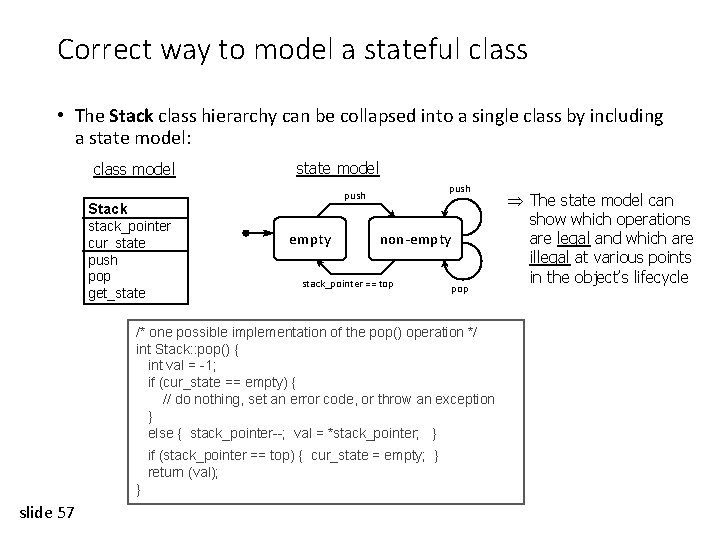
Correct way to model a stateful class • The Stack class hierarchy can be collapsed into a single class by including a state model: class model state model push Stack stack_pointer cur_state push pop get_state empty non-empty stack_pointer == top pop /* one possible implementation of the pop() operation */ int Stack: : pop() { int val = -1; if (cur_state == empty) { // do nothing, set an error code, or throw an exception } else { stack_pointer--; val = *stack_pointer; } if (stack_pointer == top) { cur_state = empty; } return (val); } slide 57 Þ The state model can show which operations are legal and which are illegal at various points in the object’s lifecycle
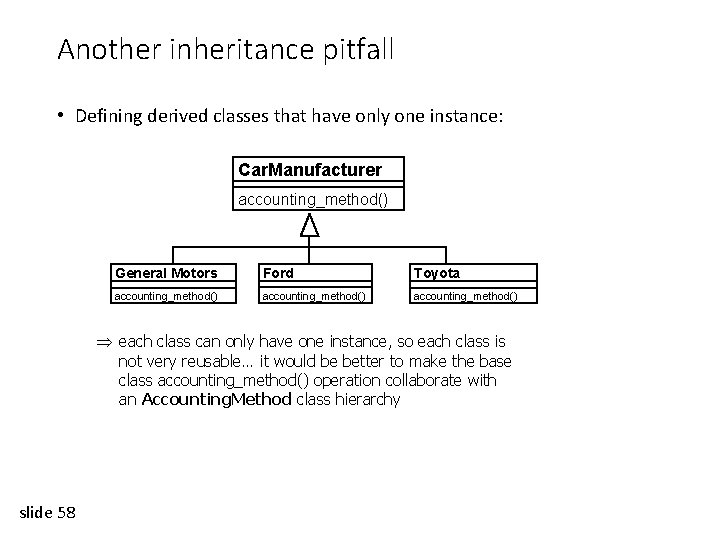
Another inheritance pitfall • Defining derived classes that have only one instance: Car. Manufacturer accounting_method() General Motors Ford Toyota accounting_method() Þ each class can only have one instance, so each class is not very reusable… it would be better to make the base class accounting_method() operation collaborate with an Accounting. Method class hierarchy slide 58
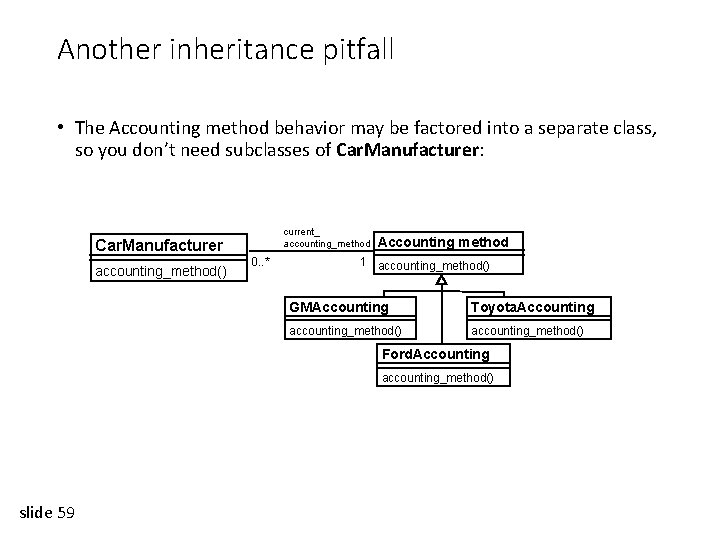
Another inheritance pitfall • The Accounting method behavior may be factored into a separate class, so you don’t need subclasses of Car. Manufacturer: current_ accounting_method Car. Manufacturer accounting_method() 0. . * Accounting method 1 accounting_method() GMAccounting Toyota. Accounting accounting_method() Ford. Accounting accounting_method() slide 59
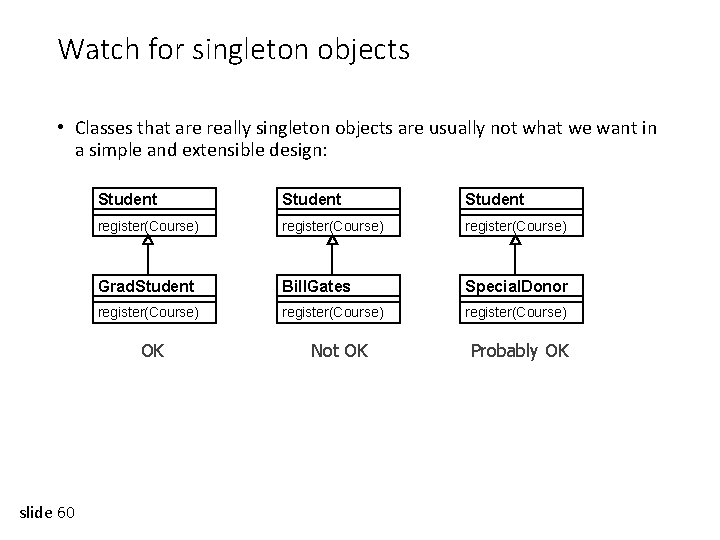
Watch for singleton objects • Classes that are really singleton objects are usually not what we want in a simple and extensible design: Student register(Course) Grad. Student Bill. Gates Special. Donor register(Course) OK slide 60 Not OK Probably OK
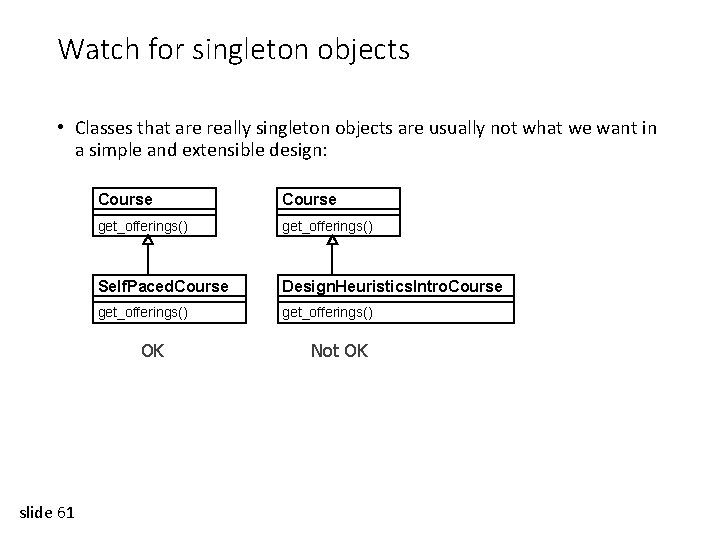
Watch for singleton objects • Classes that are really singleton objects are usually not what we want in a simple and extensible design: Course get_offerings() Self. Paced. Course Design. Heuristics. Intro. Course get_offerings() OK slide 61 Not OK
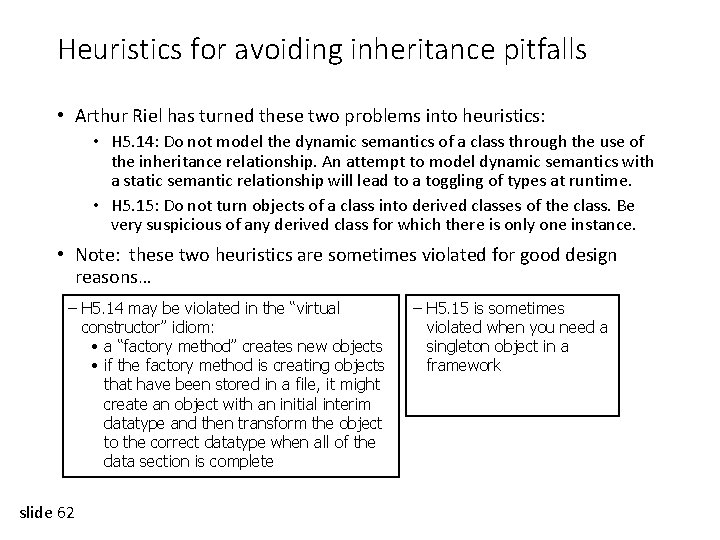
Heuristics for avoiding inheritance pitfalls • Arthur Riel has turned these two problems into heuristics: • H 5. 14: Do not model the dynamic semantics of a class through the use of the inheritance relationship. An attempt to model dynamic semantics with a static semantic relationship will lead to a toggling of types at runtime. • H 5. 15: Do not turn objects of a class into derived classes of the class. Be very suspicious of any derived class for which there is only one instance. • Note: these two heuristics are sometimes violated for good design reasons… – H 5. 14 may be violated in the “virtual constructor” idiom: • a “factory method” creates new objects • if the factory method is creating objects that have been stored in a file, it might create an object with an initial interim datatype and then transform the object to the correct datatype when all of the data section is complete slide 62 – H 5. 15 is sometimes violated when you need a singleton object in a framework
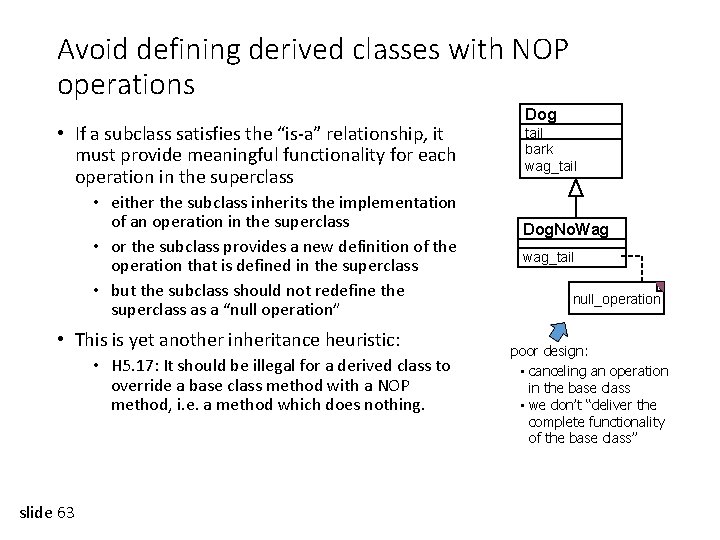
Avoid defining derived classes with NOP operations • If a subclass satisfies the “is-a” relationship, it must provide meaningful functionality for each operation in the superclass • either the subclass inherits the implementation of an operation in the superclass • or the subclass provides a new definition of the operation that is defined in the superclass • but the subclass should not redefine the superclass as a “null operation” • This is yet another inheritance heuristic: • H 5. 17: It should be illegal for a derived class to override a base class method with a NOP method, i. e. a method which does nothing. slide 63 Dog tail bark wag_tail Dog. No. Wag wag_tail null_operation poor design: • canceling an operation in the base class • we don’t “deliver the complete functionality of the base class”
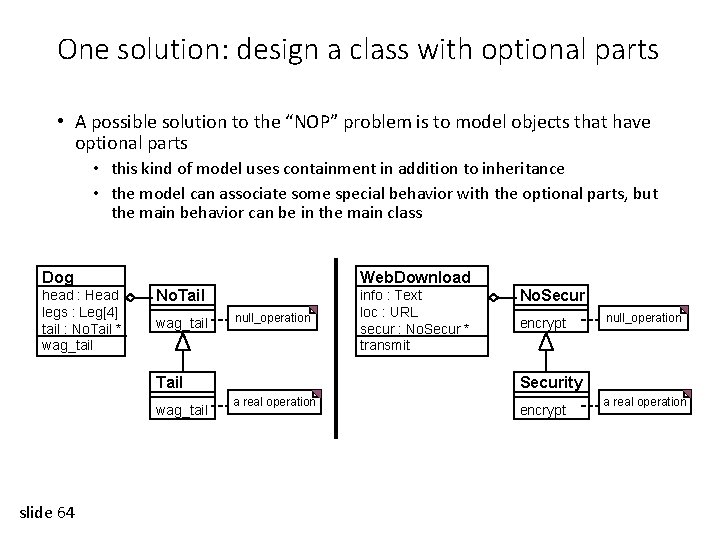
One solution: design a class with optional parts • A possible solution to the “NOP” problem is to model objects that have optional parts • this kind of model uses containment in addition to inheritance • the model can associate some special behavior with the optional parts, but the main behavior can be in the main class Dog head : Head legs : Leg[4] tail : No. Tail * wag_tail Web. Download No. Tail wag_tail null_operation slide 64 No. Secur encrypt null_operation Security Tail wag_tail info : Text loc : URL secur : No. Secur * transmit a real operation encrypt a real operation
Summary • What have we learned? How are we going to change the way we design and implement our software? • C++ and Java programming guidelines are OK, but they are not enough to assure software quality • it is easy to write superficially object oriented software • but we need to apply some of the design heuristics • The main pitfalls to watch for are: • god classes: classes that steal all of the decision-making ability of the classes around them • combining several classes into one: look for non-communicating behavior and find opportunities to make more cohesive classes • complex collaborations: breaking up the responsibilities too far can create a maintenance headache • improper inheritance: violations of the “is-a” rule slide 65
References The book: • Object Oriented Design Heuristics by Arthur Riel (Addison-Wesley, 1996) Top 20 heuristics: • http: //manclswx. com/talks/top_heuristics. html Vince Huston – listing of Arthur Riel’s heuristics: • http: //www. vincehuston. org/ood/oo_design_heuristics. html Design Principles (Bob Martin) • http: //manclswx. com/talks/Principles_and_Patterns. pdf http: //manclswx. com/talks - talks on legacy software, design patterns, technical debt, and design heuristics slide 66 Last modified: March 20, 2019
- Slides: 66