
Object Oriented Analysis and Design Using the UML
Object Oriented Analysis and Design Using the UML Analysis and Design Overview OOAD Using the UML - Analysis and Design Overview, v 4. 2 Copyright Ó 1998 -1999 Rational Software, all rights reserved 1
Objectives: Analysis and Design Overview w Introduce the analysis and design process, w Understand the difference between analysis and design w Note that the details of each of the Analysis and Design activities will be covered later. w Present a context for the detailed analysis and design activities. OOAD Using the UML - Analysis and Design Overview, v 4. 2 Copyright Ó 1998 -1999 Rational Software, all rights reserved 2
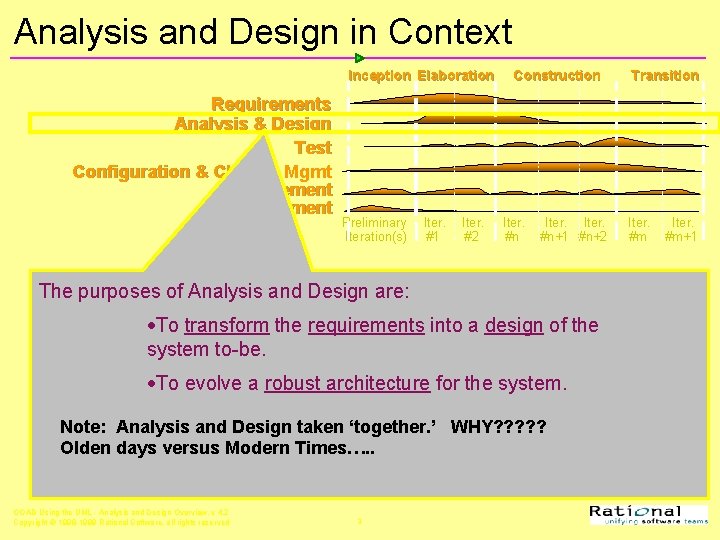
Analysis and Design in Context Inception Elaboration Requirements Analysis & Design Test Configuration & Change Mgmt Management Environment Preliminary Iteration(s) Iter. #1 Iter. #2 Construction Iter. #n+1 #n+2 The purposes of Analysis and Design are: ·To transform the requirements into a design of the system to-be. ·To evolve a robust architecture for the system. Note: Analysis and Design taken ‘together. ’ WHY? ? ? Olden days versus Modern Times…. . OOAD Using the UML - Analysis and Design Overview, v 4. 2 Copyright Ó 1998 -1999 Rational Software, all rights reserved 3 Transition Iter. #m+1
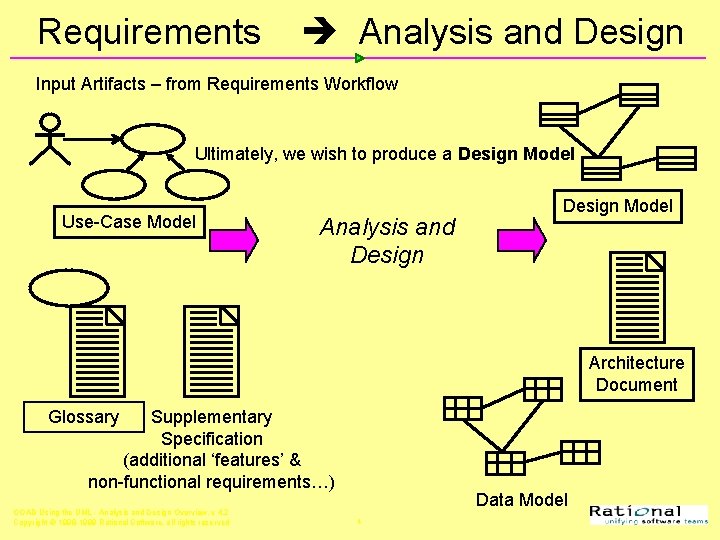
Requirements Analysis and Design Input Artifacts – from Requirements Workflow Ultimately, we wish to produce a Design Model Use-Case Model Analysis and Design Model Architecture Document Glossary Supplementary Specification (additional ‘features’ & non-functional requirements…) OOAD Using the UML - Analysis and Design Overview, v 4. 2 Copyright Ó 1998 -1999 Rational Software, all rights reserved Data Model 4
Analysis and Design Overview (continued) w Design model is an abstraction of source code and serves as the blue print for Construction. § Design Model consists of Design Classes structured into Design packages § Design Model also contains descriptions as to how objects of these design classes interact to perform Use Cases (Use Case Realizations) § The Use Case Realizations are: • Class diagrams and • Interaction Diagrams OOAD Using the UML - Analysis and Design Overview, v 4. 2 Copyright Ó 1998 -1999 Rational Software, all rights reserved 5
Analysis and Design Overview (continued) w Design activities are centered around the notion of an architecture. § Production and validation of this architecture is the main focus of early design iterations. § Architectural design takes place during Elaboration. w Architecture is represented by a number of architectural views that capture the major structural design decisions. w Architectural views are the abstractions or simplifications of the entire design, in which important characteristics are made more visible by leaving details aside. OOAD Using the UML - Analysis and Design Overview, v 4. 2 Copyright Ó 1998 -1999 Rational Software, all rights reserved 6
Analysis and Design Overview (continued) w We will create an Analysis Model as the first part of Analysis and Design. § We create Analysis Classes from Use Cases and other sources of requirements (Vision, Domain Model, …) w Our Design Model will then take the artifacts from Analysis Modeling (analysis classes) and create our Use Case Realizations: § Static View: Design classes, and § Dynamic View: showing how objects collaborate in ‘realizing’ each flow in a use case. OOAD Using the UML - Analysis and Design Overview, v 4. 2 Copyright Ó 1998 -1999 Rational Software, all rights reserved 7
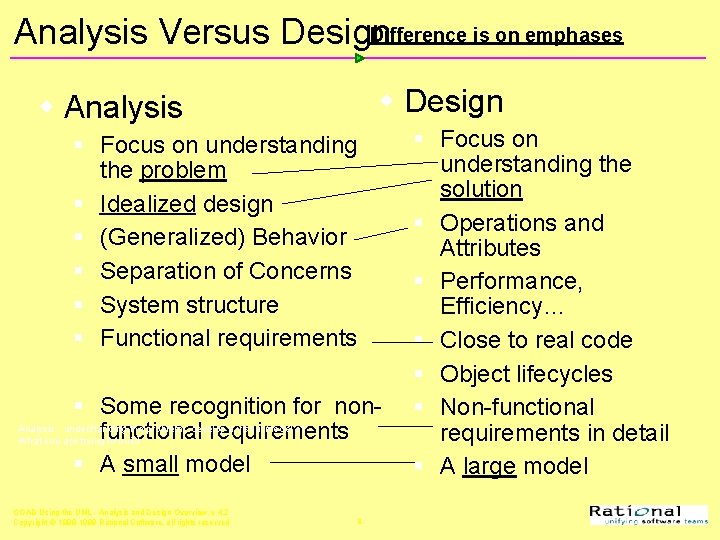
Difference is on emphases Analysis Versus Design w Analysis § Focus on understanding the problem § Idealized design § (Generalized) Behavior § Separation of Concerns § System structure § Functional requirements § Some recognition for non. Analysis: understanding the problem; develop a visual model of functional requirements What you are trying to build § A small model OOAD Using the UML - Analysis and Design Overview, v 4. 2 Copyright Ó 1998 -1999 Rational Software, all rights reserved 8 § Focus on understanding the solution § Operations and Attributes § Performance, Efficiency… § Close to real code § Object lifecycles § Non-functional requirements in detail § A large model
Goal of Analysis w Understand the problem; try to build a visual model of what you are trying to do independent of implementation or technology concerns. w Focus on translating the functional requirements into software concepts, abstractions Note: Nothing in Use Cases says ‘Objects. ’ w Get rough cut at objects that from our system but focusing on behavior and separation of Concerns… w Some authors include an Analysis Model here – w I consider analysis modeling as the prelude to architectural design. § § Sometimes considered first part of Design; Sometimes merely considered part of Design itself. In some circles, there is ‘only’ Requirements and then Design… Many ‘organizations’ tailor activities to their own ‘interpretations. ’ OOAD Using the UML - Analysis and Design Overview, v 4. 2 Copyright Ó 1998 -1999 Rational Software, all rights reserved 9
Goal of Design w Refine the Analysis Model with goal to creating a Design Model that will facilitate our moving “quickly and seamlessly” into more detailed design and implementation. w (Morph Analysis Classes into Design ‘components, ’ specific classes or other…) w Note that design model elements are abstractions of code / implementation. w Design Model constitutes the ‘Solution Space’ OOAD Using the UML - Analysis and Design Overview, v 4. 2 Copyright Ó 1998 -1999 Rational Software, all rights reserved 10
Use Case Realization w A Use Case Realization describes how a particular use case is implemented in the design model in terms of collaborating objects. § In the UP, each use case has a use case realization!! § They are one-to-one. w A Use-Case Realization maps use cases from the use-case model to design model in terms of classes and other related design entities and relationships. w A Use-Case Realization specifies what software classes must be built, how they collaborate (relationships, dependencies…), and the messages passed between objects necessary to implement each use case § Use Case Realizations have a static component and a dynamic component. OOAD Using the UML - Analysis and Design Overview, v 4. 2 Copyright Ó 1998 -1999 Rational Software, all rights reserved 11
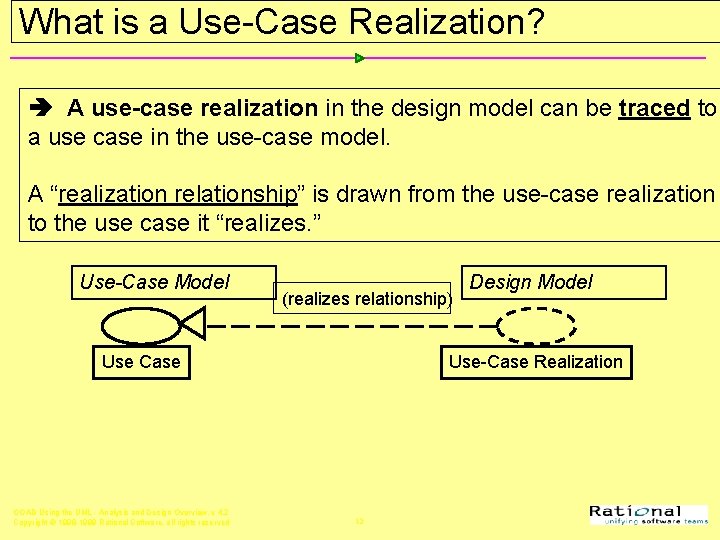
What is a Use-Case Realization? A use-case realization in the design model can be traced to a use case in the use-case model. A “realization relationship” is drawn from the use-case realization to the use case it “realizes. ” Use-Case Model (realizes relationship) Use Case OOAD Using the UML - Analysis and Design Overview, v 4. 2 Copyright Ó 1998 -1999 Rational Software, all rights reserved Design Model Use-Case Realization 12
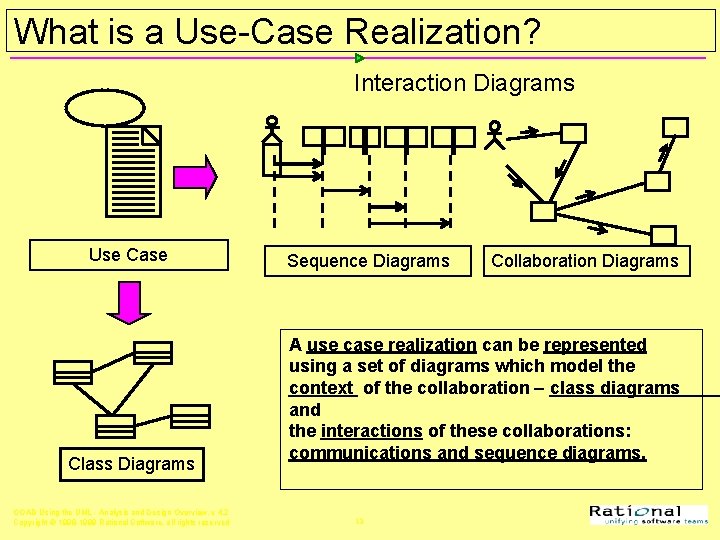
What is a Use-Case Realization? Interaction Diagrams Use Case Class Diagrams OOAD Using the UML - Analysis and Design Overview, v 4. 2 Copyright Ó 1998 -1999 Rational Software, all rights reserved Sequence Diagrams Collaboration Diagrams A use case realization can be represented using a set of diagrams which model the context of the collaboration – class diagrams and the interactions of these collaborations: communications and sequence diagrams. 13
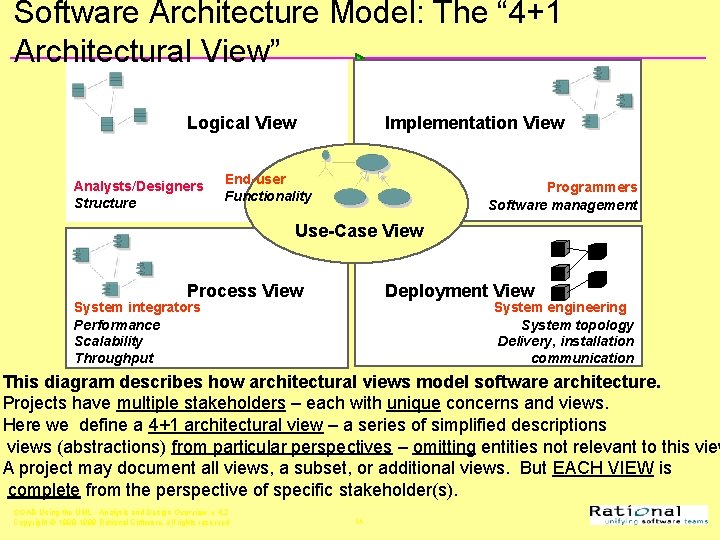
Software Architecture Model: The “ 4+1 Architectural View” Logical View Analysts/Designers Structure Implementation View End-user Functionality Programmers Software management Use-Case View Process View Deployment View System integrators Performance Scalability Throughput System engineering System topology Delivery, installation communication This diagram describes how architectural views model software architecture. Projects have multiple stakeholders – each with unique concerns and views. Here we define a 4+1 architectural view – a series of simplified descriptions views (abstractions) from particular perspectives – omitting entities not relevant to this view A project may document all views, a subset, or additional views. But EACH VIEW is complete from the perspective of specific stakeholder(s). OOAD Using the UML - Analysis and Design Overview, v 4. 2 Copyright Ó 1998 -1999 Rational Software, all rights reserved 14
Analysis & Design Overview Topics w Key Concepts w Analysis & Design Workflow Overview OOAD Using the UML - Analysis and Design Overview, v 4. 2 Copyright Ó 1998 -1999 Rational Software, all rights reserved 15
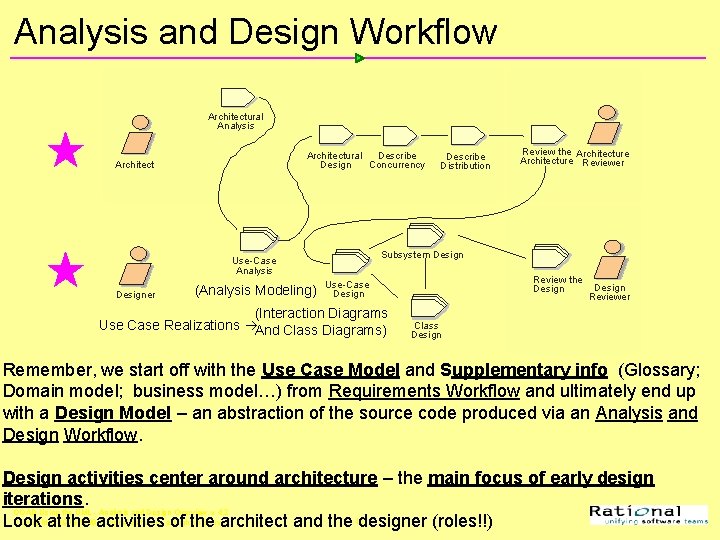
Analysis and Design Workflow Architectural Analysis Describe Architectural Concurrency Design Architect Designer Review the Architecture Reviewer Subsystem Design Use-Case Analysis (Analysis Modeling) Describe Distribution Review the Design Use-Case Design (Interaction Diagrams Use Case Realizations And Class Diagrams) Design Reviewer Class Design Remember, we start off with the Use Case Model and Supplementary info (Glossary; Domain model; business model…) from Requirements Workflow and ultimately end up with a Design Model – an abstraction of the source code produced via an Analysis and Design Workflow. Design activities center around architecture – the main focus of early design iterations. OOAD Using the UML - Analysis and Design Overview, v 4. 2 Copyrightat Ó 1998 -1999 Rational Software, all reserved Look the activities ofrightsthe architect and the 16 designer (roles!!)
The Software Architect Establishes the overall structure for each architectural view: This includes layers, if a layered approach… § the decomposition of the view, § the grouping of elements, and the interfaces between these major groupings. w In contrast with the other workers, the Architect's view is one of breadth, as opposed to depth w Frequently, the architect is the most experienced member of the team. (likely a good idea) w Architect must constantly observe all design activities to ensure that they are compatible with the overall architecture. OOAD Using the UML - Analysis and Design Overview, v 4. 2 Copyright Ó 1998 -1999 Rational Software, all rights reserved 17
The Designer w Defines the responsibilities, operations, attributes, and relationships of one or several classes and determines how they should be adjusted (modified, refined, morphed into other design / implementation artifacts (like packages, subsystems, etc. )) to support the implementation environment with the software architecture. w Must be compatible with overall architecture! w Is usually responsible for Use-Case Realizations, in order to ensure the overall consistency of how a particular use case is realized using design elements. w Software Architect works carefully here to ensure compatibility!! OOAD Using the UML - Analysis and Design Overview, v 4. 2 Copyright Ó 1998 -1999 Rational Software, all rights reserved 18
The Database Designer w Defines the tables, indexes, views, constraints, triggers, stored procedures, table spaces or storage parameters, and other database-specific constructs needed to store, retrieve, and delete persistent objects. w Will be familiar with design / implementation support from, say, APIs, such as java. sql, etc. w This information is maintained in the Data Model. OOAD Using the UML - Analysis and Design Overview, v 4. 2 Copyright Ó 1998 -1999 Rational Software, all rights reserved 19
Reviewers w Architecture Reviewer plans and conducts the formal reviews of the software architecture in general. w The Design reviewer plans and conducts the formal reviews of the design model. w Can be project manager in consultation with these other roles…Team efforts! OOAD Using the UML - Analysis and Design Overview, v 4. 2 Copyright Ó 1998 -1999 Rational Software, all rights reserved 20
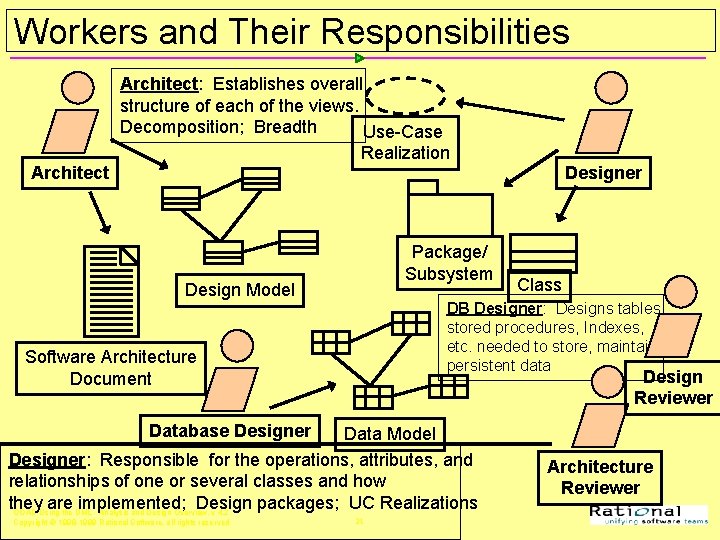
Workers and Their Responsibilities Architect: Establishes overall structure of each of the views. Decomposition; Breadth Use-Case Realization Package/ Subsystem Design Model Designer Class DB Designer: Designs tables, stored procedures, Indexes, etc. needed to store, maintain persistent data Software Architecture Document Design Reviewer Database Designer Data Model Designer: Responsible for the operations, attributes, and relationships of one or several classes and how they are implemented; Design packages; UC Realizations OOAD Using the UML - Analysis and Design Overview, v 4. 2 Copyright Ó 1998 -1999 Rational Software, all rights reserved 21 Architecture Reviewer
Review: Analysis and Design Overview w What is the purpose of Analysis and Design? w What are the input and output artifacts? w Name and briefly describe the 4+1 Views of Architecture. w What is the difference between Analysis and Design? w What is the purpose of Architectural Analysis? w What is the purpose of Use-Case Analysis? w What are the major responsibilities of the Architect, Developer, Database workers? OOAD Using the UML - Analysis and Design Overview, v 4. 2 Copyright Ó 1998 -1999 Rational Software, all rights reserved 22
- Slides: 22