
Object Oried Data Analysis Last Time Si Zer
Object Orie’d Data Analysis, Last Time • Si. Zer Analysis – Zooming version, -- Dependent version – Mass flux data, -- Cell cycle data • Image Analysis – 1 st Generation -- 2 nd Generation • Object Representation – Landmarks – Boundaries – Medial
OODA in Image Analysis First Generation Problems: • Denoising • Segmentation • Registration (find object boundaries) (align objects) (all about single images)
OODA in Image Analysis Second Generation Problems: • Populations of Images – Understanding Population Variation – Discrimination (a. k. a. Classification) • Complex Data Structures (& Spaces) • HDLSS Statistics
Image Object Representation Major Approaches for Images: • Landmark Representations • Boundary Representations • Medial Representations
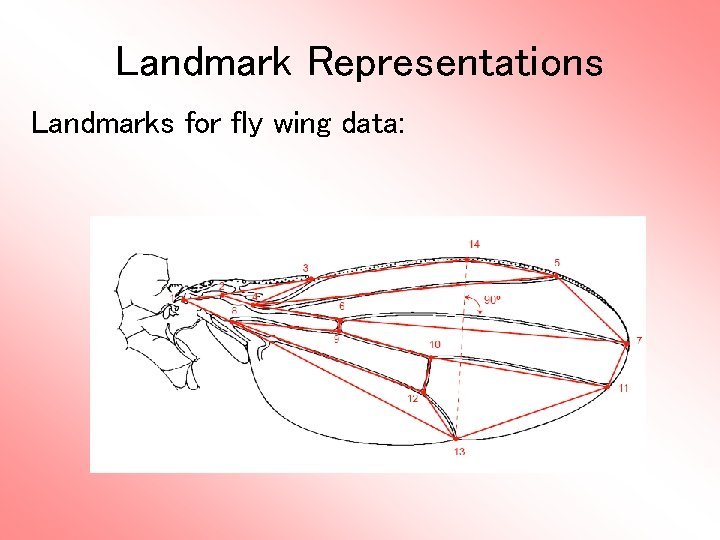
Landmark Representations Landmarks for fly wing data:
Landmark Representations Major Drawback of Landmarks: • Need to always find each landmark • Need same relationship • I. e. Landmarks need to correspond • Often fails for medical images • E. g. How many corresponding landmarks on a set of kidneys, livers or brains? ? ?
Boundary Representations Major sets of ideas: • Triangular Meshes – Survey: Owen (1998) • Active Shape Models – Cootes, et al (1993) • Fourier Boundary Representations – Keleman, et al (1997 & 1999)
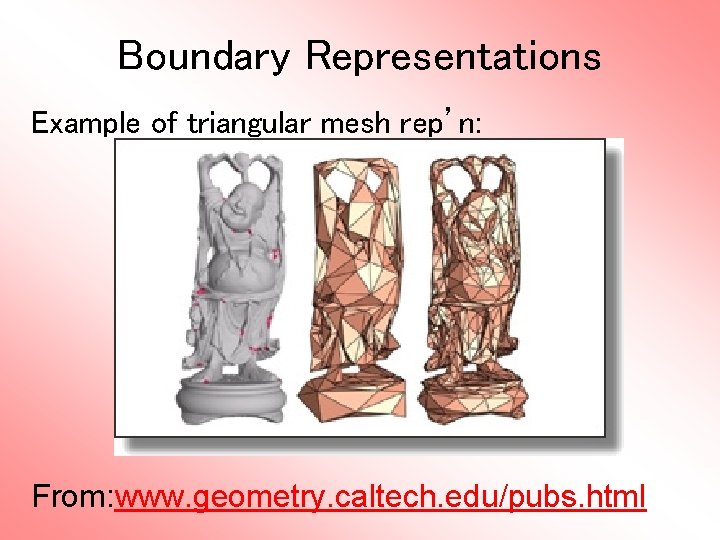
Boundary Representations Example of triangular mesh rep’n: From: www. geometry. caltech. edu/pubs. html
Boundary Representations Main Drawback: Correspondence • For OODA (on vectors of parameters): Need to “match up points” • Easy to find triangular mesh – Lots of research on this driven by gamers • Challenge to match mesh across objects – There are some interesting ideas…
Medial Representations Main Idea: Represent Objects as: • Discretized skeletons (medial atoms) • Plus spokes from center to edge • Which imply a boundary Very accessible early reference: • Yushkevich, et al (2001)
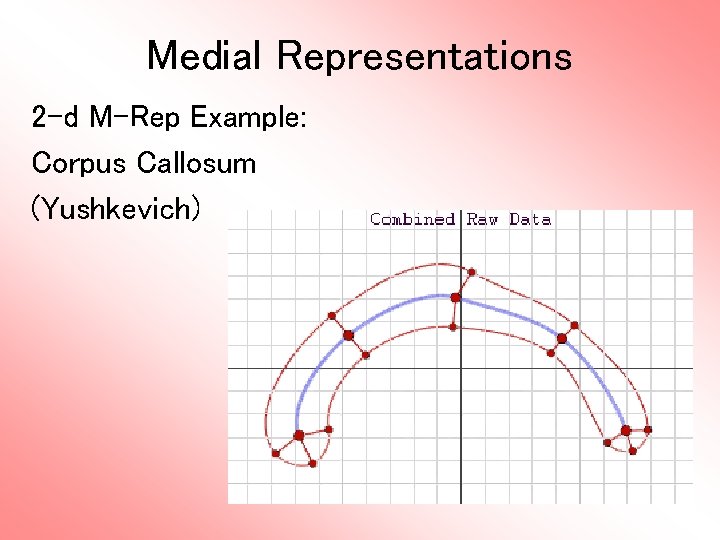
Medial Representations 2 -d M-Rep Example: Corpus Callosum (Yushkevich)
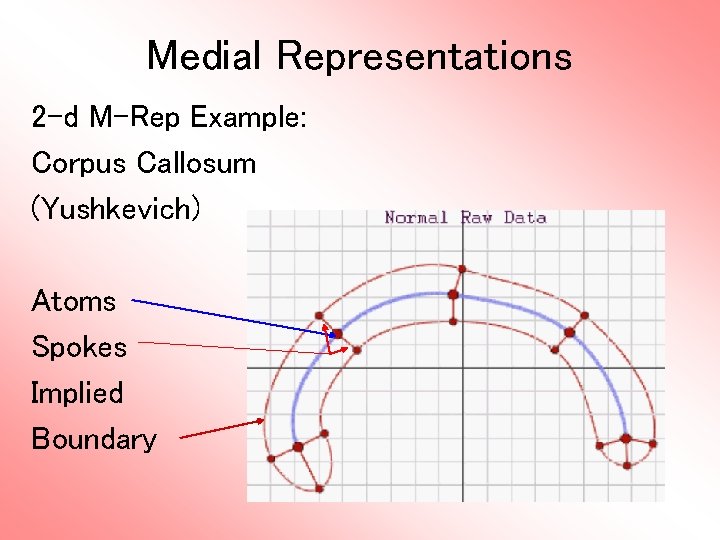
Medial Representations 2 -d M-Rep Example: Corpus Callosum (Yushkevich) Atoms Spokes Implied Boundary
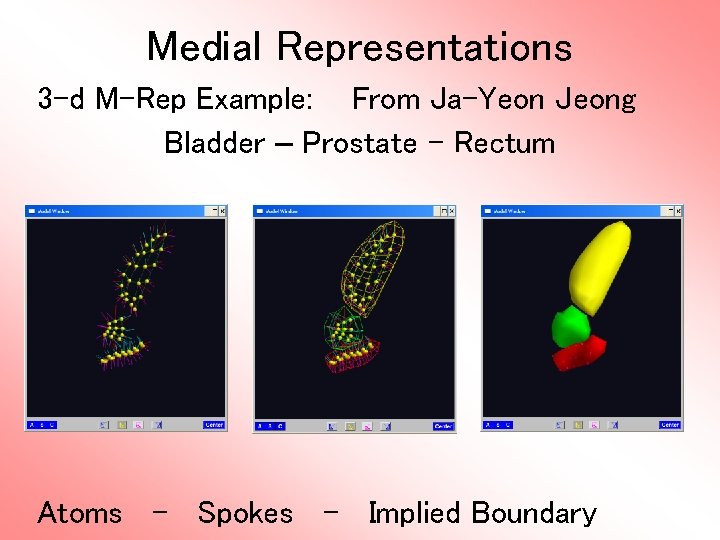
Medial Representations 3 -d M-Rep Example: From Ja-Yeon Jeong Bladder – Prostate - Rectum Atoms - Spokes - Implied Boundary
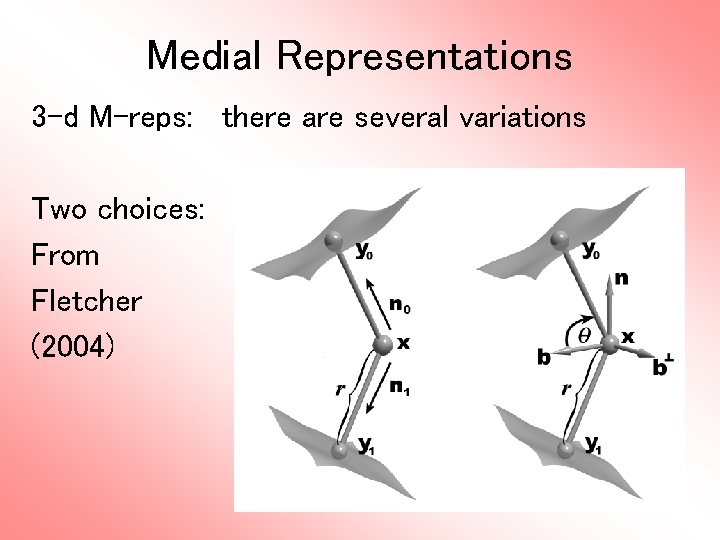
Medial Representations 3 -d M-reps: there are several variations Two choices: From Fletcher (2004)
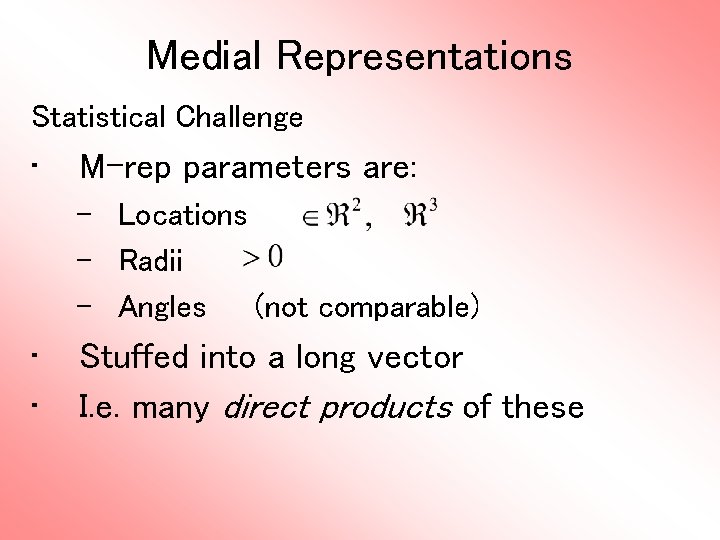
Medial Representations Statistical Challenge • M-rep parameters are: – Locations – Radii – Angles (not comparable) • • Stuffed into a long vector I. e. many direct products of these
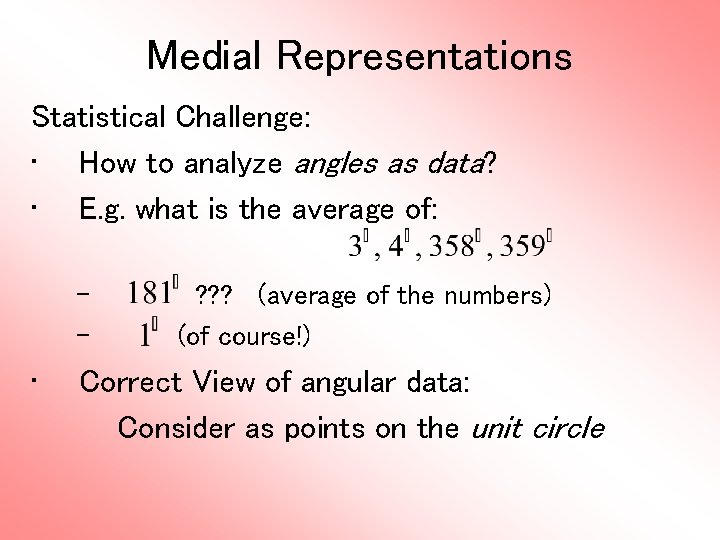
Medial Representations Statistical Challenge: • How to analyze angles as data? • E. g. what is the average of: – – • ? ? ? (average of the numbers) (of course!) Correct View of angular data: Consider as points on the unit circle
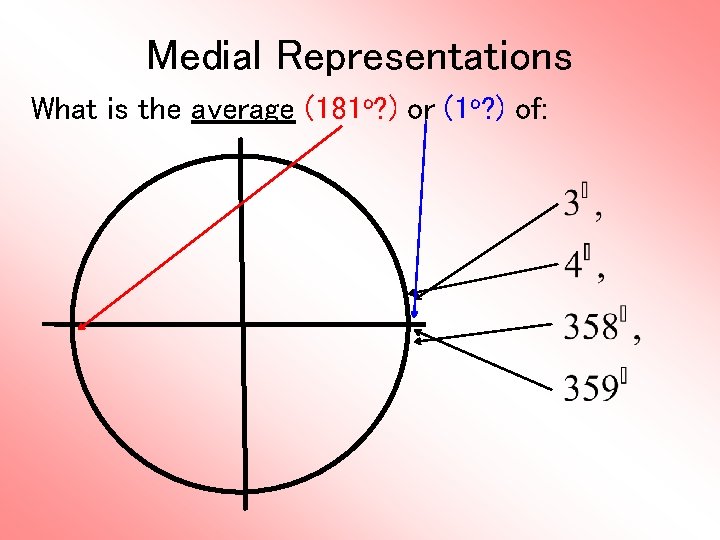
Medial Representations What is the average (181 o? ) or (1 o? ) of:
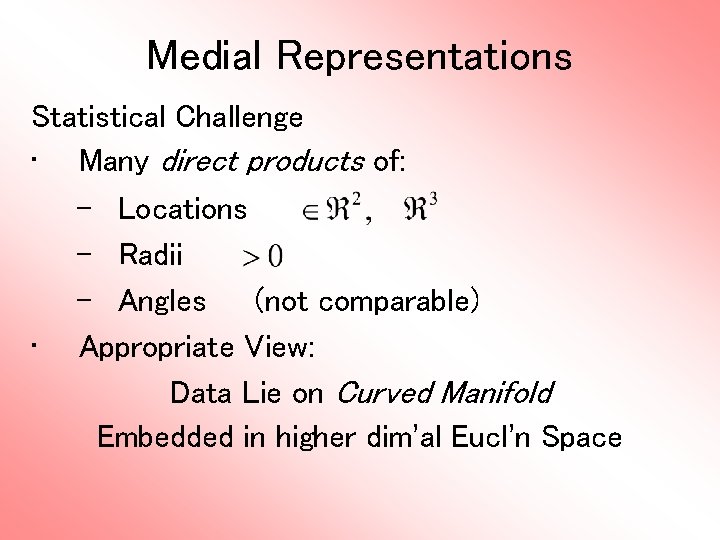
Medial Representations Statistical Challenge • Many direct products of: – Locations – Radii – Angles (not comparable) • Appropriate View: Data Lie on Curved Manifold Embedded in higher dim’al Eucl’n Space
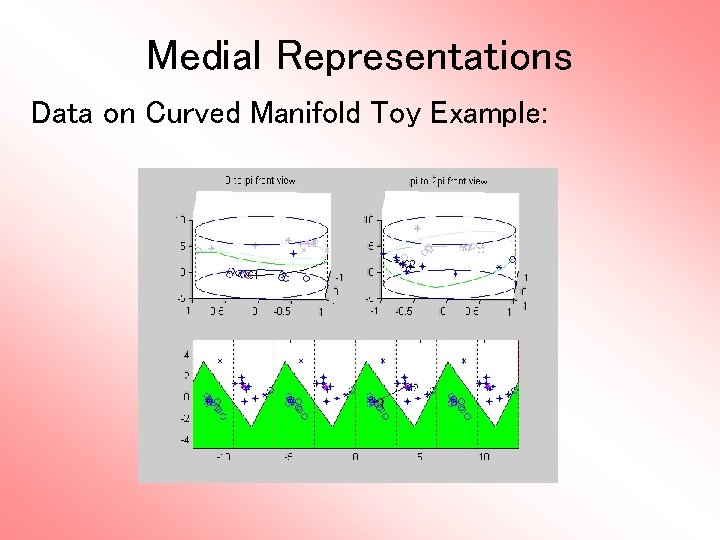
Medial Representations Data on Curved Manifold Toy Example:
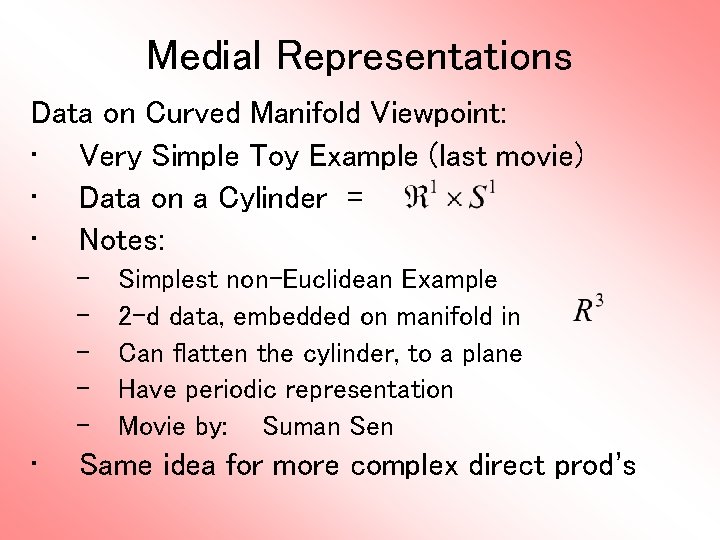
Medial Representations Data on Curved Manifold Viewpoint: • Very Simple Toy Example (last movie) • Data on a Cylinder = • Notes: – – – • Simplest non-Euclidean Example 2 -d data, embedded on manifold in Can flatten the cylinder, to a plane Have periodic representation Movie by: Suman Sen Same idea for more complex direct prod’s
A Challenging Example • Male Pelvis – – – • Bladder – Prostate – Rectum How do they move over time (days)? Critical to Radiation Treatment (cancer) Work with 3 -d CT – – – Very Challenging to Segment Find boundary of each object? Represent each Object?
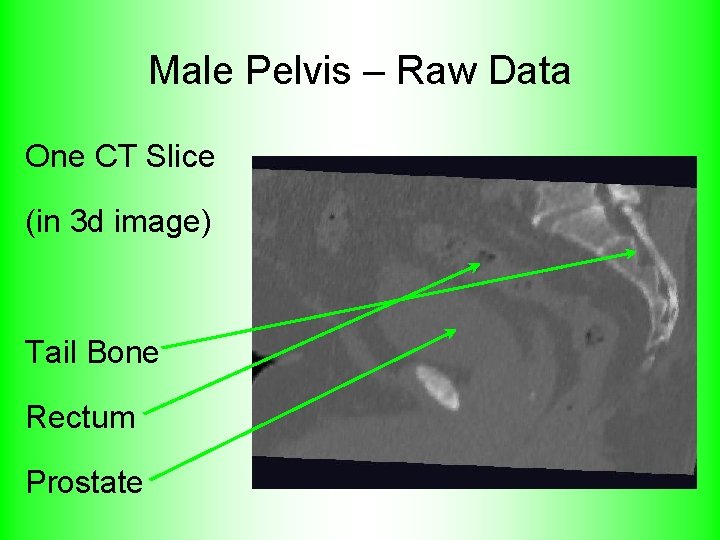
Male Pelvis – Raw Data One CT Slice (in 3 d image) Tail Bone Rectum Prostate
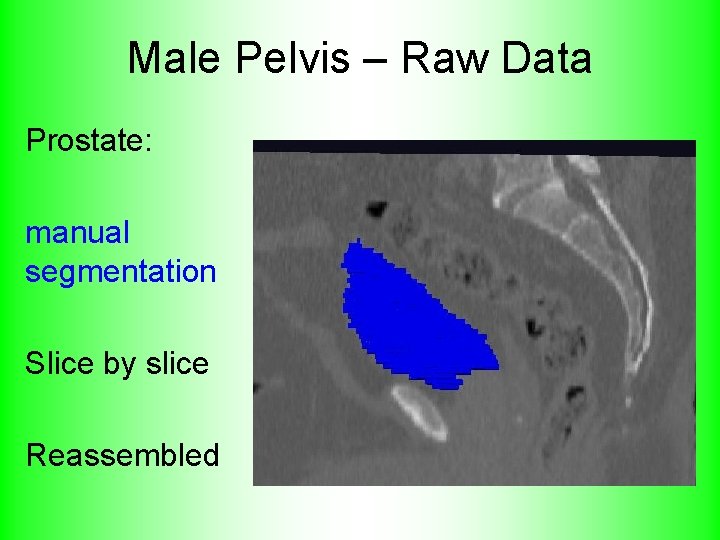
Male Pelvis – Raw Data Prostate: manual segmentation Slice by slice Reassembled
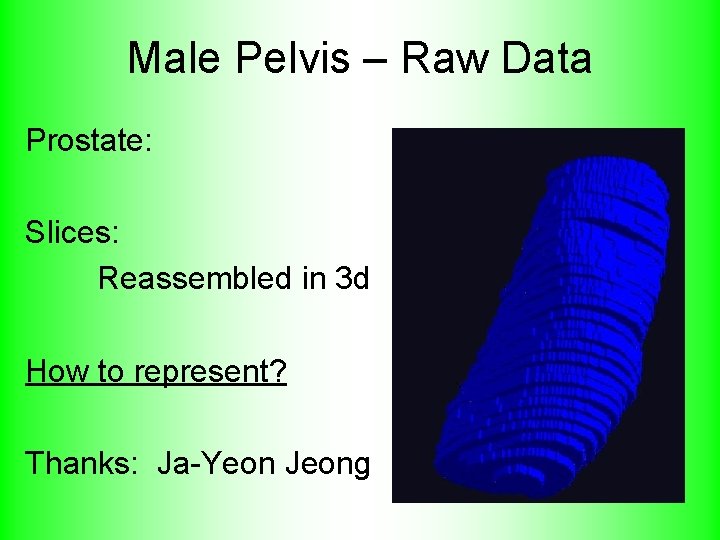
Male Pelvis – Raw Data Prostate: Slices: Reassembled in 3 d How to represent? Thanks: Ja-Yeon Jeong
Object Representation • Landmarks (hard to find) • Boundary Rep’ns (no correspondence) • Medial representations – Find “skeleton” – Discretize as “atoms” called M-reps
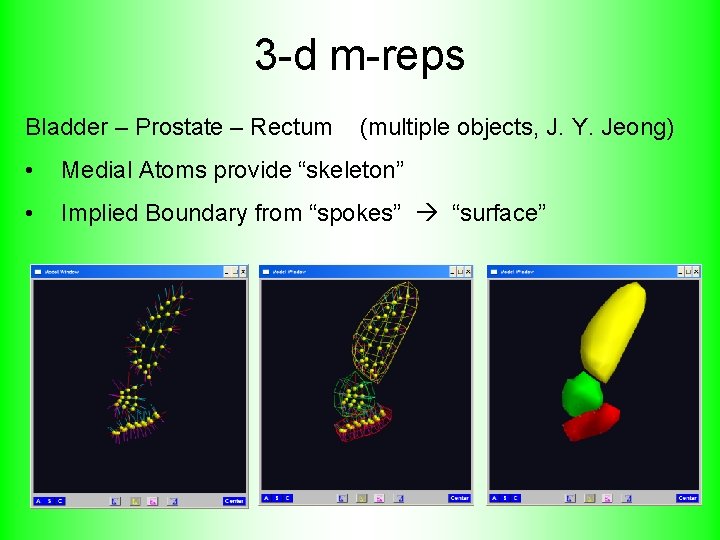
3 -d m-reps Bladder – Prostate – Rectum (multiple objects, J. Y. Jeong) • Medial Atoms provide “skeleton” • Implied Boundary from “spokes” “surface”
3 -d m-reps M-rep model fitting • Easy, when starting from binary (blue) • But very expensive (30 – 40 minutes technician’s time) • Want automatic approach • Challenging, because of poor contrast, noise, … • Need to borrow information across training sample • Use Bayes approach: prior & likelihood posterior • ~Conjugate Gaussians, but there are issues: • Major HLDSS challenges • Manifold aspect of data
Mildly Non-Euclidean Spaces Statistical Analysis of M-rep Data Recall: Many direct products of: • Locations • Radii • Angles I. e. points on smooth manifold Data in non-Euclidean Space But only mildly non-Euclidean
Mildly Non-Euclidean Spaces Good source for statistical analysis of Mildly non-Euclidean Data Fletcher (2004), Fletcher, et al (2004) Main ideas: • Work with geodesic distances • I. e. distances along surface of manifold
Mildly Non-Euclidean Spaces What is the mean of data on a manifold? • Bad choice: – Mean in embedded space – Since will probably leave manifold – Think about unit circle • • How to improve? Approach study characterizations of mean – There are many – Most fruitful: Frechét mean
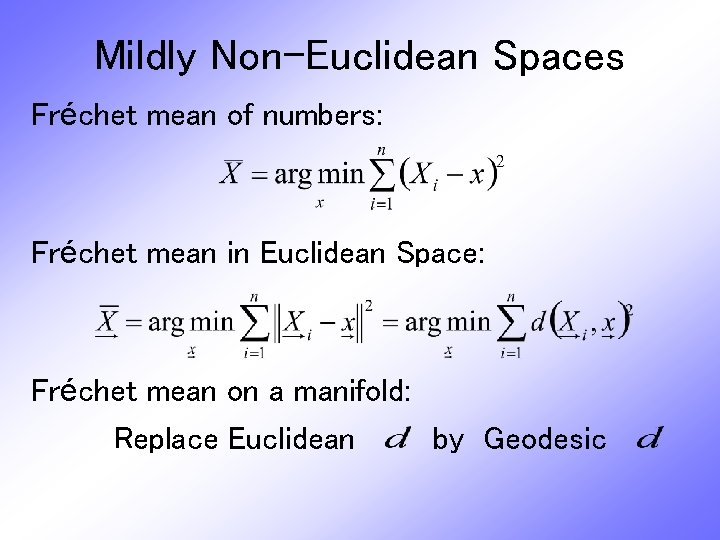
Mildly Non-Euclidean Spaces Fréchet mean of numbers: Fréchet mean in Euclidean Space: Fréchet mean on a manifold: Replace Euclidean by Geodesic
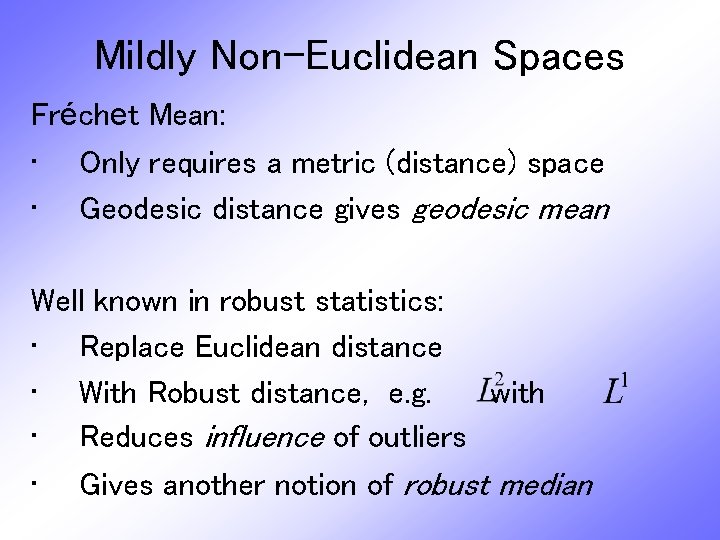
Mildly Non-Euclidean Spaces Fréchet Mean: • Only requires a metric (distance) space • Geodesic distance gives geodesic mean Well known in robust statistics: • Replace Euclidean distance • With Robust distance, e. g. with • Reduces influence of outliers • Gives another notion of robust median
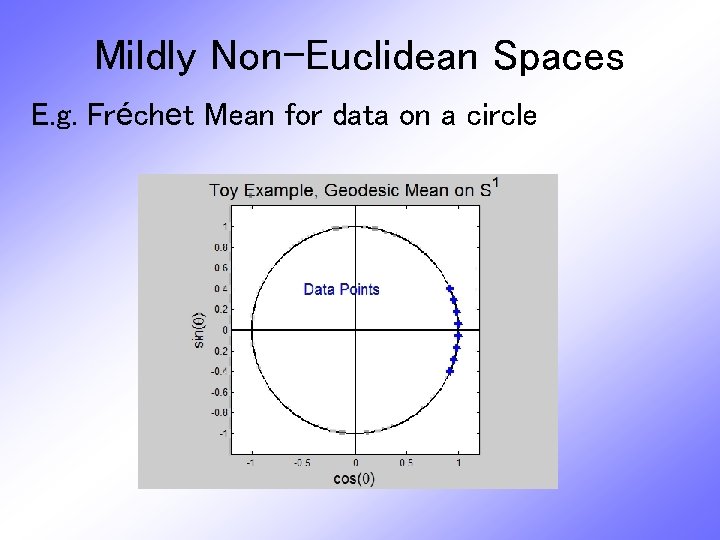
Mildly Non-Euclidean Spaces E. g. Fréchet Mean for data on a circle
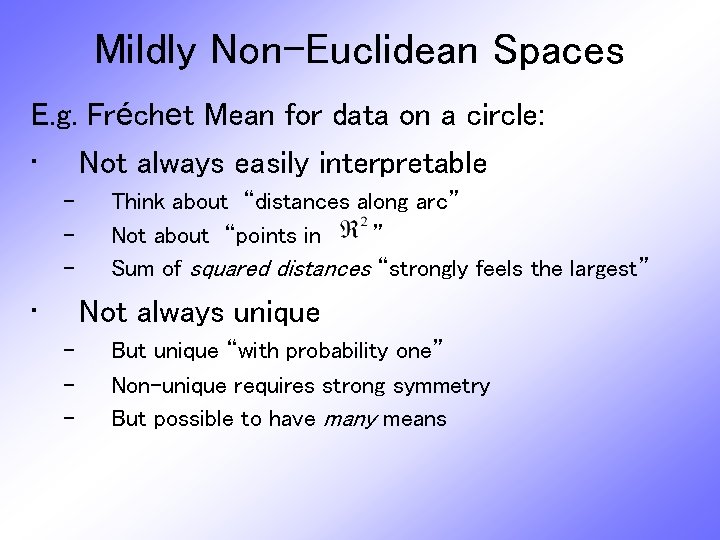
Mildly Non-Euclidean Spaces E. g. Fréchet Mean for data on a circle: • Not always easily interpretable – – – • Think about “distances along arc” Not about “points in ” Sum of squared distances “strongly feels the largest” Not always unique – – – But unique “with probability one” Non-unique requires strong symmetry But possible to have many means
Mildly Non-Euclidean Spaces E. g. Fréchet Mean for data on a circle: • Not always sensible notion of center – – • Not continuous Function of Data – – • • Sometimes prefer “top & bottom”? At end: farthest points from data Jump from 1 – 2 Jump from 2 – 8 All false for Euclidean Mean But all happen generally for manifold data
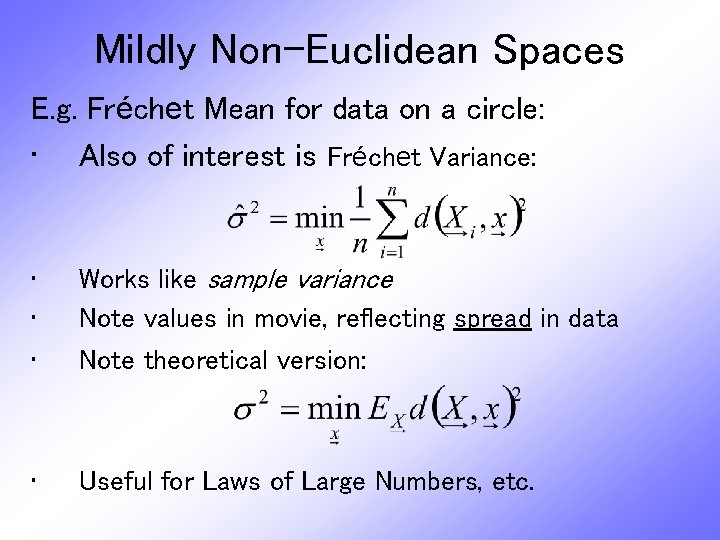
Mildly Non-Euclidean Spaces E. g. Fréchet Mean for data on a circle: • Also of interest is Fréchet Variance: • • • Works like sample variance Note values in movie, reflecting spread in data Note theoretical version: • Useful for Laws of Large Numbers, etc.
Mildly Non-Euclidean Spaces Useful Viewpoint for data on manifolds: • Tangent Space • Plane touching at one point • At which point? Geodesic (Fréchet) Mean Hence terminology “mildly non-Euclidean” (pic next page)
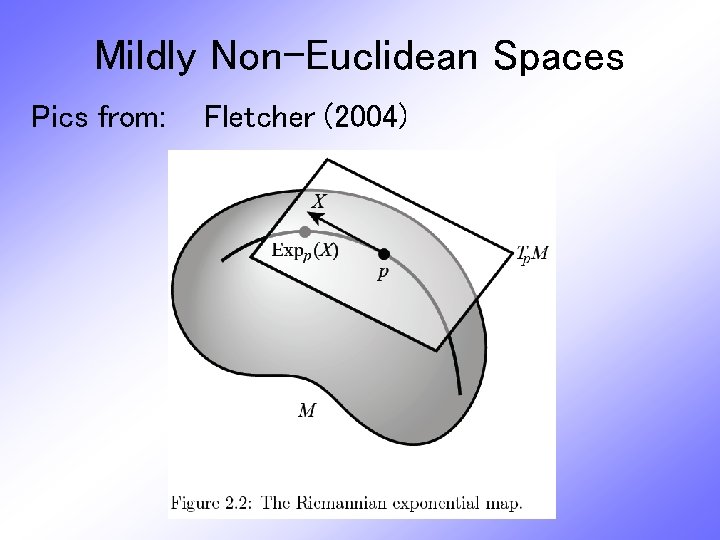
Mildly Non-Euclidean Spaces Pics from: Fletcher (2004)
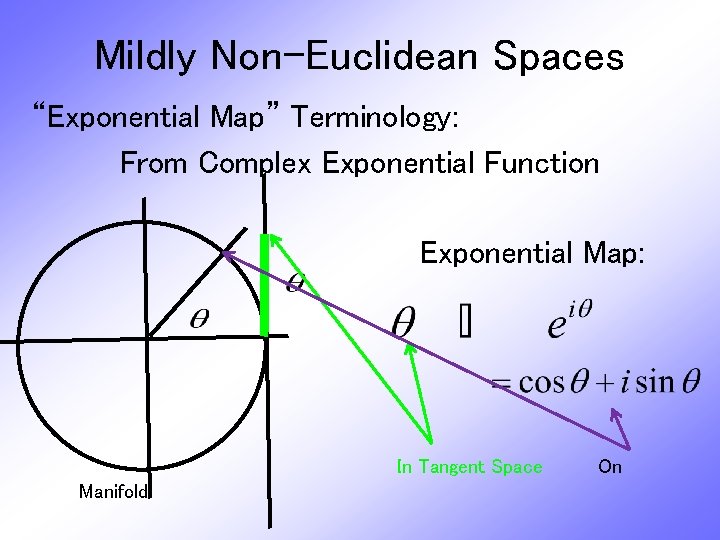
Mildly Non-Euclidean Spaces “Exponential Map” Terminology: From Complex Exponential Function Exponential Map: In Tangent Space Manifold On
Mildly Non-Euclidean Spaces Exponential Map Terminology Memory Trick: • Exponential Map Tangent Plane Curved Manifold • Log Map (Inverse) Curved Manifold Tangent Plane
Mildly Non-Euclidean Spaces Analog of PCA? Principal geodesics (PGA): • Replace line that best fits data • By geodesic that best fits the data (geodesic through Fréchet mean) • Implemented as PCA in tangent space • But mapped back to surface • Fletcher (2004)
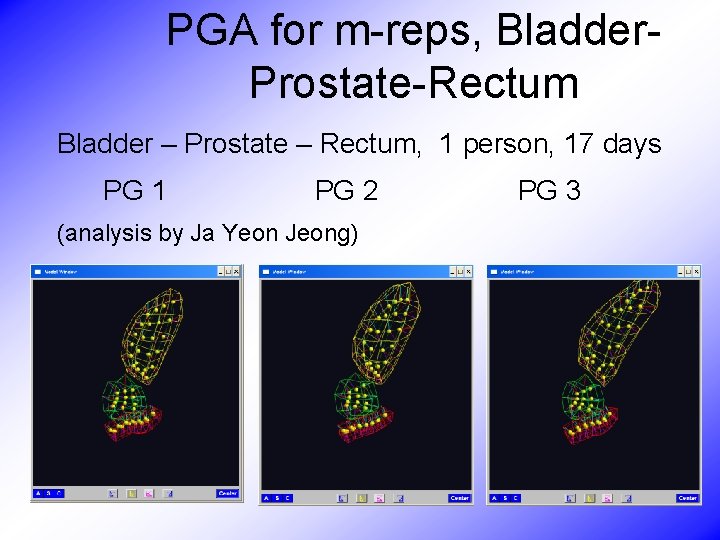
PGA for m-reps, Bladder. Prostate-Rectum Bladder – Prostate – Rectum, 1 person, 17 days PG 1 PG 2 (analysis by Ja Yeon Jeong) PG 3
PGA for m-reps, Bladder. Prostate-Rectum Bladder – Prostate – Rectum, 1 person, 17 days PG 1 PG 2 (analysis by Ja Yeon Jeong) PG 3
PGA for m-reps, Bladder. Prostate-Rectum Bladder – Prostate – Rectum, 1 person, 17 days PG 1 PG 2 (analysis by Ja Yeon Jeong) PG 3
Mildly Non-Euclidean Spaces Other Analogs of PCA? ? ? • Why pass through geodesic mean? • Sensible for Euclidean space • But obvious for non-Euclidean? Perhaps “geodesic that explains data as well as possible” (no mean constraint)? • Does this add anything? • All same for Euclidean case (since least squares fit contains mean)
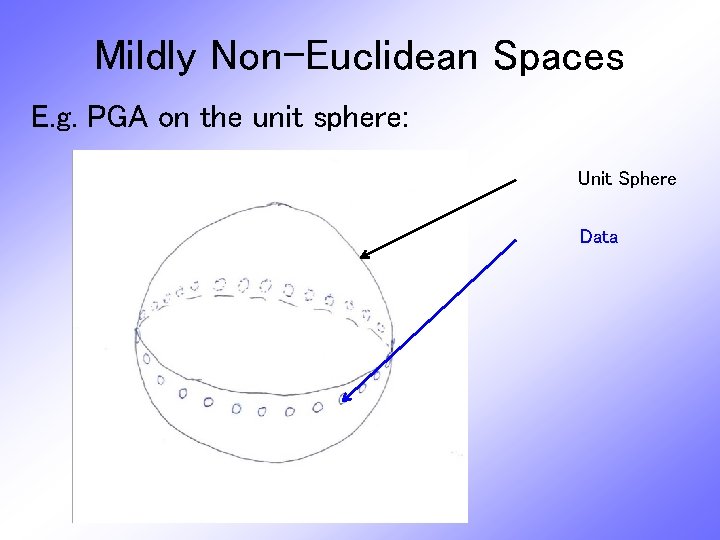
Mildly Non-Euclidean Spaces E. g. PGA on the unit sphere: Unit Sphere Data
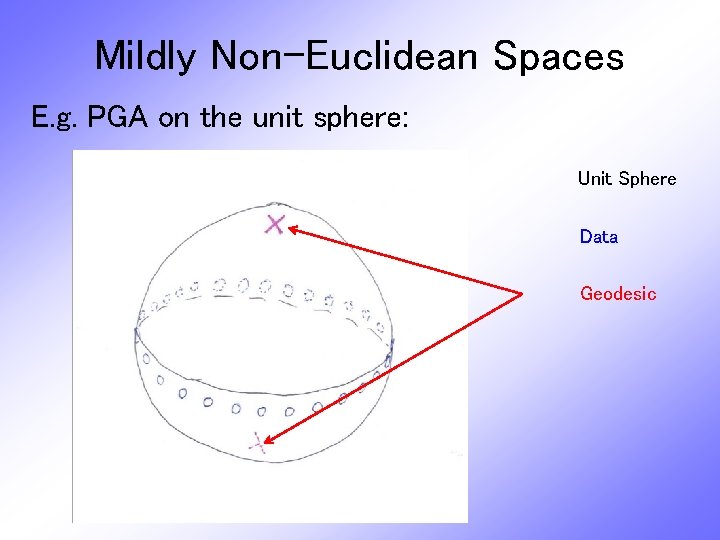
Mildly Non-Euclidean Spaces E. g. PGA on the unit sphere: Unit Sphere Data Geodesic Mean
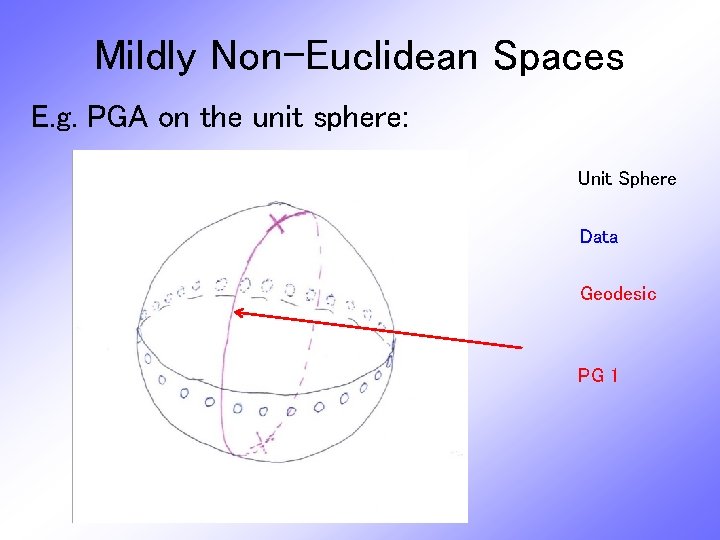
Mildly Non-Euclidean Spaces E. g. PGA on the unit sphere: Unit Sphere Data Geodesic Mean PG 1
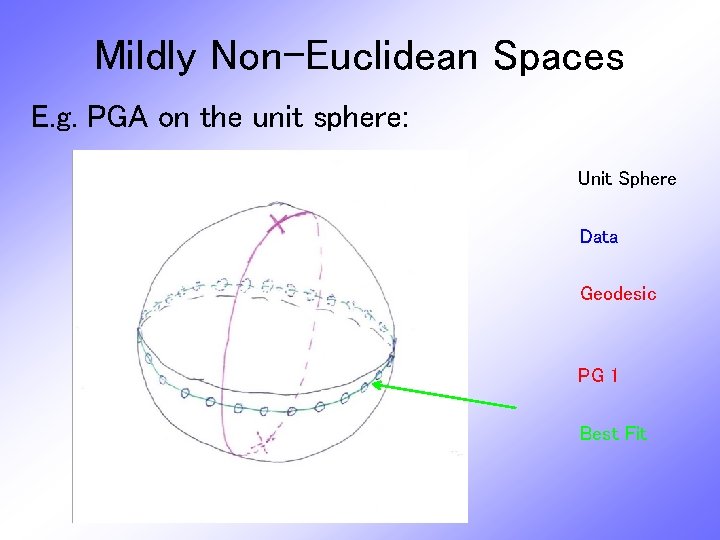
Mildly Non-Euclidean Spaces E. g. PGA on the unit sphere: Unit Sphere Data Geodesic Mean PG 1 Best Fit Geodesic
Mildly Non-Euclidean Spaces E. g. PGA on the unit sphere: Which is “best”? • Perhaps best fit? • What about PG 2? – • What about PG 3? – – • Should go through geo mean? Should cross PG 1 & PG 2 at same point? Need constrained optimization Gaussian Distribution on Manifold? ? ?
- Slides: 50