
Object movement in the double object construction in
Object movement in the double object construction in British English Bill Haddican Anders Holmberg
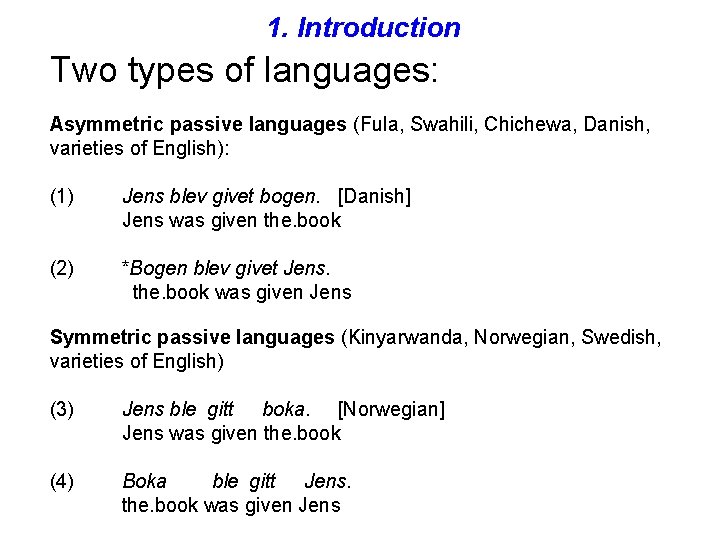
1. Introduction Two types of languages: Asymmetric passive languages (Fula, Swahili, Chichewa, Danish, varieties of English): (1) Jens blev givet bogen. [Danish] Jens was given the. book (2) *Bogen blev givet Jens. the. book was given Jens Symmetric passive languages (Kinyarwanda, Norwegian, Swedish, varieties of English) (3) Jens ble gitt boka. [Norwegian] Jens was given the. book (4) Boka ble gitt Jens. the. book was given Jens

1. Introduction Two approaches to the variation Variation in Case-absorption (Baker 1988, Woolford 1993, Citko 2008) In asymmetric languages only the case assigned to the Goal is absorbed in the passive only the Goal undergoes movement in the passive. In symmetric languages either the Case assigned to the Goal or to the Theme can be absorbed.
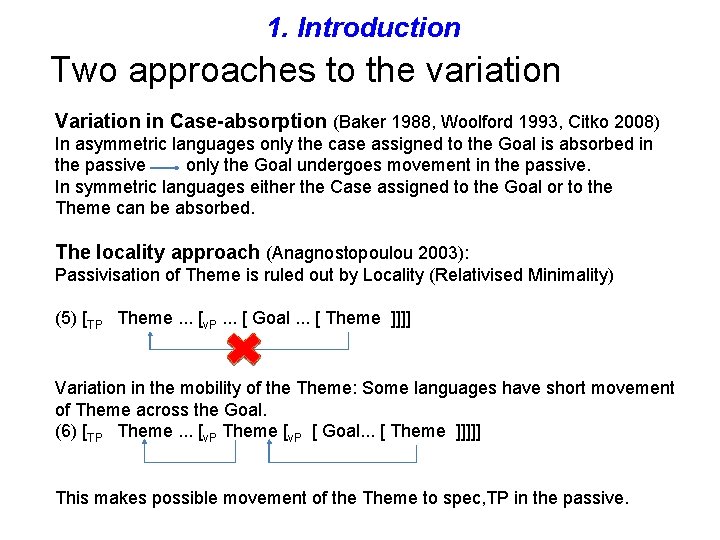
1. Introduction Two approaches to the variation Variation in Case-absorption (Baker 1988, Woolford 1993, Citko 2008) In asymmetric languages only the case assigned to the Goal is absorbed in the passive only the Goal undergoes movement in the passive. In symmetric languages either the Case assigned to the Goal or to the Theme can be absorbed. The locality approach (Anagnostopoulou 2003): Passivisation of Theme is ruled out by Locality (Relativised Minimality) (5) [TP Theme. . . [v. P. . . [ Goal. . . [ Theme ]]]] Variation in the mobility of the Theme: Some languages have short movement of Theme across the Goal. (6) [TP Theme. . . [v. P Theme [v. P [ Goal. . . [ Theme ]]]]] This makes possible movement of the Theme to spec, TP in the passive.
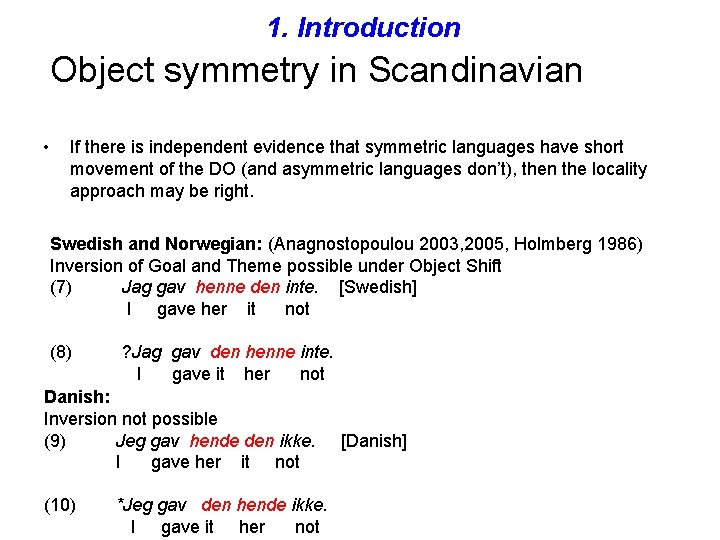
1. Introduction Object symmetry in Scandinavian • If there is independent evidence that symmetric languages have short movement of the DO (and asymmetric languages don’t), then the locality approach may be right. Swedish and Norwegian: (Anagnostopoulou 2003, 2005, Holmberg 1986) Inversion of Goal and Theme possible under Object Shift (7) Jag gav henne den inte. [Swedish] I gave her it not (8) ? Jag gav den henne inte. I gave it her not Danish: Inversion not possible (9) Jeg gav hende den ikke. I gave her it not (10) *Jeg gav den hende ikke. I gave it her not [Danish]
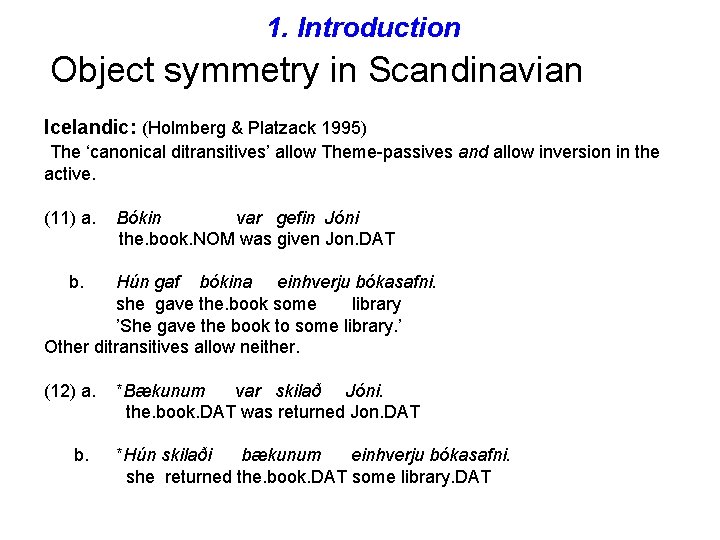
1. Introduction Object symmetry in Scandinavian Icelandic: (Holmberg & Platzack 1995) The ‘canonical ditransitives’ allow Theme-passives and allow inversion in the active. (11) a. Bókin var gefin Jóni the. book. NOM was given Jon. DAT b. Hún gaf bókina einhverju bókasafni. she gave the. book some library ’She gave the book to some library. ’ Other ditransitives allow neither. (12) a. b. *Bækunum var skilað Jóni. the. book. DAT was returned Jon. DAT *Hún skilaði bækunum einhverju bókasafni. she returned the. book. DAT some library. DAT
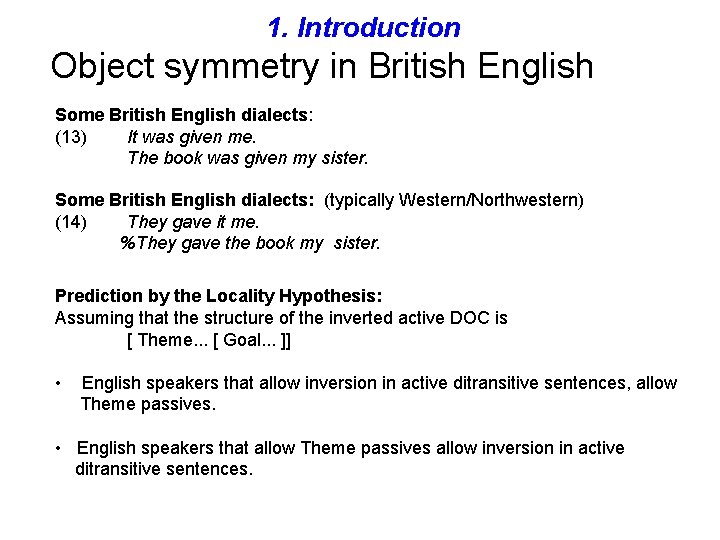
1. Introduction Object symmetry in British English Some British English dialects: (13) It was given me. The book was given my sister. Some British English dialects: (typically Western/Northwestern) (14) They gave it me. %They gave the book my sister. Prediction by the Locality Hypothesis: Assuming that the structure of the inverted active DOC is [ Theme. . . [ Goal. . . ]] • English speakers that allow inversion in active ditransitive sentences, allow Theme passives. • English speakers that allow Theme passives allow inversion in active ditransitive sentences.
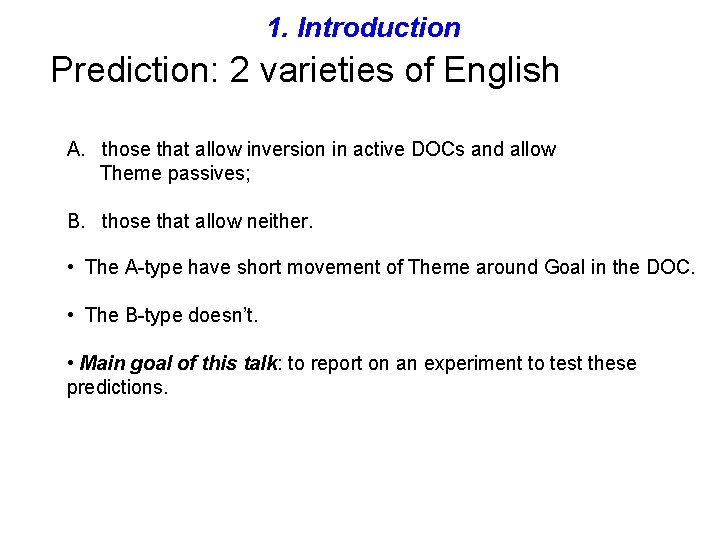
1. Introduction Prediction: 2 varieties of English A. those that allow inversion in active DOCs and allow Theme passives; B. those that allow neither. • The A-type have short movement of Theme around Goal in the DOC. • The B-type doesn’t. • Main goal of this talk: to report on an experiment to test these predictions.
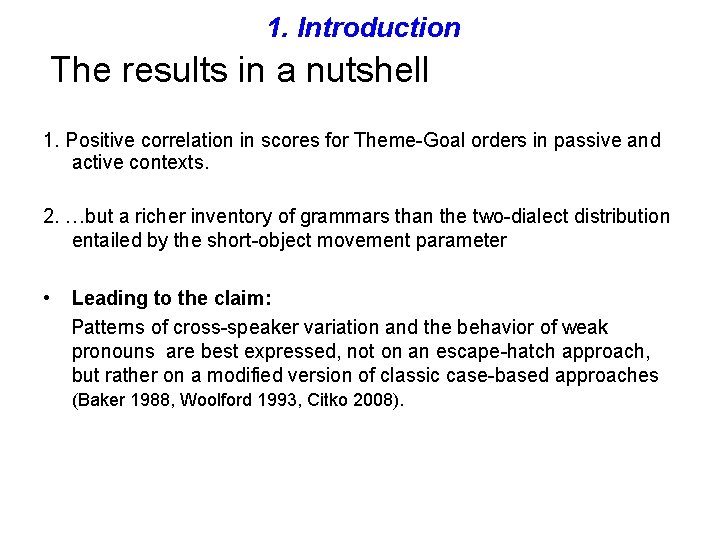
1. Introduction The results in a nutshell 1. Positive correlation in scores for Theme-Goal orders in passive and active contexts. 2. …but a richer inventory of grammars than the two-dialect distribution entailed by the short-object movement parameter • Leading to the claim: Patterns of cross-speaker variation and the behavior of weak pronouns are best expressed, not on an escape-hatch approach, but rather on a modified version of classic case-based approaches (Baker 1988, Woolford 1993, Citko 2008).
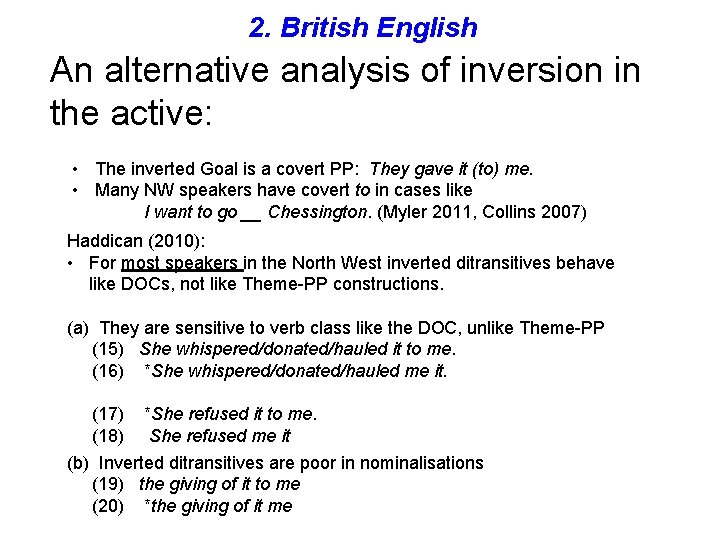
2. British English An alternative analysis of inversion in the active: • The inverted Goal is a covert PP: They gave it (to) me. • Many NW speakers have covert to in cases like I want to go __ Chessington. (Myler 2011, Collins 2007) Haddican (2010): • For most speakers in the North West inverted ditransitives behave like DOCs, not like Theme-PP constructions. (a) They are sensitive to verb class like the DOC, unlike Theme-PP (15) She whispered/donated/hauled it to me. (16) *She whispered/donated/hauled me it. (17) (18) *She refused it to me. She refused me it (b) Inverted ditransitives are poor in nominalisations (19) the giving of it to me (20) *the giving of it me
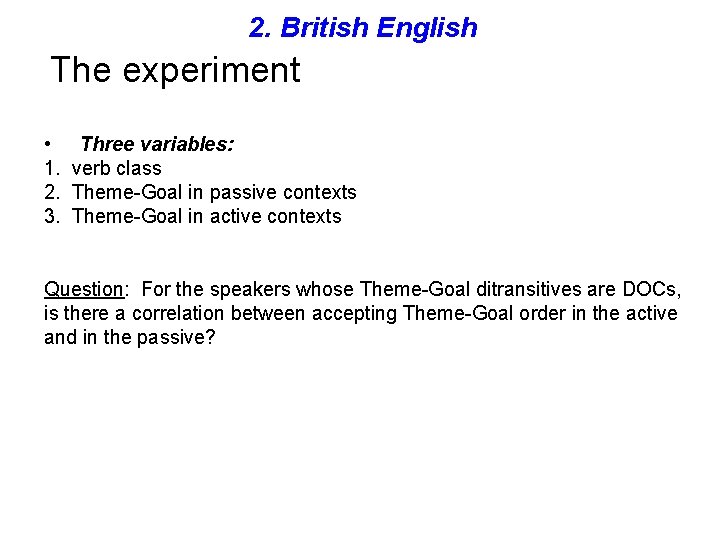
2. British English The experiment • 1. 2. 3. Three variables: verb class Theme-Goal in passive contexts Theme-Goal in active contexts Question: For the speakers whose Theme-Goal ditransitives are DOCs, is there a correlation between accepting Theme-Goal order in the active and in the passive?
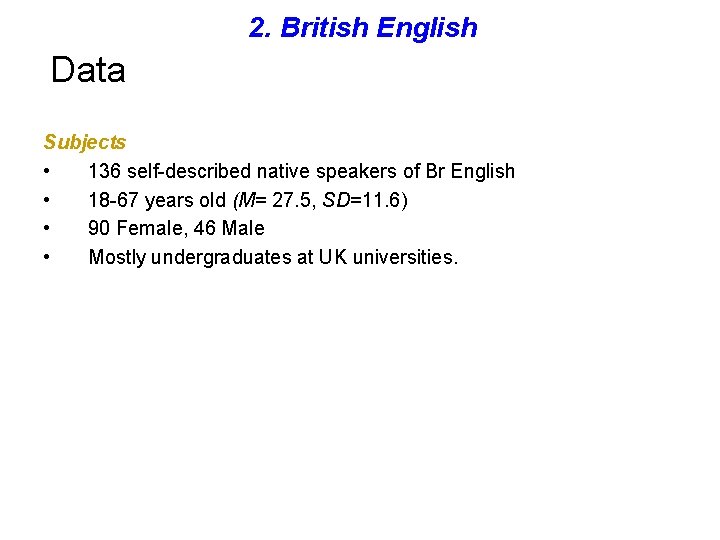
2. British English Data Subjects • 136 self-described native speakers of Br English • 18 -67 years old (M= 27. 5, SD=11. 6) • 90 Female, 46 Male • Mostly undergraduates at UK universities.
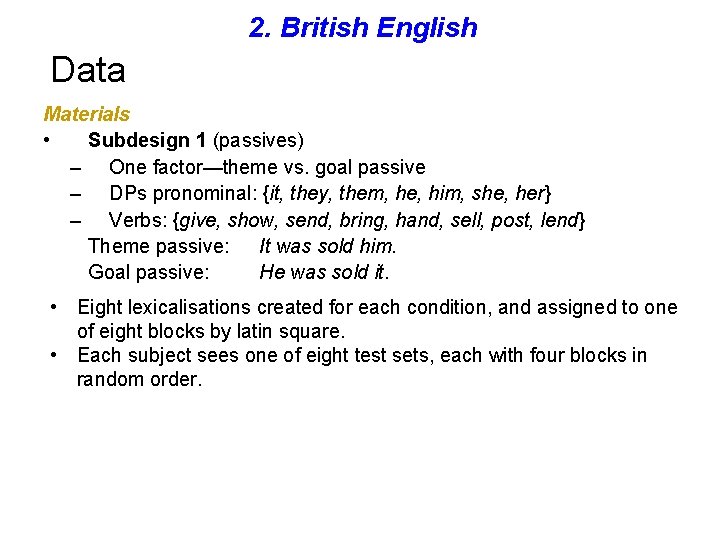
2. British English Data Materials • Subdesign 1 (passives) – One factor—theme vs. goal passive – DPs pronominal: {it, they, them, he, him, she, her} – Verbs: {give, show, send, bring, hand, sell, post, lend} Theme passive: It was sold him. Goal passive: He was sold it. • Eight lexicalisations created for each condition, and assigned to one of eight blocks by latin square. • Each subject sees one of eight test sets, each with four blocks in random order.
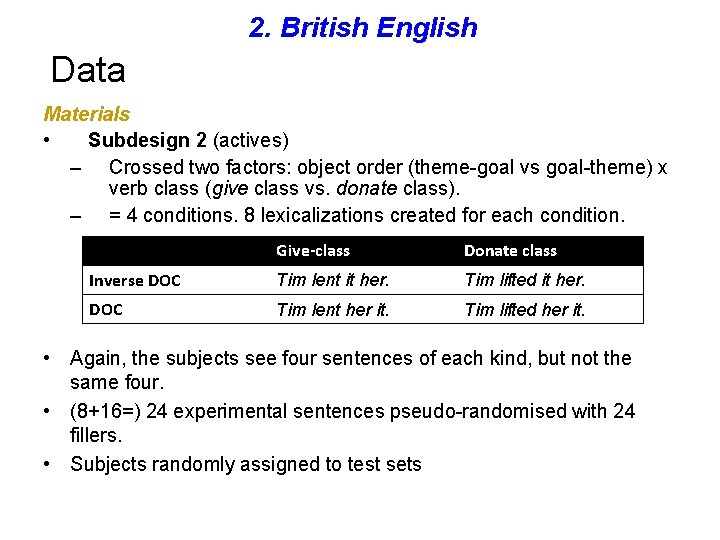
2. British English Data Materials • Subdesign 2 (actives) – Crossed two factors: object order (theme-goal vs goal-theme) x verb class (give class vs. donate class). – = 4 conditions. 8 lexicalizations created for each condition. Give-class Donate class Inverse DOC Tim lent it her. Tim lifted it her. DOC Tim lent her it. Tim lifted her it. • Again, the subjects see four sentences of each kind, but not the same four. • (8+16=) 24 experimental sentences pseudo-randomised with 24 fillers. • Subjects randomly assigned to test sets
2. British English Data Procedure • Self-paced, online magnitude estimation experiment in Autumn 2010 using Web. Exp 2 (Mayo et al 2008). • Sentences presented one by one, backtracking not allowed.
2. British English Results from crossing object order and verb class showed: • For most subjects the donate-class is degraded with Theme-Goal order, consistent with the analysis that they are inverted DOCs. • A few subjects rated Theme-Goal order with donate-verbs on a par with Theme-Goal order with give-type verbs, indicating that they may analyse them as underlying DO-PP constructions. • These subjects were excluded from the sample.
2. British English Results
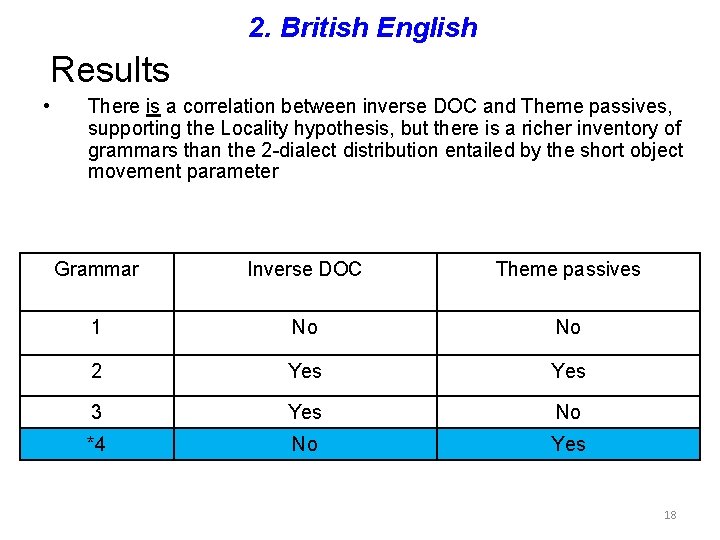
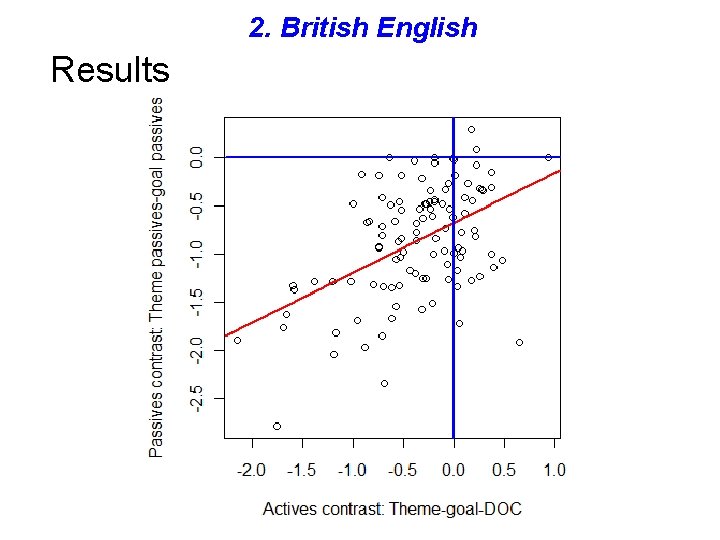
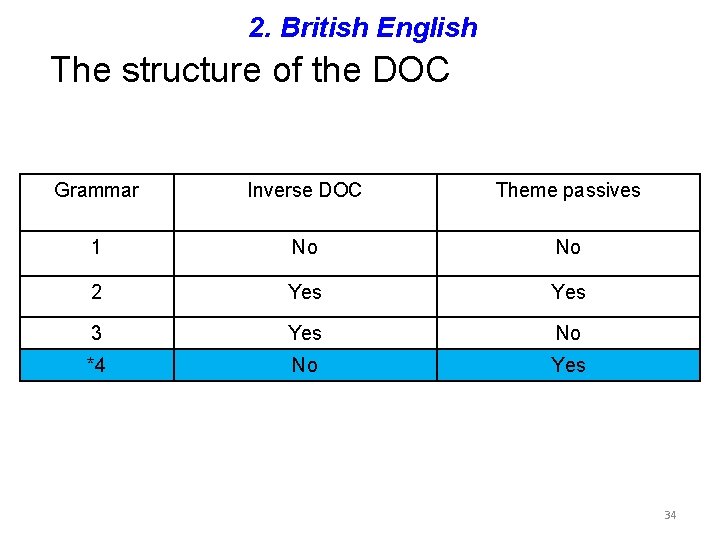
2. British English Results • There is a correlation between inverse DOC and Theme passives, supporting the Locality hypothesis, but there is a richer inventory of grammars than the 2 -dialect distribution entailed by the short object movement parameter Grammar Inverse DOC Theme passives 1 No No 2 Yes 3 Yes No *4 No Yes 18
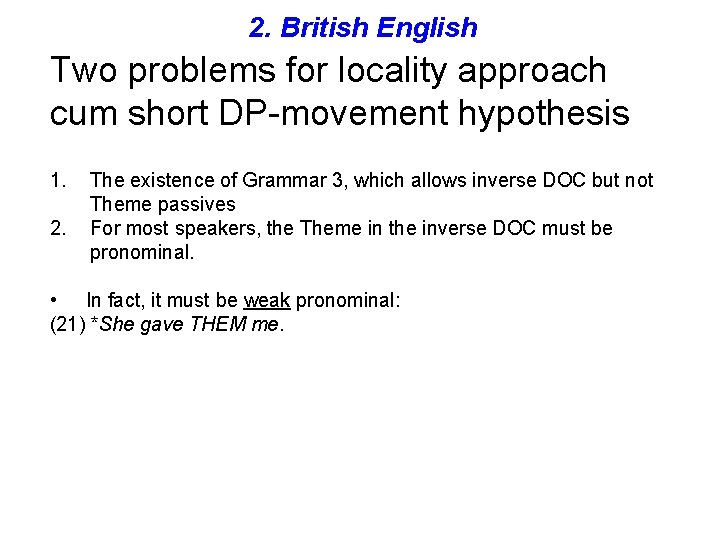
2. British English Two problems for locality approach cum short DP-movement hypothesis 1. 2. The existence of Grammar 3, which allows inverse DOC but not Theme passives For most speakers, the Theme in the inverse DOC must be pronominal. • In fact, it must be weak pronominal: (21) *She gave THEM me.
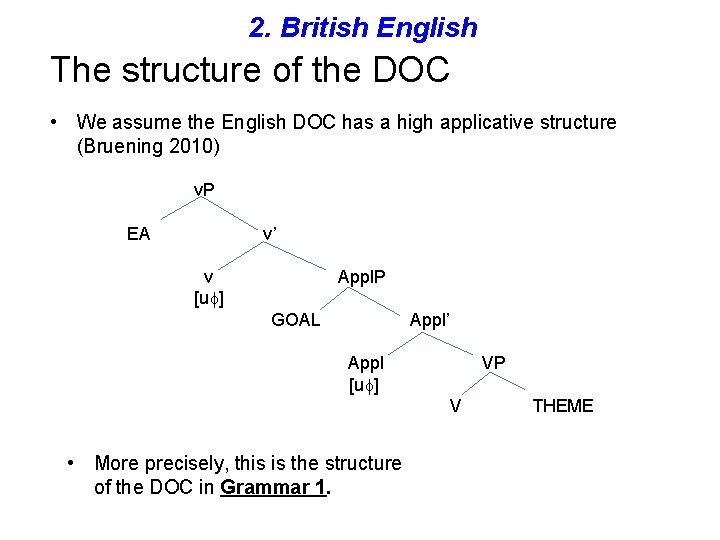
2. British English The structure of the DOC • We assume the English DOC has a high applicative structure (Bruening 2010) v. P EA v’ v [uf] Appl. P GOAL Appl’ Appl [uf] VP V • More precisely, this is the structure of the DOC in Grammar 1. THEME
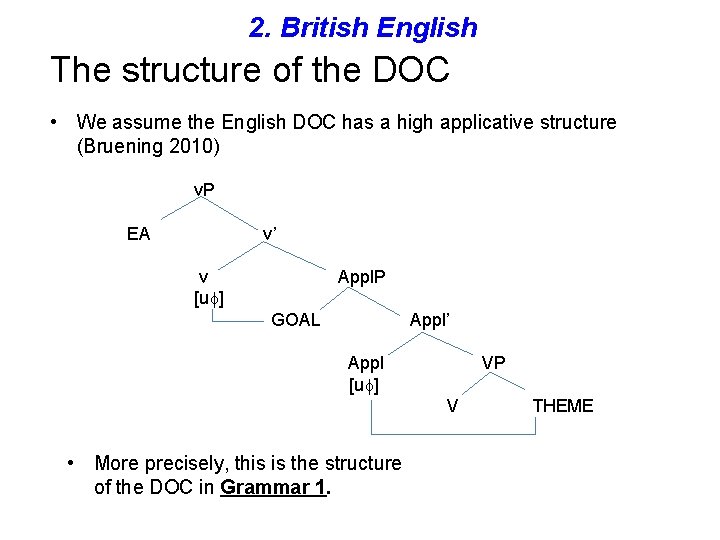
2. British English The structure of the DOC • We assume the English DOC has a high applicative structure (Bruening 2010) v. P EA v’ v [uf] Appl. P GOAL Appl’ Appl [uf] VP V • More precisely, this is the structure of the DOC in Grammar 1. THEME
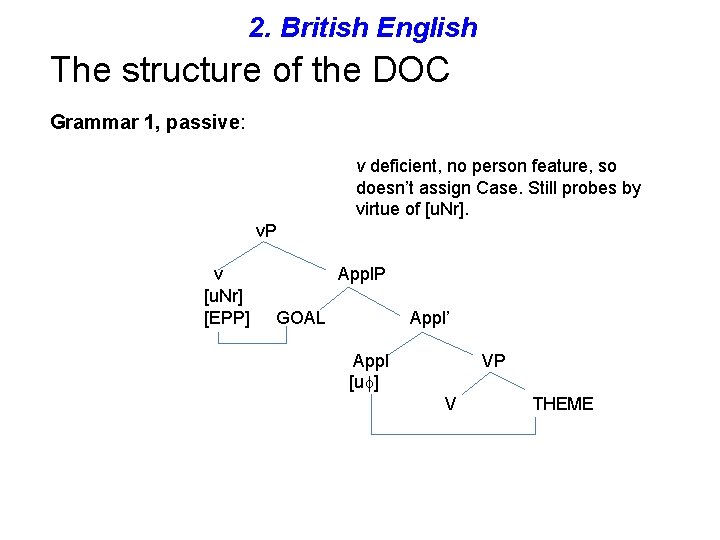
2. British English The structure of the DOC Grammar 1, passive: v deficient, no person feature, so doesn’t assign Case. Still probes by virtue of [u. Nr]. v. P v [u. Nr] [EPP] Appl. P GOAL Appl’ Appl [uf] VP V THEME
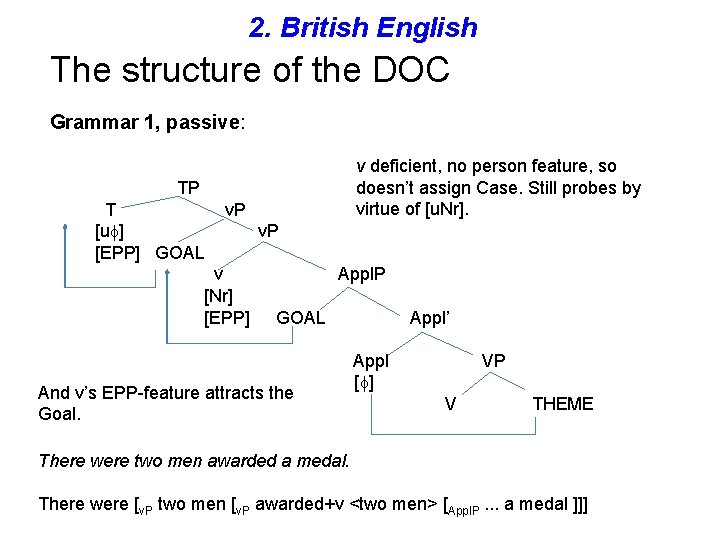
2. British English The structure of the DOC Grammar 1, passive: v deficient, no person feature, so doesn’t assign Case. Still probes by virtue of [u. Nr]. TP T [uf] [EPP] GOAL v. P v [Nr] [EPP] v. P Appl. P GOAL And v’s EPP-feature attracts the Goal. Appl’ Appl [f] VP V THEME There were two men awarded a medal. There were [v. P two men [v. P awarded+v <two men> [Appl. P. . . a medal ]]]
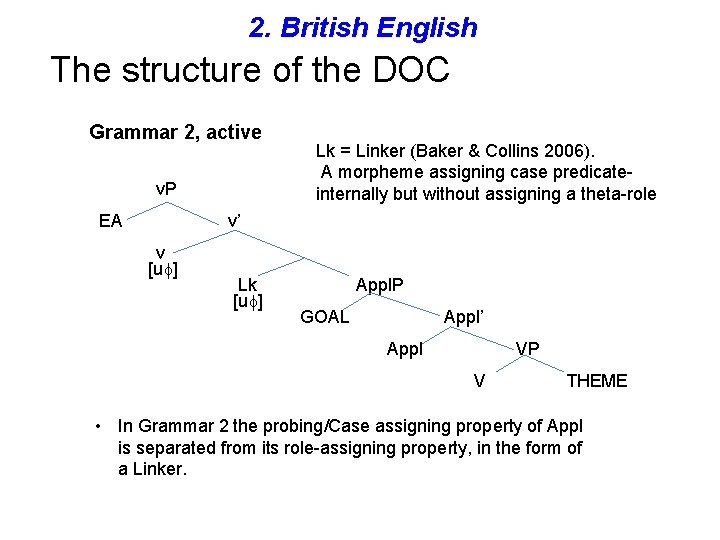
2. British English The structure of the DOC Grammar 2, active v. P EA Lk = Linker (Baker & Collins 2006). A morpheme assigning case predicateinternally but without assigning a theta-role v’ v [uf] Lk [uf] Appl. P GOAL Appl’ Appl VP V THEME • In Grammar 2 the probing/Case assigning property of Appl is separated from its role-assigning property, in the form of a Linker.
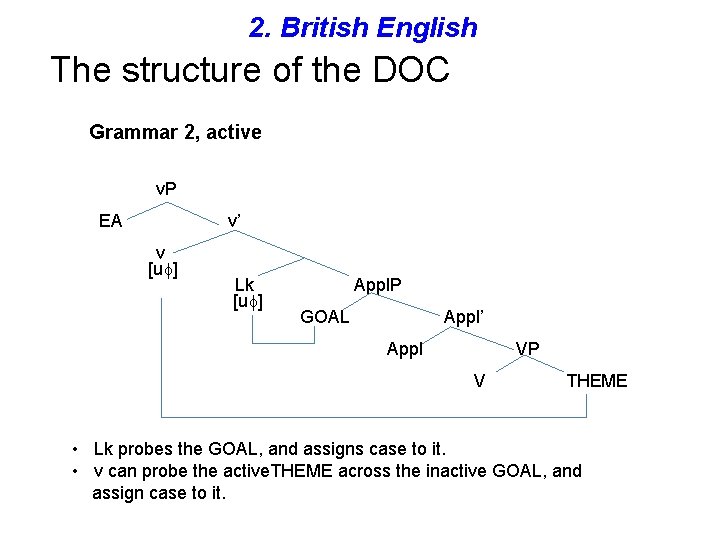
2. British English The structure of the DOC Grammar 2, active v. P EA v’ v [uf] Lk [uf] Appl. P GOAL Appl’ Appl VP V THEME • Lk probes the GOAL, and assigns case to it. • v can probe the active. THEME across the inactive GOAL, and assign case to it.
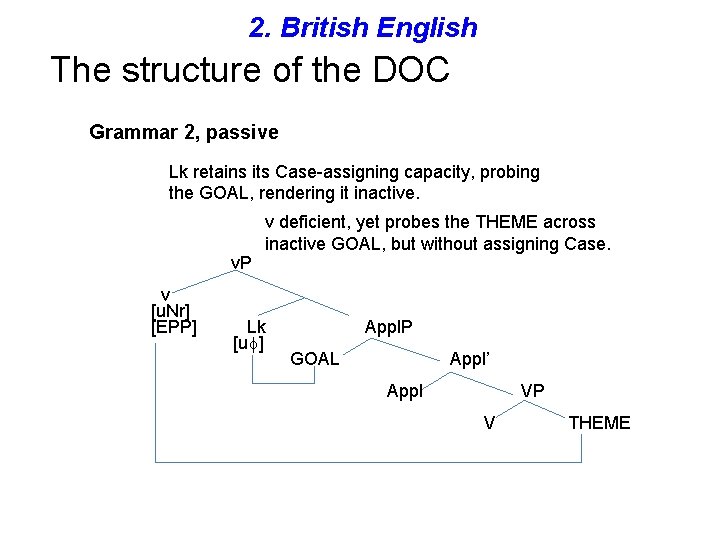
2. British English The structure of the DOC Grammar 2, passive Lk retains its Case-assigning capacity, probing the GOAL, rendering it inactive. v. P v [u. Nr] [EPP] v deficient, yet probes the THEME across inactive GOAL, but without assigning Case. Lk [uf] Appl. P GOAL Appl’ Appl VP V THEME
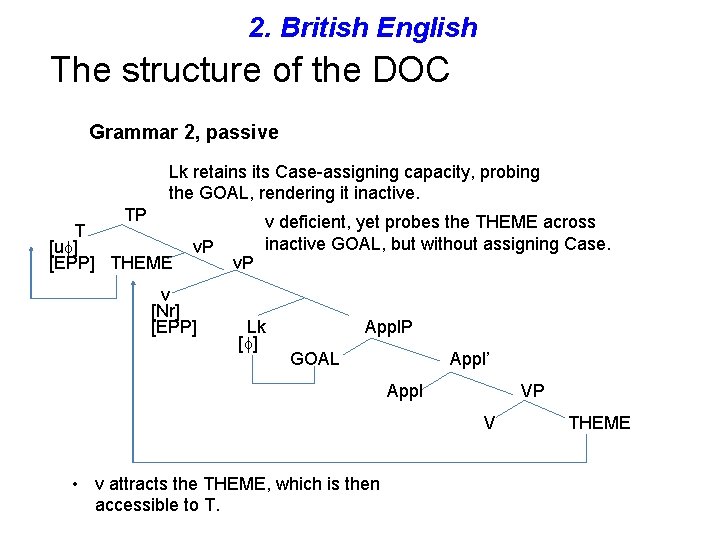
2. British English The structure of the DOC Grammar 2, passive Lk retains its Case-assigning capacity, probing the GOAL, rendering it inactive. TP T [uf] [EPP] THEME v. P v [Nr] [EPP] v. P v deficient, yet probes the THEME across inactive GOAL, but without assigning Case. Lk [f] Appl. P GOAL Appl’ Appl VP V • v attracts the THEME, which is then accessible to T. THEME
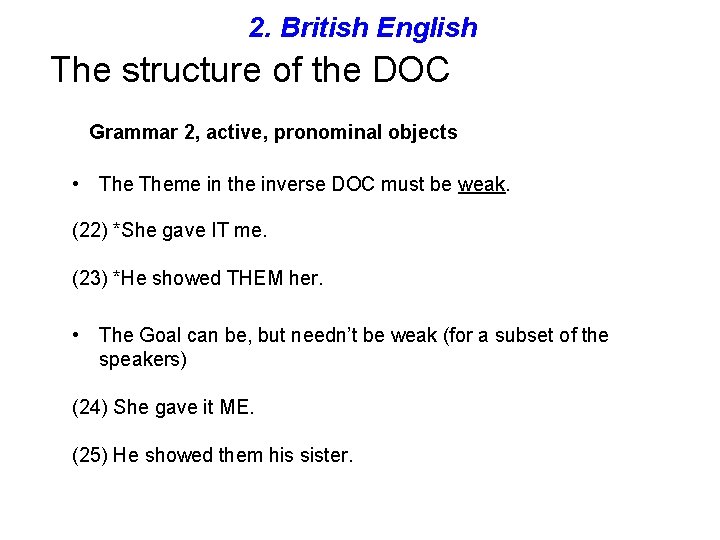
2. British English The structure of the DOC Grammar 2, active, pronominal objects • Theme in the inverse DOC must be weak. (22) *She gave IT me. (23) *He showed THEM her. • The Goal can be, but needn’t be weak (for a subset of the speakers) (24) She gave it ME. (25) He showed them his sister.
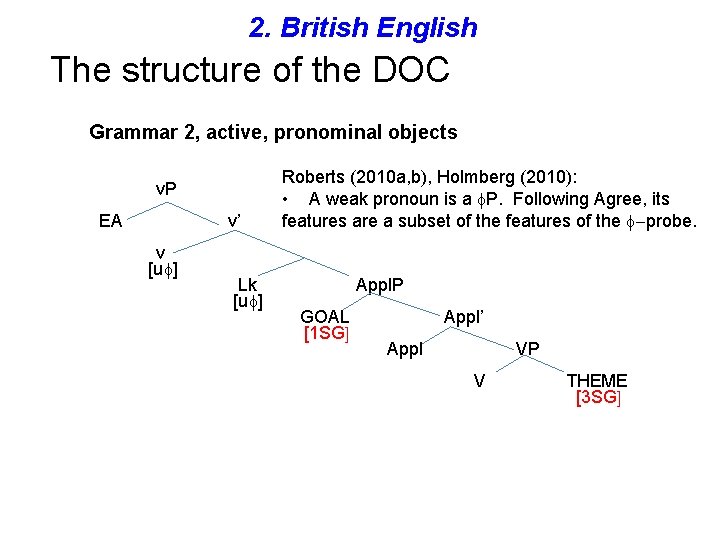
2. British English The structure of the DOC Grammar 2, active, pronominal objects v. P EA v’ v [uf] Lk [uf] Roberts (2010 a, b), Holmberg (2010): • A weak pronoun is a f. P. Following Agree, its features are a subset of the features of the f-probe. Appl. P GOAL [1 SG] Appl’ Appl VP V THEME [3 SG]
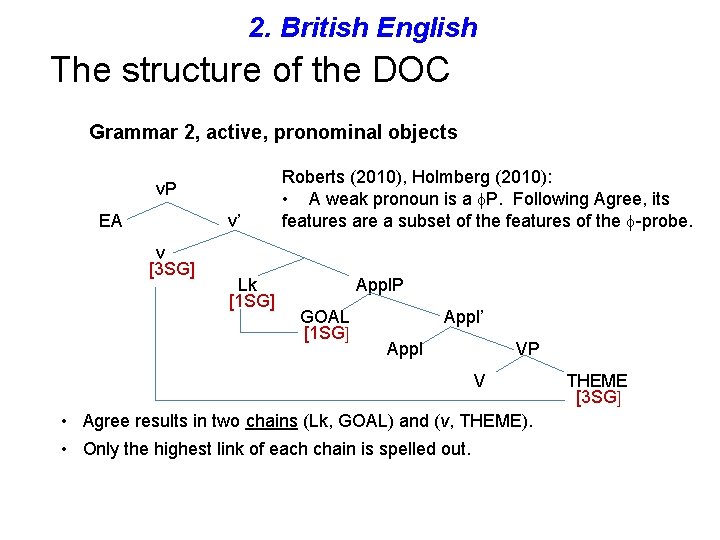
2. British English The structure of the DOC Grammar 2, active, pronominal objects v. P EA v’ v [3 SG] Lk [1 SG] Roberts (2010), Holmberg (2010): • A weak pronoun is a f. P. Following Agree, its features are a subset of the features of the f-probe. Appl. P GOAL [1 SG] Appl’ Appl VP V • Agree results in two chains (Lk, GOAL) and (v, THEME). • Only the highest link of each chain is spelled out. THEME [3 SG]
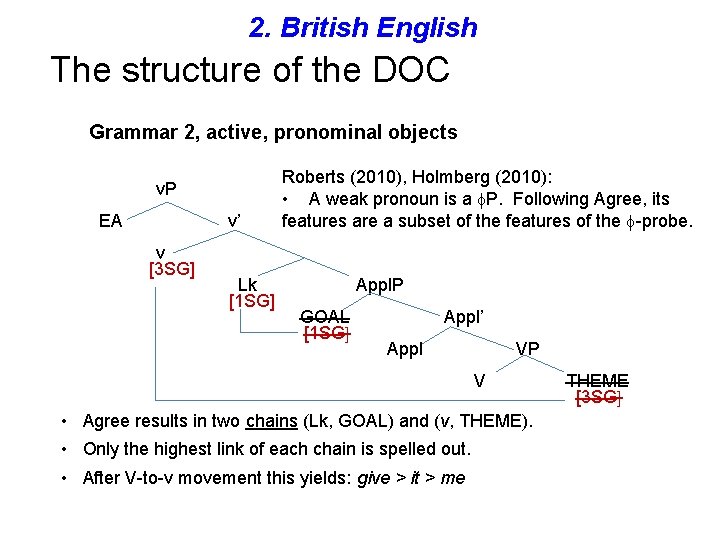
2. British English The structure of the DOC Grammar 2, active, pronominal objects v. P EA v’ v [3 SG] Lk [1 SG] Roberts (2010), Holmberg (2010): • A weak pronoun is a f. P. Following Agree, its features are a subset of the features of the f-probe. Appl. P GOAL [1 SG] Appl’ Appl VP V • Agree results in two chains (Lk, GOAL) and (v, THEME). • Only the highest link of each chain is spelled out. • After V-to-v movement this yields: give > it > me THEME [3 SG]
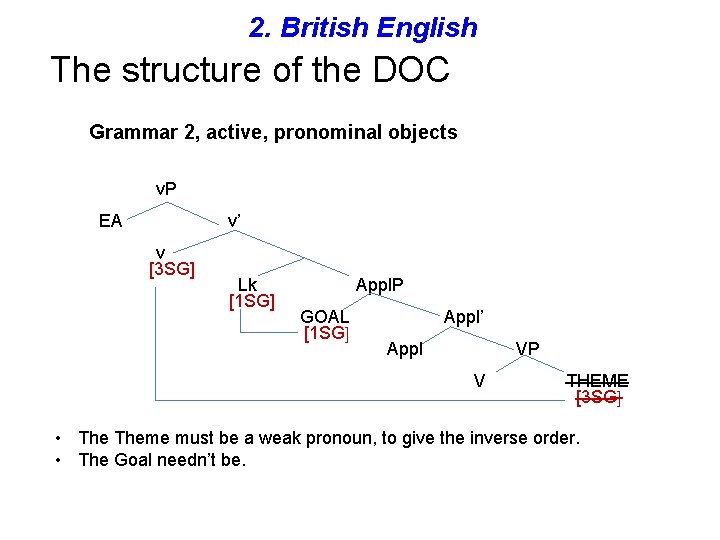
2. British English The structure of the DOC Grammar 2, active, pronominal objects v. P EA v’ v [3 SG] Lk [1 SG] Appl. P GOAL [1 SG] Appl’ Appl VP V THEME [3 SG] • Theme must be a weak pronoun, to give the inverse order. • The Goal needn’t be.
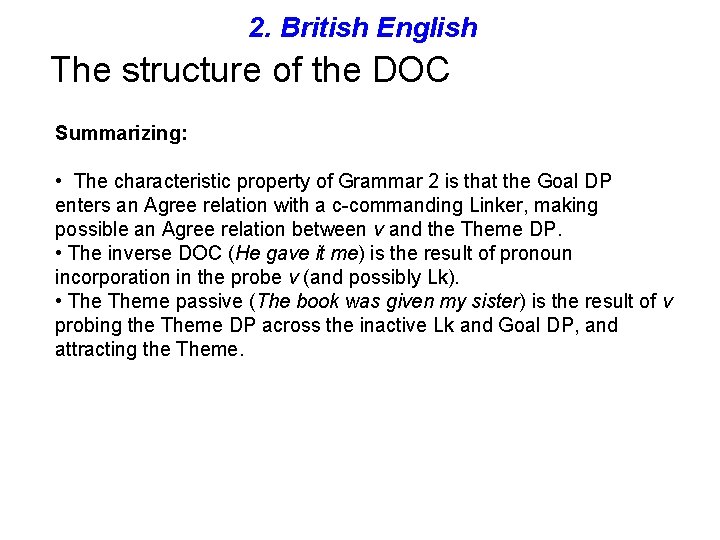
2. British English The structure of the DOC Summarizing: • The characteristic property of Grammar 2 is that the Goal DP enters an Agree relation with a c-commanding Linker, making possible an Agree relation between v and the Theme DP. • The inverse DOC (He gave it me) is the result of pronoun incorporation in the probe v (and possibly Lk). • Theme passive (The book was given my sister) is the result of v probing the Theme DP across the inactive Lk and Goal DP, and attracting the Theme.
2. British English The structure of the DOC Grammar Inverse DOC Theme passives 1 No No 2 Yes 3 Yes No *4 No Yes 34
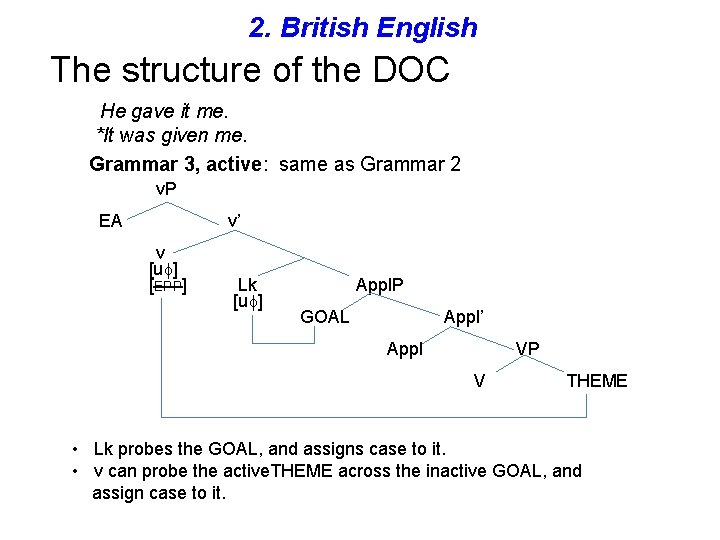
2. British English The structure of the DOC He gave it me. *It was given me. Grammar 3, active: same as Grammar 2 v. P EA v’ v [uf] [EPP] Lk [uf] Appl. P GOAL Appl’ Appl VP V THEME • Lk probes the GOAL, and assigns case to it. • v can probe the active. THEME across the inactive GOAL, and assign case to it.
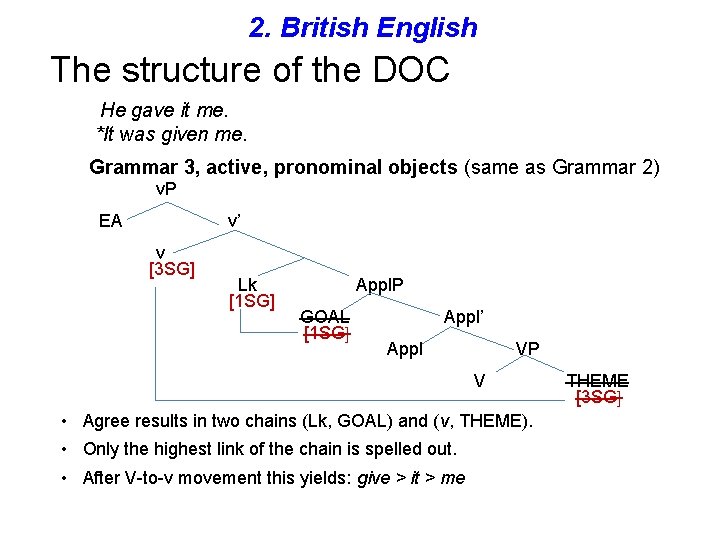
2. British English The structure of the DOC He gave it me. *It was given me. Grammar 3, active, pronominal objects (same as Grammar 2) v. P EA v’ v [3 SG] Lk [1 SG] Appl. P GOAL [1 SG] Appl’ Appl VP V • Agree results in two chains (Lk, GOAL) and (v, THEME). • Only the highest link of the chain is spelled out. • After V-to-v movement this yields: give > it > me THEME [3 SG]
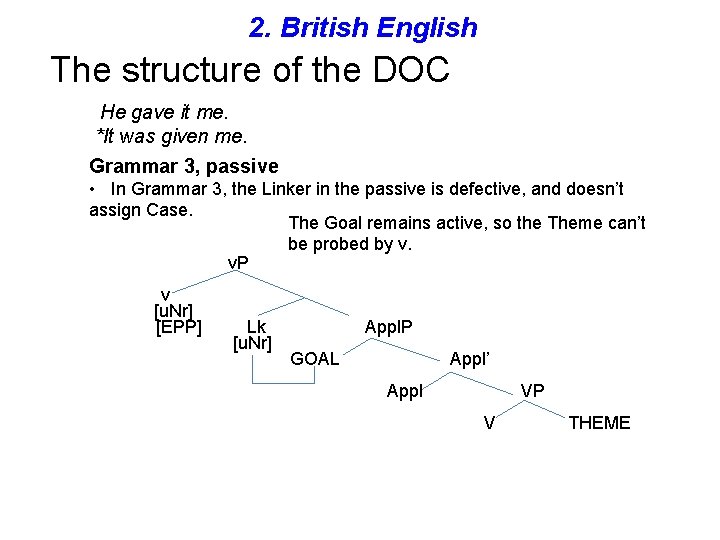
2. British English The structure of the DOC He gave it me. *It was given me. Grammar 3, passive • In Grammar 3, the Linker in the passive is defective, and doesn’t assign Case. The Goal remains active, so the Theme can’t be probed by v. v. P v [u. Nr] [EPP] Lk [u. Nr] Appl. P GOAL Appl’ Appl VP V THEME
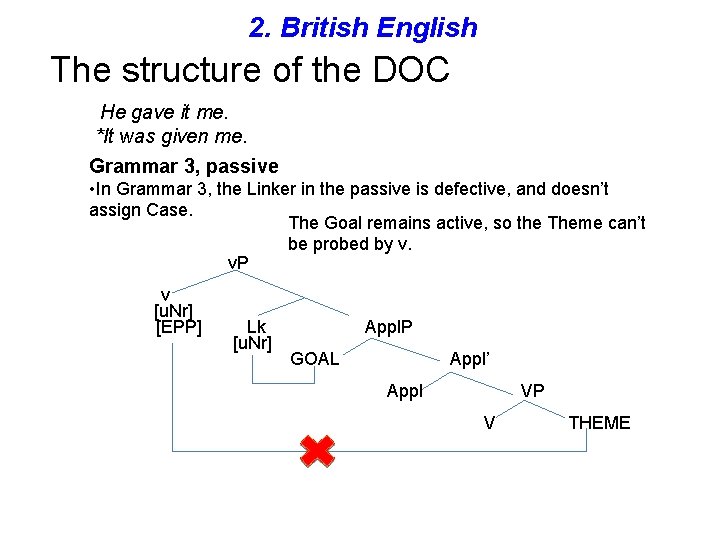
2. British English The structure of the DOC He gave it me. *It was given me. Grammar 3, passive • In Grammar 3, the Linker in the passive is defective, and doesn’t assign Case. The Goal remains active, so the Theme can’t be probed by v. v. P v [u. Nr] [EPP] Lk [u. Nr] Appl. P GOAL Appl’ Appl VP V THEME
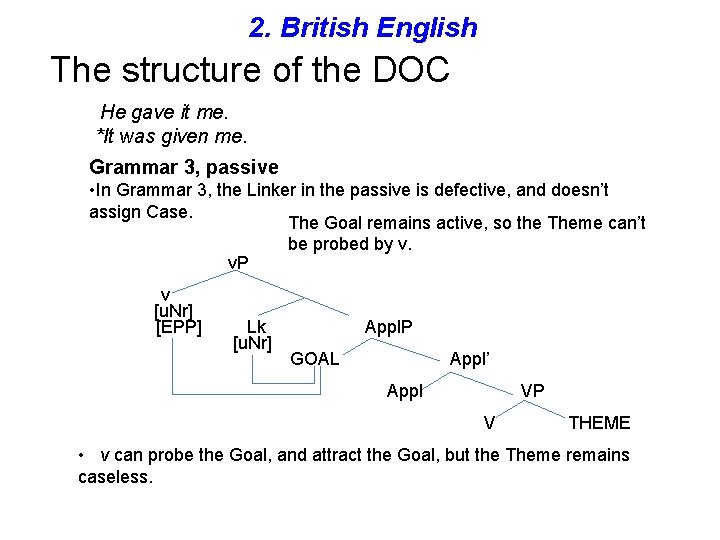
2. British English The structure of the DOC He gave it me. *It was given me. Grammar 3, passive • In Grammar 3, the Linker in the passive is defective, and doesn’t assign Case. The Goal remains active, so the Theme can’t be probed by v. v. P v [u. Nr] [EPP] Lk [u. Nr] Appl. P GOAL Appl’ Appl VP V THEME • v can probe the Goal, and attract the Goal, but the Theme remains caseless.
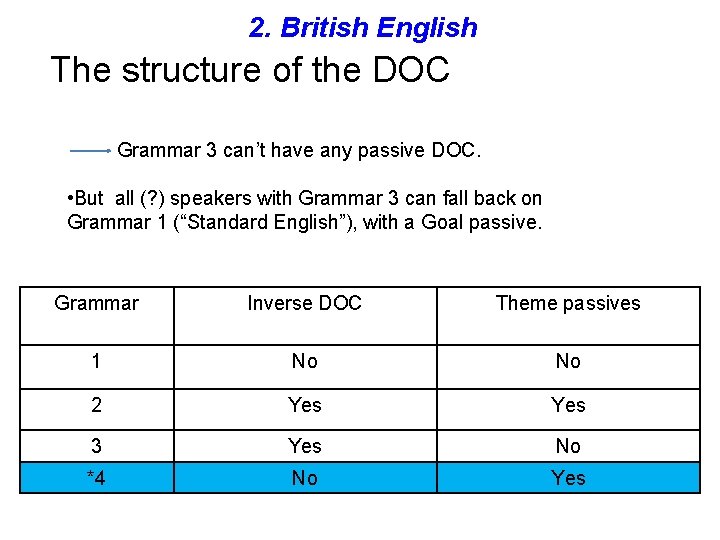
2. British English The structure of the DOC Grammar 3 can’t have any passive DOC. • But all (? ) speakers with Grammar 3 can fall back on Grammar 1 (“Standard English”), with a Goal passive. Grammar Inverse DOC Theme passives 1 No No 2 Yes 3 Yes No *4 No Yes
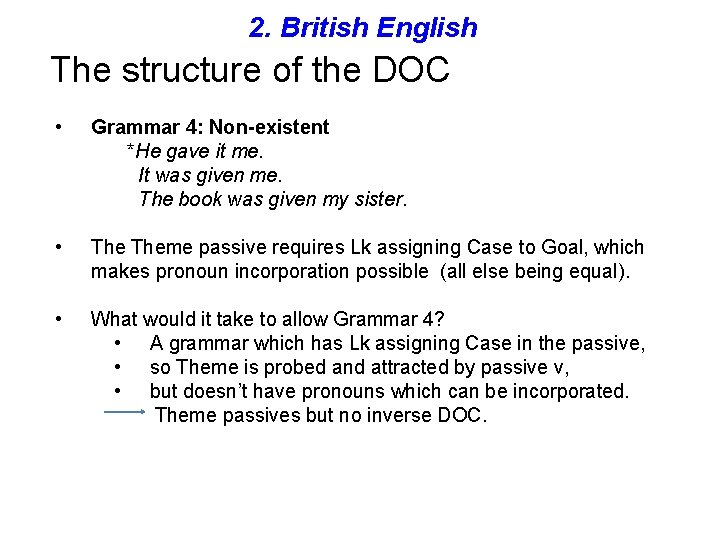
2. British English The structure of the DOC • Grammar 4: Non-existent *He gave it me. It was given me. The book was given my sister. • Theme passive requires Lk assigning Case to Goal, which makes pronoun incorporation possible (all else being equal). • What would it take to allow Grammar 4? • A grammar which has Lk assigning Case in the passive, • so Theme is probed and attracted by passive v, • but doesn’t have pronouns which can be incorporated. Theme passives but no inverse DOC.
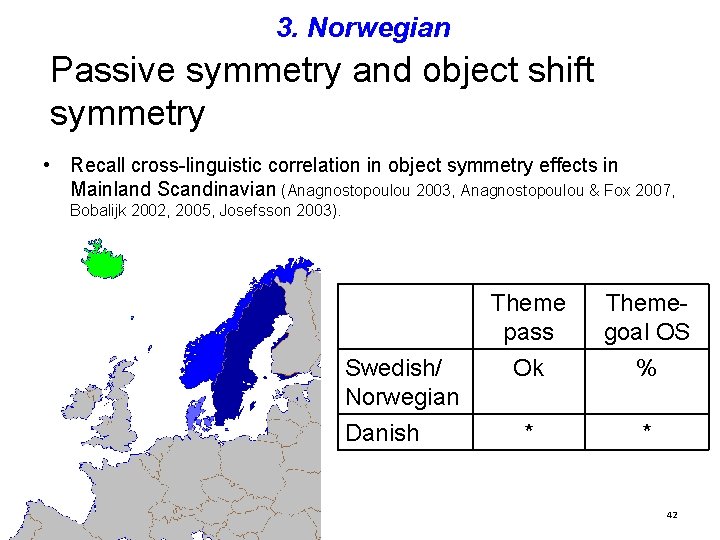
3. Norwegian Passive symmetry and object shift symmetry • Recall cross-linguistic correlation in object symmetry effects in Mainland Scandinavian (Anagnostopoulou 2003, Anagnostopoulou & Fox 2007, Bobalijk 2002, 2005, Josefsson 2003). Swedish/ Norwegian Danish Theme pass Themegoal OS Ok % * * 42
3. Norwegian Mainland Scandinavian • Two predictions/expectations raised by the locality/DP-movement approach. – Speakers will accept theme-goal orders in passive contexts iff they accept theme-goal orders in active contexts (as with Br. E experiment). – Evidence of short theme movement low in the structure (below position targeted by OS), as in Br. E (Anagnotopoulou 2003)? • We describe preliminary results from a second experiment to test these claims. 43
3. Norwegian Data Subjects • 505 self-described native speakers of Norwegian. • 18 -81 years old (M= 38. 9, SD=11. 5) • 375 F, 130 M. • Subjects recruited online by researchers. • Not required to be linguistically naive. 44
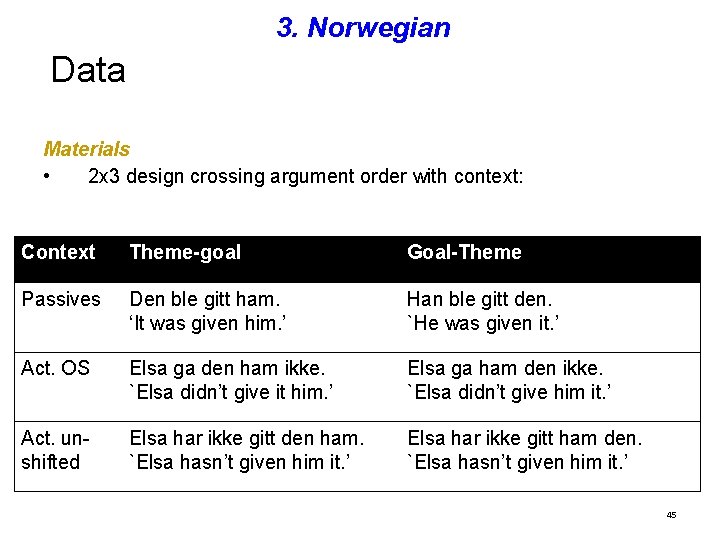
3. Norwegian Data Materials • 2 x 3 design crossing argument order with context: Context Theme-goal Goal-Theme Passives Den ble gitt ham. ‘It was given him. ’ Han ble gitt den. `He was given it. ’ Act. OS Elsa ga den ham ikke. `Elsa didn’t give it him. ’ Elsa ga ham den ikke. `Elsa didn’t give him it. ’ Act. unshifted Elsa har ikke gitt den ham. `Elsa hasn’t given him it. ’ Elsa har ikke gitt ham den. `Elsa hasn’t given him it. ’ 45
3. Norwegian Data Materials • All theme/goal arguments were 3 rd person pronouns. Theme vs. Goal interpretation biased using animate pronouns for Goals, and inanimate pronouns for Themes. • 12 lexicalizations created for each of 6 condition, blocked and assigned to lists by Latin square. Subjects pseudo-randomly assigned to lists by software • 4 items/condition/subject x 6 condition=24 experimental sentences, pseudo-randomized with 24 fillers. 46
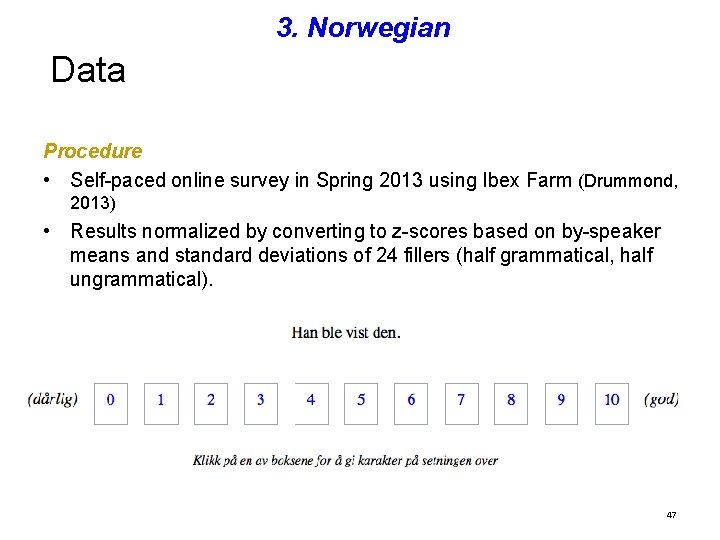
3. Norwegian Data Procedure • Self-paced online survey in Spring 2013 using Ibex Farm (Drummond, 2013) • Results normalized by converting to z-scores based on by-speaker means and standard deviations of 24 fillers (half grammatical, half ungrammatical). 47
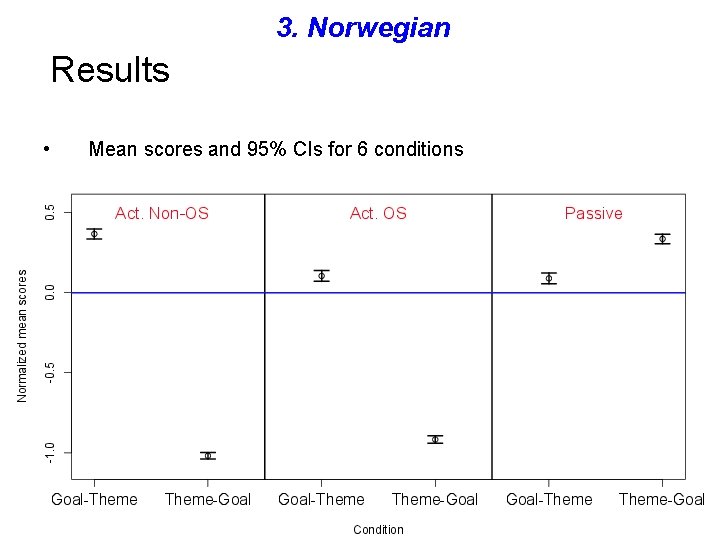
3. Norwegian Results • Mean scores and 95% CIs for 6 conditions 48
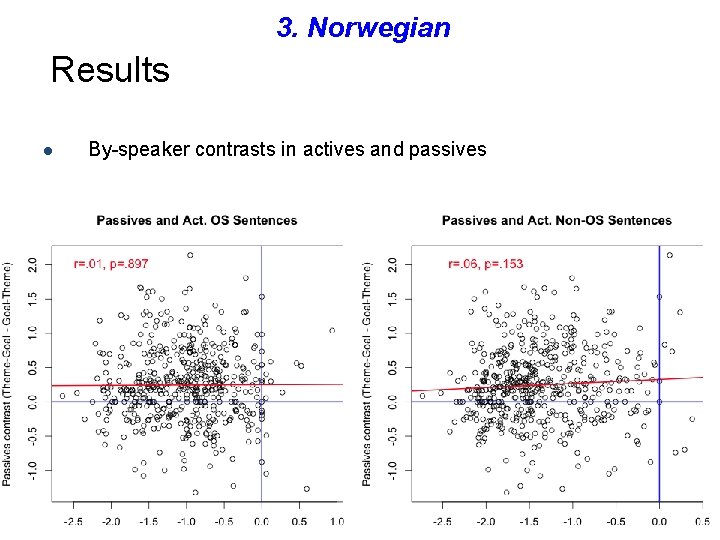
3. Norwegian Results l By-speaker contrasts in actives and passives 49
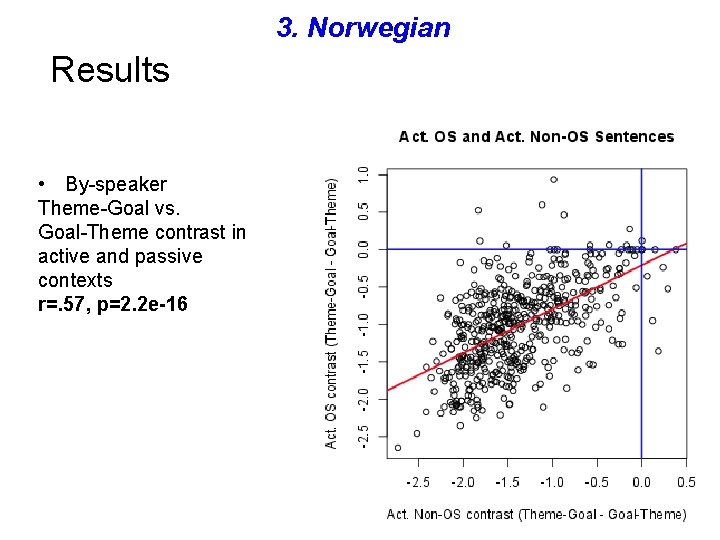
3. Norwegian Results • By-speaker Theme-Goal vs. Goal-Theme contrast in active and passive contexts r=. 57, p=2. 2 e-16 50
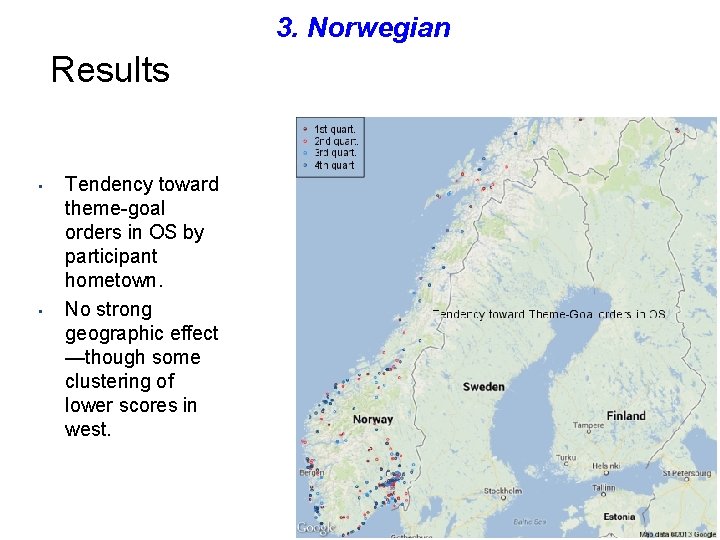
3. Norwegian Results • • Tendency toward theme-goal orders in OS by participant hometown. No strong geographic effect —though some clustering of lower scores in west. 51
3. Norwegian Staying in shape in Norway So: • Assuming a structure for DOCs with the goal merged above theme, these results suggest that theme movement above the goal in active non. OS contexts, feeds theme-goal orders in OS, i. e. speakers accept the latter iff they accept the former. • Importantly, theme-goal orders in active and OS contexts appear not to feed theme-goal orders in passives, since there’s no cross-speaker correlation in acceptance. 52
3. Norwegian Staying in shape in Norway We propose: • Norwegian results best expressed not in terms of locality but shape conservation following Fox and Pesetsky (2005) (FP). (See also Anagnostopoulou 2005). • Precedence relations established phase by-phase. Extra-phasal movement cannot permute the linear order of two syntactic objects, since this would entail conflicting ordering relations. (25) *[Phase-2 P Y X. . . [Phase-1 P X Y ] (26) [Phase-2 P X Y. . . [Phase-1 P X Y ] 53
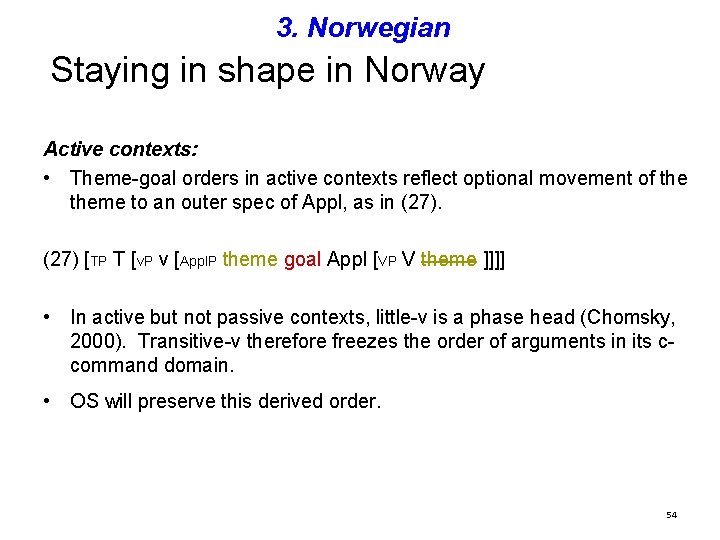
3. Norwegian Staying in shape in Norway Active contexts: • Theme-goal orders in active contexts reflect optional movement of theme to an outer spec of Appl, as in (27) [TP T [v. P v [Appl. P theme goal Appl [VP V theme ]]]] • In active but not passive contexts, little-v is a phase head (Chomsky, 2000). Transitive-v therefore freezes the order of arguments in its ccommand domain. • OS will preserve this derived order. 54
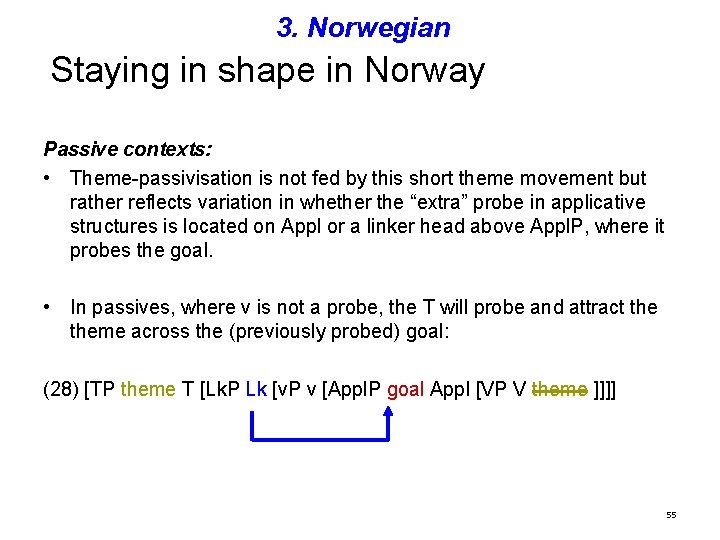
3. Norwegian Staying in shape in Norway Passive contexts: • Theme-passivisation is not fed by this short theme movement but rather reflects variation in whether the “extra” probe in applicative structures is located on Appl or a linker head above Appl. P, where it probes the goal. • In passives, where v is not a probe, the T will probe and attract theme across the (previously probed) goal: (28) [TP theme T [Lk. P Lk [v. P v [Appl. P goal Appl [VP V theme ]]]] 55
4. Conclusion Main points 1. Positive correlation in scores for Theme-Goal orders in passive and active contexts. But a richer inventory of grammars than the twodialect distribution entailed by the short-object movement parameter 2. Patterns of cross-speaker variation and the behavior of weak pronouns are best expressed, not on an escape-hatch approach, but rather on a modified version of classic case-based approaches 3. In Norwegian, no support for a cross-speaker correlation between theme-goal active orders and theme passivisation. Strong correlation, however, between acceptance of theme-goal orders in OS and un-shifted contexts. The facts fall out of FP’s Cyclic Linearization proposal without enrichments. 56
- Slides: 56