
OBJECT AS HISTORY Name Sanjana Pahuja Topic Corset

OBJECT AS HISTORY Name- Sanjana Pahuja Topic- Corset SECTION M
Introduction and Circumstances (reason of choosing the object) § A corset is a garment worn to hold and train the torso into a desired shape, traditionally a smaller waist or larger bottom, for aesthetic or medical purposes (either for the duration of wearing it or with a more lasting effect). Both men and women are known to wear corsets, though this item was for many years an integral part of women's wardrobes. § Corsets have been a fascinating clothing for me since childhood. I have always been into fashion and love the antique clothing. § When we were asked to pick up an object from the past, I thought of taking a corset which would be very interesting to research on, and will help me in my fashion career as well. § As I researched for the same, I came across a very pretty corset designed by Maison Leoty, which is exhibited in The Met museum, New York.
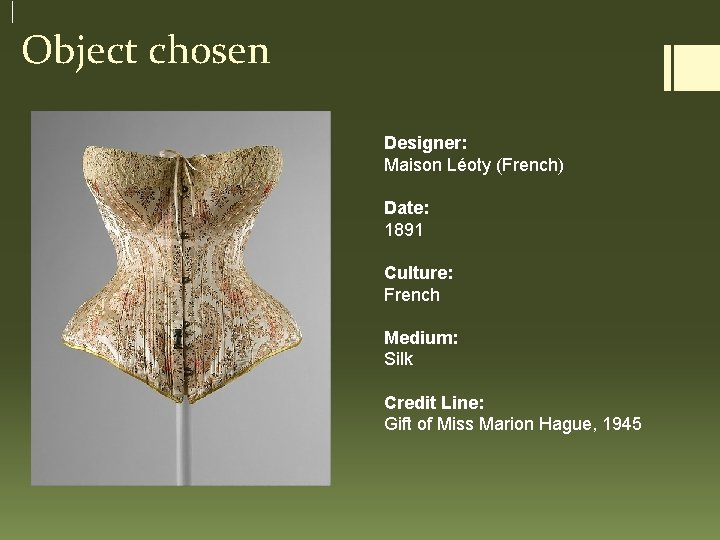
Object chosen Designer: Maison Léoty (French) Date: 1891 Culture: French Medium: Silk Credit Line: Gift of Miss Marion Hague, 1945
Culture § The origins of the corset are unknown; but it is often argued that corsetry began in the ancient world such as Greece or Minoan Crete. Alternatively, the first corset making its appearance in the Western world belongs to a particular European aristocrat, Catherine de Medici who was believed to wear corsets made of metal, “a tortuous device of steel” in the sixteenth century. § The word corset is derived from the Old French word corps and the diminutive of body, which itself derives from corpus (Latin for body). The craft of corset construction is known as corsetry , as is the general wearing of them. § Corsetry can be claimed as one of the popular garments of a social condition and the prevailing sign of a specific fashion. Additionally, there is a huge significance and use of the corset and changes of the corset in the Western culture and literature from its early usages up to contemporary time through the politics of body and fashion. In that way, the study of corsetry is aimed to unveil the ways ideology cooperates with fashion to define the beauty standards and help create the idealized (female) image as a cultural construct in Western society.
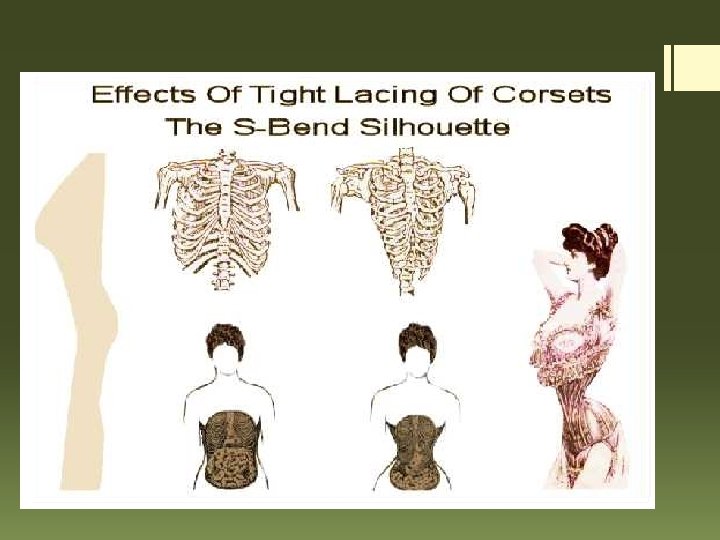
Impact § Von Sömmerring, a physician and well-known anatomist, argued that the backlaced corset, as worn by fashionable ladies of the time, constituted a heath hazard by compressing the ribs and other internal organs leading to tuberculosis, cancer, and scoliosis, or curvature of the spine. His illustration contrasts the natural shape of the female body with the artificial hourglass shape produced by tightly laced corset. In Germany, England, and the United States, dress reformers advocated looser lacing, pantaloons or “bloomers, "and clothes that allowed more natural movement. Throughout the late 19 th century, , these reformers belonged to the radical fringe of the feminist movement, and their arguments led to much merriment in the popular press. Most middle and upperclass women continued to compete for the tiniest waists, regardless of their impact on health. In more recent years, hiatus hernias caused by overly tight girdles or corsets have been termed “Sömmerring’s syndrome” in tribute to the first physician to warn of the dangers of tight lacing.
Why are corsets popular? § Despite the negative effects of the garment, women continued § to wear corsets. § The reason for the popularity of the corset perhaps owes to the symbolic meaning it represents. § It will actually give you the thinner look because it fattens your stomach. § Men and women have been using this type of support garment in order to give them comfort and not only because of the enhanced look that they get from it. § People who wanted to lose weight in a safe and effective manner can actually try wearing this kind of support garment because it gives the same effect just like that of the surgical procedure § This is also an ideal back support garment. There are waist training corset that are medically used in order to provide the back support, but has a much bulky appearance and is not custom fitted. § (https: //greatcorsettops. jimdo. com/)
Faith § Corsetry points at the dichotomy between power and restraint ideologically enacted upon the female body. That is why it stands between elegance and repression, empowerment and victimization. § Corsets have a french origin, people used to wear it to give a desired shape to their body and for aesthetic value, there is no faith it in as such. § In the past, women were forced to wear those tight uncomfortable corsets but things have changed nowadays. § There are no corsets in Christ. § Christians now believe that God has seen us fully exposed and loves us more than we can imagine. God loves the unmasked version of us, so we are free to be authentic.
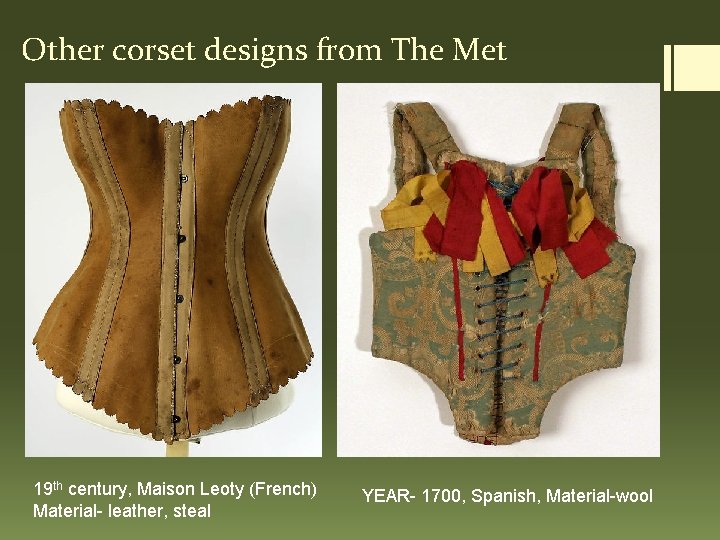
Other corset designs from The Met 19 th century, Maison Leoty (French) Material- leather, steal YEAR- 1700, Spanish, Material-wool
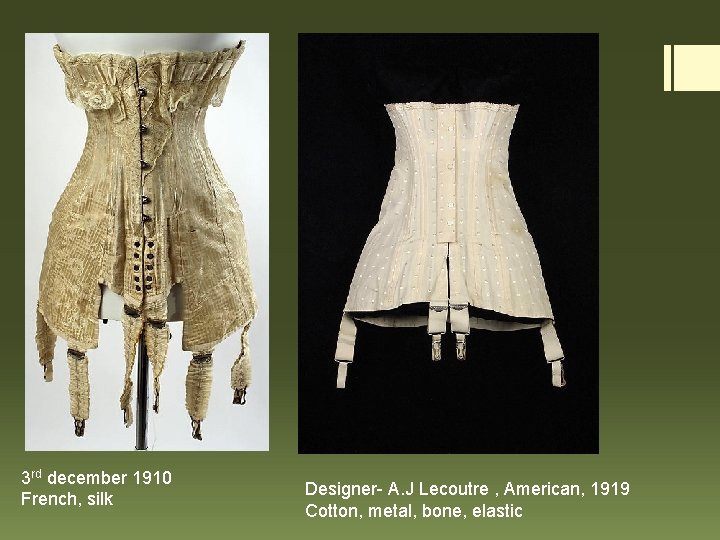
3 rd december 1910 French, silk Designer- A. J Lecoutre , American, 1919 Cotton, metal, bone, elastic
Category of the object § Corsets are one of the most versatile articles of clothing around, with a different style, design, and shape to fit anyone and everyone that’s interested in wearing them. They fall under a lot of different categories. § Hourglass – this type of corset is designed to fit around the ribs and create the illusion of a curvy body shape, and is an excellent corset for those just starting out, or do not want to drastically alter their shape. § • Waist Cincher – This is a small corset which provides support and shape to the stomach without providing anything for the ribs. § • Conical – This type of corset was popular in the 16 th through 18 th centuries, They have straight sides which taper down to the waist, and shape the lower portion of the ribs as well, and due to this, can be much more difficult to get used to wearing.
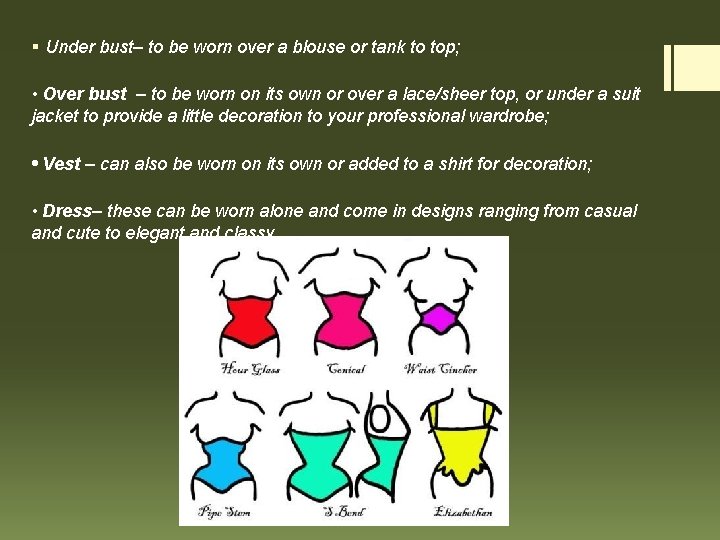
§ Under bust– to be worn over a blouse or tank to top; • Over bust – to be worn on its own or over a lace/sheer top, or under a suit jacket to provide a little decoration to your professional wardrobe; • Vest – can also be worn on its own or added to a shirt for decoration; • Dress– these can be worn alone and come in designs ranging from casual and cute to elegant and classy.
Designer of the chosen object § § The designer of my chosen coset is Maison Leoty was a French fashion designer of the 19 th century. She was also known as a Parisian Corset designer. Her famous works of art are exhibited in The Met museum , which are two brilliant corsets , one made of silk and other with leather and steal.

References § Book reference – The corset, a cultural history by Valerie Steele § Pdf- European Journal of Language and Literature Studies The Cultural History of the Corset and Gendered Body in Social and Literary Landscapes - historical background § https: //www. researchgate. net/publication/11290086_The_Effects_of_the _Corset § (https: //greatcorsettops. jimdo. com/)
- Slides: 14